road trip

2015 Trip Six, Great Smoky Mountains, Oct. 18

Marion, NC Oct. 18

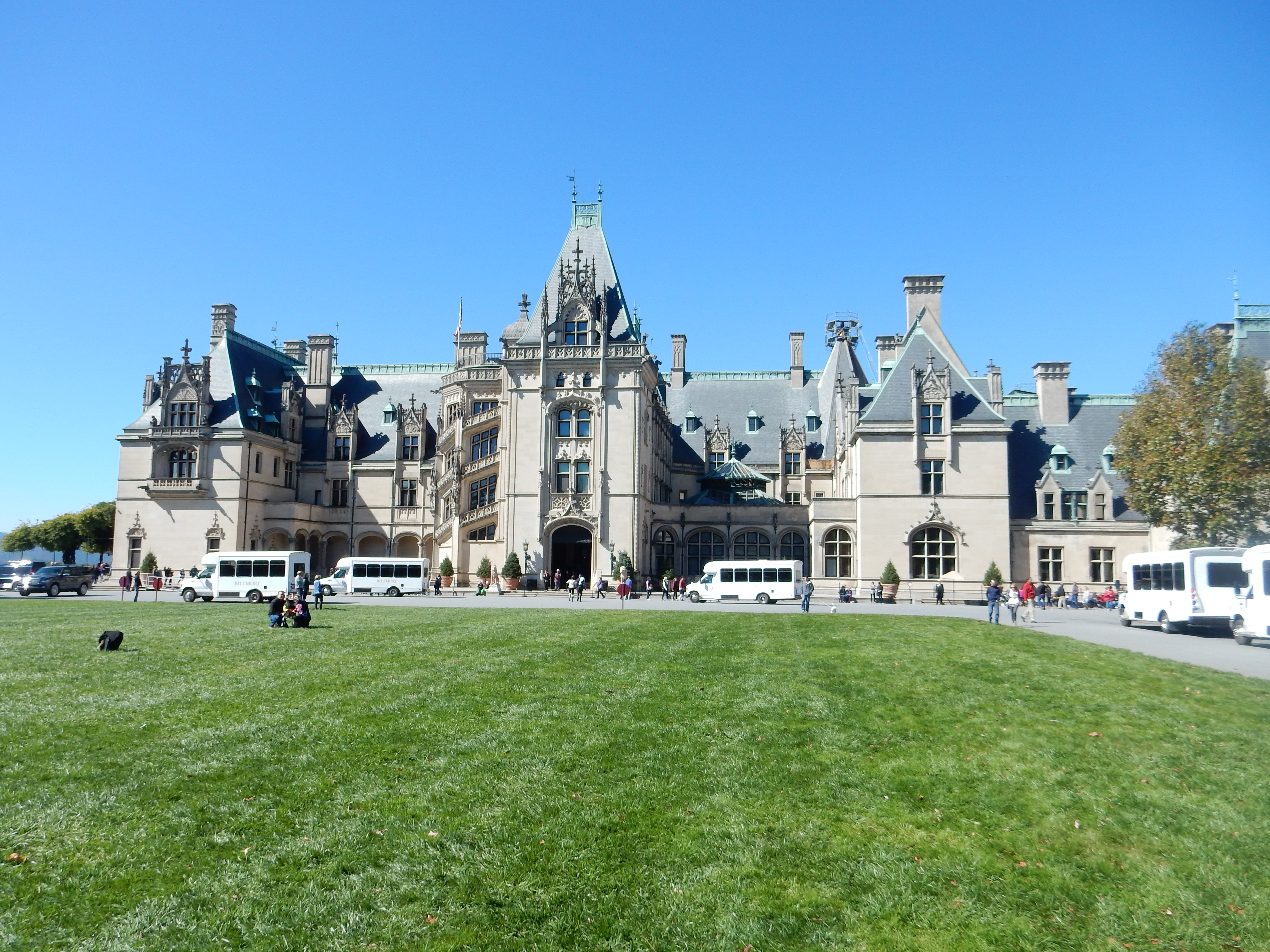
I had to bite my tongue and hold my biases in check for most of the morning. We were visiting Biltmore, the largest home in America at 250 rooms built by a grandson of Cornelius Vanderbilt, George Washington Vanderbilt. Cornelius had amassed an enormous fortune in shipping, railroads and other businesses back in the days when capitalism was unregulated.

Briefly: Cornelius left a fortune of $100,000,000 and his son Billy doubled it in less than ten years. Most of the $200,000,000 went to George Washington Vanderbilt’s two oldest brothers who ran the Vanderbilt family business. George inherited about $10,000,000 over a period of a few years in the 1880s.

Biltmore in Asheville NC

Biltmore in Asheville NC

Again, briefly, besides collecting art, George decided to amass land and build a personal mansion in Asheville NC. (Okay I am summarizing tremendously here but if you want more you will need to read biographies of the Vanderbilts.) He hired a top architect, Richard Morris Hunt, and the top landscape designer, Frederick Law Olmstead. The home took six years to build and opened officially on Christmas Eve 1895. (George died in 1914.)

Our tour time started at 9 AM. We had already calculated the amount of time necessary to reach the estate from our hotel. Good thing we added extra time. We had not calculated the ten minutes it took to drive from the entrance to the parking and the five minutes it took to walk from the parking lot to the entrance. 9 AM was the first starting time. We chose the self-guided tour, foregoing the audio wands that would go into the details of every stick of furniture, etc. (No internal photo taking is allowed.)

The next 90 minutes were spent following the tour book, staying behind the velvet ropes. The building is solid, the foundation alone took two years to build. The building is huge obviously with 250 rooms-we do not see all of them. The design, furnishings, artwork, and furniture are exquisite. Flemish tapestries, hand carved wood paneling, family paintings by John Sargent Singer, delicate figurines from Europe, etc. The guest rooms could house, feed and entertain whole families for a week or more. The mansion had indoor plumbing and electricity; it had its own indoor swimming pool and bowling alley.

walled garden at Biltmore

walled garden at Biltmore

The grounds are meticulously laid out and maintained, more in the manner of an English garden then just flowering gardens-although there are several. You may remember from yesterday’s post that Vanderbilt eventually owned 125,000 acres surrounding his estate. Much of that land had been clear-cut by lumber companies; Vanderbilt had the land replanted with over 3,000,000 plants and trees, all according to Olmstead’s master plan. After the house tour, we wandered through the formal gardens. They would probably be more stupendous during spring or summer flowering season.

The home was opened to tours in 1930, one branch of the descendants received the house and manage it as their business. They live somewhere else on the remaining 8,000 acres of the property. The estate employs 2,000 people to keep it going. We left the estate after lunch and went back on the Blue Ridge Parkway.

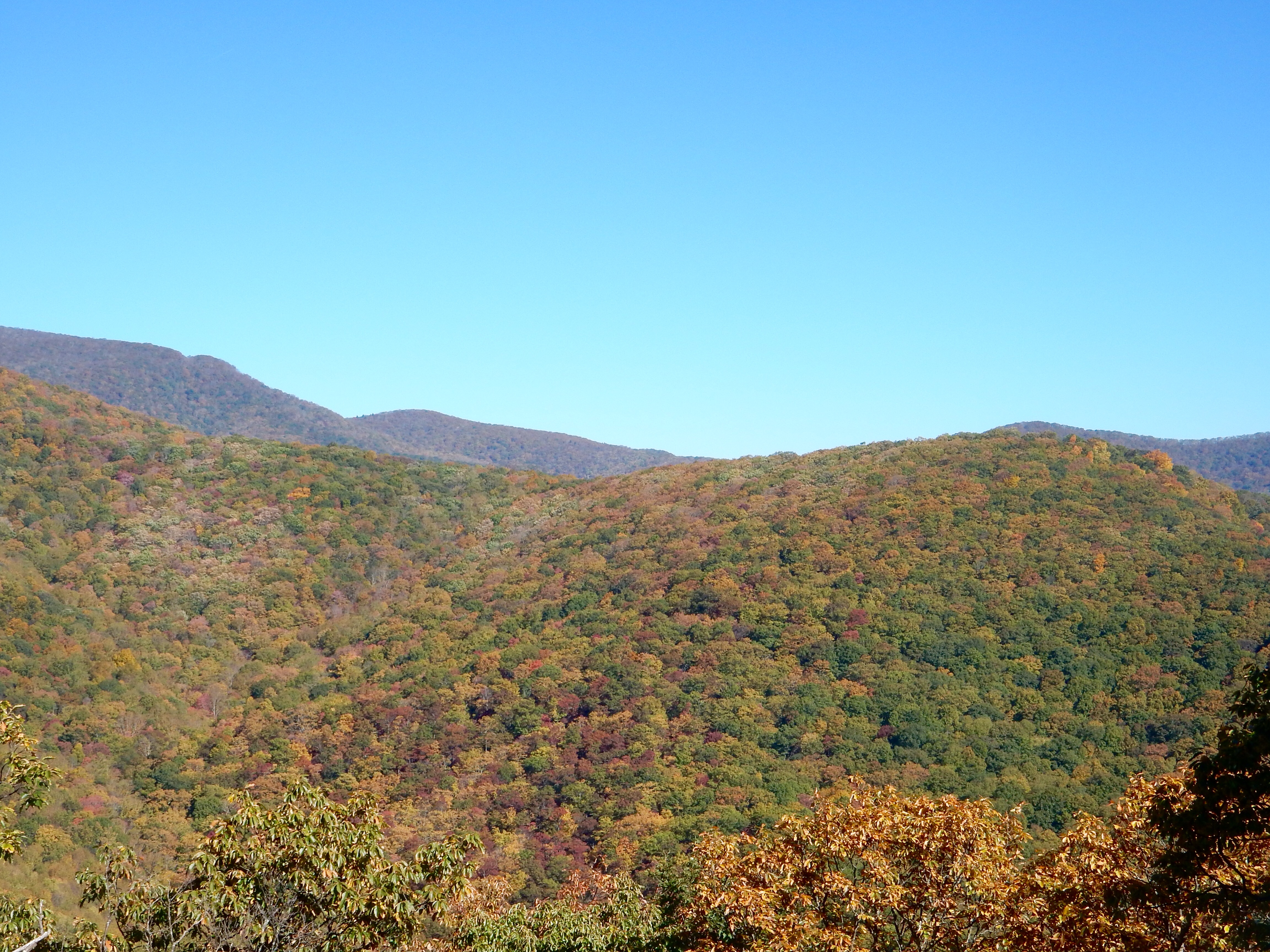
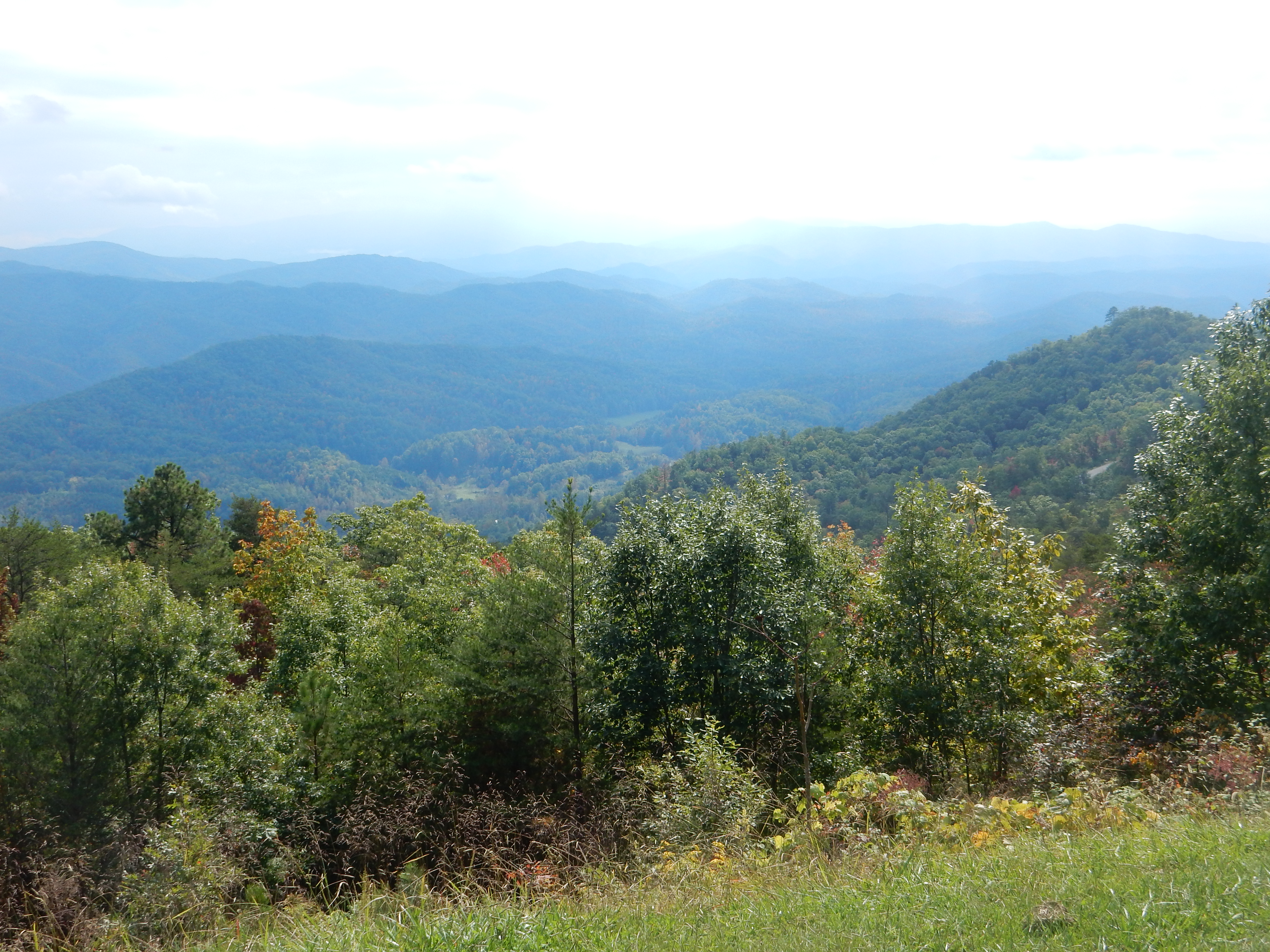
View from Blue Ridge Parkway

View from Blue Ridge Parkway

Along the parkway is The Folk Art Center, run by the Southern Highlands Craft Guild. It is a combination museum and gift shop, showcasing pottery,jewelry, quilts, wood working, toys, etc. The items are beautiful to look at. I can not judge the quality but I would imagine they are all top shelf. Numerous items struck our fancy and would look wonderful at home. Luckily we do not need, or have room for, any more items in our condo so we saved a bundle of money by not buying.

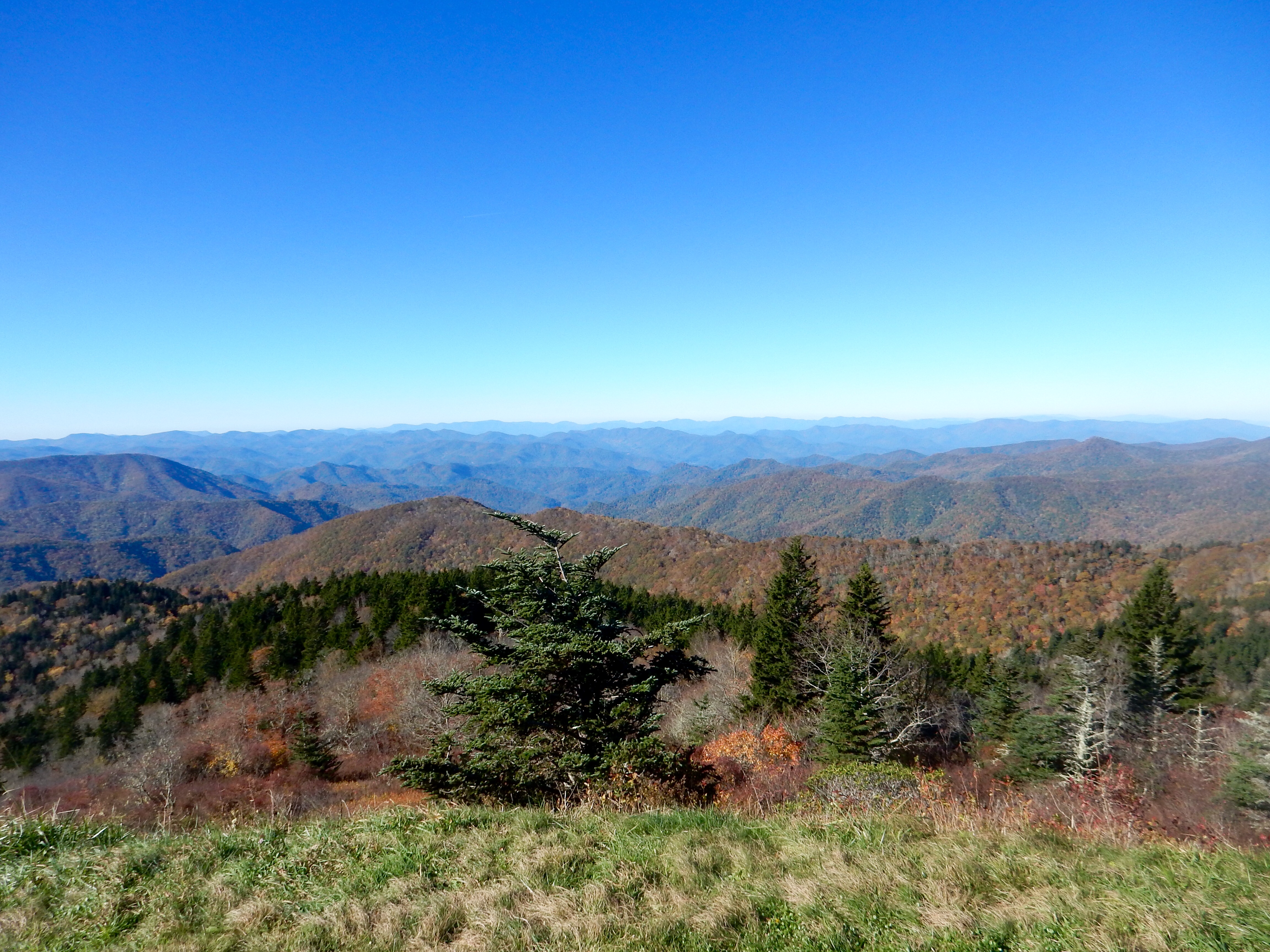
Further along the Parkway is Mt. Mitchell State Park. Mt. Mitchell, at 6,684 feet, is the highest point in North Carolina and the highest peak east of the Mississippi River. We had previously thought Mount Washington in New Hampshire was the highest. Wrong we were. Mount Mitchell is reached via a five-mile access road and then a steep hike for the last portion. The view once again was great, we have really been lucky with the weather. Similar to portions of the Great Smoky Mountains National Park, the Fraser fir trees on these slopes are usually dead.

View from Mt. Mitchell

View from Mt. Mitchell

Mount Mitchell was the first state park in North Carolina, established in 1915. It preserved an area likely to be harvested for lumber and several other notable high peaks in North Carolina. North Carolina is the home to the largest number of peaks over 6,000 feet in any part of the Appalachian Mountain Range. Most of them are along the Blue Ridge Parkway. It makes for great viewing as we drive along or as we stop at any of the 400 overlooks along the 469 miles.

Our drive off the Parkway to our lodging tonight was along a road, while not quite as “bad” as the Tail of the Dragon, came close. I am hoping that our return Monday morning to the Parkway will be via a road a little less challenging.

Ed and Chris 11:45 PM

Categories: road trip, travel | Tags: , , , , , , | 2 Comments

2015 Trip Six, Great Smoky Mountains, Oct. 16-17

Asheville, NC Oct. 17

400

Indulge me in a few paragraphs of self-congratulation. This post is our 400th since we began in January of 2013. An expectation of one year off to travel has mushroomed to three years, although the weeks traveling have decreased from 35 in 2013, to 25 in 2014, and 15 in 2015. The posts are more often than not written nightly and cover one day; slower days get combined. Rarely do we make one entry cover three days. That does not allow for serious editing, hopefully the entries are written decently.

The blog was begun as a means to remember our trips and to let family know where we were and what we were doing. That is still the primary purpose but, although the blog has not gone viral, we now have followers in Europe, India, Japan, etc. We hope you are enjoying our description of a slice of American life.

Our first posts were generally about 500 words in length. For the last year or so they have been usually over 1,000 words. Ballparking the average at 750 words for 400 posts equals 300,000 words; enough words to have written 3-4 novels. Obviously there is no plot or character development involved.

Photos are taken with a Nikon point and shoot; easy to carry, simple to operate and to recharge batteries, pictures able to be quickly uploaded to our iPad. We shoot what we see, we rarely return to a location for better lighting or weather. Pictures are meant to remind us of what we saw, we are not aiming to be professional photographers. If the day was rainy and overcast, or if the only shot of a location or subject was into the light, well, so be it.

Our travels will likely continue to decrease. We will have to determine next year if we continue to pay for blog space. Thanks to Adam and Shannon we now have a printed version of years 2013 and 2014.

So enjoy! We have been blessed to be able to travel this extensively, to enjoy our time, and, yes, to stay married after all those weeks together on the road.

Ed and Chris

On to today’s post.

Last view as we leave Great Smoky Mountains behind

Last view as we leave Great Smoky Mountains behind

We left Gatlinburg Friday morning, again in great weather. Once again over the Newfound Gap Road through the heart of Great Smoky Mountain National Park. Cullowhee NC is home to Western Carolina University. (Its 500 member marching band was the lead band of the 2014 Macy’s Thanksgiving Day parade.) Our goal was to visit the Mountain Heritage Center.

This was mid-semester break, parking on campus was easy. Thankfully since the Heritage Center was not designed as a major tourist activity; it seems to be more of research arm. The Center had just moved to the library building and no center staff seemed to be working during break week.

There was an exhibit from the North Carolina History Museum available; one that brought back memories of difficult times. The photographs of Lewis Hine from the early 1900s documented the reality of child labor in the textile factories dotting the North Carolina landscape. Children under 10 working long hours. The lack of caring by factory owners, the acceptance of the “way it is” permeated the photos. His pictures were taken for the National Child Labor Council. There was a second small exhibit located on a different floor giving a brief history of North Carolina pottery.

Former Jackson County Courthouse in Sylva, now the library

Former Jackson County Courthouse in Sylva, now the library

Not exactly a home run event. Our second stop was the small town of Sylva, supposedly postcard pretty with lots of small shops. Well, you know we are not major shoppers but we gave it a try and did find a small gift for two family members. Lunch was hilarious though. The Coffee Shop (that’s its name) had been written up as THE place the locals eat at. Well they do because it is cheap and the waitresses recognize locals and serve them first. The visitors looked at each other and said “When do we get served?” It was cheap though.

Our third stop was a complete strike out. Supposedly there are more people of Celtic heritage in North Carolina than anywhere else in the world (even Scotland and Ireland??) We did not get a chance to find out. The Scottish Tartans Museum in Franklin-Franklin was the site of our evening lodging-was closed, according to the sign on the door and not mentioned on their website, so they could attend some Scottish Games in Atlanta. We ate ice cream at a local creamery instead.

View from the Blue RIdge Parkway

View from the Blue RIdge Parkway

Saturday was our first Blue Ridge Parkway Day. We drove 70 miles along the southern end; the parkway extends from Cherokee NC (by the Great Smoky Mountain National Park entrance) 460 miles to Waynesboro VA where it connects with the Skyline Drive. The parkway was begun in 1932 and finally completed in 1987. The design was chosen to highlight views, thus there are lots of overlooks and in many areas, trees and brush are cut back so vistas can be seen by the driving public.

Blue Ridge Parkway

Blue Ridge Parkway

We drove, and stopped, and hiked, and took pictures. Due to its design, instead of focusing on managing tight corners, we were usually watching the North Carolina mountains and trees roll by. Our drive began before 9 AM (after leaving Franklin at 8AM) so initial traffic was not too heavy. By the end of the day it was heavy indeed.

School Building for the School of Forestry

School Building for the School of Forestry at Cradle of Forestry

Our major detour off the Parkway was to the Cradle of Forestry, a U.S. Forest Service sponsored site located in the Pisgah Forest east of Asheville. The Pisgah Forest was established in 1916 from the estate of George Vanderbilt who built Biltmore which we will be touring tomorrow. Vanderbilt wanted to own all of the land as far as he could see from his enormous mansion so he bought over 125,000 acres of land, including Mt. Pisgah (named after the mountain in the Bible from which Moses saw The Promised Land).

The name Cradle of Forestry is derived from the fact that Vanderbilt hired Gifford Pinchot and Frederick Law Olmstead to develop gardens and manage the forests on his estate. Eventually they turned the forestry portion over to Dr. Carl Schenck, a German. Schenck developed the first forestry school in the United States in 1896 at Biltmore, locating it in the forests among the land Vanderbilt purchased from small farmers and landowners.

The goal of the School of Forestry was to teach people who would understand “trees could be cut and the forest preserved at one and the same time”. As we saw in the Great Smoky Mountains, clear cutting was the standard lumbering practice with ruinous effects. The school operated for 15 years.I thought it was ironic that the School of Forestry was founded by the son of Cornelius Vanderbilt, the mega-entrepeneur that virtually dictated the spread of the railroads in the 1800s. The railroads used enormous amounts of wood for railroad ties and the railroad expansion across the country made lumbering large tracts of land feasible.

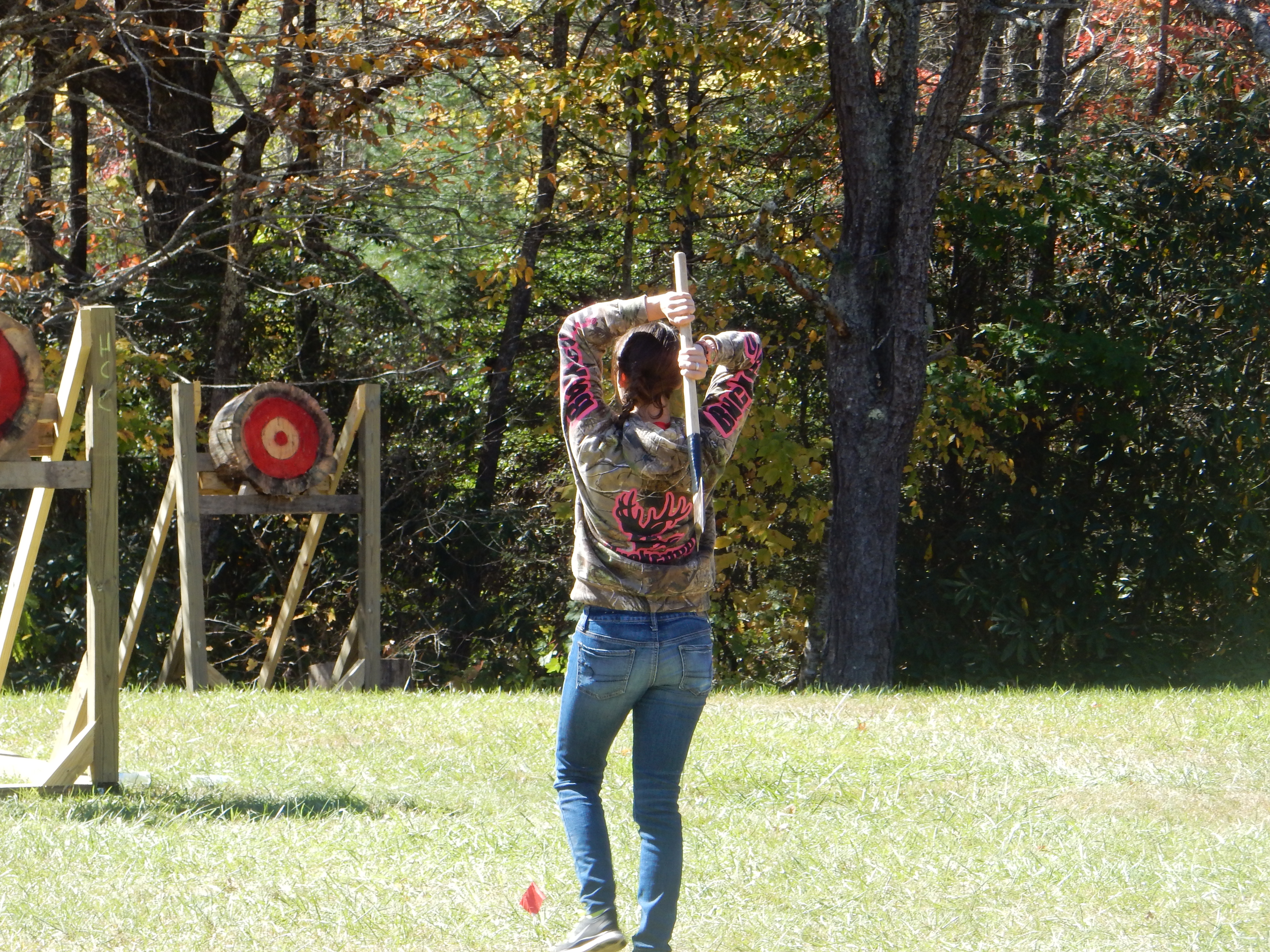
Axe hurling at Woodsmen Meet at Cradle of Forestry

Axe hurling at Woodsmen Meet at Cradle of Forestry

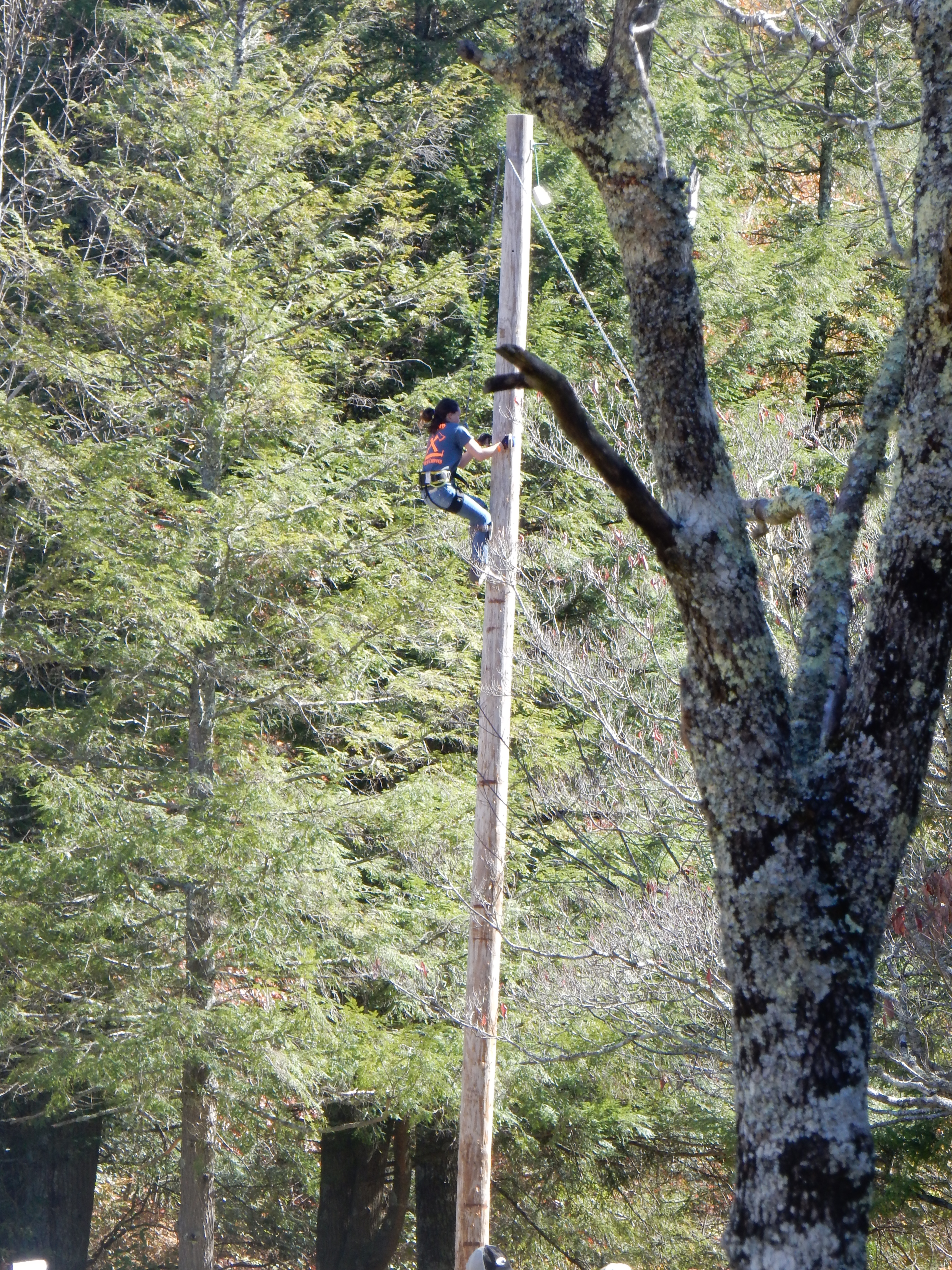
Pole climbing

Pole climbing

The Cradle of Forestry has several walks that wind among the school grounds and preserved school buildings. Our original plan was to tour them and the exhibits and move on. However, today was the re-scheduled date (from the “biblical” rains of two weeks ago) of the Woodsmens Meet. The Meet involved seven schools of forestry in team compettions in pole climbing, log cutting, axe hurling, chain saw cutting, etc. There were male and female contests. We spent an enjoyable bit of time watching several of the competitions.

Finally, we drove to Asheville and made 5 PM Mass at the Basilica of St. Lawrence. This church has the largest free-standing elliptical dome in North America. Lucky for us, a couple was celebrating their 50th wedding anniversary and we were able to spend a longer period of time in church than usual.

Ed and Chris 11:45 PM

Categories: road trip, travel | Tags: , , , , , , , , , | 2 Comments

2015 Trip Six: The Great Smoky Mountains, October 14-15

Gatlinburg, TN Oct. 15

The creation of Great Smoky Mountains National park would make for a great movie. (Books have been written on the process.) What storyline would the movie have? Well: school kids collecting money to buy land for the park; fisticuffs in board meeting of the organizing group; lumber companies grasping for dollars; bribes given; deadlines given and met; political machines in action; lawsuits; and the impact of the Great Depression.

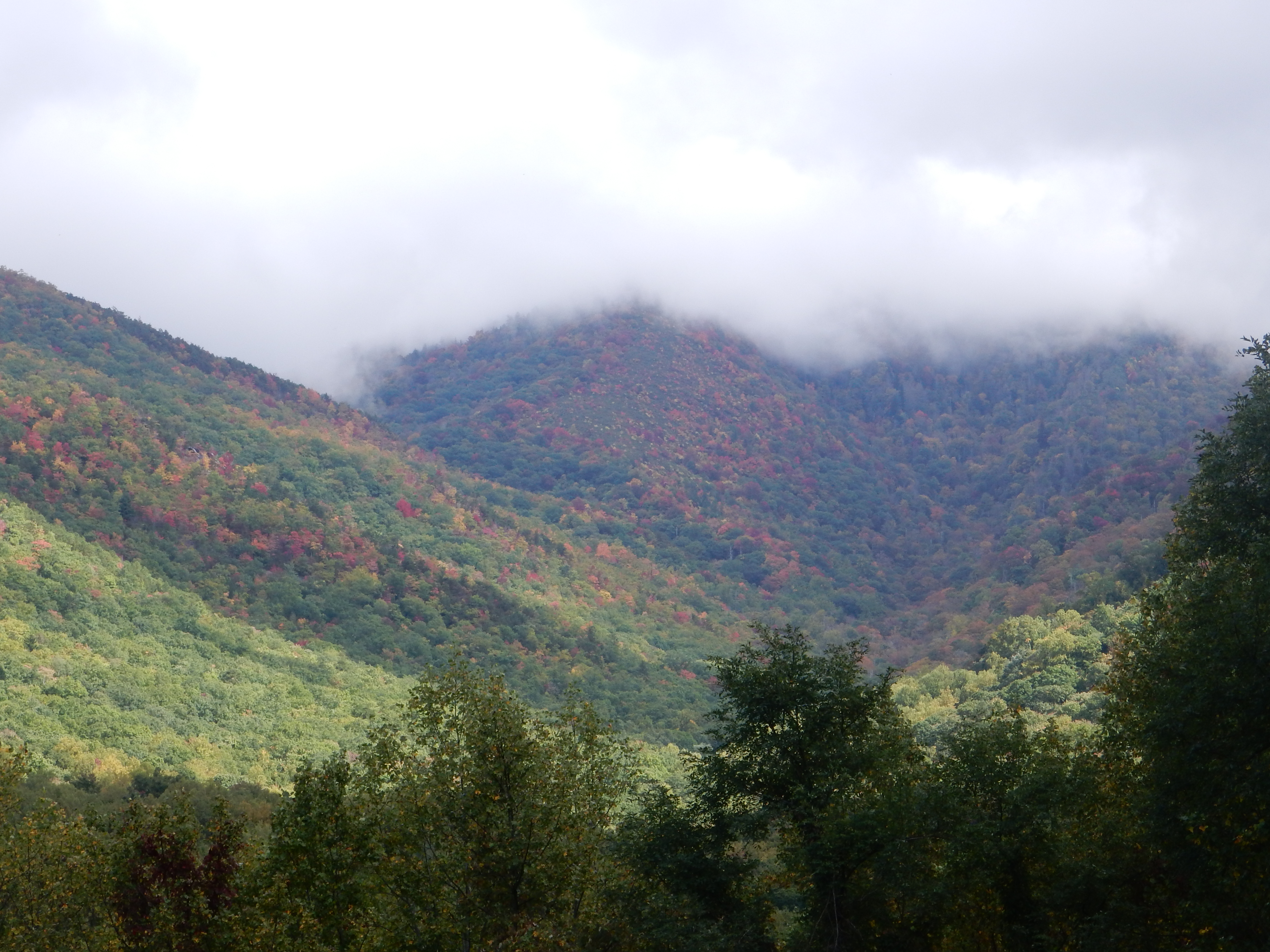
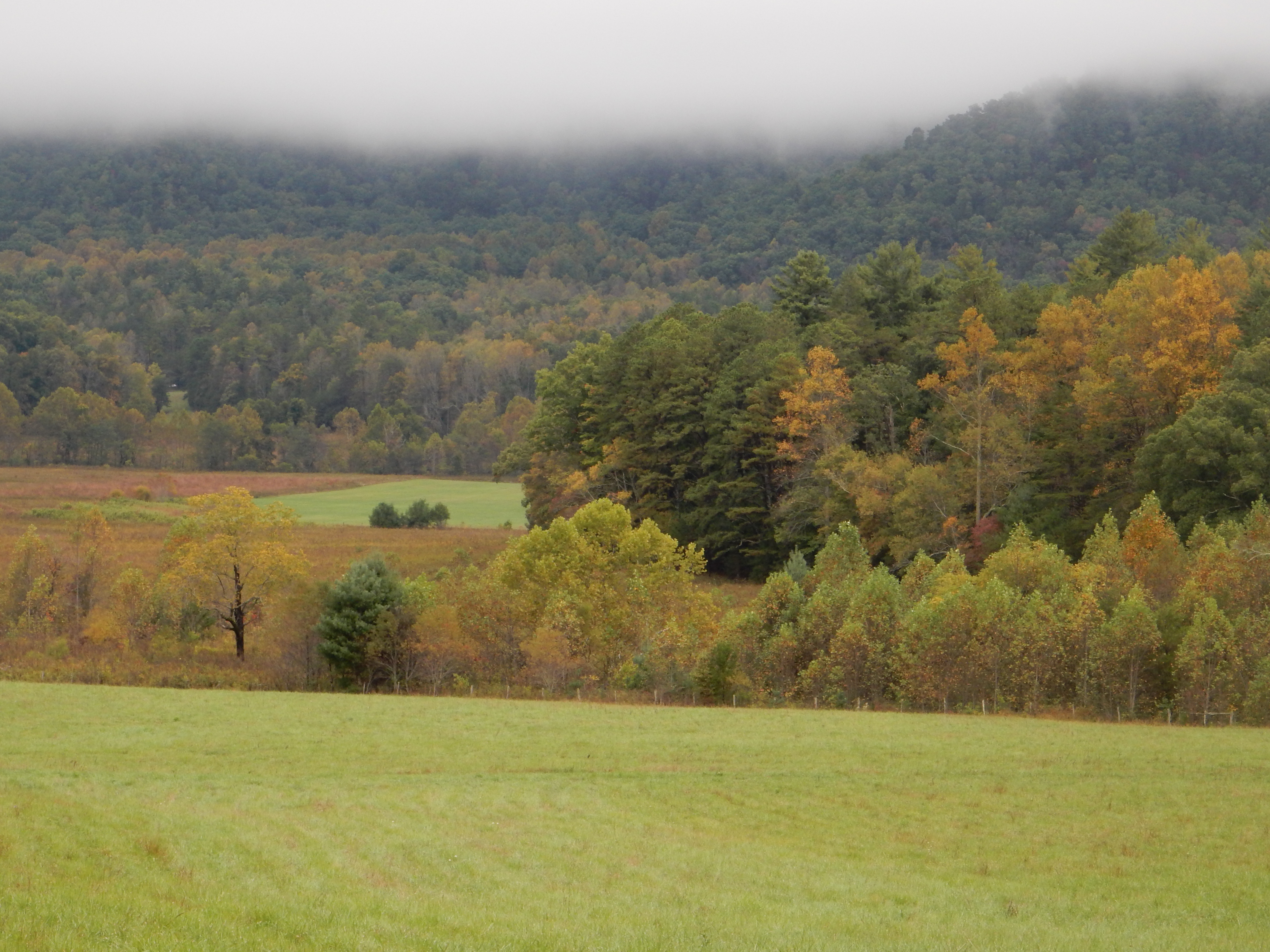
Great Smoky Mountains from Cataloochee valley overlook

Great Smoky Mountains from Cataloochee valley overlook

The park was a dream beginning in the late 1800s but grew more serious in the 1920s. The country had gone through a major discussion and creation of the National Park Service in 1916. A major focus of the discussion was a difference in attitude that resulted in the national forests being more “utilitarian” in purpose (lumbering being one major emphasis allowed) and the national parks outlawing lumbering and only for preservation and recreation. Thus lumber companies that owned much of the land in this area were opposed to a national park being created. The lumbering interests were clear cutting the land, creating a wasteland, allowing forest fires that, due to trees being removed, burnt down into the shallow topsoil and resulting in run-off that silted up the streams. However, the lumber companies employed many people and were a major tax base. People preferred the local economy that they knew versus a promise of future riches.

Easterners were pushing for their “own” national park. All of the other national parks were out west. Proponents of new national parks in the east pushed the economic advantages of tourism dollars staying here rather than going to Arizona, California, etc. The federal government had a policy then that it would not use federal dollars to buy land for a new park, the land had to be donated in some fashion.

Well, long story short. Tennessee and North Carolina citizens raised $1,000,000. The Rockefellers donated $5,000,000. The states donated additional funds. Park acceptance was tied in with development of Shenandoah National Park to create greater Congressional clout. In 1934 enough money and land was committed that the National Park Service took over the land ownership and future development. This park was a major site for the Civilian Conservation Corps who worked in the 1930s to create recreational facilities and to build trails and roads. In 1940 the park was actually dedicated by Franklin Roosevelt.

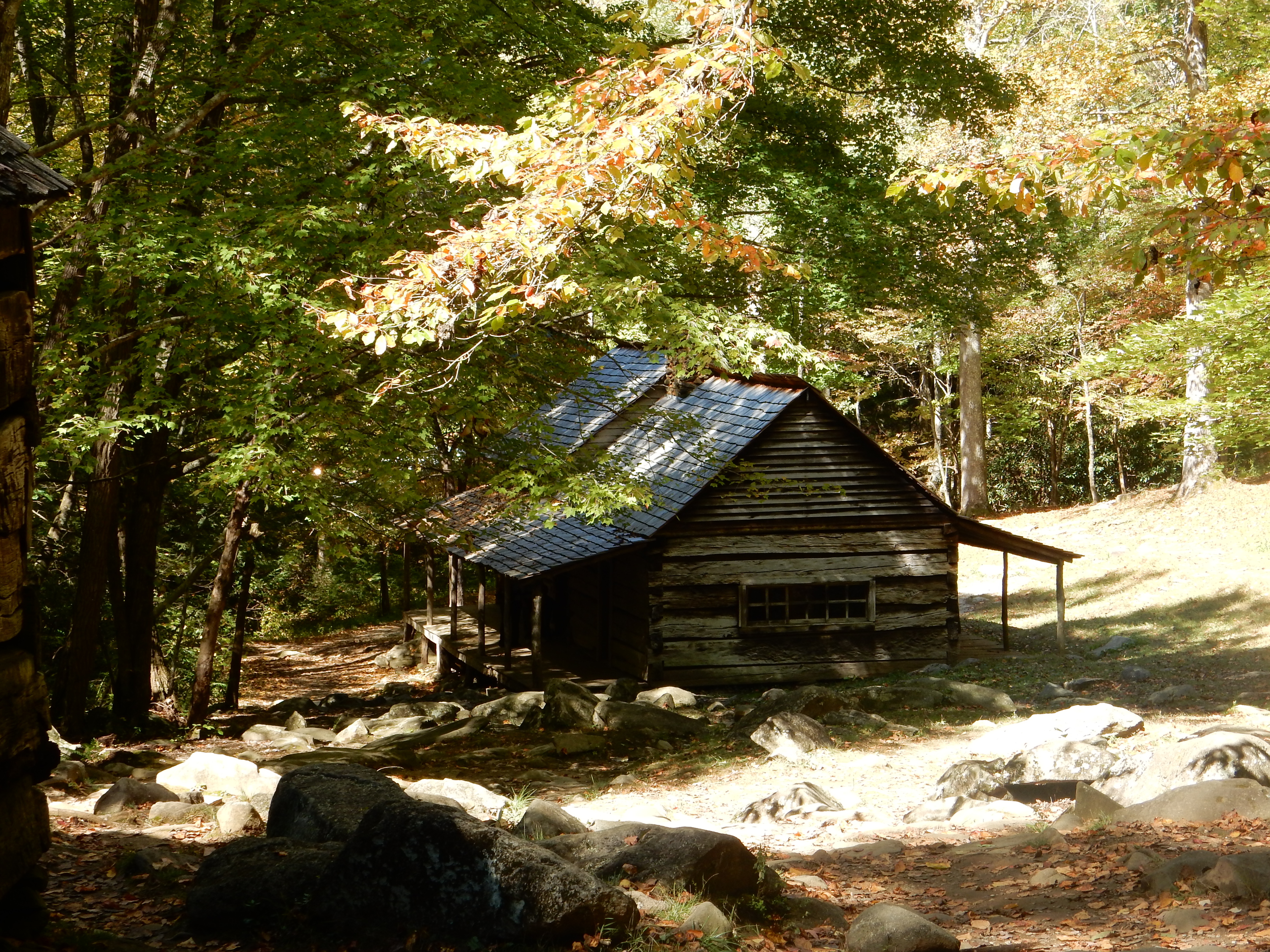
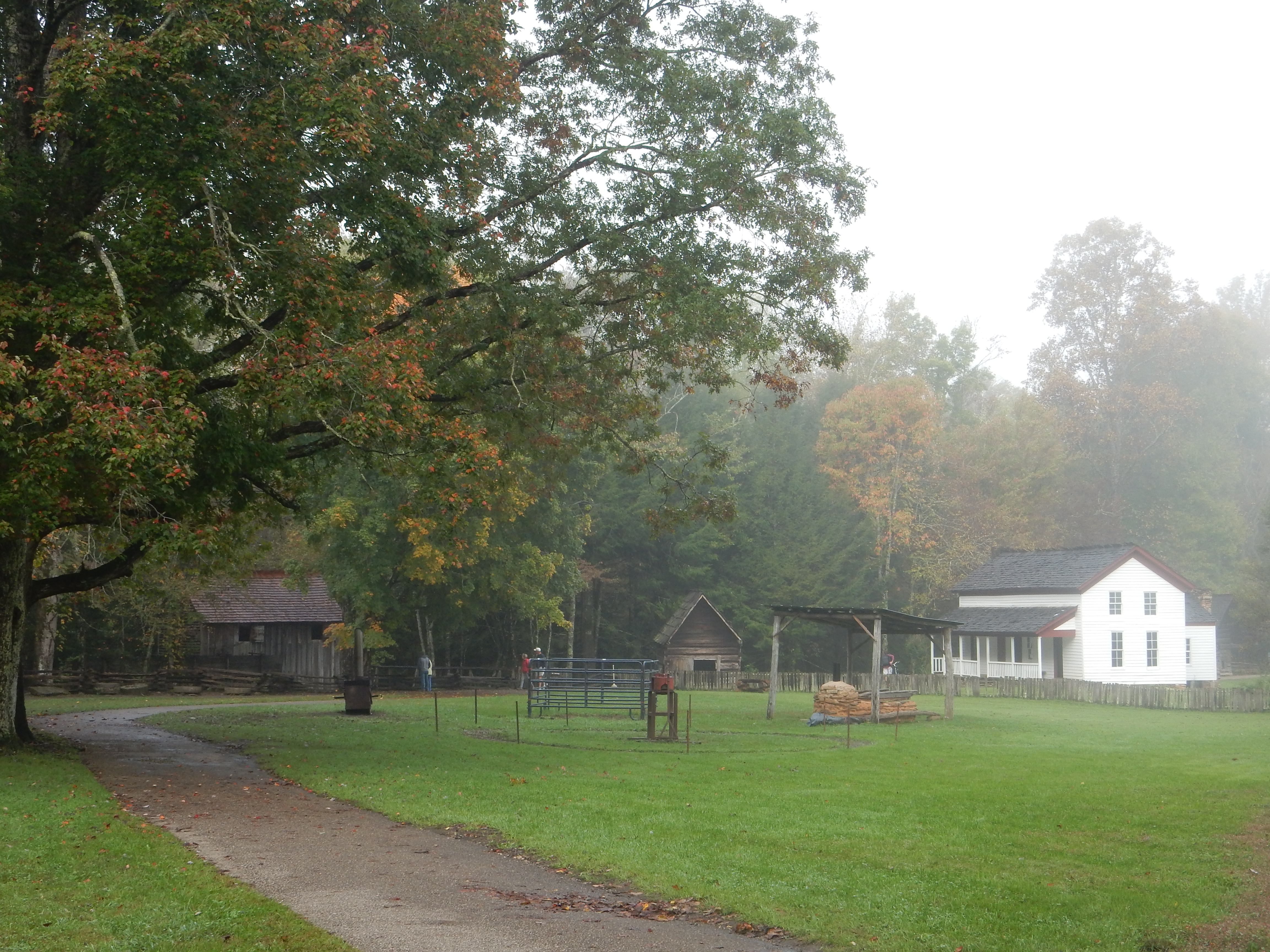
One of the preserved original farm homes

One of the preserved original farm homes

We mentioned Cades Cove in an earlier post. We have visited several park locations now where families sold their land and moved out for development of the park. Unfortunate timing meant many of them sold land that had allowed for self-sufficiency in exchange for money that was lost during the bank failures of the 1930s. Over 4,000 people were moved out, a lot of them unwillingly. A lot of hard feelings existed for many years, some still lingering today. However, the promise of regional economic prosperity due to a national park has come to fruition. Great Smoky Mountains is the most popular national park with twice as many visits as the Grand Canyon.

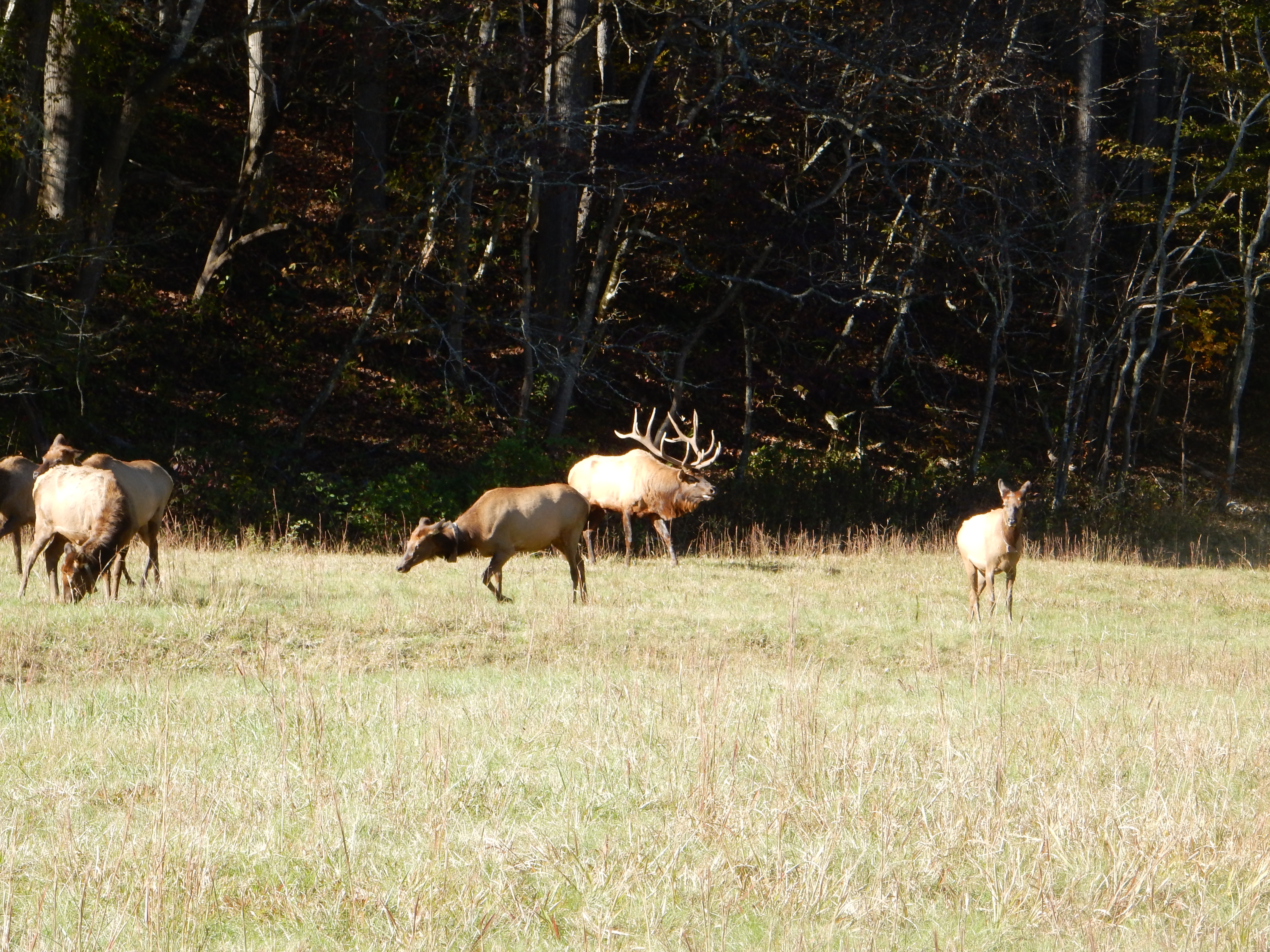
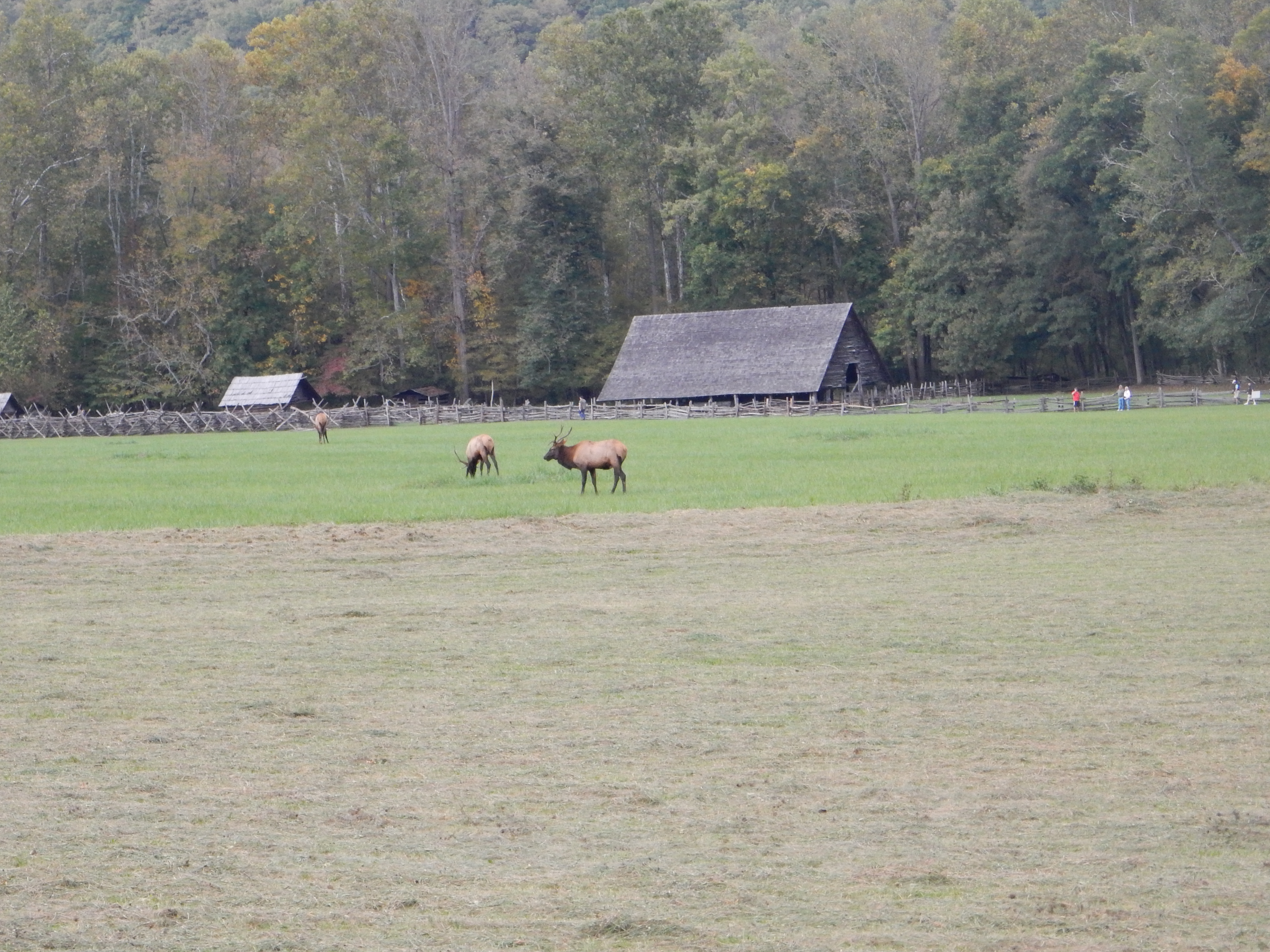
Bull elk and some of his cows

Bull elk and some of his cows at Cataloochee Valley Great Smoky Mountain National park

One of those settlement areas was Cataloochee valley where in 1910 over 1200 people were living. A few buildings have been preserved. We drove there (two hours one way) and had great mountain views and watched a herd of 20 elk. The prime male bull was bugeling and minding his harem of female cow elk, with two young bulls hanging around. The elk had been re-introduced into the park in 2001. There are about 100 elk in the park now.

While people were hanging round watching the elk, the crowd was not unreasonable. Part of that may be due to several miles of narrow dirt curvy roads that frequently require ongoing traffic to back up or wait at slight widening in the road for the opposing cars to pass by. We met one couple where the husband was the local service rep for Marvin Windows based in Warroad MN. You may recall that we toured the Marvin factory back in August of this year.

Hiking along the Little River

Hiking along the Little River

Otherwise we continued our varied hikes. Today’s major hike was five and a half miles along the Little River, watching and listening to the hum/roar of the water rushing past the rocks. On this hike we encountered a large number of anglers. This area is home to the largest number of diverse salamander species.

Cabin in Elkmont area

Cabin in Elkmont area

Other hikes continued the climbing paths through forests and along streams. Old farm buildings, churches and schools were encountered. One area of the park (Elkmont) was the vacation cottage area of the Knoxville, TN elite. A whole block of buildings are on display to convey the camp resort feel of the time with a central clubhouse.

Wednesday we went on a ranger led talk. He covered many topics but also touched on the great loss to these forests with the near elimination of the American chestnut tree due to chestnut blight in the 1920s. The chestnut tree grew to 100 feet in height and 10 feet in diameter. The nuts were major sources of food for bears and people. Now the American chestnut is, for all practical purposes, no longer in this area.

This wraps up our week at the Westgate Smoky Mountain Resort. Tomorrow we drive over to North Carolina where we spend most of the next week.

Ed and Chris 8:45 PM

Categories: road trip, travel | Tags: , , , , , , | Leave a comment

2015 Trip Six, The Great Smoky Mountains, October 12-13

Gatlinburg, TN October 13

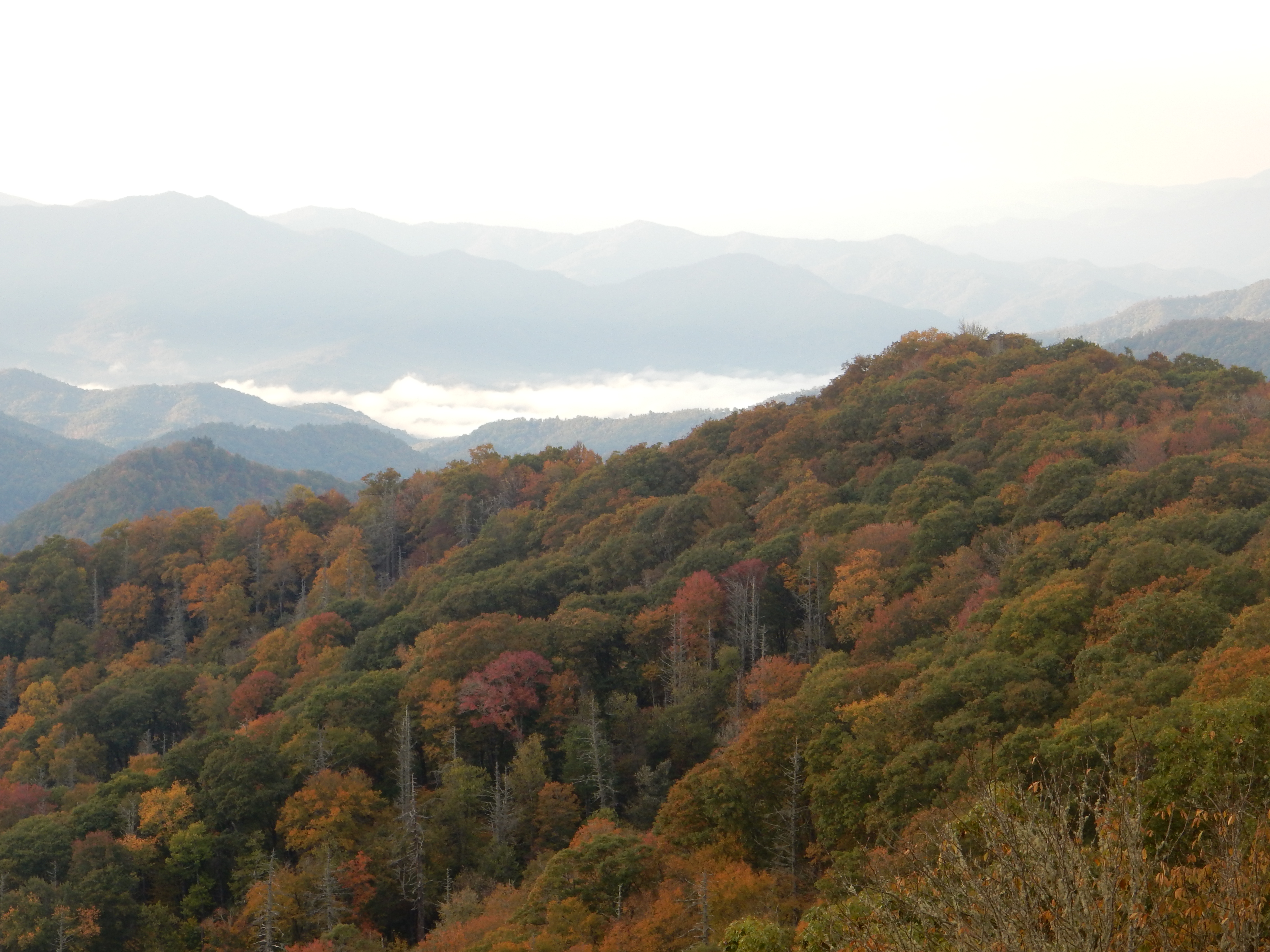
View from Newfound Gap Road

View from Newfound Gap Road

Beauty and tragedy were intermingled themes for the last two days. We continued our hiking in numerous areas of the park. We even managed to include two hikes that were primarily flat-quite an accomplishment.

Walking in the woods

Walking in the woods

Walking in the woods

Walking in the woods

Beauty first. The last two days have been clear with temperatures reaching the mid-70s, although elevation, wind and shade provide for an ever-changing temperature. One of our hikes took us to the top of Clingmans Dome where the park volunteer offered that the vista we saw is only this clear about 25% of the time.

creek side ramble

creek side ramble

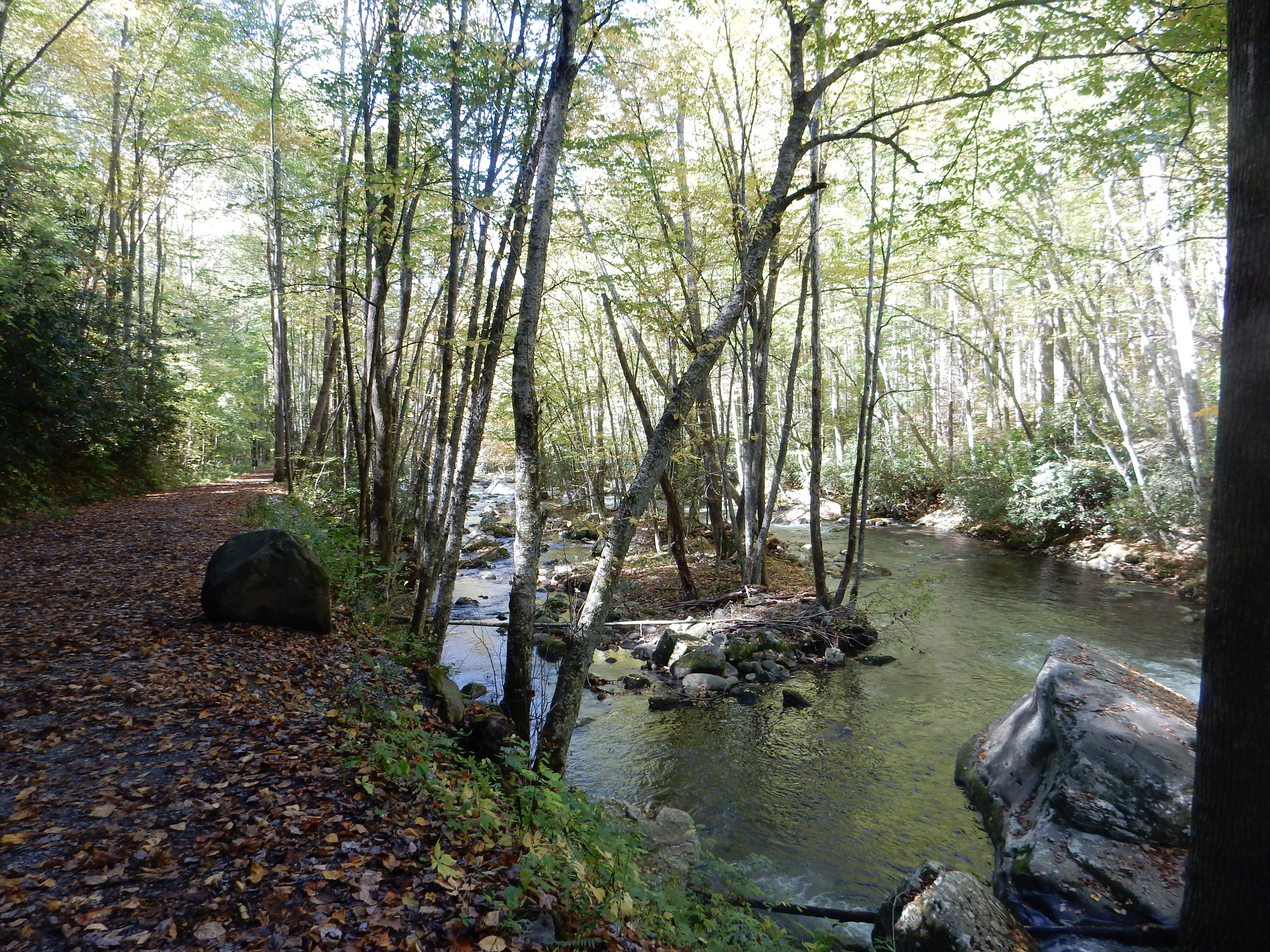
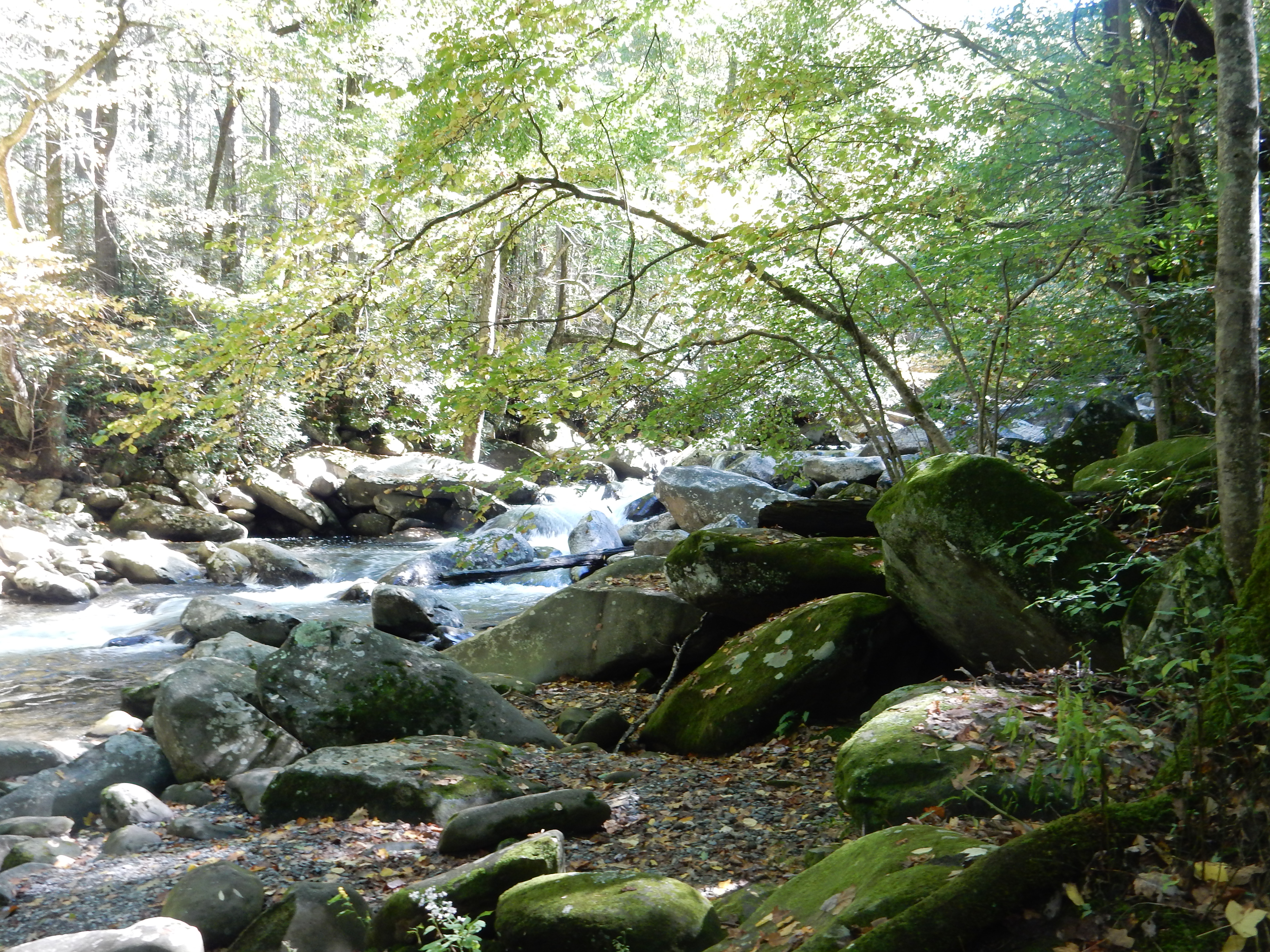
The park that we view, there are hundreds of thousands of acres that are remote and beyond our hiking skills, will have creeks and streams running at a fast pace. The geology is rocky (I will spare the details) so stream beds are dense with rapids and cascades as the water rushes over and around the rocks. The sound of rushing water is pleasant and near constant on hikes. Depending on the elevation, one is hiking in some combination of fir/deciduous trees. Pine smell, rustle of fallen leaves, mixed green/yellow and some red colors mingle among the pathways.

A restful lunch-of PBJ sandwiches

A restful lunch-of PBJ sandwiches

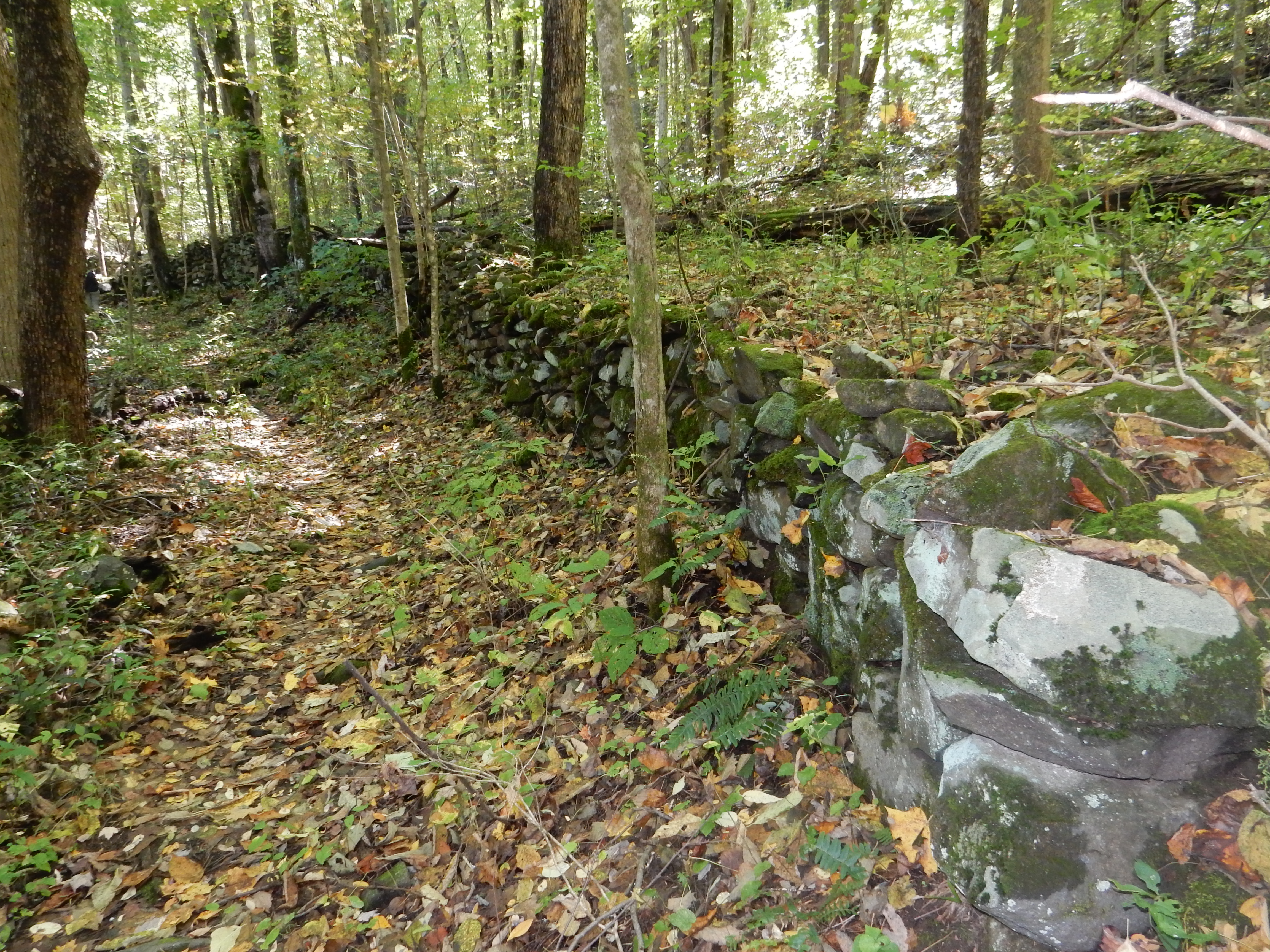
Best preserved stone wall still in the park

Best preserved stone wall still in the park

One of our destinations took us to the site of the best preserved stone fences remaining in the park. Lunch today was along the west prong of the Little Pigeon River. We stopped at the Newfound Gap Road overlook twice. Today’s stop at the overlook provided better pictures. At this overlook, you are on the Tennessee-North Carolina state line at just over 5,000 feet above sea level. (Gatlinburg is at about 1500 feet above sea level.) Several of the hikes took us to more waterfalls, pleasant but none of them overwhelming.

Clingmans Dome observation tower

Clingmans Dome observation tower

Clingmans Dome is the highest peak in Great Smoky National Park at 6,643 feet above sea level. It is the third highest peak east of the Mississippi River. Due to the boundary of the two states crossing the top of Clingmans Dome, it has the joint status of being the highest peak in Tennessee and the third highest in North Carolina. To reach the peak, one drives seven miles up past the Newfound Gap overlook. The last portion is walking one half mile which gains 330 feet in that short distance. Benches are provided for taking a break periodically. At the very top is a circular dome, reached via an inclined, spiral walkway to provide one with a view above the tree tops. You are also warned not to get your expectations too high for a great view as mist, fog, clouds, and rain are present more often than not.

View from Clingmans Dome

View from Clingmans Dome

Chris at Clingmans Dome

Chris at Clingmans Dome

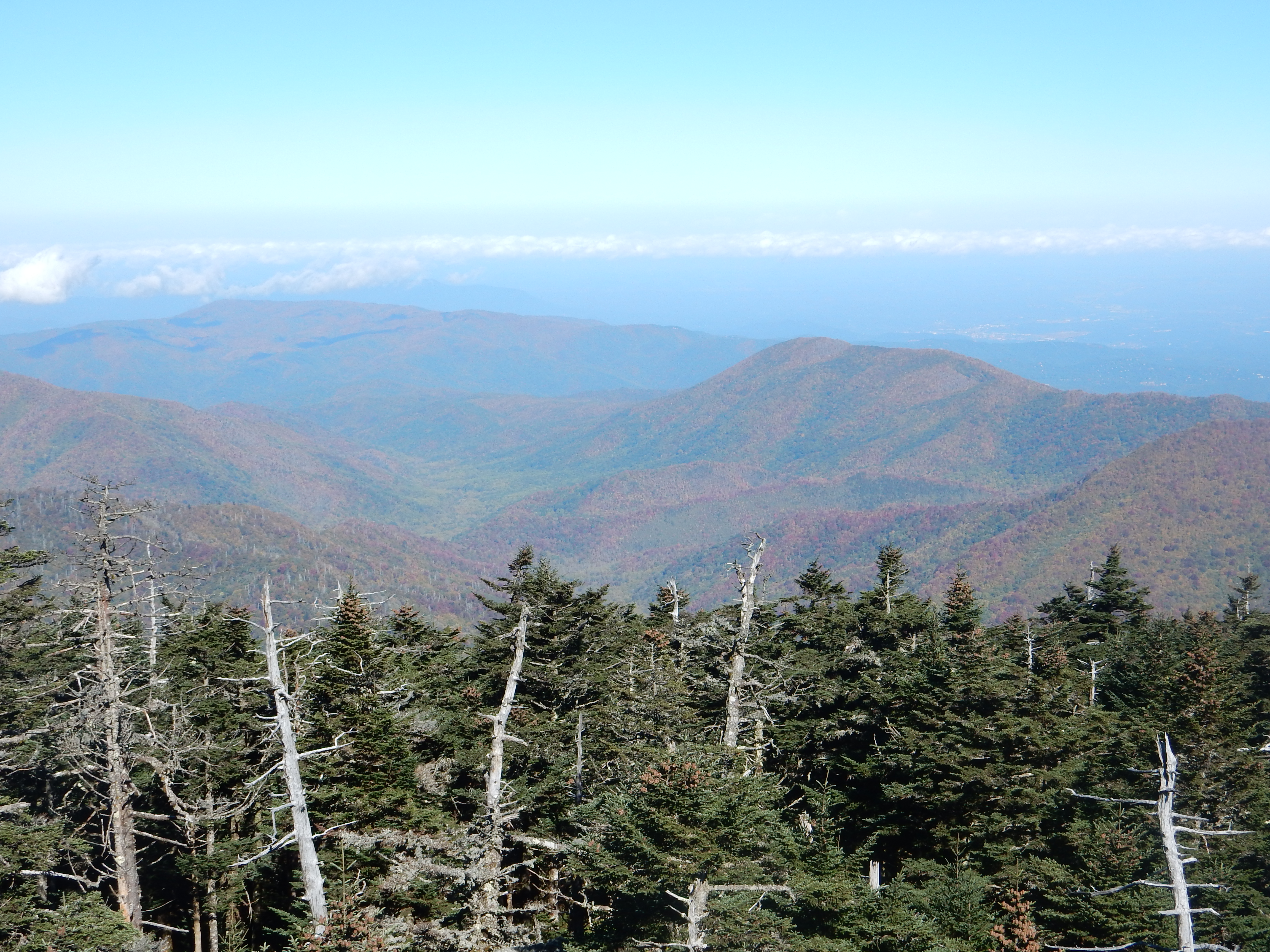
Today the 360 degree view was spectacular. Vistas in all directions. Some cumulus clouds in the distance. Fall colors visible in certain valleys. Also visible was the damage caused by the balsam woolly adelgid, an aphid like insect from Europe that is killing vast numbers of Fraser firs, one of the predominant trees at this elevation. The park is one of the few areas in the world where the Fraser fir trees grow wild.

Monday, we drove over the mountains completely to Cherokee NC. This entailed driving the Newfound Gap Road twice, usually at 35 mph. This is a 30 mile journey up and over the mountains but while curvy, most of the turns can be handled at 35 mph. The town of Cherokee is the home of the Eastern Band of the Cherokee Indians, and brought us into the tragedy portion of our two days.

The Cherokee Indians were one of five tribes (Choctaw, Cherokee, Cree, Seminole, and Chickasaw) that were forcibly relocated from the southeastern portion of the US to what is now Oklahoma. This forced relocation is called the “Trail of Tears” due to the number of Indians that died along the way and to the loss of their traditional homeland. (Previously mentioned by us on our Nov. 1, 2013 blog post at Fort Smith Arkansas, near the end of the Trail of Tears.)

Elk near Cherokee TN

Elk near Cherokee TN

Some of the Cherokee managed to hide out here, some snuck back, and a few stayed after renouncing their tribal citizenship before the Trail of Tears took place in 1838. Over time, the US government began to recognize their rights and as they bought back land, a Cherokee reservation was borne in the East.

We stopped at the Museum of the Cherokee Indian, a well-done presentation that covers topics like Indian creation stories, life prior to the arrival of European immigrants, the Trail of Tears, and the development of the current reservation. One panel discussed the role of Indian schools that forcibly removed young boys and girls from their families and educated them to white civilization standards while forbidding Indian language and traditions from being practiced. This continued until the 1920s and 30s. This was a topic we have come across before, as well as understanding from having lived in Carlisle PA for 25 years, home to one of those Indian schools.

The Cherokees were divided among themselves as to the wisdom of accepting the move to Oklahoma. Many did not wish to leave, many others saw no chance to avoid being forced out, and some ended up signing away Cherokee rights even though under tribal custom they did not possess the authority to do so. This led to decades of conflict among the transplanted Indians living in Oklahoma. (Other Cherokee had moved across the Mississippi earlier in the 1800s.) A sad tale but unfortunately only one of many such tales in America relating to the treatment of Native Americans.

Ed and Chris 10 PM

Categories: road trip, travel | Tags: , , , , , , , , | Leave a comment

2015 Trip Six, Great Smoky Mountains, Oct. 10-11

Gatlinburg TN Sunday Oct. 11

View from Newfound Gap Road Sunday in Great Smoky Mountain Park

View from Newfound Gap Road Sunday in Great Smoky Mountain Park

“Whenever you travel in the Great Smoky Mountains, plan twice as much travel time as usual.” Amen! This is a very popular park. This is a popular time to visit. It was the weekend. The road network is limited so everyone has to drive the same roads. Of course, the roads are two lane and curvy. Then you have the vehicles we experienced today: A. bumper sticker on one-I brake for photo ops–it did. B. Bubba and the gang-a pick up with folding chairs in the bed of the truck so people can sit and view the countryside. C. On the one lane, one way road next to and after the sign that says “Do Not Stop. Use Pullovers. Be Courteous” is the vehicle that is constantly stopping-not even a view or wildlife in sight.

Blue heron in woods by Cades Cove

Blue heron in woods by Cades Cove in Great Smoky Mountain National Park

Foolish us. Our own notes said to avoid Cades Cove on weekends. But we thought by getting up early and out at sunrise we would avoid traffic problems. Well, we limited some problems but when you are out all day, you are bound to experience traffic. We spent two hours driving the loop road, wandering around Cades Cove, and hiking through the woods, finishing up before it really started to get popular. (P.S. A cove is a small valley surrounded by mountains)

Part of Cades Cove area

Part of Cades Cove area

Cades Cove is one of the areas in the Great Smoky Mountain National Park that showcases the life of the European Settlers that lived here pre-national park. Native Americans hunted in this area, but their primary settlements were lower down along the rivers and valleys. In the 1820s European settlement began as Scots-Irish people from surrounding areas started to move in. The mountains are steep with few natural gaps and trails so settlement came later than surrounding areas. Subsistence farming was the main occupation.

Cades Cove

Cades Cove

The current Cades Cove area highlights how the people lived. The population seesawed, increasing to 865 by 1850 and plummeting down to 275 in 1860 and back up to 700 in 1900. Cades Cover offered better soil for growing crops and grassy areas to fatten cattle. But the soil became worn out, and with larger families, each succeeding generation had less land to farm. More people moved out but the area still remained viable. When the national park was formed (we will discuss that further in later posts) people were still living here and were bought out or forced to move.

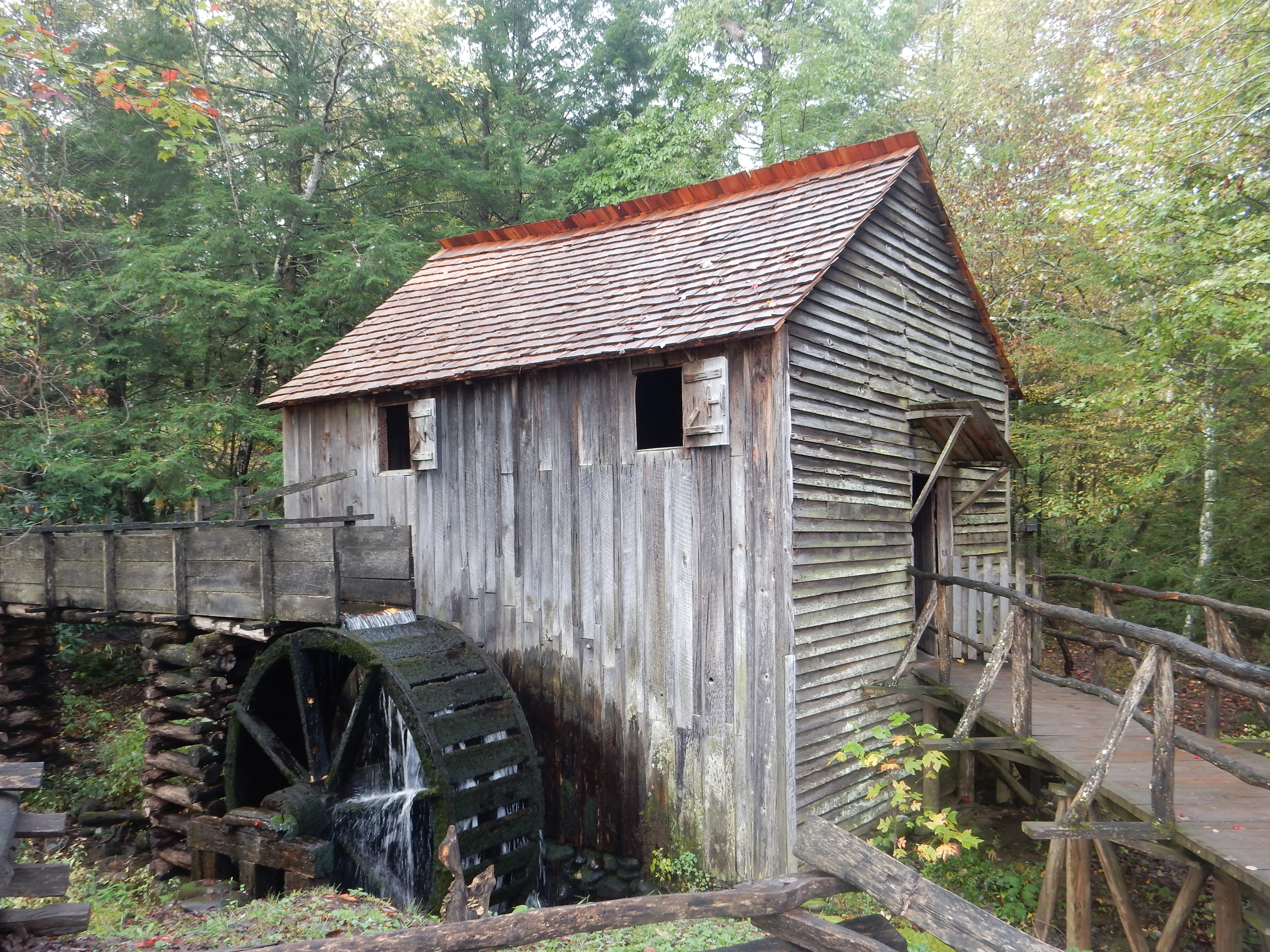
Gristmill at Cades Cove

Gristmill at Cades Cove

Cades Cove

Cades Cove

The buildings in Cades Cove include homes, a grist mill, blacksmith shop, barns, smokehouse, etc. There are three churches; the Methodist, Missionary Baptist, and Primitive Baptist. The Baptist churches split around 1840 due to a major disagreement over the literalness of the Bible and new “innovations of the day”. In the same vein, the Civil War caused deep divisions. The mountainous areas of Tennessee, North and South Carolina had Union sympathizers and deep family and neighbor conflicts occurred.

Laurel Falls

Laurel Falls in Great Smoky Mountains National Park

Today (Sunday) started out cloudy, with the rain that began Friday night continuing through all day Saturday. We only went on a few hikes Saturday. One was to Laurel Falls, an 80 foot waterfall that had high water volume due to the rain. The trail is one of the few paved trails but is steep and it took us over an hour to hike out and back the 2.6 mile trip. The Great Smoky Mountains usually receive 55 inches of rain per year. This makes for slick rocks and vegetation on the trails, but also translates into abundant vegetation. Mountain Laurel and Rhododendron are seen on most trails.

The Park Service also promotes trails called “Quiet Walkways”. These are trails that don’t go to any particular destination and you can hike along them and then return back whenever you like. These trails are designed just to let you get out and experience the woods. This park is actually an International Biosphere Reserve. The park literature states: “No place this size in a temperate climate can match Great Smoky Mountains National Park’s variety of plant and animal species.” Whew! You can be sure that when we are out hiking, we are not able to identify more than a few of the 1,500 flowering plants here.

After climbing up this hill, ...

After climbing up this hill, …

..we found this old cemetery

..we found this old cemetery

On one of the quiet walkways Saturday we scampered (well, sort of, for two people in their 60s) up a steep hillside path and were surprised to find an old cemetery hidden in the woods. In most cases, the grave markers were simply slabs of a shale like stone stuck in the ground. Only two or three had lettering that was still visible. None of the literature we read had mentioned this place.

Along the West Prong of the Little Pigeon River

Along the West Prong of the Little Pigeon River

Another quiet walkway on Sunday led to a valley along side the West Prong of the Little Pigeon River. This area had also been the site of a small gathering of settlers until the park came along. A few stone fireplaces were still standing. Since the park was established in 1934, the vegetation has sprung up and one is hard pressed to visualize how the homesteads and farms would have looked in what now seems to be a floodplain forest.

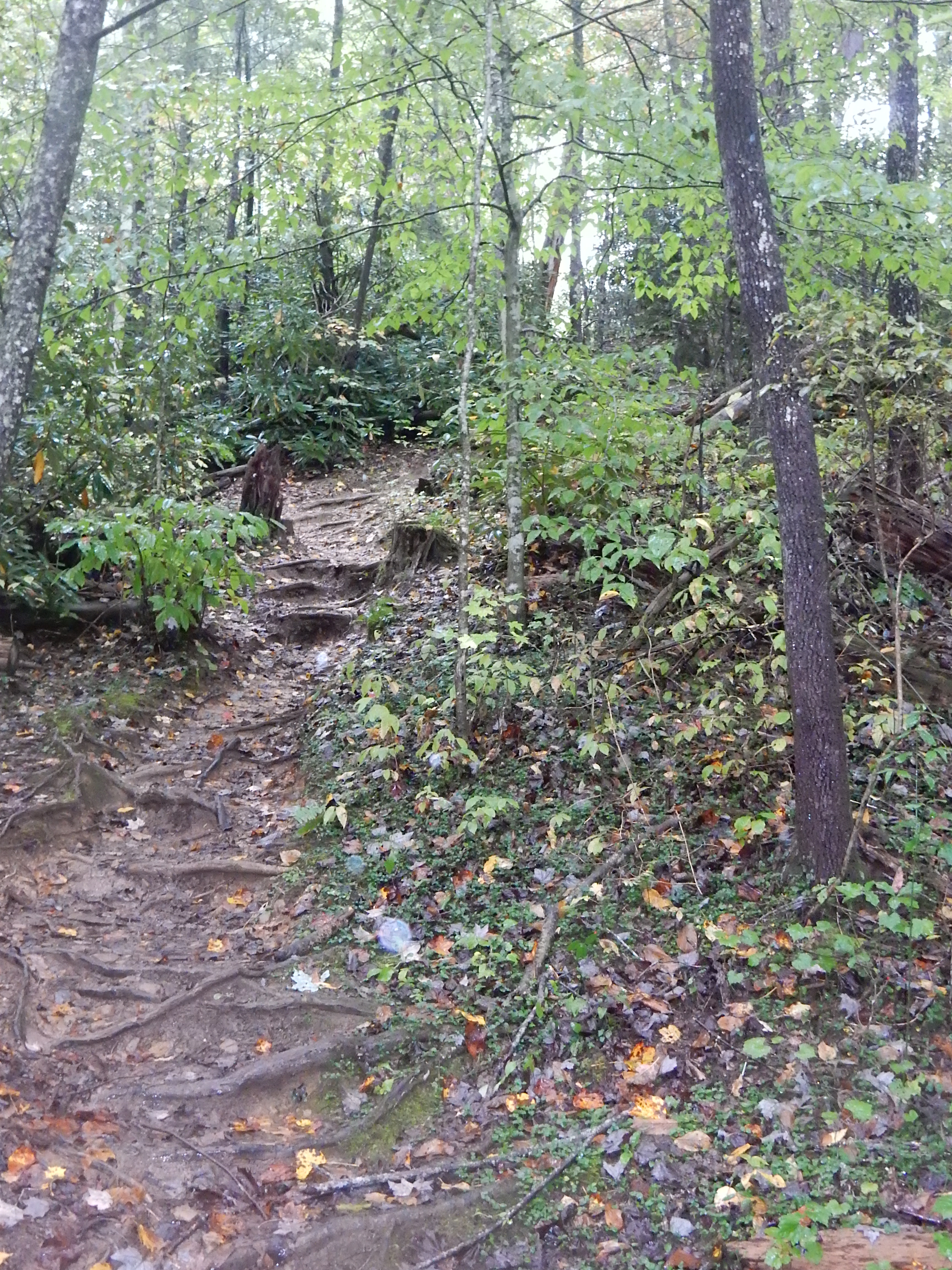
On the Cove Hardwood trail today, we did see relatively fresh bear scat but pushed on anyway. Luckily there was a family of four and one dog in front of us on the trail. We pushed ourselves to keep them in sight as a bear prevention device. This was a challenge, the hike was steep and slippery with rocks and roots just looking for a chance to trip us.

Just a small falls, Cataract Falls, near the visitor center at Great Smoky National Park

Just a small falls, Cataract Falls, near the visitor center at Great Smoky National Park

Meals the last two days have been in our unit. Frozen beef patties for dinner on both nights; cooking them created a smoke odor which managed to permeate the rooms with the smell of burnt meat.

Ed and Chris 9:30 PM

Categories: road trip, travel | Tags: , , , , , , | Leave a comment

2015 Trip Six, Great Smoky Mountains, Oct. 9

Gatlinburg, TN October 9

We spent half an hour today following “The Virgins”. That is our term for a couple on a motorcycle and trailer combination driving along the two lane roads in NC. They were from Alabama and in a 45 mph zone, were doing 35 mph. At every turn, they braked some more. We assumed it was an elderly couple on their first motorcycle trip. On our two lane, curvy roads, there was no opportunity to pass them. They did not pull over until it started to rain and they probbly had to put on rain gear. AND, two hours later, they pulled in to the cafe in Townsend TN that we had chosen for a mid day meal! They were old! Probably about our age.

Speaking of two lane roads, a direct path from our Thursday lodging to our Friday lodging would be 150 miles. We drove 300 miles, only 15 of those were on four lane roads. Most of these were on scenic byways. We hit the road early, stopping for breakfast in Ellijay again, this time at the Cornerstone Cafe. Food was fine but this is definitely not a dairy zone. No real butter, just “butter” spread. Milk was in a small juice glass for $3.

As we passed into Tennessee, we went through Copperhill and Ducktown, towns that were the site of a copper mine, now closed. Old mining buildings still line the road. In the nearby forest was the site of the Olympic kayak course from the Atlanta Olympics.

View along Cherohala Skyway

View along Cherohala Skyway

Our first major scenic byway was the Cherohala Skyway, a 40 mile national scenic byway. The name comes from a combination of Chero for the Cherokee National Forest and hala from Natahala National Forest. The road goes through both of those forests. The Cherohala Skyway took 30 years to build and cost $100 million. The road goes from an elevation of 1000 feet above sea level to 5,390 feet above sea level. $100 million did not buy shoulders, though.

Some red among the fog along the Cherohala Skyway

Some red among the fog along the Cherohala Skyway

The scenery was good but pictures from this section are few. The drive covers forests and several rivers and river valleys. The pull-offs (about one in every two miles) either were in areas with poor visibility or poor scenery. Fall colors here were much brighter-in areas with no pull-offs. Plus, the day was cloudy and drizzly early, with complete fog (or in the clouds) from about 4,800 feet to 5,390 feet and then back down to about 4,800 feet above sea level.

View from the Cherohala Skyway

View from the Cherohala Skyway

As expected, we observed numerous motorcycles, generally with good mufflers, and obeying the speed limits. Coming down from the high point on the Skyway, we pulled over at one overlook crowded with motorcylists enjoying the view and swapping tall tales. As we drove farther down, we encountered “The Virgins” and were thus able to even enjoy the scenery more as the speed was reduced below its already moderate level of 35, 45, or infrequently, 55 mph. Halfway between the end of the Skyway and the beginning of the next scenic route, “The Virgins” pulled over.

Along the "tail of the dragon"

Along the “tail of the dragon”

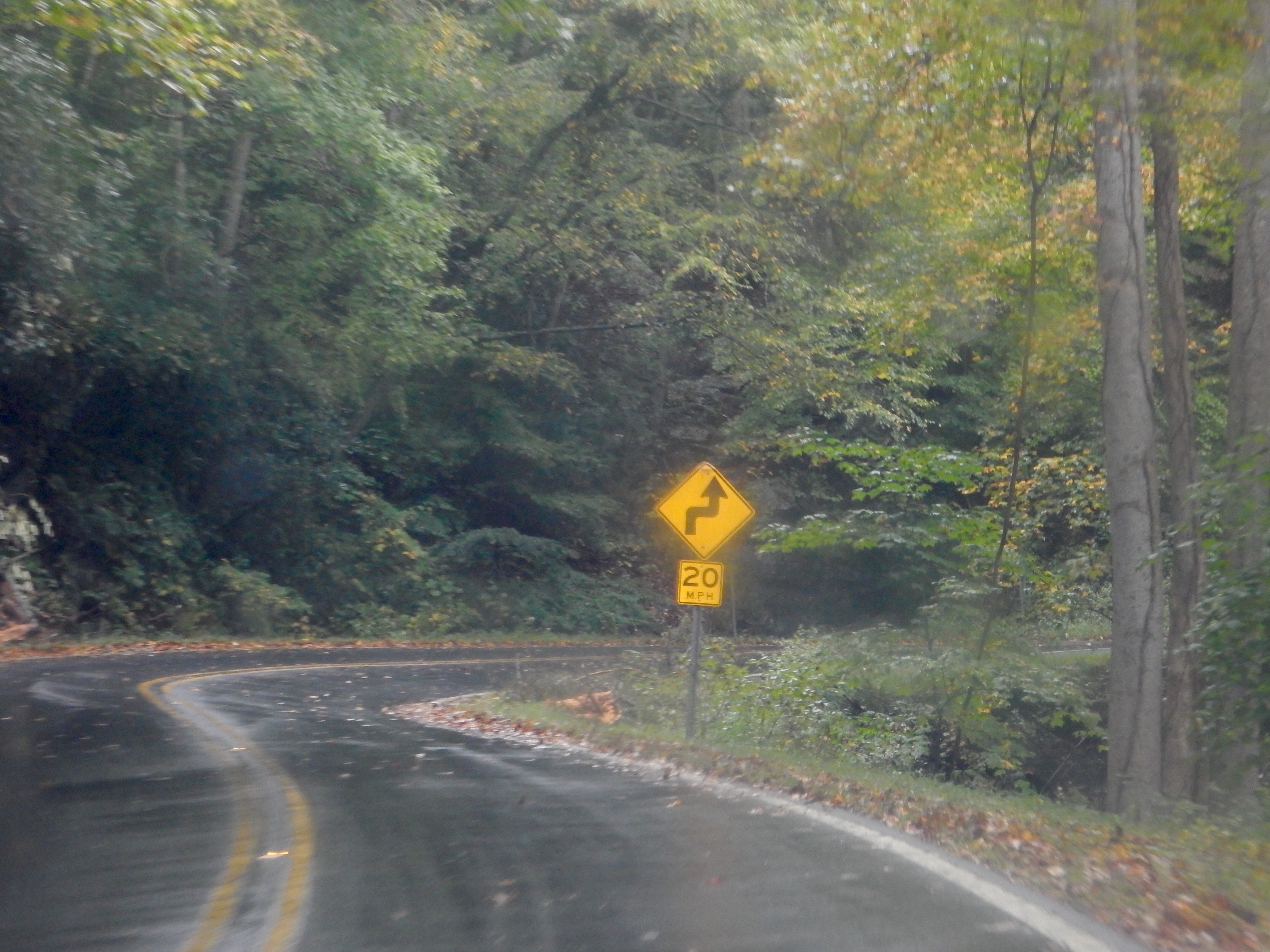
Our next major “named” scenic route was the “Tail of the Dragon”. This road is really hyped as a major motorcycle route. It is only 11 miles long with the speed limit 35 mph for the majority of the route. There are 318 curves along the 11 miles. Some of the curves are named: Hog Pen Bend, Parsons Curve, Little Whip, Pearly Gates, Wheelie Hell, Brake or Bust Bend, etc. Many of the curves are sloping, so on left turns the road drops down to the left side. Once again, we got behind a slow motorcyclist. Before this, I never would have thought I would be driving behind two slow motorcyclists in one day. This guy, however, on left curves with no oncoming traffic, dipped into the oncoming lane to enjoy the ride.

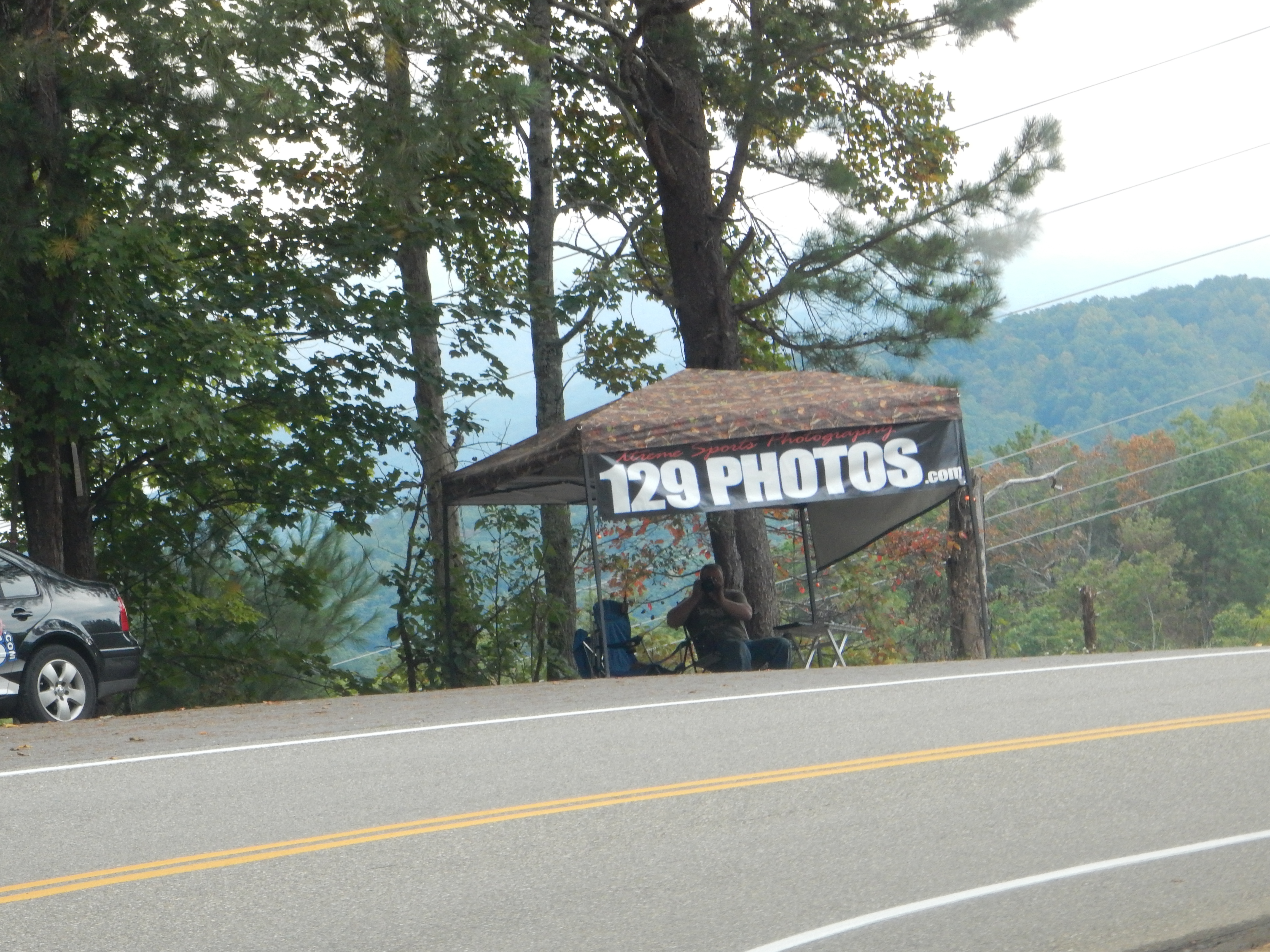
One of the photo entrepeneurs

One of the photo entrepeneurs

Near the beginning of the route is The Tail of the Dragon Store where there must have been over 100 bikers parked. Every kind of bike imaginable seemed to be taking the road and enjoying the curves. During the 11 miles, we passed at least five spots where entrepreneurs were set-up under a canopy and taking pictures of every vehicle that went by. They sell these pictures on the Internet. We went to one site and there were thousands of pictures. We were not positive of the time we drove by, doing a search for an hour period would have taken forever. Chris had fun waving to them as we passed, though.

A view from the overlook along the Tail of the Dragon

A view from the overlook along the Tail of the Dragon

As we were close to the end, we pulled over at an overlook. The motorcyclists were having a great time chatting and comparing bike notes. Us car people were in a minority. A short drive from Tail of the Dragon began the Foothills Parkway.

Chris was pleased to have us reach the Foothills Parkway. After the Cherohala and Tail of the Dragon and the hundreds of curves, her stomach was starting to feel a little queasy. Foothills is much gentler, although there are plenty of curves, generally you can take them at the posted speed limit of 45 mph. For Cherohala and Tail of the Dragon, the car was braking for the curves and she would have to hold on, the car would start accelerating again, then braking for curves, and repeat over and over.

View from the Foothills Parkway east into the Great Smoky Mountains

View from the Foothills Parkway east into the Great Smoky Mountains

The Foothills Parkway looks over into the Great Smoky Mountains, traveling along the Tennessee River valley uplands. Here the trees were almost completely green, even though we were farther north. Later on, a park ranger at the Great Smoky Visitor Center indicated he believed soil conditions played a major role in determining fall color. I don’t know, over the years I have heard so many conflicting reasons as to why fall color changes, or why its vividness is different, when the changeover begins, etc. We will just enjoy what we see.

This 20 mile stretch of the Foothills is not new to us. We drove it 2 years ago but it continues our theme of making the day one of scenic viewing with very little hiking. It ends at Townsend, TN.

One day in June, when I was at Union Depot in St. Paul, waiting for the Amtrak train to arrive and begin one of my Trails to Rails stints, I met a woman from Townsend. As we were talking, she mentioned that when we visited the Great Smoky Mountains, we should eat at Miss Lily’s Cafe. I made a note of it and Chris and I had our major meal of the day there at 3 PM. The food was quite good, we shared a strawberry salad and a chicken salad croissant sandwich. Dessert was chocolate cake and a sugar cookie.

The final scenic drive was along the Little River within the national park. It was the most direct way to Gatlinburg without traversing miles of tourist trap stores. It provided just a glimpse of the steep mountains, tall trees, and rushing creeks we will be seeing over the next week.

We stopped at the Sugarlands Visitor Center for the Great Smoky National Park and gathered up our literature for the next week. Driving through Gatlinburg was as unpleasant as driving through Pigeon Forge, Atlantic Beach, or other tourist places. Mini-golf, fudge shops, pedestrians, restaurants, hotels, T-shirt shacks, curio shops, etc. Our lodging is at the Westgate Resort, between Gatlinburg and Pigeon Forge. While it is off the main road, it is a large complex and has its own crowds. Oh well, the unit has two bedrooms, a jacuzzi tub, kitchen, two bathrooms, a deck and it came for a great price.

Ed and Chris Sat. 10/10 11:15 AM and it has been raining constantly for the last 12 hours

Categories: road trip, travel | Tags: , , , , , , , , | 2 Comments

22015 Trip Six, Great Smoky Mountains, Oct. 8

Dahlonega, GA October 8, Thursday

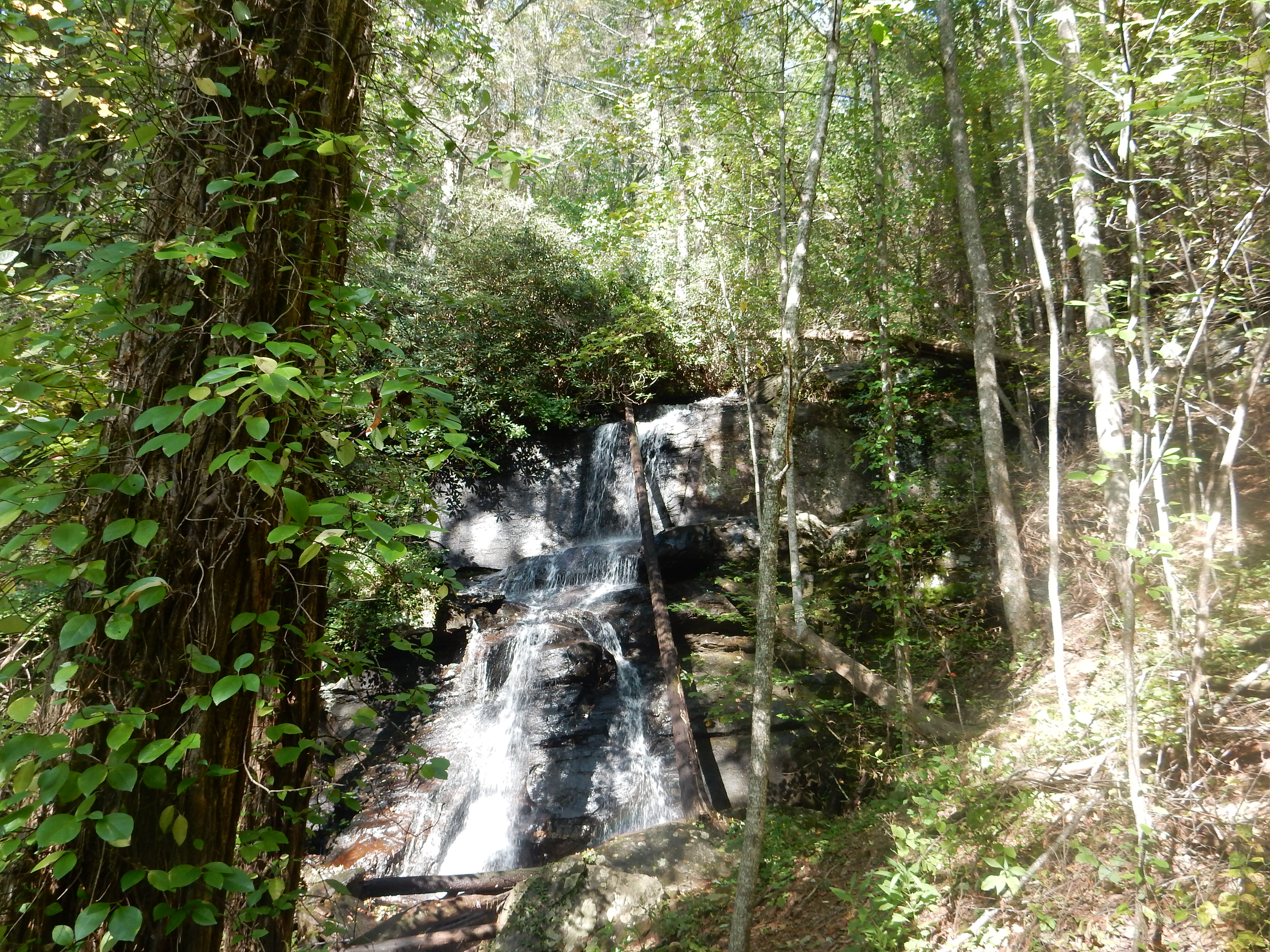
DeSoto Falls in the Chattahoochee National Forest

DeSoto Falls in the Chattahoochee National Forest

Sitting on the veranda at Amicalola Lodge this evening, watching the sunset, and listening to others talk, we are struck once again that our style of travel differs from that of many others. Many of the veranda sitters were discussing their hikes, either today or in the past. Two of them mentioned that today they had hiked 18 miles from here to Springer Mountain, the southern end/beginning of the Appalachian Trail. Both were maybe about our age. One mentioned that she had broken her wrist. Another mentioned that he had pulled a groin muscle.

Chris and I probably walked five miles today on four hikes at three different locations. We generally prefer to go to varying places to try to see more of the terrain and beauty of the areas of the country which we visit. That length, particularly with elevation gain and rough terrain, is plenty of exercise for us. Maybe that is our way of justifying shorter walks, rather than one all day hike that might be too difficult for us. In any event, it works for us and we plan to stick with it.

Dunkin Donuts was our breakfast stop this morning. Sausage/egg sandwich with a donut and milk and coffee. Then it was driving time in the Georgia Blue Ridge Mountains. First stop was in the Chattahoochee National Forest. This forest began with purchases in 1911 under the Weeks Law that allowed the government to purchase land from willing sellers to preserve the headwaters of navigable waters and preserve timber resources. Much of the land here had been abandoned by miners after it had been played out or destroyed by hydraulic mining that washed away the soil by high pressure water lines. Other land had been abandoned by lumber companies who cut the timber and then left the area when the trees were harvested. Other land was never truly good farmland and had been abandoned.

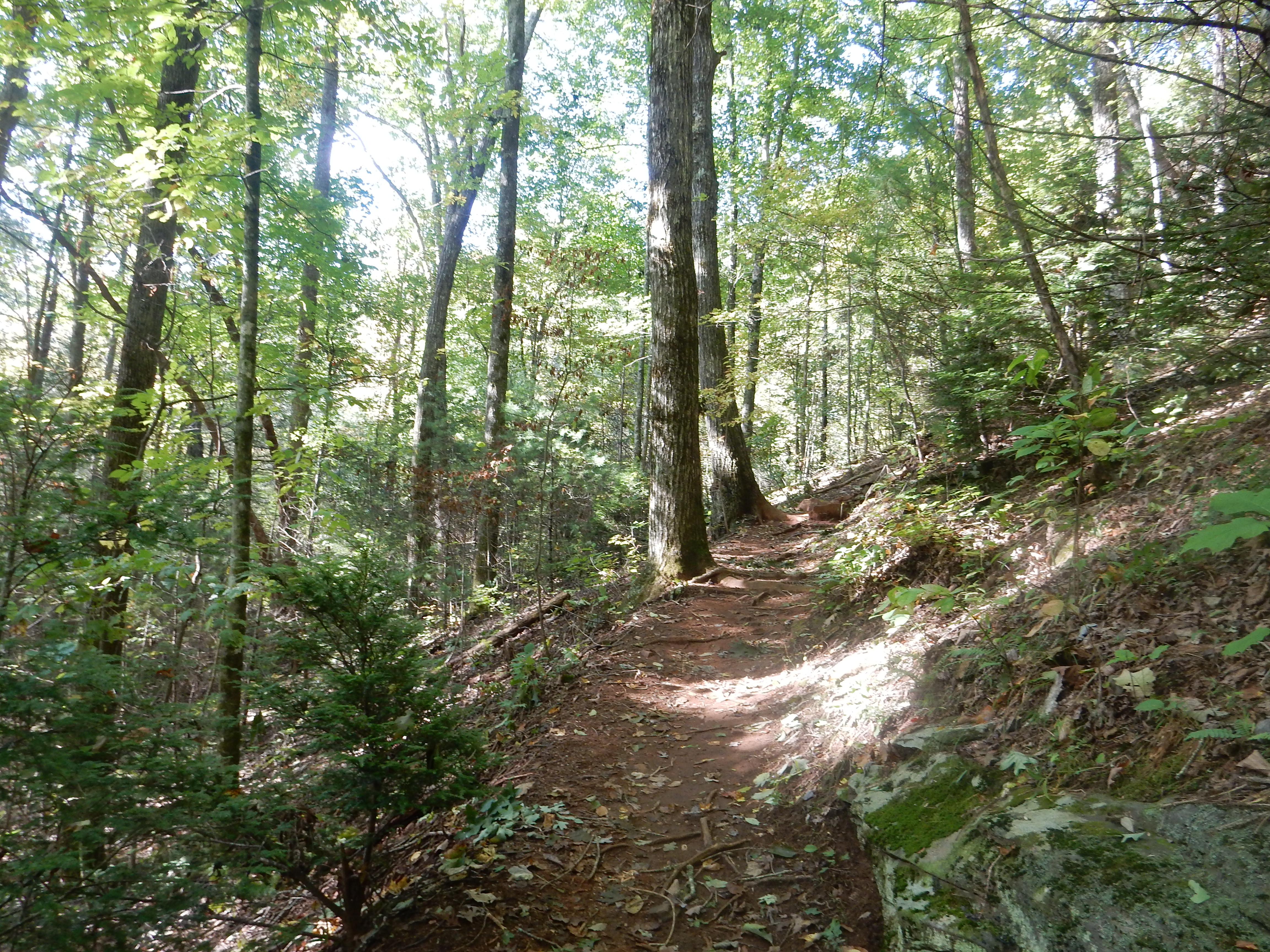
The trail to DeSoto Falls

The trail to DeSoto Falls

DeSoto Falls is a pleasant little falls reached after hiking a mile along a stream and up a hillside. It was a pleasant time for a hike, the day was clear with just a gentle breeze. We have not seen deer surprisingly and no bear thankfully for Chris; a few woodchuck and wild turkeys scattered about. The forest service also has a campground here that was still well populated.

The drive continued north from Dahlonega to Vogel State Park. The park has 1 bedroom cabins, among other lodging, that we had considered in 2013 for the Deep South trip that was postponed for a year. Staying here would have been a nice option for the springtime also. Mountain laurel and rhododendron were frequent along the trails, although not blooming. Fall color was not predominant, mainly green and fallen brown leaves.

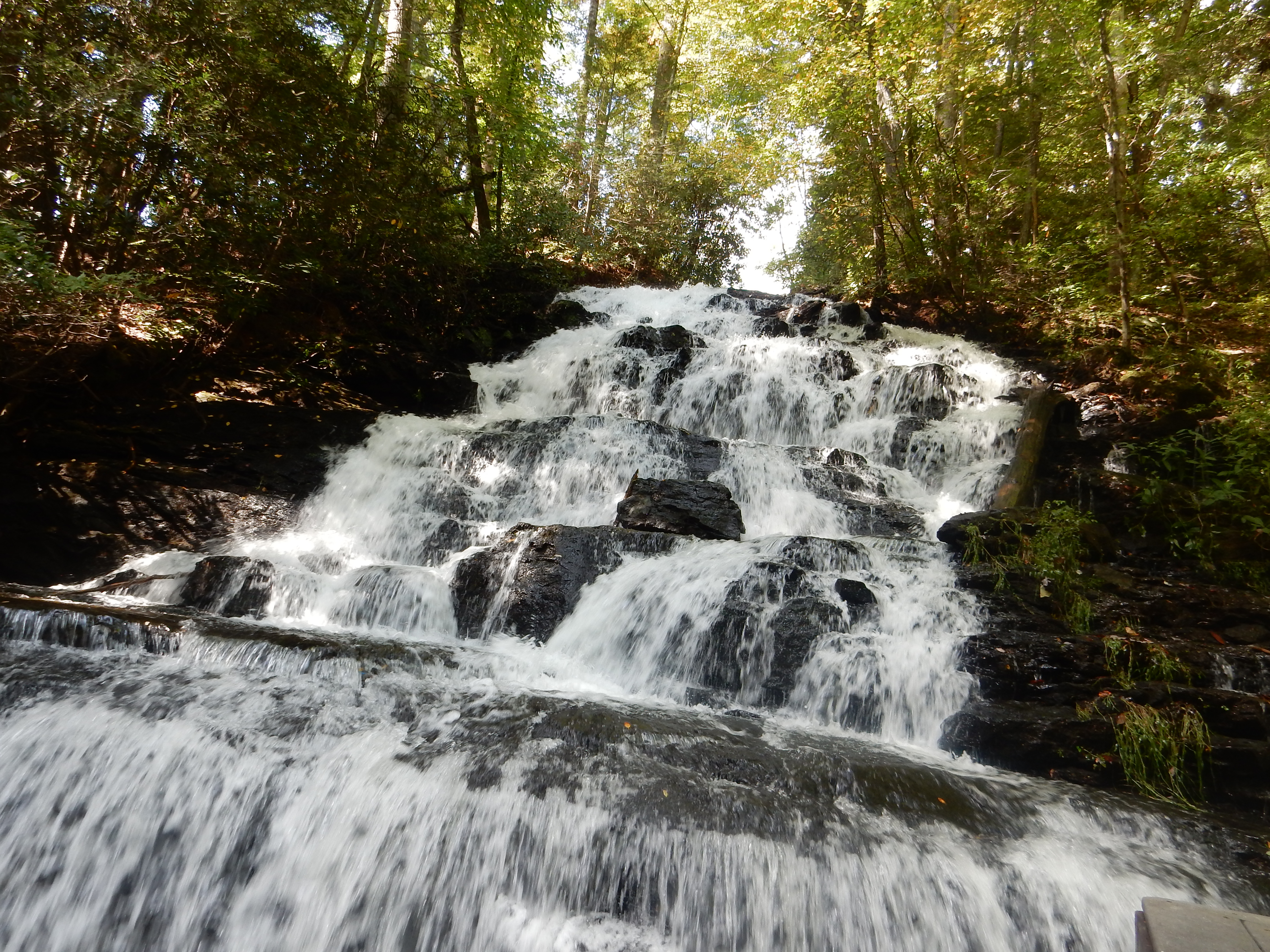
Spillway falls at Vogel State Park

Spillway falls at Vogel State Park


Vogel State Park

Vogel State Park

Vogel has a lake (Trahlyta) that feeds a trout stream and a mile long hike along the lake brings you to a spillway at the end of the lake with a rock outcropping falls. The dam was constructed by the Civilian Conservation Corps during the 1930s. Shadow Mountain (4338 feet) and Blood Mountain (4458 feet) guard the lake and park. The second hike here took us along the slopes of a mountain. Not too many people were here; according to park literature Vogel is one of Georgia’s most popular parks.

Our third stop took us a while to reach. Springer Mountain is the designated southern end/beginning of the Appalachian Trail. Why they located it on a mountain top that is a challenge to reach is beyond me. Why not make the terminal point one with parking, a place to say goodbye, etc?

But we returned to back roads searching for it. No major road signs. We obtained directions when we were at Amicalola Falls State Park, but those directions were based on starting at Amicalola, probably 50 miles and an hour and a half away. So we improvised, sharing back roads with the largest daily contingent of motorcycles we have yet encountered (but we expect them to increase). The scenery has been great and the roads generally smooth-although without any shoulders; it is just the constant up and down and curves that increase the driving challenge (pleasure).

The final stretch of road is 6.5 miles and is an US Forest Service road, gravel, bumpy, and narrow. That stretch took us 25 minutes to traverse; we were glad we had a rental car. Our 2001 Saturn would not have survived the bumps, its suspension is already in need of some repair work. There is a small parking lot on this forest service road; you park here and then hike one mile and up about 400 feet on a very rocky path to reach the official terminal point at the top of Springer Mountain.

the trail to Springer Mountain

the trail to Springer Mountain

The view  through the trees on the trail to Springer Mountain

The view through the trees on the trail to Springer Mountain

We decided early on that making it to the official point was not critical for us. You might say, well, why hike the path if you are not going to go to the end? Because there is satisfaction and enjoyment in hiking. Going too long starts to tax our strength and makes mistakes more likely, particularly on this very rough, rocky path. (Remember my comment about the two people on the veranda this evening?) So we went out for 30 minutes and then headed back. Back to the car and another 25 minutes to return to a paved road.

Scarecrows in Ellijay GA

Scarecrows in Ellijay GA

We had forgone lunch and only had a granola bar between us so we drove 45 minutes to Ellijay GA for dinner. Ellijay is the center of the apple growing section of GA; the next two weekends mark the Fall GA Apple Festival in the town. Scarecrows and mums decorated the streets. The 1907 Pub had a tasty meatloaf (Ed) and chicken (Chris) dinner with some original and tasty flavors. It did not take us long to clean our plates.

Tomorrow we head out to Gatlinburg TN. We plan to drive more scenic byways, taking a meandering path to reach Gatlingburg. Amicalola Falls Lodge has been great, the views fantastic, the meals reasonable. There were one or two forgotten items by housekeeping that were promptly and pleasantly resolved. We would have no problem returning here in the future.

Ed and Chris 10/8/15 9:45 pm

Categories: road trip, travel | Tags: , , , , , , | Leave a comment

2015 Trip Six, The Great Smoky Mountains, Oct. 7

Dahlonega, GA Tuesday Oct. 7

A long day of driving over primarily two lane roads; up and down, left curves, right curves, and switchbacks all for the goal of more scenery. But success was achieved.

Tallulah Gorge

Tallulah Gorge

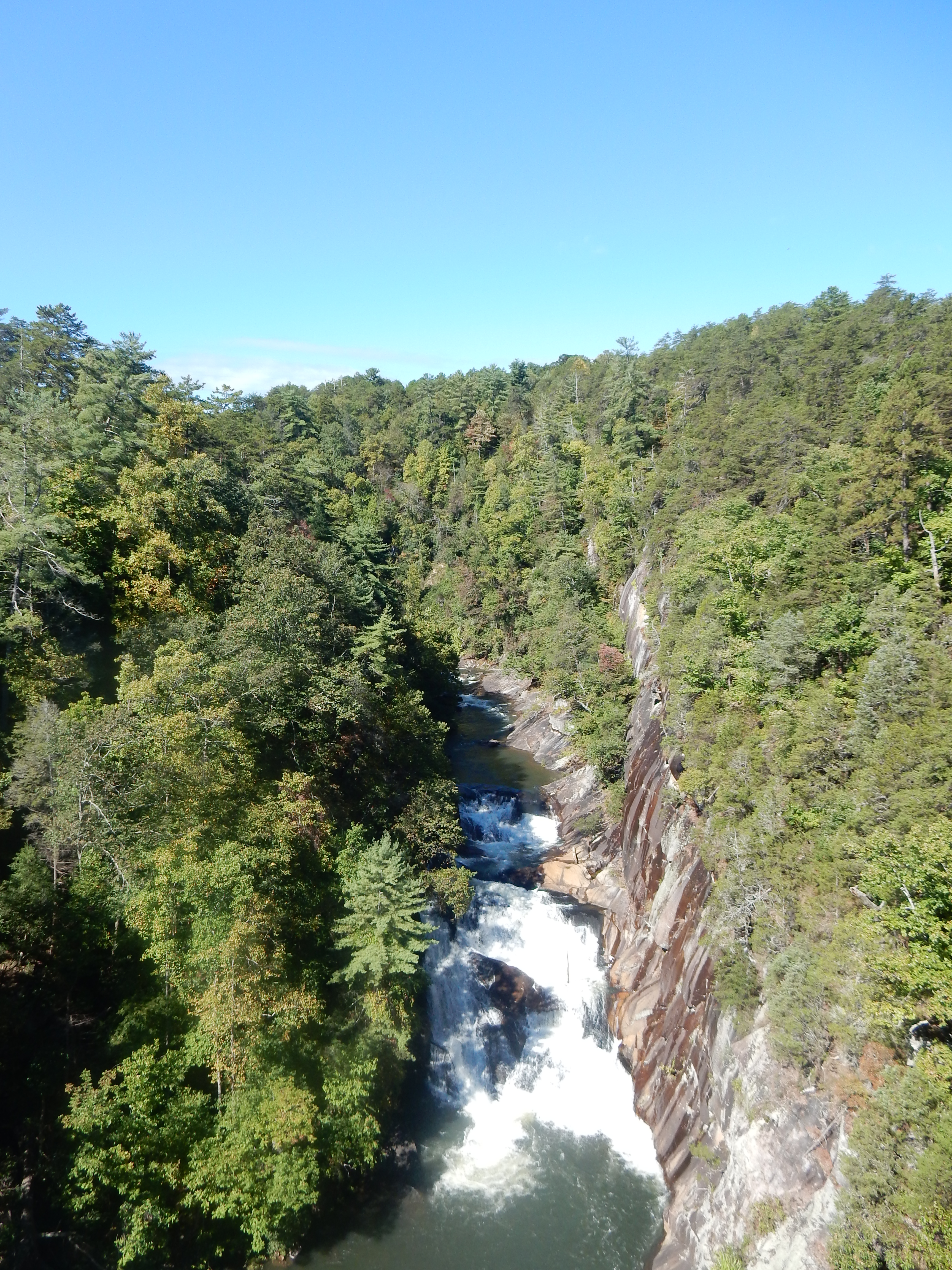
It took 90 minutes to reach the first destination, Tallulah Gorge State Park. The gorge is two miles long and nearly 1,000 feet deep. We timed the visit for this day in particular. Tallulah Gorge is part of the Tallulah River, heavily dammed in the early 20th century for hydropower. The vast majority of the water is used for this purpose and normal stream flow is low. However, on about 30 days per year, the power company releases higher volumes, either at an aesthetic level or at a whitewater rapids level. Today was one of the days for an aesthetic release of water, five to seven times greater than normal flow.

Tallulah Gorge

Tallulah Gorge

It made me recall our trip in the fall of 2014 when in Wawa, Ontario one waterfall was not flowing until later in the day when the power company “turned the water on” and we were lucky enough to be at the waterfall at the right time.

Tallulah Gorge is the creation of water, active over millions of years; water moving mountains and carving river gorges from stone. The falls are a series of five falls, each with its own characteristics. The area was a major tourist site as people came from great distances to see the gorge and the waterfalls. The creation of the dams on the river slowed the visits but today the state park on both sides of the gorge provide fantastic views.

Tallulah Gorge

Tallulah Gorge

In the 1970s, Karl Wallenda (of the famous wire walking Wallendas) walked over the 1000 foot wide gorge, doing two hand stands in the middle. The steel towers used to hold the two-inch steel cable wires are still there, although laying on the ground to deter anyone stupid enough to try it again.

North rim trail at Tallulah Gorge

North rim trail at Tallulah Gorge

We spent two hours here, hiking the rim trail, climbing up and down the trail to obtain varying views. There is not one spot (other than in the air) that allows for a full view. It is possible to walk along the river on days when there is no increased flow. On those low flow days, it takes 1062 steps to reach the bottom. We limited ourselves to several hundred feet of elevation gain along the trails. We could have gone down 600 some steps to a suspension bridge over the river but declined the opportunity.

Brasstown Bald tower

Brasstown Bald tower

Our second destination was Brasstown Bald, at 4,784 feet above sea level it is the highest point in Georgia. It is in the Chattahoochee National Forest and reached again via two lane twisty roads with constant inclines and declines in the road. The early part of the journey went around Lake Rabun, formed by the damming of the Tallulah River, with narrow roads by homes and cabins of some distinction. No “good ol’ boys” in this neighborhood.

Brasstown Bald is managed by the US Forest Service and is reached via the Russell-Brasstown Scenic Byway which drives through the highest mountains of the Georgia mountain country. Mountain laurel and rhododendron are everywhere, a visit in May or June would also be stupendous. You are able to drive to a staging area, 6/10 of mile in length and 400 feet in elevation gain, from the summit. We chose to take the shuttle up and walk down.

Views  from Brasstown Bald

Views from Brasstown Bald

image

image

At the summit is a visitor center affording great views in all directions. You can view portions of Tennessee, South Carolina, and North Carolina, as well as Georgia obviously. At this higher elevation, the weather is different from the lower, surrounding areas. The highest temperature recorded at Brasstown Bald is 84 degrees F, 27 degrees F below zero is the lowest temp recorded.

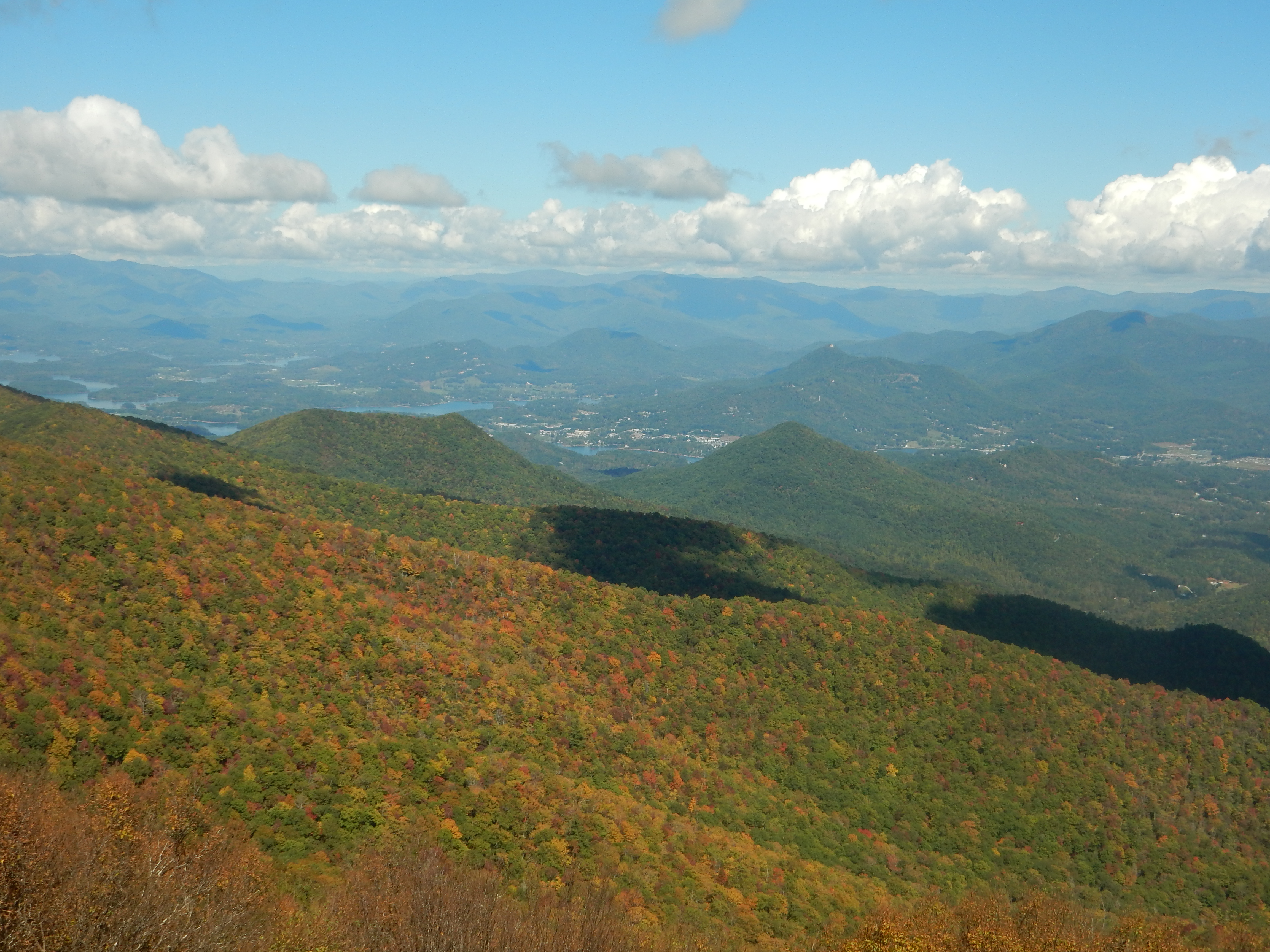
Due to the higher elevation, we were able to view our first significant areas of fall leaf color change. Several mountainsides were almost completely in yellow, orange and red. The day was primarily sunny with temps in the low 70s, clouds were high in the sky so views were not impeded.

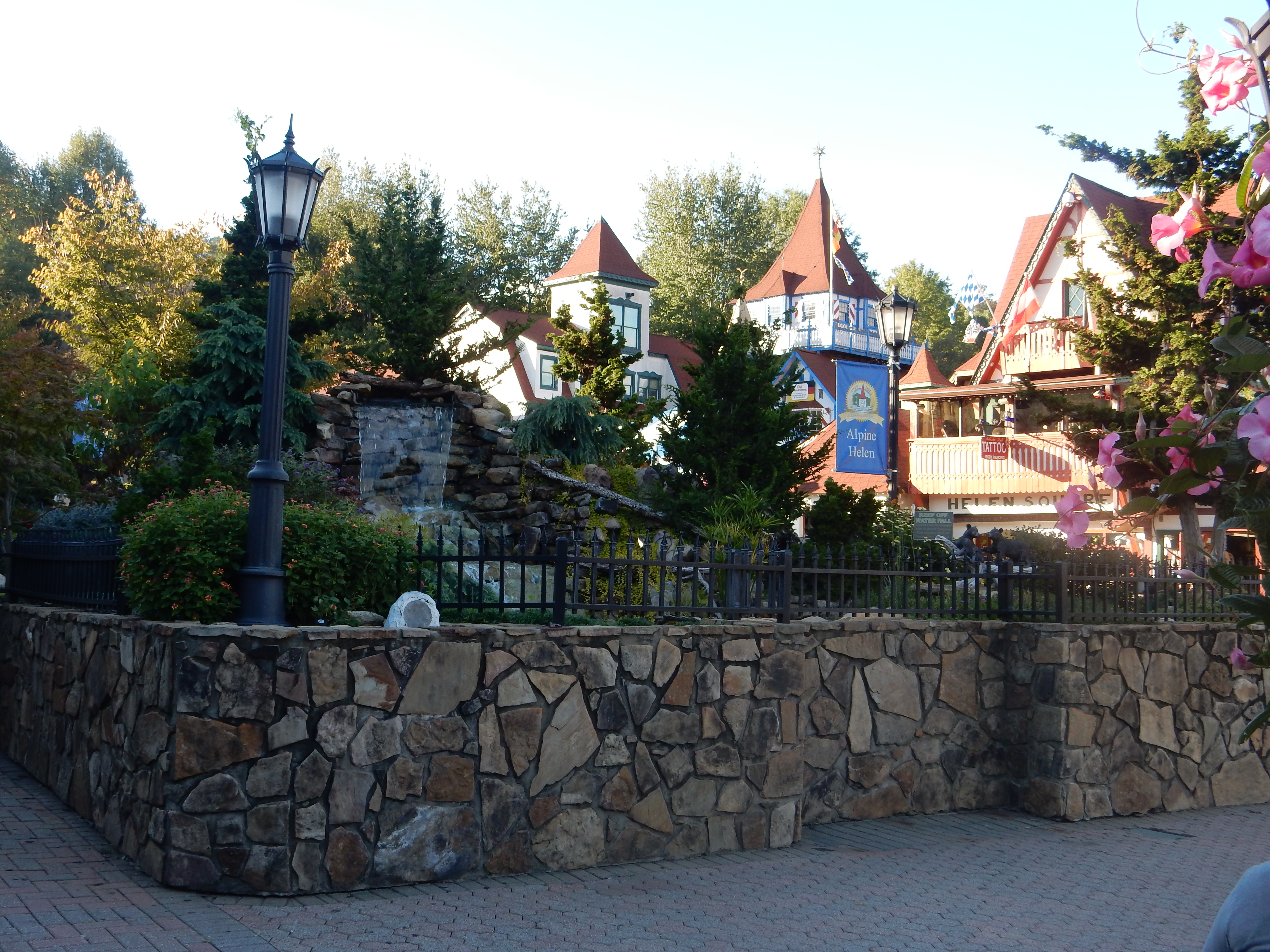
The Scenic Byway forms a rectangle. Brasstown Bald is at the top, center of the rectangle. Helen GA is at the bottom right corner. We started and ended the byway at Helen, a town that now advertises itself as a re-created Alpine village. Like Leavenworth WA which we visited in 2013, Helen was facing hard economic times. In 1968, the concept of an Alpine village was agreed to and the community re-built itself with new facades, murals and special events.

Helen GA

Helen GA

Helen, then, was our third destination and the one the park ranger at Chattahoochee River Recreation Area feared would be overrun with tourists. But, as we thought, Wednesday was not a peak visitation day. The town is 90 miles from Atlanta and while this section of northern Georgia is full of cabins and RV parks, even in the fall, weekdays are not the busiest time.

We had an early dinner here at an authentic German restaurant,loading up on schnitzel, rouladen, red cabbage, spaetzle, German potato salad, apple strudel, etc. The stores did not hold a lot of interest for us so we continued our day’s pattern of driving on those two lane twisty, hilly roads arriving back at Amicalola Falls Lodge just after sunset.

Ed and Chris 10 pm

Categories: road trip, travel | Tags: , , , | 1 Comment

2015 Trip Six, The Great Smoky Mountains, Oct. 6

Dahlonega, GA Tuesday Oct. 6

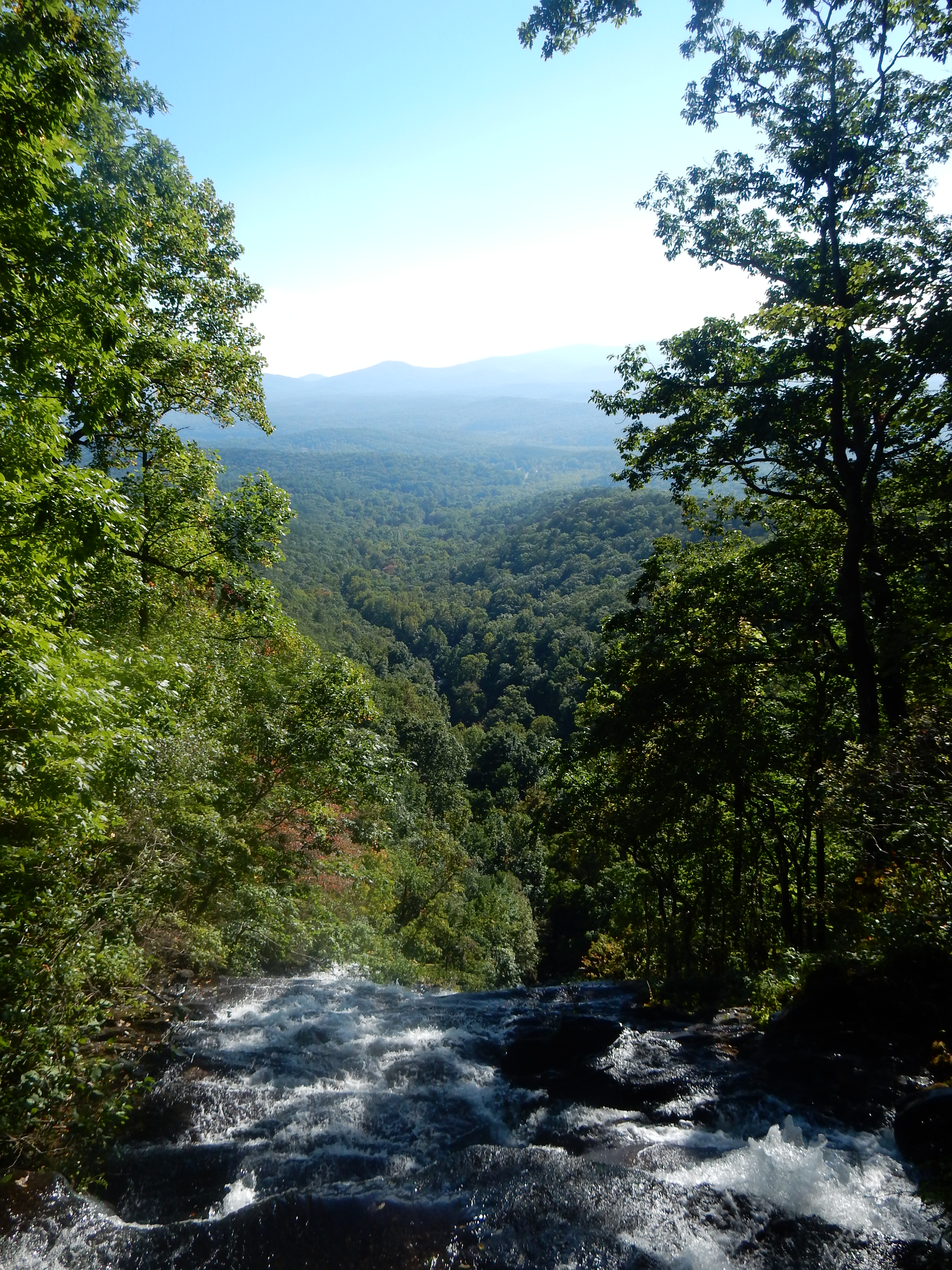
View from the top of Amicalola Falls

View from the top of Amicalola Falls

Well we are back on the road, looking for fall in GA, TN, NC, and SC. Yes, this means we will miss fall colors in Minnesota and who knows when fall colors will show here and how brilliant they will be, but we are here. And fall colors are only one piece of the journey’s pleasures. Mountain scenery and hiking are other expected pleasures along with several national parks.

Chattahoochee River

Chattahoochee River

We flew into Atlanta last night and spent the night in a hotel in the NE suburban area, closer to our destinations than the airport itself. Our first stop this morning was at the Chattahoochee River National Recreation Area. Like the Mississippi National River and Recreation Area in St. Paul and Minneapolis, this is an urban, linear park focusing on the beauty and activities associated with 48 miles of a major river. Unlike the Mississippi National River and Recreation Area, the Chattahoochee park owns a lot of parkland along the river. There are numerous park units scattered along the river but only the visitor center is staffed with park rangers.

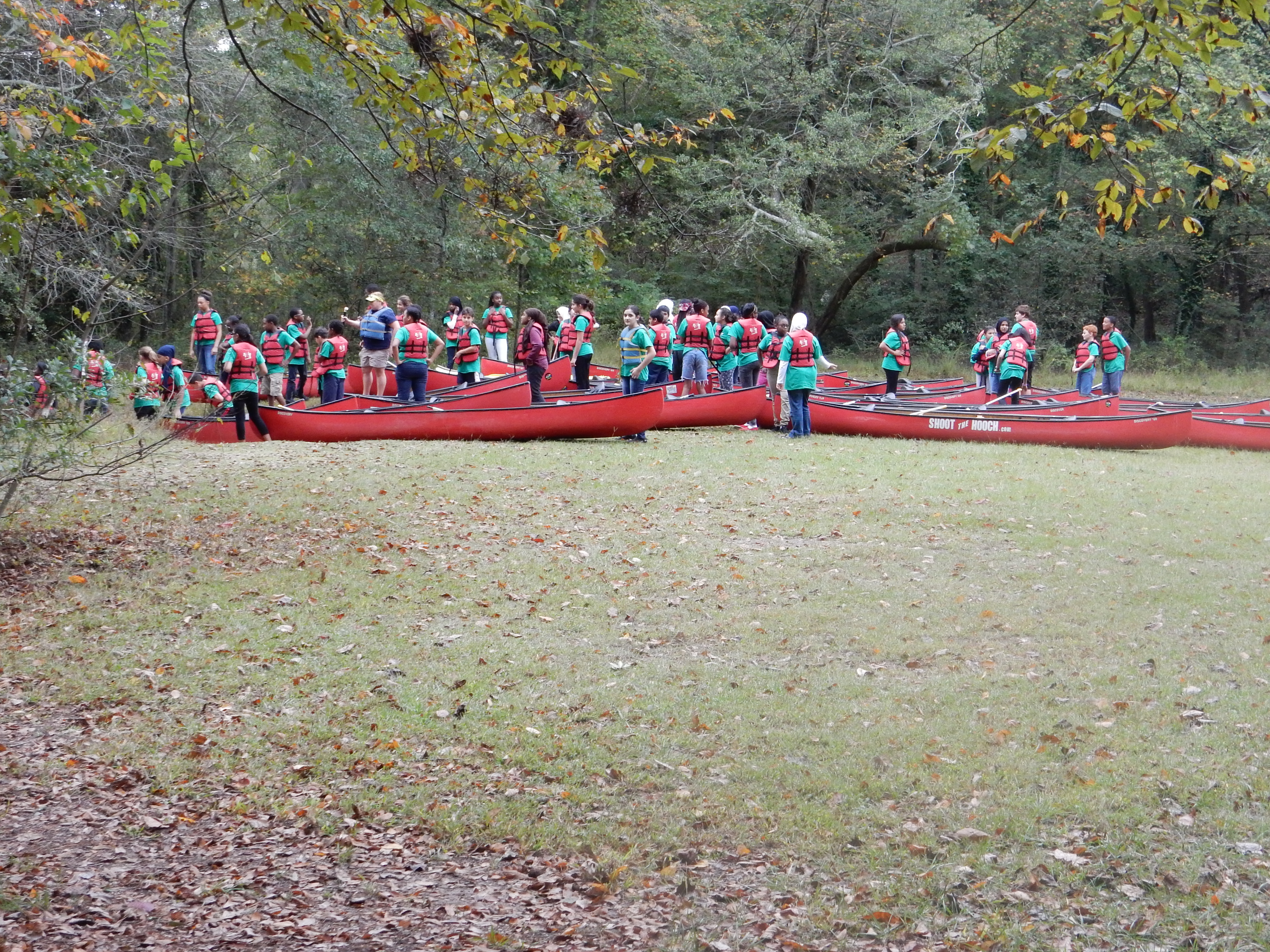
Some of the kids getting ready to canoe on the Chattahoochee River

Some of the kids getting ready to canoe on the Chattahoochee River

School kids canoeing on the river

School kids canoeing on the river

One of the sights was a group of maybe 50 school kids getting into canoes and paddling two miles downriver to a city park where they will land. Oh, we felt sorry for the adults, even though they seemed to have control of the situation. The kids seemed to be enthused and we only observed a few canoes going backwards.

The Chattahoochee River Recreation Area has a visitors center housed in a log home built of logs from the Okefenokee Swamp back in the 1930s. Their introductory film does a nice job of discussing the Chattahoochee and water use; it was a little light on dramatic scenery. The ranger on duty had made a career switch from business and he seemed to be pleased with the change. We told him our Georgia destinations and he approved, although warning us of potentially heavy traffic at one town with an upcoming Octoberfest festival. We plan to be there tomorrow and believe we will miss the crowds.

Finding the park visitor center was a challenge, even with maps and a smart phone. Some roads on the map/phone were blocked off, and there was only one sign giving directions. That sign was right off the Interstate and of course at further intersections, some where you went straight, and some where you had to turn, there were no further signs.

We walked for a while in the park by the visitor center and had forgotten that the Chattahoochee joins with the Flint River south of Atlanta to form the Apalachicola River which flows from southern Georgia through northern Florida into the Gulf of Mexico. This spring we had spent time in the town of the same name at the mouth of the Apalachicola, even buying a T-shirt emblazoned with the name Apalachicola.

Dahlonega Georgia was our second stop of the day. Lunch was our first priority, at the Smith House, with a traditional Southern meal of fried chicken, fried okra, mashed potatoes with white gravy, creamed corn, green beans, ham and collard greens finished off with strawberry shortcake. Smith House has been in operation since 1946, and had previous owners with inn and food service going back to the 1800s.

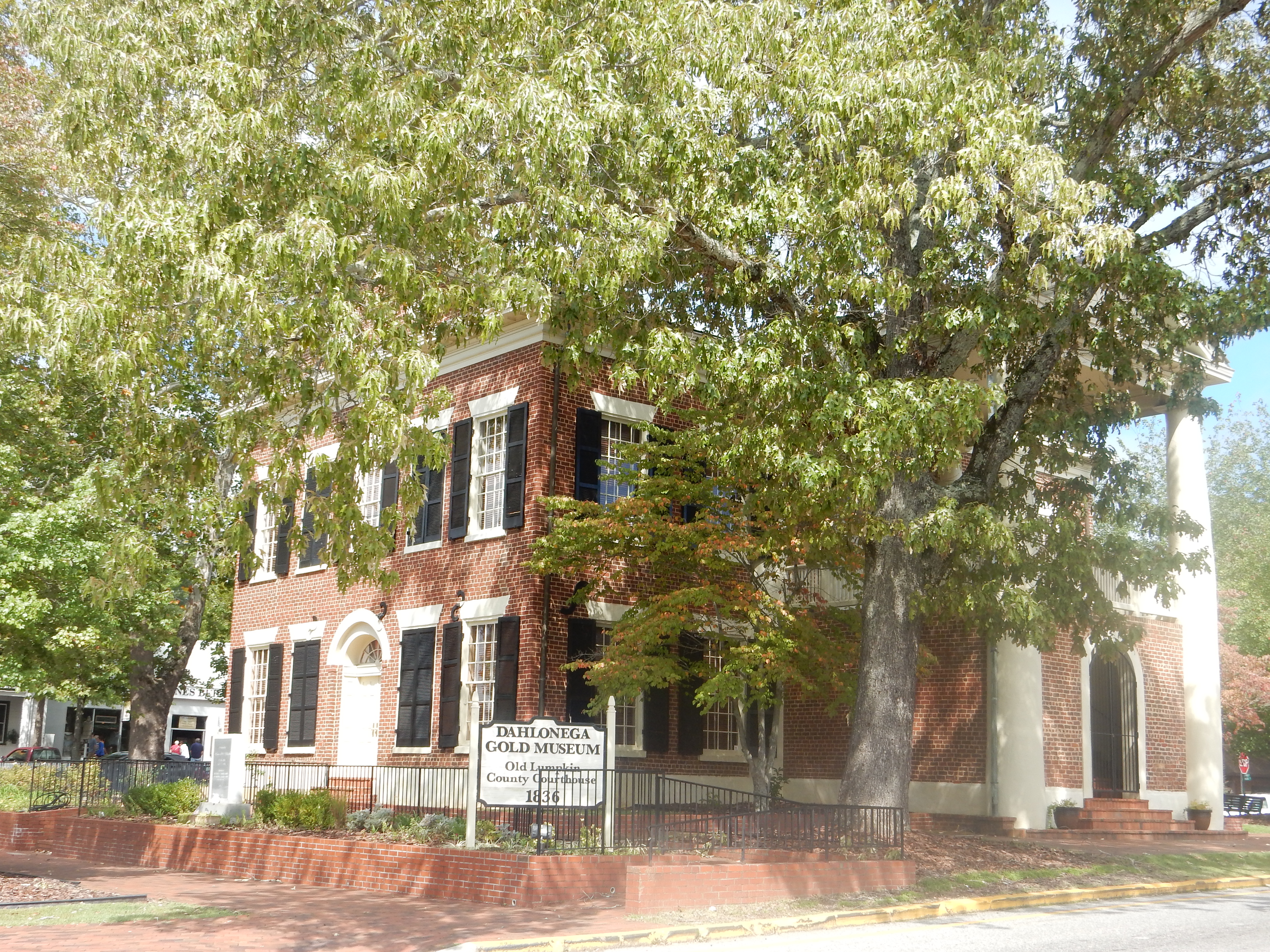
Why Dahlonega?? Well, this portion of Georgia was the area of the first gold rush in the United States. Beginning in 1828, gold was found here along a ridge of mountains stretching from the North Carolina border to the Alabama border. Dahlonega was the focal point, over 200 mines were located in this area. The U.S. mint actually had a branch mint here until the start of the Civil War. Men came from all over the existing U.S.; many left here for California when gold was found at Sutters Mill in 1848.

Dahlonega Gold Museum

Dahlonega Gold Museum

The gold in the Dahlonega area was especially pure, over 99% gold. Some mines continued until the Second World War but most were played out by the early 20th century. The area is still home to at least two gold mines which allow people to pan for gold or to tour an abandoned gold mine. The Smith House is actually located over a gold mine, the hole is visible from the lower level of the restaurant-although safely sealed off by glass from modern-day explorers. We took a tour through the Dahlonega Gold Museum in downtown, located in the old county courthouse. A pleasant experience, learning a new nuance of U.S. history we were clueless about before this visit. Of course, the land here was taken from the Cherokee Indians and when land plots were given away by lottery, Native Americans were not eligible.

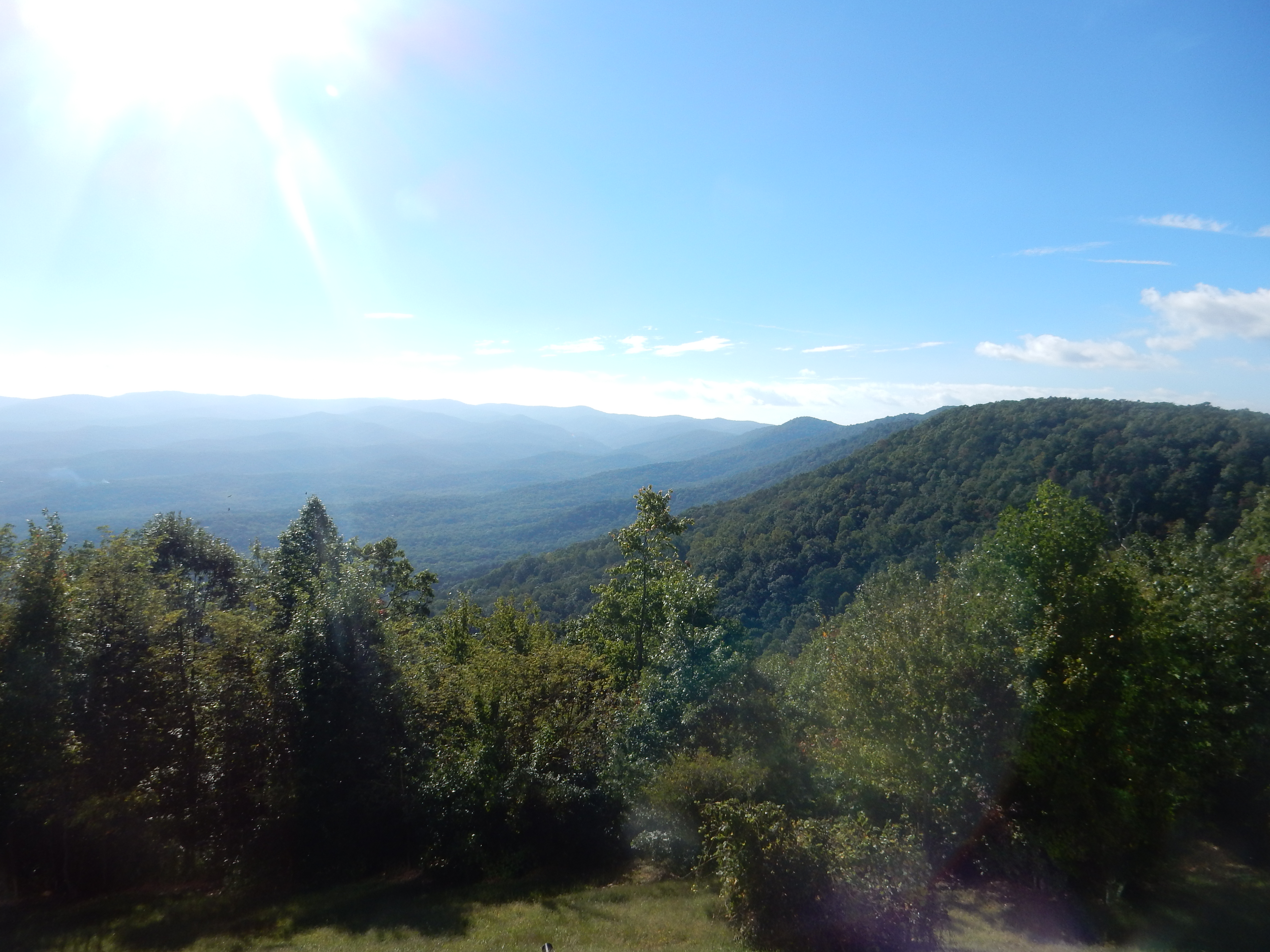
View from our room at Amicalola Falls State Park Lodge

View from our room at Amicalola Falls State Park Lodge

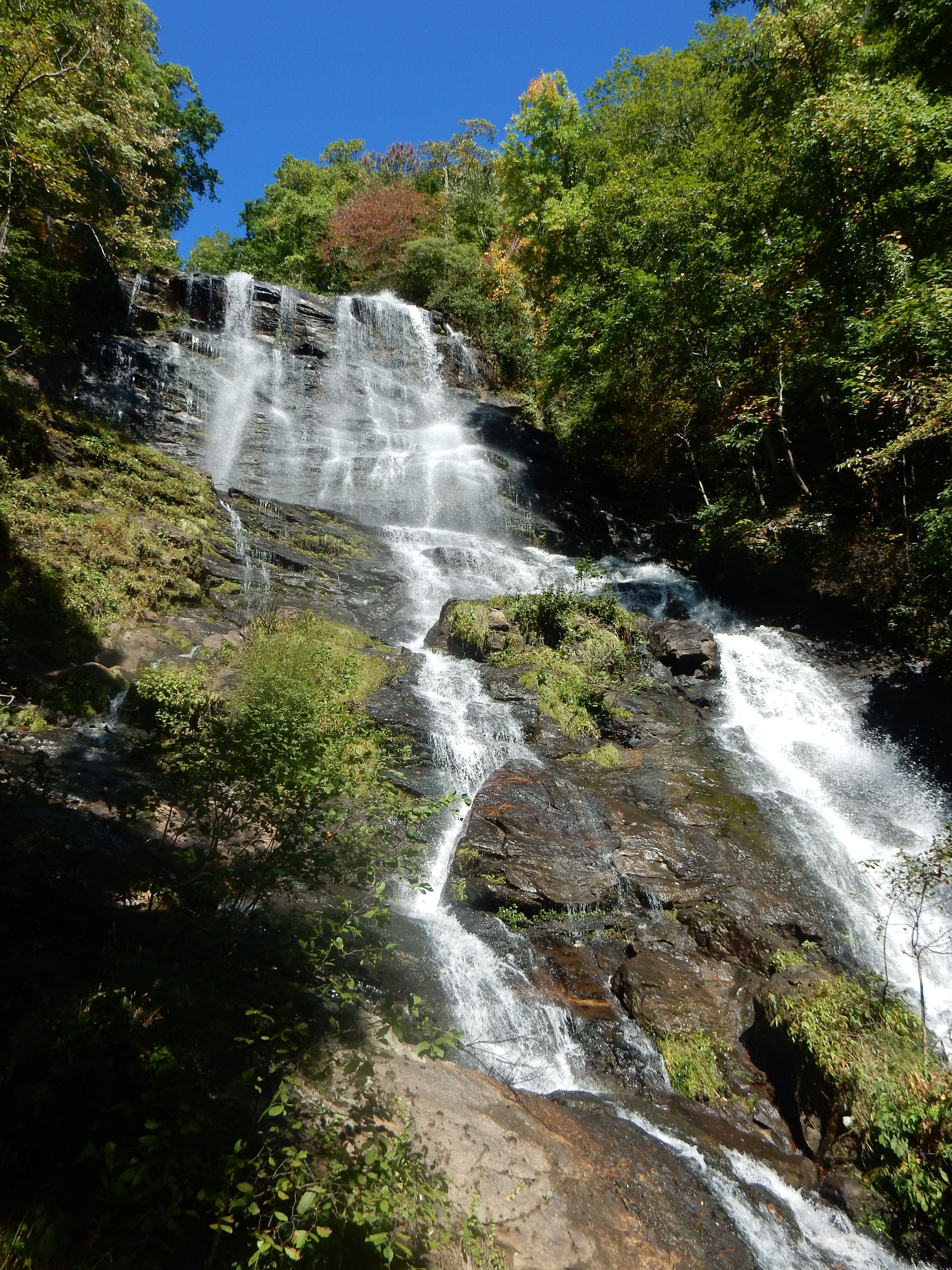
Our third stop was at Amicalola Falls State Park. We are staying three nights here at the lodge; it has a great view of the mountains from our bedroom window. (Actually 90% of the rooms here have a great view.) As you might guess from the park’s name, there is a waterfall here. Amicalola Falls drops
729 feet, supposedly the tallest falls east of the Mississippi River.

View of upper section of Amicalola Falls

View of upper section of Amicalola Falls

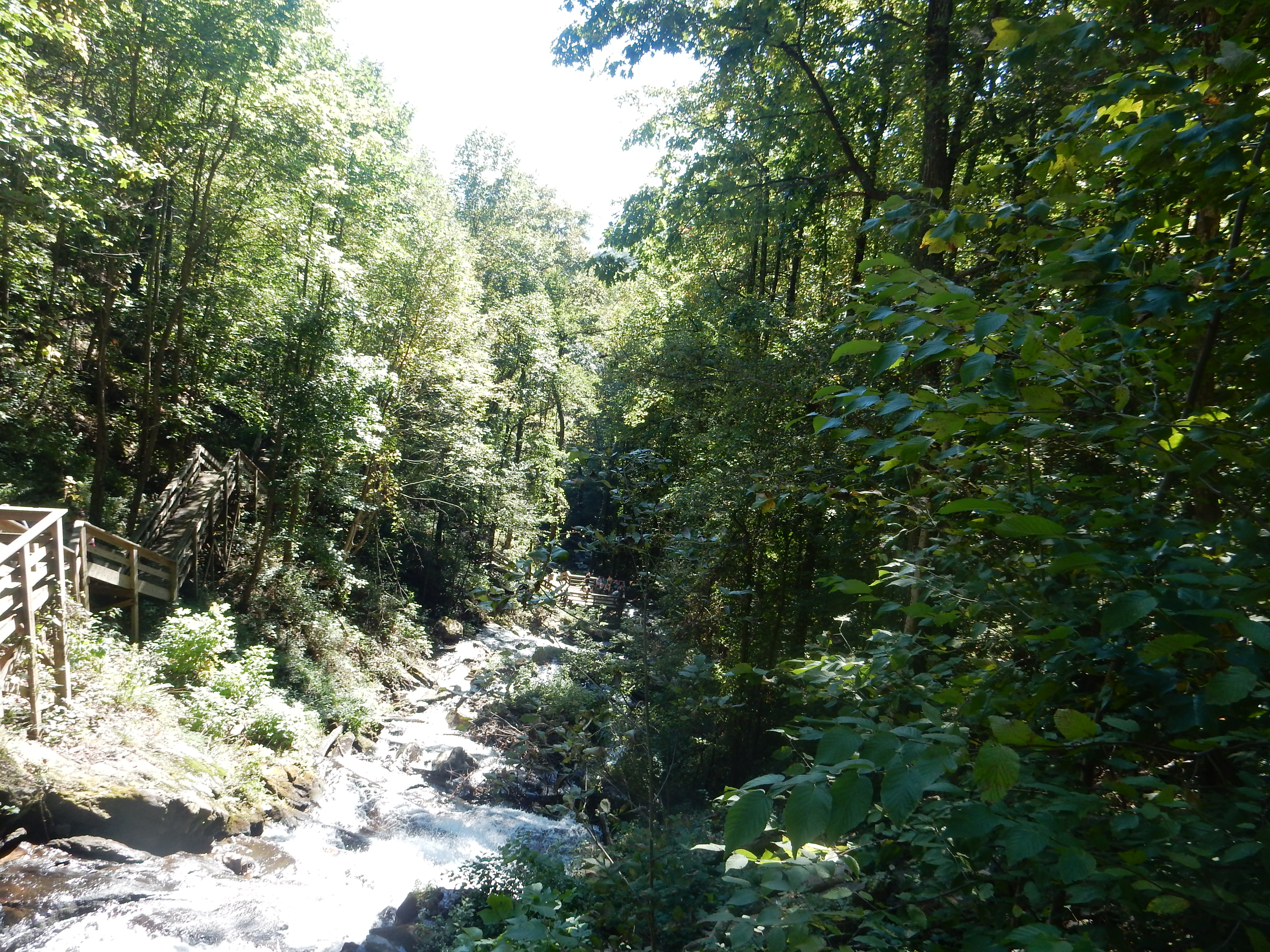
View of lower section of falls, 175 stairs up and down plus walking

View of lower section of falls, 175 stairs up and down plus walking

Attempt to show all of Amicalola Falls

Attempt to show all of Amicalola Falls

We hiked a good portion of the falls, going down 175 steps and back up 175 steps plus walking on trails before and after the steps with a steep grade. BUT, we did not hike the second portion of the falls. That was another 425 steps up and 425 down and we felt no need to prove ourselves. The falls come from a small creek so while the drop is great to look at and to listen to, it is not overwhelming in the total amount of water flowing. There are numerous falls throughout Georgia and North Carolina, etc so we will have to pick and choose which ones we deem worthy of our time and energy.

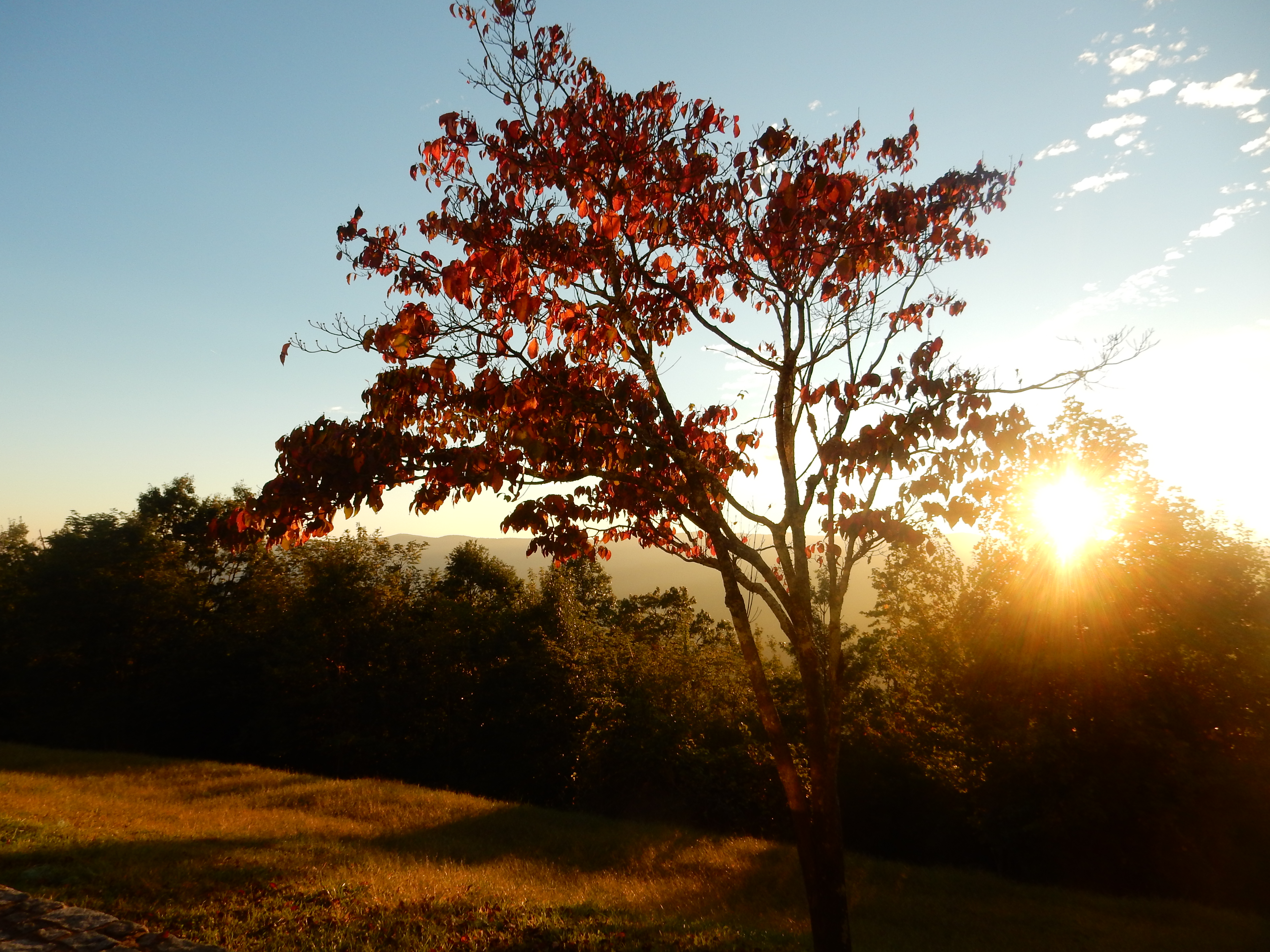
Sunset is coming

Sunset is coming

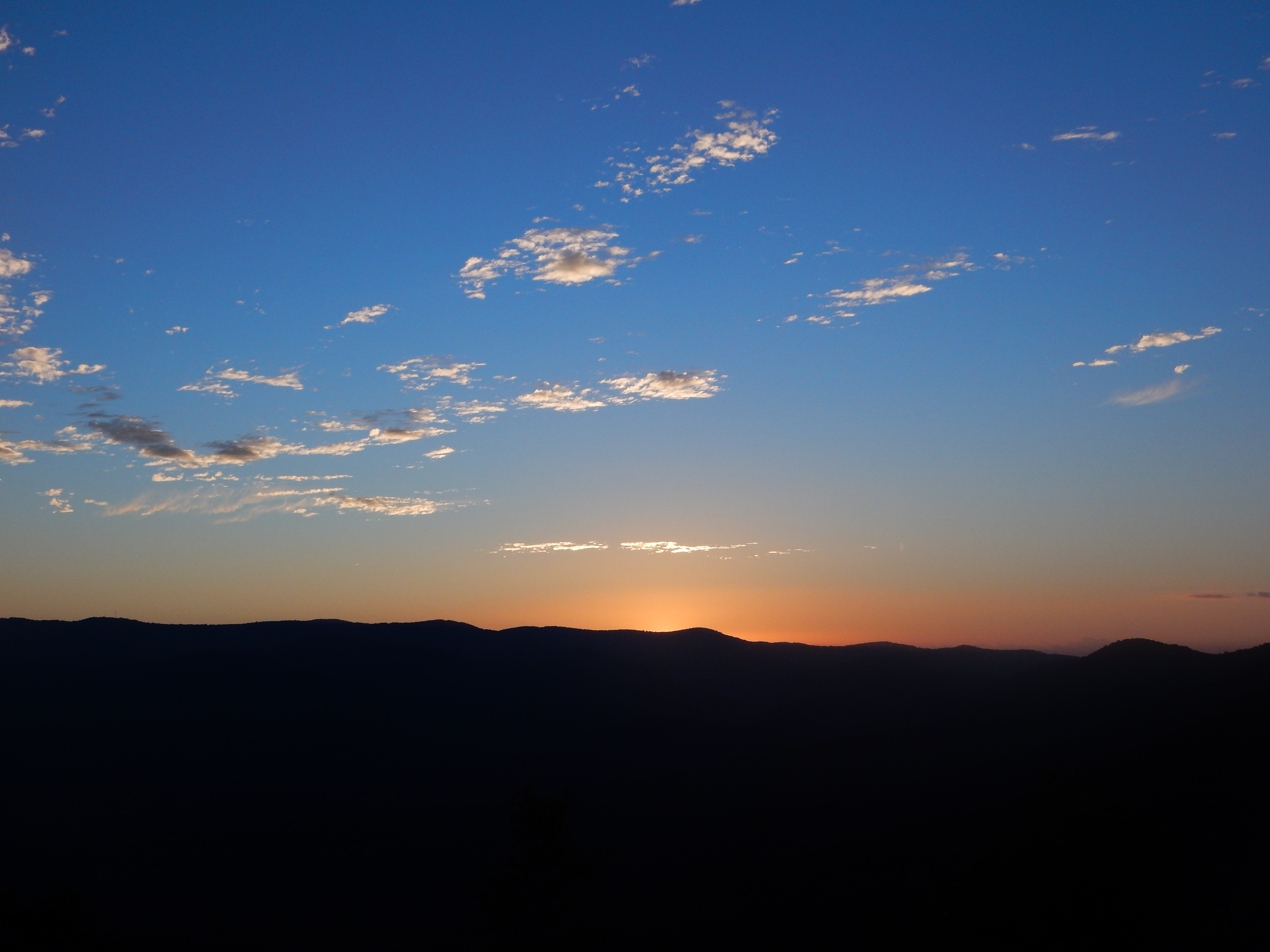
A sunset view from the veranda

A sunset view from the veranda

Dinner was in the restaurant at the lodge; this time of year it is all buffet. The restaurant also has a great view of the mountains and we sat out on the veranda after dinner watching the sunset. A pleasant beginning to our 22 day journey.

Ed and Chris 9:30 pm

Categories: road trip, travel | Tags: , , , , , , , , | Leave a comment

2015 Trip Five, Voyageurs National Park and NW MN, August 21-23

International Falls MN
Friday August 21

The sound of the calling loons is a clear indication that we are back up north in the land of woods and waters. We have left behind the primary agricultural use of the land and are now in the logging, fishing, and tourist activities. Two of our stops on the way to international Falls were at Minnesota State Parks.
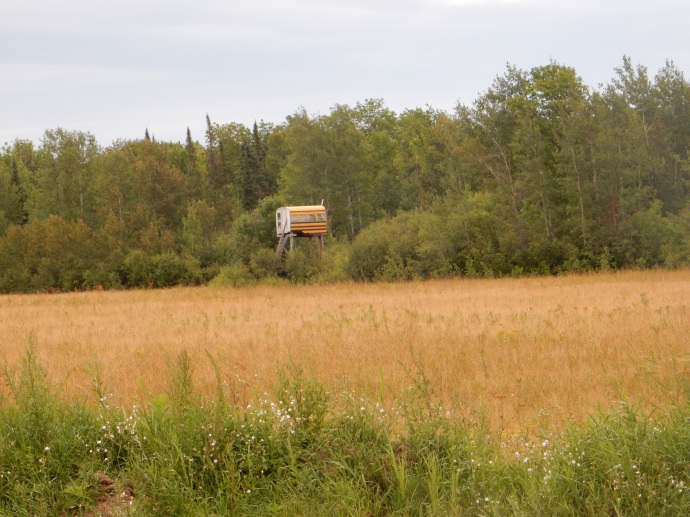
On our way to Zippel Bay we came across this unique deer hunting stand

Road tripping in northern MN, On our way to Zippel Bay State Park, we came across this unique deer hunting stand

Friday morning we left Roseau Minnesota, driving again through Warroad on our friendly two lane roads. Our first stop was to be at Zippel Bay State Park. This park looks out onto Lake of the Woods, in that area of Minnesota that sticks out like a sore thumb at the top of the US border with Canada. Zippel Bay is primarily used for fishing, although camping is also possible. On this part of the lake, there is a sandy shoreline.
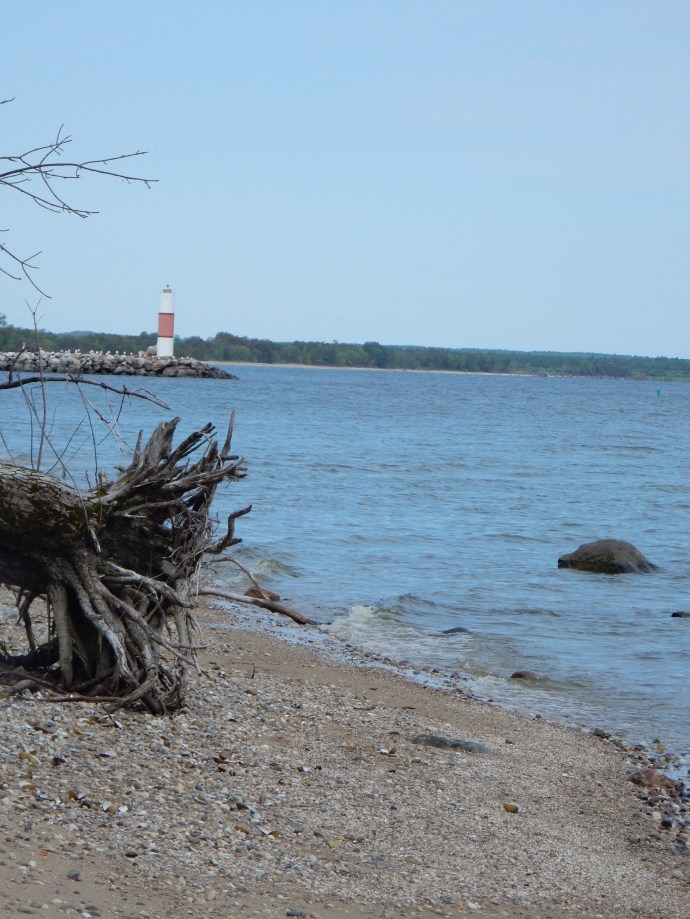
Lighthouse at Zippel Bay State Park

Lighthouse at Zippel Bay State Park

We hiked along the shoreline out towards the lighthouse sticking into the waters. The sun is starting to peek through the clouds, where it will remain out for just a brief portion of the day. At this park, as we have been doing previously, and as we will be doing for the remaining days of this trip, we keep looking for moose. Moose are declining in Minnesota although the reasons are not fully known. We keep hoping to see several, even just one, but our hopes are not to be fulfilled.
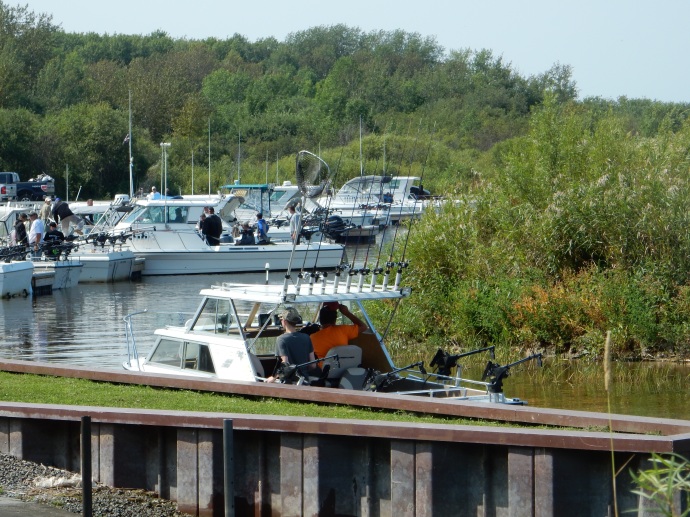
VFW fishing lunch for disabled vets

VFW fishing lunch for disabled vets at Zippel Bay State Park, MN
image

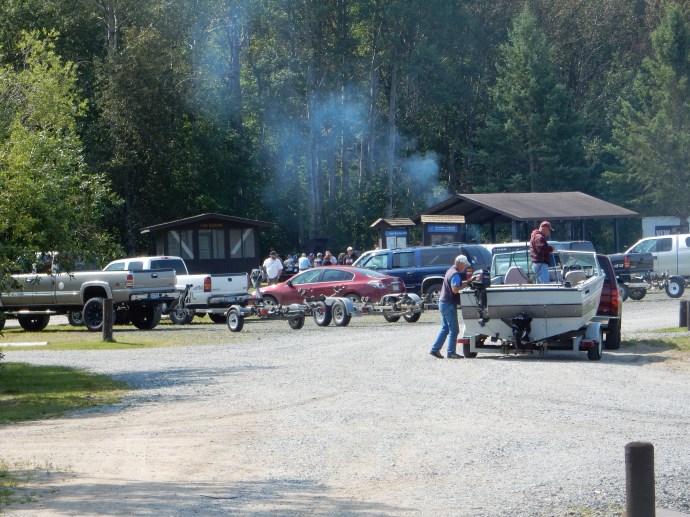
The fishing docks are busy as boaters arrive for the lunch hour. The local VFW post is sponsoring a luncheon. Numerous boat owners are taking disabled veterans out to fish for the day, with lunch provided here at the docks. These boats are much larger than most of the ones seen previously on the other lakes so far in Minnesota. It seems as if everyone knows each other as they yell back and forth as the boats come in. The food smells great.
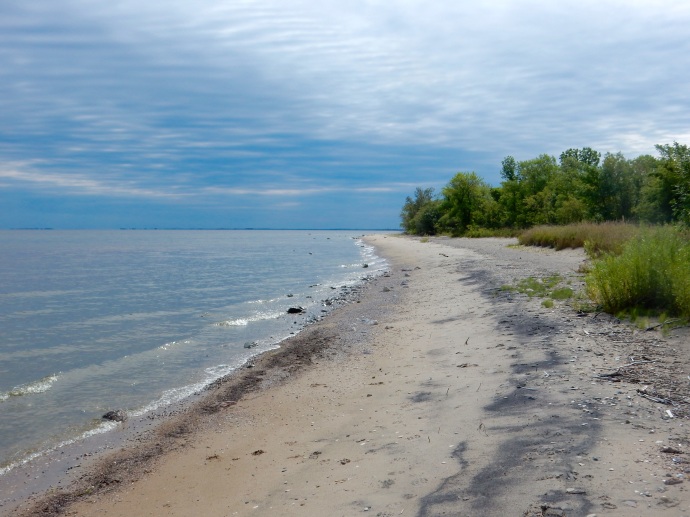
Zippel Bay State Park

Zippel Bay State Park, lake shore view

This lake is large, the 100th largest in the world, stretches into Canada, and produces heavy wave action.The fishing is evidently quite good here, according to the head ranger who was here visiting with the anglers. He provided us with a luncheon suggestion in Baudette Minnesota, the next town on our way to International Falls.

In the town of Baudette, we came across a pharmaceutical manufacturing company, ANI Pharmaceutical, that employs 100 people. Amazing the variety of small businesses located in these smaller communities. Why we seem unable to get some of these small business locations on to the Indian reservations is beyond my knowing.
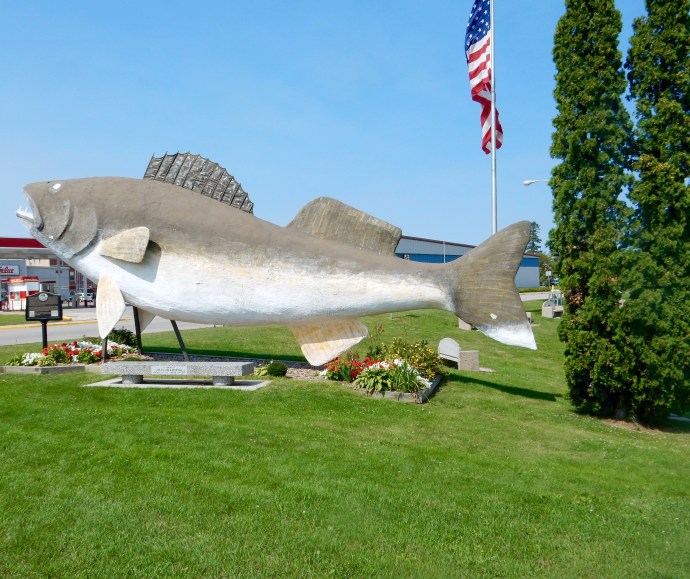
Willie Walleye in Baudette MN

Willie Walleye in Baudette MN

Baudette also had its local motto and mascot. “Walleye Capital of the World” and Chris took a picture of the statue of “Willie Walleye”. Every town wants to have some motto or claim to fame. How about “We are just normal”?

International Falls is our home for the next two nights. One of the three main entry points to Voyageurs National Park is located here. As is our custom, we stopped at the park today to check out the area prior to our boat ride tomorrow. Outside of the office is a park volunteer, tending the garden and talking to people like us.

This gentleman has been doing volunteer work here and at other parks for nine years. He lives out of his RV. On this trip, we also met a couple who sold their home and have been living out of an RV for 18 years. A third couple have been living out of an RV for three years. Makes our periodic vacation rambles minor in comparison. The three-year couple were from the Harrisburg, PA area and we knew several people in common.

We asked the Voyageurs volunteer, and have asked several other travelers, their impressions of Big Bend National Park in Texas. All of them have been universally in acclaim for the beauty of Big Bend, if you avoid the hot months. Chris has been resisting traveling there. It really is a long distance from anything else. Now however, it looks like she has agreed to add this to our list.
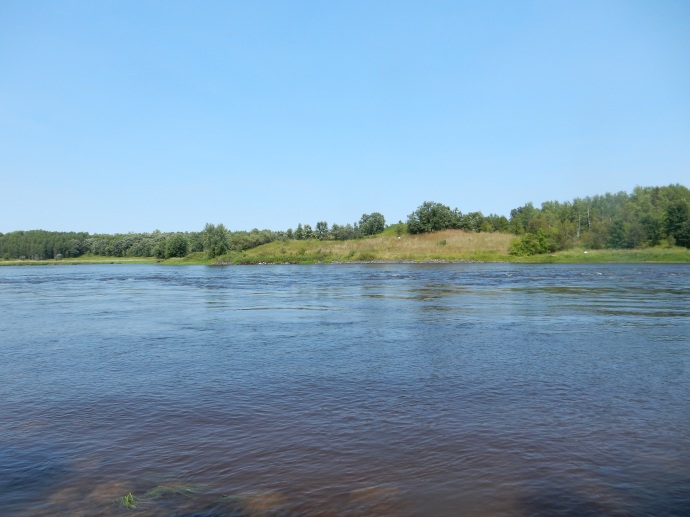
Looking north into Canada from the Rainy RIver at Franz Jevne State Park

Looking north into Canada from the Rainy River at Franz Jevne State Park

Voyageurs National Park is another water based park. The Minnesota border with Ontario from Lake Superior over to Lake of the Woods is a series of lakes and rivers nestled among land masses. Parks are located on both sides of the border. Due to the vagaries of land, water and international borders, you can view Canada from the Kettle Falls area of Voyageurs by looking south-, yes, south.
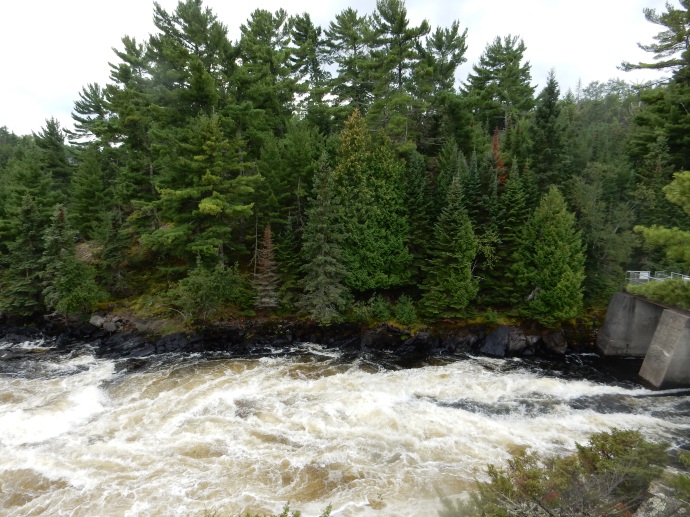
Looking SOUTH into Canada from Kettle Falls

Looking SOUTH into Canada from Kettle Falls in Yoyageurs National Park, MN

Lake of the Woods is primarily water, much of the land is privately owned. Voyageurs National Park has 218,000 acres which combine lakes, rivers, and land which is usually only accessible from water. The Boundary Waters Canoe Area is further to the east, and is a 1,000,000 acre wilderness within the Superior National Forest. There is a mosaic of green park land and blue water from International Falls to Grand Portage, MN/Thunder Bay, Ontario, a distance of about 200 miles.
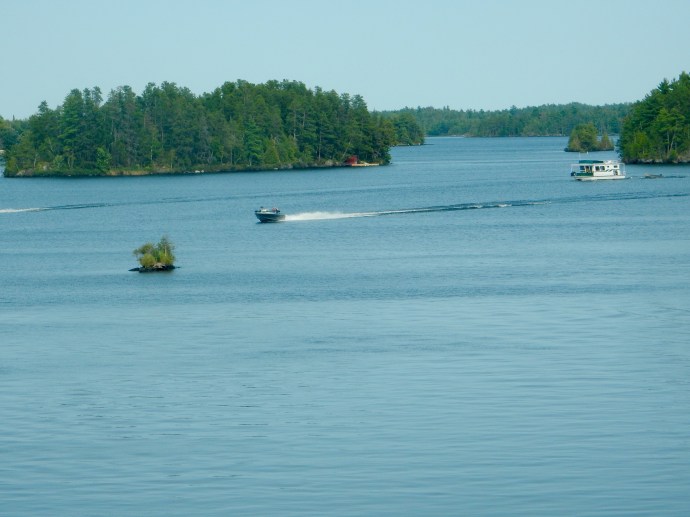
Boating on Rainy Lake

Boating on Rainy Lake, Voyageurs National Park

As a national park, Voyageurs allows motor boats. Boundary Waters does not. We watched a constant parade of motorboats traveling along the lakes. Voyageurs National Park has four primary lakes; Rainy Lake, Namakan Lake, Sand Point Lake, and Kabetogoma Lake. Houseboats can be rented here and we saw numerous boats going in and out of port as well as along the various landing points allotted to them. The waters here flow primarily northwestward through International Falls, along Rainy River, to Lake Winnipeg and then out to Hudson Bay.

We are staying for two nights at the Thunderbird Lodge across the road from the Kabetogoma Lake visitor center. We had a great dinner at the lodge Friday night and at Saturday morning breakfast we met two other couples that were going with us on the 6 1/2 hour boat ride to Kettle Falls Hotel.

Saturday, August 22
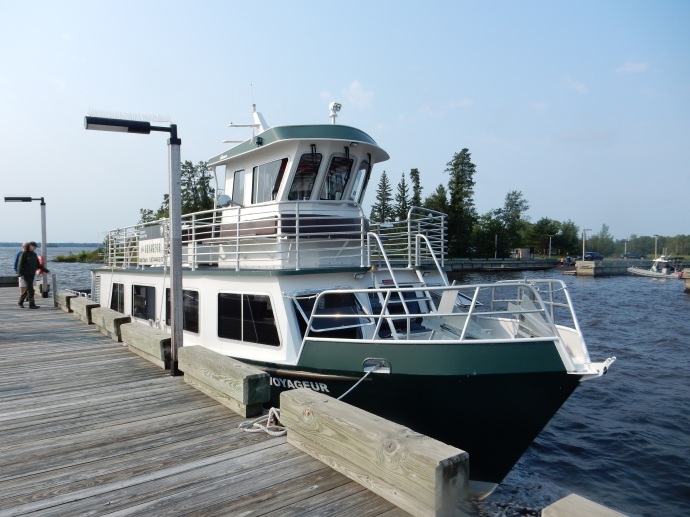
Our boat for the trip to Kettle Falls Hotel at Voyageurs National Park

Our boat for the trip to Kettle Falls Hotel at Voyageurs National Park

This boat ride was much smoother and more comfortable than the ride to Isle Royale back in June. A park ranger accompanied us and provided information about the park and the history of this area. If you have read this blog previously, you may recall the history of the French-Canadian voyageurs. This park is named after them. The French-Canadian voyageurs were active in the 1700s and 1800s; collecting beaver and other animal furs and sending them back to Montreal to be shipped to Europe. Europe was in the midst of a beaver hat frenzy. The voyageurs brought European made products to trade with the Native Americans who hunted beaver and other animals. The route they followed also became part of the border between Canada and the U.S.
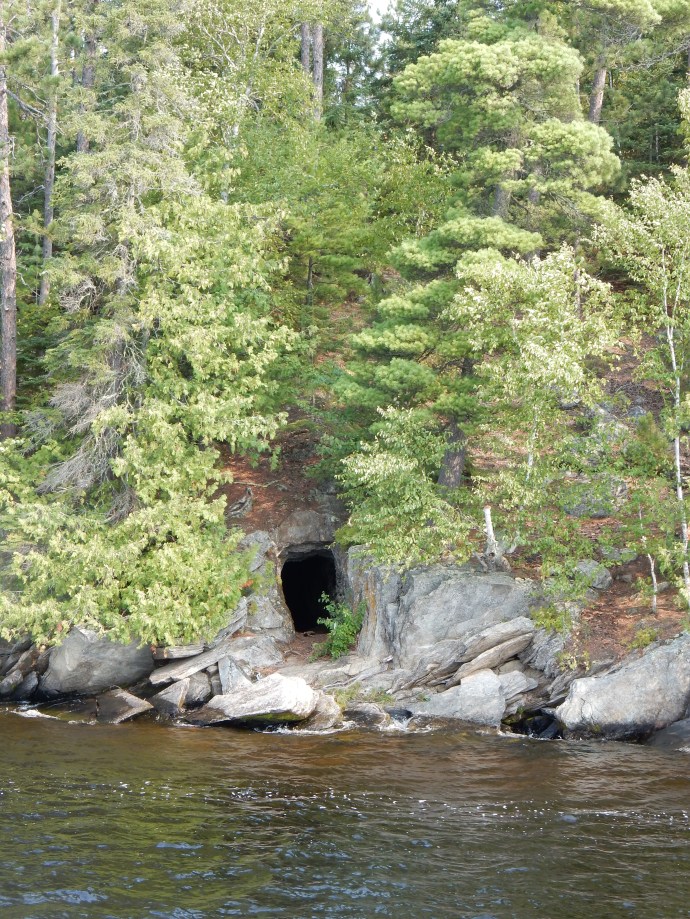
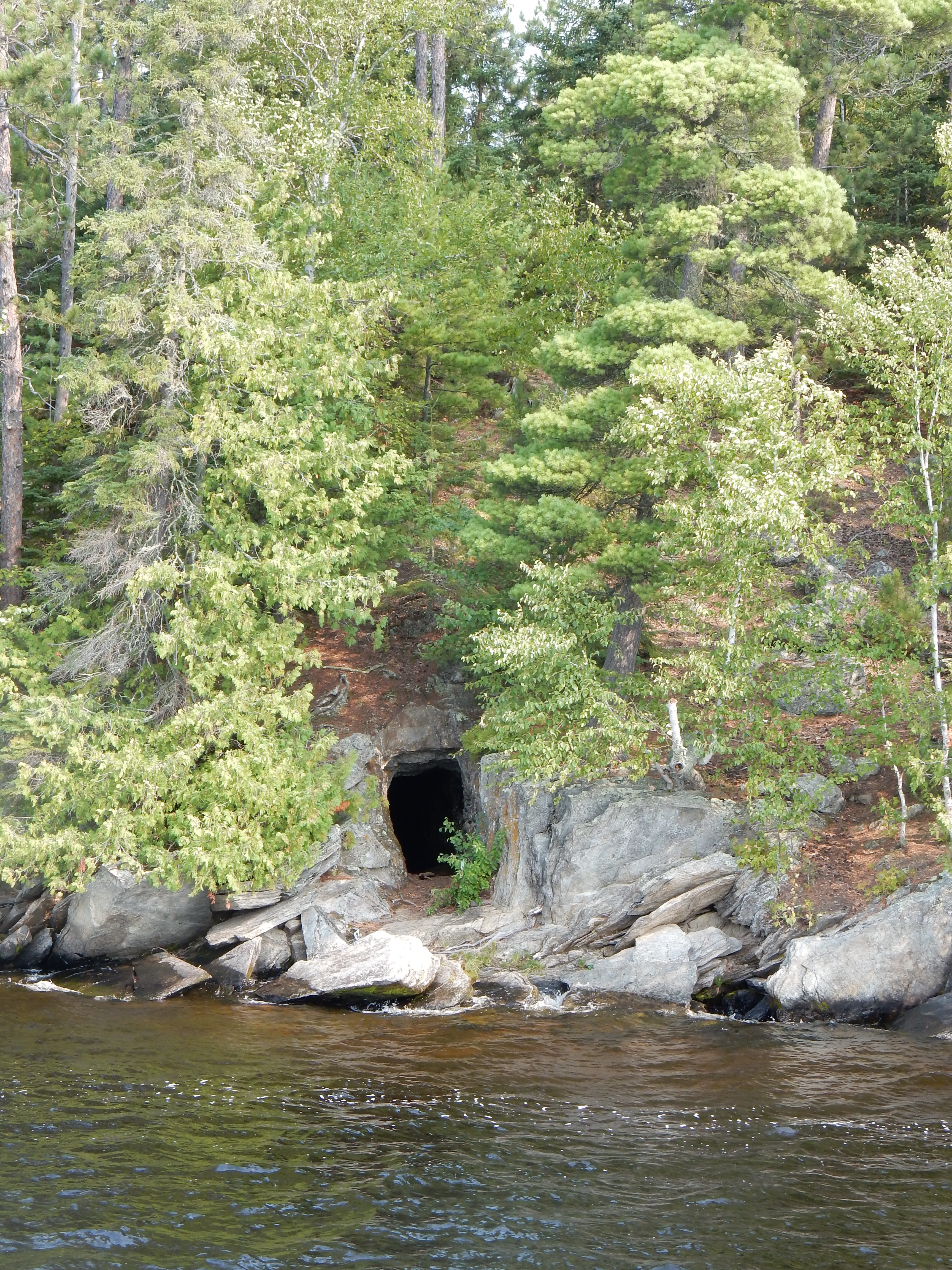
Mine shaft dug for gold rush in 1893 in Voyageurs

Mine shaft dug for gold rush in 1893 in Voyageurs

The Voyagers were not settlers, however. Settlement by European immigrants came late to this area. There was a brief gold rush in 1893 which did not last long. The Klondike gold rush started in 1896 and attracted most of the miners who came to this area with a greater promise of wealth.

Logging was the next economic driver for the area. The red and white pine would be cut down and sent along the lakes and rivers to International Falls where the hydropower drove saw mills and paper making plants. Some of that industry continues to this day. We were told that the paper plant in Fort Frances, the city across the Rainy River in Ontario, had shut down, while the plant in International Falls was operating, but on a reduced basis.
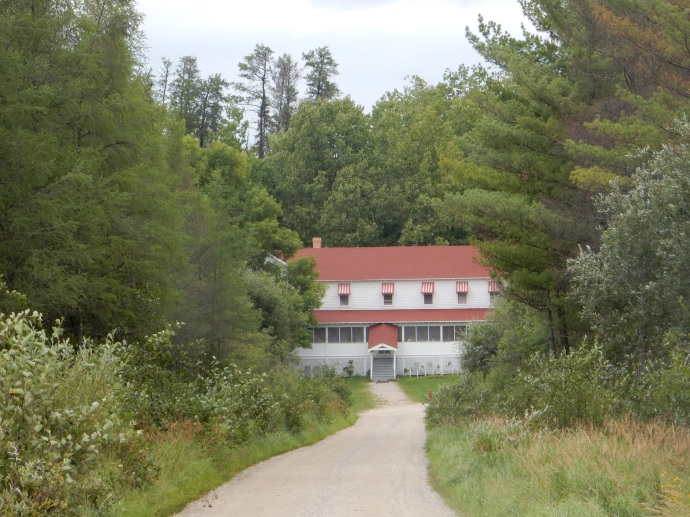
Kettle Falls Hotel

Kettle Falls Hotel in Voyageurs National Park

Commercial fishing was the third business in the area but was prohibited beginning in the 1930s. Tourism took over along with recreational fishing. The lumber industry wanted to build more dams but this was denied and in the 1970s, Voyageurs National Park was created as the 36th US National Park. Our boat ride mainly went through Rainy Lake to Kettle Falls Hotel. The hotel was begun in 1913 and continues to this day. Overnight lodging is still available here during the summer months. We had looked at that option but decided to pass on it. Instead the boat ride and lunch at the hotel took up our Saturday.
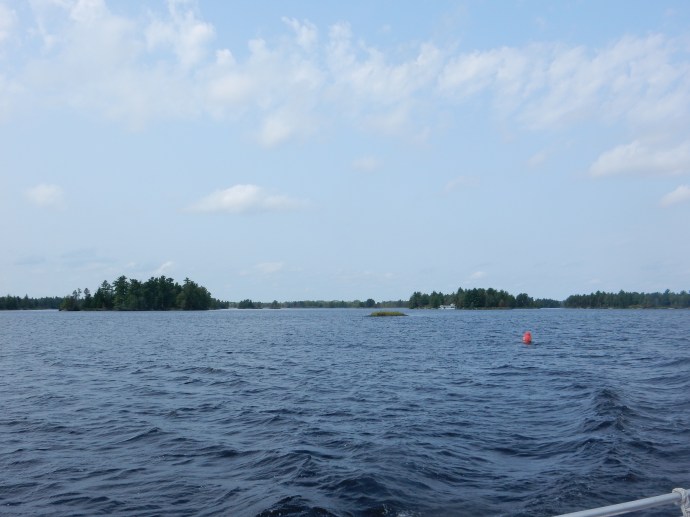
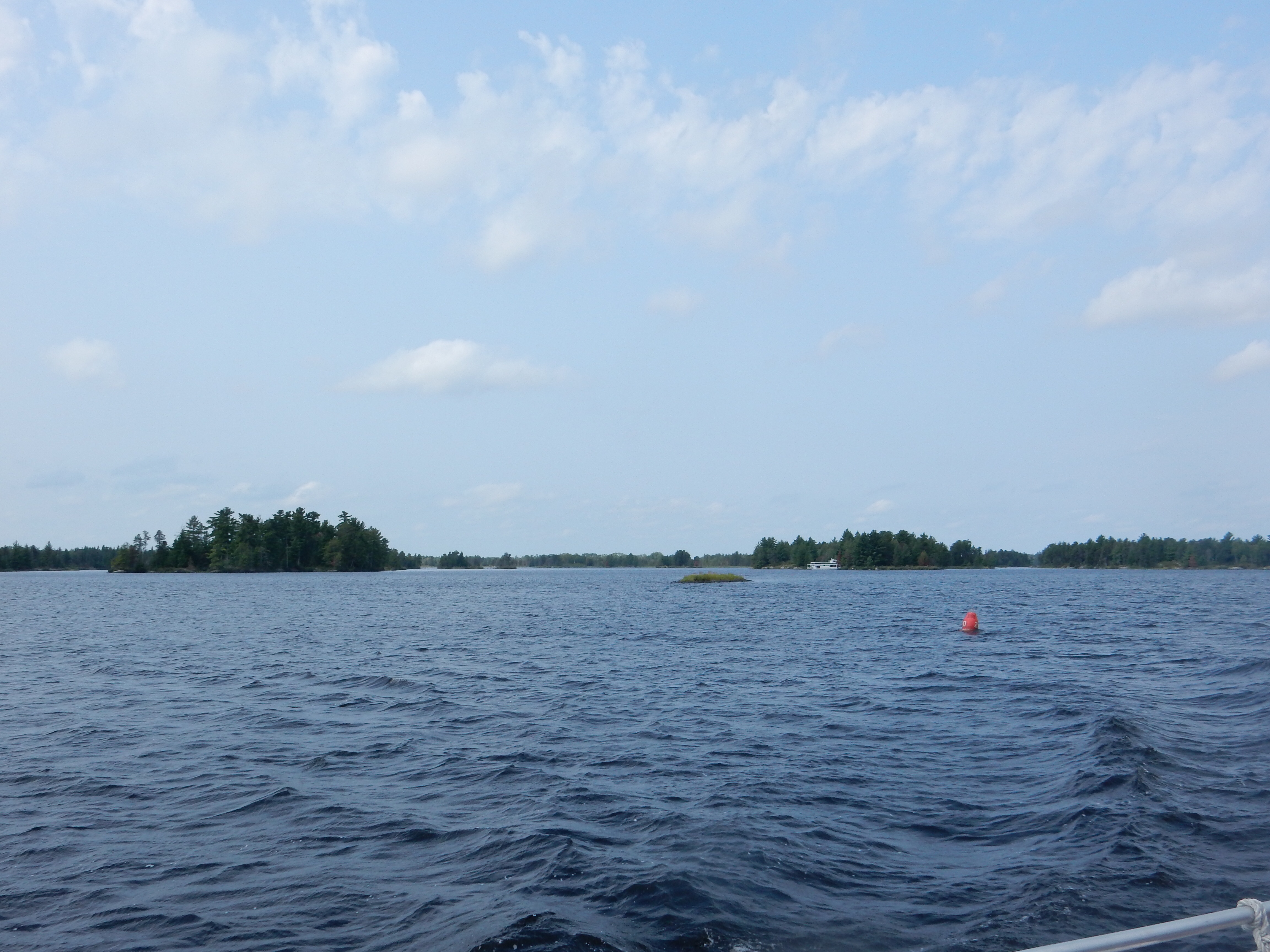
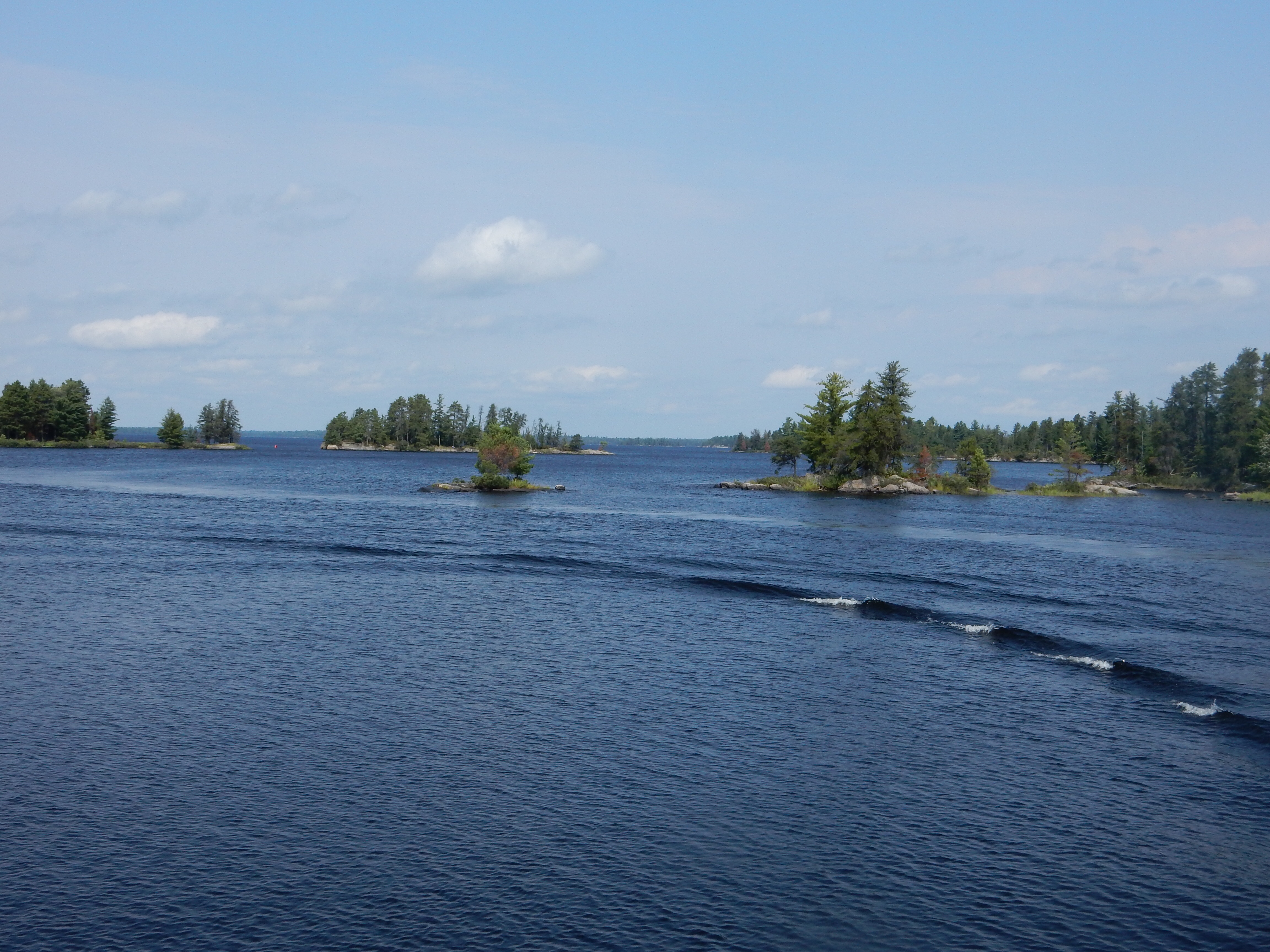
Rainy Lake
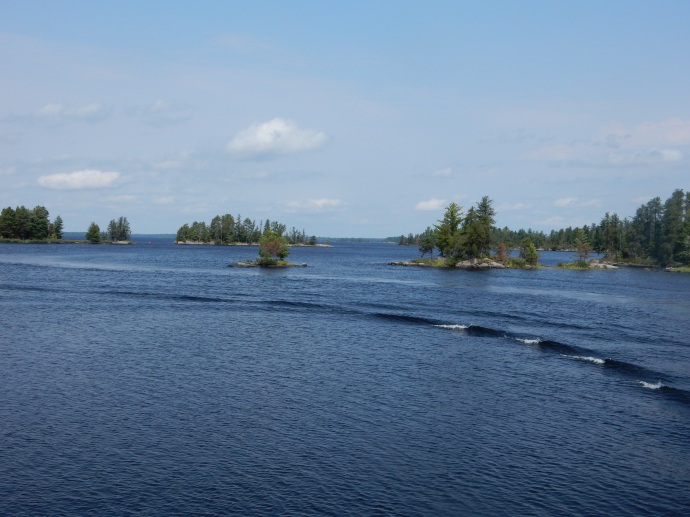
Rainy Lake

image

While Rainy Lake is large, we were normally in view of islands or the Kabetogoma peninsula. So land was normally a reassuring visage. People were out fishing and the houseboats here are tied up to trees or iron rods driven into the ground. None of that hole digging for anchors that we had to do at Lake Powell. The morning ride was generally with sunny skies. By the time of our afternoon return journey, the skies were dark, some rain came down, and the wind and waves had picked up, but still at a tolerable level.
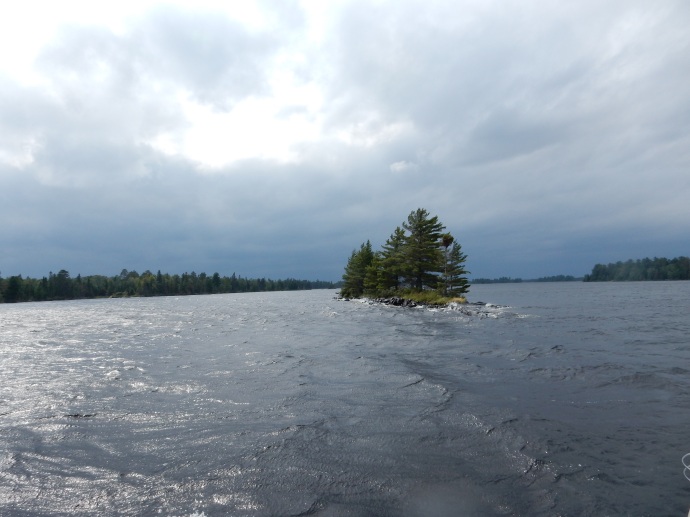
Starting to get stormy

Starting to get stormy in Voyageurs National park
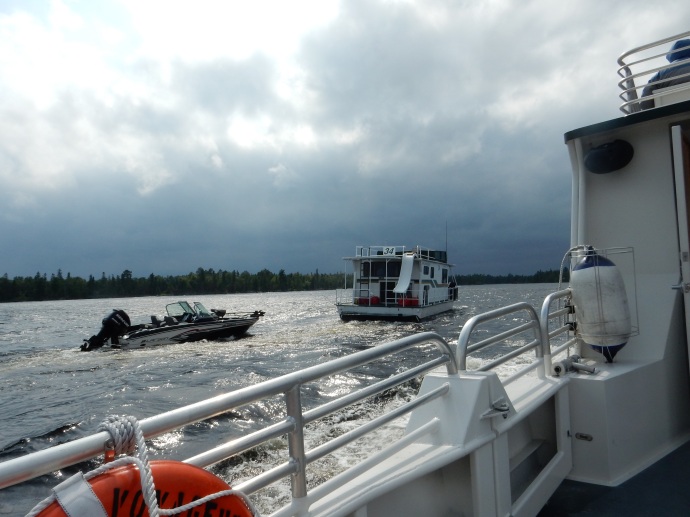
Houseboat heading out into stormy weather

Houseboat heading out into stormy weather

Sunday August 23
Driving the Edge of the Wilderness Scenic Byway

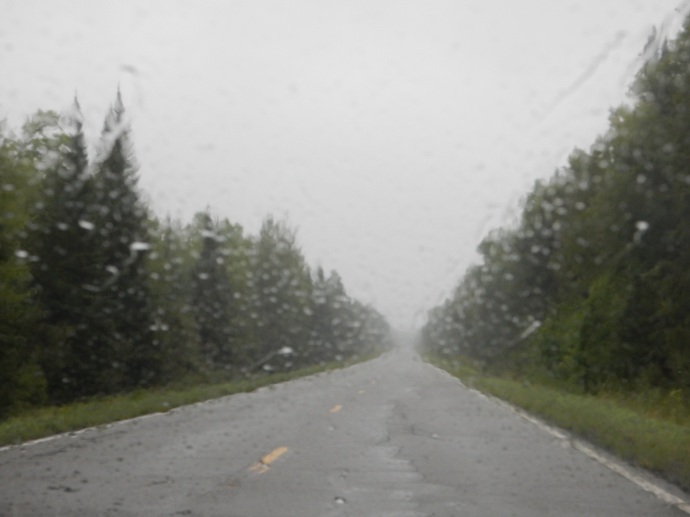
Driving the Edge of the Wilderness Scenic Byway, MN

International Falls is 300 miles from Saint Paul so our Sunday journey was able to allow us a few stops along the way. Chris wanted to stop at Scenic State Park. On the way there, we drove a scenic byway that was one of the first 20 created in the country. It is called the Edge of the Wilderness Scenic Byway. To be honest, we had driven this 47 mile route once before and while it is a pleasant drive, it is not spectacular.
Local history displayed at Bigfork MN

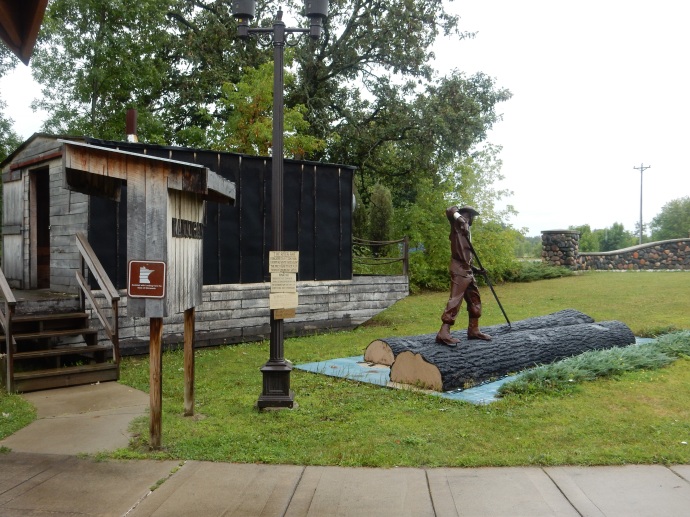
Local history displayed at Bigfork MN

It is well-marked and has story boards in several of the small towns along the route. Of course, the mosquito statue in Effie MN is always worth a look and a few comments. Again, lumbering and modest agriculture rules the area. Railroads used to come through here to transport the lumber, but they are long gone. Much of the road goes through the Chippewa National Forest and there are a plenitude of lakes on either side of the road, normally hidden by the forest of trees.
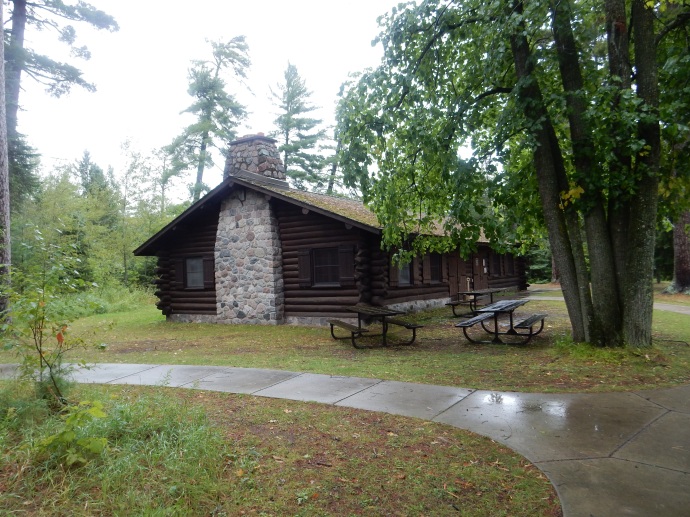
Scenic State Park shelter constructed by the CCC in the 1930s
Scenic State Park shelter constructed by the CCC in the 1930s

image

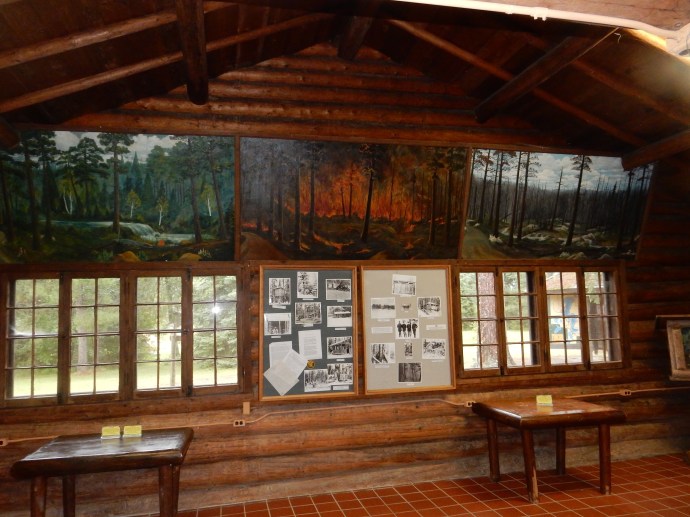
Scenic State Park is located just a few miles east of the road. It was created in 1921 after local residents asked the state to preserve the remaining pine and birch trees. The Civilian Conservation Corps created beautiful wood structures here in the 1930s which are still standing and in great shape. Our hike here was not long, Sunday was continuing the overcast, windy, and rainy conditions of Saturday afternoon. We had stopped at the park office and in talking to the ranger, learned that the clothing merchandise offered for sale was primarily created by a local guy who goes around to numerous local parks and businesses and creates unique designs for them. It was refreshing to hear that local business was involved; we were impressed with the designs available. However, there were no T-shirts with pockets being offered.

A late lunch in Grand Rapids, home of Judy Garland and Blandin Paper Mills, and then St. Paul by 6 PM. A pleasant visit to parts of our state we had not visited previously. We were able to obtain several more park stamps to add to our collection to eventually complete the Minnesota Department of Natural Resources State Parks Passport Club.

Ed and Chris
Saint Paul, Monday 10 pm

Categories: road trip, travel | Tags: , , , , , , , , , , , | Leave a comment

Blog at WordPress.com.