road trip

2017 Trip Two: Tour of Texas March 20-21

Miami Beach Florida March 21. Tuesday

Today will be a photo post primarily. We took an urban hike of five miles along the boardwalk today and spent much of yesterday on the beach. Today would have been a good beach day but we decided to get exercise and re-explore the area.

There is an alternating paver sidewalk/raised boardwalk system that extends from much of the area from 46th St to around SouthPoint at the Miami Ship Channel (down to 1st St.) except for a few blocks from about 3rd to 5th. It is a fantastic way to get exercise and view both ocean and the high rises as it runs between the buildings and the dunes. Other than feral cats and bike riders on the boardwalk portion (where they hadn’t oughta be), there is little hassle.

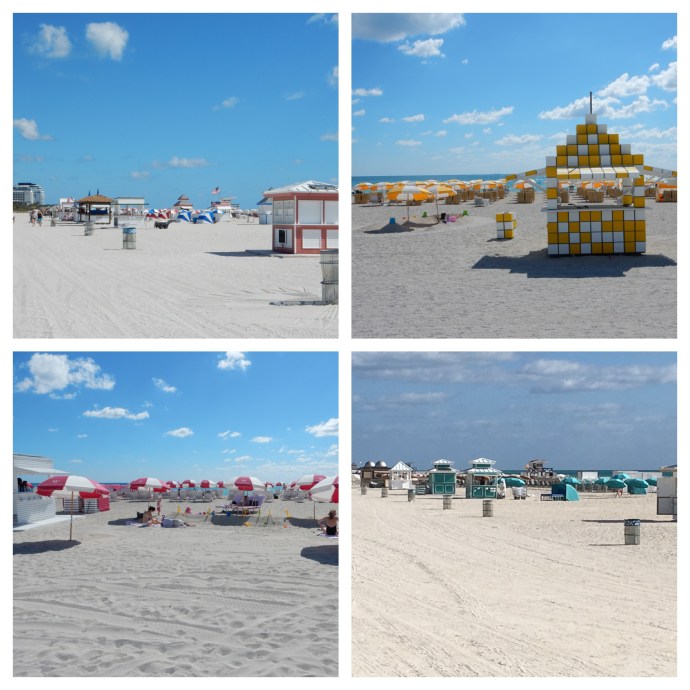
The various condos/hotels/apartments have their own booth where people get umbrellas and beach chairs. Some of the booths are color coordinated with the color or style of the hotel.

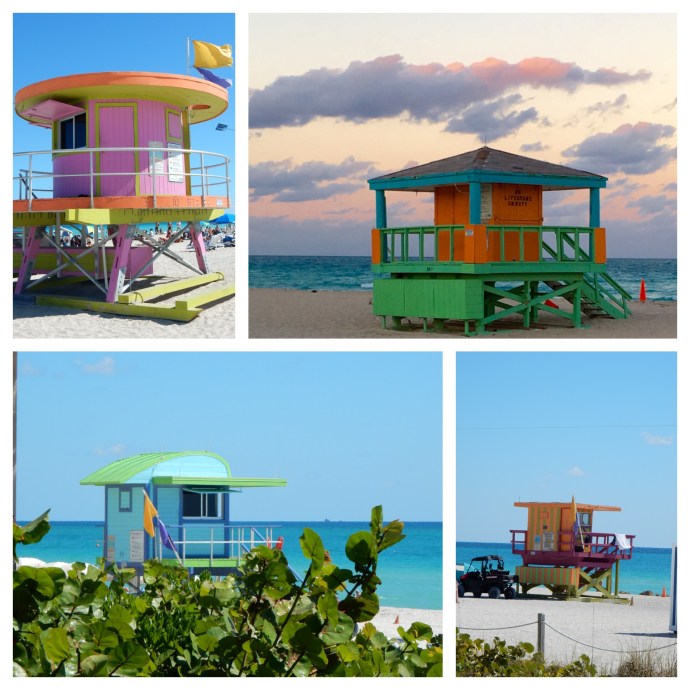
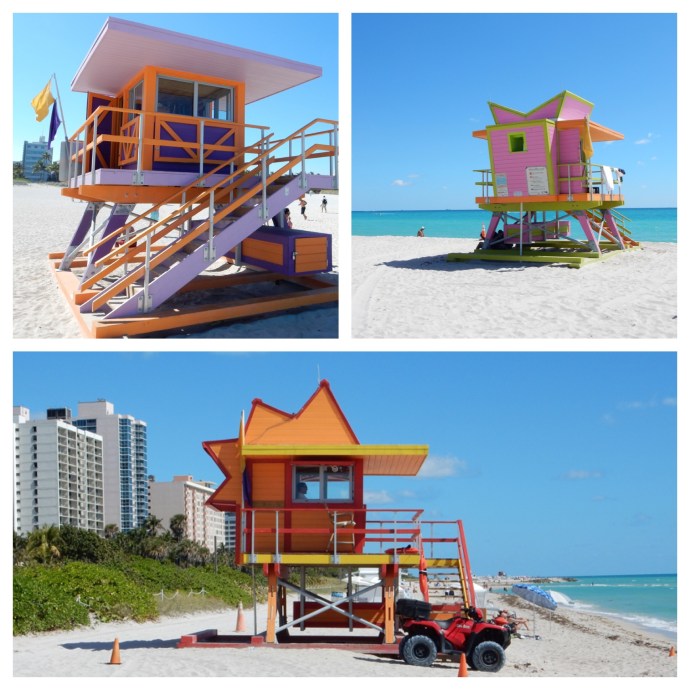
South Beach is known for the unique lifeguard stands lining the beach. No two are the same. Bright colors and styles differentiate them.

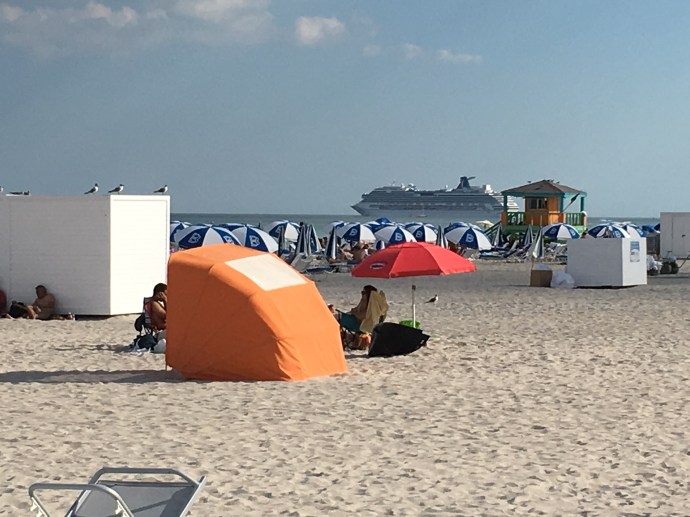
Cruise ships go out Thursday through Monday so nothing today but here is a shot from Monday.

Ed and Chris. March 21

Categories: road trip, travel | Tags: , | 2 Comments

2017 Trip Two: Tour of Texas March 18-19

Miami Beach Florida, March 19

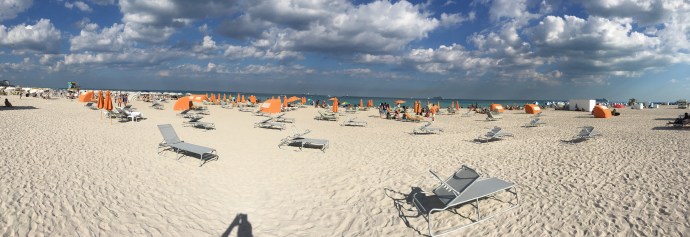
Panoramic view of South Beach at the end of the day on Sunday March 19

“Toto, I have a feeling we are not in Kansas anymore.” How true that it is. Crowds throng along the sidewalks. Mopeds, roller bladers, cars, bikes and people all seem to compete for the same space on the streets, with little regard for traffic lights or lanes. That last is actually somewhat reasonable given that traffic moves so slowly at crowded times. U-turns, double parking, stopping to chat from car to sidewalk, all are constant occurrences. Coming across the causeway from the mainland, there are skyscrapers lined up along the shore as far as the eye can see.

Sidewalks are always busy. Some walkers wait for the lights, most do not. Many forget that the sidewalk has to be shared with people going in the opposite direction. Of course, with restaurants taking up more than half of the sidewalk for al fresco dining, walking is even more of a challenge but people watching is enhanced.

The Beach was jammed today (Sunday). Normally we arrive around 10:30 as we did today and get an umbrella and beach chairs in the front row. Today we were in row three. Sat next to a nice family from Vancouver BC that are heading out for a 4 day cruise tomorrow. Six cruise ships departed between 4:15 PM and 5:10 PM. Numerous foreign languages heard on the beach; I thought Trump was scaring foreign tourists away? There were a lot more selfie sticks being used than I remember from previous years.

La Sandwicherie, a hole-in-the-wall frequent stop for take-out dinner (salads and sandwiches) is open from 8 AM to 5 AM, closing only for three hours. The closest Walagreens is only two blocks away but has no pharmacy. It is basically a convenience store. It is relatively new, much cleaner and better prices than the old, run-down grocery we used to frequent. I had to ask three staff members before I found one who knew the closest Walgreens that had a pharmacy. That Walgreens is three blocks in the other direction. We went there tonight but the pharmacy closed at 5 PM on Sunday. We got used to 24 hours pharmacy back home. Suntan lotion and food seemed to be the big sellers; this Walgreen also sold beer, wine, and alcohol.

Several of our favorite places are being renovated. This happens constantly down here. It is amazing how long it takes to complete the work, we can go several yearly trips before a place re-opens. The hotel next to us, the Betsy, has taken over an old hotel across the alley and is renovating the old hotel and connecting the two buildings. Another hotel and restaurant a block away is wrapped in plastic with workers going in and out. No idea what is happening.

Our place, the Hilton Grand Vacation Club timeshare looked different to us as we walked back tonight. Then we realized, the two building comprising the HGVC property were both bathed in green LED light. Previously each building had its own color in neon lights.

So, yes, we have left the prairies of Kansas and Nebraska behind. The forests and farm fields of Mississippi, Georgia, and Alabama are gone. Concrete, asphalt and steel have replaced it, along with sand beaches and blue oceans.

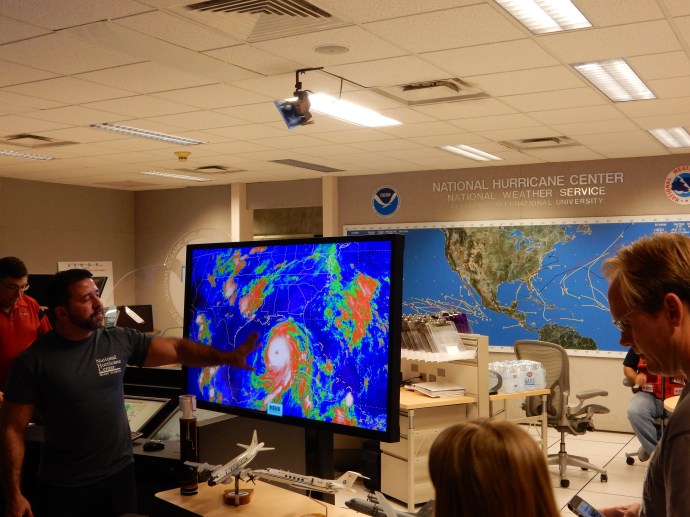
Speaker at the National Weather Service National Hurricane Center tour

Saturday was projected to still be a little too cool and breezy for the beach. I was reading the Miami Herald and there was a short blurb that the National Weather Service and National Hurricane Center were having an open house. What the hey, why not go? So we did. It was a 45 minute drive out there which included two wrong turns. Only two was pretty good. We were using Google directions but sometimes the spoken direction was different from the wording on the freeway traffic signs. Even at 70 mph we guessed correctly on several of the differences but did miss two of them.

The two agencies are part of the National Oceanic and Atmospheric Administration and share one concrete and steel hardened facility west of the Miami airport. A guided tour was offered in groups of about 25. The two missions collaborate and support each other while still being distinct. The Hurricane Center focuses on tracking severe storms in the Atlantic and eastern Pacific. They will also provide weather and wave information to mariners, like cruise ships and freighters. There is a room that converts into an emergency weather media center during hurricanes.

The National Weather Service will take the broad hurricane forecasts prepared by the Hurricane Center and localize the impact. They deal with local emergency management teams to inform them which communities will be spared and which will likely be struck by the storm.

One of the speakers had piloted the planes that fly directly into the storms when they are occurring. Another guy, not a pilot, recalled being onboard one of the planes as it flew through the storm and admitted he had gotten sick. We did ask if they could address climate change and they answered “No”. On the issue of budget cuts, they just said they were awaiting details.

This place is open 24/7, 365 days a year. The data they collect helps prepare for emergencies from hurricanes to fires and floods. Our reading indicates the NOAA is proposed to be cut 17% in Trump’s budget. How penny wise and pound foolish.

The Weather Service sends up two Weather balloons each day to gather weather data. The balloon goes up 100,000 feet before disintegrating and releasing an instrument package tethered to a parachute which brings it slowly back to earth. THe data is relayed back here. If I heard correctly, there are 1000 locations around the world that release a balloon at the same time. During severe weather, the Weather Service will release four balloons a day. For this open house, a third balloon was released at 1 PM. We all got to do the countdown and watch the balloon float off into the atmosphere.


Video of balloon launch

Ed and Chris. March 19

Categories: road trip, travel | Tags: , , , | 2 Comments

2017 Trip Two: Tour of Texas March 16-17

Miami Beach, FL. March 17

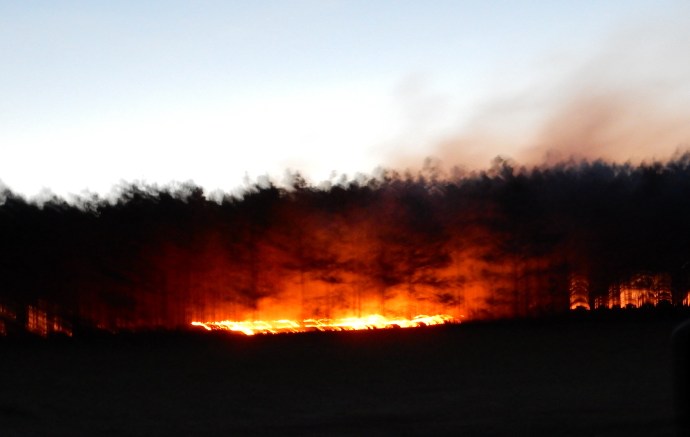
Early morning ground cover fire in Georgia

This is a short post, more to let you know we are still around. Thursday, March 16 was our driving day from Fort Gaines GA to Miami Beach FL, about 580 miles. A 7 AM departure produced a 6:30 PM arrival with stops and traffic. Other than a constant flow of heavy-footed Florida speeders, the only notable items were two areas where the landowners appeared to be burning the undergrowth or old corps in their fields.

We had dinner at a regular spot of ours, the Front Porch cafe. It is less than a block from our lodgings at the Hilton Grand Vacation timeshare on Ocean Drive. The Front Porch always has tasty food at reasonable prices. Reasonable restaurant meal prices can be a challenge in Miami.

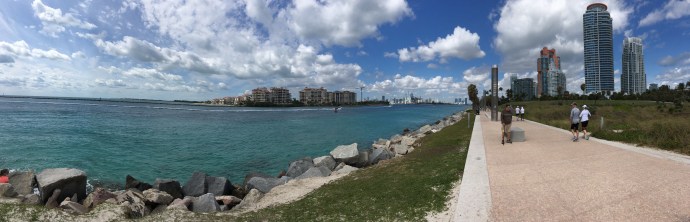
The Miami Ship Channel at South Pointe

On Friday, Miami Beach was cool. It was up to 70 but with a 15 mph wind. We hiked down to SouthPoint and the Miami Ship Channel where cruise ships and freighters enter and leave the city. In the afternoon we spent an hour on the beach, mainly bundled up to avoid the wind. The next few days should be warmer.

Chris on the beach Friday

Friday evenings the Wolfsonian Museum of Florida International University has free admission and a docent tour. The Wolfsonian focuses on items, not just art, from around 1850 to 1950. They had a special exhibition on Dutch design currently on display so enjoyed that before dinner at Spiga. Spiga is an Italian restaurant we have visit frequently and is only three blocks from our lodging.

The lobby of the Wolfsonian with vinyl prints highlighting the Danish modern exhibit, More is More.

As usual, the streets are crowded in Miami Beach although there is no major event happening. Spring breakers are still here but nothing overwhelming.

Ed and Chris. March 17

Categories: road trip, travel | Tags: | 1 Comment

2017 Trip Two: Tour of Texas March 14-15

Fort Gaines, Georgia Wednesday March 15
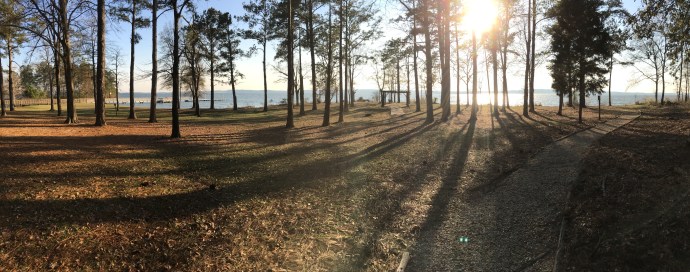
A view of George Walters lake from George Bagby State Park

Wednesday, March 15
Quite the contrast from the red soil peanut farm and farm business of President Jimmy Carter to President Donald Trump’s gold gilded Trump Tower. Carter has only been ranked 26th of 43 presidents (Trump obviously has not been rated yet.). However, Carter’s style, humble beginnings, and morality stand in sharp contrast to the current president.

We bring this up because we spent part of today touring the Jimmy Carter National Historic Site in Plains GA. (His Presidential Library is in Atlanta.) The site includes his boyhood farm home, his school, and his 1980 presidential campaign headquarters in the Plains railroad depot. (The depot had been closed and it became the campaign HQ since it was the only available large facility in Plains that had a bathroom.)

Carter was born in 1924 into a middle class family. We viewed the farm home the family moved to in 1928 on a farm that raised cotton, peanuts, corn, watermelon, sweet potatoes and sugar cane. A vegetable garden and livestock provided additional nourishment. The farm grew to over 300 acres and his father added a “store” that stocked provisions needed by locals who could not easily get into Plains three miles away. The Carter family later added electricity in 1937 and a windmill came in 1935 to provide running water to the house. The shower faucet was a large pail with holes punched in the bottom.

Like most farm kids, Carter worked on the farm with mixed enthusiasm. One hated task was something called “mopping” the cotton, a term I had not heard of previously. Mopping was done to poison boll weevils that were devastating to the cotton crop. Boys would take a mixture of arsenic, molasses, and water and apply it with a cotton mop to the bud of each cotton plant. His legs, feet, and pants would become covered with this goo-which also attracted insects.
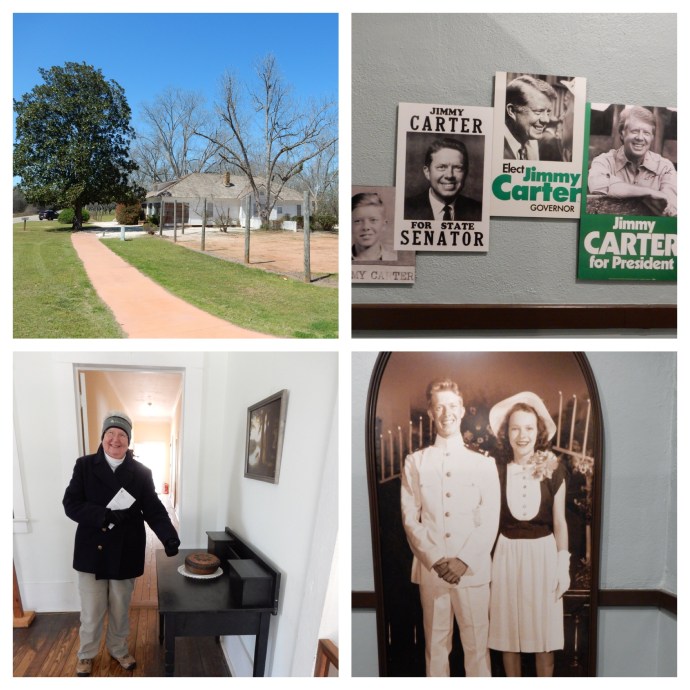
A montage of Carter Historiccc site photos: boyhood home, Chris by black desk, Carter election signs, Jimmy and Rosalyn wedding

Carter’s mother “Miss Lillian” was a nurse and frequently gone from the home when the kids came home from school. On a black desk by the front door, she would leave a “to-do” list of chores that had to be completed. At age 68, Lillian Carter joined the Peace Corps serving in India.

Carter has stated that both of his parents played a strong role in his development. He won an appointment to the Naval Academy and married Rosalyn after graduation. He was on a fast track to rise high in the ranks when his father died in 1953. When he returned to Plains for the funeral, he realized what a positive impact his father had on individuals in the community. He decided to resign his commission and return to live in Plains and run the family farm and business. Rosalyn was not pleased, she was getting used to Navy life and seeing the world. She indicated she pouted for about a year before learning to like and accept life.

Carter grew the business and decided to enter political life with his first position being on the local school board. He went on to the Georgia State Senate, then Governor, and finally President. The pace upward was not without hardship. The school position created local animosity when their plan to consolidate schools was seen as a ploy to integrate schools. His first Senate campaign required a judicial challenge to overcome election fraud by the entrenched politicians who thought he was too liberal. His first run for governor was a loser and he ended up $66,000 in debt.

Race wise, Carter was a product of his times. He grew up in segregation and accepted it. He was not hard-core, accepting black friends and neighbors. He refused, as a local businessman, to join the White Citizens Council, which cost his business needed revenue until the issue died down. His family’s effort to allow local blacks to enter their Maranantha Baptist Church was defeated soundly. (Carter has stated his religious beliefs were minor until he lost the race for Governor and spent time reflecting on his life.) Nevertheless, he was not a leader in the segregation efforts of the 1960s but as he became Governor, he pushed extensively for inclusion of blacks and women into state government.

Carter has credited his teachers, and his principal, at Plains for pushing him to excel. His principal, Miss Julia Coleman, used to tell her students to study and work hard and even a child from Plains could grow up to become the U.S. President. She died in 1973, not seeing her protegé become President. Carter said at his inauguration one of her famous sayings: “We must adjust to changing times and still hold to unchanging principles.”

While Carter only served for four years, he and Rosalyn have led a post-presidential life that exemplifies the concept of working for the benefit of all mankind. He still teaches Sunday School and he and Rosalyn join other members of their small church community to cut grass and maintain the church facilities. They have established the Carter Center that focuses on peace, nation-building, and eradication of diseases in third world countries.

Carter also still volunteers for Habitat for Humanity. We left Plains for Americus GA, 10 miles away to have lunch and visit the Global Village and Discovery Center of Habitat for Humanity. Lunch was first of course. Our chosen spot, listed in AAA, was full and we walked to a local independent bookstore and cafe. We did not buy any books but did have a croissant sandwich made on the premises.

On the left, two slum, pre-Habitat housing shots; on the right, a new home outside and inside

Habitat has its headquarters in Americus due to history. The founders of Habitat were members of a “commune” called Koinonia located just outside Americus. Koinonia started in 1942 and due to its acceptance of people of all races, it was targeted by the Ku Klux Klan in the 1950s. They survived and prospered, growing more when a wealthy couple, Millard and Linda Fuller, sold their possessions and became its leaders. Fuller recruited Jimmy Carter and that added to the acceptance and prestige of Habitat. (Fuller was fired in 2005 over a combination of a disagreement in management philosophy and some allegations of improper behavior.)

In any event, Habitat is now recognized worldwide as a leader in building sustainable homes for people in poverty. The Global Village recreates a collection of “before” and “after” housing. A visitor walks down a street of shacks typically found in slums around the world. Then the scene changes and one views typical homes constructed in various countries, adapted specifically to the weather and building materials of the specific country.
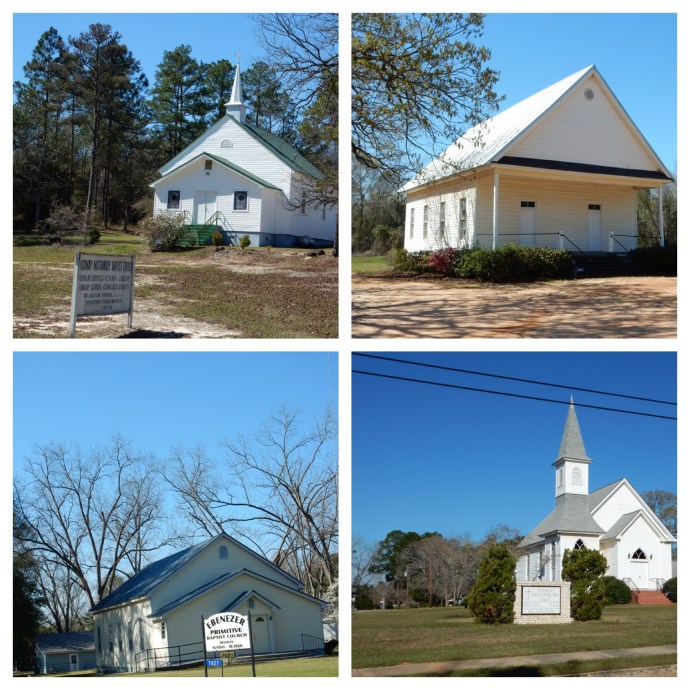
Four of the many small churches we passed along the back roads

We returned to our lodging, once more driving down two lane roads, viewing red clay farm soil, noting the numerous small churches dotting the countryside, and observing the acres of forest that are the backbone of the lumbering business in Georgia. One final stop was visiting The Walter George dam and lake on the Chattahoochee River. The lake is what we can view from our lodging at George Bagby State Park. The Chattahoochee River is a source of contention between Alabama, Georgia and Florida. I do not know all the details, but evidently Florida believes the Atlanta metropolitan area is sucking up too much water and depriving the mussel industry in Florida of sufficient water resources. The staff member at the visitor center was doubtful of any near term resolution.

Tuesday, March 14
This post covers Tuesday and Wednesday. We did not believe Tuesday was robust enough to post by itself. We left Oxford Alabama and drove to Horseshoe Bend National Military Park. Yup, two lane roads, rural countryside, and a gray, drizzly day to boot. Horseshoe Bend was one of two battles which Andrew Jackson won and which propelled him to the Presidency of the United States. Horseshoe Bend was the determining battle of the Creek Indian War. (The second was the Battle of New Orleans-part of the War of 1812.)

The Creek Nation lived in what is now Georgia and Alabama. As the European settlers expanded across the country, the Creek Nation was split between groups; one that was willing to cooperate with the settlers and adopt their ways and goods versus the second which wanted to hold fast to their traditional culture, way of life, and land. As these things will do, a series of small atrocities led to a complete war between the US and the more traditional Creeks in 1813-1814. (While during the time of the War of 1812, this was a separate conflict.)

An aerial view of Horseshoe Bend where the battle was fought

Andrew Jackson lead the U.S. military troops and suffered two early defeats. With reinforcements, he pursued the Creeks who were spending the winter at Horseshoe Bend with their families behind a strongly built barricade across the neck of the bend. At the end of March 27, 1814, 800 of the 1,000 Indian warriors were dead and their families sold into slavery. In August of 1814, the Treaty of Fort Jackson stripped the Creek of their remaining lands (most already ceded in earlier treaties). The treaty made no differentiation between the Creeks who fought and those who wanted to live like the Europeans.

In 1828, Jackson became President and in 1830 signed the Indian Removal Bill requiring southeastern U.S.tribes to move west of the Mississippi River in a dreadful forced march called the “Trail of Tears.”

Art Museum of Auburn University

After Horseshoe Bend, we spent a little time in Auburn Alabama, home of Auburn University. We visited the Art Museum of the university which had a special exhibit of works by Jiha Moon. She is a Korean born artist now living in Atlanta. It was not spectacular but succeeded in using up time before we checked in to George Bagby State Park in Fort Gaines, GA.

Walking the Chattahoochie Trail at George Bagby State Park in Fort Gaines GA

We are staying in the lodge here, built in 1988. The rooms are like old style highway motel rooms, but clean and neat. Not fancy, no Ritz Carlton; although I have only stayed in a Ritz Carlton once and it was on another organization’s dime. Tuesday after arrival, we took a walk through the trails while the sun was still somewhat warm. We were a little confused on the trail, not lost, just confused. I blame it on the poor quality of the map, not the map readers. Wednesday we stuck to the paved trail, no confusion ensued.

There is a restaurant here. None of the literature we recall reading indicated the restaurant was seasonal; i.e., it was closed Tuesday night. The nearest open restaurant was a five table pizza/barbecue place 20 miles away. We made it before they closed and the food was tasty.

Two other groups are staying at the park. A group of utility line workers repairing storm damage and a group of GA DNR water rescue instructors. Due to the DNR group, the restaurant was open for breakfast and dinner today (Wednesday) and may be open early enough Thursday that we can eat and leave. Thursday is a long driving day down to Miami Beach, over 550 miles so it is likely there will be not be a post Thursday evening.

Ed and Chris

Categories: road trip, travel | Tags: , , , , | Leave a comment

2017 Trip Two: Tour of Texas March 13

Anniston, Alabama Monday March 13

A panoramic view of the Talladega Scenic Drive

Twenty four years ago, I was responsible for the move of the law firm I was administering from one old building to a brand new building that was constructed for us in Harrisburg PA for ourselves and a few tenants. Over that weekend, about 8 of us completed the details after the movers finished dropping off all of the furniture and equipment at 2 AM Saturday morning March 13. As they left, it started to snow. Over 20 inches of snow fell that weekend, the winds howled, and the Pennsylvania Governor closed the roads in the state. Now on March 13, 2017, the northeast section of the U.S. is having another good snowstorm. I feel for folks up there.

Our weather here in northern Alabama was not a snow storm but unpleasant enough that it impacted our plans for the day. The day was cool, breezy, and rainy/drizzly. We had hoped to do more walking in the northern Alabama foothills of the Appalachian mountains. We left Gadsden and drove the Appalachian Highlands Scenic Byway and the Talladega Scenic Drive to Cheaha State Park.

Four views along the Talladega Scenic Drive

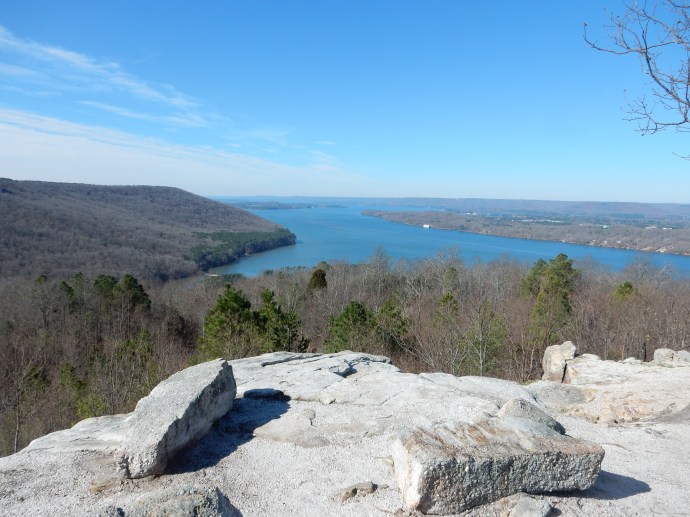
The Appalachian Highlands Scenic Byway is a standard two lane route nestled in the valley below the mountains. The low clouds only allowed for a partial view of the mountains. The Talladega Scenic Drive was constructed in Talladega National Forest specifically to connect to Cheaha State Park, home to the highest point in Alabama. This scenic drive is constructed similar to the Shenandoah Drive or Blue Ridge Parkway. It has limited connections. It is two lane. It is smooth. It is designed with vistas in mind. It is on top of the mountains presenting views down in to the valleys. It is enjoyable to drive.

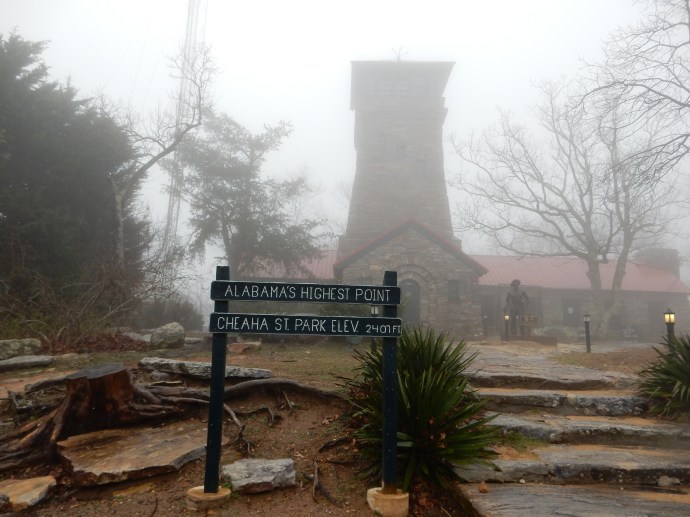
The Bunker Observation Tower, 2407 feet above sea level, at Cheaha State Park, highest elevation in Alabama

Cheaha State Park is eerily similar to the highest point in another state, but for the life of me I can not remember which one. There is a circular design at the top,, with cabins around the edges. There is a stone restaurant at the end of the one way drive. In the middle of the circular, one-way drive is a stone blockhouse at the highest point in the state. The stone block house has stairs climbing to the top and the design looks exactly the same. There is an observation area. There is a USGS brass marker embedded in the concrete out front. One difference, today’s weather was cloudy and foggy and practically nothing could be seen out of the observation windows. I will probably wake up in the middle of the night remembering which state this observation tower resembles.

Given the weather, we chose not to do any hiking. I guess we could have, but it was not going to be pleasant and so we skipped it. Our second choice was a museum of natural history in Anniston Alabama. Oops, today is Monday, that traditional day for all museums to be closed. Third choice was a new national monument to be run by the National Park Service. However, this national monument is so new it has no visitor center. It is the Freedom Rider National Monument.

This national monument recognizes an error in the civil rights movement and specific acts of violence and courage that occurred in and around Anniston. In May 1961, a group of white and black freedom riders were riding on a Greyhound bus. At the Anniston Alabama bus station, the bus was attacked by a mob that threw rocks, broke windows, and slashed tires on the bus. The bus left the station for Birmingham but had to pull over about 6 miles west of town due to tire damage. The mob had followed the bus and when the bus pulled over, the mob attacked again and threw burning rags into the bus. With difficulty, the riders found their way to the Anniston hospital, which provided no real treatment. Once again the freedom riders were under siege by the mob. No police intervention occurred. Eventually deacons from a local Baptist Church rescued the riders and drove them to Birmingham. Even with the intervention of Attorney General Robert Kennedy, the ride could not be completed.

The downtown Anniston plaque about the bus burning and the photographer

A local freelance photographer had been tipped off the night before the bus ride that there might be some “action” at the bus depot. When challenged at the bus station the following morning by mob members, he lied and said that the head of the local Ku Klux Klan had sent him. They let him stay. His pictures of the burning bus were published locally and nationally.

After the photos were published, other freedom riders came forth. A few days later, and under further attack, they were able to complete the bus ride. By the end of the summer, the number of freedom riders multiplied dramatically across the South. The local photographer was haunted and threatened by members of his community. He and his family had to be given federal police protection around the clock. Eventually he moved out of Anniston and never returned.

Let us hope and pray that we are not returning to a time when hate crimes will multiply across America.

After lunch at a local barbecue restaurant, we stopped at a local antique store and did some shopping. Unusual for us but necessary since we could not yet check into the hotel. We did buy one set of notecards.

We ended up checking into the hotel early and doing laundry.

Ed and Chris. Anniston Alabama. March 13

Categories: road trip, travel | Tags: , , , , | 2 Comments

2017 Trip Two: Tour of Texas March 11 and 12

Gadsden, Alabama. Sunday March 12

Trees starting to bloom in northern Alabama.

March 11, Huntsville Alabama

Watercress Capital to Rocket City is the quick summary of Huntsville Alabama. We left Tupelo Mississippi Saturday morning on a gray, drizzly drive through the Bankhead National Forest. Once again, the ride was on smooth, two lane roads. We passed on the Jesse Owens Museum for the Natural Bridge of Alabama as our quick stop before the bright lights of Huntsville.

The Natural Bridge of Alabama was actually a decent rock formation run by a mom and pop operation; much better than the natural bridge we saw a few years ago in the Missouri Ozarks. The stop helped to solidify that the geography was changing, this area starts the foothills of the Appalachian mountains. The visit was not too long, the drizzly rain was cool and a warm car was beckoning. The formations and hiking are similar to the northern portion of Georgia we encountered a year and a half ago when we were on our way to visit the Great Smoky Mountains.

This is not cotton growing area. We are realizing there is a great deal of manufacturing in northern Mississippi and Alabama. Huntsville, Gadsden and Tupelo all have a strong manufacturing base. Huntsville has a population of 180,000. Huntsville has its European settler roots, founded by a man named Hunt in 1805. The Indian population left early due to disease and U.S. pressure. After the Civil War, textile manufacturers moved into the area and along with railroads, kept the economy humming. As the Great Depression ravaged the area, the growing of watercress was Huntsville’s claim to fame.

WWII brought the beginning of its newest phase. The Redstone Arsenal was established here to produce chemical weapons. While the U.S. signed off on the agreement not to use chemical weapons, it kept the provision it could make them to use against an enemy who used them first against us. When WWII was over, Redstone became the home of the Werner von Braun rocket development group and to this day maintains a strong presence in rocket development by the military and many civilian contractors. The von Braun history is a whole book worth of writing we are not going to attempt to touch.

The base of the Saturn V rocket, can not even get the whole thing in the viewfinder

Today, for most people Huntsville and the Arsenal are known for the Marshall Space Center and the U.S. Space and Rocket Center. The Center is a large collection of exhibits devoted to space, rocketry and the military. We spent several hours here touring the exhibits, seeing such items as inventions developed out of Huntsville, Saturn V rocket, Apollo moon launches, Apollo command module, space lab suits, etc.

We took an hour-long bus ride focusing on re-built aircraft from the post WWII era. We toured the facility where over 4500 youth attend one week-long classes at Aviation Challenge with simulations on flying military aircraft. Coming this summer will be the chance to experience up to 3.2 Gs in a centrifuge. The place also runs a Space Camp focused on science, rocketry and robotics for youth.

Saturday evening was Mass at a service with the church full and the balcony full also. Dinner was at a franchise called Logans’s Roadhouse, a southern style steakhouse now in 23 states. A good meal and less expensive than Outback. Standard lodging at Hampton Inn.

View of the Tennessee River near Fort Payne AL

Sunday our journey began in cold weather but it warmed up to almost 60 degrees F with a great sun out. We enjoyed the day immensely, partially because we know tomorrow is to be rainy and colder. (Still much better than the snow forecast from the Dakotas over to Boston.) We drove almost to the Georgia border as we crossed the wide Tennessee river and started climbing hills again. Our primary destination was the Little River Canyon National Preserve.

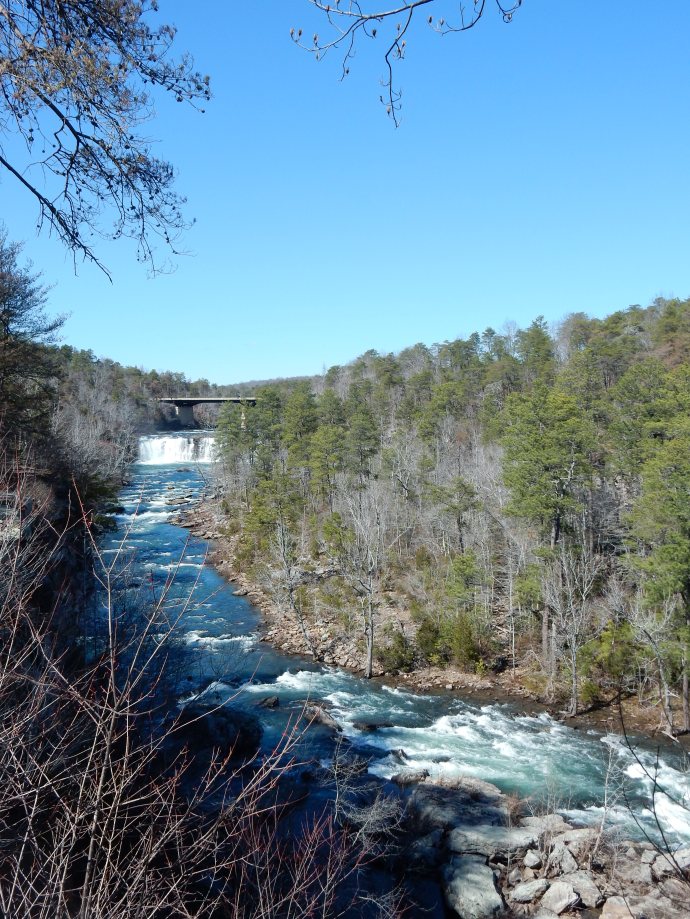
Little River became part of the National Park Service in 1992. It protects a river unique in that it flows atop a mountain, retaining a pristine and clean river. We were able to observe several creeks feeding into the river. The creeks were very clear. It provided a sharp contrast to most of the rivers we have observed in northern Mississippi and Alabama which have been uniformly brown.

The canyons here are deep and extensive, and along with other protected wilderness areas in the Northeast Alabama area, provide for extensive recreational opportunities. There is a visitor center jointly sponsored by NPS, a local university, NASA and others which sponsors considerable educational lessons for people in an area from Chattanooga to Birmingham.

The “Trail of Tears”, that forced march of Muscogee Creeks, Chickasaw, Seminoles, and Cherokee from portions of the south and east to Indian territory in the 1830s went through part of this area.

Little RIver Falls

Our experience started at the visitor center and then moved outdoors, with viewing of the Little River Falls. Then we drove up to DeSoto Falls, north of DeSoto State Park. This can be confusing, there is a DeSoto Falls in Georgia which we also visited 18 months ago. Both are named after Hernando DeSoto, a Spanish explorer who came through the area in 1539-1540.

Wildflower Cafe in Mentone AL

Lunch was at the Wildflower Cafe in Mentone AL, a small town home to unique shops and eclectic personalities (Jude, sort of like Madrid,NM). We ate nutritionally here, a brunch extravaganza of a strawberry crepe with whipped cream, spinach quiche, five kinds of fresh fruit, a tomato pie, and mashed potatoes with strips of steak and zucchini.

Little RIver Canyon

After lunch we drove along Lookout Mountain Parkway, passing a small Baptist church with three walls of standard construction and a fourth wall completely comprised of one huge boulder. Then it was on to view more of Little River Canyon, stopping at several overlooks to view the canyon, another waterfall, and hiking some trails. The canyon depth is over 600 feet towards the canyon’s southern edge. The waterfalls were about 90 to 130 feet high. Trees are beginning to blossom, we are worried we may miss the bluebonnets in Texas if they pop too soon.

Chris and Ed at Top of the River in Gadsden AL

Dinner was at a local restaurant, Top of the River, which specializes in catfish and cornbread. Well, I have never liked the idea of catfish. I mean, those fish are ugly. I thought I had tasted them years ago and did not like it, too mushy and greasy. Our server was persuasive in getting us to try catfish as part of a combination platter. We decided on a platter with catfish, shrimp, and a chicken kebab. The platter comes with hush puppies, coleslaw, corn bread, and a baked potato. Plenty of fried food and carbohydrates. Hopefully our healthy lunch balanced it all out. We actually decided the catfish was not too bad. A major advancement for southern food over our northern taste buds.

Ed and Chris. March 12

Categories: road trip, travel | Tags: , , , , , , , , , , , | 2 Comments

2017 Trip Two: Tour of Texas March 9 and 10

Tuplelo, Mississippi. March 10, Friday

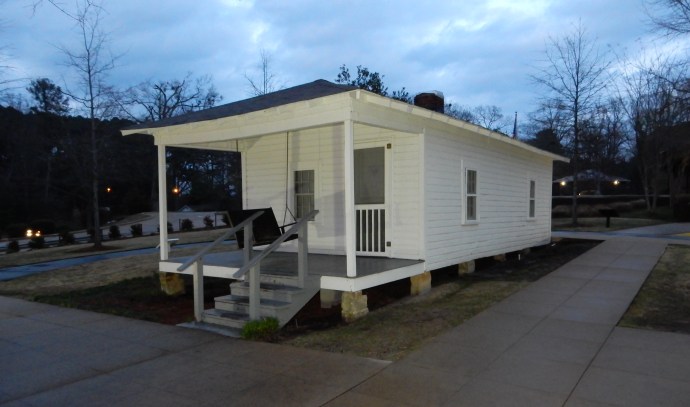
Birthplace of Elvis Presley in Tupelo MS

Yup, we are down South. Civil War, William Faulkner and Elvis Presley. Since we left home, all of the states we have traveled through have less population than Minnesota. That will continue with Alabama. Just a tidbit.

One can not truly know an area by a quick drive through the state. But a few items struck us. We were impressed with the quality of the roads in northern Mississippi-other than the right turn lanes which are too short to have any value. Smooth, frequently four lane. Towns seem more prosperous than rural areas. Oxford MS is a pretty college town with cutesy shops. Tupelo surprised us with a large medical center and plenty of business and industry. Arkansas had two rest centers marked closed “For Remodeling”. Since we did not see any signs of remodeling, we went online to read that the state was closing a dozen or so rest areas for cost saving measures. Deceptive signage???

I understand people are thrilled with the open spaces of the prairies. However, it was nice to drive into southwestern Missouri and northwestern Arkansas and view trees and almost mountains.

Thursday we left Forrest City Arkansas and our destination was Tupelo MS. We stopped at Oxford Mississippi, the home campus of the University of Mississippi. Ole Miss has 24,000 students. The census must not count them since the population for the town is listed as 20,000. Maybe a census person can enlighten me.

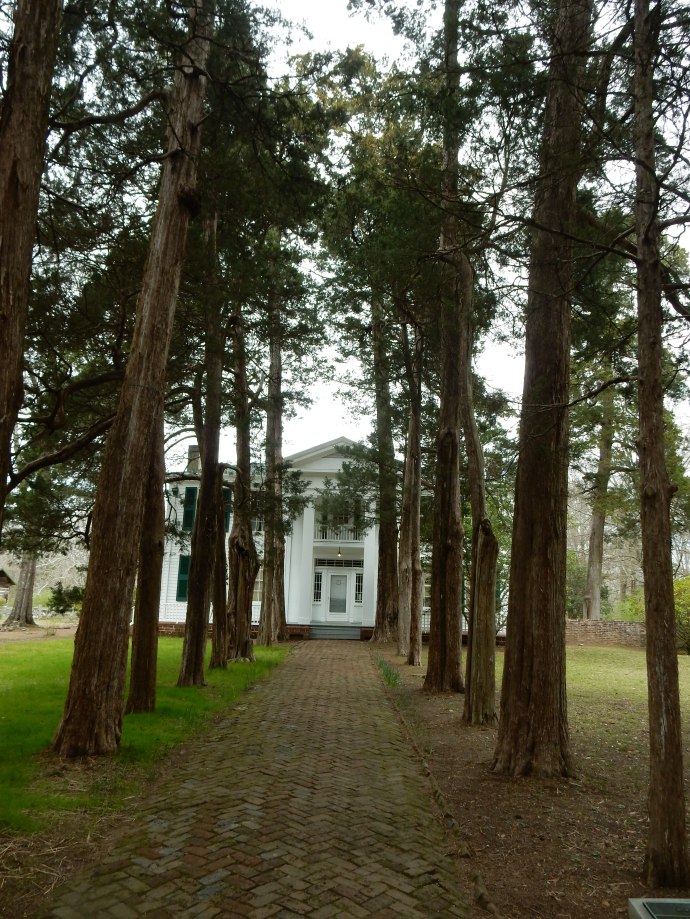
Rowan Oak in Oxford MS, the home of William Faulkner for 30 years during his major writing period.

Oxford was the home to William Faulkner, who lived in the house called Rowan Oak from 1930 until his death in 1962. His daughter sold it to Ole Miss who maintains it to this day. When we visited it, there were Italian scholars going through the house. Faulkner, as you probably recall, received a Nobel Prize for Literature in 1949 and the Pulitzer Prize in 1954.

Rowan Oak only offers a self-guided tour. Frankly, unless you are into Faulkner, it could be skipped. We much preferred the tour of Carl Sandburg along the Blue Ridge Parkway which we toured when we visited the Great Smoky Mountains. The house is not remarkable other than his use of it. Two curiosities: by the phone are numerous phone numbers written directly on the wall; in an upstairs writing office is an outline for one of his books also written on the wall. Evidently the wind kept blowing away his papers.

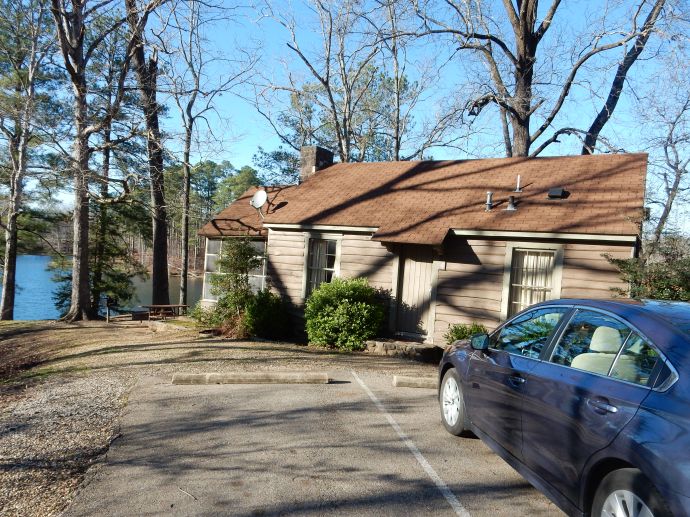
Our cabin home for two nights in Tombigbee State Park

We made our way over to Tupelo. Our lodging for the two nights was a bit of a risk. We have a cabin in Tombigbee State Park. Reviews were mixed but the location was near to Civil War sites and Chris likes to try state parks. My take is that it was a reasonable choice; it is large, has a screened in porch, and a full kitchen although we have not used it much. The water is hot but I definitely believe the bathroom could be cleaner. The price was only $75 per night although tomorrow’s Hampton Inn is only $10 more. Luckily it has heat, tonight’s temperature will go down into the 30s. Most days have been up in the 60s and 70s. The cabin is on the shore of a lake, the frogs and birds can be heard early and late. Thursday night a storm came through but tonight is clear with a pleasant sunset and a moon to shine on the water. The screened in porch has a swing which we used during the day.

After dinner Thursday night, we drove by the birthplace of Elvis Presley. When we booked this area, we had forgotten that Presley was born here and lived here for his first 13 years. We did not pay for the tour, the area is open to the public for viewing after hours.

Friday we drove up to Corinth MS, very close to the Tennessee border. Corinth was a strategic railroad crossing for two main tracks going north-south and east-west that tied the Confederacy together. The major battle of Shiloh in April 1862 was fought with a high percentage of untested soldiers. The North was driving down from the Ohio River in its goal to split the Confederacy in two.

Over two days of battle, with the advantage going back and forth, the Union forces eventually prevailed and the Confederate forces retreated the 20 miles to Corinth. In a two-day battle in early October the Confederates had re-grouped and attacked Corinth. The result was similar, the Union forces prevailed. The Confederate generals had predicted to Richmond that if they lost Corinth, the South would lose the war. Correct.

The Union controlled Corinth until January 1864. The town was basically destroyed as the Union forces burned public buildings when they marched out. Over the two years that the throng of soldiers was based here, they made a mess of the town. More than 100 battles, skirmishes, and raids occurred in the area.

When the Union forces won, the town also became a refuge for slaves, or as they were known at the time, “contraband property”. The Union established a camp who housed 3,500 refugees who fed themselves, had literacy classes, and delivered soldiers to the Union Army. The food and cotton grown by the former slaves not only fed the camp but turned a profit that was sent on to the federal government. The camp resembled a small town, complete with a church, commissary, hospital, and homes.

The water feature at Corinth Battlefield National Historic site visitor center

The Corinth visitor center was a marvel. Three excellent films, numerous clear displays, and brochures for further information. It has a water feature monument that represents the history of the U.S. with symbolism and words showing the Declaration of Independence, the first 13 states, the expansion of new states with the conflicts these caused, the major battles of the Civil war, and the re-unification.

The next two locations were downers. Brice’s Cross Roads was about a battle in June 1864, after the Union had left Corinth. The battle was a tactical maneuver by the Union to bring back Confederate forces who were heading east to harass Sherman on his march to the sea. Although the Union forces lost this battle, they succeeded in stopping this group of Confederates from fighting against Sherman. But the battlefield itself is small, few signs, and just one side of a brochure to discuss it.

The final site was Tupelo battlefield Monument. This we knew in advance was just a monument, stuck on a piece of ground along a busy highway. Why it even made it to an official National Park Service site is beyond me. It was but another skirmish, among many, where the Union forces kept the Confederates busy here instead of marching east. But we drove by and got a picture without being rear-ended by a car behind us on the road.

Hiking along the Natchez Trace

One other stop was a visitor center along the Natchez Trace Parkway. The parkway is 444 miles long and recreates an early foot traffic route used by American Indians and then early settlers who transported goods along the Ohio and Mississippi rivers to the port of New Orleans. River currents prohibited their boating back home so they walked back. This process lasted until the growth of steamboats. The parkway was a project begun by the Daughters of the American Revolution. It was declared a unit of the National Park Service in 1938 but not completed until 2005. We took an hour hike on a trail across from the visitor center.

As they say in the South “Have a blessed evening”.

Ed and Chris. Tupelo MS. March 10

Categories: road trip, travel | Tags: , , , , , , , | Leave a comment

2017 Trip Two: Tour of Texas March 8

Forrest City, Arkansas March 8

Shades of Saskatchewan. For those of you who have been following this blog for a long, long time may remember the flat tire we had on the plains of Saskatchewan on a Saturday afternoon. We just made the service department of Canada Tire in time to have the spare tire replaced before they closed for the Canada Day weekend.

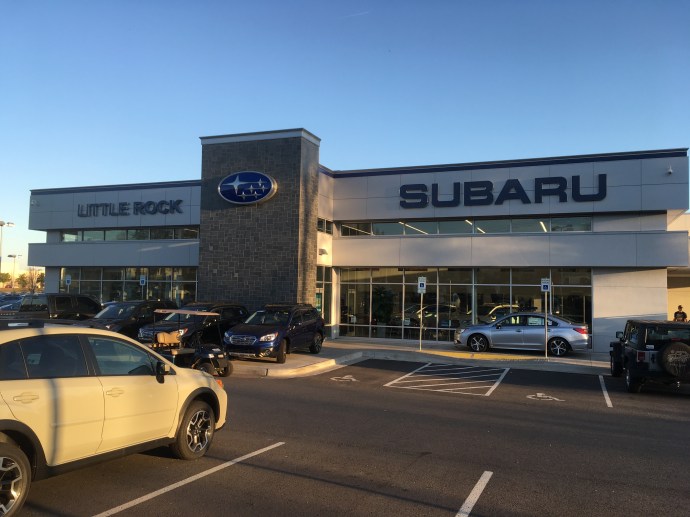
Car repairs in Little Rock, Arkansas

Well today around 3:30 PM we hit a piece of broken truck tire, actually the third or fourth piece of tire, we encountered on I-40 in central Arkansas. The tire apparently knocked out our fog light and jarred loose the front right bumper. We made it to the Little Rock Subaru in time for them to fix the fog light (a broken bracket holding the light, the light itself was ok), re-attach the bumper, and get our next 6,000 mile service check done between 4:45 and 6:15 PM. (The service department closes at 6 PM.) Way to go Subaru.

The consequences were: we got our service check done now, the cost was minimal, we demonstrated our flexibility by canceling one night’s lodging, the planned activities for Thursday to lodge here in Forrest City Arkansas, and we are likely to be able to walk the trails at Tombigbee State Park near Tupelo Mississippi.

So what did we do today? Well, Fort Scott National Historic Site was the sole focus, other than driving. Fort Scott was a fort based on the Kansas-Missouri border. It was only in operation from 1842 to 1873. It had four main purposes. They were, in sequence, guaranteeing land for Indian tribes from white settlers, trying to keep the peace during the “Bleeding Kansas” era, establishing a base of operations during the Civil War, and protecting the expanding railroads from Indian attacks.

Fort Scott was one of numerous forts built from Minneosta to Louisiana. Their purpose was to protect Indian Tribes and the lands they were guaranteed from white settlers. It actually worked for a while, until gold was found in California, Texas was annexed, and the “Manifest Destiny” theory became reality as settlers just poured westward. Indians became even more restricted to the least desirable lands and Fort Scott was abandoned in 1853.

Officers’ quarters at Fort Scott National Historic Site

Bleeding Kansas refers to the period when US legislation allowed the people in the territory of Kansas to determine if the state would allow or prohibit slavery. Three groups emerged. Abolitionists wanted to get rid of slavery everywhere. Proslavers wanted slavery obviously. Free-staters did not object to slavery but just did not want it here. Violence broke out and 1858 soldiers returned to Fort Scott to try to control the violence. Eventually Kansas was entered into the US as a free state in January 1861.

So, 1861. The Civil war starts up. The US Army returns to Fort Scott and the fort was a storehouse for Union Armies, was a hospital for soldiers, and a refuge for people in distress. The Confedertes made two efforts to capture Fort Scott, but failed.

After the war, railroads began their westward expansion. Soldiers were recalled to Fort Scott to protect railroad workers from landowners who did not want the railroad crossing their land. By 1873 the railroads were completed and Fort Scott was permanently closed down.

The lobby of the Courtland Hotel at Fort Scott

We left Fort Scott, the town and the historic site, and our lodging at the Courtland Hotel. The hotel was a pleasant old hotel in downtown Fort Scott. The current owner has been here for 12 years, we congratulated him for running a samll business in a struggling area. The hotel was pleasant and well maintained.

Ed and Chris. Forrest City Arkansas

Categories: road trip, travel | Tags: , | Leave a comment

2017 Trip Two: Tour of Texas March 7

Fort Scott Kansas Tuesday March 7

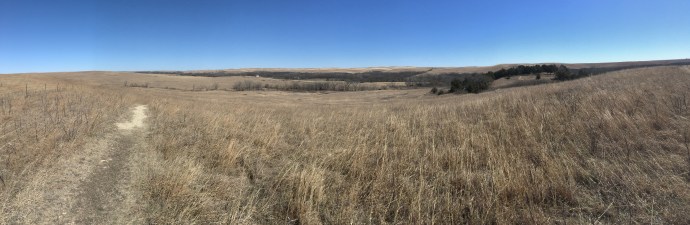
A view of the tallgrass prairie

America encompasses many types of scenery. A simplistic fact but important here. We drove through the Flint Hills of Kansas today, on purpose, to see portions of the Tallgrass Prairie and the Flint Hills. For some people this type of scenery would be boring. Relatively flat land, small streams, no mountains, no dramatic rock formations, no waterfalls, few trees. And we did not see it at its best, when wildflowers of all colors populate the fields.

Yet the starkness and openness has a beauty also. Today we heard birds chirping. The wind (strong) rustles the grasses. The deep blue sky contrasts nicely with the undulating hills of brown grasses. No, it is not our favorite scenery in the country, I am still partial to waterfalls. But we are glad we made the effort to get off the interstates and drive the two lane roads through the area.

When we left Topeka, we took the Native Stone Scenic Byway. The brochure says: “Take a drive down the Native Stone Scenic Byway and you will see miles of stone fences made from the native limestone found in that area. Well, we drove 50 miles of the byway and did not see any along the route. We did see one or two short sections of re-constructed stone walls. It was not until we arrived at the Tallgrass Praire Natoinal Preserve, probably 30 miles past the turnoff from the Native Stone Scenic Byway, we did see some old stone walls. I would call that a case of over-hype by someone in an office who has not driven the route. We still enjoyed the drive, but not for the original reason.

The ranch house at National Tallgrass Prairie Preserve

Our first stop was the Tallgrass Prairie National Preserve in Strong City, KS. In the U.S. there are three types of prairie; tallgrass in the eastern portion of the plains, shortgrass in the western portion of the plains closest to the Rockies, and mixed grass prairie which is in between the two. This preserve is tallgrass. The height of the prairie grass has everything to do with rainfall.

The Tallgrass Prairie preserve was originally an 11,000 acre ranch with home, barn, and one-room school house. The ranch demonstrates life on the prairie but for us the main attraction was the prairie itself. We walked out along the hills and trails and marveled at the vista. I can imagine that it might be cold and lonely here in a blizzard however.

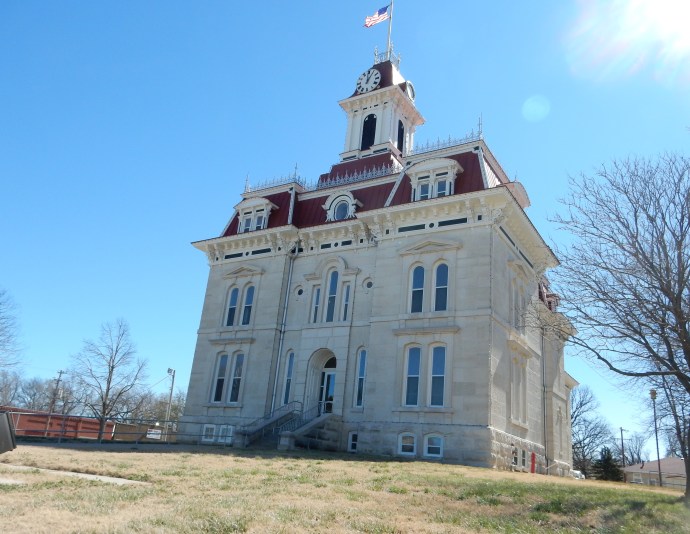
The Chase County Courthouse in Cottonwood Falls KS

After the Preserve, we drove a few miles and had lunch in Cottonwood Falls (population 874) at the Grand Central Hotel. It was a pleasant meal at probably the only restaurant in town. At the end of Main Street is the Chase County Courthouse, an imposing structure completed in 1873 and the oldest operating courthouse in the state of Kansas.

A local art gallery in Cottonwood Falls was host to a traveling exhibit on the Chisholm Trail, that route used by cattle drovers from 1866 to 1887 to drive Texas Longhorn cattle to railheads near Abilene Kansas and other towns to ship their cattle to eastern markets. We may see more about this when we get to Texas.

Ed and Chris
Categories: road trip, travel | Tags: , , | Leave a comment

2017 Trip Two: Tour of Texas March 6

Topeka KS. Monday March 6

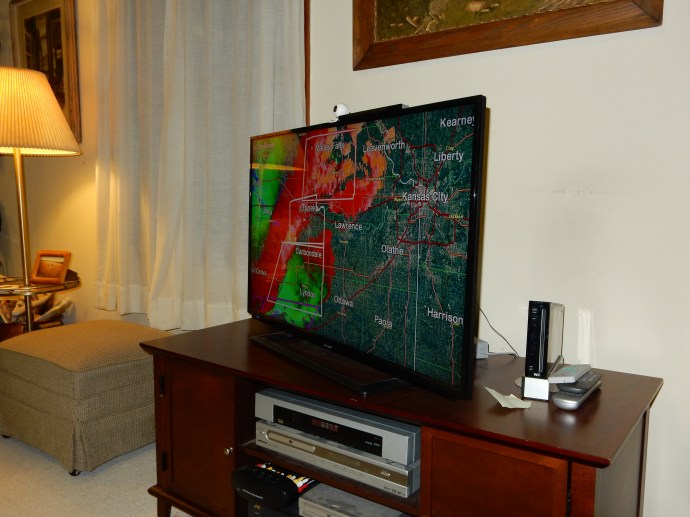
Our tornado warning on the TV screen

Shades of Dorothy and the Wizard of Oz. We experienced a tornado warning at dinner tonight in Topeka. The sirens went off, the emergency alerts rang on all of the phones in the restaurant where we were dining. People here take tornado warnings seriously. We and the other diners boxed up our food and headed back to our Evergreen host’s basement to finish dinner. The restaurant offered to have people move into their secure area but most of us chose to leave. Three tornadoes were spotted but it seems none landed or caused any damage.

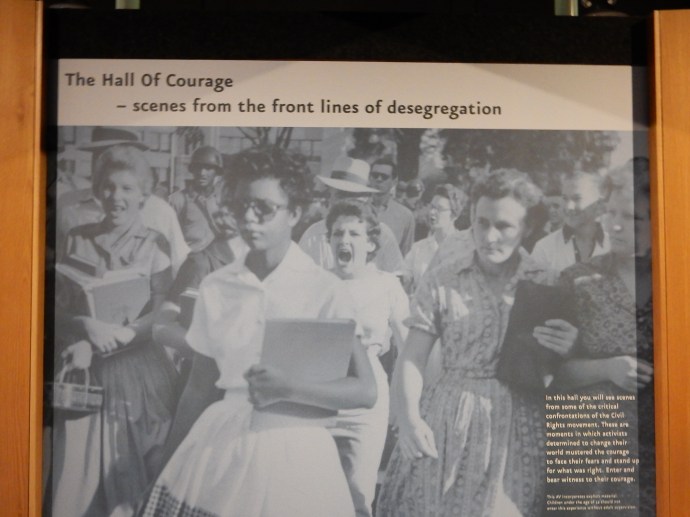
That was an exciting end to a calm day touring Topeka. It was warm (80 degrees F) and windy today, fine for walking around. The Bradford pear trees downtown were already blooming. Our travels started with the National Historic Site of Brown v Board of Education. Hopefully at least the Americans reading this blog recognize Brown. This was the historic 1954 Supreme Court decision declaring that: “We conclude that in the field of public education the doctrine of ‘separate but equal’ has no place. Separate educational facilities are inherently unequal.”
This National Park Service site had one of the most powerful videos I have experienced. A young black girl is talking to a long-time friend of her grandfather and is receiving a history lesson about the roots of segregation and the battle to provide freedom for all Americans. Her expressions of amazement conveyed clearly the wonder that people actually believed in this segregation stuff.

One display case at the Education exhibit at the NPS Brown v Board of Education National Historic Site

The building is in the former Monroe Elementary School, one of four segregated elementary schools for African-Americans in Topeka. This is the school Linda Brown attended instead of the closer white only elementary school. Other rooms in the building showcased exhibits on education and the battles fought to end segregation in the U.S.; a sample kindergarten room from that time period, and the actions that followed Brown v Board of Education to implement the Supreme Court decision. Amazing that government officials thought they did not have to obey the Supreme Court decision.

Once again, this NPS unit was staffed by a friendly and knowledgable ranger. Park rangers are just one of the reasons we like NPS sites so much.

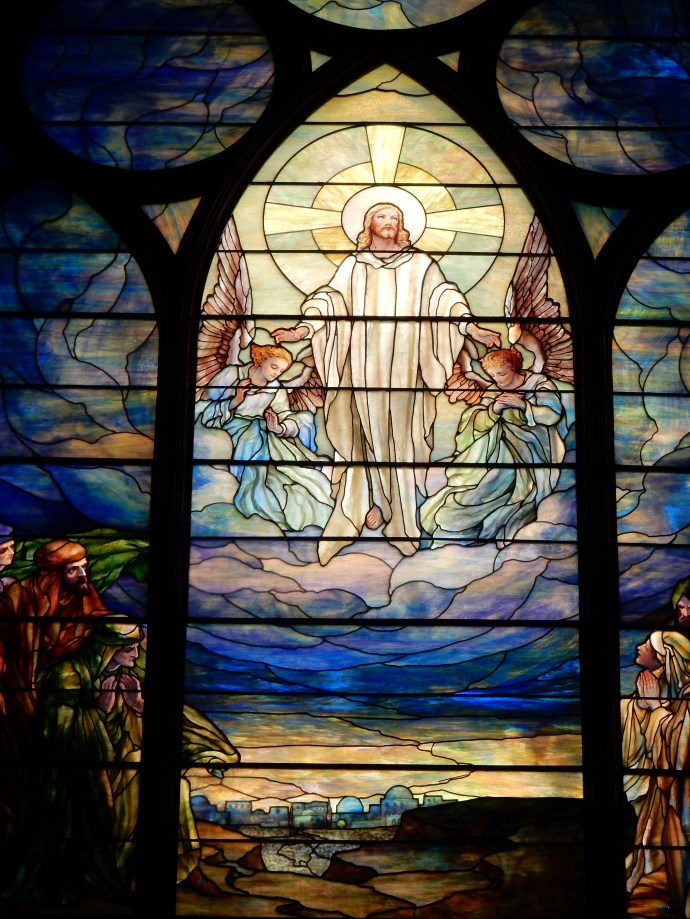
The Ascenson stained glass window by TIffany in First Presbyterian Church in Topeka

Our second stop was at the First Presbyterian Church across from the State Capitol. This church has a series of Tiffany prepared stained glass windows. Tiffany stained glass has gained its reputation because it is glass without paint,enamel, or stains. Instead, the color is produced using additives like cobalt,copper, gold, etc. Evidently, on Tiffany’s orders, the formulas to produce these colors were destroyed upon his death.

The Kansas State Capitol in Topeka

After a quick lunch, we took the 2 PM tour of the Kansas State Capitol. The guide was the husband half of our Evergreen host couple. He has been doing these tours for 18 years and part of his “Schtick” is that he sings several songs during the tour that relate to the story line. He got all of us to join him in singing the Kansas state song “Home on the Range”.

The actual sledge hammer used to break down the door to the Kansas House chambers.

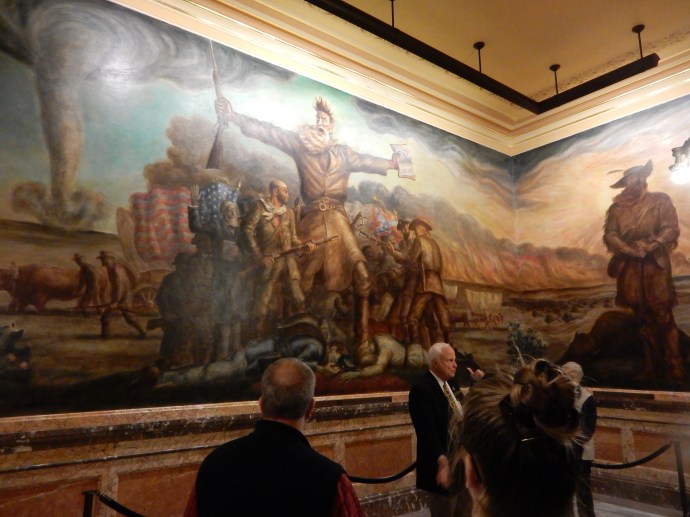
Two of his interesting stories. First, in 1893, there was a dispute between Republicans and Progressives over which party controlled the House of Representatives. The Progressives took possession of the building and locked the Republicans out. Eventually the Republicans got fed up and took a sledgehammer to the door of the chambers and got in. Eventually the matter was settled without the use of firearms which both sides possessed. Second, as we viewed a famous mural of John Brown titled Tragic Prelude by John Steuart Curry he pointed out several of the figures and which famous personages they represent.

“Tragic Prelude” mural in Kansas State Capitol

Another in a series of impressive and beautiful state capitols. Unlike Nebraska, the Kansas capitol is constructed in the dome style. With the statue of the Indian on top, it is taller than the U.S. Capitol. One could climb the 296 steps to the dome but with my vertigo, we passed on that opportunity.

Ed and Chris. March 6. Topeka

Categories: road trip, travel | Tags: , , , , , , | Leave a comment

Blog at WordPress.com.