Monthly Archives: March 2017

2017 Trip Two: Tour of Texas March 11 and 12

Gadsden, Alabama. Sunday March 12

Trees starting to bloom in northern Alabama.

March 11, Huntsville Alabama

Watercress Capital to Rocket City is the quick summary of Huntsville Alabama. We left Tupelo Mississippi Saturday morning on a gray, drizzly drive through the Bankhead National Forest. Once again, the ride was on smooth, two lane roads. We passed on the Jesse Owens Museum for the Natural Bridge of Alabama as our quick stop before the bright lights of Huntsville.

The Natural Bridge of Alabama was actually a decent rock formation run by a mom and pop operation; much better than the natural bridge we saw a few years ago in the Missouri Ozarks. The stop helped to solidify that the geography was changing, this area starts the foothills of the Appalachian mountains. The visit was not too long, the drizzly rain was cool and a warm car was beckoning. The formations and hiking are similar to the northern portion of Georgia we encountered a year and a half ago when we were on our way to visit the Great Smoky Mountains.

This is not cotton growing area. We are realizing there is a great deal of manufacturing in northern Mississippi and Alabama. Huntsville, Gadsden and Tupelo all have a strong manufacturing base. Huntsville has a population of 180,000. Huntsville has its European settler roots, founded by a man named Hunt in 1805. The Indian population left early due to disease and U.S. pressure. After the Civil War, textile manufacturers moved into the area and along with railroads, kept the economy humming. As the Great Depression ravaged the area, the growing of watercress was Huntsville’s claim to fame.

WWII brought the beginning of its newest phase. The Redstone Arsenal was established here to produce chemical weapons. While the U.S. signed off on the agreement not to use chemical weapons, it kept the provision it could make them to use against an enemy who used them first against us. When WWII was over, Redstone became the home of the Werner von Braun rocket development group and to this day maintains a strong presence in rocket development by the military and many civilian contractors. The von Braun history is a whole book worth of writing we are not going to attempt to touch.

The base of the Saturn V rocket, can not even get the whole thing in the viewfinder

Today, for most people Huntsville and the Arsenal are known for the Marshall Space Center and the U.S. Space and Rocket Center. The Center is a large collection of exhibits devoted to space, rocketry and the military. We spent several hours here touring the exhibits, seeing such items as inventions developed out of Huntsville, Saturn V rocket, Apollo moon launches, Apollo command module, space lab suits, etc.

We took an hour-long bus ride focusing on re-built aircraft from the post WWII era. We toured the facility where over 4500 youth attend one week-long classes at Aviation Challenge with simulations on flying military aircraft. Coming this summer will be the chance to experience up to 3.2 Gs in a centrifuge. The place also runs a Space Camp focused on science, rocketry and robotics for youth.

Saturday evening was Mass at a service with the church full and the balcony full also. Dinner was at a franchise called Logans’s Roadhouse, a southern style steakhouse now in 23 states. A good meal and less expensive than Outback. Standard lodging at Hampton Inn.
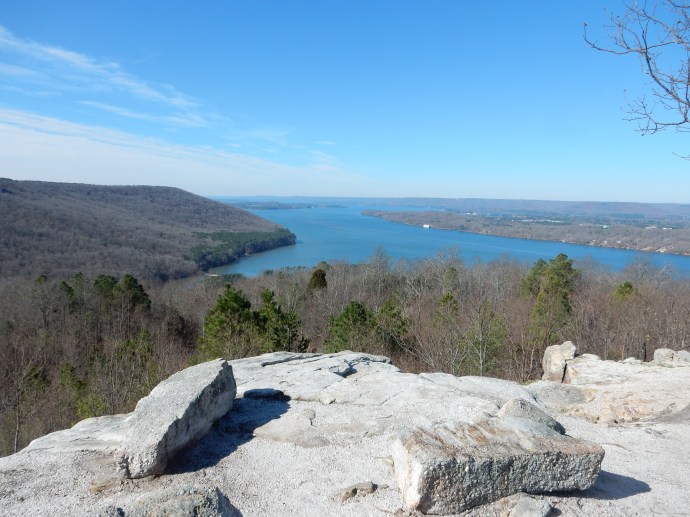
View of the Tennessee River near Fort Payne AL

Sunday our journey began in cold weather but it warmed up to almost 60 degrees F with a great sun out. We enjoyed the day immensely, partially because we know tomorrow is to be rainy and colder. (Still much better than the snow forecast from the Dakotas over to Boston.) We drove almost to the Georgia border as we crossed the wide Tennessee river and started climbing hills again. Our primary destination was the Little River Canyon National Preserve.

Little River became part of the National Park Service in 1992. It protects a river unique in that it flows atop a mountain, retaining a pristine and clean river. We were able to observe several creeks feeding into the river. The creeks were very clear. It provided a sharp contrast to most of the rivers we have observed in northern Mississippi and Alabama which have been uniformly brown.

The canyons here are deep and extensive, and along with other protected wilderness areas in the Northeast Alabama area, provide for extensive recreational opportunities. There is a visitor center jointly sponsored by NPS, a local university, NASA and others which sponsors considerable educational lessons for people in an area from Chattanooga to Birmingham.

The “Trail of Tears”, that forced march of Muscogee Creeks, Chickasaw, Seminoles, and Cherokee from portions of the south and east to Indian territory in the 1830s went through part of this area.
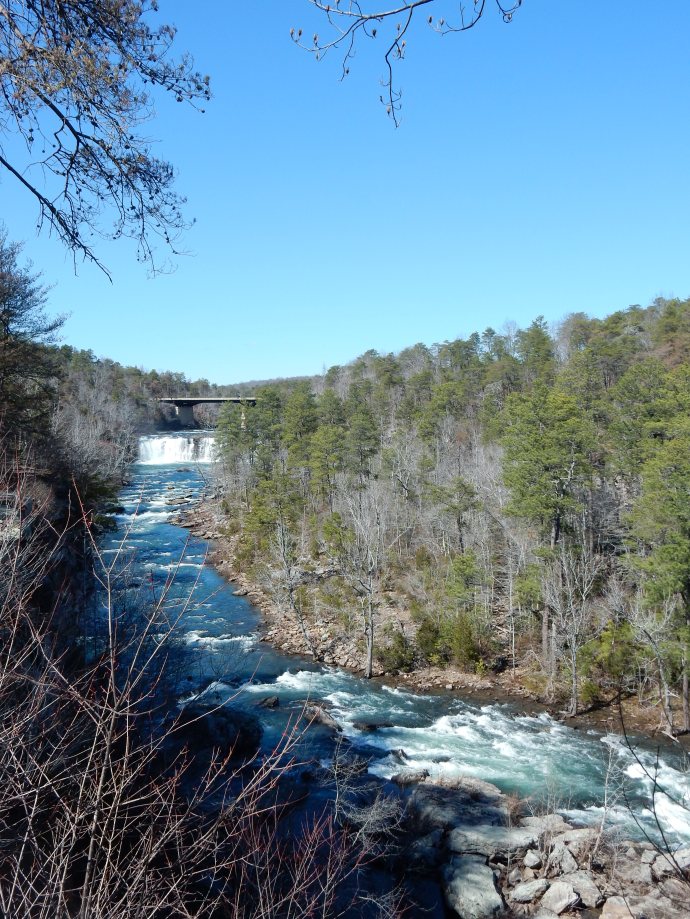
Little RIver Falls

Our experience started at the visitor center and then moved outdoors, with viewing of the Little River Falls. Then we drove up to DeSoto Falls, north of DeSoto State Park. This can be confusing, there is a DeSoto Falls in Georgia which we also visited 18 months ago. Both are named after Hernando DeSoto, a Spanish explorer who came through the area in 1539-1540.

Wildflower Cafe in Mentone AL

Lunch was at the Wildflower Cafe in Mentone AL, a small town home to unique shops and eclectic personalities (Jude, sort of like Madrid,NM). We ate nutritionally here, a brunch extravaganza of a strawberry crepe with whipped cream, spinach quiche, five kinds of fresh fruit, a tomato pie, and mashed potatoes with strips of steak and zucchini.

Little RIver Canyon

After lunch we drove along Lookout Mountain Parkway, passing a small Baptist church with three walls of standard construction and a fourth wall completely comprised of one huge boulder. Then it was on to view more of Little River Canyon, stopping at several overlooks to view the canyon, another waterfall, and hiking some trails. The canyon depth is over 600 feet towards the canyon’s southern edge. The waterfalls were about 90 to 130 feet high. Trees are beginning to blossom, we are worried we may miss the bluebonnets in Texas if they pop too soon.

Chris and Ed at Top of the River in Gadsden AL

Dinner was at a local restaurant, Top of the River, which specializes in catfish and cornbread. Well, I have never liked the idea of catfish. I mean, those fish are ugly. I thought I had tasted them years ago and did not like it, too mushy and greasy. Our server was persuasive in getting us to try catfish as part of a combination platter. We decided on a platter with catfish, shrimp, and a chicken kebab. The platter comes with hush puppies, coleslaw, corn bread, and a baked potato. Plenty of fried food and carbohydrates. Hopefully our healthy lunch balanced it all out. We actually decided the catfish was not too bad. A major advancement for southern food over our northern taste buds.

Ed and Chris. March 12
Categories: road trip, travel | Tags: , , , , , , , , , , , | 2 Comments

2017 Trip Two: Tour of Texas March 9 and 10

Tuplelo, Mississippi. March 10, Friday

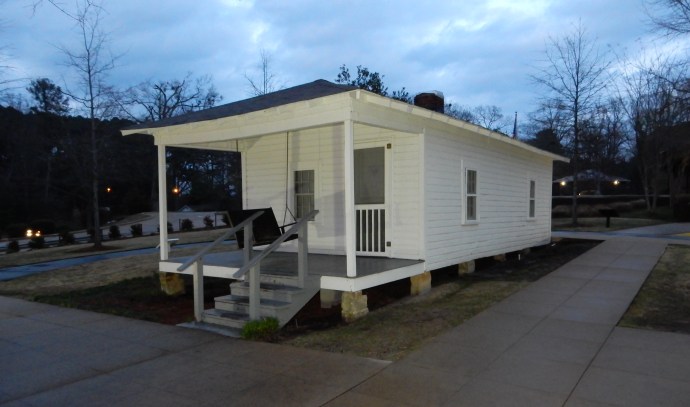
Birthplace of Elvis Presley in Tupelo MS

Yup, we are down South. Civil War, William Faulkner and Elvis Presley. Since we left home, all of the states we have traveled through have less population than Minnesota. That will continue with Alabama. Just a tidbit.

One can not truly know an area by a quick drive through the state. But a few items struck us. We were impressed with the quality of the roads in northern Mississippi-other than the right turn lanes which are too short to have any value. Smooth, frequently four lane. Towns seem more prosperous than rural areas. Oxford MS is a pretty college town with cutesy shops. Tupelo surprised us with a large medical center and plenty of business and industry. Arkansas had two rest centers marked closed “For Remodeling”. Since we did not see any signs of remodeling, we went online to read that the state was closing a dozen or so rest areas for cost saving measures. Deceptive signage???

I understand people are thrilled with the open spaces of the prairies. However, it was nice to drive into southwestern Missouri and northwestern Arkansas and view trees and almost mountains.

Thursday we left Forrest City Arkansas and our destination was Tupelo MS. We stopped at Oxford Mississippi, the home campus of the University of Mississippi. Ole Miss has 24,000 students. The census must not count them since the population for the town is listed as 20,000. Maybe a census person can enlighten me.

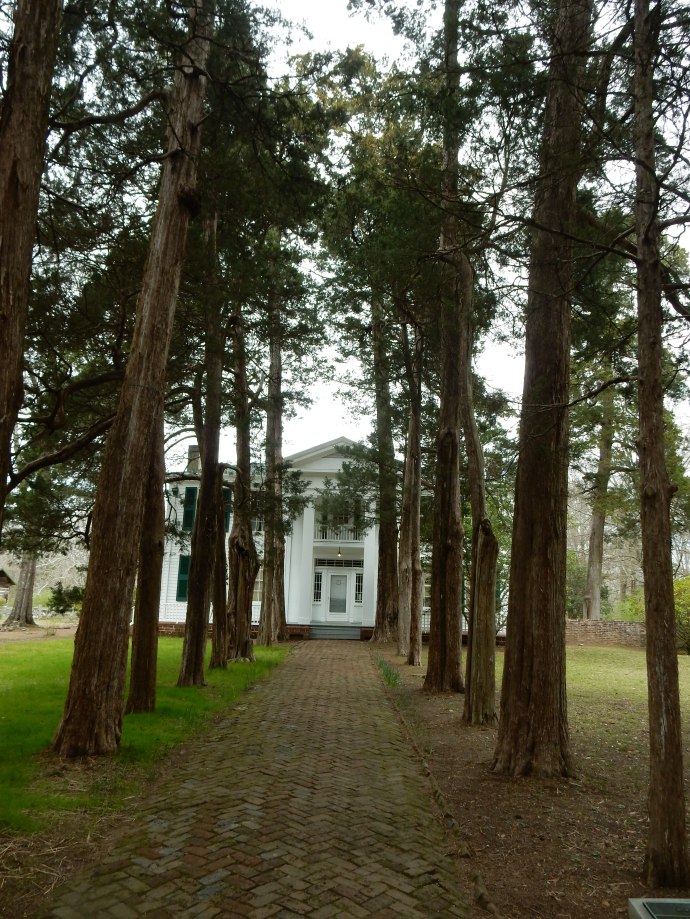
Rowan Oak in Oxford MS, the home of William Faulkner for 30 years during his major writing period.

Oxford was the home to William Faulkner, who lived in the house called Rowan Oak from 1930 until his death in 1962. His daughter sold it to Ole Miss who maintains it to this day. When we visited it, there were Italian scholars going through the house. Faulkner, as you probably recall, received a Nobel Prize for Literature in 1949 and the Pulitzer Prize in 1954.

Rowan Oak only offers a self-guided tour. Frankly, unless you are into Faulkner, it could be skipped. We much preferred the tour of Carl Sandburg along the Blue Ridge Parkway which we toured when we visited the Great Smoky Mountains. The house is not remarkable other than his use of it. Two curiosities: by the phone are numerous phone numbers written directly on the wall; in an upstairs writing office is an outline for one of his books also written on the wall. Evidently the wind kept blowing away his papers.

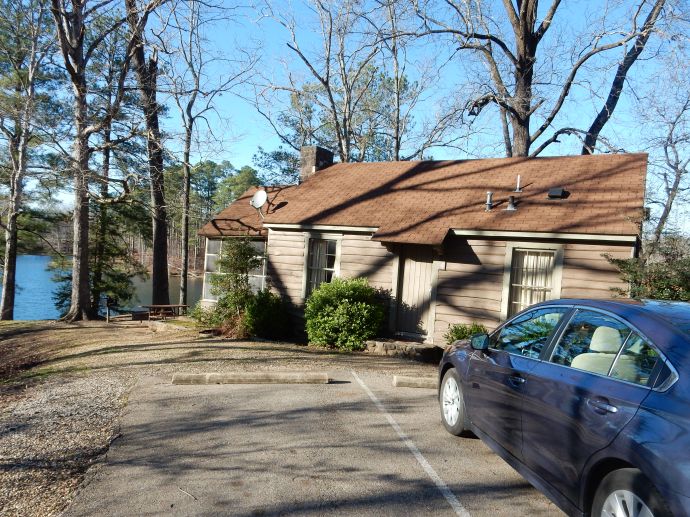
Our cabin home for two nights in Tombigbee State Park

We made our way over to Tupelo. Our lodging for the two nights was a bit of a risk. We have a cabin in Tombigbee State Park. Reviews were mixed but the location was near to Civil War sites and Chris likes to try state parks. My take is that it was a reasonable choice; it is large, has a screened in porch, and a full kitchen although we have not used it much. The water is hot but I definitely believe the bathroom could be cleaner. The price was only $75 per night although tomorrow’s Hampton Inn is only $10 more. Luckily it has heat, tonight’s temperature will go down into the 30s. Most days have been up in the 60s and 70s. The cabin is on the shore of a lake, the frogs and birds can be heard early and late. Thursday night a storm came through but tonight is clear with a pleasant sunset and a moon to shine on the water. The screened in porch has a swing which we used during the day.

After dinner Thursday night, we drove by the birthplace of Elvis Presley. When we booked this area, we had forgotten that Presley was born here and lived here for his first 13 years. We did not pay for the tour, the area is open to the public for viewing after hours.

Friday we drove up to Corinth MS, very close to the Tennessee border. Corinth was a strategic railroad crossing for two main tracks going north-south and east-west that tied the Confederacy together. The major battle of Shiloh in April 1862 was fought with a high percentage of untested soldiers. The North was driving down from the Ohio River in its goal to split the Confederacy in two.

Over two days of battle, with the advantage going back and forth, the Union forces eventually prevailed and the Confederate forces retreated the 20 miles to Corinth. In a two-day battle in early October the Confederates had re-grouped and attacked Corinth. The result was similar, the Union forces prevailed. The Confederate generals had predicted to Richmond that if they lost Corinth, the South would lose the war. Correct.

The Union controlled Corinth until January 1864. The town was basically destroyed as the Union forces burned public buildings when they marched out. Over the two years that the throng of soldiers was based here, they made a mess of the town. More than 100 battles, skirmishes, and raids occurred in the area.

When the Union forces won, the town also became a refuge for slaves, or as they were known at the time, “contraband property”. The Union established a camp who housed 3,500 refugees who fed themselves, had literacy classes, and delivered soldiers to the Union Army. The food and cotton grown by the former slaves not only fed the camp but turned a profit that was sent on to the federal government. The camp resembled a small town, complete with a church, commissary, hospital, and homes.

The water feature at Corinth Battlefield National Historic site visitor center

The Corinth visitor center was a marvel. Three excellent films, numerous clear displays, and brochures for further information. It has a water feature monument that represents the history of the U.S. with symbolism and words showing the Declaration of Independence, the first 13 states, the expansion of new states with the conflicts these caused, the major battles of the Civil war, and the re-unification.

The next two locations were downers. Brice’s Cross Roads was about a battle in June 1864, after the Union had left Corinth. The battle was a tactical maneuver by the Union to bring back Confederate forces who were heading east to harass Sherman on his march to the sea. Although the Union forces lost this battle, they succeeded in stopping this group of Confederates from fighting against Sherman. But the battlefield itself is small, few signs, and just one side of a brochure to discuss it.

The final site was Tupelo battlefield Monument. This we knew in advance was just a monument, stuck on a piece of ground along a busy highway. Why it even made it to an official National Park Service site is beyond me. It was but another skirmish, among many, where the Union forces kept the Confederates busy here instead of marching east. But we drove by and got a picture without being rear-ended by a car behind us on the road.

Hiking along the Natchez Trace

One other stop was a visitor center along the Natchez Trace Parkway. The parkway is 444 miles long and recreates an early foot traffic route used by American Indians and then early settlers who transported goods along the Ohio and Mississippi rivers to the port of New Orleans. River currents prohibited their boating back home so they walked back. This process lasted until the growth of steamboats. The parkway was a project begun by the Daughters of the American Revolution. It was declared a unit of the National Park Service in 1938 but not completed until 2005. We took an hour hike on a trail across from the visitor center.

As they say in the South “Have a blessed evening”.

Ed and Chris. Tupelo MS. March 10

Categories: road trip, travel | Tags: , , , , , , , | Leave a comment

2017 Trip Two: Tour of Texas March 8

Forrest City, Arkansas March 8

Shades of Saskatchewan. For those of you who have been following this blog for a long, long time may remember the flat tire we had on the plains of Saskatchewan on a Saturday afternoon. We just made the service department of Canada Tire in time to have the spare tire replaced before they closed for the Canada Day weekend.

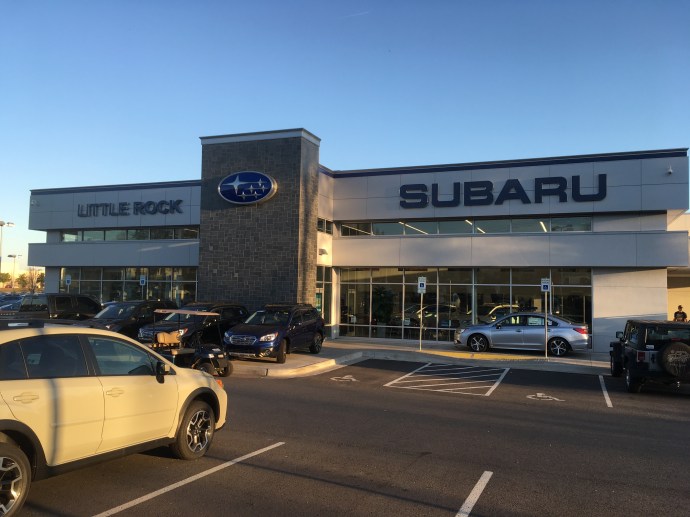
Car repairs in Little Rock, Arkansas

Well today around 3:30 PM we hit a piece of broken truck tire, actually the third or fourth piece of tire, we encountered on I-40 in central Arkansas. The tire apparently knocked out our fog light and jarred loose the front right bumper. We made it to the Little Rock Subaru in time for them to fix the fog light (a broken bracket holding the light, the light itself was ok), re-attach the bumper, and get our next 6,000 mile service check done between 4:45 and 6:15 PM. (The service department closes at 6 PM.) Way to go Subaru.

The consequences were: we got our service check done now, the cost was minimal, we demonstrated our flexibility by canceling one night’s lodging, the planned activities for Thursday to lodge here in Forrest City Arkansas, and we are likely to be able to walk the trails at Tombigbee State Park near Tupelo Mississippi.

So what did we do today? Well, Fort Scott National Historic Site was the sole focus, other than driving. Fort Scott was a fort based on the Kansas-Missouri border. It was only in operation from 1842 to 1873. It had four main purposes. They were, in sequence, guaranteeing land for Indian tribes from white settlers, trying to keep the peace during the “Bleeding Kansas” era, establishing a base of operations during the Civil War, and protecting the expanding railroads from Indian attacks.

Fort Scott was one of numerous forts built from Minneosta to Louisiana. Their purpose was to protect Indian Tribes and the lands they were guaranteed from white settlers. It actually worked for a while, until gold was found in California, Texas was annexed, and the “Manifest Destiny” theory became reality as settlers just poured westward. Indians became even more restricted to the least desirable lands and Fort Scott was abandoned in 1853.

Officers’ quarters at Fort Scott National Historic Site

Bleeding Kansas refers to the period when US legislation allowed the people in the territory of Kansas to determine if the state would allow or prohibit slavery. Three groups emerged. Abolitionists wanted to get rid of slavery everywhere. Proslavers wanted slavery obviously. Free-staters did not object to slavery but just did not want it here. Violence broke out and 1858 soldiers returned to Fort Scott to try to control the violence. Eventually Kansas was entered into the US as a free state in January 1861.

So, 1861. The Civil war starts up. The US Army returns to Fort Scott and the fort was a storehouse for Union Armies, was a hospital for soldiers, and a refuge for people in distress. The Confedertes made two efforts to capture Fort Scott, but failed.

After the war, railroads began their westward expansion. Soldiers were recalled to Fort Scott to protect railroad workers from landowners who did not want the railroad crossing their land. By 1873 the railroads were completed and Fort Scott was permanently closed down.

The lobby of the Courtland Hotel at Fort Scott

We left Fort Scott, the town and the historic site, and our lodging at the Courtland Hotel. The hotel was a pleasant old hotel in downtown Fort Scott. The current owner has been here for 12 years, we congratulated him for running a samll business in a struggling area. The hotel was pleasant and well maintained.

Ed and Chris. Forrest City Arkansas

Categories: road trip, travel | Tags: , | Leave a comment

2017 Trip Two: Tour of Texas March 7

Fort Scott Kansas Tuesday March 7

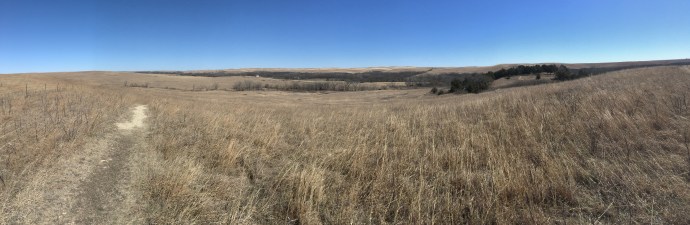
A view of the tallgrass prairie

America encompasses many types of scenery. A simplistic fact but important here. We drove through the Flint Hills of Kansas today, on purpose, to see portions of the Tallgrass Prairie and the Flint Hills. For some people this type of scenery would be boring. Relatively flat land, small streams, no mountains, no dramatic rock formations, no waterfalls, few trees. And we did not see it at its best, when wildflowers of all colors populate the fields.

Yet the starkness and openness has a beauty also. Today we heard birds chirping. The wind (strong) rustles the grasses. The deep blue sky contrasts nicely with the undulating hills of brown grasses. No, it is not our favorite scenery in the country, I am still partial to waterfalls. But we are glad we made the effort to get off the interstates and drive the two lane roads through the area.

When we left Topeka, we took the Native Stone Scenic Byway. The brochure says: “Take a drive down the Native Stone Scenic Byway and you will see miles of stone fences made from the native limestone found in that area. Well, we drove 50 miles of the byway and did not see any along the route. We did see one or two short sections of re-constructed stone walls. It was not until we arrived at the Tallgrass Praire Natoinal Preserve, probably 30 miles past the turnoff from the Native Stone Scenic Byway, we did see some old stone walls. I would call that a case of over-hype by someone in an office who has not driven the route. We still enjoyed the drive, but not for the original reason.

The ranch house at National Tallgrass Prairie Preserve

Our first stop was the Tallgrass Prairie National Preserve in Strong City, KS. In the U.S. there are three types of prairie; tallgrass in the eastern portion of the plains, shortgrass in the western portion of the plains closest to the Rockies, and mixed grass prairie which is in between the two. This preserve is tallgrass. The height of the prairie grass has everything to do with rainfall.

The Tallgrass Prairie preserve was originally an 11,000 acre ranch with home, barn, and one-room school house. The ranch demonstrates life on the prairie but for us the main attraction was the prairie itself. We walked out along the hills and trails and marveled at the vista. I can imagine that it might be cold and lonely here in a blizzard however.

The Chase County Courthouse in Cottonwood Falls KS

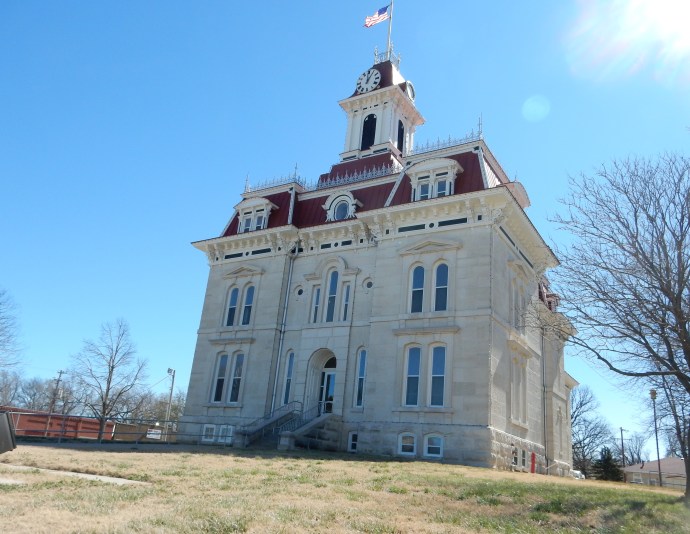
After the Preserve, we drove a few miles and had lunch in Cottonwood Falls (population 874) at the Grand Central Hotel. It was a pleasant meal at probably the only restaurant in town. At the end of Main Street is the Chase County Courthouse, an imposing structure completed in 1873 and the oldest operating courthouse in the state of Kansas.

A local art gallery in Cottonwood Falls was host to a traveling exhibit on the Chisholm Trail, that route used by cattle drovers from 1866 to 1887 to drive Texas Longhorn cattle to railheads near Abilene Kansas and other towns to ship their cattle to eastern markets. We may see more about this when we get to Texas.

Ed and Chris

Categories: road trip, travel | Tags: , , | Leave a comment

2017 Trip Two: Tour of Texas March 6

Topeka KS. Monday March 6

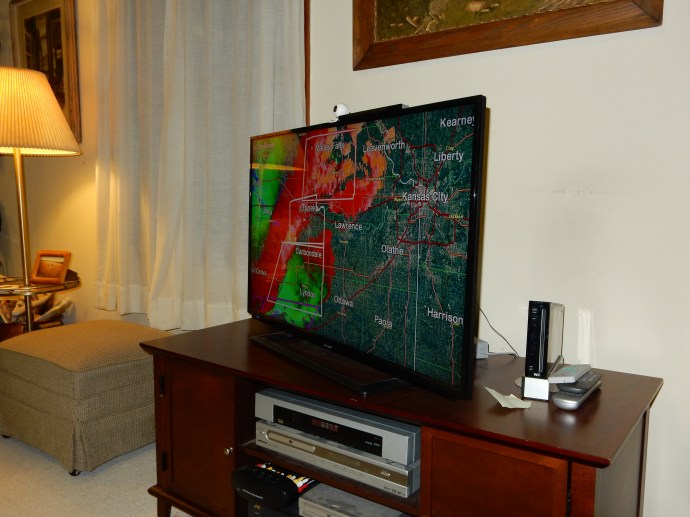
Our tornado warning on the TV screen

Shades of Dorothy and the Wizard of Oz. We experienced a tornado warning at dinner tonight in Topeka. The sirens went off, the emergency alerts rang on all of the phones in the restaurant where we were dining. People here take tornado warnings seriously. We and the other diners boxed up our food and headed back to our Evergreen host’s basement to finish dinner. The restaurant offered to have people move into their secure area but most of us chose to leave. Three tornadoes were spotted but it seems none landed or caused any damage.

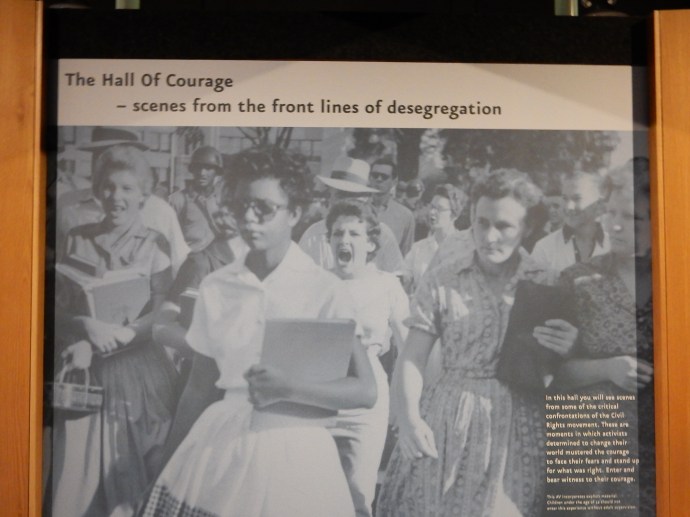
That was an exciting end to a calm day touring Topeka. It was warm (80 degrees F) and windy today, fine for walking around. The Bradford pear trees downtown were already blooming. Our travels started with the National Historic Site of Brown v Board of Education. Hopefully at least the Americans reading this blog recognize Brown. This was the historic 1954 Supreme Court decision declaring that: “We conclude that in the field of public education the doctrine of ‘separate but equal’ has no place. Separate educational facilities are inherently unequal.”

This National Park Service site had one of the most powerful videos I have experienced. A young black girl is talking to a long-time friend of her grandfather and is receiving a history lesson about the roots of segregation and the battle to provide freedom for all Americans. Her expressions of amazement conveyed clearly the wonder that people actually believed in this segregation stuff.

One display case at the Education exhibit at the NPS Brown v Board of Education National Historic Site

The building is in the former Monroe Elementary School, one of four segregated elementary schools for African-Americans in Topeka. This is the school Linda Brown attended instead of the closer white only elementary school. Other rooms in the building showcased exhibits on education and the battles fought to end segregation in the U.S.; a sample kindergarten room from that time period, and the actions that followed Brown v Board of Education to implement the Supreme Court decision. Amazing that government officials thought they did not have to obey the Supreme Court decision.

Once again, this NPS unit was staffed by a friendly and knowledgable ranger. Park rangers are just one of the reasons we like NPS sites so much.

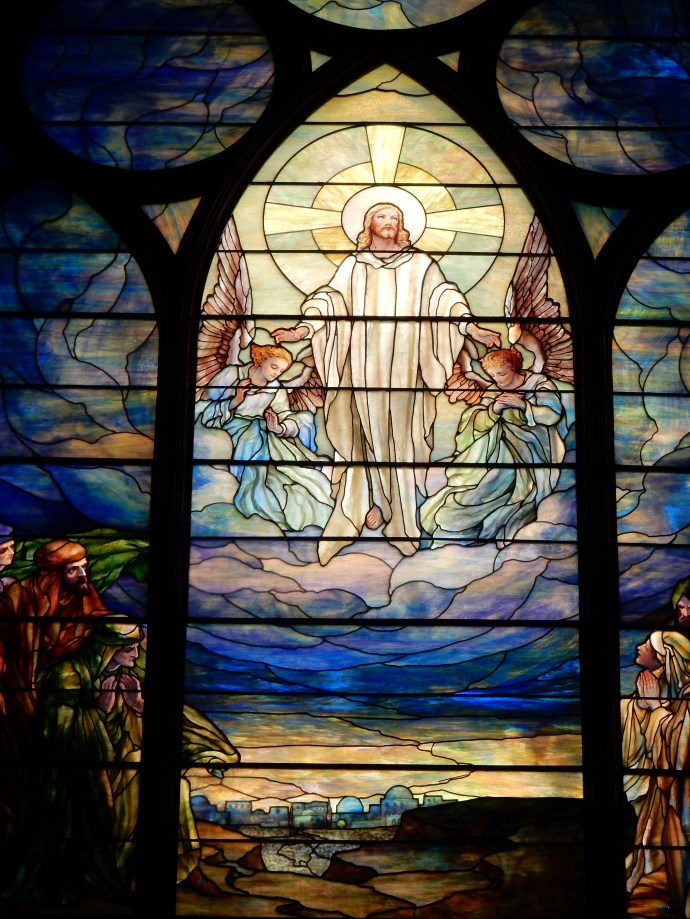
The Ascenson stained glass window by TIffany in First Presbyterian Church in Topeka

Our second stop was at the First Presbyterian Church across from the State Capitol. This church has a series of Tiffany prepared stained glass windows. Tiffany stained glass has gained its reputation because it is glass without paint,enamel, or stains. Instead, the color is produced using additives like cobalt,copper, gold, etc. Evidently, on Tiffany’s orders, the formulas to produce these colors were destroyed upon his death.

The Kansas State Capitol in Topeka

After a quick lunch, we took the 2 PM tour of the Kansas State Capitol. The guide was the husband half of our Evergreen host couple. He has been doing these tours for 18 years and part of his “Schtick” is that he sings several songs during the tour that relate to the story line. He got all of us to join him in singing the Kansas state song “Home on the Range”.

The actual sledge hammer used to break down the door to the Kansas House chambers.

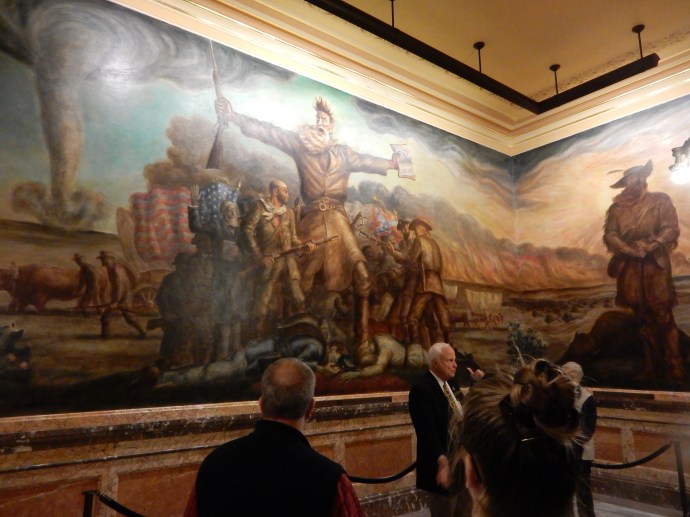
Two of his interesting stories. First, in 1893, there was a dispute between Republicans and Progressives over which party controlled the House of Representatives. The Progressives took possession of the building and locked the Republicans out. Eventually the Republicans got fed up and took a sledgehammer to the door of the chambers and got in. Eventually the matter was settled without the use of firearms which both sides possessed. Second, as we viewed a famous mural of John Brown titled Tragic Prelude by John Steuart Curry he pointed out several of the figures and which famous personages they represent.

“Tragic Prelude” mural in Kansas State Capitol

Another in a series of impressive and beautiful state capitols. Unlike Nebraska, the Kansas capitol is constructed in the dome style. With the statue of the Indian on top, it is taller than the U.S. Capitol. One could climb the 296 steps to the dome but with my vertigo, we passed on that opportunity.

Ed and Chris. March 6. Topeka

Categories: road trip, travel | Tags: , , , , , , | Leave a comment

2017 Trip Two: Tour of Texas March 4 Part 2, and March 5

Topeka, KS. Sunday March 5

Part 2 of March 4 (Part 1 of March 4 focused solely on sandhill cranes. This post discusses the rest of Saturday.)

Saturday was more than cranes. We kidded each other that Saturday was birds and bombs. The sunrise crane watch ended around 7:30. We drove the 30 miles back to the hotel for breakfast before heading out again. Our first stop was Hastings, NE, home to the Hastings Museum. This museum was rated as a “Gem” by AAA. The couple we met leaving the lunch at Southeast Community College on Thursday had also recommended another place to see in Hastings as well as a great lunch place so we had several stops planned for Hastings.

Hastings is 50 miles from Kearney and the first 10 miles of our route took us through the corn fields used by the sandhill cranes to feed while laying over on the Platte River. Birds were crowded in many fields, flocks flying to and from fields were crowding the sky.

The Hastings Museum was the creation of Albert Brookings (1880-1946) who was a collector from his youth. The Museum officially dates back to 1926 and has been a collaboration with the City of Hastings which supports it to this day. The museum in its early days moved from excess building to excess building, usually school buildings.

Inside the museum are collections of: dioramas showcasing animals of North America, Plains Indians exhibits, early autos and late-model buggies, information about European immigrants to Nebraska, firearms, and the creatures and the time period when this part of the United States was covered by an inland sea. There is a planetarium and large screen movie theater (similar to IMAX). Finally there is a special exhibit focused on Kool-Aid.

Part of the Kool-Aid exhibit at the Hastings Museum

Kool-Aid was an invention of Edwin Perkins while he was living in Hastings. The Perkins family ran a grocery and distribution business in Hensley NE. Edwin moved to Hastings and began inventing products, selling a brand of items called Onor-Maid which I relate to Watkins products. He was quite successful. His most successful invention was Kool-Aid which was first manufactured in Hastings in 1927. It proved extremely successful. Eventually Perkins moved the factory and company to Chicago but maintained his roots to Hastings. The exhibit does an excellent job presenting the family history, his business endeavors, and the development and marketing of Kool-Aid.

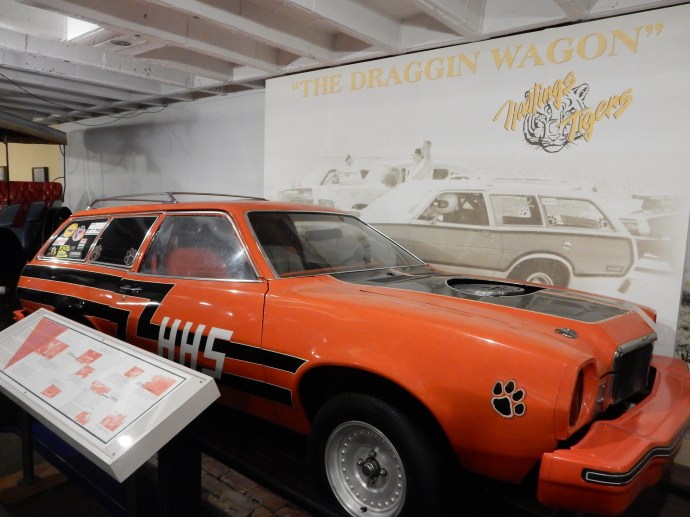
The Hastings High School exhibit at the Hastings Museum

I am sure each person who visits here has their own particular memory. Some of the items that resonate with us included the fact that Cliff notes, that college staple, was created by a Nebraskan, Cliff Hillegas. The Hastings High School had a program in drag racing, where over the years students worked on car repairs. Some of those 240 cars were used in drag racing, at the local raceway; others were re-sold or used by the local Fire Department for “Jaws of Life” practice. We also learned that Sears Roebuck sold automobiles from 1905-1911.

One exhibit had a section on notable Hastings and Nebraska people. Notable in this regard is less newspaper famous and more notable in their accomplishments as a member of their local community. First female dentist or notable business person are examples. Another tid-bit of American history was presented through the story of a Japanese man who had been interned in camps during WWII. As he grew up, he matured and fell in love with a local woman. Unfortunately Nebraska had until 1963 a mixed marriage law. A white person could not marry a person who had one-eight or more or Negro, Chinese,or Japanese blood. The couple had to get married in Kansas but fought to have the law overturned, being successful in 1963.

We were impressed with the museum and the accuracy of the exhibits. For instance, the information and sensitivity to the Plains Indians and the impact by the arrival of European immigrants was accurate and culturally sensitive. The information did not appear to be recently added which made the sensitivity more remarkable. We have been to numerous museums around the country and this museum rates very highly, particularly when you consider this museum is financed by a community of about 25,000.

For lunch, we went to the Back Alley Bakery in downtown Hastings. This small cafe served an excellent strata which both of us enjoyed. We did not have room for any of the excellent appearing desserts.

In the afternoon, we drove around one of the nation’s most significant naval landmarks. Yes, a naval landmark in Kansas, 900 miles from the nearest ocean. The Naval Ammunition Depot in Hastings produced 40% of the US WWII munitions for the navy, including bombs, rockets, torpedoes, mines, etc.

The depot was located here, far inland where it would not be subject to enemy attack by ship or plane. Three major railroad lines could ship the product easily. Over 200 properties were condemned to build 2200 buildings on 48,000 acres of land with all of the related roads, railroad tracks, water, sewer, electrical and gas lines, etc. 10,000 workers doubled the pre-war population of Hastings. The facility did have one major explosion that killed nine people and was heard 100 miles away in Lincoln.

Just a few of the ammunition storage vaults at the Hastings Naval Depot.

The depot was decommissioned in 1996. Today parts of the facility ae used for a community college, a golf course, National Guard training, and industrial facilities. However, there are still numerous facilities still in evidence. Hundreds of concrete bunkers that had been used for explosives storage are lined up in rows. Over 1,000 ammunition vaults can be seen as you drive along the roads.

Thus came our motto for the day, birds to bombs.

Sunday March 5

A close-up of Sandhill Cranes feeding in fields south of the Platte River

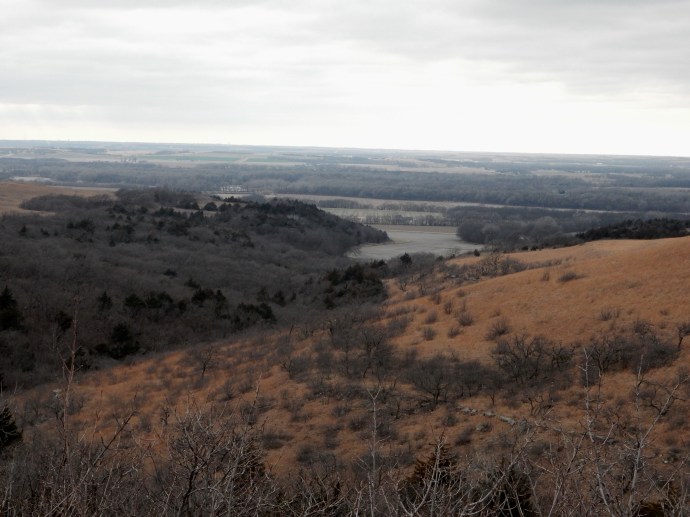
A view of prairie preserve near Red Cloud NE

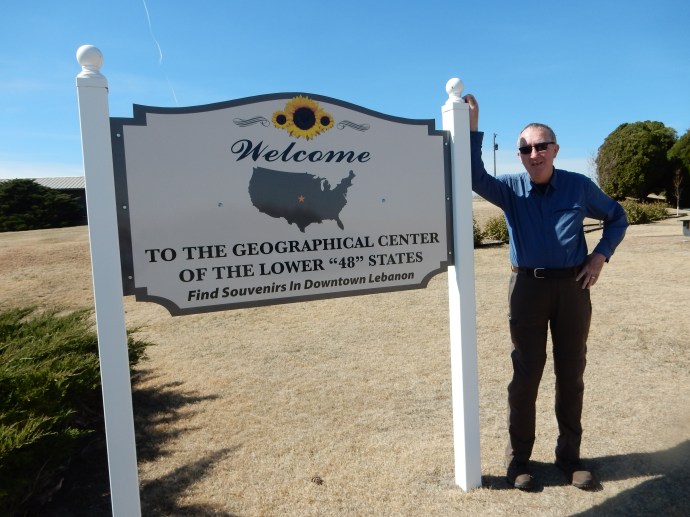
The geographical center of the 48 contiguous U.S. states

After church and breakfast, we left for our next destination, Topeka Kansas. No interstate today, it was two lane roads through farming country. The first portion of the day passed through the traditional flat corn and grain raising fields; frequently populated by sandhill cranes feeding on left over corn. As we drove further south, the land became less flat with rolling hills. Just south of the Nebraska-Kansas state line, we made a quick stop at the “Geographical Center for the Lower 48 States”. This location in the middle of agriculture is marked by a small chapel, a U.S. flag, a picnic table, and two markers.

The world’s largest ball of twine in Cawker City, Kansas

As we continued through Kansas, our next stop was unplanned. In Cawker City, we stopped at the “largest Ball of Twine”. Now, you have to understand, we thought we had already seen the largest ball of twine back in Darwin MN. Well, according to Roadside America, there is quite the competition between the two. Evidently, the one here in Cawker City is larger, but, it was rolled by several people. The original largest ball of twine in Darwin MN was accumulated by one man. When he died, the Darwin ball surpassed the Cawker City ball of twine. The people in Cawker City decided they would continue the process and added more twine to their ball. The Darwin people decided to be purists; to this day, the ball of twine in Darwin is the “Largest Ball of Twine Made by One Person”. The Cawker City ball of twine is the largest but made by numerous people.

Now, there is still another controversy. The Cawker City ball of twine is so large, it can no longer be lifted up easy enough to allow the twine to be added on all sides. New twine is only added to the top and sides. Soon it will no longer be circular. Can it still be a “ball” of twine if it is not round?

Our route to Topeka took us through Manhattan Kansas, home to the Flint Hills Discovery Center. The Center partially focuses on the Flint Hills, partially serves as a children’s hands-on learning center. We came here to learn more about the Flint Hills. The Flint Hills are a region in Kansas and northern Oklahoma distinguished by its rocky hills. This area was the site of an inland sea millions of years ago.

A view of the Flint Hills area in Kansas, showing the taller hills than were present at the prairie near Red Cloud NE

In the Flint Hills, the limestone soil is interlaced with flint rocks which erode more slowly. The result has been an area with land being taller and rockier than the rest of Kansas. Rockier soil meant the European settlers were unable to till the soil. The result means more cattle farming and less grain crops. In this rocky area, the prairie grass roots have to maneuver through cracks in the rocks and flint. The water source is beneath the rock layer and thus the roots are deeper into the ground than the eight foot height of the grass above the ground.

The Discovery Center was impressive but given the heavy emphasis on children’s learning, we did not spend a long time here.

Sunday and Monday nights we will be staying with an Evergreen host couple in Topeka.

Ed and Chris. March 6. Topeka KS

Categories: road trip, travel | Tags: , , , , , , , | 2 Comments

2017 Trip Two: Tour of Texas March 4, Part 1

Kearney, NE March 4. Saturday

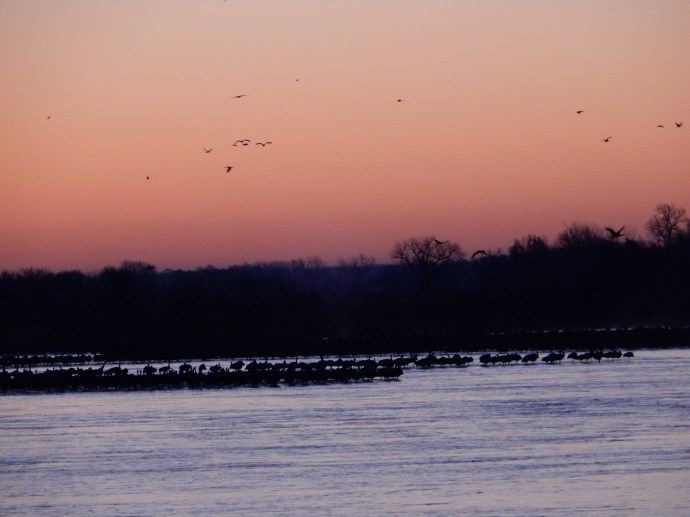
Sunrise on the Platte River from the Crane Trust blind

Sunrise on the Platte River from the Crane Trust blind

We stumbled through the dark at 5:15 AM, trying not to trip on the person ahead of us. 18 of us, bundled up, hoping to see, and hear, large numbers of sandhill cranes. Most people were in dark jackets which would have been great if they were trying to be a cat burglar. But as they blended in to the early morning gloom, it was difficult to see them. Our destination was a blind, a wooden structure with windows overlooking the largest roost of sandhill cranes along the Platte River. We parked our cars about a block away. We were told it was critical to be quiet and to not use cell phones for calling or lighting the way. Our leader had a small, red colored flashlight to slightly show the way. But towards the back of the line, the red light of the guide only indicated in a general sense where we were headed.


Morning video at Crane Trust

We made it to the blind without any major incidents and sat down, after fumbling around in the dark to find the benches. Now the waiting began, until enough light appeared to see the cranes. We heard them first, a cacophony of bird calls that increased and decreased spasmodically. Besides the cranes, we could hear ducks and song bird type calls. The sound level increased as the light increased. Eventually there was enough pre-dawn light to begin taking photos. I waited to shoot until at least two other people began taking photos; I did not want to be the first and then discover I made some noise that would alert the cranes to our presence.

Sunrise on the Platte River

Sunrise on the Platte River

My first photo was taken at 6:20 AM and the last at 7:25. The light was colorful but still not enough to do a good panoramic shot showing the full roost. Most of the birds were still, not a lot of preening and dancing. Around 7 AM, birds started flying around, not necessarily leaving the roost to feed but just flying around the river. Chris and I took turns with the camera and the iPhone. Some people had their 35 mm cameras with zoom lenses; you will not see those close-up shots from what we have.

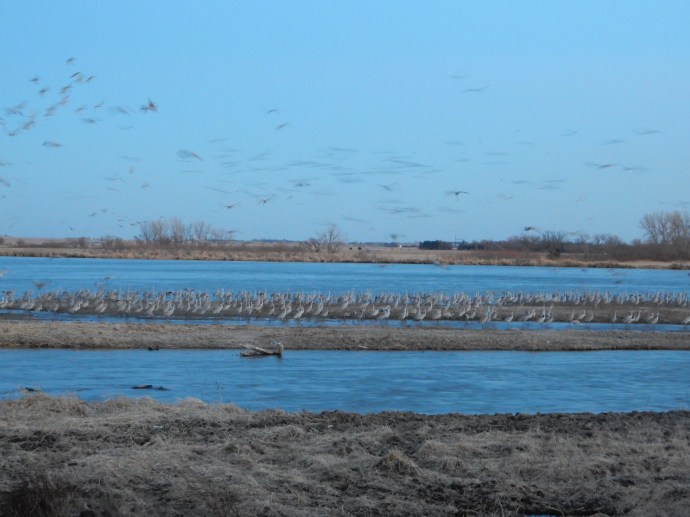
It was a great experience. The Crane Trust says about 200,000 cranes are in the area at the current time. As we returned to our hotel, a 30 minute drive from the Crane Trust offices, we started seeing flocks of cranes, from 5 to maybe 100 birds in a group, flying from the river area and landing in fields along I-80 to feed. Heck, they woke up hours after we did and got to have breakfast well before we did. Not fair.

We returned to the blind for the evening, sunset crane watch. We had signed up (in early January) for both sunrise and sunset out of concern that the weather would not be conducive for at least one of them. Frankly I was concerned that both of them would wash out, either due to weather or lack of birds. The sunset crane watch was even more spectacular than the sunrise.

Sunrise was about 30 degrees and we had to wait an hour before we saw anything. Sunset temperature ranged between 71 and 61 degrees Fahrenheit, some birds were already present, and at the end, a huge throng of cranes roost less than 150 feet from the blind. There were more people, but not enough more to degrade the experience. Since we already had pictures, we could relax a bit more and enjoy just watching and listening.

Evening sandhill crane watch on the Platte River

Evening sandhill crane watch on the Platte River

The blind faces roughly southeast and the Platte River runs from the right (west) to the left (east). The sandhill cranes seemed to return primarily on a route that brought them in along the course of the river, they gathered in the air at a spot to our left front-but still a distance away, then seemed to congregate on land or a sandbar in a combined slow glide, helicopter fashion. Groups of 5 to 100 would mesh into this big group, circle around a bit-sort of like a whirlpool or eddy, and then slowly drop down. Every now and then a small group would come across land. This group would head to the west, get towards the end of a larger group, and make a slow turn similar to a cloverleaf exit ramp to a highway, and then become part of the larger river group. It was fascinating.

Sandhill cranes land close to us

Sandhill cranes land close to us

We had to use binoculars to watch individual cranes. Our cameras were not powerful enough to shoot images as the cranes landed and roost across the river. As the afternoon faded, more and more groups kept arriving. The sound of their calls kept increasing. As the light was almost gone, a large flock, maybe several thousand, started landing on a sandbar less than 150 feet in front of us. Our guide later said he had never seen them come this close to the blind before. You could hear the camera shutters click away constantly. Unfortunately, one of our group had a flash go off and 95% of the cranes rose almost instantaneously and flew off. (Using a flash in a big no-no. I even had electrical tape over my flash to make sure it stayed off.) Over the next 10-15 minutes, some of them returned but most were circling around trying to decide if they were returning or roosting somewhere else. We left shortly afterward since it was too dark to see and certainly too dark to shoot photos.

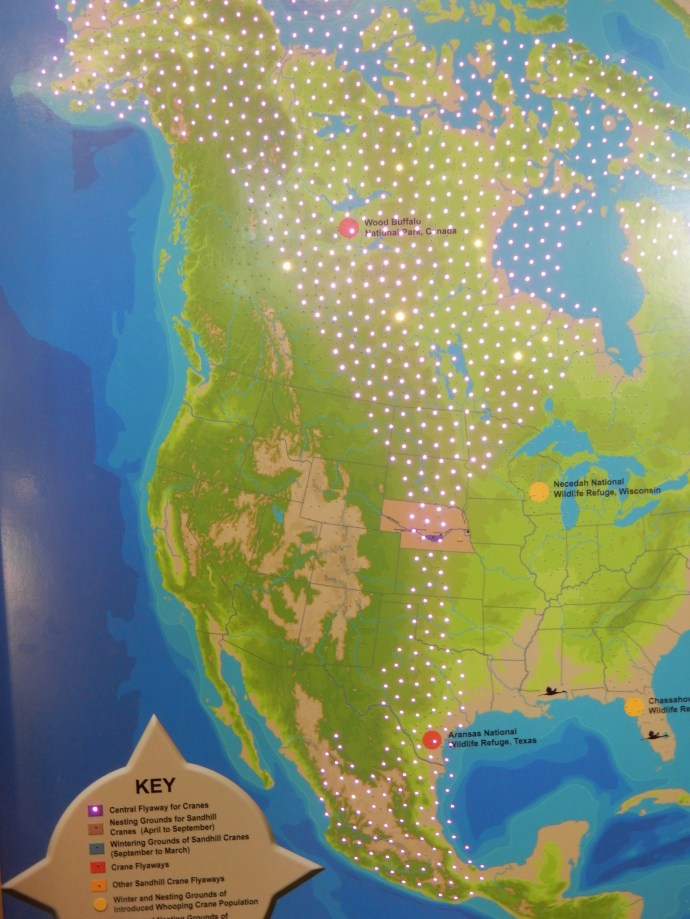
Crane migration path showing the pinch point on the Platte River

Crane migration path showing the pinch point on the Platte River

This was a once in a lifetime experience. We are glad we decided to go and lucky that the weather and birds cooperated. The migration here is of critical importance. The picture demonstrates the migration pattern of not only sandhill cranes, but whooping cranes, Monarch butterflies, and numerous other migratory birds and waterfowl. For the sandhill cranes, this is a stopping point where they eat and add 15-20% of their body weight. Without this stop, they would not have enough food and energy to make it to their summer breeding grounds.


Evening video at Crane Trust

However, the addition of over 20 dams along the Platte has reduced its volume by 80% and changed its hydraulics so that it no longer scours the shore. The dams provide for recreation, irrigation and drinking water, and hydro power. The impact for the birds is dramatic. THe picture below demonstrates the migration path and how it narrows here at the Platte River. If this one small, pinch point becomes eliminated, the migration path is destroyed.

The pinch point is only about 20 miles wide. Every Monday, a plane flies between Odessa and Overton Nebraska. One man in the plane is responsible for counting the number of cranes in the area covered by his fist, then he counts the number of fists that it takes to cover the sea of cranes below. This provides the first rough estimate. The more detailed count is provided by a person manually counting the cranes seen in the pictures taken by cameras in the plane as it flies along the river. Not a job I would want.

The Crane Trust was established to use human means to keep the Platte providing suitable habitat in this region. Environmental groups had sued when the Greylocks Dam was proposed on a tributary of the Platte. The judge allowed the dam but mandated the establishment of the trust to mitigate the dam’s impact.

Our day had other activites. We decided to make this fantastic crane adventure be part 1. We will complete a part 2 later of the other activities.

Ed and Chris. March 3 Saturday in Kearney NE

Categories: road trip, travel | Tags: , , , , | 3 Comments

2017 Trip Two: Tour of Texas March 3

Kearney NE. March 3, Friday

Wow. Another scrumptious meal from our Evergreen hosts. This could get addictive. After breakfast, we toured another uniquely Nebraskan facility, the Larsen Tractor Test and Power Museum. Not high on your list? Too bad, it was an informative look at the only agricultural tractor test site in the Western Hemisphere.

 A scene at the tractor Test Museum depicting two unrestored tractors

A scene at the tractor Test Museum depicting two unrestored tractors

Why here in Nebraska? Well, in 1918 Nebraska farmer W.F. Crozier bought a Minneapolis Ford tractor (not associated with the Ford Motor Company). The new tractor did not live up to its advertised claims. So he and Nebraska State Senator Charles Warner put into motion a bill to advance consumer protection; specifically protecting farmers by requiring that any tractor sold in the State of Nebraska must be tested and proved to meet its advertised claims of performance. Voila, thus was born the University of Nebraska Tractor Test Laboratory.

The tractor test track at University of Nebraska

The tractor test track at University of Nebraska

We had a tour of the facility by a retired professor, and dean, of the university who provided the background above and explained the various tractors on display. This facility has set the standard the world over and other countries abroad use the performance standards and testing measures to test their own tractors. Any tractor sold in the U.S.now will be first tested here on the test track with the equipment the lab has perfected. It will take about one week for each tractor to be tested. If the tractor does not pass, it will not be put on the market and has to go back to the manufacturer. And, the manufacturer can not just then lower the advertised claim of performance. The tractor has to be re-manufactured to meet the original professed standards.

A quilt by Pauline Burbridge

A quilt by Pauline Burbridge

From tractors we headed over to the International Quilt Study Center and Museum housed at the University of Nebraska-Lincoln. This museum is one that Chris has been hoping to visit for several years. Our tour focused on special exhibits. The first was a series of 12 quilts, more like artwork than household textiles, made by a British artist, Pauline Burbridge.
One of the award winning Japanese quilts

One of the award winning Japanese quilts

The second exhibit was from Japan, about 23 quilts by Japanese artists. The quilts are selected in Japan’s largest contest sponsored by the Japan Handicraft Instructors association. Neither Chris nor I quilt, but even we were impressed by the intricacy and detail obvious in the quilts exhibited.

Some of the Luke Haynes quilts

Some of the Luke Haynes quilts

The third exhibit was a group of 50 quilts by a Luke Haynes from New York. These quilts were displayed on and over a series of metal cubes created since the artist did not wish to have his work hanging on walls.

While all of the quilts were impressive, I guess overall we were disappointed not to see more of the 5000 plus quilts the Museum has in its archives. The museum follows strict protocol in storage and care of quilts lent for other displays. It also has quilts (I believe all but maybe only most of them.) available to be viewed online. Our recommendation would be to view them online where you can observe more of them and can do it at your leisure.

Our final stop at the University was at their dairy store. The University produces its own cheeses and ice cream and locals say it is the best. Of course, you hear that comment around any local creamery. We decided to test out the product, trying Karmel Kashew, Butter Brickle and Butter Pecan. The ice cream was good, worth the trip, but not outstanding. Maybe it would taste better when the weather was 20 or 30 degrees warmer.

Some sandhill cranes feeding in fields by the Platte River near Kearney NE

Some sandhill cranes feeding in fields by the Platte River near Kearney NE

We left Lincoln around 12:30 and headed out to Kearney NE-Sandhill Crane Capital of the World. More than 80 percent of the world’s sandhill crane population converges on the Platte River of Nebraska. Here they feed, gain weight, rest up, and prepare for their final journey to their summer breeding grounds in Alaska, Canada, Siberia and parts of the northern U.S. We hope to view hundreds of thousands of them tomorrow. We stopped at the Crane Trust headquarters and they indicated that the birds have arrived. We drove a few back roads to make sure.

A view of the Archway spanning Interstate 80

A view of the Archway spanning Interstate 80

Before checking in to our hotel, we stopped at The Archway, a tourist attraction spanning Interstate 80. This unique arch has a privately sponsored attraction providing a Reader’s Digest version of the westward expansion of the U.S.from the 1840s on. Displays, videos, and audio exhibits cover topics such as the early pioneers, Pony Express, the transcontinental railroad, the Lincoln Highway, etc. The tour consumed about an hour and is probably best for families with kids or people with just an overall understanding of US history. But, it got us out of our car and satisfied our curiosity as to what the heck was this thing crossing over the entire Interstate.

Ed and Chris. Kearney NE March 3

Categories: road trip, travel | Tags: , , , | Leave a comment

2017 Trip Two: Tour of Texas March 2

Lincoln, NE Thursday March 2

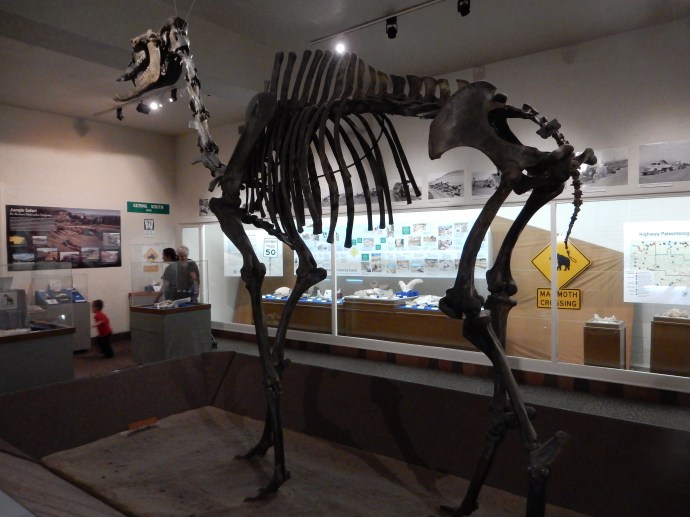
The camel skeleton at Morrill Hall at the University of Nebraska

The camel skeleton at Morrill Hall at the University of Nebraska

Who knew that camels originated in Nebraska? You doubt me? Well, the University of Nebraska State Museum in Morrill Hall at the campus says so and has a large display discussing how camels originated here and migrated elsewhere. Nebraska is evidently a major, major location for fossils. “Three floors of exhibits focus on the cultural diversity, biodiversity and paleontology of Nebraska. The museum houses one of the world’s best collections of elephant fossils, including one of the world’s largest mammoth skeletons.” (Per the AAA description)

Three of Todd Williams' Paintings the the Nebraska History Museum

Three of Todd Williams’ Paintings the the Nebraska History Museum

We had a blast at the museum. Actually it was the culmination of a very interesting day. We started out at the Nebraska History Museum. We only spent about 60-90 minutes here, but they were enjoyable. A new exhibit just opened up today. Over the last five years, the artist Todd Williams (from Nebraska) has painted 123 works of art, representing scenes from all 93 counties in Nebraska. The art includes portraits, landscapes, buildings, animals, etc. that cover the entire modern history of Nebraska. All scenes were realistic and, to my eye, extremely well done.

Kool Aid and Nebraska

Kool Aid and Nebraska

The second floor had an exhibit featuring items from their collection telling a story about a piece of Nebraska history. It might be a Kawasaki motorcycle since the first U.S.made Kawasaki was made in Nebraska. It might be a packet of Kool Aid since that product originated in Nebraska. It might be a Ku Klux Klan robe with the story of how the guy who wore it began a local Klan around 1990 and began harassing Jews. One Jewish family he called responded with kindness and compassion. Over a few years, the Klan member renounced the Klan, converted to Judaism, became ill and the Jewish family acted as his hospice service. It might have been a story about a Latino girl who picked sugar beets out in western Nebraska. The exhibits gave you a personal feel for the history of Nebraska and its people, not just a rote telling along a timeline.

After the Nebraska History Museum, we had lunch. Our Evergreen hosts had invited us to share with them lunch at Southeast Community College where the culinary students were preparing and serving the luncheon. Faith was our server, hoping to graduate this fall and to go into a bakery career. For the first course you chose between navy bean and ham soup or smoked duck salad. The main course options were carpet bagger steak, herbed salmon or bangers and mash. Dessert was your choice of milk chocolate pots de crime, dried fruit bread pudding, or white chocolate mousse. None of us had the bangers and mash but everything else was chosen and rated excellent. For $12 including tax and gratuity, it was a grand meal that fed us for the entire day.

As we left the college, we talked with another couple who gave us tips for other places to see and eat at between Lincoln and Grand Island NE, our next lodging location.

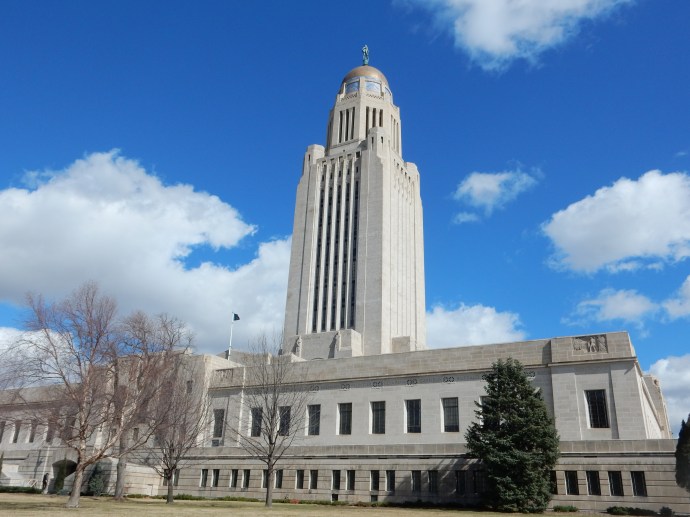
The Nebraska State Capitol in Lincoln

The Nebraska State Capitol in Lincoln

Next stop: Nebraska State Capitol. For a state capitol, the Nebraska capitol is a grand and pleasing surprise. Nebraska’s population is a little less than two million with over one half of that in the metro areas of Omaha and Lincoln. Nebraska has the only unicameral (one house) legislature in the United States, dating back to the 1937. The capitol building was built between 1922 and 1932 so there are two legislative chambers, but one is never used now. The state built the capitol on a pay as you go basis so it was completed and paid for at the same time. The building is also one of only four (I believe) that are shaped as a tower; Florida, Louisiana and North Dakota are the other three.

An interior dome at the Nebraska Capitol

An interior dome at the Nebraska Capitol

One of the murals in the north wing hall of he Capitol in Lincoln NE

One of the murals in the north wing hall of he Capitol in Lincoln NE

The capitol tower does have a small dome with a statue of “The Sower” on top. There are four rectangular low-rise office wings with their own courtyard surrounding the tower. Each wing extending out from the rotunda area has its own unique feel. For instance, the Supreme Court wing is dark and gloomy. The north wing has numerous murals, friezes, and tile works that amaze and delight the person walking down the hall. We were the only people on the 2 PM tour so we were also able to get into the locked Supreme Court chambers and the locked unused legislative chambers. Both were filled with symbolism of Nebraska and ancient philosophers and, while well-done, did not “Wow” us.

We made a quick stop at a small museum. The American Historical Society of Germans from Russia. This museum is sponsored by a group of people intent on maintaining their heritage. During the time of Catherine the Great and Alexander I of Russia, about 1760 to 1820, these two Russian leaders invited foreigners to settle in Russia to fill in population voids. Foreigners were guaranteed the ability to run their own communities in their own languages and to not be drafted to serve in the Russian army.

Tens of thousands of Germans took up the offer. Lousy economic conditions, forced military service-frequently for other countries (think of the Hessians fighting with the British in our Revolutionary War), religious intolerance, shortage of land, etc all contributed to this movement. But around 1870, Alexander II revoked those promises. Migration to the United States and South America followed with most of those emigrating to the US settling in North Dakota, Nebraska and other Plains states. This museum is dedicated to telling their story and preserving the records of who came over and when. It was pleasant, a new bit of history but not necessarily the highlight of the day.

The day’s highlight was Morrill Hall. If the name sounds familiar to Americans, it is because there are a dozen Morrill Halls on college campuses. They are named after Justin Morrill, a U.S. Representative from Vermont who sponsored the Morrill Land Grand College Act that gave land to the states to pay for establishing universities.

Morrill Hall has wonderful, but dated stylistically, exhibits on the unique and numerous role of fossils in this state. If I remember the exhibits correctly, Nebraska has more fossil finds than any other state in the US. Nebraska works extensively with road building projects and any fossils found become a cooperative effort between the contractor and archaeologists to extract the fossils without slowing down the road construction.

So camels are but one fossil find. In fact, there are over 100 camel fossil sites in Nebraska. Woolly mammoths and other prehistoric fossils and recreated extinct animals are the major focus of many exhibit halls. Some of the exhibits are unique and found nowhere else in the world.

From the National Geographic PhotoArk exhibit

From the National Geographic PhotoArk exhibit

The PhotoArk: trying to provide a sense of the immensity of the task

The PhotoArk: trying to provide a sense of the immensity of the task

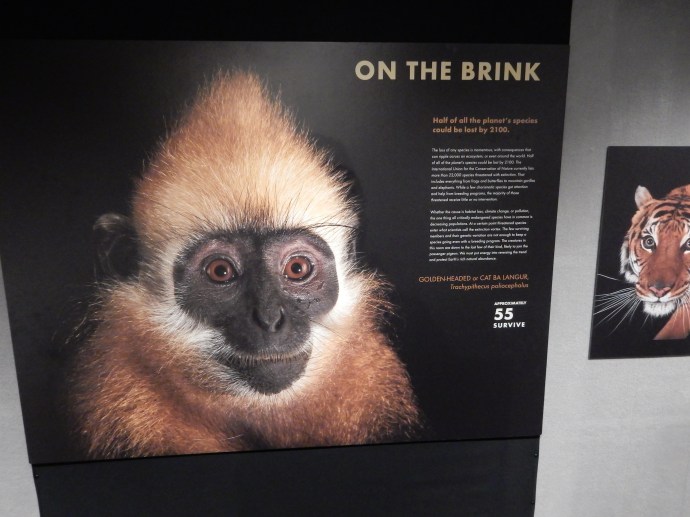
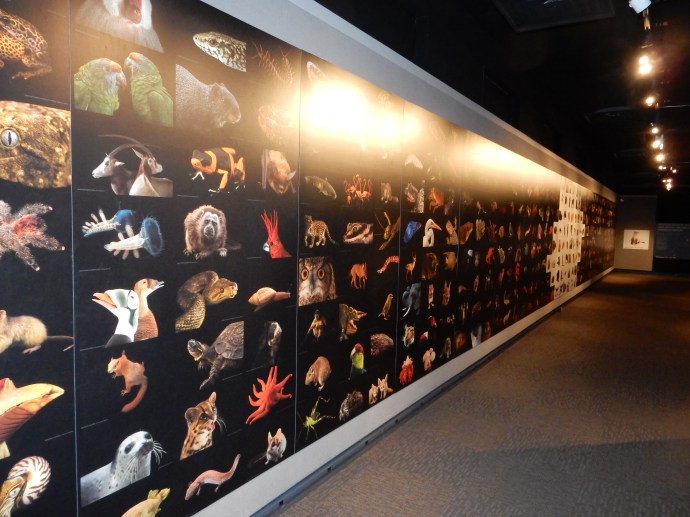
Another display showcases the National Geographic PhotoArk. This is an effort to photograph biodiversity by showcasing all species on earth. A stupendous effort. One exhibit hall is dedicated to photos of hundreds of animals with an emphasis on the species close to extinction.

2017 is the sesquicentennial of Nebraska’s statehood and the Museum was sponsoring several events tonight. We could have done yoga-we did not. There was story time we skipped. And we almost skipped free pizza because we were just suspicious about why free pizza. Well, there was a catch. We were invited in to be creative and make some art work as part of the process. We probably could have passed and still eaten the pizza but Chris was a good sport and gave it a go. Let’s just say the final product will not be hanging on anybody’s wall.

So, a long day filled with some unique activities. Tomorrow we finish up in Lincoln and head out to Grand Island and Kearney NE.

Ed and Chris. March 2

Categories: road trip, travel | Tags: , , , , , | Leave a comment

2017 Trip Two: Tour of Texas, March 1

March 1, 2017

On the Road Again.

Well, we are off on our longest journey yet. This trip is projected to be 61 days, arriving back in St. Paul on April 30. We actually deleted a few days at the end that we were going to spend in Oklahoma City and Tulsa, OK. Upon reflection, we decided that we would probably be in a mood just to zip home by the end of April. Our previous longest trips were 54 days driving around Florida in 2015 and 50 days in 2013 going to western Canada and parts of northwest U.S.

The schedule and dates were driven by several goals: A. to visit Big Bend National Park along the Rio Grande in southwestern Texas; B. to visit Kearney NE to try to observe the sandhill cranes in their northern migration; C. to spend a week at our timeshare in Miami Beach; D.to see the bluebonnets and other flowers in bloom in Texas; and E. to see previously unexplored areas of Texas. As usual, getting lodging inside a national park (this time Big Bend) meant having to pick a day months ahead of time before the rooms were all booked up. The Miami Beach timeshare also books up months ahead of time. After Big Bend and Miami Beach were locked in, we had to make the rest of the journey work. Some decisions may not provide for visiting at the optimal time. The sandhill cranes make their own timetable, usually the birds are most numerous in mid-March but we will be there in early March. While early April is normally a good time for bluebonnets, the weather has been warmer earlier than usual so blooms will pick their own dates as when to blossom. Since we will be in Texas, we will visit relatives in Houston and San Antonio, cities we have visited previously.

St. Paul MN Wednesday March 1.

St. Paul MN Wednesday March 1.

Today we started out in light snow in St. Paul. Maybe fifty miles into Iowa the snow from today and from last Friday’s storm had disappeared. We had left home a little later than usual in order to have lunch with my niece Shannon and her husband Adam in Iowa. Lunch was really just an excuse to get together and get caught up since we had not visited with them for over a year.

As we made our way through Iowa, we passed one intersection in Ames Iowa that had three large manufacturing facilities on three of the corners. Danfoss is a Danish company that makes pumps, motors, refrigeration equipment, compressors, etc. Amcor is an Australian company that manufactures packaging products. Barilla is an Italian company making pasta and sauces. Such a commentary on our world, three large international companies with a substantial corporate presence in the heartland of the U.S.

Wind Turbines along I-80 in Iowa

Wind Turbines along I-80 in Iowa

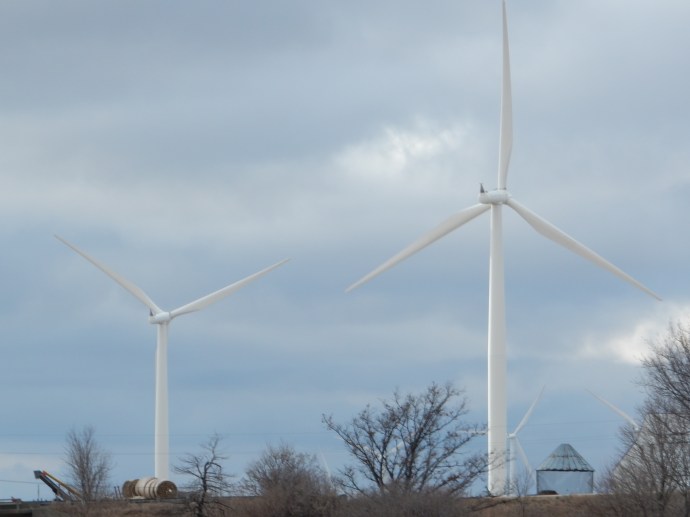
As we turned west at Des Moines, the winds picked up. We could have attached a sail to our car and used wind power to get us to Nebraska. Very appropriately as Iowa has jumped to number two in the ranking of states and the amount of wind power generated in that state. Texas is number one. Along both Interstate 35 and Interstate 80, one can observe numerous large wind farms. We recently decided to switch our home energy use to all wind power through Xcel Energy; maybe it will help offset the gasoline we use in our trips around the country.

When one thinks of Iowa, a flat landscape of fertile farm fields comes to mind but it is not all flat and agricultural. We have already mentioned the manufacturing presence in the state. As we drove west on Interstate 80, the flat landscape we had encountered driving south on Interstate 35 transitioned to a series of rolling hills.

Why? Loess. Loess can occur in differing parts of the world but here loess is glacial “flour” or dust (according to Wikipedia) that was laid down as sediment by glacial action and blown into hills and sediments basins as the wet sediment dried. In other parts of the upper Mississippi RIver valley, it forms part of the rich farming soil. Here the wind has shaped it into peaks and saddles of land noticeably different from the flat agricultural land of northern Iowa and parts of Illinois.

We ended the day in Lincoln Nebraska where we will be visiting for the next two days. The land has reverted to the flat lands although we expect to be driving through the Flint Hills of Nebraska and Kansas shortly.

At the top of the blog, we stated this will be a 61 day trip. We have been asked how we decide on our route and what to see along the way. The first step is similar to the description in the paragraph above; to envision an area of the U.S. we have not seen, or relatives to visit, or both. Then we start looking at Google Maps and our National Geographic 12 x 15 bound US map to get an overall sense of a route, focusing more on areas we have not traveled to previously. From there we hit the books, printed books first. Resources like AAA Tour books (particularly their Gems), a map of the 400+ National Park Service units around the country, books by National Geographic like Best Small Towns, Best Scenic Drives, etc., books (these are older but still valuable) by Readers Digest on Off the Beaten Path, the Road Less Traveled, Public Gardens in the U.S, etc. Reading these allows us to highlight locations relatively close to the area we are considering. Most of these books, when writing about a particular destination, also mentioned other interesting places within a reasonable distance. Then we go to the Internet, checking current reviews, hours of operation, how the attraction describes itself, etc. After choosing the most important locations, we sketch out a timetable, using an Excel Spreadsheet to list mileage, attractions to see that day, etc. It allows us to project how many days to spend in any one location and how long to get to the next night’s lodging. Finally, we will go to sources like Roadside America or Atlas Obscura to discover unusual attractions that might be along the way and can fit into our schedule.

The map included in this blog gives a general sense of the route we have plotted out.

2017 Trip Two, Tour of Texas

2017 Trip Two, Tour of Texas

Ed and Chris, March 1, 2017 Lincoln Nebraska

Categories: road trip, travel | Tags: , , , | 3 Comments

Blog at WordPress.com.