

We are in Alaska
Copper Center Alaska. Monday August 19
On this, the fourth day of this trip, Chris could finally say that she felt she was in Alaska, that the views matched her expectations of Alaska, not her previous feelings that we were traveling in the Canadian Rockies or even New Zealand. Today was primarily a travel day, a day of observing, a day of stopping to take photos, a day to have the scenery change. Fortunately the weather was pleasant. The strong winds died down as we left Palmer, with sunny to partly cloudy skies. Temperatures are starting to get cooler, highs in low 60s but dropping to mid 40s for part of the day.
The drive begins as we follow the Matanuska River, in the valley between the Talkeetna Mountains to our north (left) and Chugach Mountains to our south (right). The Glenn Highway was constructed in the 1920s, is designated Route 1, and was the first major highway in Alaska. It is primarily two lanes at this stretch with some passing lanes as one ascends hills. The river is frequently visible, still with that braided style of multiple channels and the milky white color from glacial “flour”, or ground up rocks, originating from glacial ice/snow/water moving over the mountains. But the river is below us, not a bubbling creek rushing alongside the roadbed, but a broad river a little distance away.
Roadside scenic overlooks are frequent, we take constant advantage of them, stretching out the time it would normally take to drive the 150 miles from Palmer to Copper Center. Towns are rare, even those are generally a small cluster of buildings, not a concentrated downtown or even a strip mall type of gathering. Traffic is busy with numerous pickups, travel trailers, and RVs.
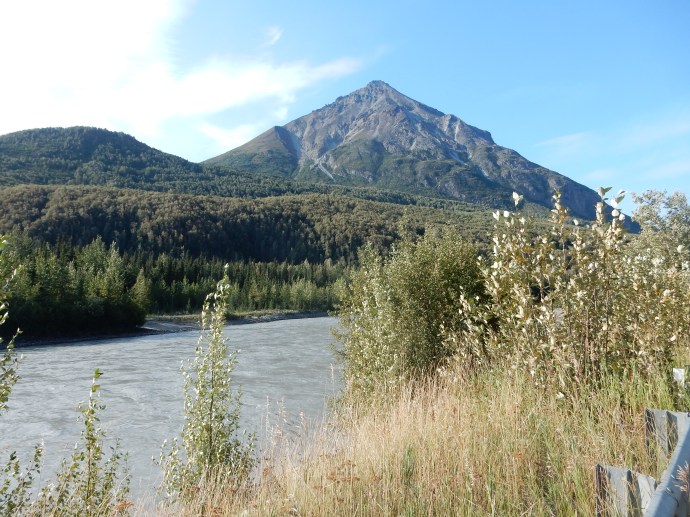
King Mountain and the Matanuska River

Glaciers appear
It seems about two-thirds of the way into the journey that the snow on the mountains begins. We pass a definite glacier, than a few more; recognizing that we do not know if they are interconnected and just one official glacier with multiple views or separate glaciers. In any event, snow in the crevasses is more frequent and easily visible in the Chugach Mountains to the south. The Talkeetna Mountains are drier and steeper, no snow is visible there. We pass King Mountain, a massive looking mountain that squats ponderously across the river.

The “tundra” area

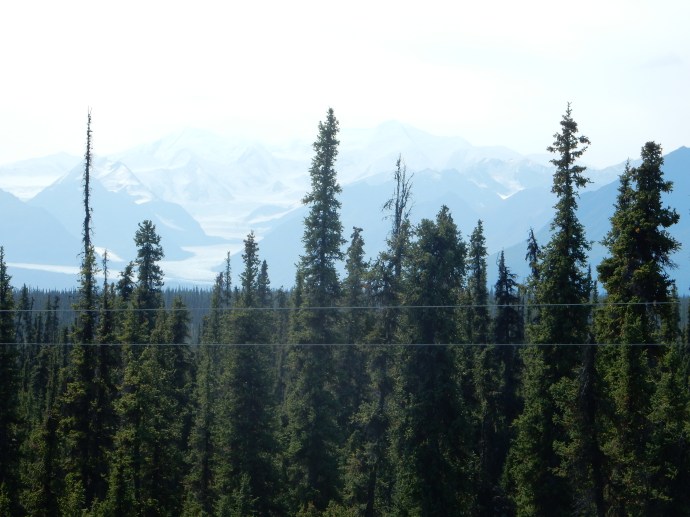
Finally the Chugach and the Matanuska river veer away from us, angling to the south. We enter an area of what I call tundra, a series of rolling hills and plains with spruce trees and low vegetation. These are black spruce we later learn, heavily infested with an invasive beetle that is killing many of them. We can see the difference, the dying trees are blacker with the needles still on them but not as green. The difference is quite noticeable as the dead and living trees are intermingled.
Again later we learn that even here there is permafrost; that permanently frozen ground that may be just 16 inches or 16 feet below the surface. Black spruce is aptly suited to grow where the soil is shallow. We take a break in Eureka to have a piece of pie at the Eureka Roadhouse, an 83 year old small cafe and gas station with a few rooms to rent.

Mountains or clouds??
As we leave and continue our drive, to the east appear either clouds or a new mountain chain. As we get closer it is clear, the view is more mountains but more massive than the Chugach or Talkeetna. This is our first, far off view of what will be Wrangell-St. Elias National Park and Preserve. We drive to Glennallen, a slightly larger community with a grocery store and three gas stations. We gas up here as the Glenn Highway meets the Richardson Highway. The Glenn will continue on to Tok and the Alaska (Alcan) Highway. The Richardson travels between Valdez to the south and Fairbanks to the north. Here the Richardson is our choice as it follows the Copper River which forms the western boundary of Wrangell-St.Elias.

Lunch at the visitor center of Wrangell-St.Elias National Park and Preserve AK
The main visitor center for Wrangell-St. Elias is 10 miles south of the juncture of the two highways. We spend about two hours here; talking with the rangers, viewing the movie, shopping, viewing the exhibits, having a late lunch that we had packed, and taking a short hike.
Wrangell-St.Elias is huge. It is the largest national park. It is the size of six Yellowstones, bigger than New Hampshire and Vermont combined, bigger than Switzerland. 20% of the park is covered by snow and there are only about 100 miles of road in the entire park, concentrated on two spurs that enter the park, one from the north, and the McCarhy Kennecott Road that we will be taking Tuesday. Parts of four mountain ranges are in the park; the Alaska Range, the Wrangell Mountains, the Chugach, and the St. Elias. It has nine of the 16 highest mountains in the U.S. These monsters are over 13,000 feet with Mt. St. Elias at 18,008 feet being the second highest in the U.S.; the Hatcher Pass mountains were only 4-5,000 feet. The park is 150 miles wide and 200 miles top to its bottom at the Gulf of Alaska. This is one massive park, most of which is wilderness and challenging to explore.
We will tackle a small piece of the park Tuesday. Tonight we are staying at the Copper Princess Wilderness Lodge; one of four lodges Princess Cruises has set up in Alaska. It is about the only lodging of substance and size in the area. This one closes in mid-September. Until then though the park service offers talks and walks here on a daily basis. Our ranger presenter tonight is a seasonal with experience in Alaska and Iceland with her home base being a small cabin in Maine.
Our walk around the forest surrounding the lodge discusses the animals and vegetation common in this area. For instance, she led us to a branch that had been eaten by a snow-shoe hare and recounted how one time she had been crouched down to examine some bushes when a snow-shoe hare ran past her without stopping. Moments later a lynx also ran past but as it passed it realized she was there and skidded to a halt, turned around and just stared at her for half a minute before bounding off. Chris and I related immediately to the story, we have a diorama at the Bell Museum in St. Paul that tells the story of the interconnectedness between the hare, the lynx and food sources.
Later, after the walk, the ranger presented a talk and slide show in one of the meeting rooms of the hotel. Open to all, it did seem to have a hard time competing with the bus travelers who headed straight for the dining room. This presentation covered climate change with detailed historical backing to present how the current change in the climate occurs, and how the current increase is so dramatic in such a short period of time without any connection to past changes caused by rotation of the sun, etc.
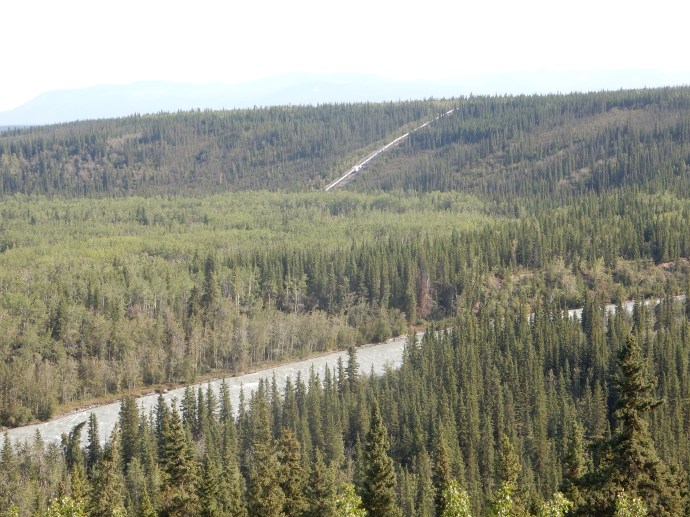
Our first view of the Trans Alaska pipeline
Of particular note for us traveling in Alaska is the danger caused by the melting of the permafrost. Just one obvious example is the danger posed to the Trans-Alaska Pipeline. The pipeline is built and heavily dependent on permafrost. If the permafrost melts, the stability of the pipeline is threatened and pipeline breaks are likely; threatening the supply of oil, the economics of the companies and of Alaska, and the resultant environmental damage.
Part of her presentation discussed Wrangell-St. Elias. Between her presentation and the movie, we could understand the beauty and majesty of the park, most of which we will not be able to see firsthand. Snow, ice and glaciers abound here; actually there are more glaciers in this southeastern section of Alaska due to the effect of the high mountains stopping the Pacific storms. Parts of the park receive over 60 feet of snow per year; the areas down around Juneau and Sitka can receive up to 100 feet of snow. The more northerly parts of the state, while colder, are drier.
Wrangell-St.Elais houses a building showcasing the Ahtna native culture but it was not open today and has not been most of the summer. It was unclear if funding or staffing was an issue but we will miss learning about the Ahtna. They are part of the Athabaskan group of indigenous peoples and were well-known as a trading people. Just east of Palmer as we started off the day, we were able to visit the Alpine Heritage Park in Sutton-Chickaloon. It is a small but well-maintained grouping of buildings that serves a historical purpose and as a community park. The Dene’ branch of the Athabascan tribe lived in this area.
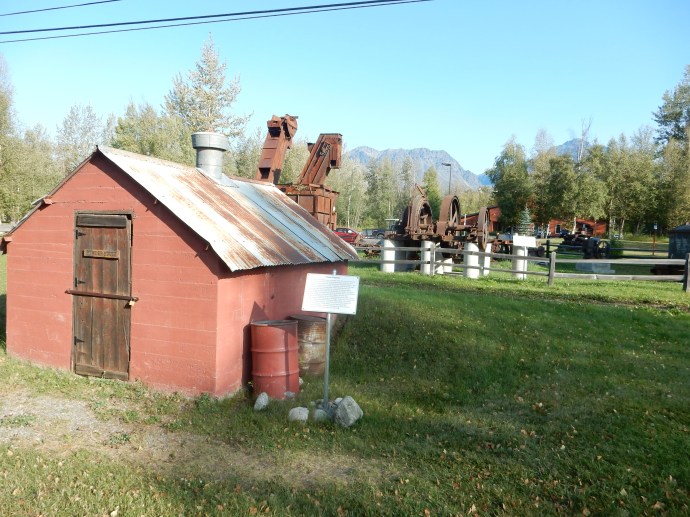
The Alpine Historical Park in Sutton, Chickaloon AK
The Alpine Historical Park related the native culture and the history of the Russian and American coming to the area. Coal had been discovered in the area and a railroad spur was constructed to provide coal to the U.S.Navy. Unfortunately, the Navy switched to diesel fuel before the coal could have a major impact on the economy here. The park has numerous building well-preserved with descriptive information available about each one. We were impressed with the quality of the work, particularly for such a small community.
Ed and Chris. Copper Center AK August 20. 6 AM
 Chris Klejbuk and Ed Heimel travel adventure
Recent Comments