

Lake Kabetogama at Voyageurs National Park
October 1. International Falls MN
We are in northern Minnesota. Land of water and forests. Home to a long, unheralded history of three major economic impacts for America. Fur trapping was one of the major drivers of the early American economy, an activity not forbidden by the English and which produced early riches. From there, by 1900, Minnesota produced one third of the timber cut in the United States. Huge swaths of forest were clear cut with no re-planting to produce the homes and buildings of a growing population. Finally, the iron ore mines of Minnesota fueled the rise of skyscrapers and then the armaments of the Second World War.

Lake views
Today, the area still produces lumber and iron ore. But the heydays are gone and tourism has become a new economic support for the people who live here. From Lake Superior to Lake of the Woods, the northeast section of Minnesota is home to canoeing, fishing, lake cabins, and wilderness adventures. We are here, again, because of Voyageurs National Park. (For other info, visit our 2015 Trip Five travel blog for Aug. 21-23.)
Over the next month, we will cover and discuss the area. Our underlying reason for being here is to volunteer at Voyageurs National Park. Four days a week will be spent assisting with park activities. Three days a week will be spent discovering the area.
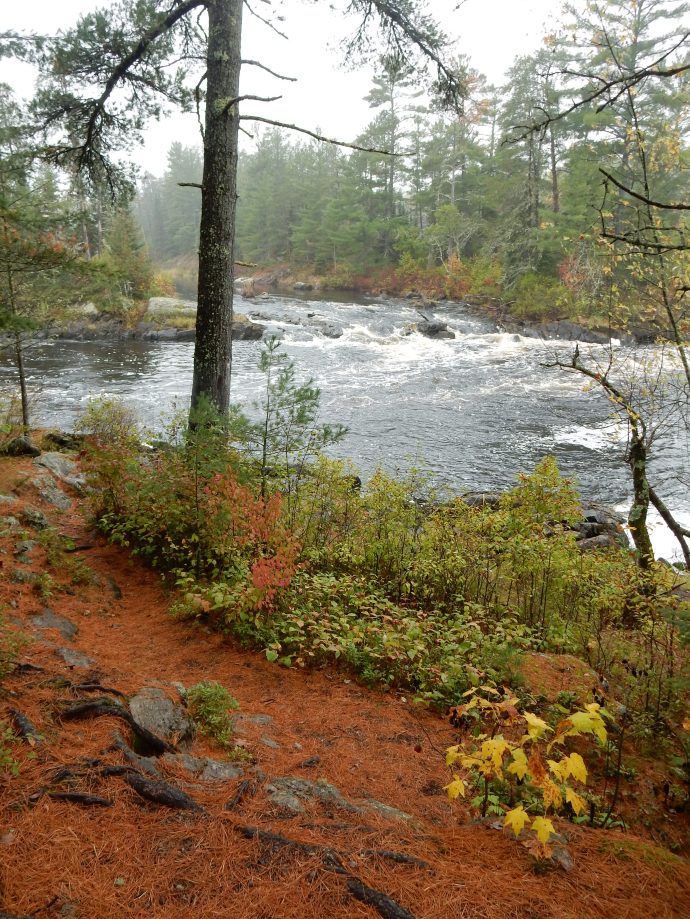
Vermillion Falls in Superior National Forest in northern Minnesota
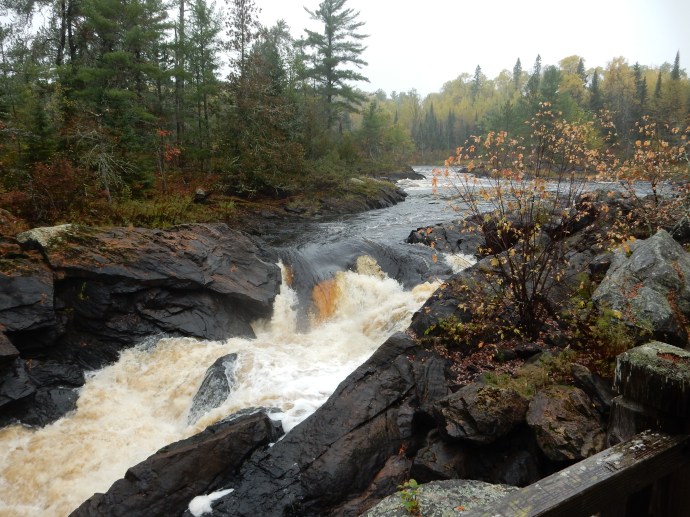
Our 300 mile drive up Monday from Saint Paul was under gray skies with periodic rain and drizzle. Not a spectacular way to begin the journey but even so, we found unexpected beauty. The fall colors were muted on the roads we took but on the back roads of Superior National Forest we came across Vermillion Falls, a quick flowing, short falls jammed into a rocky embrace. Superior National Forests 2,000,000 plus acres stretch west from Lake Superior and includes hundreds of lakes and streams. It includes the BWCA or Boundary Waters Canoe Area, a wilderness of water and wood devoted to non-motorized travel.
Vermillion Falls is on Vermillion River which flows out of Lake Vermillion. In this area of Minnesota, the waters flow north into Canada’s Hudson Bay, an important fact that lies behind the existence of Voyageurs National Park. So I guess you could say we are exporting to Canada, free of charge, some of the pristine waters that this part of the state is noted for.

Remnants of old railroad trestle used to carry pine logs out of northern MN forests
The rest of the back roads drive covered forests of pine and deciduous trees, beaver lodges, lakes and streams, wild rice patties, bogs, and remnants of early logging days. We visited the Crane Lake ranger station and visitor center, closed for the season, at Crane Lake at the southeastern tip of Voyageurs National Park. It is a long drive from the Rainy Lake visitor center we will be volunteering at, so we wanted to stop by while we were, somewhat, in the area. It is just good to be able to visualize multiple areas of the national park.
We arrived at Thunderbird Lodge in International Falls, our home away from home for the next 3-4 weeks. Our room is spacious with a deck and view of Rainy Lake. The microwave and fridge will allow us to eat breakfast at home and prepare lunches for our days volunteering. The lodge has a full-service dining room available also.
Tuesday was busy with a full day’s schedule of orientation activities and visits to various sections of Voyageurs National Park. Over 1/3 of the park’s 218,000 acres is water, and much of the land mass can only be reached via water. There are four visitors centers but after the summer season, only Rainy Lake Visitor Center is open.

Hiking
As part of the orientation on Tuesday, and again on our own Wednesday, we visited the Ash Lake Visitor Center area and Lake Kabetogama Visitor Center area. We hiked several trails that are on the land portion of the national park. For the first time we can recall, we spotted ruffed grouse several times as we walked along backwoods trails. They scampered into the woods, blending into the underbrush and foiling my attempts at a picture.
The Canadian Shield (also known as Laurentian Plateua) is a term for ancient rocks from the most ancient periods of geologic history of the earth. These rocks have been scoured by glaciers so, unlike southern Minnesota, the topsoil is thin. The impact for us is that hiking trails on higher land are laden with exposed tree roots and rocks/boulders that have as their sole aim to trip any unwary hiker. We have managed to avoid that problem so far.

Walking through a bog area
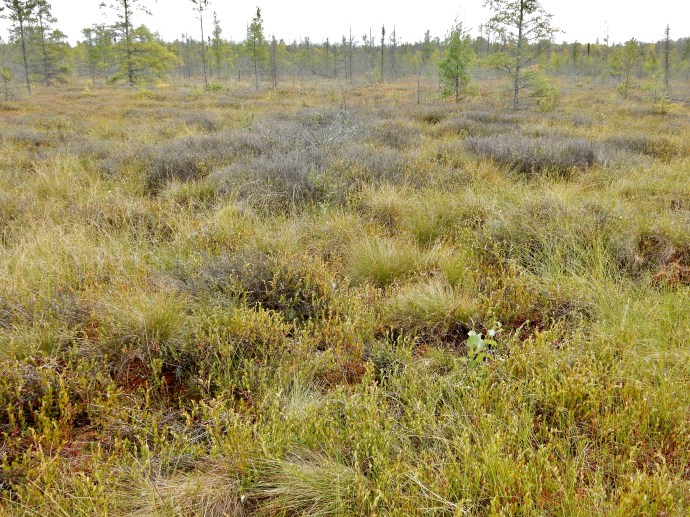
Other trails went through wetlands. We observed a huge beaver dam and lodge at one wetland. We passed by many bogs; spongy wetland ground too soft to walk on with an acidic base of decaying plant material frequently resulting in peat. (Fens are similar but alkaline with more nutrients and a broader plant collection.)
The weather has been cool and damp. As we exited our last hike near Kabetogama Visitor Center and got into our car, we discovered it did not want to start. AAA was not much help; evidently their supply of service stations in northern MN is not very large. We made some calls on our own and small town cooperation resulted in us getting a jump from two park rangers. We followed them the 30 miles back to International Falls before continuing on to the Thunderbird Lodge. The car was parked with its front end pointing out in case we needed a jump again Thursday morning. However, the car was fine on Thursday; we stopped by a local repair shop at 8 AM and made an appointment for next Wednesday to have the battery and electrical system checked out.

Yellow is the primary fall color up here with splashes of red and orange.
Ed and Chris. Thursday Oct. 3. 9 PM
 Chris Klejbuk and Ed Heimel travel adventure
Recent Comments