
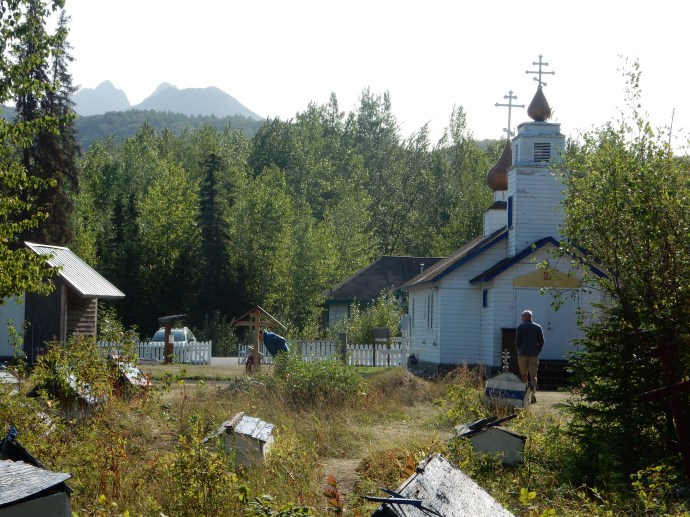
Eklutna Historical Park near Palmer AK
Palmer AK. August 17
If you divide Alaska in half, Texas would be the third largest state. Given that fact, it is egotistical to state that we will know Alaska by the time we leave the state on Sept. 10. However, we will certainly do our best to see as many different areas as we can. Today was an excellent start.

Thunder Bird Falls in Chugach State Park, AK
Thunder Bird Falls is only 25 miles northeast of Anchorage. It is viewable after a one mile hike along a cliff side trail that features a constant parade of up and down hills. The trail is wide and relatively smooth. Halfway along the trail is an overlook that presents views of the falls on Thunder Bird Creek which flows into the Eklutna River. Another half mile brings you to the view of the falls; today, however, the angle of the sun created poor photo opportunities. Still, the walk was in a forest, temperature was 65 degrees, and the sun was shining. A pleasant interlude to begin the Alaskan adventure.
Our next stop was the Eklutna Historical Park. This small collection of buildings is a result of the intermingling of the Dena’ina Athabaskans and Russian hunters and traders. The Athabaskans moved in here from the west thousands of years ago. The Russians came in the 1700s searching for pelts; beaver, sea otter, etc. as well as copper and gold. The story of Russian exploration is long and complicated; murderous and greedy combine with concern and compassion. By the time they sold Alaska to the U.S. in 1867, Russian Orthodox churches had gained a foothold in various settlement areas.

A variety of spirit houses at Eklutna Historical Park
The Eklutna Historical Park retains the old St. Nicholas Church originally built in Knik and moved to Eklutna in 1900. The new St. Nicholas Church was built in 1962. Both are very small and are locked on Saturdays, we only viewed the outsides. An unusual feature of the area are the “spirit houses”. These burial markers are a unique combination of Athabaskan tradition married to Russian Orthodox practices. While small in number, it appeared to us be about 50 or so spirit houses, they exhibit a variety of styles and care. Some are care-worn, possibly reflecting the end of a family line who no longer live in the area. Others are painted, well-maintained, and have fresh flowers on display.

The Matanuska River near Palmer AK
We left Eklutna for Palmer, our lodging site for the next two nights. To get to Palmer, we took the Old Glenn Highway which ambles along the Knik River. The Knik River begins at Knik Glacier-which we did not drive to. The river is a milky white color with wide, sandy beaches. With the Talkeetna Mountain Range across the river to the west, it made for a much better photo op than Thunder Bird Falls. Then, as we got closer to Palmer, we were driving along another river, the Matanuska, which was flowing much faster than the Knik. It is the Matanuska River that we will be following on Monday, over to Wrangell St. Elias National Park and Preserve.
In Palmer, we took a 90 minute docent tour of the historic Palmer Colony. Forgive me, but I need to present a little background data first. 10,000 years ago the last great ice age had this part of Alaska under thousands of feet of ice. The glacial melt left glacial drift in the valleys, dirt that is finely ground and fertile. (Similar to the plains of the Midwest.) This section of Alaska is thus one of the few areas in the state that presents great agricultural opportunity. With a short growing season but long hours of daylight, this fertile soil produces vegetables that are much larger than normal. Some of the record vegetables at the Alaska State Fair include: 39.2 pound turnip, 82.9 pound rutabaga, 138.25 pound green cabbage, a 1469 pound pumpkin, and a 71.75 pound carrot-all world records.

The Colony Inn B & B, formerly a dormitory for service personnel for the Palmer relocation program
During the Great Depression, one of the lesser-known recovery efforts was the transplanting of 203 Midwestern farm families to the Palmer area. This federal government program was conceived, planned, and put into execution with the first families arriving in Alaska in May 1936. Without going into great detail, the effort failed and succeeded. One-half of the families returned to the lower 48 by the end of 1937. But the effort laid the groundwork for greater development of Palmer and its agricultural resources which proved vital when WWII began. With the Japanese invading and capturing several Aleutian Islands, the American armed forces began a swift build-up in Alaska. The bases built then, and still maintained, provided labor for the farmers, a ready market for produce, and an introduction to the area for military personnel; some of whom made the area their permanent home.
The docent tour presented the story well. We saw several of the original homes, one of the churches, and a former dormitory now a B and B. The docent provided plenty of time for questions and we obliged by asking a lot.
After the Palmer tour, we checked in to our Airbnb lodging, got groceries, and had dinner at a small cafe in downtown Palmer. Since it is still light out, we drove down to the Hay Palmer flats and took a one mile hike around Reflection Lake. Hay Palmer Flats are a wildlife refuge at the confluence of the Knik and Matanuska Rivers and the Knik Arm of the Cook Inlet.
Of particular interest is the fact that this area had been a hay growing area for the dairy farms around Palmer. On Good Friday 1964, a 9.2 earthquake with a resulting tsunami, the largest in North American history, struck Alaska causing widespread death and destruction. The ground was pushed up in some places and depressed in others. Here, at Hay Palmer, the land subsided 4-6 feet and the hay fields became too swampy for growing hay. The marshes and swamps became a gathering place for wildlife. Reflection Lake is in the refuge and there is a pleasant one mile hike around it.
Ed and Chris. 10:30 PM
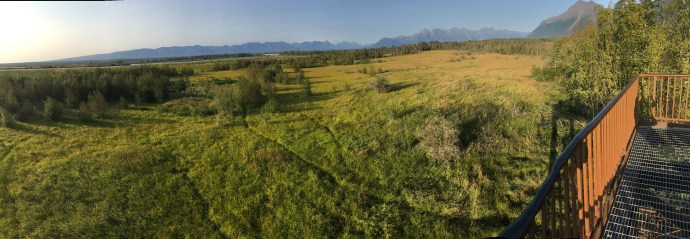
A view at Hay Palmer wildlife refuge, Palmer AK
 Chris Klejbuk and Ed Heimel travel adventure
Recent Comments