Posts Tagged With: Swan Lake fire

2019 Trip 5: Alaska: Sept.4-5

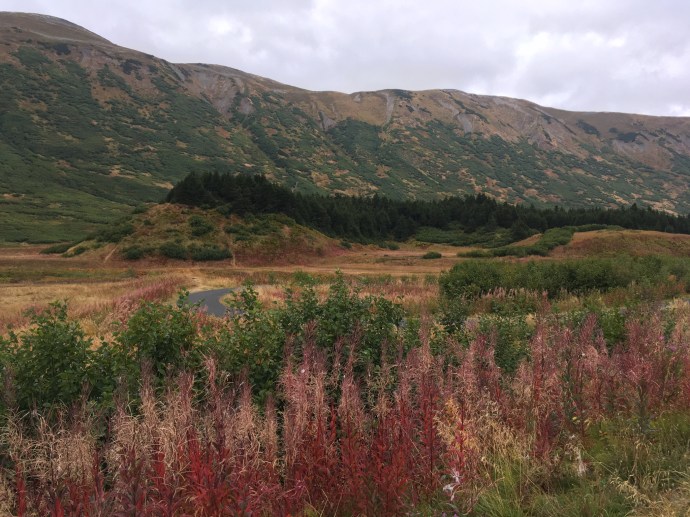
On the hills above Homer AK

Seward, Alaska, Sept. 4-5

Wednesday and Thursday were two relaxing days seeing the sights bookended by the exciting air flight on Tuesday and Friday’s upcoming water cruise.

Fishing boat design varies by the type of fishing being done

The day started at the Pratt Museum, the local historical society in Homer. While small, it had good displays unique to the Kachemak Bay Area. Coal mining was an early driver of settlement from the Lower 48. Fishing has historically been important, changes and overfishing have made full time commercial fishing a difficult occupation. That is one reason for the growth of fishing tourism.

The area covered by the oil spill from the Exxon Valdez

One display section focused on the Exxon Valdez oil spill. This was an oil tanker which after leaving the oil terminal in Valdez, ran aground in Prince William Sound on Good Friday 1989. 11 million gallons of crude oil were released, creating a monumental environmental crisis.

The display in the Pratt showed the extent of the spill. To help one visualize the extent of the oil spill, they have a U.S.map with a portable outline of the spill area. I placed the spill along the Mississippi River. The spill would have stretched from the headwaters at Lake Itasca in northern Minnesota almost to St. Louis. This gave me a better realization of the spill and its consequences.
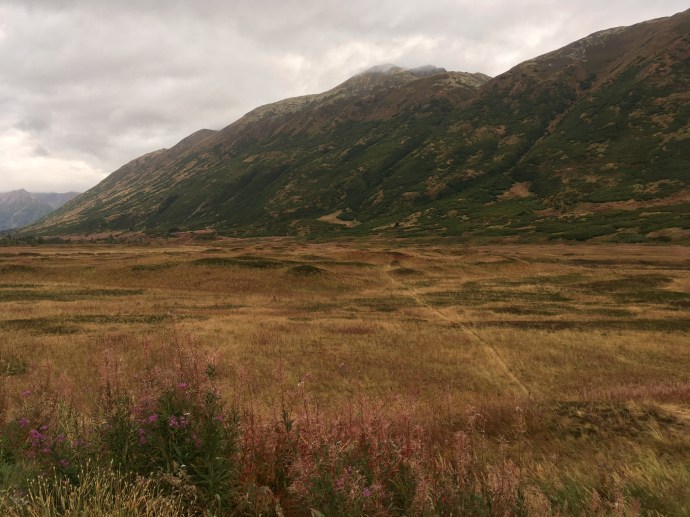
Hiking around Homer

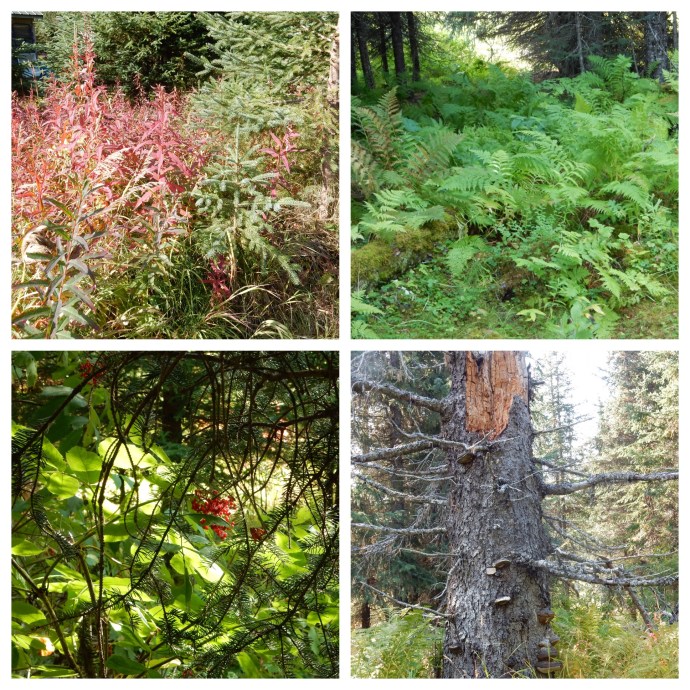
Homer offers numerous hiking options from full day hikes across the bay at Kachhemak State Park to strolls around town. Wednesday we selected more leisurely options. While mountains line the south side of the bay, Homer itself has steep hills behind it on the north. To us, it resembled Duluth MN with its hills and view of Lake Superior.
Hiking around Homer

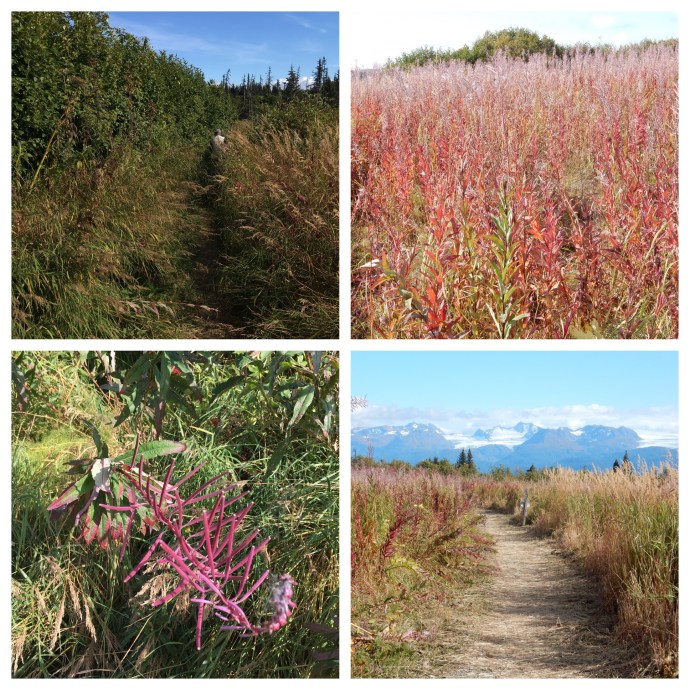
While deciduous trees are not abundant, there are some. Our expectations of a colorful scene of orange, and red, and yellow is not to be seen. Most of the deciduous trees have brown, falling leaves. The underbrush, however, has been colorful. Fireweed is a common plant here and can carpet a field completely or line the roadside with its 4-6 foot tall stalks. It is coming to the end of its season and depending on locale, may still be flowering or starting to seed. Its fluff is similar to cottonwoods or dandelions and you can walk through a cloud of the fluff as you walk along.

Our hikes did not produce any wildlife viewings. On one, a moose and her calves had been seen in the area and when we came across very fresh moose scat, we decided to take a different path. Female moose are known to be aggressively protective of their young. Views of mountains, sea, and glaciers were pretty much everywhere.

Routine tasks came into play, we had several loads of wash to do. The mud from the walk on Tuesday was on numerous articles of clothing and even the rinsing and washing down on Tuesday only partially got rid of the mud. An excellent halibut dinner capped our Wednesday activities.

Holy Assumption Orthodox Church, Kenai AK

Thursday was time to retrace our steps through the fire zone over to Seward. The people at the Maritime Islands National Wildlife Refuge had recommended a slight detour into the city of Kenai where a herd of caribou frequently hang out. Today they were absent.

The Nikiski area north of Kenai along the east shore of Cook Inlet

Since we were in Kenai, we decided to drive a few more miles north along the Cook Inlet looking for evidence of the oil industry. The Alaska papers had written about BP selling its Cook Inlet oil interests to a smaller firm out of Houston. I had not realized oil was a big deal outside of the North Slope Area. Evidently Cook Inlet is a major player as are several new fields elsewhere in Alaska that are getting attention. Those new fields will require new roads to be built through tundra and wilderness area. I am not going to get into the complicated history of oil, Alaska, tax write-offs, annual payments to residents and environmental concerns but did want to at least see this aspect of Alaska.

Nikiski is about 10 miles north of Kenai and a world away. As you leave Kenai, the roadside changes to an industrial setting with oil related businesses lining the sides, along with a surprising number of small churches. We passed a fertilizer plant, refinery, liquid natural gas processing facility, etc. Oil drilling rigs in the inlet were too far out to be visible to the naked eye although an exhibit at the Kenai Visitor Center said they were there.
Driving along the Sterling Highway in the Swan Lake fire zone

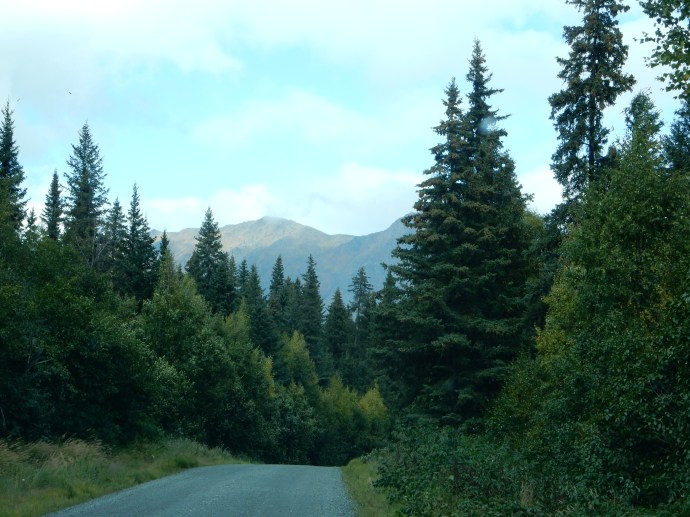
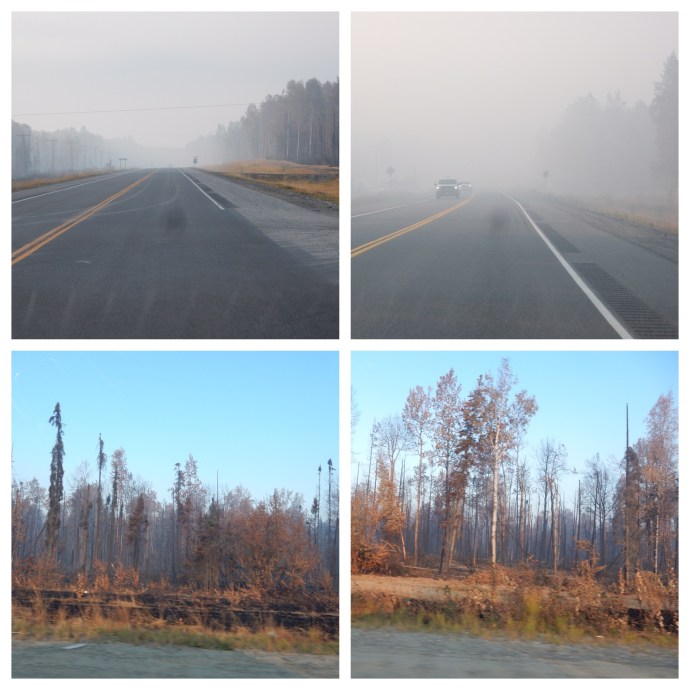
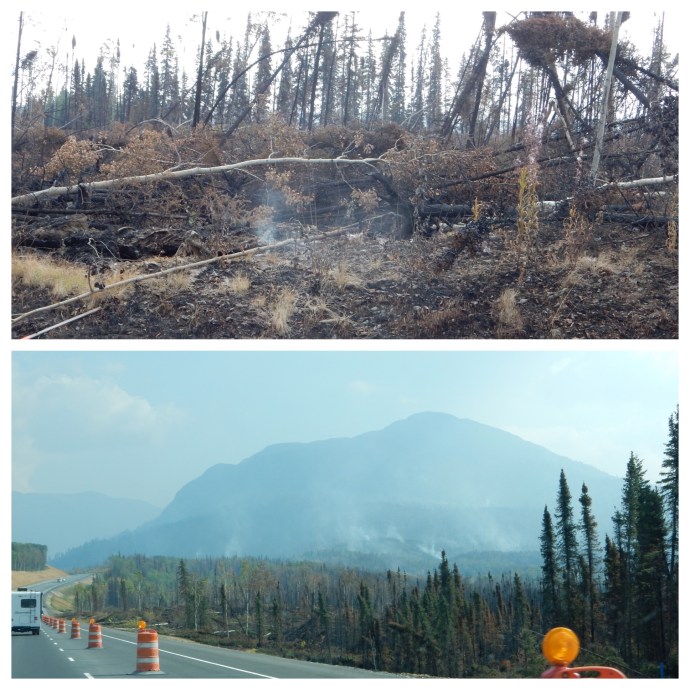
Leaving Nikiski, we continued our journey. Several times today we were stopped and had to wait for pilot cars to lead us through road construction zones. Going through the Swan Lake fire zone was slower this time. On Monday, Labor Day, the pilot car had zipped through. On Thursday, with construction crews active alongside fire containment workers, speeds rarely reached 20 mph. No fire was visible and the wind seemed to keep most of the haze to the south side of the road. But numerous areas not far from the roadside were smoldering and sending out heavy plumes of smoke. We had frequently heard comments predicting that the fires will return next spring. The boggy area tends to allow the fire to burn slow under the surface.
Exit Glacier, Kenai Fjords National Park

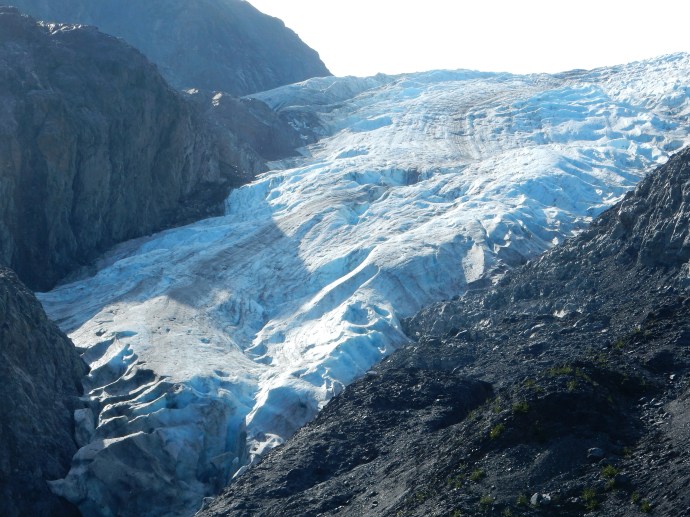
For us, the major attraction in Seward is Kenai Fjords National Park. Once again, much of the park is wilderness and difficult to reach. One accessible area is Exit Glacier just north of Seward. We reached it in time to take a hike to the viewing platform short of the glacier itself. Along the way are the usual signs indicating how the glacier has retreated. As you drive in and then as you hike, you pass signs indicating the glacier was down here in 1815, here in 1899, here in 1929, here in 1951, etc.

Friday the cruise is with Major Marine, a five hour expedition with lunch and views of the glaciers and fjords of Kenai National Park. Five hours seemed long enough, longer ones exist but take you out on rougher seas. After the Florida trip, rougher seas seemed not to be a wise option. We will let you know how this cruise fared.
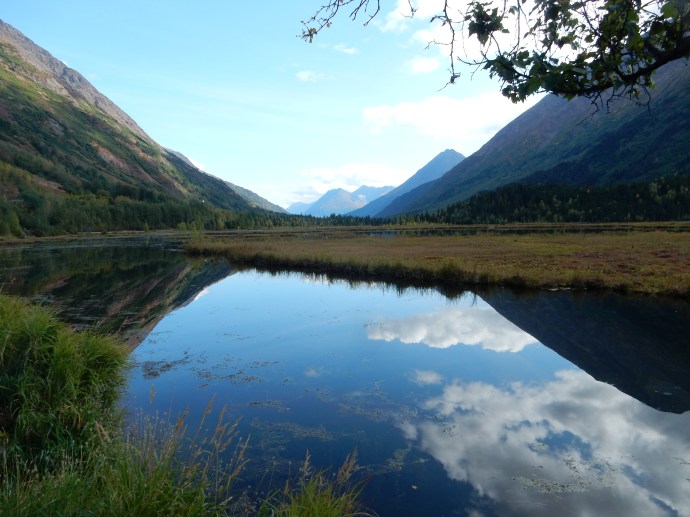
Tern Lake, Seward Highway

Ed and Chris. September 6. 6:45 AM

Categories: road trip, travel | Tags: , , , , , , , , , , | 4 Comments

2019 Trip 5: Alaska: September 1

Kenai Lake at Cooper Landing, AK

COOPER LANDING FINALLY. Sunday September 1

Cooper Landing, population 286, lodging for this evening. We only had to wait about 15 minutes for the pilot car to lead us on the highway. Rain yesterday and cooler temperatures appear to have brought down the fire threat. Most of the actual burnt areas are west and north of here in the forest. Cooper Landing is still on “set” status; that is, be set to depart if the fire changes dramatically.

Driving to Cooper Landing along the end of Turnagain Arm

We left Anchorage around 9 AM. The rain cleared the skies a bit and we were able to view the southern shores of Turnagain Arm for the first time. Mountain peaks and valleys surrounded us as we drove past the Whittier turn-off onto new road. Cooper Landing came into view as we crossed the Kenai Lake and River with perhaps a dozen businesses. We drove past the rafting company that had to cancel our Saturday evening rafting adventure.

Can you spot Ed having dessert at the Kingfisher Restaurant?

The Kenai Princess Lodge is closed to overnight guests, not sure where Princess Cruises is housing the people who were scheduled to stay there. The Princess Lodge is open for meals, apparently most of their business is for fire fighters. We plan to patronize a small, local restaurant for dinner called the Kingfisher. It is on Kenai Lake and when fire fighting planes load up with water, they do so from Kenai Lake. Evidently it takes about 12 seconds for the plane to fully load as it scoops water from the lake. We are staying at The Hutch, a small B and B here in Cooper Landing.

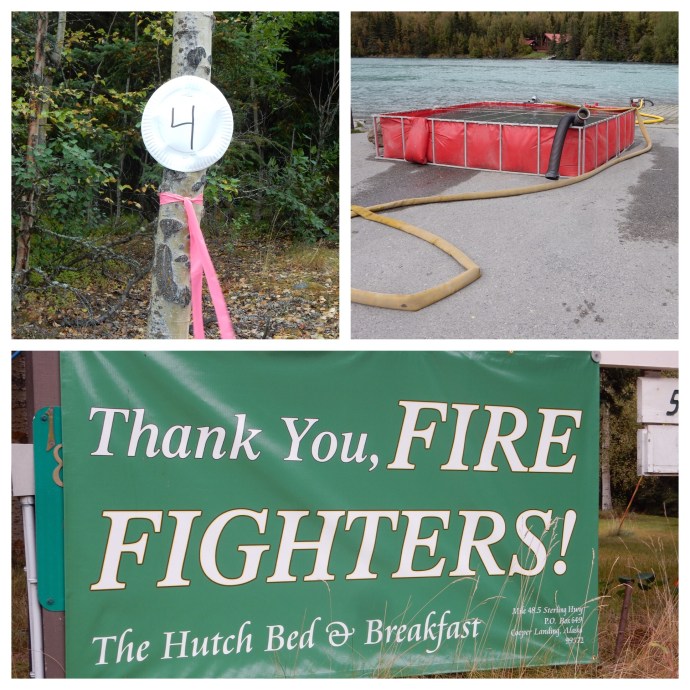
Paper plate ID, water pumping readiness for fire fighters, Thank you sign

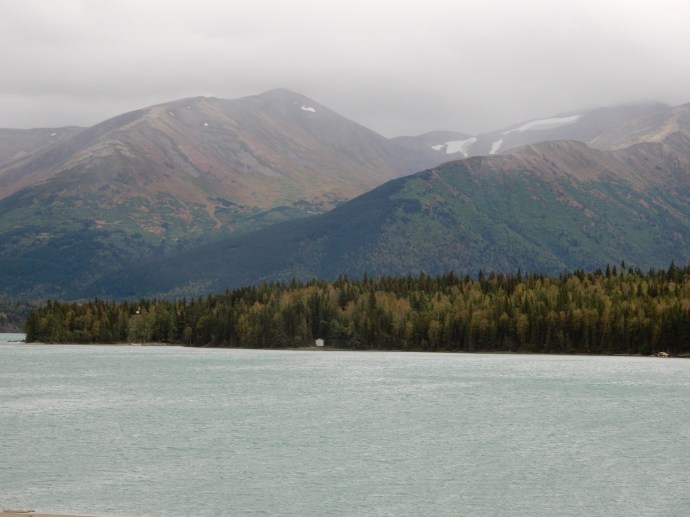
A short walk took us to the outlet where Kenai River runs out of Kenai Lake. With mountains,of course, in the background, it made for a great picture of Alaska. The firefighters have pre-planned their fire stoppage efforts. A pump, hoses, and tank lined each side of the river. Homes and business have temporary identification markers posted on paper plates at the front of each property. Signs are frequent to thank the firefighters for their efforts.

Along one of the walks

Driving back roads near Cooper Landing

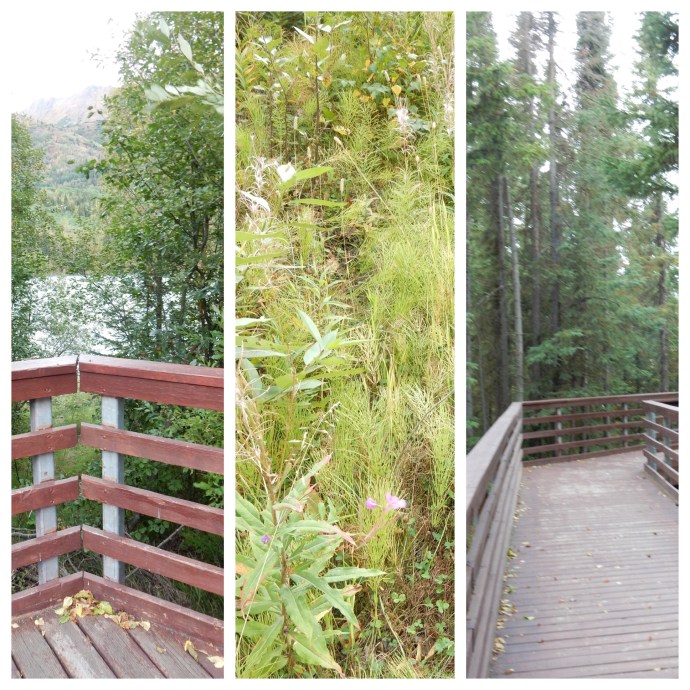
We went for a few short walks. The scenery is beautiful. Every now and then the sun would peak out, then the clouds, wind, and a few drizzles show up.

Kenai Lake at Cooper Landing

Ed and Chris. Cooper Landing. September 1. 8 PM

Categories: road trip, travel | Tags: , , , | 2 Comments

2019 Trip 5: Alaska: August 31

Potter Marsh, Anchorage Alaska

Anchorage, Alaska. Saturday August 31

While people back in Minnesota are thronging to the State Fair in record numbers, we are still exploring Alaska. Our current adventure has us in Anchorage for an alternate date, avoiding the town of Cooper Landing since the wildfire would not have allowed us to do the hiking and touring we had planned. It does appear that last night’s rain may make travel to Cooper Landing Sunday and Homer on Monday much more feasible.

Potter Marsh just south of Anchorage

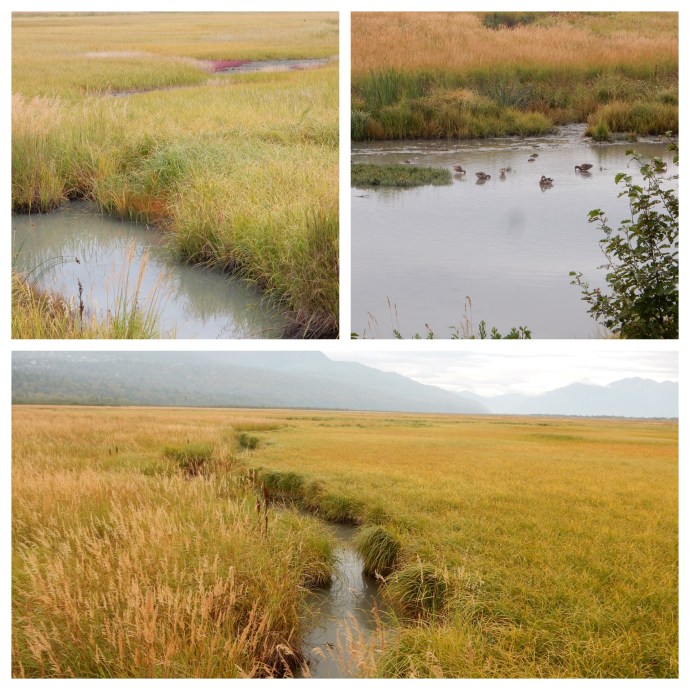
The day started at Potter Marsh, a well-known and highly touted wildlife marsh just minutes from downtown Anchorage. The boardwalk at Potter Marsh takes you on several paths into the marsh. The marsh is partially salty with tidal influence. The day was windy with overnight rain and a promise of more rain to come. The birds did not cooperate. We saw a few ducks of some type and a magpie or two but that was it. The boardwalk was popular with humans; none seemed to be having better luck at finding birds.

Leaving the marsh, we went in to Anchorage and spent four hours at the Anchorage Museum. The museum is the largest in Alaska and focuses on Alaskan art, cultures, history, and science. We took advantage of two docent led tours although the one focusing on art was less worthwhile. The art collection focuses on images of Alaska and, where feasible, on art by Alaskans. Sydney Lawrence, probably the best known Alaskan painter, is heavily represented.

Chris and I were extremely impressed by the areas of the museum that focus on the various native groups of indigenous Alaskans. I used to wonder why there appeared to be so many different names; weren’t they all Eskimos or some such? The docent covered it nicely; as did James Michener in his novel “Alaska”. When the last period of glaciation occurred in North America and Europe, sea levels dropped dramatically exposing Beringia.

In very basic terms, Beringia is the land exposed by that sea level drop; extending from the McKenzie River in Canada to the Lena River in Russia. The Chukchi and Bering Seas were not seas then, but grassy steppes. Peoples from Asia migrated at many different times; each group of migration tended to end up as a different indigenous people. The indigenous peoples stayed in Alaska, developing their own history and culture since the glaciers in America and Canada blocked further southward movement until the glaciers receded, Each group developed according to its own locale; vast differences occur between the Tlingit people down along the southeast coast of Alaska from the Unangan people of the Aleutian Islands, as an example.

Child’s snowshoe hare parka

Somewhat similar to the museums in Flagstaff and in Fairbanks, each indigenous group is highlighted. The items in the displays have been selected by the elders of each group from items in the possession of the Smithsonian Institute. The exhibits are enhanced by video monitors that describe each specific item in greater detail. One can go online to see this at: http://Alaska.si.edu. A snowshoe hare child’s parka might only be made every few years; the snowshoe hare population has peaks and troughs. The peak years would produce enough hares for a parka, other years, no.

An example that the docent highlighted included a winter parka made out of the intestinal guts of seal and a winter parka made out of ground squirrel hides. Each used the wealth of resources Alaska makes available to them in the area in which they live. Each peoples had sufficient free time to create works of art, either for pleasure or for ceremonial purposes.

Of course, the coming of Russian and American explorers and settlers negatively brought disease and high rates of death, forced labor, forced loss of cultural habits, etc. Positively, it brought new materials and habits that made their life easier. The resources of the state were a prize to be extracted and shipped back to the parent country, whether that was furs, salmon, or gold and copper. The profits from the resources were not spent on local improvements.

A separate exhibit highlighted the past and current media representations of Alaskan indigenous peoples. “Molly of Denali”, a new PBS kids show, was highlighted as an example of improved accuracy in media presentation. Another exhibit demonstrated the role and importance of salmon. Hopefully we will not foolishly waste away that important resource in favor of indiscriminate mineral extraction. It took time for humans to acknowledge their overfishing of salmon threatened it with extinction. Reasonable safeguards and regulations seem to be keeping the salmon fisheries at a sustainable level.

AAA rates the Anchorage Museum a “Gem”, the top honor. We would agree and encourage others to take time to explore it in depth.

The rest of the afternoon was housekeeping; laundry, church, and dinner. Tomorrow, Cooper Landing.

Varied photographs by Fred Marchetanz of Alaskan scenes in the Anchorage Museum

Ed and Chris, Saturday August 31. 9 PM

Categories: road trip, travel | Tags: , , , | 1 Comment

2019 Trip 5: Alaska: August 28

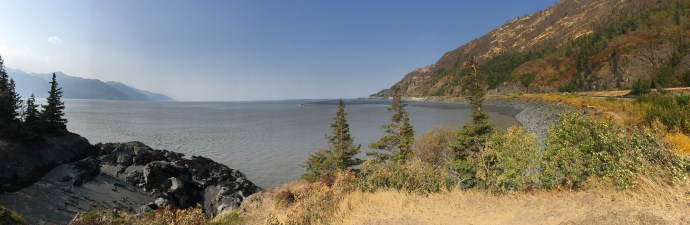
A view along Turnagain Arm, between Anchorage and Whittier. Left side, south, shows evidence of smoke from the Swan Lake Fire on the Kenai Peninsula

Girdwood, Alaska. Wednesday August 28

Smoke and fire were major concerns today. We left Talkeetna to drive to Girdwood, east of Anchorage. We plan to stay here in Girdwood for two nights. The drive here continued on the Parks Highway, along a 20 mile stretch of road that has been plagued by wild fires. Over the past week, travelers were only allowed to go in one direction at a time, led by a pilot car, much as you might encounter in some construction zones. Emergency firefighting crews had first priority over the travel lanes. Delays of several hours had been common. The Alaska Railroad had canceled some of their runs since the fires were even closer to their tracks.

Fire view along Parks Highway between Talkeetna and Willow Alaska

Luckily the roadway just opened to full two lane traffic, although at reduced speeds. We past numerous stretches of burnt forest. Smoke stench was still prevalent. No structures that we could see had burnt, though. Many properties had signs thanking firefighters.

We spent an hour this evening listening to a local radio station live broadcast a community meeting in Cooper Landing, AK where we planned to spend Friday, Saturday, and Sunday nights. Our lodging host said “No problem, come on down.” This town on the Kenai Peninsula south of Anchorage was likely to be the area in which we hiked the most. The topic of the community meeting was the Swan Lake Fire, a blaze that has been burning for 84 days north and west of Cooper Landing. It is the largest fire in the U.S. So far it has burnt 160,000 acres. (see this video from Accu Weather: https://www.accuweather.com/en/weather-news/apocalyptic-footage-shows-cars-narrowly-avoiding-flames-from-massive-alaska-wildfire/70009192) For most of that time it had not been threatening more developed areas.

Recently, the Sterling Highway through Cooper Landing over to Homer has been closed off and on; when open, it usually has a pilot car leading traffic one-way for a 20 mile stretch from Cooper Landing west towards Soldotna and Homer. We have to decide if we seek alternate lodging and forego one, two, or three of the expeditions we have reserved. At the moment, we are leaning to making different arrangements. You will find out the end result as it happens.

The Turnagain Arm is a body of water off Cook Inlet. The British Captain James Cook-he of fame for being a major European explorer to visit and map much of the Pacific Ocean. During his voyage to Alaska looking for the Northwest Passage, he came up the now-named Cook Inlet and turned right. That right turn led to a dead end and so he had to turn again to reverse his travel. Thus this body of water was named. It is ringed by mountains, forests and glaciers. It was the site of several gold strikes in the early 1900s.

The Turnagain Arm drive is rated as one of the most scenic in the country. The Seward Highway as it is called, is the only road route to the Kenai Peninsula, home to hiking, glaciers, boat tours, and great fishing. It is difficult for us to comment on its scenic beauty; most of it, particularly the southern side across the water from the road, was obscured by smoke from the Swan Lake fire.

Beluga whale in Turnagain Arm

Smoke did not make the drive uneventful though. At Beluga Point, we pulled over and watched Beluga whales diving for food. Belugas hunt for other fish to eat in shallow waters where killer whales have difficulty maneuvering. We could see several belugas, their white color in sharp contrast to the gray water as they dove and re-surfaced over and over again. Our pictures show them although not really close up. We have been “out-camera’d“ throughout this trip by the visitors with huge spotting scopes and zoom SLR cameras.

Mountain goats in Chugach State Park along the Seward Highway

Still at Beluga Point, we simply turned around and up on the mountains a group of about 25 mountain goats were walking single file along a narrow path. There was less smoke on the northern mountains. The goats stood out clearly with their white against the dark rocks.

McHugh Falls, another stop along the Seward Highway

The Chugach State Forest and Chugach State Park cover a large swath of land from Anchorage over east to past Valdez and south as far as Seward. We will be making numerous stops in these two during the remaining two weeks in Alaska. Beluga Point was just one of several stops today. We had lunch at the Turnagain Armpit Bar B-Q in Indian, AK. Great food.

A view of Alyeska Resort

Our lodging tonight is at Alyeska Resort, one of our splurges. It is a resort close to Anchorage with winter skiing and summer mountain hiking and biking. We chose it since it is very close to Whittier, home to one of our boat rides, and the lodging in Whittier appeared to be the pits.

Views from Alyeska Resort, non-smoke obscured

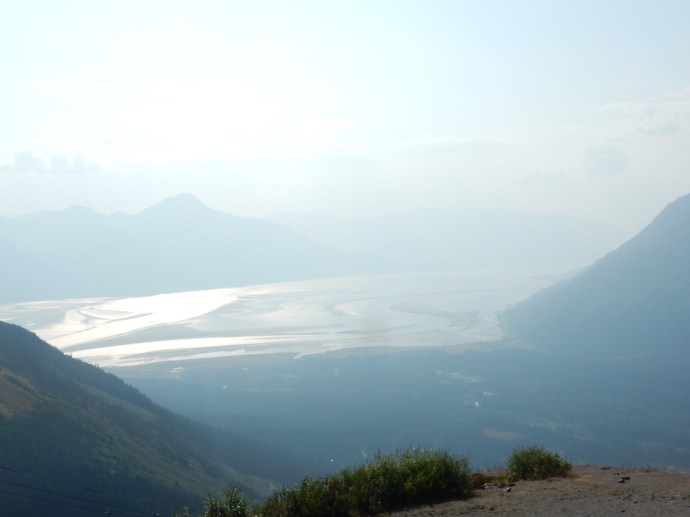
We rode the tram up the mountain and obtained great views of the smoke on the other side of the water. Our host at Armpit Bar BQ indicated today was a good day, the wind was keeping the smoke on the south side. Our planned hike was cut short by swarms of “no-see umm”. The small gnats were so irritating we headed back down again.

Thursday we drive to Whittier. Several aspects of that day should be interesting and fire free.

Smoke obscuring the view of Turnagain Arm as seen from top of tram ride at Alyeska Resort in GIrdwood

Ed and Chris. Thursday August 29 4:30 AM

Categories: road trip, travel | Tags: , , , , , , , , | 1 Comment

Blog at WordPress.com.