Posts Tagged With: Summer Camp for the Senior Crowd

2017 Trip Six: Summer Camp for Seniors: Aug. 24

Britt, MN. August 24, 2017

We played hookey from summer camp today. The lesson on loons and on lake ecology were well recommended but one of our goals for this trip was to visit two state parks: Bear Head Lake State Park and Lake Vermillion-Soudan Underground Mine State Park. Bear Head is a popular destination, despite its distance from the Twin Cities. It was a 60 minute drive for us from the Laurentian Environmental Center. The geology of the park reflects the glacial action ending about 12,000 years ago to form hills, lakes, and rocky landscape over the 4,000 acres of the park.

The Norberg Trail at Bear Head Lake State Park in northern Minnesota

Chris and I hiked the Norbert Lake Trail, a 3.5 mile loop that traversed numerous hiking terrains. We started out on a smooth, wide, well-marked trail with soft pine needles on the trail. The trail switched to a narrower, grassy trail under birch trees. But, the last two-thirds of the trail was on rocky, hilly ground that slowed us considerably. Those rocks translated into a hike of 1.75 hours to traverse 3.5 miles.

Seen along the Norberg Lake Trail at Bear Head Lake State Park in northern Minnesota

We passed two lakes, Norberg and Bear Head. Some of the red and white pines were quite tall; they were too small to cut in the late 1800s when wholesale logging decimated the area and have had 140 years to grow. Small bushes, ferns and flowers occupied the undergrowth. Deciduous trees are starting to fill in.

Lunch was at the “Good Ol’ Days Bar and Grill” in Tower MN. Food was quite tasty but Chris was a little nervous as it took a while for the food to be served and we had a 2 PM tour at the Soudan Underground Mine. But we were able to enjoy the meal and drive to the mine with plenty of time before the tour started. The bar has been in business for 13 years but its roots pre-date Prohibition. They have a little paper “broadsheet” that re-publishes old news tidbits from the Tower Soudan area. The old newspapers seemed to delight in listing the mis-deeds of local Finns.

The mine tour was excellent; while the young man never worked here, he has conducted local research to go along with his geology degree. The mine is in Soudan, the town of Tower was the business-residential center for the area. Together their current population is less than 1,000. (The broadsheet listed above reprinted one article from 1893 that enumerated 22 bars in Tower.)

Soudan was named after the African country Sudan as being the opposite (heat) from the extreme cold of the Tower-Soudan area. Tower was named after Charlemagne Tower, a Pennsylvania industrialist who financed the initial prospecting and mining here. Tower’s accumulation of land seems to have been fraught with illegalities, particularly in regard to the acquiring of small plots of land owned by Native Americans. Eventually he sold out to eastern steel interests leading to ownership by U.S. Steel.
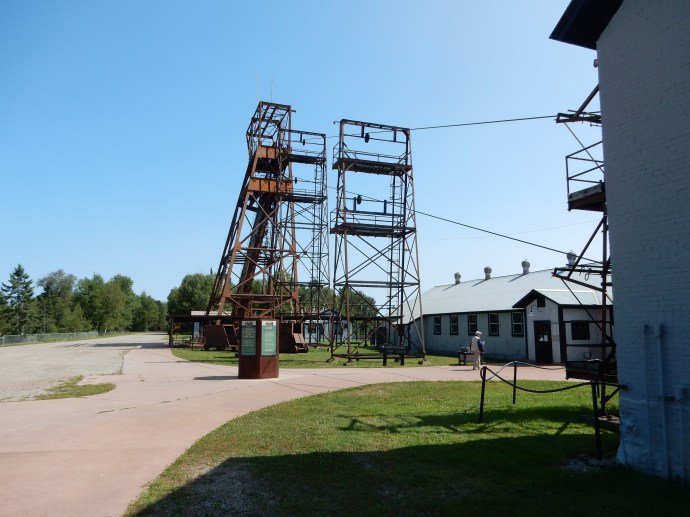
The tower hoist above the Soudan Mine shaft

The Soudan mine is considered the oldest, the deepest, and the richest in Minnesota. Its best days were in the late 1800s as its ore was extremely rich in iron and could be used directly in steel furnaces. However, it was expensive to mine given that its ore seams have to be mined underground, and its use lessened but did not die out until 1962. The iron ore here had a percentage of oxygen in it that was crucial to the operation of Bessemer blast furnaces. As the last Bessemer furnace was closed in 1962, so was this iron ore mine. The Mesabi region of Minnesota, south of here around Hibbing, which utilizes open-pit mining of low-grade ore to convert into taconite pellets, surpassed the output of the Soudan mine in the early 1900s and continues to be the largest U.S. source of iron ore.

Charlemagne Tower, despite the questionable land purchases, innovated in that he paid his first workers twice the wages they were making in Michigan mines, promoted home ownership over company rented housing, and encouraged local shopping over company stores, all grievances held by miners prior to this time. The Soudan mine is located in extremely hard rock that provided safer working environments for underground mines with low rates of water infiltration. These circumstances led to high miner loyalty and good wages; not perfect conditions but better than that found in comparable mines of the day.
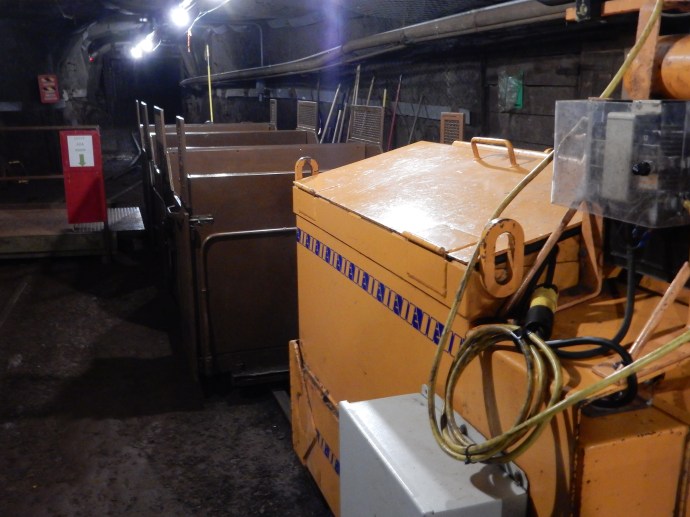
Our carriage awaited us 2,341 feet below the ground at Soudan Mine

Our day included going underground in two steel cages, down to a depth of 2341 feet below the surface, over 700 feet below sea level. Our cages descended at a rate of close to ten miles per hour. Once down at stage 27, we rode 3/4 of a mile in a tracked car that resembled a Disney ride with sharp turns and minimal lighting. At the end of the ride, we walked and climbed around the mining area as it was when it closed in 1962. Another part of the tour described the working conditions of the late 1800s when candle light was used–after the workers walked the 3/4 mile to the work area in pitch blackness.
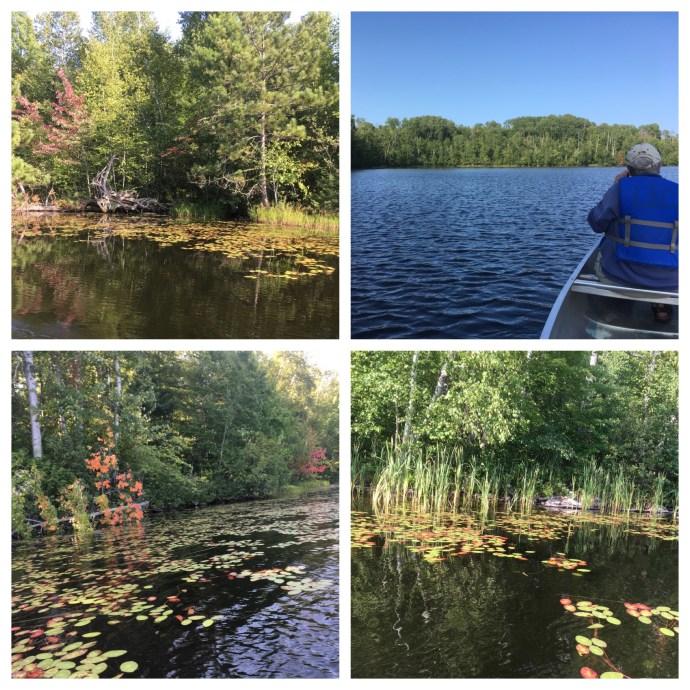
Our canoe ride on Arrowhead Lake in northern Minnesota

After the tour we returned to summer camp and went for a half hour canoe ride before dinner. The weather was perfect; calm, sunny, 68 degrees Fahrenheit. Dinner was tater tot hot dish. After dinner was a presentation on bats; it seems currently there is an effort around the U.S. to educate people about the positive benefits of bats.

Ed and Chris. Aug. 25

Categories: road trip, travel | Tags: , , , , , , , , , | 1 Comment

2017 Trip Six: Summer Camp for the Senior Crowd: Aug. 22-23

Britt, MN. Wednesday August 23

Looking at Laurentian Environmental Center across Arrowhead Lake

After lunch on Tuesday, most of the participants gathered to take a hike to the “Meteorite Site”. With 25-35 hikers, with a mix of hiking speeds, it took us a while to hike through the forest to the site. What is the “Meteorite Site” you ask? Well, it is a hole in the ground, 60′ deep, and 300′ around. The people here have been researching the hole for over twenty years; with no special funding the research has been piecemeal and dependent on the goodwill of various research groups.

Three theories exist. One, a meteor crashed here. Two, glacial action created the hole. Three, mining activity resulted in this round depression. Our guide discussed each theory in detail and the research undertaken in an effort to support it. For theory one, scientists calculate a meteor the size of a softball would have been required to generate a hole the size of this one. But, there is no obvious residue that would be associated with a meteor.

The large group hiking to the Meteorite Site on Tuesday afternoon

For theory two, since the bottom of the hole is uniformly dry, glacial action would have also created an outlet for the water that falls in the depression. Searching over numerous years has revealed no outwash from the depression. For theory three, the size of the trees indicates that mining activity would have had to have occurred by Paleo-Indians and again, there are no remnants of copper mining and the depression would likely have had a more gradual exit from the pit rather than the uniformly steep sides that exist.

So the conclusion is no conclusion. No scientific evidence exists, so far, to back any of the three theories. We all hiked back in time for dinner of pork bar b que, potato salad, etc with home-made cookies for desert. After dinner, one of the participants made a slide show presentation about owls. He covered each of the owls found in Minnesota with pictures and audio of the sound they make.

Chris and I debated an evening canoe trip but the on again-off again drizzle discouraged us until the weather is definitely clear. Instead, I played cribbage with two other women. I won one game and lost one game.

Paper birch trees: several tall ones on the right; on the left stumps. Paper birch last about 70 years, then they start to rot and frequently the top of the tree falls off.

[The following sections may be a little confusing in style as Chris and I took turns writing about the activities we each undertook separately.]

Wednesday morning breakfast was French toast sticks and bacon. After breakfast, Chris and I split. Chris went to a popular presentation on dream interpretation. The morning talk was presented by a retired ER doc from the Twin Cities. While I (Chris) went more to support a fellow camper, I found her talk rather interesting. A comment made by a member of the group was “we all dream, so there must be a reason”. So true. She talked about how to remember dreams (put them in a notebook), to having a dream buddy to share your dreams with. She talked about how to analyze dreams (are they symbols, represent feelings, point to emotional/physical issues now). She talked about how to “program” your dreams and how to ‘confront” your nightmares (turn to the demon and ask “what do you want).

The group session Ed skipped to go hiking worked on cleaning apples. The end result was a very tasty apple crisp to go with our lunch.

After lunch we split up again with Chris going to a talk on fire ecology and Ed joining an art project. The fire ecology talk focused on the three elements needed for fire (heat, fuel, and oxygen) and how these elements are found in our world and sometimes work against successful fire suppression. It, too, proved an excellent talk by a member of the Center’s staff that had great discussion as we answered the question “are fires good?”

Ed’s art tile creations

I (Ed) went on a solo walk in the morning, able to set my own pace. I learnt less than on the group walk but enjoyed the time to myself. As Chris mentioned in the two paragraphs above, the afternoon was a real role reversal. Art made by me would not be my first choice and while fire ecology seemed interesting, I chose the less obvious path to make some personalized art tiles. Store bought ceramic tiles were covered by sharpie pens in our design and then sprayed with isopropyl alcohol which allows the colors to melt and blend. When dried they are covered with a clear spray enamel to protect them. The eight tiles I produced may not win any awards but now we have eight more drink coasters.

The second afternoon session again saw us separate. Chris was with the group that had a demonstration on how to make deep dish pizza. While she said that it seemed ‘doable”, I will not be holding my breath to have this anytime soon. The work done by the group led to the preparation of several varieties of pizza which we had for dinner-along with salad, canned pears, cut veggies, etc.

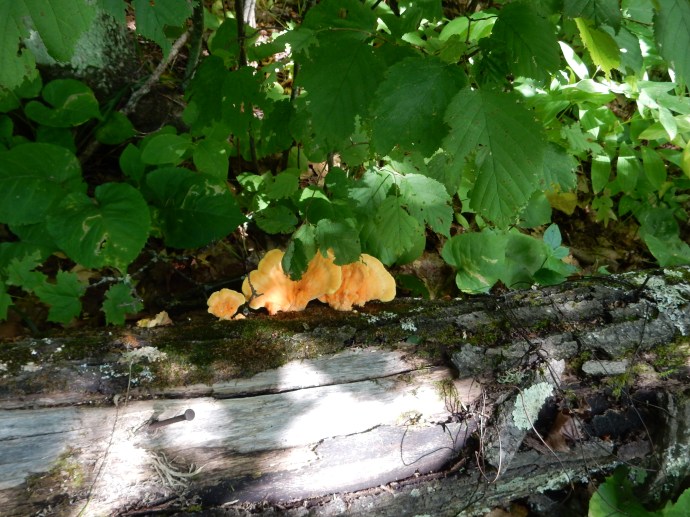
Pineapple Mushroom

My second group afternoon activity was another walk. This one was planned to be faster with less interpretation. It was although the small group of six people still asked questions of our leader and pointed out numerous plants along the way-including a nice specimen of pineapple mushrooms. Our trek went out into the Superior National Forest and did create a little nervousness on our return as the path disappeared and we had to bushwhack through the underbrush until we landed back on the trail. All in all, I hiked over eight miles today.

After dinner, we had a sing along in the lodge, led by one of our participants who had brought along his guitar. The group of participants interact well together which makes for a very pleasant experience. Chris is already laying plans for next year. I am enjoying myself but would be more interested in spending this time next year continuing our explorations of areas of the U.S. we have not yet enjoyed.

Ed and Chris Wednesday Aug. 23, 8:30 PM

Categories: road trip, travel | Tags: , , , | Leave a comment

Blog at WordPress.com.