Posts Tagged With: St. Paul MN

2019: Out and About in the Cities

St. Paul MN May 22, 2019
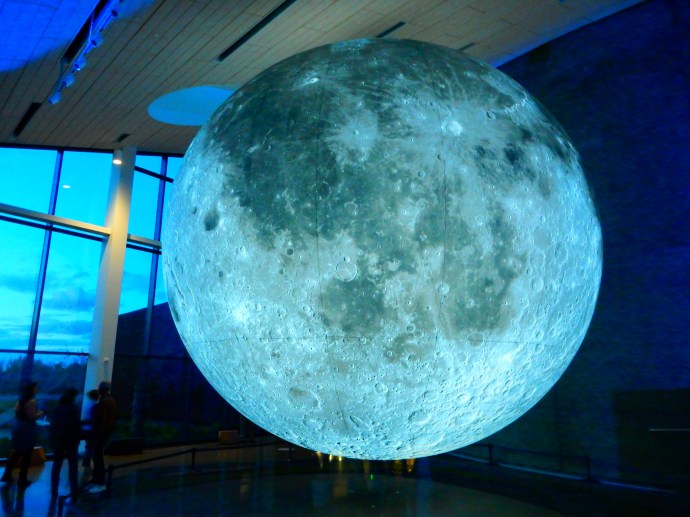
Museum of the Moon at the Bell Museum St. Paul

Almost all of our blog posts are travel adventures; trips away from the Cities, whether elsewhere in Minnesota or more likely, around the U.S. or Canada. In the past two weeks however, we experienced a diverse set of activities that seemed worthy of mention. The activities  reflected the non-standard activities available to a person in the Cities, not just the museums and historical locations.
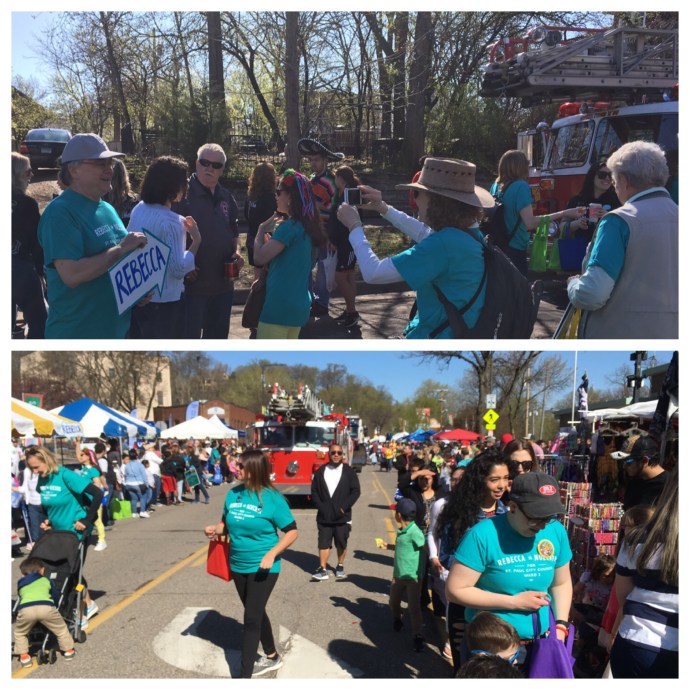
The Noecker group marching

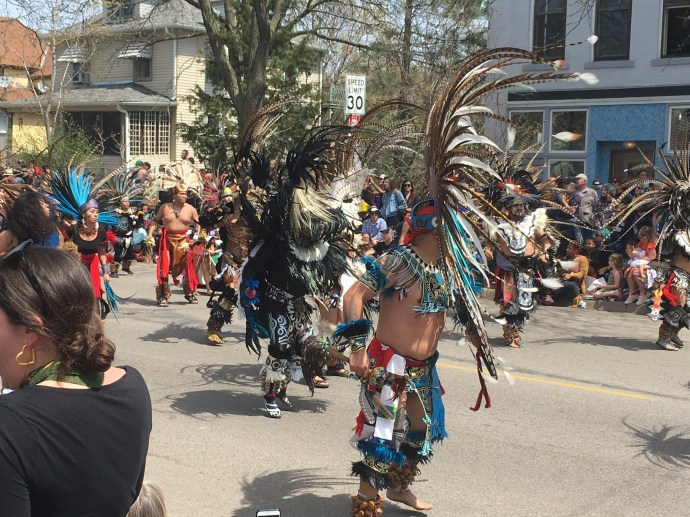
Our tale starts on Saturday May 4 for the 34th annual Cinco de Mayo parade on the West Side of St. Paul. This year, we marched with a group sponsored by our St. Paul Councilmember, Rebecca Noecker. As is our style, we arrived plenty early and had chatting time with other parade marchers and volunteers. The West Side of St. Paul is actually south of the Mississippi River since the river here takes a bend and changes from a north-south orientation to an east-west orientation for about eight miles. Thus, here the city is considered to be on the west bank of the Mississippi. It is the only section of St. Paul located on the south or west shore. Historically, this area was Dakota land and as treaties removed the Dakota from their homeland, French-Canadian, German and Irish immigrants settled here. (My German father’s house was on the West Side.) Later Eastern Europeans moved in and then it became home to a thriving Mexican immigrant community, which it still is today.

Cinco de Mayo parade St. Paul MN

The Cinco de Mayo festival and parade here is reported to be one of the ten largest in the U.S. But as a parade participant, we saw more of the crowd and less of the parade. The day was pleasant and the crowd numerous and relaxed. Families with children and grand-parents composed the large majority of the people lining the street.

The crowds at the Mayday Parade Minneapolis

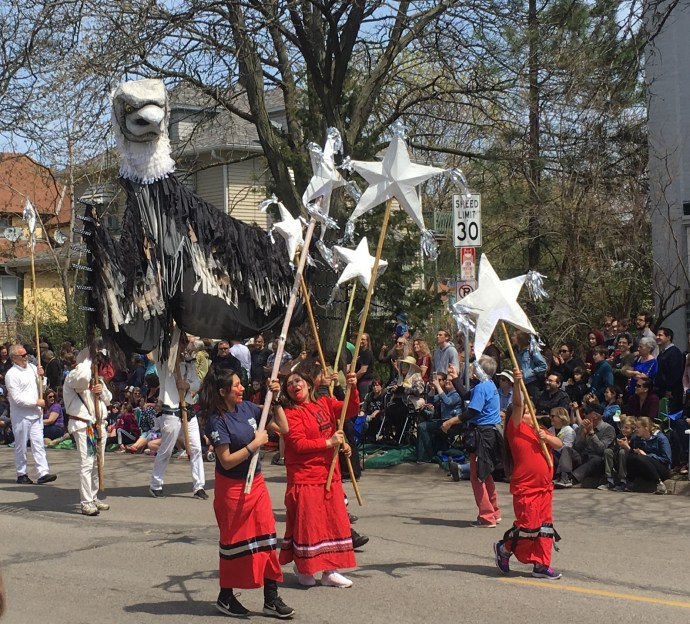
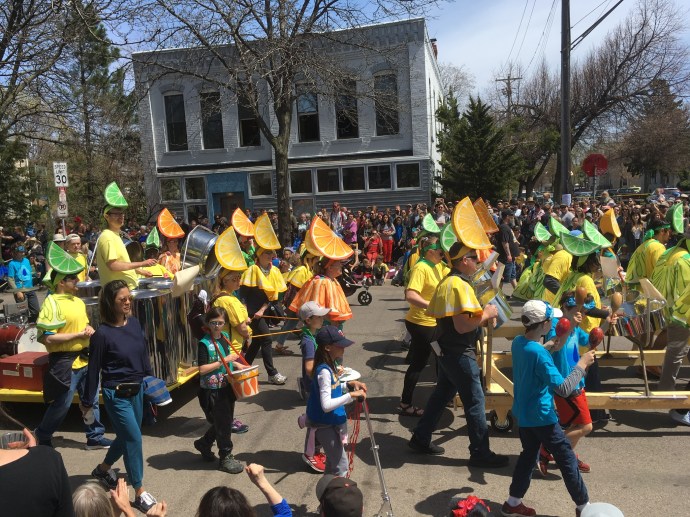
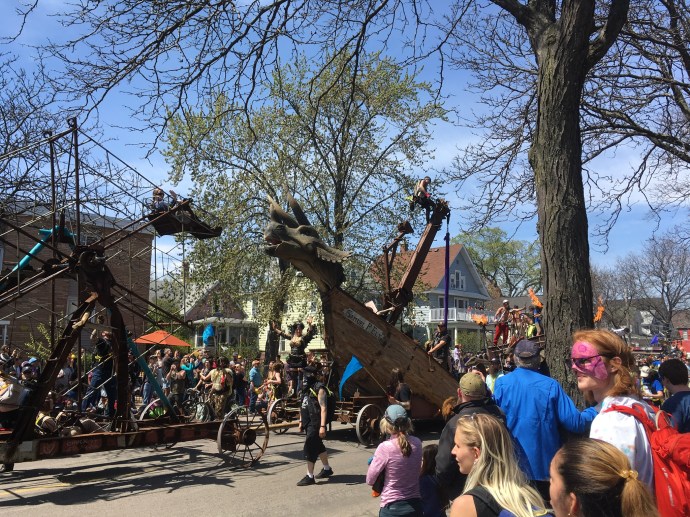
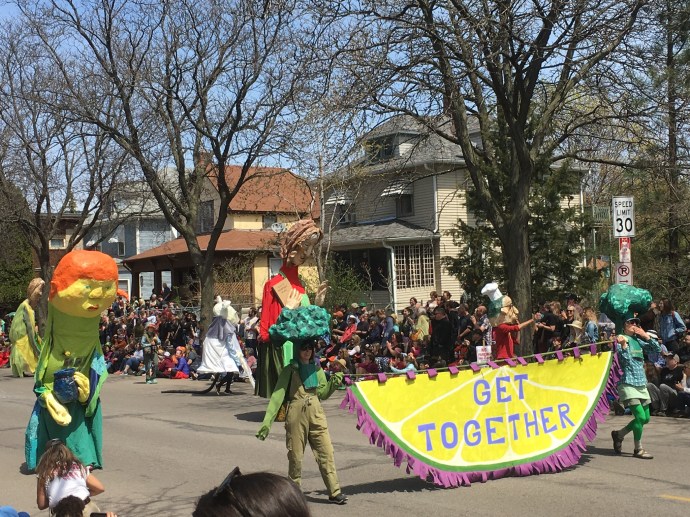
On Sunday, May 5, we traveled compass-west and river-north to Minneapolis for the 45th annual MayDay Parade, Ceremony, and Festival sponsored by In the Heart of the Beast Puppet and Mask Theatre. Boy, this was the time to really see diversity in Minneapolis. The parade runs down Bloomington Avenue to Powderhorn Park where festivities continue all afternoon. Knowing there would be an even bigger crowd for this parade, we arrived with plenty of time to people watch. We were the unusual ones; we did not have a dog, did not ride a bike, did not color our hair, did not have a tattoo, did not have a child present, did not wear clothes with a message, etc. Once again the crowd was polite; maybe more boisterous and jolly, but still uneventful. The parade is self-managed, no police cars leading the way. In fact, no motorized vehicles are allowed in the parade, unlike Cinco de Mayo which has a large crop of public organization vehicles. The crowd lined the sidewalks and curb area, leaving a small walkway for people to get through.
Mayday Parade
Mayday Parade
Mayday Parade Minneapolis
Mayday Parade Minneapolis
Mayday Parade

This year’s theme was Beloved Community revolving round reconciliation and respecting our earth. Community groups are encouraged to participate with their own display that ties into the overall theme. After the parade, there is a community festival at Powderhorn Park.
Como Park Conservatory
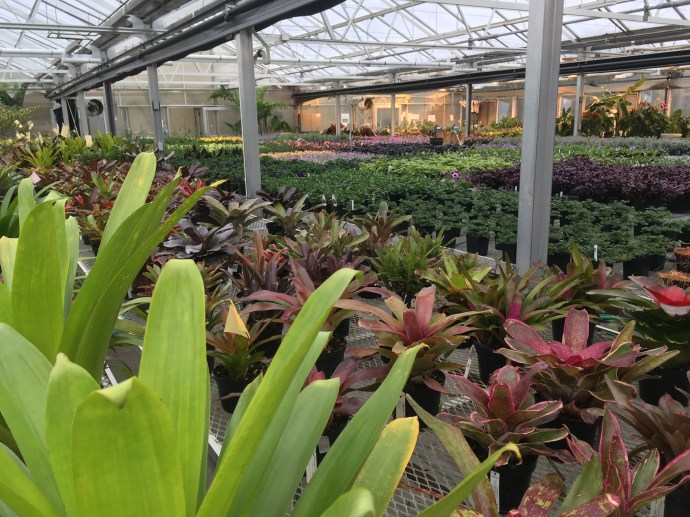
Inside the greenhouses at Como Park Conservatory

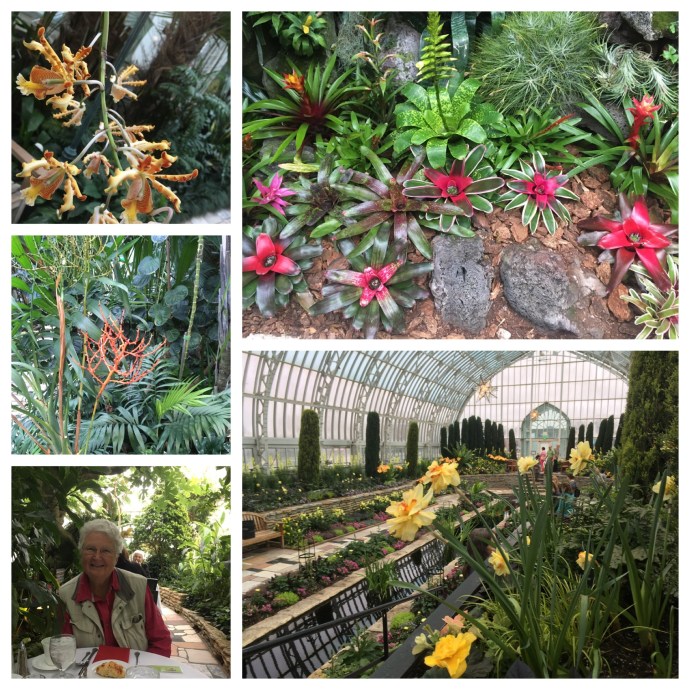
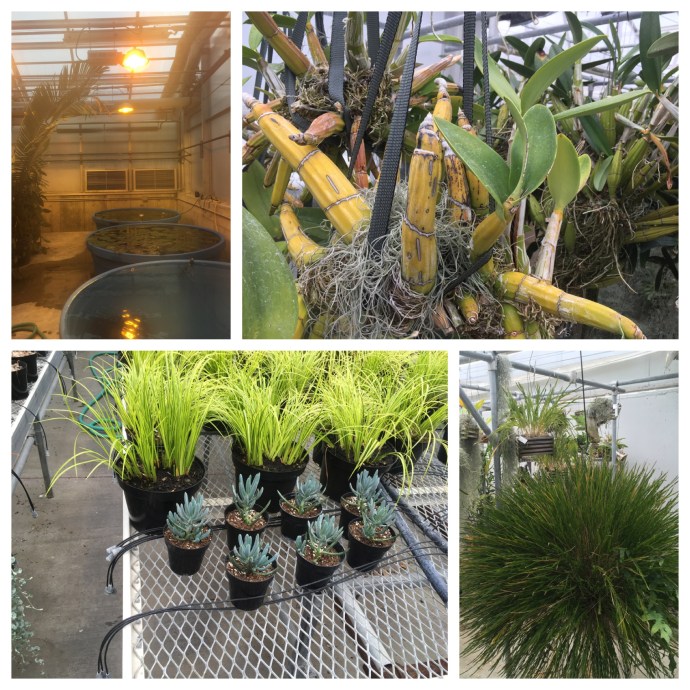
Thursday, May 9 brought us back to a familiar site but with a different focus. We have visited Como Park, Zoo, and Conservatory frequently. Today, though, we had a catered breakfast in one of the gardens followed by a behind the scenes tour of the greenhouses. The Conservatory grows many of its plants and will rotate specimens during the year. Rotating exhibits are designed by horticulturists and other Como staff. In the off-season for that plant, many plants are stored in the greenhouses at the appropriate off-season temperature.
Inside the greenhouses at Como Park Conservatory

The greenhouses are awash in colors, row upon row of plants in various stages of their growth cycle. Drip irrigation systems contrast with overhead irrigation. Large tubs of water host the first growth of the large pond Victoria Water Lilies that will appear outside Como come late July. Winter blooming plants are kept chilled until they are ready to pop. The chilling goes so far that the combination of cold and moisture sometimes creates a few flakes of snow. Would this not be a great place for someone to volunteer if they are into gardening?

Saturday May 11 we switched gears again. For 8 hours we saw and heard about the history and significance of several places of cultural, religious and historical importance to the indigenous peoples who lived here prior to European immigration. While the Dakota people were not the only indigenous people to live here, they were the ones present when Americans started moving here from the Eastern states in the 1800s. Fur trappers preceded the settlers and while the fur trappers did not take the Dakota land, their pattern of trapping the native beaver to near extinction created long-term destruction of natural habitat that still persists today. The treaties signed by the U.S. were never sufficient in the eyes of the new settlers. Treaty violations and treaty non-compliance by the U.S. government drove the Dakota in 1862 to declare war on the settlers, killing hundreds. The state raised an army and defeated the Dakota. After the war, 38 Dakota men were hung in the largest mass hanging in U.S. history. The remaining Dakota were shipped out of state after forced marches and winter imprisonment in camps. This fulfilled the demand of then-Governor Ramsey of Minnesota that, “the Sioux (Dakota-note Ed) Indians of Minnesota must be exterminated or driven forever beyond the borders of the state.”

CF960BEF-BE65-4F1B-92CD-1B9941B06BF8

Mounds Park

7249B7D7-C470-4067-87F0-9F75542B3B1A

Wakan Tipi

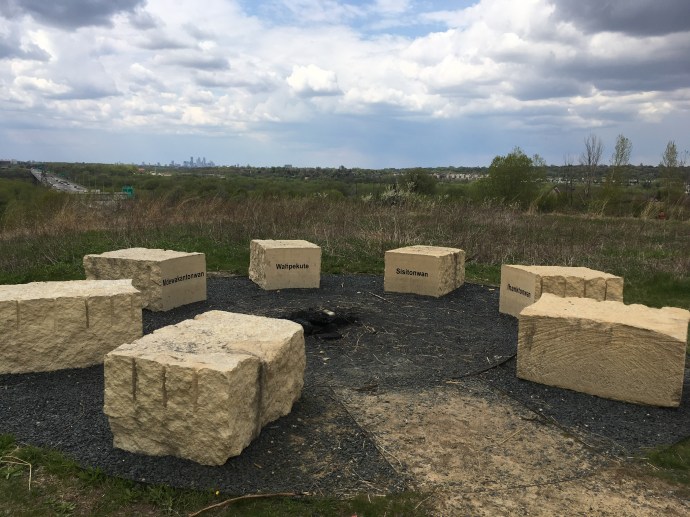
During the daylong event, we listened to speakers and visited several sites. Mounds Park (Kaposia) is the site of six remaining burial and spiritual mounds; others have been excavated and bulldozed with the relics sold to museums. Wakan Tipi or Bruce Vento Nature Sanctuary is located below the bluffs of Mounds Park. The site remains a Dakota sacred site today even after the railroads bulldozed the front portion of the cliff entrance to the cave for more railroad tracks. At Fort Selling historic site and at the overlook to the confluence of the Minnesota and Mississippi Rivers, we heard how the Dakota used to converge on this spot for mothers to give birth. Unfortunately, this spot was chosen by the U.S. soldiers for a fort and was used as the internment camp for Dakota people during the winter after the Dakota War of 1862. (The actual internment site is located in Fort Snelling State Park on the river below the Fort and the park was closed due to high water.)
233A51A8-AF7E-4935-BB4F-5450FB4C7588

Looking from Pilot Knob towards downtown Minneapolis in the distance

Finally we stopped at Pilot Knob. To the Dakota the prominent hill was known as Oheyawahi, or “a hill much visited.” It was here that the Dakota buried their dead and Dakota villages dotted the river below during the early 1800s. The hill remains a sacred place to the Shakopee Mdewakanton Dakota. All in all, it was an awakening experience to learn the beliefs of the Dakota people who preceded us here and who still fight for respect and treaty rights.

Wednesday night, May 15, the Voyageur National Park Association hosted an event in Minneapolis. (You will read more about Voyageurs on this blog come October.) It was held at Open Book’s auditorium and about 60 people showed up. The speaker was Ben Goldfarb, author of the award-winning book “Eager, the Surprising, Secret Lives of Beavers and Why They Matter”. Ben is an environmentalist journalist, editor, and beaver believer. We were surprised; the author was an excellent speaker and provided in an interesting way new information about beavers.  There is a movement in the country to allow beaver freer rein to build their dams; improved water retention, fishing, and decreased flooding are likely to result if we can resist our emphasis on man-made answers to the problems we have created in our environment.


Beaver pelt were the only export early American settlers had to pay for their English made goods. Beaver hunting fueled the economy, drove westward expansion and settler anger at British limits on expansion, and by the late 1800s had practically exterminated beavers in North America. This over hunting resulted in topography that is drier, has less animals, and is more barren then pre-1700s. The impact is still felt today and the American instinct to build man-made structures to replace what nature does on its own continues to haunt us. We bought a copy of the book and suggested to the Bell Museum store that they stock it.

Just one interesting tidbit: The Catholic Church, in 17th century Quebec, after discussions with theologians in France, declared beaver a fish since even though a mammal, it swims. Therefore, Catholics could eat the red meat of beaver on Friday during Lent without a guilty conscience.

Last weekend, May 18-19, was the inaugural Doors Open Minneapolis event. 115 buildings throw open their doors and invite the public to visit and take a peek behind doors normally closed. Venues included historic buildings re-used for hotels and offices, public works locations like a hydro plant or recycling facility, churches normally open only to their members, public yet private areas like the Federal Reserve or Post Office.

St. Anthony Falls Lock and Dam was one of the 115 venues open to the public. Each venue had its open staff or volunteers welcoming guests. In addition, Doors Open planned to have two volunteers at each of the 115 venues, working in two shifts of four hours each. Doors Open needed 900 volunteers. I do not know the final result, but it seemed like they came close to reaching their goal.

On Saturday, I was a volunteer for the National Park Service and Army Corps of Engineers (not a volunteer for Doors Open) at the St. Anthony Lock and Dam. We had over 400 visitors between 10 and 2, on a blustery dreary day.
Sample artwork at the Intercontinental Hotel MSP AIrport

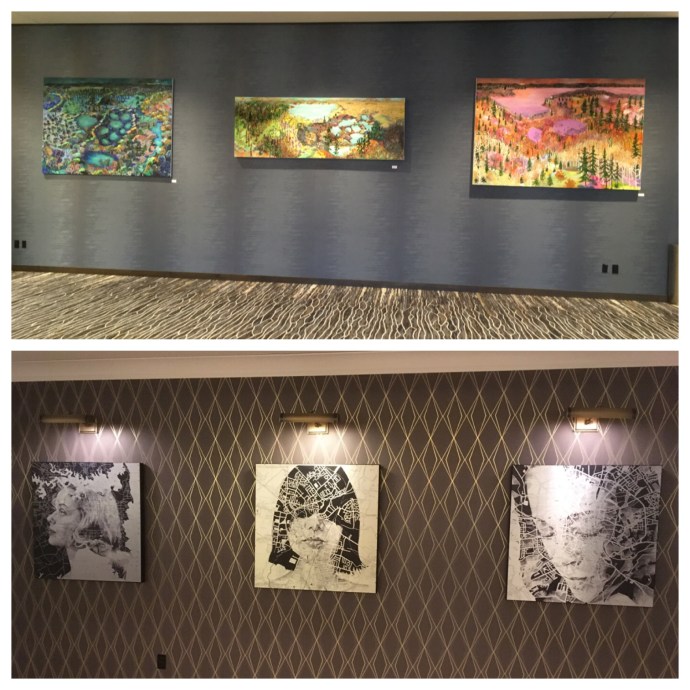
On Sunday, Chris and I were volunteers for the Doors Open program. Our shift was at the Intercontinental Hotel at MSP airport. It opened in July of 2018 and has a very nice collection of art work. The hotel manager gave us a tour, visitors received a hand-out for a self-guided tour. Our gig as Doors Open volunteers required us to greet visitors pleasantly, answer questions, guide them as to the best route and provide them with complimentary parking garage passes. During the other half of the day, we visited two sites.

F41B7BB2-81BF-4FF3-BAF6-52C67ECB5E4D

Danish American Center

325EB29E-57F6-4E64-9C68-EDFE6B96D129

Pancakes

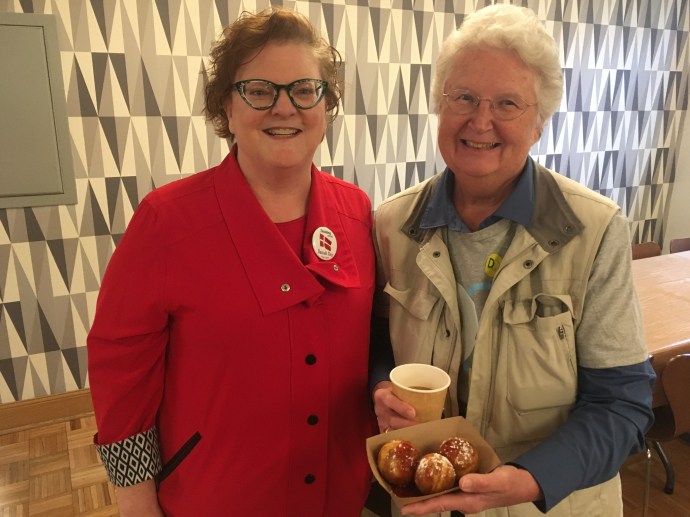
First, we stopped at the Danish American Center, a building we have passed innumerable times along West River Road in Minneapolis. Over a hundred years ago it began as a home for seniors, today it is a community center and offers overnight lodging for out of town visitors to members. All Doors Open visitors received a personal tour and a serving of Danish pancakes, a round pastry called an Aebleskiver.
B5C127D7-4C05-41BE-8B7E-3FA2EAFA7BB4

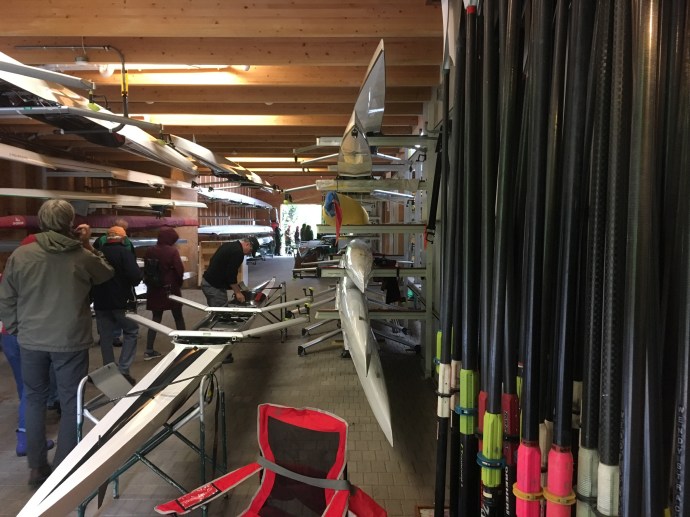
Minneapolis Rowing Club boathouse

Our second stop was at the Minneapolis Rowing Club. Their boathouse along the Mississippi, after their previous A-frame building burnt down in the late 1990s, is designed to resemble a duck in flight. Inside we were treated to a tour and discussion of rowing; single, double, four and eight person. Note: if a rower uses two hands to hold two oars, it is sculling. If a person holds only one oar with both hands, it is called sweep rowing. As you walk in, you are overwhelmed with the rows of boats, the lined up oars, and the second floor exercise room. The exercise area can have one wall opened to provide fresh air and an up-close view of the Mississippi River. All ages are welcome, we talked with one woman who had just begun rowing three years ago when she retired.

In an interesting note, at St. Anthony Falls Lock and Dam on Saturday, numerous visitors asked about the publicized study being undertaken by the Army Corps of Engineers to determine the fate of the lock which was closed four years ago. No answer is expected for 18 months; implementation will take longer no matter the recommendation. One option discussed has been to remove the lock and allow the river to flow freely. This would likely eliminate the ability of the rowing club to practice on this stretch of the river.

6085EA31-B968-4D65-9BA0-BDEAEC872827

Flood waters at Crosby Farm Regional park in St. Paul on April 26

479C27E5-AEA3-4941-92A7-F957BB6BDBC3

May 20th at Crosby Farm park

372264EC-0A5A-4D26-923E-71614FFC8504

May 20th at Crosby Farm Park

58C2E692-C5E6-40B8-B760-106069F08100E83623BC-7ACE-4D34-AF17-EBA1E8DAC8B5

BDD852A2-DB6A-40E4-83AD-FCC8E40B78E0

The family swimming in Crosby Lake

C89B2F8F-BB71-4DFB-9DA5-3B38A6B45CAB

The flood residue is over 7 feet high on this tree

Monday night I explored Crosby Farm Park, located across the street from our condo. The trail has been closed for weeks due to high water. On my visit Monday, the water has receded in most places leaving behind muck and debris. The woods were full of bird songs, chirping and tweeting and honking. A few hardy bicyclists had taken the path, I could see their trails in the mud. One couple was walking along, when they reached the inch or two high water crossing the path, the woman climbed on the back of the man who carried her over to the next patch of dry pavement. One pair of Canada Geese were perched on washed up grasses on the path, they moved into the water and swam away as I approached. 100 feet further on, another pair did the same only this time they had their eight or so chicks in between them. With more rain coming, it will be a while until the paved path is free and clear.

29D980AD-52FB-4159-A575-065E817D701D

Wolf diorama at the Bell Museum

Wednesday night, May 15 we returned to the Bell Museum to listen to a talk about wolves. Two University of Minnesota researchers have been studying wolves in Voyageurs National Park. This multi-year study was one of the first, if not the first, to capture wolves on film catching fish in a stream.

As a supplemental treat, the Bell has a three week exhibit on the Moon, closing Sunday June 9th. The view of the lighted moon is spectacular. A 20 minute presentation was offered to tonight’s visitors so we added two experiences for just one trip.

We hoped you enjoyed this post, just a note about different activities that are available to one, even in your home town.

Ed and Chris  St. Paul May 23
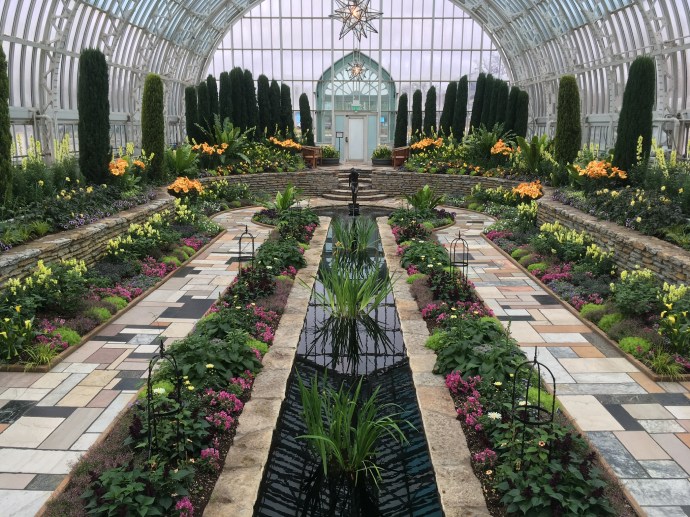
Como Park Conservatory, St. Paul MN
Categories: road trip, travel | Tags: , , , , , , , , , , , , , , , , | 1 Comment

2018:Staying Home for Awhile, July

Sherburne National Wildlife Refuge

St.Paul MN, August 11

Since our retirement in 2013, we have been usually spending most of the summer in Minnesota. Our condo in Saint Paul offers us 7th floor patio views of downtown Saint Paul and the Mississippi River valley to enjoy with our breakfast and/or dinner. Right across the street are walking and biking trails that can take us over to Minneapolis and beyond. With family nearby for spontaneous or planned gatherings, free concerts somewhere (usually near a body of water), tours at nature centers and local gardens, professional theater just a 10-minute bus ride away and numerous opportunities for civic engagement, what is not to like in “staying put” for the summer in the Twin Cities?

As we delight in staying in our condo, we are so pleased to know that we actually live in a national park. Yes, our condo, across from Crosby Farm Regional Park, is part of the 72-mile Mississippi National River and Recreation Area that stretches from Dayton to Hastings. This National Park is a partnership park with local and regional parks along the river corridor. And yes, we live in that national park corridor!

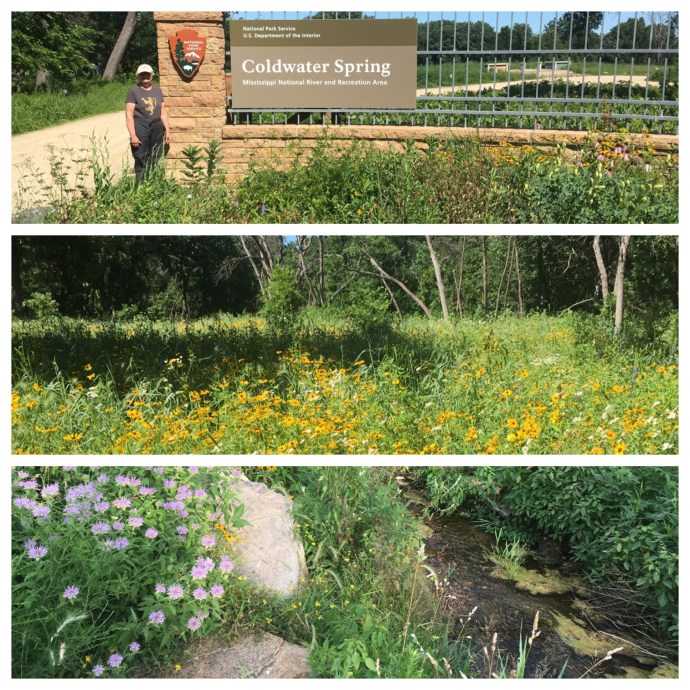
The spring and prairie flowers at Coldwater Spring

One section owned by the National Park Service is Coldwater Spring near Minnehaha Falls. This area had been an important gathering site for Native Indians and then a water supply for the soldiers at Fort Snelling. It is gradually returning to its forested, native flower beginnings, and is just gorgeous. Throughout the season, park rangers or other guides lead tours on specific topics at Coldwater. We took a twilight tour by an author who has written a book about the history of Coldwater (at one time as one of the regional federal Bureau of Mines testing sites).

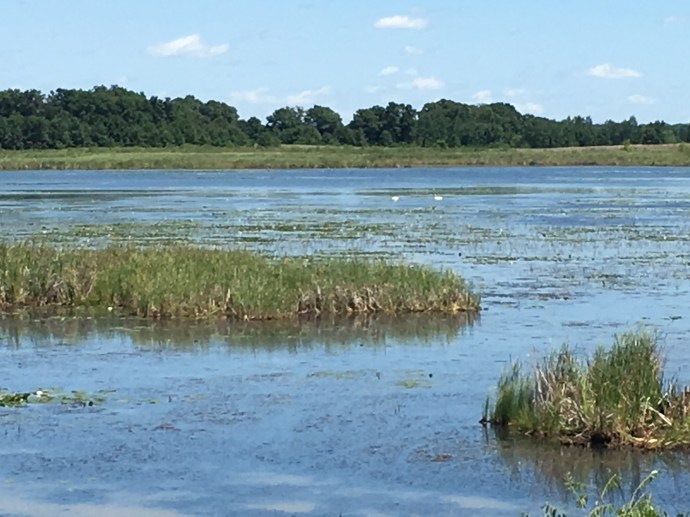
In addition to visiting national parks, we enjoy exploring national wildlife centers/refuges. There are several in Minnesota (one right near the airport) and this month we stopped by the Sherburne National Wildlife Refuge and traveled its 10-mile auto tour through its wetlands.

Fun at historic Grand View Lodge on Gull Lake MN

We celebrated Ed’s birthday (not a multiple of 5)this month with a gathering at one of his sister/brother-in-law’s home; my sister had also taken us to the MN History Theater to see “Glensheen”, a story about a double murder in a Duluth lumber baron’s mansion, (excellent) as a birthday gift. We also hosted an Evergreen couple from Nebraska who were here for a family wedding and took a long weekend with our Minneapolis daughter/daughter-in-law and their Houston nephew to Grand View Lodge in Nisswa (central lakes region of the State).

Wabasha Street Caves

It is always a treat for us when we “finally” experience something in Saint Paul that has been here for a long time and that we had not yet visited; a tour of the Wabasha Street Caves was such an outing. These sandstone caves over the years have been the site of a thriving prohibition speakeasy, a mushroom farm, a cheese storage area and now an event center that provides tours on Sundays.

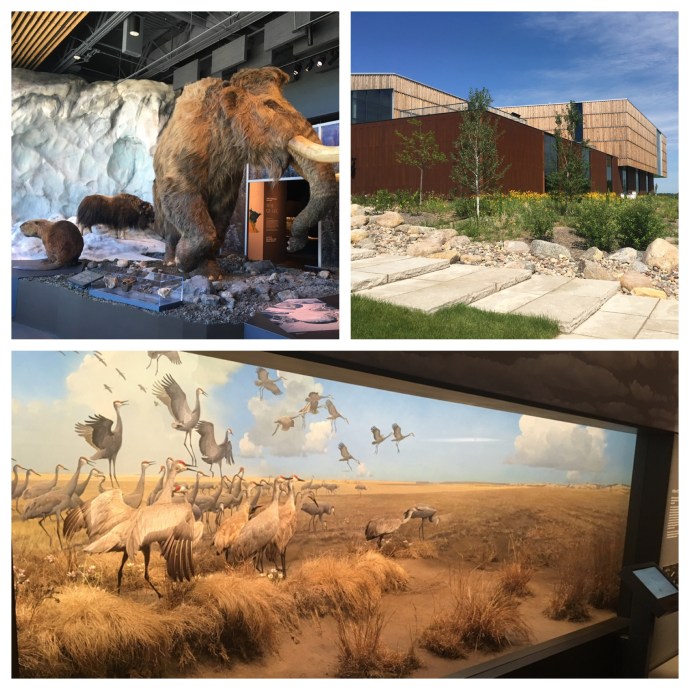
The Bell Museum; our area’s newest gem

We have been involved with voter registration events with the Saint Paul League of Women Voters, attended a discussion with our mayor on suggestions for the upcoming budget and always appreciate an opportunity to participate at our city councilwoman’s monthly morning coffee or happy hour. Ed volunteers with the National Park Service at 2 of its locations and both of us are volunteering weekly at the newly opened The Bell Museum (natural history). It is stunning. Primary election is this Tuesday, August 14 and Ed is working all day as an assistant election judge. GET OUT AND VOTE!

The Mississippi River, a working river; viewed from our walk along the river in Lilydale.

Chris and Ed. Saint Paul MN August 11, 2018

Categories: travel | Tags: , , , , , , | Leave a comment

2014 Trip Five, August 3, Summer in the Cities

Saint Paul, MN  Sunday August 3

We have been back from WI for a week now and are continuing our explorations of our home area, an area we have neglected for the last 18 months as we have traveled around the U.S.  The last week was one in which we continued testing out a few new  events unaccomplished in our previous ten years here.

Friday and Saturday we explored the Minnesota Fringe Festival. The Fringe Festival is a potpourri of short (less than 60 minutes), adventurous acts of comedy, drama, dance, music or a combination of the former. This year there are 169 different shows at 19 different venues around Minneapolis. Each show is performed five times over an 11 day period, but at just one of the 19 different venues. Show descriptions are brief, until online reviews are written providing an attendee’s explanation and critique of a show. Ticket options vary from one show, to ten ticket packages, on up to an unlimited number. Shows are offered every 90 minutes. To get into a show, you have to show up, get in line to obtain a ticket, and then get in line to get into the theater. Seating capacity varies on the venue. Performers actually receive 65% of the ticket revenue for each show they perform so online reviews are important. The artists may also have friends passing out flyers about their show at some of the other 168 shows. It seems they also try to get friends to write early positive reviews, sort of stacking the deck.  One veteran fringe-goer we talked to in line said to pay more attention to reviews written by people who write multiple reviews, those are less likely to be written by friends or family.

There are about 25 fringe festivals in the U.S, 10-12 in Europe,and another 10-12 in Canada and Australia. Minnesota Fringe is the largest non-juried festival in the United States and the third-largest Fringe festival in North America. This year is the 21st one in Minnesota. Supposedly it started in Edinburgh Scotland in 1947 but took a while to gain traction elsewhere.

Doing the Fringe Friday night in Lyn-Lake area

Doing the Fringe Friday night in Lyn-Lake area

This being our first time, our tactic was to focus on two locations and decide among shows being offered Friday and Saturday. Friday evening we were in the Lyndale-Lake area with three venues close by each other. Saturday we chose the Rarig Center at the U which offered four venues in the same building. We figured trying to drive to another part of town and get into a theater in 30 minutes would be a pain. We had purchased a punch card good for ten tickets, or five shows for us as a couple. Of course, given our habits, we were in each area plenty early. In fact, Friday night we had time to walk around Lyn-Lake and have appetizers at Bryant -Lake Bowl (one of the venues). The neighborhood has changed dramatically since we lived here 40 years ago; much more upscale housing nowadays.  This first weekend of fringe we did not encounter any sold out performances; supposedly this is likely the second weekend as reviews coalesce around the top shows and attendees try to make sure they can get in to the top performances.

Four of our choices were comedies, one was a mystery. Three were pretty decent, one so-so and one kinda lousy. The lousy one was still receiving pretty positive reviews 24 hours later from other people on-line. No sense describing the plots, you won’t see them and I probably could not detail them in an interesting and concise fashion. But the overall experience was a fun one; one we might well continue if we are home next summer. But we think five is a reasonable number to see. There is considerable standing around time for a performance that probably will only last 45-55 minutes. (If the show goes over 60 minutes, they turn on the stage lights and tell them to get off.)

Saturday was a particularly busy day. A morning bike ride went into Crosby Farm Park to observe if the bike/walking trails had been completely cleaned up after the flooded Mississippi River had inundated the park. The City crews had done a great job and we enjoyed the ride, even more so when Jim and Heidi spotted us on the path and we stopped to chat for a while. Unfortunately our Fringe Festival activities prevented us from watching Jim’s St. Paul Pioneers football team win again Saturday afternoon.  One more win and they are on to another national title play off next January in Florida. We may have to adjust our winter plans if they make the championship.  After the bike ride, we headed over to the Guthrie area of Minneapolis. We had a 1 P.M. walking tour sponsored by the Mill City Museum.

Jim, Heidi and Chris along the bike trail

Jim, Heidi and Chris along the bike trail

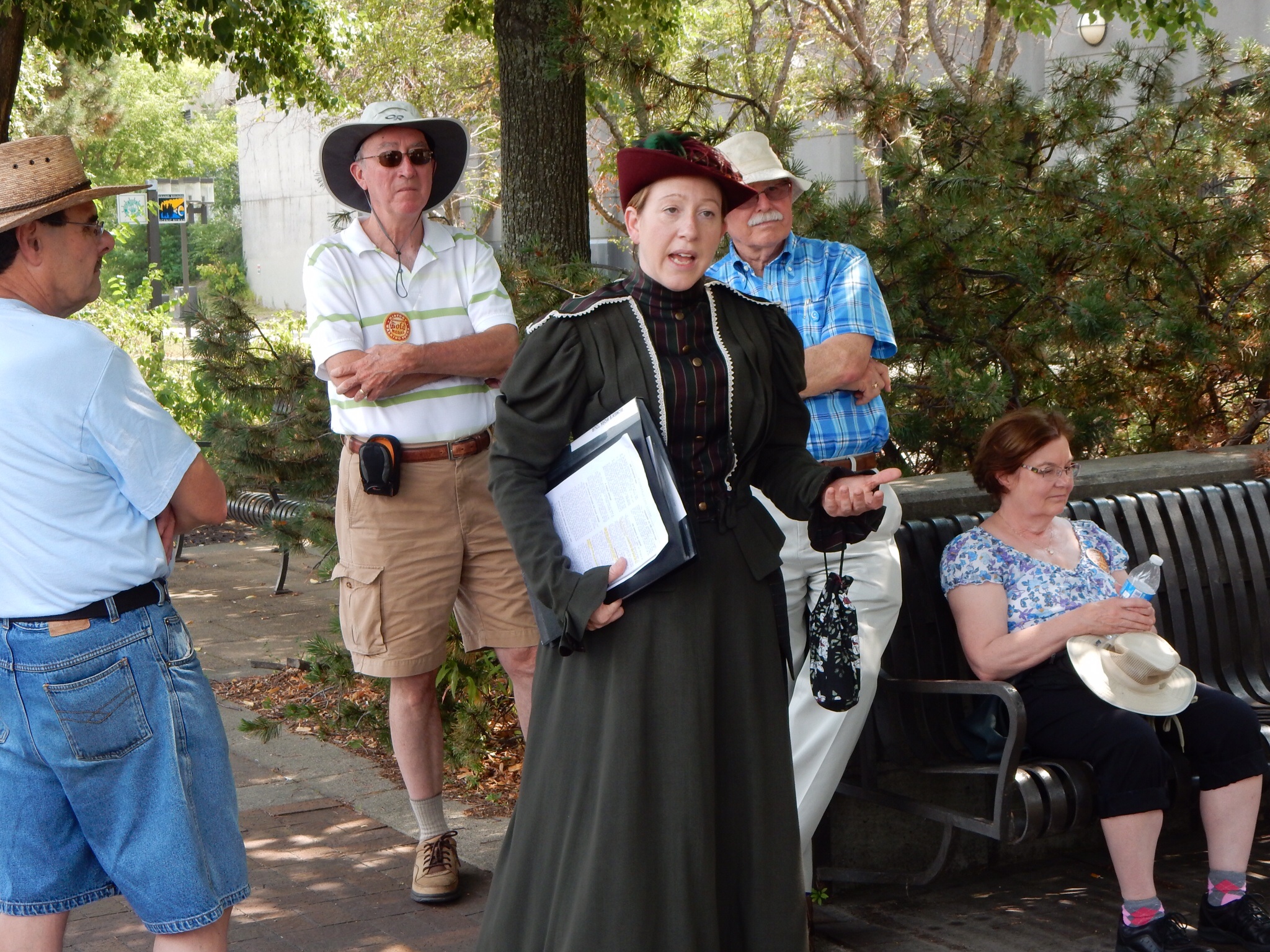
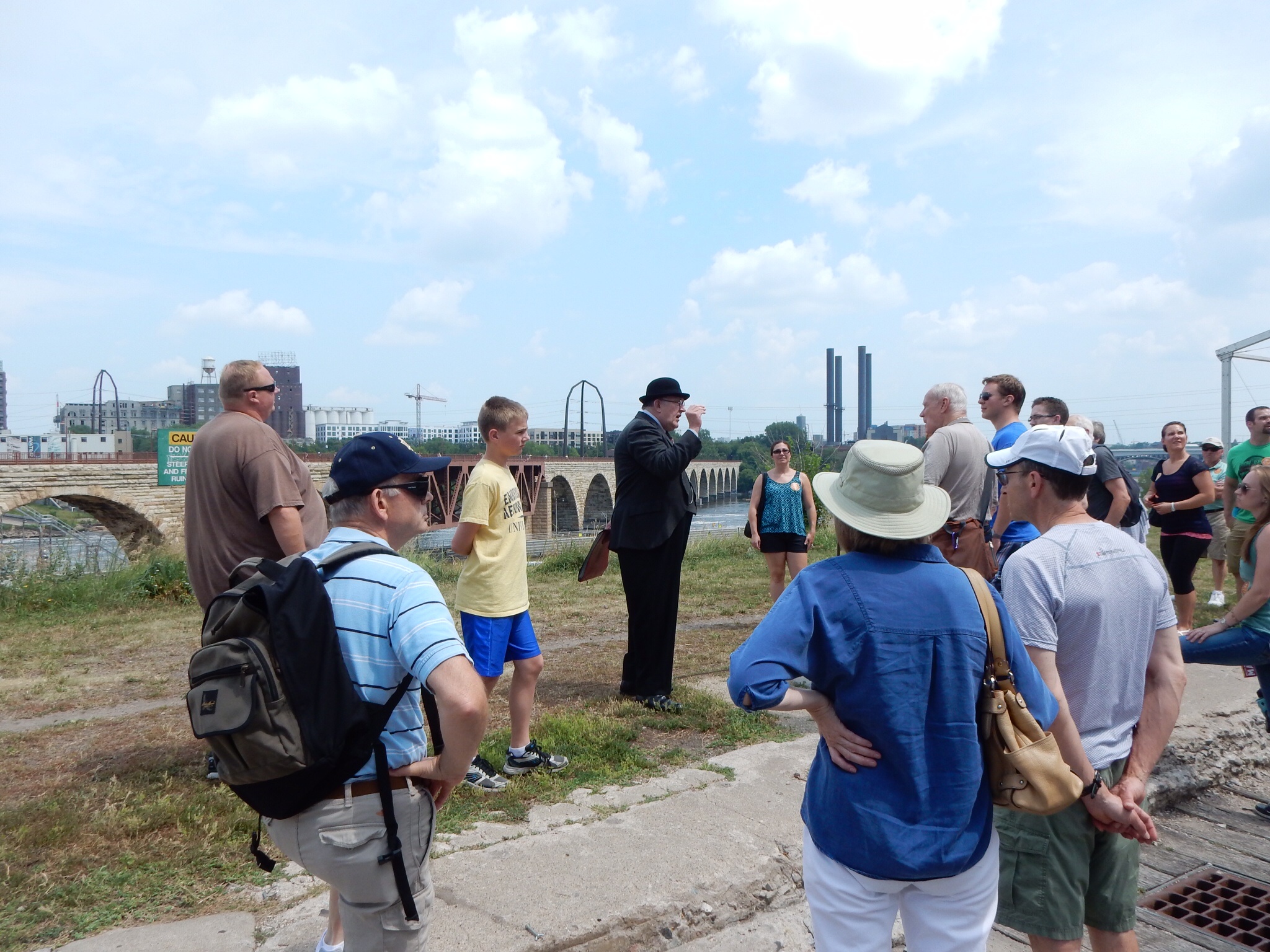
This walking tour was about the conditions for working women in the mill area during the late 1800s and early 1900s. A re-enactor in period dress gave the presentation for us and about 15 others as we walked along the mill area streets and the river. The day was warm and hazy (smoke from Canadian wildfires has drifted our way) but the 90 minute tour was worthwhile. The re-enactor portrayed a female reporter(Eva Valesh) for a St. Paul labor paper who later became a union organizer and national speaker.Valesh was just 19 when she began reporting and would go undercover, get jobs in the factories, and then report on working conditions. The good factories were relatively clean with reasonable wages for the time ($6-7 per week.) Many were dirty, low paying, and required standing on concrete for 10 hours per day, frequently 6 days per week. At one factory, the women went on strike for better working conditions, the owner would not make improvements and the factory closed and went bankrupt a few months later. When Valesh was on her speaking tours, she charged $5 per speech except when she was back in Minneapolis where she presented her talks for free.

Mill City Museum working women tour

Mill City Museum working women tour

Sunday we returned to the Mill City Museum for another 90 minute walking tour. While we were waiting for it to begin, we caught the 19 minute film on the history of Minneapolis. It is a humorous account of the city’s history but there is one inaccuracy. When talking about the local labor movement, the narrator (Kevin Kling) gives the history of Minneapolis labor but calls it Twin City labor history. In reality, the two cities approached labor relations in completely different attitudes. St. Paul was more benevolent while Minneapolis was run by corporations who maintained a strict anti-union workforce until the 1930s and 40s.

St. Anthony falls area today at non-flood and with water not diverted for mills

St. Anthony falls area today at non-flood and with water not diverted for mills

The  Sunday walking tour was about the water power of the falls. In this tour, a costumed museum interpreter portrays William de la Barre, who was born in Austria and moved to Minneapolis from Philadelphia to be the head engineer working for the Washburn Crosby mills and water power company. He spent half a century developing flour mills and waterpower for the company. The guide has been giving these presentations for a dozen years and does it very well. The Washburn-Crosby mills were the forerunner of today’s General Mills. General Mills makes a flour labeled as Gold Medal. In 1880, the national milling association held an international competition to determine the best flour. The Washburn Crosby company, using the new technology that de la Barre installed, won the gold prize and hence the brand name. Fortunately for the company, the competition was only held once and thus the prize could not be claimed by any other company.

Engineering the Falls Mill City Museum tour

Engineering the Falls Mill City Museum tour

Mr. de la Barre was hired after the Washburn A mill exploded in 1878 to build a new mill that would not explode and went on the be the person responsible for controlling and maximizing the water power created at St. Anthony Falls as Washburn bought up all of the riverfront land and its water rights. The city wanted water power and the industry it would sustain. Flour mills, saw mills and textile mills all lined the riverfront and along the parallel canal which had been created to furnish the waterpower. Over time, saw mills and textile mills dropped out and milling became the dominant force for many decades. The river bed geology is soft sandstone over a varying depth of harder limestone. Besides creating Minnehaha and St. Anthony Falls, the geology led to numerous sinkholes and collapsed tunnels at the dam and raceways that had to be repaired.  One factoid we learned, the original suspension bridge on Hennepin Avenue was the first bridge crossing the Mississippi River.  (St. Louis tries to take credit erroneously.)  Izzy’s ice cream has located a second shop three blocks from the Mill City Museum so we ended our afternoon activities with a visit there.

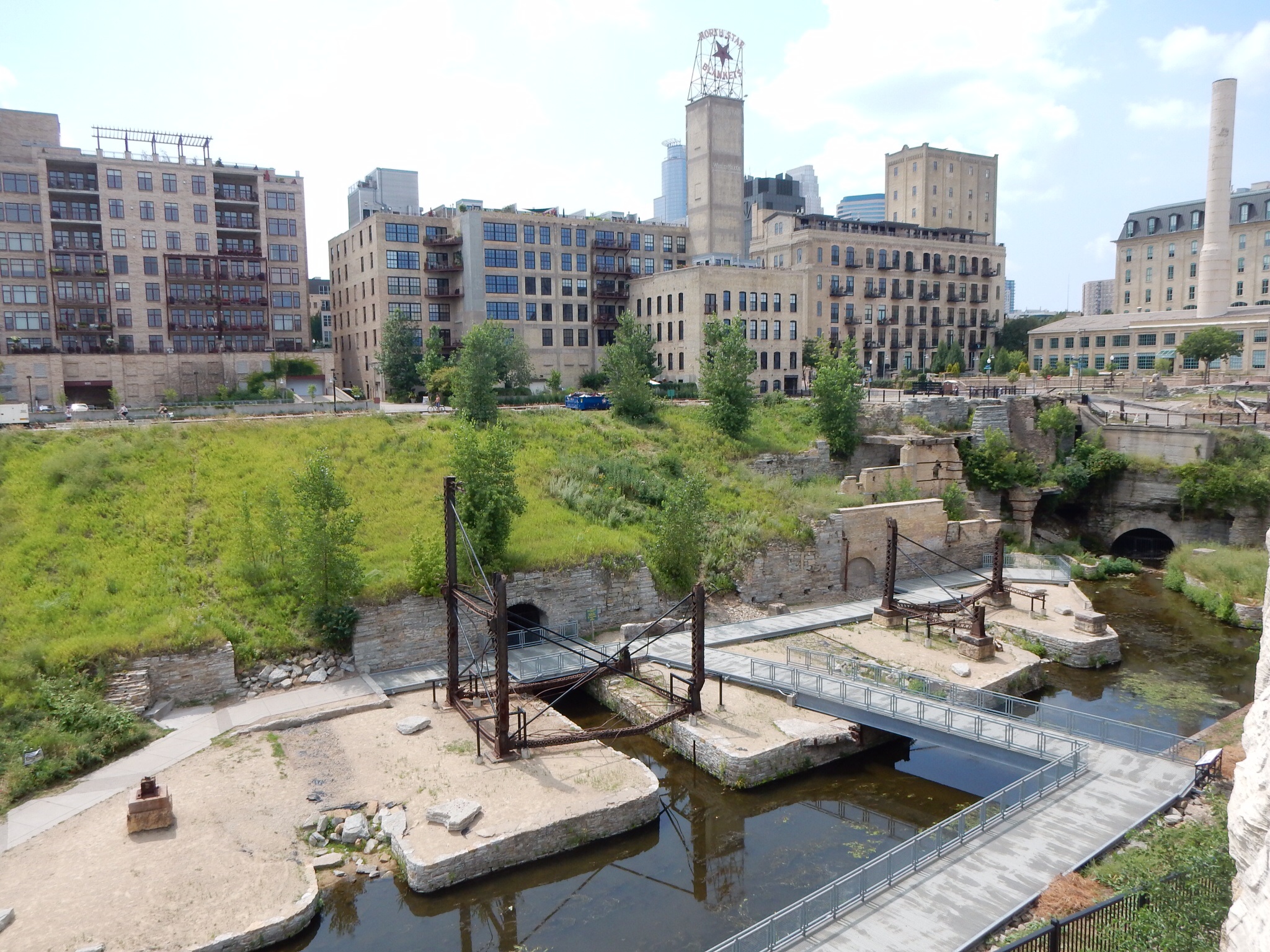
Mill City ruins area of Minneapolis

Mill City ruins area of Minneapolis

Earlier in the week I volunteered for the National Park Service doing the enviable task of pulling weeds. At Coldwater Springs is a new park along the Mississippi created on the site of a spring that provided water to Fort Snelling. The Park Service has been the responsible party in bringing this to fruition as a park. In most of the Mississippi River National River and Recreation area, they just partner with local governments and park agencies to provide a coordinated approach. I spent 1.75 hours bending over, hunched over, or kneeling on the ground pulling out crown vetch. Great fun;  my lower back is still crying out to me.

Thursday night was the Lynx, our WNBA team that has won the WNBA championship two of the last three years, finishing second the third year.  We met the Sarahs and some of their friends at Kieran’s Irish pub before the game. The Lynx had close to a sell out crowd at Target Center as they played the Phoenix Mercury, the team currently with the best record in the WNBA and riding a 16 game winning streak.  Well, the Lynx put an end to that streak in an exciting game.

MN Lynx defeat the Phoenix Mercury

MN Lynx defeat the Phoenix Mercury

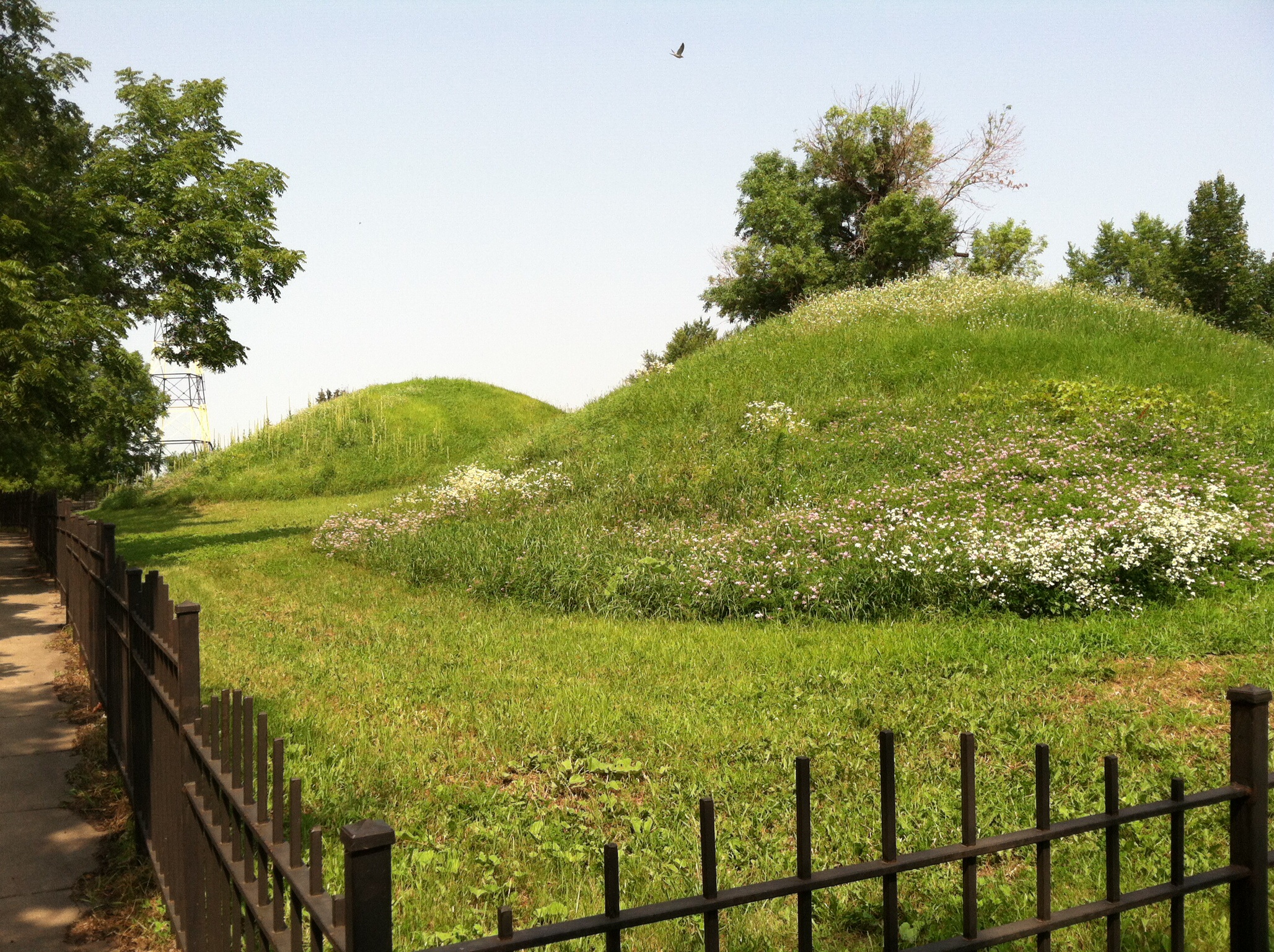
The rest of the week was quieter. We had dinner with Kathy and breakfast with Bernie and Tony.  We paid a visit to Indian Mounds Park in the Dayton’s Bluff area of St. Paul. We figured if we drive to Iowa and Mississippi to see Native American mounds, we can certainly make another visit to our local ones. There is no museum here though.

Indian Mounds Park in St. Paul

Indian Mounds Park in St. Paul


Ed and Chris Monday August 4  2 PM

Categories: road trip, travel | Tags: , , , , , , , , , , | Leave a comment

Blog at WordPress.com.