Posts Tagged With: Seward AK

2019 Trip 5: Alaska: Sept. 7-8

Lake Hood Floatplane Base, Anchorage

Anchorage, AK. Sunday September 8

Saturday was the first day of consistent rain since we began this trip three weeks ago. Luckily Seward had a few options for indoor activities. The Alaska Sealife Center is basically an aquarium although one with a heavy research and conservation emphasis. The admission is pricey at $30 per person but again the Alaska Tour Saver Book came in handy with a buy one, get one coupon.
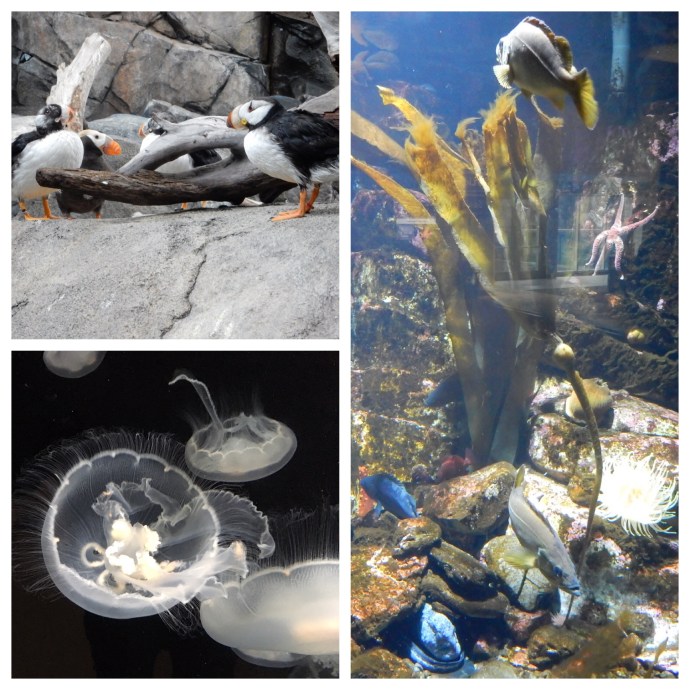
Alaska Sealife Center in Seward

Besides keeping us dry, the Sealife Center gave us an opportunity to closely observe some of the animals we have been seeing. The puffins, for instance, were much cuter when seen from a close distance. Although the fish were ugly, the underwater creatures like jellyfish, anemones, etc. are always cute and surprising.

Educating the visitor to climate change and pollution’s impact was a consistent, secondary theme presented by the Sealife Center. Given the importance of the Alaskan fisheries to the production of seafood supplies, the theme is timely. It has taken a while for the world to understand sustainable fishing, now it has to more fully practice it.

Two of the many murals in Seward Alaska

During our time in Seward, we had the occasion to enjoy the many murals painted on the walls of buildings. Seward has been proclaimed the mural capital of Alaska, with about thirty murals scattered around the community. Local artists paint local scenes and topics. I will admit some of our photos came while driving from place to place during rainy Saturday rather than walking all over town to observe them. Seward is not the first town we have visited using murals to make a statement about local history and pride, but whenever it is done, we have enjoyed it.

A second indoor stop was at the Seward Community Library and Museum. The museum is small but was a visual insight into life in early Alaska. Seward’s ice free port, Resurrection Bay is over 900 feet deep, had long been its claim to fame for fishing and shipping. The 1964 earthquake changed that into tourism as the destruction by the earthquake and tsunami wrecked the piers and railroad line. The lengthy rebuilding process and less severe destruction in Anchorage switched the shipping function to Anchorage harbor and to Anchorage’s airports.

Statue in Seward honoring the Iditarod Trail, dog and man

The library/museum hosts two half hour films daily which we viewed. The first recaps the severity and impact of the earthquake. The second discusses the Iditarod National Historic Trail. Not to be confused with the Iditarod race, the Iditarod Trail was a dog sled route that predated the railroad and provided a means of travel for the early gold rush. The almost 1,200 mile trail began in Seward and ended in Nome, utilizing many trails used by indigenous peoples. Later supplanted by the railroad and then highways, the Iditarod Trail was an important supply route in the early days of Alaska. It has been recognized as one of the first historic trails in the U.S. by the Bureau of Land Management.
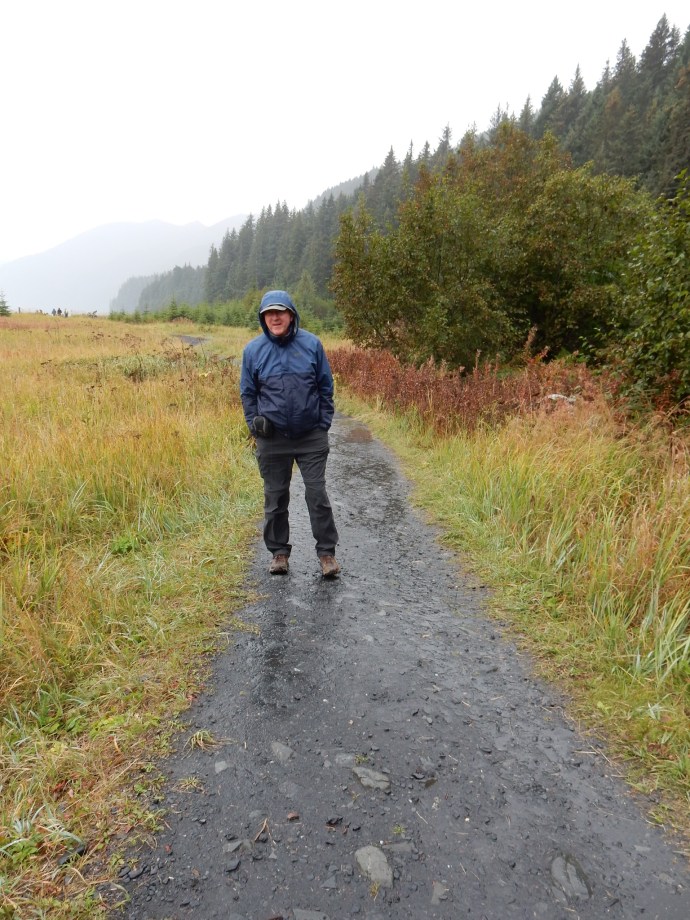
Fall in Alaska

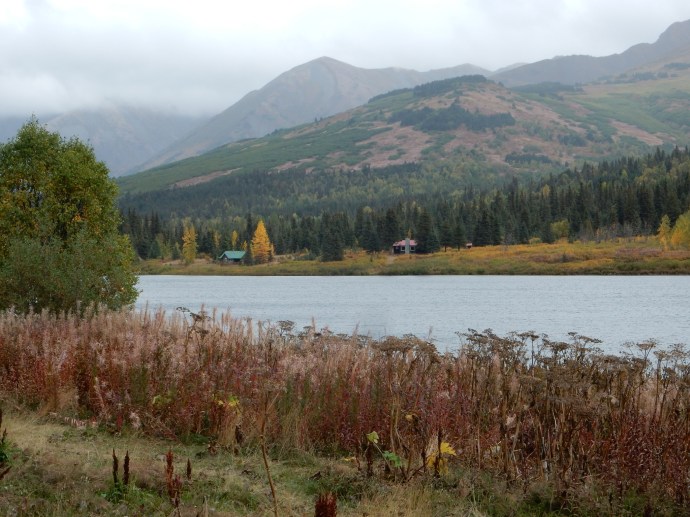
Fall in Alaska

After the videos, we left Seward for our last Alaskan destination, Anchorage. We will be here until Tuesday morning when we fly to Seattle. Sunday morning’s church service had another Minnesota connection as we met a woman who had recently been back there to visit family and had made sure she took in the Minnesota State Fair. It was a low-key day, still a bit drizzly. We walked along Earthquake Park, built around a portion of town that actually slid into Cook Inlet during the 1964 earthquake. The signs here confirmed the earthquake impact but that Anchorage was spared the tsunami that destroyed so much of Valdez and Seward.

Fixed wheel plane using road to reach runway at Lake Hood Floatplane base

The highlight of the day was time spent at Lake Hood Floatplane Base. This is the largest seaplane base in the world with over 2,000 take-offs daily. There is a runway for fixed wheel planes also so we were constantly turning our heads to determine if the sound of another plane’s engine came from the land runway, the water runway, or the skies. Besides large closed hangers, open storage of planes occurred at large marina like locations but also stacked alongside the roadway. Frequently a small building would be built alongside the planes along the roadway. Signs warn you to yield to planes on the road which we thought was cute until we actually observed a plane warm up and head down the road to the land runway.
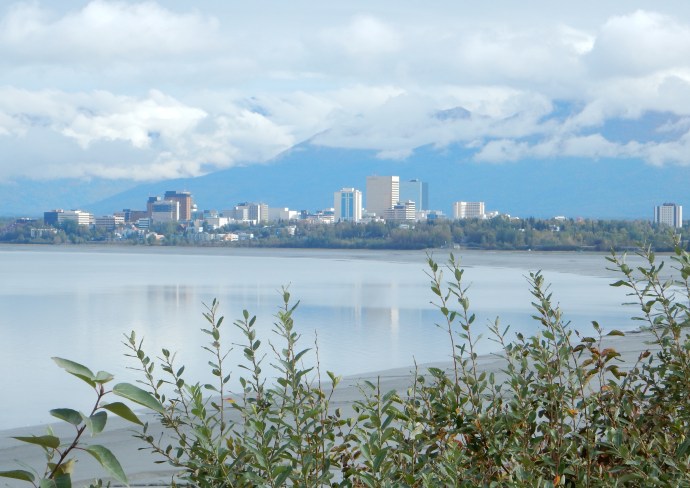
Anchorage Alaska skyline

Ed and Chris Monday September 9 4 AM

Categories: road trip, travel | Tags: , , , , , , , | Leave a comment

2019 Trip 5: Alaska: Sept.4-5

On the hills above Homer AK

Seward, Alaska, Sept. 4-5

Wednesday and Thursday were two relaxing days seeing the sights bookended by the exciting air flight on Tuesday and Friday’s upcoming water cruise.

Fishing boat design varies by the type of fishing being done

The day started at the Pratt Museum, the local historical society in Homer. While small, it had good displays unique to the Kachemak Bay Area. Coal mining was an early driver of settlement from the Lower 48. Fishing has historically been important, changes and overfishing have made full time commercial fishing a difficult occupation. That is one reason for the growth of fishing tourism.

The area covered by the oil spill from the Exxon Valdez

One display section focused on the Exxon Valdez oil spill. This was an oil tanker which after leaving the oil terminal in Valdez, ran aground in Prince William Sound on Good Friday 1989. 11 million gallons of crude oil were released, creating a monumental environmental crisis.

The display in the Pratt showed the extent of the spill. To help one visualize the extent of the oil spill, they have a U.S.map with a portable outline of the spill area. I placed the spill along the Mississippi River. The spill would have stretched from the headwaters at Lake Itasca in northern Minnesota almost to St. Louis. This gave me a better realization of the spill and its consequences.

Hiking around Homer

Homer offers numerous hiking options from full day hikes across the bay at Kachhemak State Park to strolls around town. Wednesday we selected more leisurely options. While mountains line the south side of the bay, Homer itself has steep hills behind it on the north. To us, it resembled Duluth MN with its hills and view of Lake Superior.

Hiking around Homer

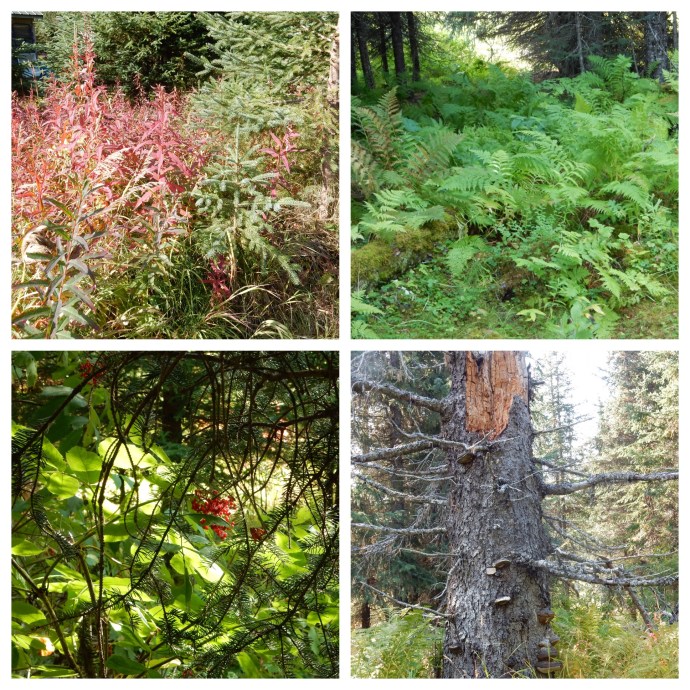
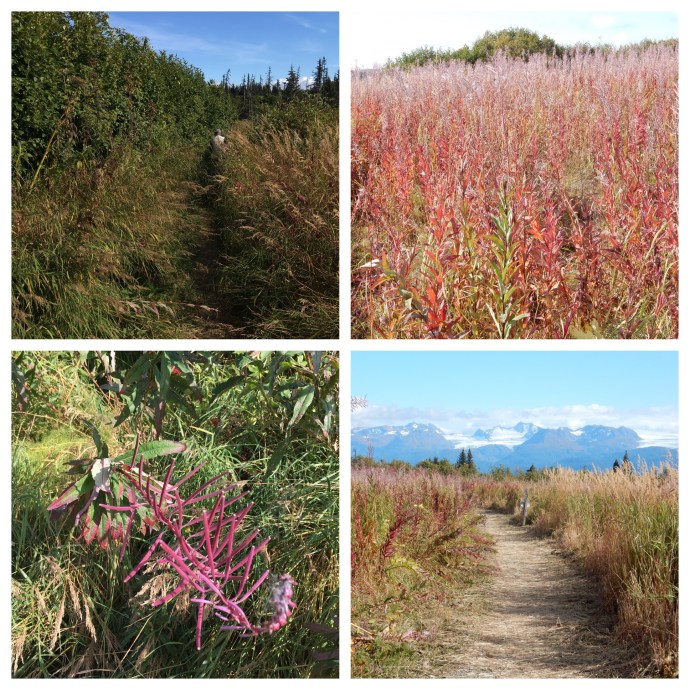
While deciduous trees are not abundant, there are some. Our expectations of a colorful scene of orange, and red, and yellow is not to be seen. Most of the deciduous trees have brown, falling leaves. The underbrush, however, has been colorful. Fireweed is a common plant here and can carpet a field completely or line the roadside with its 4-6 foot tall stalks. It is coming to the end of its season and depending on locale, may still be flowering or starting to seed. Its fluff is similar to cottonwoods or dandelions and you can walk through a cloud of the fluff as you walk along.

Our hikes did not produce any wildlife viewings. On one, a moose and her calves had been seen in the area and when we came across very fresh moose scat, we decided to take a different path. Female moose are known to be aggressively protective of their young. Views of mountains, sea, and glaciers were pretty much everywhere.

Routine tasks came into play, we had several loads of wash to do. The mud from the walk on Tuesday was on numerous articles of clothing and even the rinsing and washing down on Tuesday only partially got rid of the mud. An excellent halibut dinner capped our Wednesday activities.

Holy Assumption Orthodox Church, Kenai AK

Thursday was time to retrace our steps through the fire zone over to Seward. The people at the Maritime Islands National Wildlife Refuge had recommended a slight detour into the city of Kenai where a herd of caribou frequently hang out. Today they were absent.

The Nikiski area north of Kenai along the east shore of Cook Inlet

Since we were in Kenai, we decided to drive a few more miles north along the Cook Inlet looking for evidence of the oil industry. The Alaska papers had written about BP selling its Cook Inlet oil interests to a smaller firm out of Houston. I had not realized oil was a big deal outside of the North Slope Area. Evidently Cook Inlet is a major player as are several new fields elsewhere in Alaska that are getting attention. Those new fields will require new roads to be built through tundra and wilderness area. I am not going to get into the complicated history of oil, Alaska, tax write-offs, annual payments to residents and environmental concerns but did want to at least see this aspect of Alaska.

Nikiski is about 10 miles north of Kenai and a world away. As you leave Kenai, the roadside changes to an industrial setting with oil related businesses lining the sides, along with a surprising number of small churches. We passed a fertilizer plant, refinery, liquid natural gas processing facility, etc. Oil drilling rigs in the inlet were too far out to be visible to the naked eye although an exhibit at the Kenai Visitor Center said they were there.

Driving along the Sterling Highway in the Swan Lake fire zone

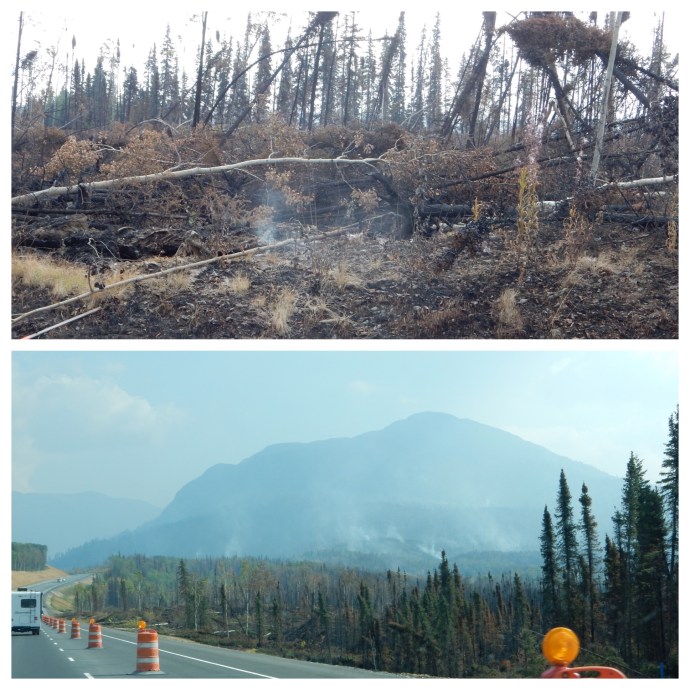
Leaving Nikiski, we continued our journey. Several times today we were stopped and had to wait for pilot cars to lead us through road construction zones. Going through the Swan Lake fire zone was slower this time. On Monday, Labor Day, the pilot car had zipped through. On Thursday, with construction crews active alongside fire containment workers, speeds rarely reached 20 mph. No fire was visible and the wind seemed to keep most of the haze to the south side of the road. But numerous areas not far from the roadside were smoldering and sending out heavy plumes of smoke. We had frequently heard comments predicting that the fires will return next spring. The boggy area tends to allow the fire to burn slow under the surface.

Exit Glacier, Kenai Fjords National Park

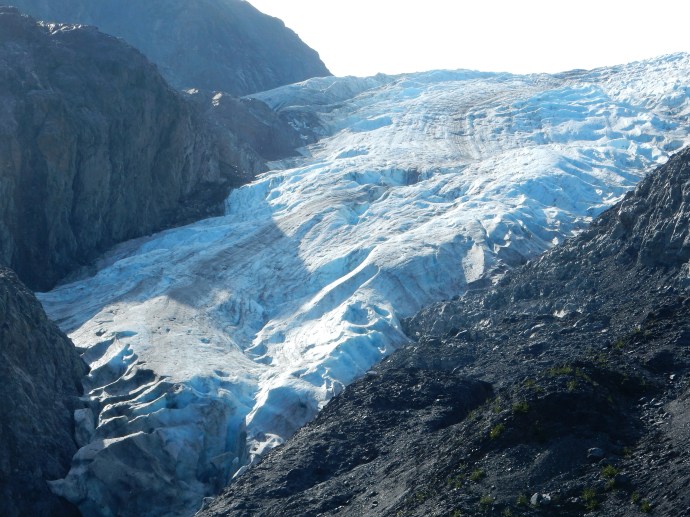
For us, the major attraction in Seward is Kenai Fjords National Park. Once again, much of the park is wilderness and difficult to reach. One accessible area is Exit Glacier just north of Seward. We reached it in time to take a hike to the viewing platform short of the glacier itself. Along the way are the usual signs indicating how the glacier has retreated. As you drive in and then as you hike, you pass signs indicating the glacier was down here in 1815, here in 1899, here in 1929, here in 1951, etc.

Friday the cruise is with Major Marine, a five hour expedition with lunch and views of the glaciers and fjords of Kenai National Park. Five hours seemed long enough, longer ones exist but take you out on rougher seas. After the Florida trip, rougher seas seemed not to be a wise option. We will let you know how this cruise fared.

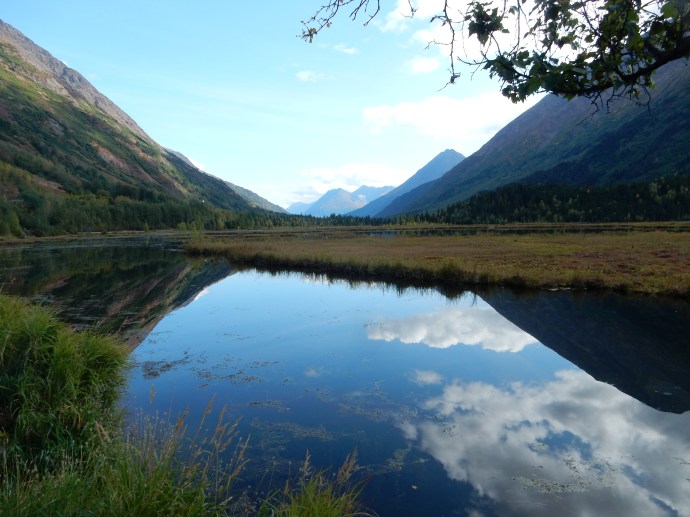
Tern Lake, Seward Highway

Ed and Chris. September 6. 6:45 AM

Categories: road trip, travel | Tags: , , , , , , , , , , | 4 Comments

Blog at WordPress.com.