Posts Tagged With: sandhill cranes

2019 Trip 5: Alaska: August 23

Creamer’s Field Wildlife Refuge, Fairbanks AK

Fairbanks, Alaska Friday August 23

We must be getting old. A full day of travel has us tired out by dinner time. The day was good, we enjoyed it quite a bit, we are just bushed. Maybe we got out of travel shape and will find our bounce during the next few days.

Sandhill Cranes at Creamer’s Field Wildlife Refuge, Fairbanks AK
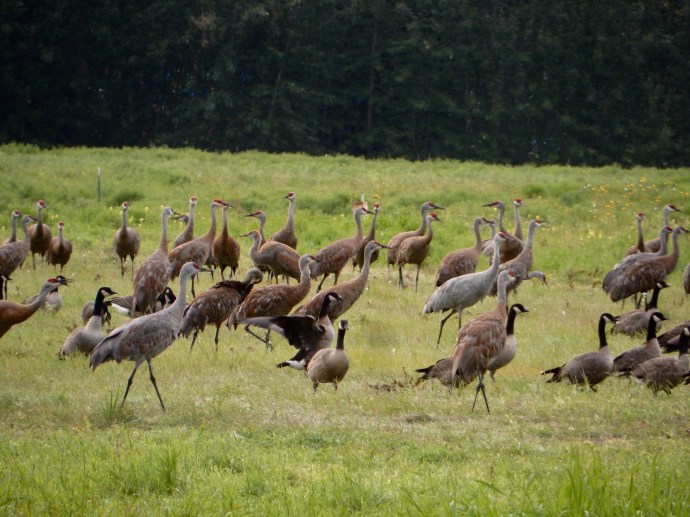
The day began at the state-owned Creamer’s Field Wildlife Refuge. Just two miles from downtown Fairbanks, the refuge is the site of a former dairy farm which always had hosted migratory birds even when it was an operating dairy. When it closed up shop in the 1960s, the community stepped in, bought the property, and converted it into the refuge. This weekend, the predominant birds were Sandhill Cranes and Canada Geese. Both were resting and feeding in preparation for continuing their journey southward. We walked around the property, enjoying the walking, the observing, and the listening. A very nice way to start off our day. (We also met and talked to a woman who had been born in International Falls MN.)

Blooming flowers at the Botanical Gardens of the University of Alaska-Fairbanks

Down the road a mile or two sits the University of Alaska, Fairbanks. The Museum of the North is located on the campus and it was our primary destination. A minor sidelight had appeared in our planning, the Botanical Garden run by the University. The Garden seemed worth a look-see, being just a few minutes from the Museum. What a pleasant surprise! Although not large in acreage, flowers were blooming delightfully.
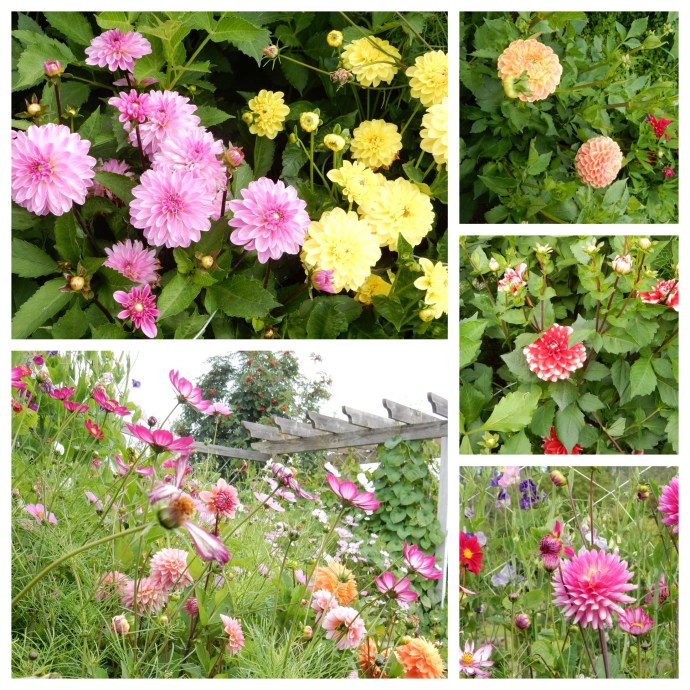
dahlias at the Botanical Garden, University of Alaska

Several types of research were highlighted. For instance, Alaska is in a unique position for growing peonies. Alaskan peonies bloom in late summer, after all others around the world. They grow fast and large. The climate discourages insects and moose don’t like the taste. The U of A has worked with growers throughout the state and peonies are now an export market for Alaska.

Museum of the North
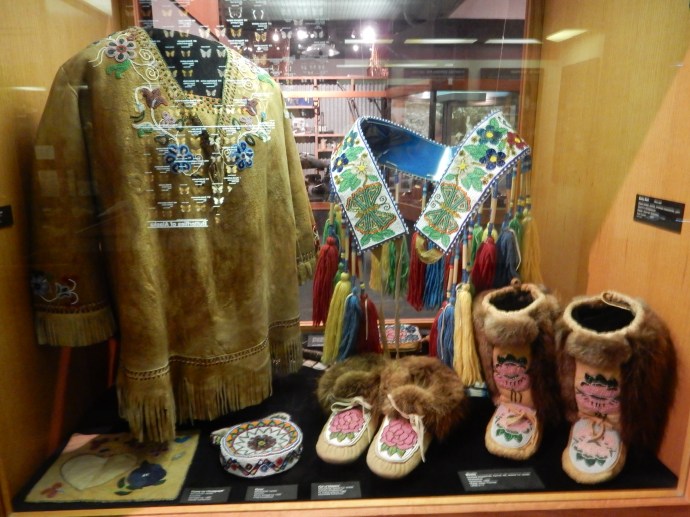
Finally it was time for our primary target for the day. The Museum of the North is housed in a dramatic building with a focus on Alaskan art and anthropology. The first floor galleries have a primary exhibit area that highlights each region of the state. In each region, history, culture and natural history are combined. We found it fascinating, informative, and overwhelming. On display were a Woolly Mammoth tusk and skull we can discuss when we are back at the Bell Museum.

I found the section about the Japanese invasion and conquest of two Alaskan islands in the Aleutians fascinating. The military build-up in Alaska can be traced partially to this successful Japanese invasion and follow-up re-taking by the U.S. Even less known is the impact on the islanders who lived in the Aleutians. Towns were bombed; villages on many islands evacuated with some villages permanently barred from being re-settled after the war; homes were looted by soldiers from both sides and from civilians; and no effort made by the U.S. to re-establish the communities. We did vastly more for Western Europe than we did our own citizens.
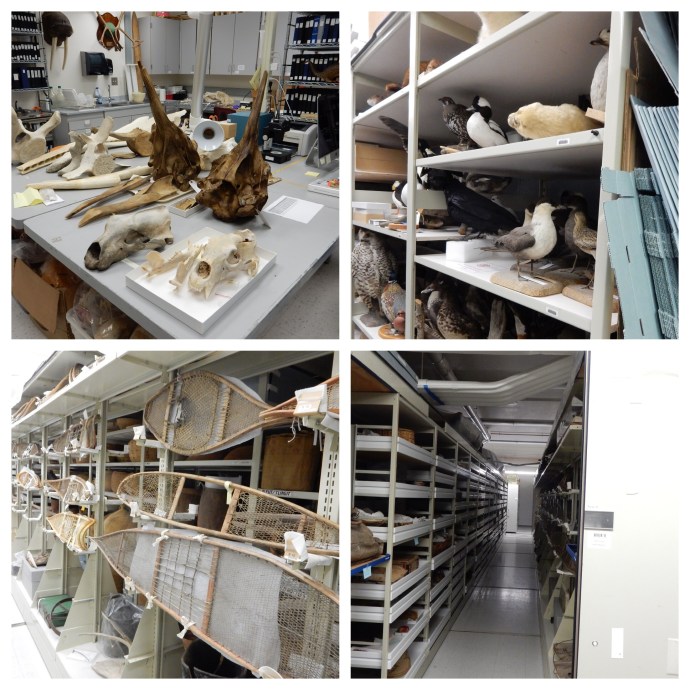
Behind the scenes at Museum of the North, University of Alaska Fairbanks

To break up the experience, we took in a 30 minute video presentation about the aurora borealis. If we are not likely to see it, we might as well learn a little more about the phenomena. After the video we took an hour long tour that showed us the inner workings of the museum. The guide, from the mammal department, started with the freezers used to kill any pests that might be on any incoming specimens. The new specimens go in the deep freeze, 40 degrees below zero for three days.

The Museum and University have over 1,000,000 specimens and we passed row upon row of rolling file cabinets that house items in boxes, on shelves, and in locked cabinets. Chris got to hold a grizzly skull. We watched a person preparing a bird specimen for storage and two people working on digitizing records of insects. Several people discussed their work and answered our questions patiently. It was time well spent and very informative.

Arctic Research Institute

After the tour, we hustled over to the Arctic research center to look at some displays about climate change. This University plays a pivotal role in research about climate change, given its location and faculty expertise. It even has its own rocket range for sending up rockets for weather observation. You may have read about the massive budget cuts proposed by the Governor of Alaska which would decimate the research efforts. Hopefully that won’t happen. If faculty are cut, the research knowledge and expertise may take a long time to get re-established, if ever.

We returned to the Museum and visited the rest of the galleries. A complete visit would take longer or several visits but we spent the day at the Museum and left knowledgeable and hungering for more. The Museum of the North comes highly recommended by us.

Chris and Ed safely getting close to bears

Ed and Chris. Fairbanks AK. August 24 6 AM

Categories: road trip, travel | Tags: , , , , | 1 Comment

2018: Staying Home for Awhile, October

Headwaters of the mighty Mississippi River at Itasca State Park in MN

Saint Paul, MN October 26

We will be leaving tomorrow for a week’s trip to Florida. We will blog about our travels and adventures in Florida next week so we want to wrap up our fall “close to home” activities.

Minnesota, like many other states in our diverse and beautiful country, has an extensive state park system. There are 76 state parks in Minnesota. Many people, we included, visit state parks that are near to their home and/or have a unique feature. To encourage people to visit all of the Minnesota state parks, the Minnesota Department of Natural Resources (DNR oversees our state parks) has a program called the Passport Club. A person buys a booklet at a state park and then when they visit a MN state park, the booklet is stamped and dated from that park. In retirement, we decided to see how long it would take us to visit all the parks. We started in April 2015 and got our 74th stamp last October. (Two parks do not have to be visited since they can only be accessed by boat.). We picnicked, hiked and participated in programs at parks we never would have visited except for this passport challenge.

We have decided to complete a second MN State Parks Passport and have added the challenge of doing the Hiker’s Club hike that is identified at each park. These hikes range from 1 mile to 6 miles. We have already visited 9 parks on our road to complete our second passport book.

Itasca State Park

Hiking at Wild River (top), Lake Louise (Chris in pic) and Interstate State Parks in MN

This month we visited Itasca State Park with Ed’s sister Jude. Itasca is the headwaters of the mighty Mississippi River. It begins its 2350 mile journey to the Gulf of Mexico as a small stream flowing out of Lake Itasca where flat rocks and a footbridge have been placed to allow people to walk across the Mississippi. Itasca is the second oldest state park in the nation, after Niagra State Park in New York. The park is home to over 100 lakes and thousands of acres of wetlands and forests. We also visited and hiked at Lake Louise, Interstate and Wild River State Parks this month.

The Nuns’ Bus in Cedar Rapids IA

Have you ever heard of the Nuns on the Bus? The advocacy arm of U.S. women religious (nuns) over the years has criss-crossed the country on a bus tour to talk about targeted political issues. This October a group started in California on a truth tour to talk about the Republicans’ tax policy. They hold town hall meetings, meet with members of Congress, have site visits and rally’s. Last week, they (and their bus) were in Cedar Rapids, Iowa for a town hall meeting on our nations’ recently enacted tax policies. We went down for the meeting, listened to the presentation and joined the small group discussions on what an individual can do (VOTE).

Prior to the evening gathering, we went to the National Czech and Slovak Museum and Library in Cedar Rapids. One gallery was a heart wrenching telling of Czechoslovakia during WWI and shortly thereafter. Czechoslovakia no longer exists; divided into the Czech Republic and Slovakia in 1993. If folks feel depressed about our current political climate, reflect on history, ours and that of other nations.

Returning to St. Paul from Cedar Rapids across IA farm land and along the Mississippi River

We stayed overnight in Cedar Rapids after the nuns’ program and since the next day turned out to be one of our rare (for this year) glorious fall days, we decide to take the long way back to St. Paul through western Wisconsin. We stopped at a wonderful conservation interpretation center in Clayton County, IA and were pleased to discover a new information center that opened this summer along the Great River Road in Genoa, WI by the U.S. Fish and Wildlife Service.

Mary of the Angels Chapel attached to St. Rose Convent

At the nuns’ program in Cedar Rapids, we met some nuns (Franciscan Sisters of Perpetual Adoration) who had come down from LaCrosse, WI. They invited us to stop at their convent, St. Rose Convent, if we had time; we did and were so glad we stopped. We had a tour, with historical commentary, of their chapel (located on the campus of Viterbo University) and their perpetual adoration chapel (a Catholic worship space) that has had uninterrupted prayers being said in it 24/7 since August 1878!

Sandhill cranes at Sherburne National Wildlife Refuge

Last weekend we participated in a bright and early (6:30 a.m.) activity at the Sherburne National Wildlife Refuge to watch the morning wake-up of about 9,000 sandhill cranes from their roost to forage in neighboring fields as they fatten up for their flight to Florida. It was 32 degrees out with 20 mph winds; there was no bird watching shelter, so were outside for 2 hours. We have seen 200,000 sandhill cranes in Kearney, Nebraska several years ago so this was a low-key affair but worth it. In an interesting fact (to us, at least) the Kearney sandhill cranes migrate north to Canada from Texas, going to the west of Minnesota. The Minnesota sandhill cranes migrate southeast to Florida. Maybe we will see some of the same birds next week, we did not check to see how long the cranes’ migration journey takes.

We continued this month our volunteer work with the Bell Museum of Natural History and Ed with the Mississippi National River and Recreation Area, including the annual volunteer dinner where Ed received a National Park Service backpack for exceeding 750 cumulative hours of service.

Did we mention to VOTE on November 6?!

Fall in St. Paul, two days apart

Chris and Ed
October 26

Categories: road trip, travel | Tags: , , , , , , , , | Leave a comment

2017 Trip Two: Tour of Texas March 4, Part 1

Kearney, NE March 4. Saturday

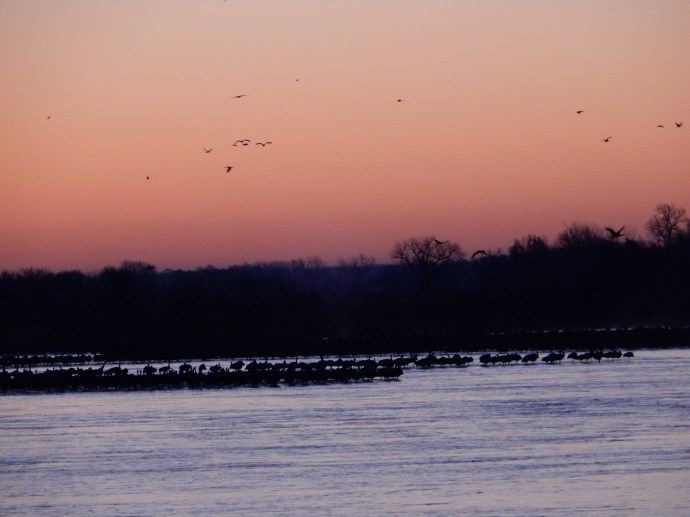
Sunrise on the Platte River from the Crane Trust blind

Sunrise on the Platte River from the Crane Trust blind

We stumbled through the dark at 5:15 AM, trying not to trip on the person ahead of us. 18 of us, bundled up, hoping to see, and hear, large numbers of sandhill cranes. Most people were in dark jackets which would have been great if they were trying to be a cat burglar. But as they blended in to the early morning gloom, it was difficult to see them. Our destination was a blind, a wooden structure with windows overlooking the largest roost of sandhill cranes along the Platte River. We parked our cars about a block away. We were told it was critical to be quiet and to not use cell phones for calling or lighting the way. Our leader had a small, red colored flashlight to slightly show the way. But towards the back of the line, the red light of the guide only indicated in a general sense where we were headed.


Morning video at Crane Trust

We made it to the blind without any major incidents and sat down, after fumbling around in the dark to find the benches. Now the waiting began, until enough light appeared to see the cranes. We heard them first, a cacophony of bird calls that increased and decreased spasmodically. Besides the cranes, we could hear ducks and song bird type calls. The sound level increased as the light increased. Eventually there was enough pre-dawn light to begin taking photos. I waited to shoot until at least two other people began taking photos; I did not want to be the first and then discover I made some noise that would alert the cranes to our presence.

Sunrise on the Platte River

Sunrise on the Platte River

My first photo was taken at 6:20 AM and the last at 7:25. The light was colorful but still not enough to do a good panoramic shot showing the full roost. Most of the birds were still, not a lot of preening and dancing. Around 7 AM, birds started flying around, not necessarily leaving the roost to feed but just flying around the river. Chris and I took turns with the camera and the iPhone. Some people had their 35 mm cameras with zoom lenses; you will not see those close-up shots from what we have.

It was a great experience. The Crane Trust says about 200,000 cranes are in the area at the current time. As we returned to our hotel, a 30 minute drive from the Crane Trust offices, we started seeing flocks of cranes, from 5 to maybe 100 birds in a group, flying from the river area and landing in fields along I-80 to feed. Heck, they woke up hours after we did and got to have breakfast well before we did. Not fair.

We returned to the blind for the evening, sunset crane watch. We had signed up (in early January) for both sunrise and sunset out of concern that the weather would not be conducive for at least one of them. Frankly I was concerned that both of them would wash out, either due to weather or lack of birds. The sunset crane watch was even more spectacular than the sunrise.

Sunrise was about 30 degrees and we had to wait an hour before we saw anything. Sunset temperature ranged between 71 and 61 degrees Fahrenheit, some birds were already present, and at the end, a huge throng of cranes roost less than 150 feet from the blind. There were more people, but not enough more to degrade the experience. Since we already had pictures, we could relax a bit more and enjoy just watching and listening.

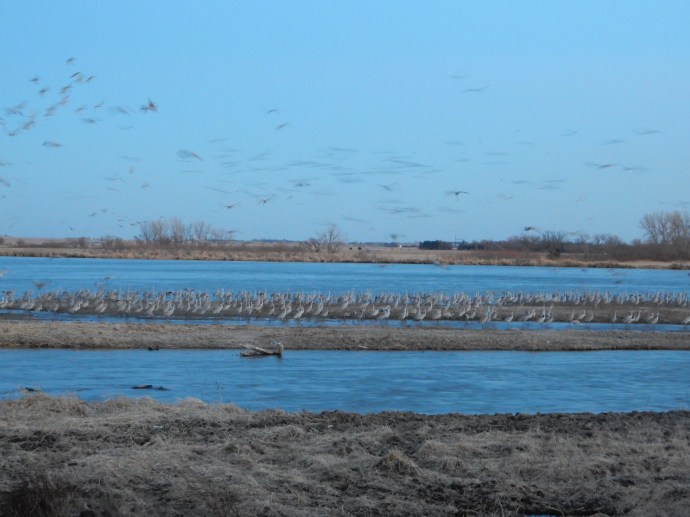
Evening sandhill crane watch on the Platte River

Evening sandhill crane watch on the Platte River

The blind faces roughly southeast and the Platte River runs from the right (west) to the left (east). The sandhill cranes seemed to return primarily on a route that brought them in along the course of the river, they gathered in the air at a spot to our left front-but still a distance away, then seemed to congregate on land or a sandbar in a combined slow glide, helicopter fashion. Groups of 5 to 100 would mesh into this big group, circle around a bit-sort of like a whirlpool or eddy, and then slowly drop down. Every now and then a small group would come across land. This group would head to the west, get towards the end of a larger group, and make a slow turn similar to a cloverleaf exit ramp to a highway, and then become part of the larger river group. It was fascinating.

Sandhill cranes land close to us

Sandhill cranes land close to us

We had to use binoculars to watch individual cranes. Our cameras were not powerful enough to shoot images as the cranes landed and roost across the river. As the afternoon faded, more and more groups kept arriving. The sound of their calls kept increasing. As the light was almost gone, a large flock, maybe several thousand, started landing on a sandbar less than 150 feet in front of us. Our guide later said he had never seen them come this close to the blind before. You could hear the camera shutters click away constantly. Unfortunately, one of our group had a flash go off and 95% of the cranes rose almost instantaneously and flew off. (Using a flash in a big no-no. I even had electrical tape over my flash to make sure it stayed off.) Over the next 10-15 minutes, some of them returned but most were circling around trying to decide if they were returning or roosting somewhere else. We left shortly afterward since it was too dark to see and certainly too dark to shoot photos.

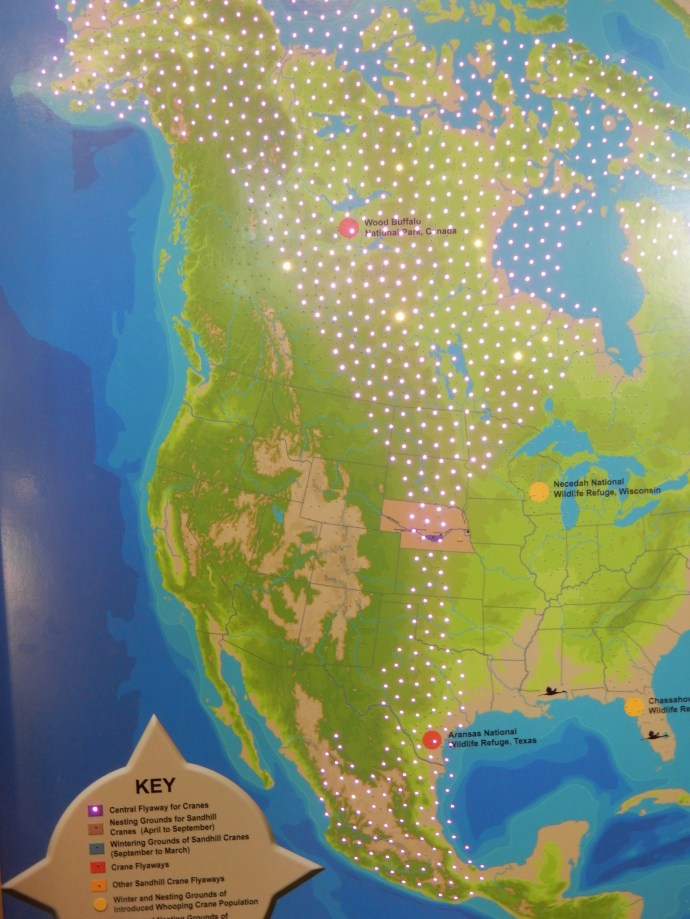
Crane migration path showing the pinch point on the Platte River

Crane migration path showing the pinch point on the Platte River

This was a once in a lifetime experience. We are glad we decided to go and lucky that the weather and birds cooperated. The migration here is of critical importance. The picture demonstrates the migration pattern of not only sandhill cranes, but whooping cranes, Monarch butterflies, and numerous other migratory birds and waterfowl. For the sandhill cranes, this is a stopping point where they eat and add 15-20% of their body weight. Without this stop, they would not have enough food and energy to make it to their summer breeding grounds.


Evening video at Crane Trust

However, the addition of over 20 dams along the Platte has reduced its volume by 80% and changed its hydraulics so that it no longer scours the shore. The dams provide for recreation, irrigation and drinking water, and hydro power. The impact for the birds is dramatic. THe picture below demonstrates the migration path and how it narrows here at the Platte River. If this one small, pinch point becomes eliminated, the migration path is destroyed.

The pinch point is only about 20 miles wide. Every Monday, a plane flies between Odessa and Overton Nebraska. One man in the plane is responsible for counting the number of cranes in the area covered by his fist, then he counts the number of fists that it takes to cover the sea of cranes below. This provides the first rough estimate. The more detailed count is provided by a person manually counting the cranes seen in the pictures taken by cameras in the plane as it flies along the river. Not a job I would want.

The Crane Trust was established to use human means to keep the Platte providing suitable habitat in this region. Environmental groups had sued when the Greylocks Dam was proposed on a tributary of the Platte. The judge allowed the dam but mandated the establishment of the trust to mitigate the dam’s impact.

Our day had other activites. We decided to make this fantastic crane adventure be part 1. We will complete a part 2 later of the other activities.

Ed and Chris. March 3 Saturday in Kearney NE

Categories: road trip, travel | Tags: , , , , | 3 Comments

2014 Trip Five, July 22, Summer in the Cities

Stevens Point, WI July 22, 2014

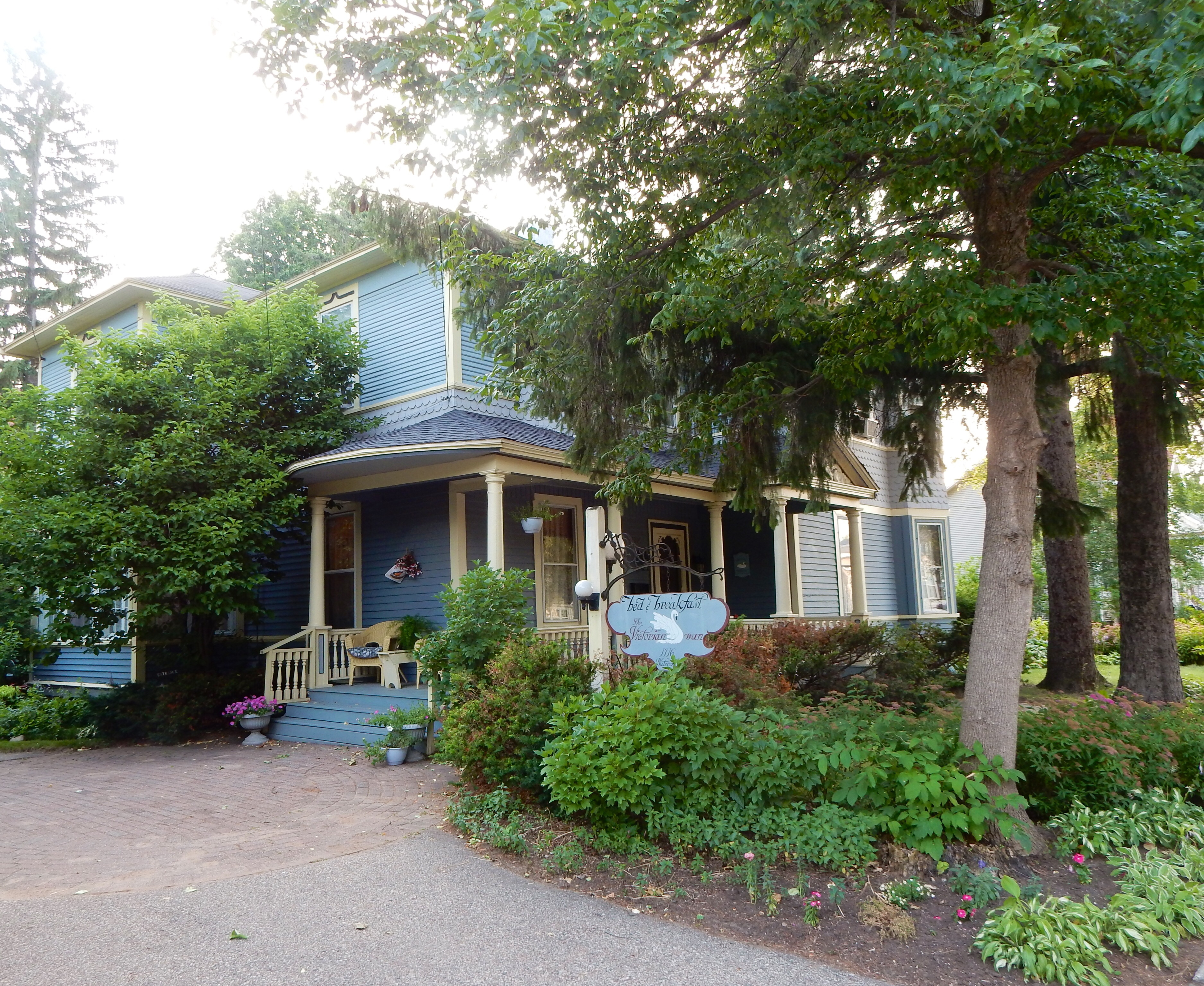
We had a later start this morning as we enjoyed conversation and home-made breakfast at the Victorian Swan on Water B & B in Stevens Point. The other couple staying last night was from Kentucky, originally Chicago and also enjoying a few days in the area. Breakfast was a potato-egg casserole with home made cinnamon rolls. Very yummy. Tomorrow is stuffed french toast I believe.

A Victorian Swan on Water

A Victorian Swan on Water

The B and B was originally built in 1888-1890. One of its claims to fame is that was originally located downtown but was moved here in 1938. When moved, the house lost its third floor and a second kitchen. We have one of the smaller rooms here (we got a tour) and it suits us very nicely. Joan is a wonderful host and has done her share of traveling also. In addition, her garden in back makes a wonderful place to sit and relax-as we did at dinner time Monday night.

We headed out for Warrens WI, home to the Cranberry Discovery Museum. Cranberries are big here since WI is the number one producing state in the nation, growing about 2/3 of the US crop. Right now cranberries are growing. Blossoms were in mid-June and we did not make it up here after the Fennimore trip. Harvesting is mid-September to mid-October and we just might miss that also as we return from our post Labor Day trip to Canada, the Adirondacks, and Deb and Rebecca’s wedding in Ct.
We thought we should stop in now since we were relatively in the area.

Our drive from Stevens Point to Warrens took us through cranberry growing territory. The museum in Warrens is a modest size and took us about 45 minutes to explore and read the displays. The displays do an admirable job of explaining how cranberries are grown and harvested. We had known about harvesting them in flooded fields but the museum explains the details of the whole process in an easy to comprehend process. For instance, we did not know about the addition of sand to the fields during winter when the fields are frozen; or the meticulous monitoring of soil and water that occurs throughout the year. We did taste test cranberry ice cream-delicious and purchased some cranberry mustard, salsa, chutney and jam.

Cranberries, Concord Grape and blueberries are the only fruits native to the US. They are among the highest of all fruits in antioxidants.

Two sandhill cranes

Two sandhill cranes

Our return trip was through the cranberry fields again but the return trip by another route brought us by several sandhill cranes. The growing of cranberries takes up about 180,000 acres in Wisconsin. Only about 18,000 of those acres are actually growing cranberries. The remaining acres,called support land, consists of natural and man-made wetlands, woodlands,and uplands. Because of this, waterfowl, like the sandhill crane, are plentiful in the area. Sandhill cranes are supposed to be aggressive in defending their territory but we managed to get several photos without hassle.

Lunch was at a rest stop at Dexter County Park at Lake Dexter. Really fancy, two cans of pop with the left over sausage, cheese and crackers from yesterday. But we helped the local economy by buying the two cans of pop at the Dexter Drive-In.

An example of a paper making mold from Siam (Thailand)

An example of a paper making mold from Siam (Thailand)

Wisconsin Rapids is the home to the Wisconsin River Papermaking Museum. This is a small museum in the historic home of Stanton Mead. The Mead family ran the Consolidated Water Power and Paper Company for most of its 100 year history. The company has gone through several recent changes and is now owned by New Page Corporation. The company is a major employer in Wisconsin Rapids and in Stevens Point-the factory behind A Victorian Swan on Water is a New Page factory.

The Wisconsin River Papermaking Museum

The Wisconsin River Papermaking Museum

The museum had three exhibits that interested us and we had the pleasure of having two docents explain various portions of the exhibit. The first was about Dard Hunter, a man born in 1883 who spent the majority of his life researching the paper making process, particularly hand-made paper.

The second exhibit was about the history of the Consolidated Water Power and Paper Making Company. It began in the early 1900s and controlled most of the paper making in the Wisconsin River valley. From the size of the facilities we have seen, it is a big player in a dying market-it focuses in this region on coated papers (for magazines) and other specialty papers. It’s early history would make a good novel with skullduggery and broken contracts.

Gib Endrizzi mural

Gib Endrizzi mural

The final exhibit was about art made by Gib Endrizzi. Endrizzi was the design engineer for Consoweld and the company during WWII made a product similar to Formica. Layers of paper are coated with a resin and heat pressed to create a very strong product. It was even used to make glider planes during WWII. (That is another whole story.) After the war, the product was produced in multiple designs and colors. Endrizzi used the product (no longer made) to create art work. Several of his murals were on display and were quite remarkable.

Deer at Schmeeckle Reserve

Deer at Schmeeckle Reserve

We drove back to Stevens Point and walked some of the trails at Schmeeckle Reserve, part of the University of Wisconsin-Stevens Point. It was a relaxing way to end the afternoon. We saw several deer; I know, they are everywhere nowadays but these were kinda cute.

Schmeeckle Reserve

Schmeeckle Reserve

Dinner was at Father Fats, a local eatery serving tapas. We shared three selections and all were great.

Sunset on Wisconsin River Tuesday night

Sunset on Wisconsin River Tuesday night

Ed and Chris July 22 11 pm

Categories: road trip, travel | Tags: , , , , , | 2 Comments

Blog at WordPress.com.