
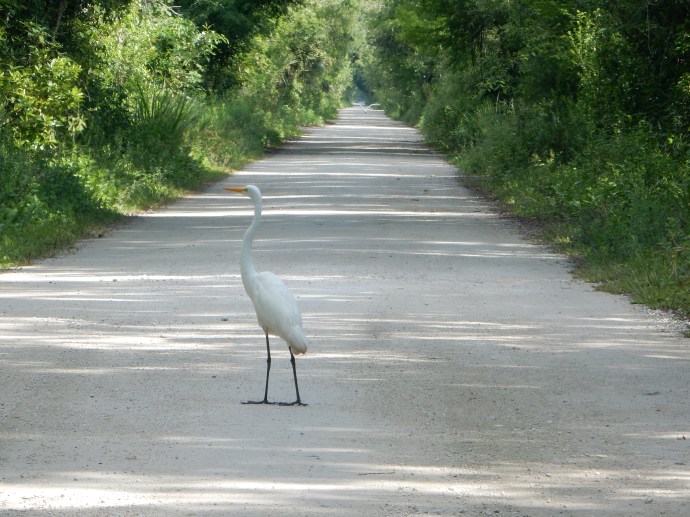
This bird knows he owns the road and he is not moving until he feels like it
Everglades City, FL April 2
We spent much of the day in the Fakahatchee Strand Preserve State Park. Fakahatchee is Seminole for forked river and a strand means a long narrow, swamp forest. The Fakahatchee is Florida’s largest state park and is home to numerous wild orchids, one of which is in bloom now. The FSPSP connects Florida Panther National Wildlife Refuge (one of Sunday’s stops) to the Gulf of Mexico. FSPSP is the orchid capital of the US and has the largest population of native Royal Palms in the US.
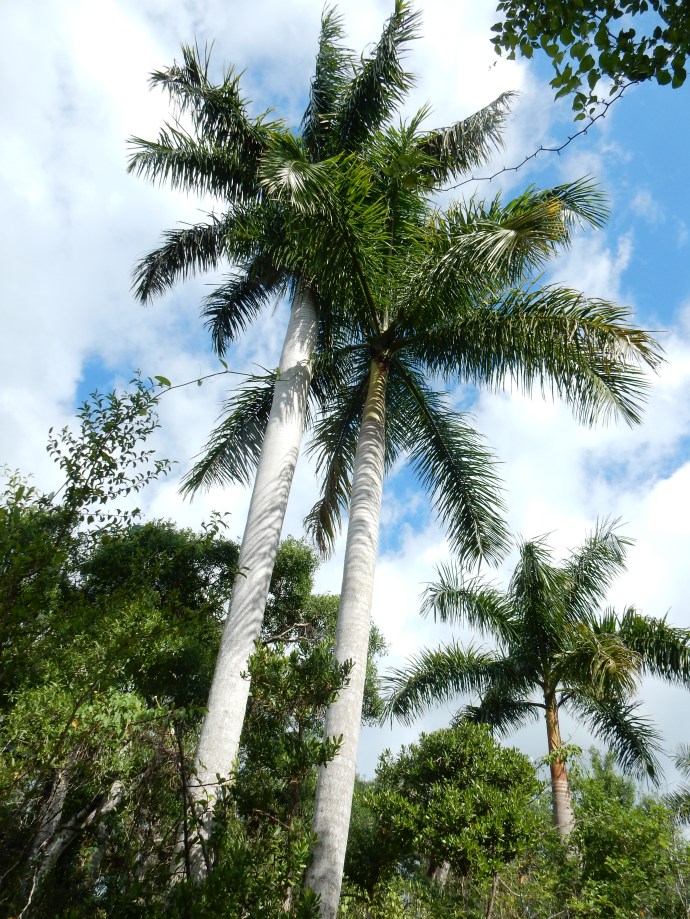
Royal Palms in Fakahatchee Strand Preserve State Park
Met another volunteer couple staffing the welcome center; they summer in Rhinelander WI and have been volunteering here for over six years. They gave us a few pointers about the best places to hike. Instead, we ended up driving most of the time we viewed the park. The Janes Scenic Drive is gravel (not a problem) but full of potholes that suggest strongly that one drive slowly and carefully. The portion of the road that is open for cars is only 6 miles; we drove it at speeds of 3-6 mph. There were just many birds to see and it was relaxing to motor along nice and slow.
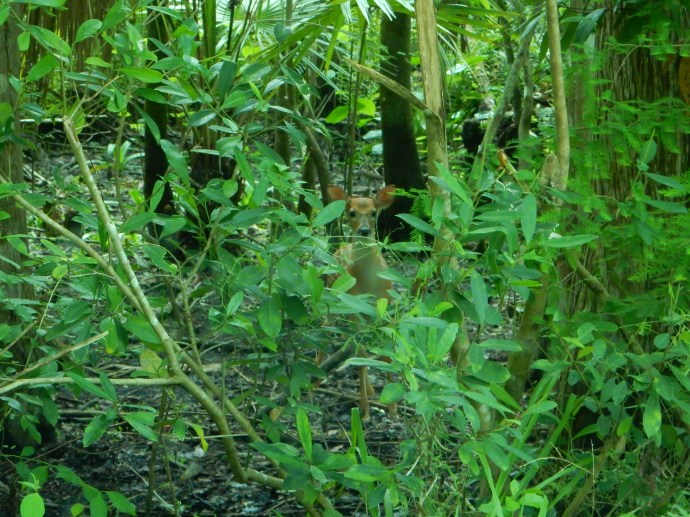
Can you spot the fawn?
Twice we headed out on hikes. For the first one, we chose to be safe rather than sorry. Signs about alligators tell you not to harass them, not to feed them, etc. The signs we read were not specific how to deal with them sitting in your trail path.
In general, alligators are not aggressive and do not attack humans. But what if they are just right there?? Alligators are big, have strong jaws and tails, and can move fast for short distances. On this first hike, the alligator was taking up about one-third of the trail. Oh, did we say they frequently just stay in one spot? Thus, the likelihood of the gator ambling along soon was low. We chose to turn around and abort this hike.
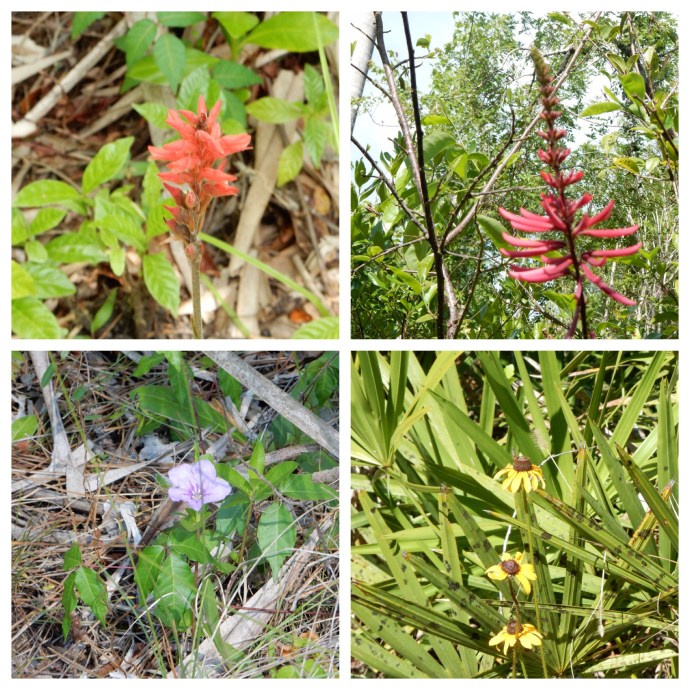
Along our hikes
On our second hike, we met another volunteer clearing the trail to assist people in walking along. We asked him about the alligator and he suggested that in the future, we should use a big stick and gently touch the alligator on the tail. That touch normally would encourage it to just move forward a bit. We thanked him but I am not sure we will take advantage of this suggestion in the future.

Along the Big Bend Cypress Boardwalk at Fakahatchee Strand Preserve State Park
All in all, we spent about three hours at Fakahatchee Strand Preserve State Park. We returned to the Ivey House, had a snack, went in the pool, and then returned to our exploring. This time we went to a different portion of the park to explore the Big Cypress Bend Boardwalk Trail. Here, we were told that a bear was just ahead on the right side and to be quiet as we approached it. Well, we were quiet but alas, the bear had disappeared. Chris, who was not excited about seeing any bear, was nonetheless 30 feet ahead of me on the trail; I was trying to look everywhere and she was just marching at double pace. In any event, it was just a walk in the woods.
Our final stop was exciting. Monday we had taken in a presentation at the Everglades National Park Visitor Center. The ranger giving the talk, besides telling us about his adventures in Alaska, advised us to take the Marsh Trail to watch the birds returning to the roost at sunset. The experience was magnificent. An observation tower is strategically placed for bird watching. We spent at least 45 minutes there until sunset had occurred.

Birds landing along the Marsh Trail at Ten Thousand Island Wildlife Refuge

Birds at Marsh Trail at Ten Thousand Island National Wildlife Refuge
When we arrived, the ponds and marsh were already busy with roosting birds. As we watched, more birds arrived in groups of 1, 2, 3 or 4. As time went on, the groups grew in size to have 20, 30, or 40 returning birds. A variety of species were landing, chirping, and gathering. But as time went on, many of the birds which had landed in the pond to our right picked up and flew to a group of trees on our left to roost for the night. It must be a safer location to avoid predators there. Only about 20 people were here, it was a great experience and lightly attended. Several of the human attendees had cameras that likely cost at least 10 times the cost of our point and shoot but our pictures are sufficient to illustrate the experience.
On our way back to the car, we saw an alligator crossing the paved trail from west to east about 100 feet in front of us, heading home evidently for the night. When we passed the point where the gator had crossed, we could see the wet trail his feet and tail had made on the pavement. This time we did not have to worry about what to do with a gator on the trail.
This marsh area was also part of Ten Thousand Islands National Wildlife Refuge. We did not observe any damage from Hurricane Irma here, evidently the barrier islands had helped to mitigate the storm. When we had taken the boat ride Monday, several islands had been hit with a 14 foot tidal surge. The amount of salt water was enough to kill a long line of mangrove trees at the edge of the islands. We did not observe that here.
Ed and Chris Everglades City FL. April 3

Sunset over the Everglades and Ten Thousand Islands
 Chris Klejbuk and Ed Heimel travel adventure
Recent Comments