

John Muir’s office where he did most of his writing
Pleasant Hill, CA
This day messed up our schedule. One of the National Park Service sites to see in the San Francisco area is the Port of Chicago Naval Magazine National Monument. Port Chicago is one of the most difficult sites to visit and thus one of the least visited sites in the National Park Service. In 2018 it had only 653 visitors. It normally only has tours on Thursday, Friday, and Saturday. To get on a tour, you have to register two weeks ahead of time. The site is on an active Army base so permission must be given to enter. The tour takes less than a dozen people each time. The tour can be canceled at any time. It is run through the John Muir NPS site in Martinez, CA since Port Chicago does not have a visitor center of its own. You have to arrive at the John Muir site by 12:15 pm for the one tour given each day.
We planned to visit on Saturday February 25. We requested to be on the tour about five weeks in advance. We were then notified that there would be no Saturday tour on the 25th, we would have to take the tour on Friday the 24th. Well, our schedule had us leaving Jenner along the coast on Friday morning and spending the day in Santa Rosa, directly on the way to Pleasant Hill CA where we would be staying three nights while we visited the four NPS sites in the East Bay Area. A very efficient use of time and gasoline. Changing our schedule to make Port Chicago on Friday meant on some other day we would have to backtrack for an hour and a quarter each way to see the Santa Rosa locations we planned to visit. Well, there was not much choice. Inconvenience or miss visiting one more NPS site that we would be unlikely to ever see in the future.We voted for inconvenience.
We left Jenner Friday morning at 8 AM for the two hour drive to Martinez CA and the John Muir National Historic site. (This is his main place of residence while alive, not to be confused with Muir Woods.) More than enough time you say. True, but we were going over the mountains after 12 hours of rain might have caused mud slides or fallen trees. It was a Friday at rush hour, what would the roads be like? And remember, we were in an area of no cell or Internet coverage so we could not plan for road problems in advance. We later found out Thursday night/Friday morning had the highest snowfall in memory for this part of California. In the higher areas along San Francisco Bay, several inches of snow had fallen. People were getting in their cars and taking their kids out to experience snow. Not exactly the 15 inches or so that had fallen back in the Twin Cities, but pretty exciting for this area of California
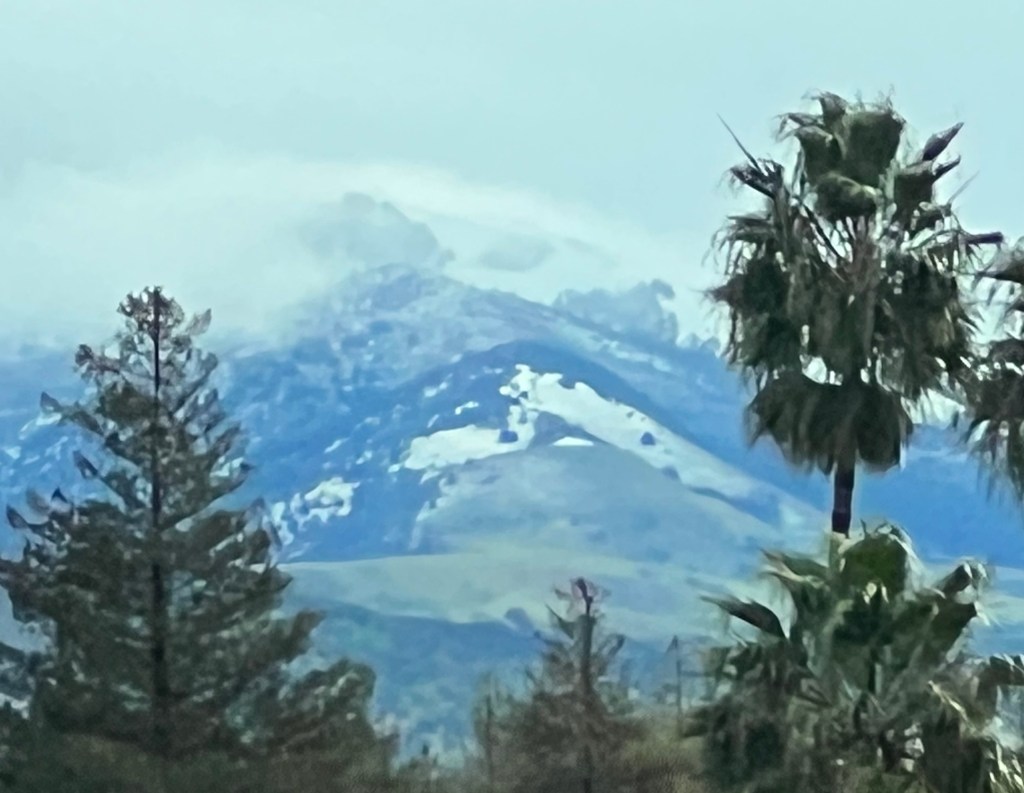
Snow on one of the peaks around Martinez, CA
Our luck continued to hold. We had no driving issues, made it to Martinez with enough time for a McDonalds breakfast and a tour of the John Muir homestead before the Port of Chicago tour.
John Muir is one of the premier early conservationists in the U.S. He was a founder of the Sierra Club. He wrote prodigiously on the need for preservation and the value of spending time outdoors. His efforts are credited with the creation of Yosemite National Park and with influencing President Theodore Roosevelt to actively create national monuments and forests. Born in Scotland in 1838, his family immigrated to central Wisconsin in 1849. As a young man, he traveled extensively around the U.S.

The John Muir home in Martinez, CA
The NPS site in Martinez reflects his later life. He married Louisa (Louie) Wanda Strenzel when Muir was 42. His father in law owned extensive fruit orchards and Muir managed the orchards for a number of years. The 10,000 s.f. home we visited originally belonged to his father in law, who was wealthy due to his fruit business. When the father in law dies in 1890, Muir, his wife Louie and children move into the ornate house where his mother in law is living. Louie takes over the handling of the fruit business, freeing Muir to write and travel. Muir dies in 1914 at age 76.
For the Port of Chicago Naval Magazine tour, you probably need a bit of history. We had no idea what this NPS site was when we looked at the list of National Park sites in California. I will try to make the history concise yet sufficient. First, in World War II, the U.S. still practiced informal segregation. After the Civil War, the 13th, 14th, and 15th amendments to the U.S. Constitution were supposed to end segregation and slavery. Yet in reality, segregation still existed throughout the U.S. The military was not different. Black soldiers in the Navy were used as cooks and stewards, not active participants in warfare. They were commanded by white officers. They lived in segregated housing.
Port Chicago was constructed as a naval facility to load ships with supplies and munitions for the Pacific Theater of War. It had a deep harbor, direct rail lines, and isolation from populated areas. Blacks were used to load the ships under the direction of their white officers. Neither the officers nor the seamen had special training in handling munitions. Bets were placed by the officers as to which crews could load ships the fastest.
On 10:18 PM July 17,1944, two explosions ripped the air. One of two ships was full of munitions,16 rail cars lined the pier. The blasts obliterated the ships, pier, and rail cars. Debris went 12,000 feet into the air. The shock wave was felt for 40 miles. Businesses a mile away in the town of Port Chicago were damaged. But this national monument is not for property damage.

Inner ring shows how far debris was blown, the outer ring the extent of damaged buildings
320 men lost their lives that night. For most of them, their remains were never found. 202 were African American enlisted personnel loading the ships, nine of their officers, 64 crewmen from the two ships, 33 Naval personnel guarding the ships, 6 civilian workers, five Coast guard crewmen and one Marine on guard duty. Yet the consequences of the blast weighed most heavily on the African Americans. White officers were given 30 days leave and transferred to other duty-away from the trauma and memories. The African American seamen who worked on munition loading details but had not been present on the pier received no time off and three weeks later were ordered to load munitions at another naval shipyard in the area.
258 of the seamen refused, saying they were afraid to load. Threatened with death by firing squad, 208 gave in and were given bad conduct discharges after serving their term. The 50 who persisted faced the largest mass mutiny in naval history. Despite questions about the base’s safety practices and the men’s fear of being blown sky high, all were convicted and given sentences of 8 to 15 years. After the war, the Navy granted clemency and put them on ships to finish their enlistments. No whiteNavy officer faced punishment for lax or unsafe procedures. Though their convictions were not overturned, their acts of civil disobedience brought to light the injustice of racial segregation in the military.
In 1948 President Truman issued an Executive Order beginning the process of integration of all military forces although it took years for it to be fully implemented.
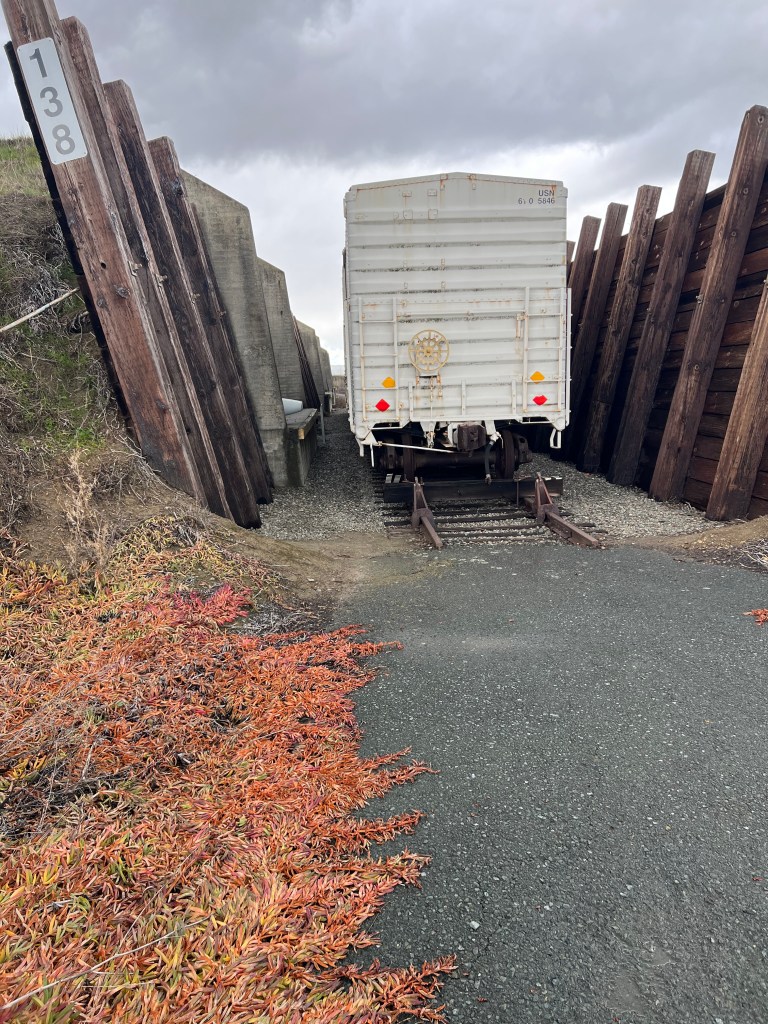
One of the revetment areas at Port Chicago Naval Magazine National Historic Site
The memorial for Port Chicago is located where the explosion occurred. The NPS has plans to build a new and more comprehensive visitor center in the next 10 years. For now, 8 visitors, one ranger and one volunteer traveled by car from the John Muir historic site driving through land cleared of old and damaged buildings. Some of the revetments remain, structures designed to temporarily hold munitions until they were loaded onto ships. The names of the 320 men who died are listed on memorial plaques. The rest is memory.
Ed and Chris, February 25
 Chris Klejbuk and Ed Heimel travel adventure
Recent Comments