

Salem, VA April 23, Saturday
North Carolina’s capital city was not always in Raleigh. Its first permanent colonial and state capital was in the town of New Bern, located on the tidal Neuse River. To gather more history about North Carolina and its early days, we spent most of Friday at Tryon Palace, or Governor’s Palace. Britain appointed William Tryon Royal Governor in 1764 and he served until 1771 when he was promoted to be Royal Governor of New York. One of Tryon’s official acts was to build a government house to represent the Crown and a home for his family. He was allotted 5,000 pounds to do so.
Unfortunately for the citizens of North Carolina, Tryon spent 15,000 pounds to build an opulent structure, even bringing in artisans from places like Philadelphia to work on it. The extra funds to complete the government house were to be collected from additional taxes. The government house was nicknamed Tryon’s Palace due to its opulence. The taxes were one factor that led to an uprising by local citizens in western North Carolina. Gov. Tryon put the uprising down using the state militia. He has been labeled unduly harsh by friend and foe in North Carolina and New York.
Governor Josiah Martin replaced Tryon and is notable also. He was the first Royal Governor in the colonies to give up his post and flee back to England. He sent his wife and children away first and in May 1775 Gov. Martin and his assistant left town giving false information about his plans. Martin went to New York, picked up the family and then fled to England. When the colonists realized what was happening, they emptied the palace of its furnishings and auctioned them off. After all, they had paid for them. The capital was moved to Raleigh in 1794. The Governors Palace only saw limited use until it burned in 1798.
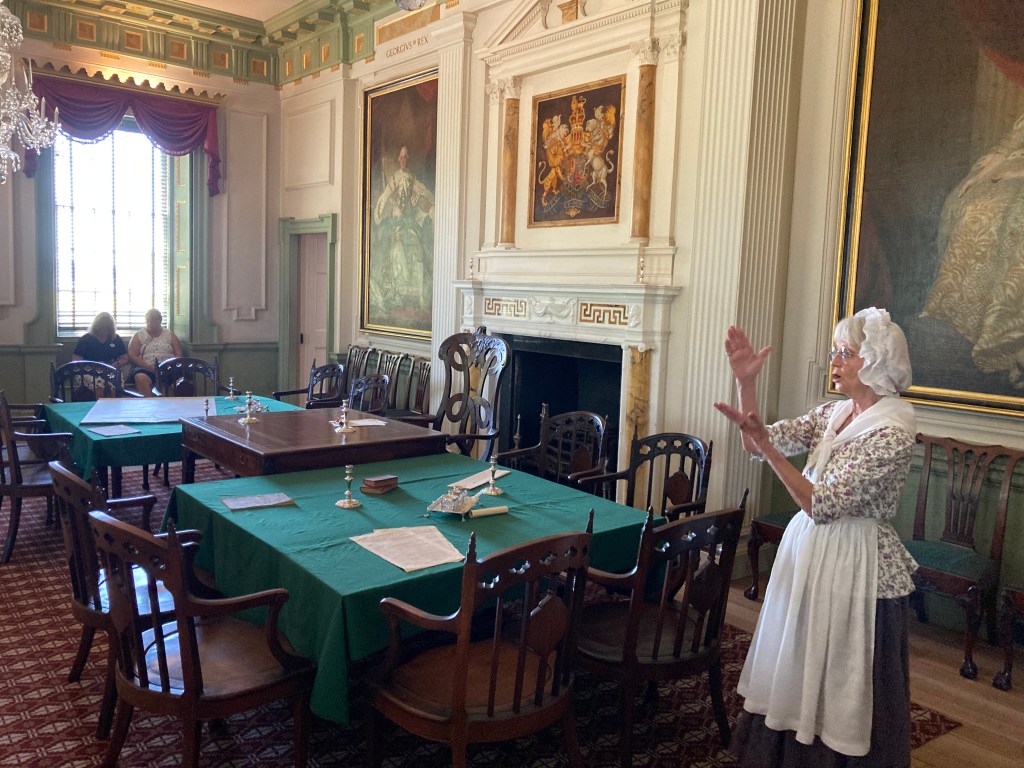
In the 1950s, the Governor’s Palace was rebuilt using the original architectural drawings. The task was immense, removing buildings and highways and constructing a new bridge over the Trent River. We received a tour of the building and it’s replacement furnishings. There are living history demonstrations and an English garden to view. The name Tryon Palace applies to this complex with other historic buildings, the palace and outbuildings, the garden, and across the street, the North Carolina History Center.
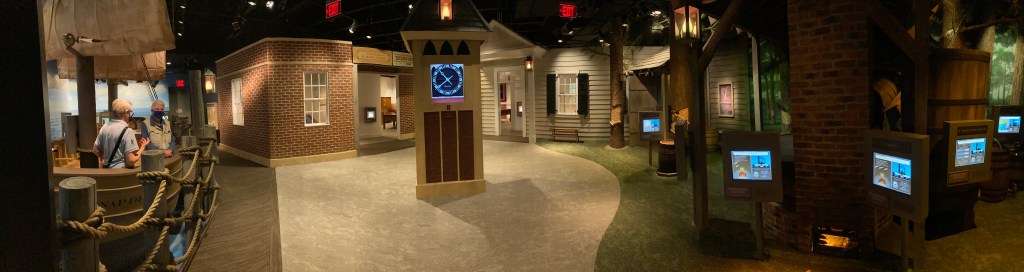


The early afternoon was spent at the History Center, including lunch at their cafe. (Delicious brownies by the way.) The exhibit area was well done. An extensive range of topics are covered. The Pepsi Family Center deserves special recognition. This area is designed as an interactive learning experience for elementary age youth. Each of the five stations (dry goods store, kitchen, print shop, turpentine distillery, and sailing ship can accommodate eight students who have to work cooperatively on tasks common to 1835. The docent on hand gave us several in person demonstrations. We were impressed. This learning center had just re-opened a month ago after flooding by Hurricane Florence in 2018 and Covid 19.
If we were in to it, we could have spent time at the Pepsi Museum (Pepsi started in New Bern), the New Bern Fire Museum, or hunting down the signature fiberglass bears in the downtown area. Bern means bear in German and was named New Bern by the Swiss settlers who came here from Bern Switzerland in 1710. We had already spent much of the day here and it was time to drive the three hours to our lodging for the night in Burlington, NC. Thankfully the drives now reveal green trees and blooming dogwood trees and azalea bushes.
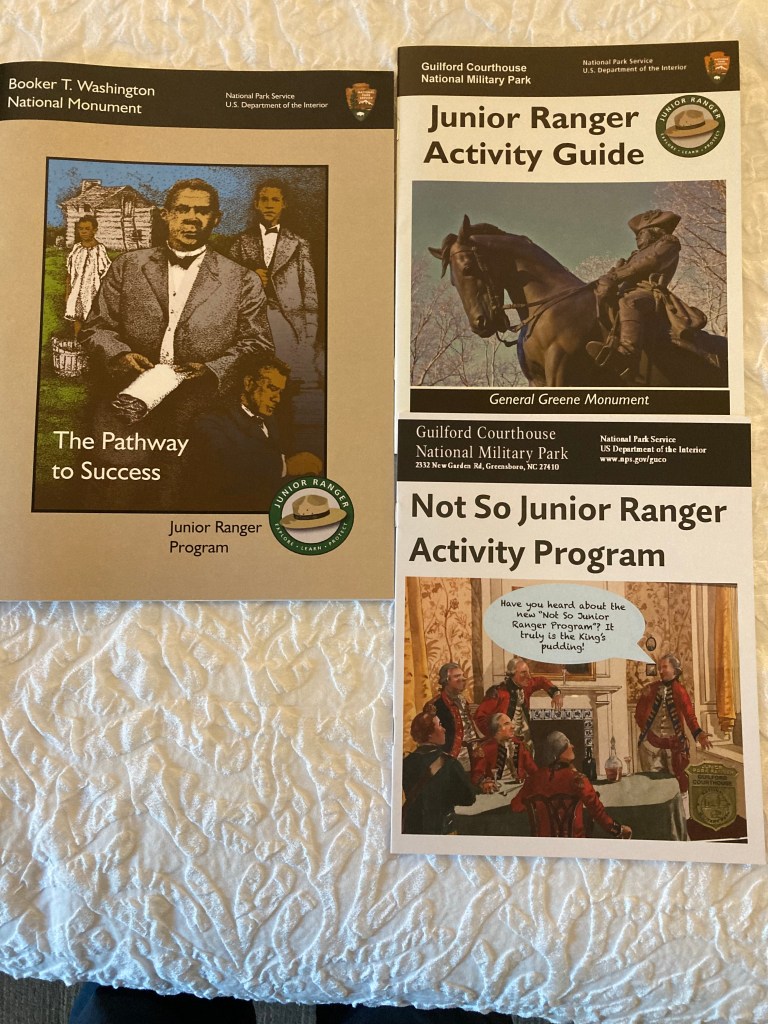
Today (Saturday) the National Park Service celebrates Junior Ranger Day. The park rangers at our first stop at Guilford Courthouse National Military Park were prepared for visitors. They had a special table set up, parking guide volunteers, and re-enactors. Guilford Courthouse even has a junior ranger book for Not So Junior Rangers. You have to understand, most junior ranger books offer kids a chance to learn about that park through questions, drawings, and similar activities. It takes some effort but is very achievable. When completed, the child obtains a badge and is sworn in as a Junior Ranger. The Not So Junior Ranger Activity Program booklet here was quite the challenge for the older child or adult. It required more time and had more difficult questions. I thought it was well done and would have required real thinking and searching out for the answers. Luckily I did not really examine it until after I had left the park so I am spared the embarrassment of not knowing numerous answers.
We did learn about Guilford, though. Friday night we watched their 30 minute explanatory video on the web. Saturday morning we watched an additional 10 minute video about the conflict and read many of the exhibits inside the visitor center. Finally we walked part of the grounds.
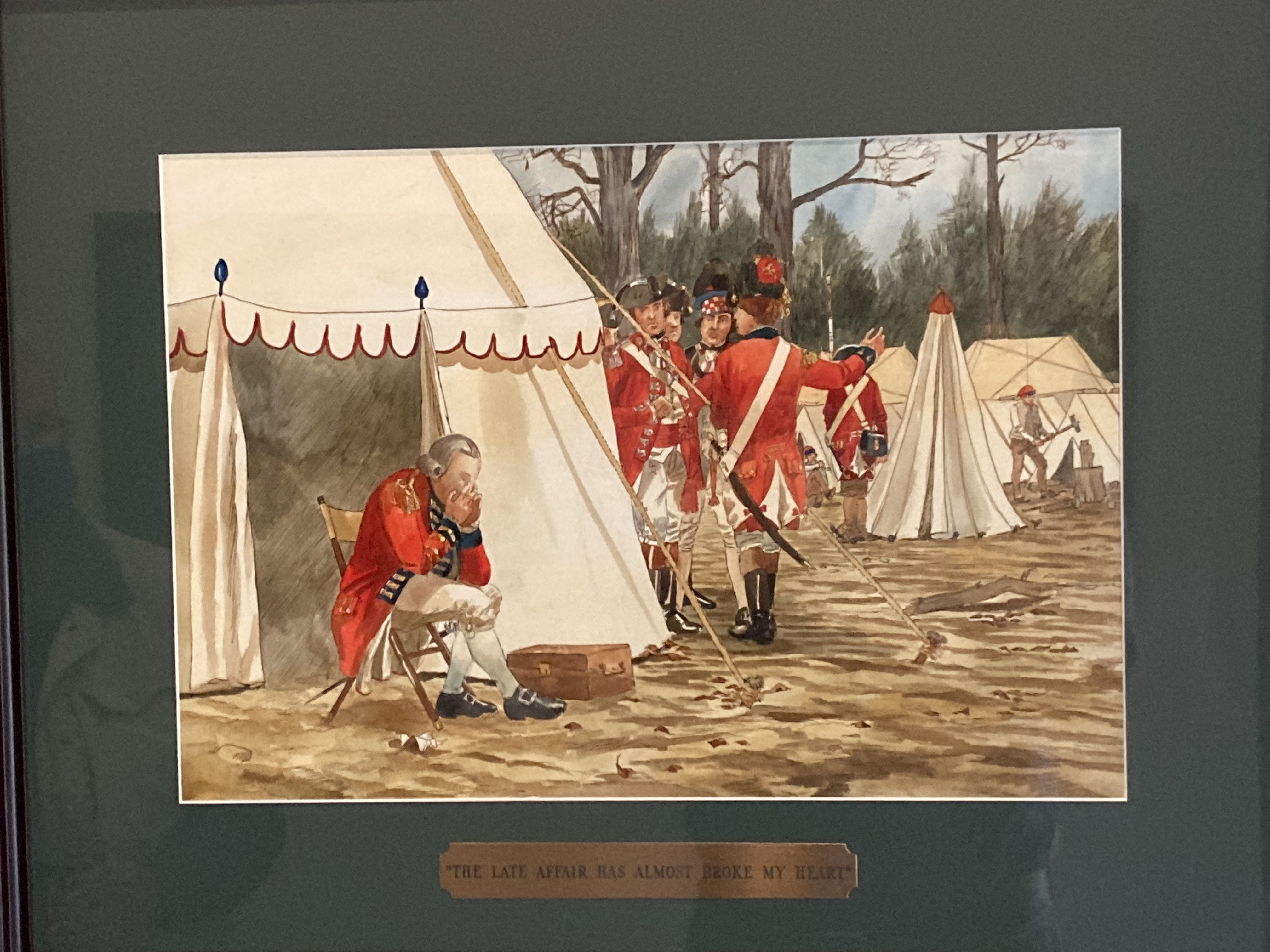

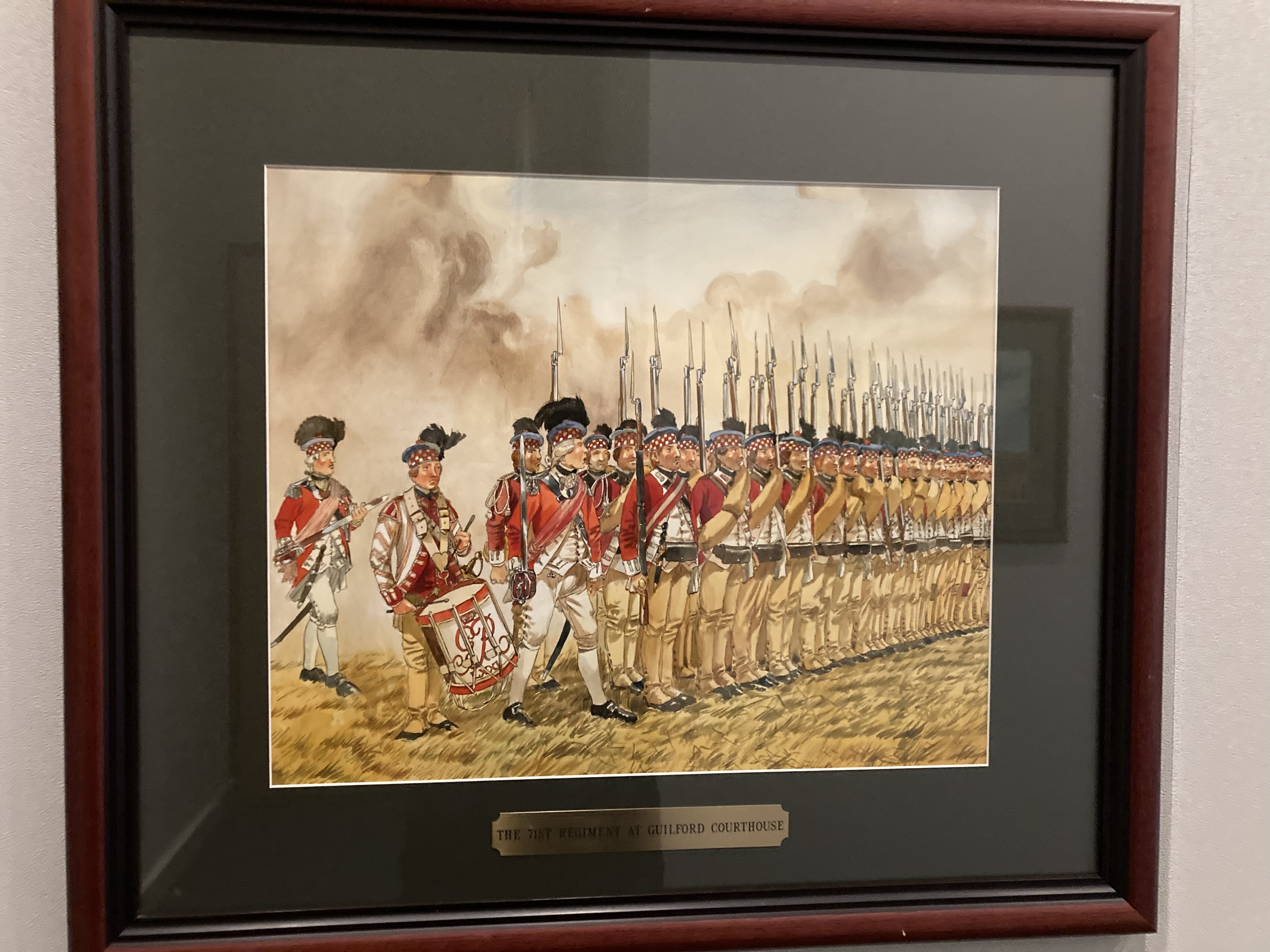
Some of the paintings commissioned by the NPS to reflect the Southern Campaign. The artist is Don Troiani.
Guilford was established in 1917 as the first national military historical park. Initially it was under the direction of the Army but was later transferred to the National Park Service. The only reason it was available to be preserved was due to private parties that had purchased and preserved a portion of the battlefield.
Guilford was extremely important to the successful conclusion of the Revolutionary War. Most Americans think of Boston and Valley Forge, maybe Saratoga, as the primary battles of the war. However, in 1778 the war was stalemated and the British changed tactics and went to southern colonies to fight and defeat the colonials. They had success in Georgia and South Carolina and planned to go north into Virginia.

British General Cornwallis was leading his troops but suffered setbacks at Kings Mountain (Oct. 1780) and at Cowpens (Jan. 1781). (Both of which we visited on previous trips). However, Cornwallis still outnumbered the Americans who needed reinforcements and supplies. The British troops were better trained and many of troops of the Continental Army were local militia. By March of 1781, General Nathaniel Greene of the Continental Army was better prepared and the two armies met at Guilford Courthouse. The end result was that Cornwallis won the battle but Greene won the war. The British troops lost 1/5 of their troops and 1/3 of their officers. As an English member of the House of Commons stated: “Another such victory would ruin the British Army.”
Seven months later Cornwallis surrendered at Yorktown.
For the afternoon, we drove to the birthplace of Booker T. Washington. Washington was born a slave on a Virginia tobacco plantation in 1856. In 1861, at age five, he was valued at $400 on his owner’s property inventory. He was freed after the end of the Civil War, uneducated since it was illegal to teach a slave to read and write.
Washington attended school in the evenings while working in salt and coal mines in West Virginia. At age 16 he walks and begs rides to reach the Hampton Institute, 500 miles from his WV home. He graduates from schools of higher education and after several teaching stints, is appointed the head of a new school in Tuskegee Alabama. He is 25 years old.
Booker T. Washington builds Tuskegee, brick by brick, student by student. George Washington Carver was one of the students there. As Tuskegee grows, Washington becomes better known and works tirelessly to promote education and economic prosperity for African Americans. Tuskegee today has over 2,500 students.

The birthplace site demonstrates well the harsh realities of life for slaves. The plantation at which he was enslaved was not huge and the slaves were the main value of the owners. No education, poor food despite living on a farm, and harsh, violent treatment designed to keep slaves in their place was normal. Booker’s most lasting memory of slavery was his uncle being stripped, tied to a tree, and beaten with a whip.
The ranger at this site mentioned how even now she has visitors who were taught that the Civil War was about states rights. How easily some groups have been able to twist history into a story that distorts reality. Civil War was about slavery and money. If you need proof, read the speeches of legislators from seceding states, read the declarations of secession they wrote and approved.
As we left Booker T. Washington National Monument, we stopped at a local creamery. Homestead Creamery in Burnt Chimney VA had wonderful ice cream and rocking chairs in the shade. It is a small dairy started in 2001 utilizing milk from several local dairy farms. Quote: “Each farm is dedicated to the health and happiness of the cows and the quality of the products that are produced for the consumers”. I don’t know if the cows are happy but these consumers were overwhelmingly satisfied. What better way to enjoy the afternoon.
Tonight we are Salem, VA, a suburb of Roanoke. Tomorrow it is off to Appomattox and then three nights in West Virginia before heading for home.

Ed and Chris, Salem VA April 23
 Chris Klejbuk and Ed Heimel travel adventure
Recent Comments