

Independence Mine State Historical Park near Palmer AK
Palmer, AK. Sunday August 18
Today will be a day that justifies our Jeep rental. Yesterday, Chris was a little hesitant to drive the Jeep through a water crossing along the Knik River. Today, however, we will be driving Hatcher Pass, a gravel road with sharp switchbacks and only open from July 4 to mid-September. Now, we could come here in the winter and do dog sledding, skiing, snowmobiling, or even backpacking, etc. but for now our adventurousness is limited to driving a few remote roads.
Hatcher Pass leads into and over the Talkeetna Mountains. Miners looking for gold found flakes in the creeks flowing from these mountains and explored the mountains to find a mother lode. In 1906 the first mother lode was discovered and mines operated here until 1951 when the high cost of underground mining forced the decision to close the last mines. Today, Independence Mine State Historical Park maintains the mine site and buildings.
That is the plan as we sit here at 6 AM listening to the wind howl, marveling at the mountain peaks across the valley, watching the almost full moon in the sky, and waiting for official sun rise. Yesterday our guide was talking about the wind in Palmer. There are three mountain ranges that produce strong winds throughout the year and we experienced it during the day. During the night one could hear it blowing even stronger. We have not yet explored if there are any wind farms here.
The day started with instant oatmeal and church. The local church was well attended for 8 AM Mass with several large families. Two people came up to us and discussed their St. Paul background. (Chris stood up and introduced us when they asked if there were any visitors present.) After the service ended, we were off to Independence Mine and to Hatcher Pass. A bright blue sky accompanied us although the winds were strong, giving a slight nip to the air as we left Palmer.

Driving up to Hatcher Pass
The drive to Independence Mine is paved. There is a lush green color on the agricultural fields which continues as one goes up the mountains. The mountain tops are at 4-5,000 feet. Some are granite, rocky, and steep. Others are still steep but covered in green trees or grass. Somehow, despite reading, seeing, and hearing otherwise, one still expects to see snow everywhere in Alaska. The green mountainsides, in this area, were a constant source of amazement.

Independence Mine State Historical Park, Alaska
Independence Mine jumps out at you. The buildings are abandoned and many are falling down. However, the first impression is of the mountains. The first gold claim was near the top of Skyscraper Mountain, to the left as you drive up. There is a gap in your view and then Granite Mountain takes over on the right side. The buildings, creek, waste piles, etc. are bunched in the middle gap between the two peaks. Information boards give the history of the mine and of each building.
The mines here produced 141,000 ounces of gold, at today’s prices that is 210 million dollars. But of course, for much of the time the mine was operating, the price of gold was fixed at $35 per pounce, so only about $5,000,000. At its peak, 203 miners worked here, with only Christmas and the 4th of July off. The 38 mines around here were the second most productive gold hard-mining area in the state of Alaska.

Some views of Independence mine State Park
This mine was costly to operate. Supplies were shipped to Seattle or San Francisco from the east and then re-shipped to Seward. Finally supplies were placed on trains to Palmer where the final leg brought them up to the mine site. Some families lived here; a school was begun to teach the children. One young girl raised here learned to ski the mountains and went on to be on the 1956 U.S. Olympic Alpine ski team. Generally miners and other workers were single men living in bunk houses and were fed at the commissary. Huge quantities of ore had to be extracted from deep in the earth, with machinery to pulverize the rock before separating the gold.
Today it is abandoned. As we walked among the ruins, the wind increased in intensity. We had to wear both a fleece jacket and a down jacket to stay warm. While we could enjoy the views while warmly dressed, the miners would have had to work even during the worst of the winter.
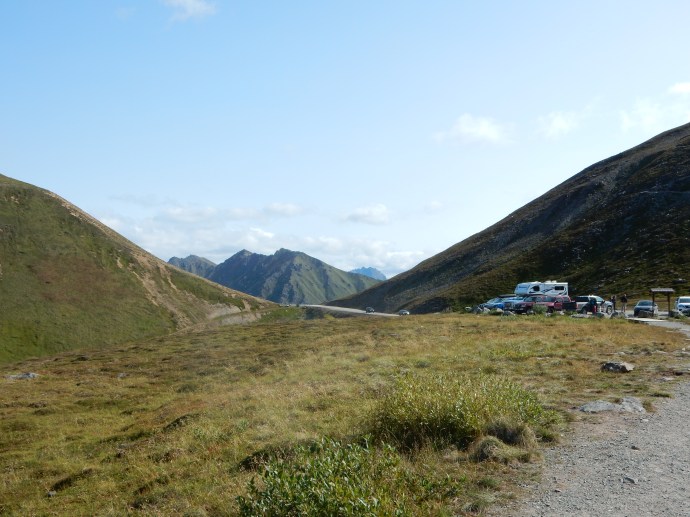
Hatcher Pass

Hatcher Pass
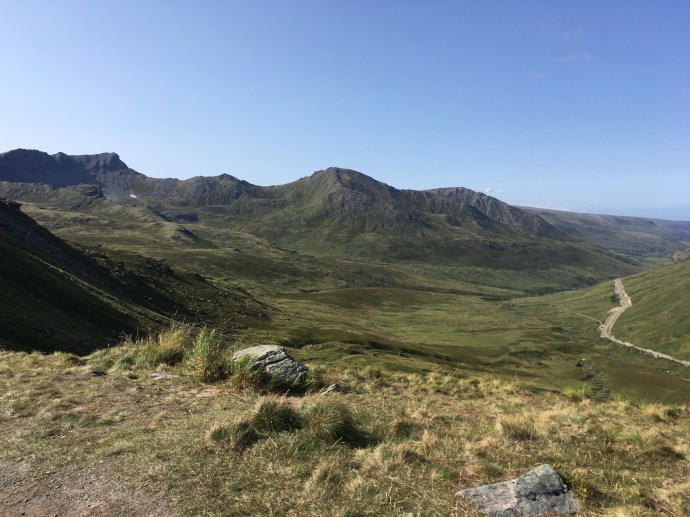
Hatcher pass
We left the mine and looked forward to our drive over Hatcher Pass and a nice meal at the Hatcher Pass Lodge with potential scenic views of the valleys and mountains. Unfortunately, the lodge was accommodating lodgers but the cafe part of the lodge, supposedly open according to the web site, was closed. Chris and I each had a granola bar for lunch instead.
The Hatcher Pass Road was not as bad as its reputation. I think the most difficult part of it may be the likelihood the road will be closed due to snow. The road is wide enough for two cars and only the first few miles (of 23) were washboardy. There is a drop-off at the sides of course, but we have experienced much worse.
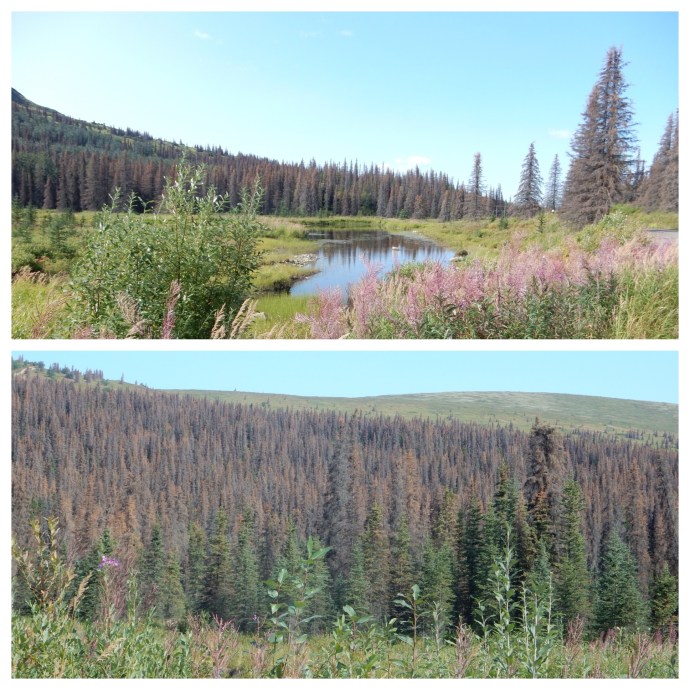
Dead trees on west side of Hatcher Pass
Numerous pull-offs provided opportunities for short hikes and for picture-taking. We frequently observed groups of people picking berries in the fields along the road; off road vehicles could be seen off in the distance but rarely on the road itself. After the pass, as we went west and down, the Little Susitna River was frequently by the side of the road. No moose were seen grazing along its banks. BUT, remember those nice comments about the lush green grass and trees?? On the west side of the pass, dead trees were everywhere. I am not sure what insect or disease is at work here, but the result was devastating.
At one of the overlooks, we met again two brothers (they were at the mine site earlier) originally from Miami (although one now lives north of Anchorage) who warned us that fires and smoke were closing portions of the Parks Highway connecting Fairbanks and Anchorage, usually right in the Denali area. We will have to monitor that, it could be a major disruption in our plans.
Hatcher Pass Road took about an hour but now we are west of Palmer. It took us another hour or so to return to Palmer. We could smell smoke in the air and traffic was heavy on the Parks highway. Eventually we made it back to Palmer and had a late lunch downtown at the same small cafe we enjoyed Saturday. Sunday is a much busier day for them, lucky to find a table.
But after lunch it was off to our last stop of the day, the Musk Ox Farm. Chris and I were particularly interested in this since our docent work at the Bell Museum in St. Paul includes a display of a musk ox-and a wooly mammoth. Both existed in Minnesota thousands of years ago. Musk ox became extinct in the U.S. but were re-introduced from small herds still remaining in Canada and Greenland. Our admission includes a 30 minute tour; our guide, a young man, made a nice presentation about musk ox, the farm, and fire plans for the farm-which is located on one of the Great Depression colony farms.

Musk ox in Palmer AK
This group of about 80 animals are domesticated and raised for their hair, called quivut. Pound for pound it is the warmest material on the planet and the quivut combed and gathered from the oxen are provided to indigenous women to weave into scarfs, mittens and hats. The techniques replicate the traditions of their heritage. Nowadays one can buy the finished products-although at a hefty price. The musk ox calves born each year are named after a theme: cheese (Gouda and Munster), national parks (Zion, etc), trees (larch, maple, oak), etc.
Dinner was take out from the local grocery store; fried chicken with two sides and a roll. Good food and we came back to our lodging and relaxed.
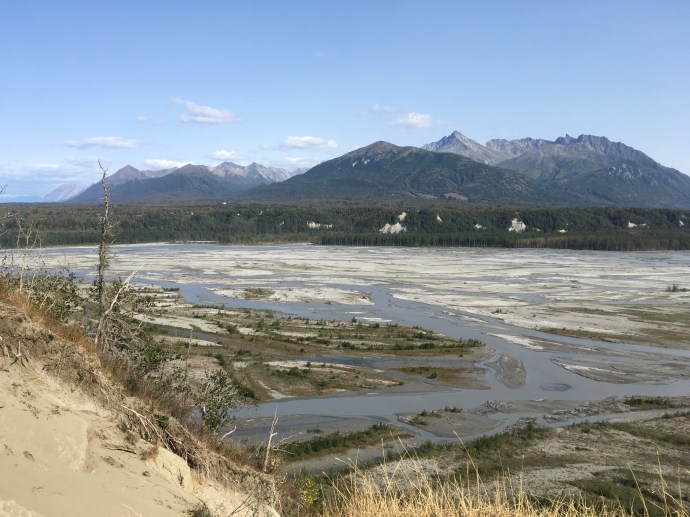
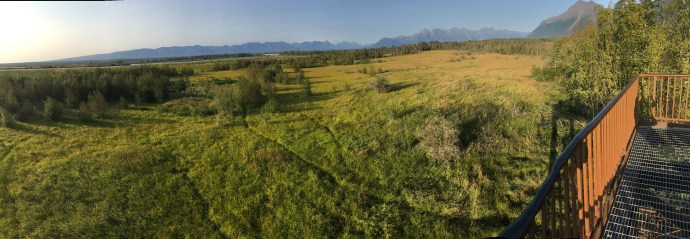
Matanuska River north of Palmer, looking toward Chugach Mountains
Ed and Chris Palmer AK 9:30 PM


 Chris Klejbuk and Ed Heimel travel adventure
Recent Comments