

La Junta CO May 31, 2021
National parks. Yellowstone, Everglades, Yosemite, Acadia, Glacier. That’s what you think of when we say national parks, correct? Yet there are over 420 national park units. Today we visited two of them, distinctly not like those mentioned above.
The mission of the National Park Service encompasses natural and cultural resources. That is why national battlefields, Independence Hall, and the Herbert Hoover National Historic site (among many others) are units of the National Park Service along with great scenic parks one normally associates with the NPS. Today’s sites were Nicodemus National Historic Site in Kansas and the Sand Creek Massacre National Historic Site in Colorado. We will be able to touch on each site only briefly; hopefully you will be interested enough to pursue further information on your own later.
Founded in 1877 by a white developer and local black minister, and assisted by five black ministers from back East, Nicodemus was created as a town built by and for black settlers. Kentucky and Tennessee sent the largest number of settlers, most of them newly freed slaves. It was an opportunity to own land and make decisions for themselves. The town grew and prospered with general stores, bank, lawyers, newspapers, blacksmith, etc. Yet like many other towns in America, Nicodemus’ prosperity was damaged when the railroad chose a route south of Nicodemus. Many settlers moved to seek greater prosperity elsewhere, and the double whammy of the dust bowl and Great Depression led the town to wither to almost nothing.
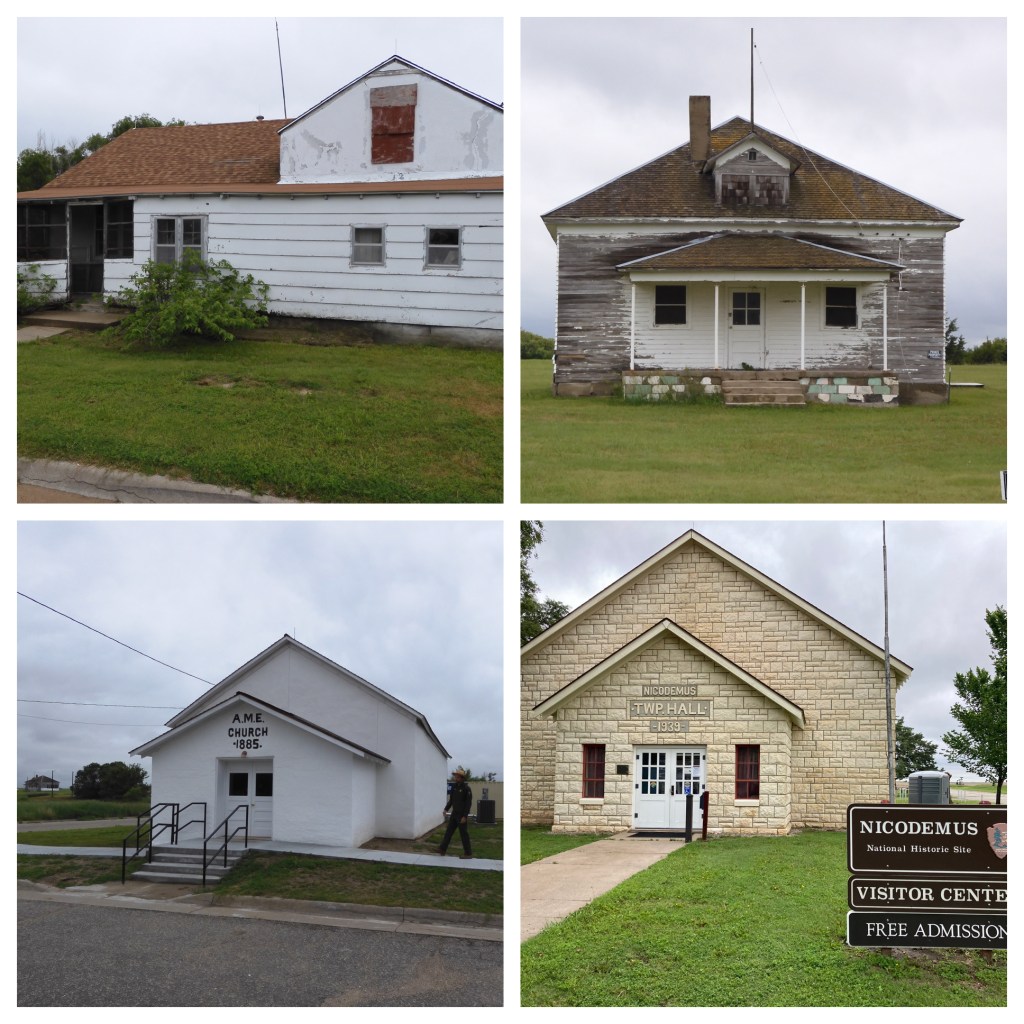
Yet the historic site tells an important story of the American post-Civil War period and the efforts to fight the Jim Crow society developing in the South. There are five remaining buildings from the period. Every summer for over 130 years, hundreds of the descendants of the original settlers return to celebrate their roots. Even while we were there, a person stopped in because a co-worker in Denver with roots here told him to visit. One of the two park rangers we talked with traces her roots to the town.
The other park ranger gave us a personal walking tour of the community, interlacing history with stories from the oral history of residents and other descendants. The tour brought the town alive for us, and coupled with the park videos, one leaves Nicodemus with a greater appreciation of the richness of U.S. history and the multitude of ways blacks fought to shake the personal harm done to them by slavery. Why not take a few minutes and check out the Nicodemus videos available on the web?

While Nicodemus is located off the major interstates and tourist trap routes, the roads to get there are well paved. Traveling back roads provides an opportunity to notice little details and points of information. One teeny town had its own brewery and tap room; a second was holding its annual peony weekend with life sized dolls; Kansas has 24 major reservoirs impounding water for flood control, irrigation and recreation (we passed several of them); topography changes from flat land to rolling hills to bluffs; and you can enjoy a up close and personal view of those crop circles you see from planes traveling over “fly-over country” as the huge, wheeled irrigation systems drain the aquifer but provide the food that feeds you. We even passed probably close to 200 empty train cars designed specifically to transfer automobiles from manufacturing plants to dealers. They were sitting on sidings in western Kansas waiting for car manufacturers to ramp up their production once computer chips become more plentiful.
Our second NPS unit, Sand Creek Massacre Site, presented an American tragedy. Hopefully you have not gone into the myth of the cowboys and Indian themes so prevalent in America. Hopefully you understand that Native Americans, after being decimated by illnesses new to them, were kicked out of their homeland, promised much and delivered nothing, and had their traditions and children stolen from them.
Even if you are a person that believes Native American warriors massacred individual settler families without any provocation whatsoever, you should truly also believe that innocent men, women, and children should not be slaughtered in cold blood by anyone. In a nutshell, this is what happened at Sand Creek Colorado. While we had prepared ourselves by reading and watching videos, we were fortunate to just make the 2 o’clock presentation by another extremely knowledgeable park ranger. Her one hour description of the backdrop of Indian-settler relations in the West during the Civil War and the actual timeline of events was sobering and disturbing.
Native Americans had their own disagreements about how best to deal with a continual loss of their homeland and broken treaties by the United States. Many of them realized that despite the broken promises, the Indians had little chance against the massive numbers of settlers and United States Army. Many tribes and subsets of the tribes, under their own individual chiefs, surrendered to the military and civilian authorities with the promise of safety and relocation to new homelands. Here at Sand Creek, in 1864, members of the Cheyenne and Arapahoe tribes had already come to agreement with the governor of Colorado and the military commander of US forces, Col. John Chivington.

Colonel John Chivington, the top US military commander in Colorado, had told the peace seeking members of the tribe to lay down any arms and turn themselves in to Fort Lyon. They did. For weeks the Native Americans had gathered just north of the fort at Sand Creek. Present were about 700 men, women, children and elders. None of them were warriors. For some reason, unknown to this day, Chivington brought his Colorado regiment down from the Denver area. With some troops from Fort Lyon, Chivington went after the peaceful tribes people.
Chivington had four cannon and about 675 soldiers. The Indians didn’t have a chance, despite trying to flee in every direction. When the firing ended, 165 to 200 Cheyenne and Arapaho people were killed, 2/3 of them women, children, and elderly. Another 200 were wounded or maimed. More appalling, is that the next day some of the soldiers came back and looted, scalped, and mutilated the dead. They didn’t even bury the corpses.
Colonel Chivington and his troops talked up their bravery in this great battle. Slowly the details came out, some from soldiers who had refused to partake in the massacre. The governor was forced to resign although Chivington gave up his commission and was never punished. From 1909 to 2002, the state of Colorado had a monument on its grounds commemorating the great battle of Sand Creek as a Civil War battle. When modifications were made, the change only said the earlier monument designers had mis-characterized Sand Creek as a battle.
The Sand Creek massacre had massive implications as Native Americans who were against a peaceful rapprochement with the US had enhanced standing and increased leadership roles due to the death of many peace loving chiefs at Sand Creek. What Indian chief could promote a peaceful settlement when US troops had massacred so many people who were following the rules laid down for a peaceful resolution? For the Cheyenne and Arapaho people, their traditions, family providers, and lands died also at Sand Creek.
The stories that belong to our journeys are not just the locations that we visit. Part of the stories are the journeys themselves. Today’s journey had a particularly interesting but brief experience. The Sand Creek Massacre site has its major entrance from the south. This was the entrance described in the website. We were approaching Sand Creek from the north and east. Google maps gave us an alternate route that would be shorter than circling around to the south. We chose it. Mistake.
The alternate route had us going down a dirt County road. Now as faithful readers know, we have taken many dirt and back roads around the United States. The vast majority of the time this is fine. Today’s road joins the smaller list of memorable but horrendous roads. This road made the list because the road bed was wet sand turned into slippery mud. Little to no gravel to give support to the road surface. We made it maybe a football field’s length before the car’s sliding and poor road conditions seemed likely to put us into the ditch. Recognize once again, this is not a populated area, on a lonely road, with poor cell service. Even executing a K-turn was out of the question. We needed all of the Subaru’s all wheel drive to slowly back up the way we came. Frequently we stopped and pulled forward a bit to gain a few more feet of road away from the ditch. Of course, it was raining so looking out the back window, the side mirrors, and the rear view camera were not sufficient. Chris and I both had our doors open to get a better sense of where on the road we were and how poor was the traction.

Then we come to La Junta, our locale for tonight’s lodging. Chris has read about how La Junta is a “gem”. Sometimes first impressions are incorrect, maybe La Junta is a gem. But we arrived in town by way of the large and smelly cattle feedlot; drove through streets that were muddy from recent rains that must not have just flooded roads but brought all of the dirt from surrounding properties onto the street; and had a hard time finding a gas station that did not seem sketchy. The strip with the major hotels is across from the rail yards. Even the McDonalds looked deserted. We bought sandwiches at Subway and ate in our room.
Ed Heimel, Chris Klejbuk
La Junta CO May 31, 2021
 Chris Klejbuk and Ed Heimel travel adventure
Recent Comments