
St. Paul, July 24
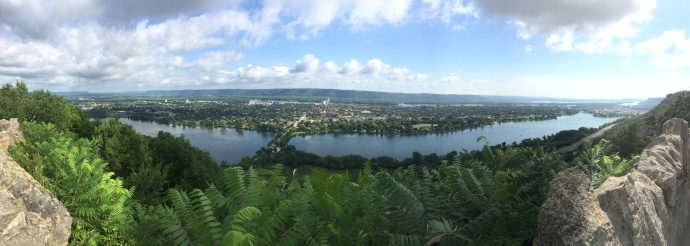
Panoramic view of Winona MN. Wisconsin bluffs in background, then thin blue ribbon is Mississippi River, then City of Winona, then Winona lakes and finally nearest to you the Garvin Heights Bluffs
Although our next major trips will be in September and October, we did take a short trip down the Mississippi River to the Bluff Country of Minnesota. Chris and her sister Kathy and I spent three nights in a cabin in Dakota, MN about halfway between Winona MN and LaCrosse WI. But I do need to write a few sentences about geology before other details. In my simplified wording, this area of Minnesota was underneath a vast sea hundreds of millions of years ago. That sea laid down layers of sediment that was smoothly eroded by wave action and over time cemented into easily eroded sandstone. Depending on the action of the seas, a less easily eroded rock type, dolomite, which is a hard limestone, was also laid down, usually over the top of the sandstone. Then during the times of the glaciers, which generally did not cover the Bluff Country, windblown dust from a glaciated area east of here, called loess, was laid down on top. Finally, when the glaciers to the north eventually melted, they formed a huge lake covering much of northern Minnesota and Ontario, with an ice dam at the southern end. Periodically the ice dam gave way releasing torrents of water that carved out the Minnesota and Mississippi River valleys. That final erosion gave us the valley we drove through with bluffs up to 600 feet high, numerous side valleys, and the bluffs in Minnesota and Wisconsin separated by up to four and a half miles. The current Minnesota and Mississippi River are just shadows of the glacial rivers.
Our drive on Thursday took us through the reservation land of the Mdewakanton Dakota Indians. This is a small reservation consisting of land re-purchased for them by the U.S. in the 1880s to replace land taken from them by treaties not adhered to. They currently have a casino here which they, on their website, call the “new buffalo” providing the basis for food and jobs similar to their dependence on the buffalo hundreds of years ago. The Dakota have not forgotten their traditions though, they have a “Buffalo Project” that consists of a new herd of buffalo (bison) that they graze on reservation land. The herd of bison is thinned periodically to provide food and materials for tribal activities.
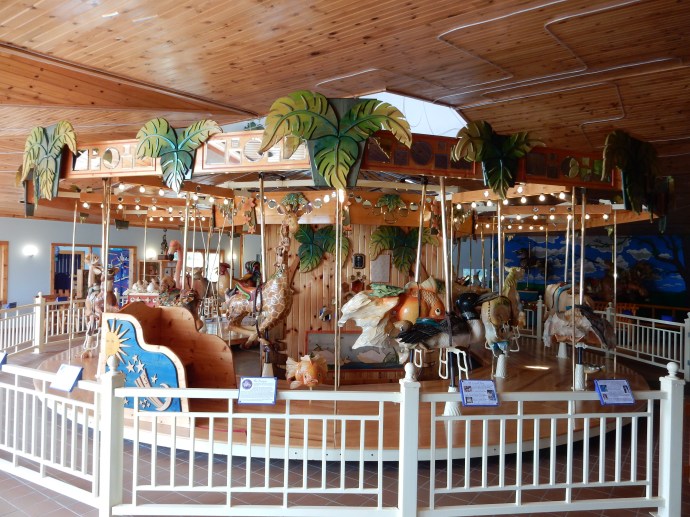
Carousel at LARK Toy in Kellogg MN
We stopped in Kellogg, MN, home to the LARK toy store, ranked the number one toy store in MN by the viewers of a Twin Cities TV station. LARK began by making hand-made wood toys and has since expanded, incluidng an indoor carousel with hand carved animals. While we did not buy any toys, the vast array of toys was mesmerizing-and we rode the carousel.
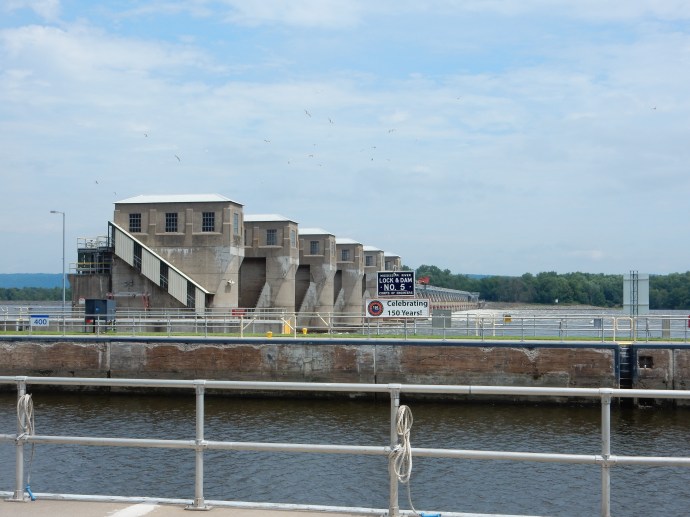
Lock and Dam Number 5 on the Mississippi River
We had planned to stop for a picnic lunch at John Latsch State Park. On our way there, we passed the town of Minneiska, home to the highest per capita rate of wood carvers. They have two wood carvers, and with a town population of only 111, see if you can find another place with a greater concentration of wood carvers to the general populace. We missed the turnoff to the Latsch State Park and turned around at Lock and Dam #5 which had modern restrooms, picnic tables, and a view of the lock and dam. We ate lunch here instead and watched a rented houseboat lock through on its journey upriver. When we did arrive at Latsch, we discovered no restrooms and a small picnic table next to the steps that climb to the top of the bluffs. (Most of the park is remote bluffs.) Since the temperature was 85 degrees and the humidity was at 80%, we decided to pass on the hike and continue our journey. John Latsch was a wealthy wholesale grocer. Interesting note about John Latsch though.
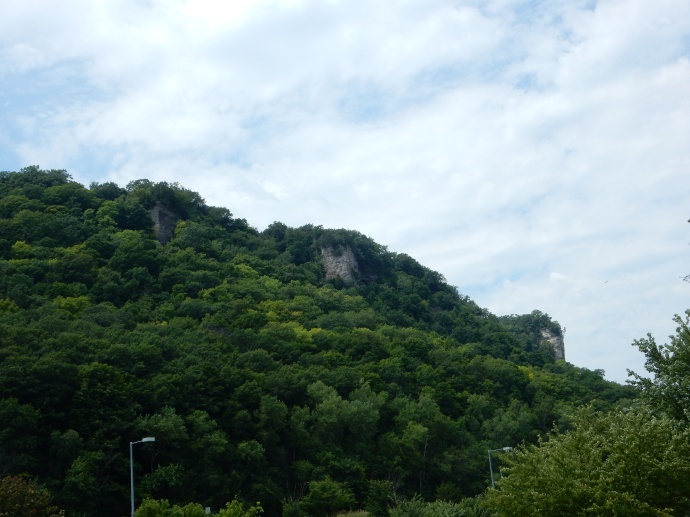
Looking at the bluffs in John Latsch State Park
From an article in “Minnesota Trails” written in 2013:
” The June sky turned an angry thunderstorm blue bringing rain down on John A. Latsch, canoeing near Camp Glory, now Bass Camp, on the Mississippi River above his hometown of Winona.
Latsch, a wealthy, 47-year-old grocer, loved to fish, hunt and explore the byzantine backwaters of the Mississippi River in his little boat. Back in 1907, the Mississippi River bottomland was privately owned yet used by the public. Usually, landowners allowed boaters brief refuge along the shore.
Not this day. As Latsch beached his canoe to wait out the storm, an angry farmer and his dog confronted him. The farmer demanded Latsch push-off immediately.
Latsch complied but was deeply shaken. The next morning, he directed his business agent to purchase all of the land on which the incident occurred. He wanted the wild riverbanks to belong to everyone beginning a conservation career benefiting us all today.
By the time John Latsch died in 1934 at age 73, he had donated nearly 20,000 acres valued at over $2 million. He bought most of the 20 miles of bottomland from Whitman to Homer, Minnesota. He became southeastern Minnesota’s most generous conservationist, donating land to Minnesota and Wisconsin. These lands eventually became parts or all of John A. Latsch and Whitewater state parks in Minnesota and Perrot and Merrick state parks in Wisconsin.
As lavishly as he bestowed gifts to the public, John A. Latsch was personally frugal. He neither owned nor drove a car, preferring to travel in his canoe. Never married, he dressed plainly, ate sparingly and lived simply in his Winona home, occupying only a small part of the house. He was a modest man, never making a show of his generosity.
Growing up on the family farm in Trempealeau County, Wisconsin, Latsch had little time for play. When John was 7, his father moved the family to Winona and opened a grocery business.
Paddling the backwaters of the Mississippi was his refuge from the long hours and responsibilities of his business. The solitude of the bottom lands, woods and bluffs along the Mississippi became his passion. Being denied refuge on the river during the storm only steeled his resolve to preserve the untamed natural beauty surrounding him for the enjoyment of future generations.
And from the “Winona Times” in 2013:
Before his death in 1934, Latsch bought and donated more than 18,000 acres, including Aghaming Park, Gabrych Park and Westfield Golf Course in Winona; John Latsch State Park and portions of Whitewater State Park in Minnesota; and Trempealeau Mountain, John Latsch Overlook, and portions of Merrick and Perrot state parks in Wisconsin. And he funded the John C. Latsch Public Baths on Latsch Island that provided Winona with safe swimming and recreation for decades.
The example Latsch set had even more far-reaching consequences.
In the early 1920s, confronted by reclamation projects that would have destroyed thousands of acres of prime wildlife habitat along the upper Mississippi, Chicago businessman, outdoor enthusiast and friend of Latsch, Will Dilg, organized 50 wealthy and influential colleagues to lobby for federal action that would preserve and protect habitat for future generations.
As a result of their efforts, in 1924, the Congress authorized the Federal Wildlife and Fish Refuge Act which laid the basis for the federal refuge system that protects thousands of acres of prime habitat across the country.
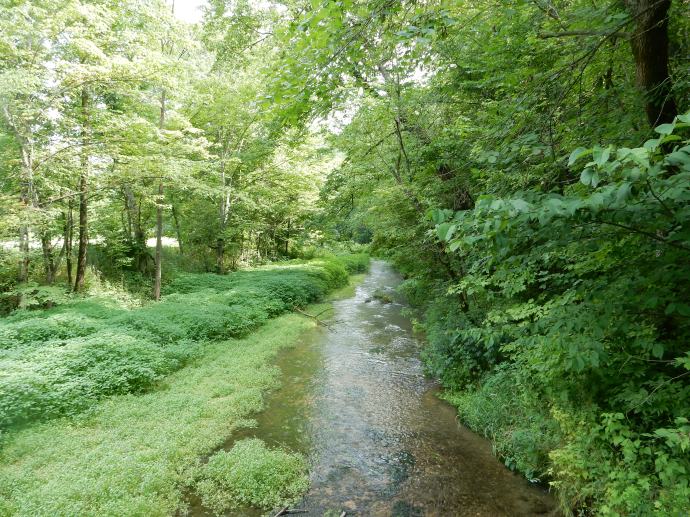
The creek at Beaver Creek Valley State Park
After checking in at our cabin, we drove down to Beaver Creek Valley State Park near Caledonia, MN. Today was just about the worst day of the summer; a heat advisory in effect, and I will admit, we did very little hiking at Beaver Creek Valley. We did encounter two park interns conducting a survey of park users for the state. Well, we were their first visitors and this was close to 4 PM. We obliged them and answered the questions, inquired about the job (they spend a week at various parks and camp there), and then headed to La Crescent, a town of 4,800 for pizza and ice cream. This was a good decision; yes, the food was good but the skies opened up and a 20 minute deluge occurred while we were eating. La Crescent is supposed to be the heart of the apple growing area of MN, we did not see any orchards although we were later assured they do exist. If so, the orchards are quite unlike the many acres of neat rows of apple trees we were used to in south central Pennsylvania. We drove our share of two lane roads throughout the area, at one point driving through Rollingstone MN, a town founded by immigrants from Luxembourg. Unfortunately, it appeared that their historical museum is no longer open to visitors.
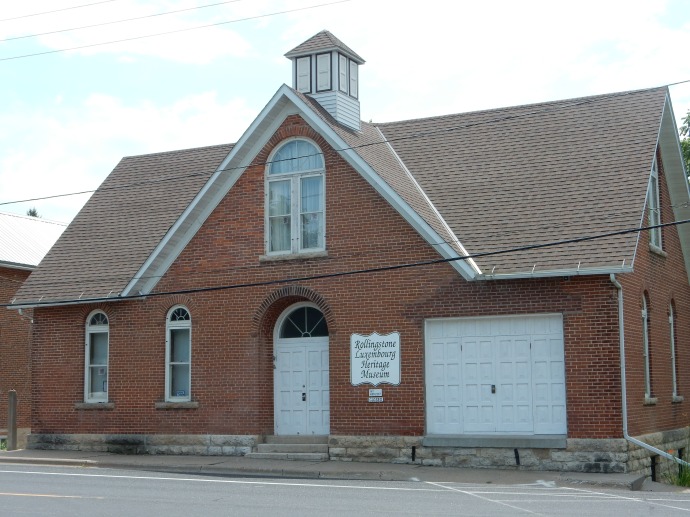
The Rollingstone MN historical museum building
We spent Thursday, and the other nights, playing games, reading, watching the convention, and watching “Murdoch” movies on Acorn on our tablet computer since the cabin, while air conditioned, did not have the promised DVD player.
Friday Chris and I were up and out visiting Great River Bluffs State Park. The park is just a long baseball drive from our cabin but we had to drive a circuitous route, through the not-visible apple orchards, to the park entrance. The entrance route has been re-planted in prairie grasses which were blooming colorfully. Not many campers had arrived for the weekend yet and we were but one of a handful of hikers on this, another scorcher day. Thankfully our hikes here were in the woods to several overlooks providing a view of the Mississippi River Valley 600 feet below us. The Mississippi River Valley here is 4.5 miles wide. From the bluff top one can see the river channel clearly; as you watch the boats below go through the channel dredged by the US Army Corps of Engineers, you see the river next to the channel with ripples caused by wing dams and obstructions. It visualizes so obviously the need for barge traffic and recreational boaters to stay within the dredged channel.
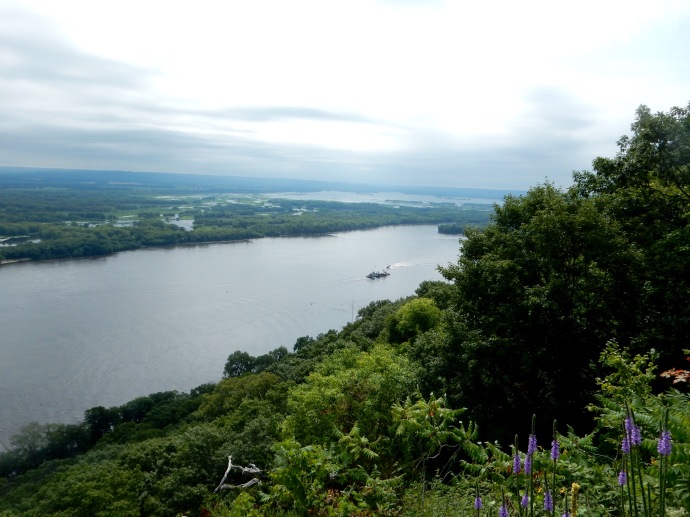
Looking down from Great River Bluffs State Park to a US Army Corps of Engineers boat that dredges the river channel to a nine foot depth
We returned to the cabin for lunch with Kathy and headed to Winona, a town of 27,000 people along the river. Founded in 1851 by a steamboat captain, the town grew prosperous early due to the milling of lumber and the shipment of grains and lumber downriver. Today it is home to three higher education institutions. One of them, Winona State University, is the only higher educational institution offering a BA in composite engineering. Composite engineering is the “how” of manufacturing products from plastics. It is the home to Wenonah Canoe and to over 20 other companies who in total employ 1200 workers making products from composites. But our visit today was to two other notables: the J.R. Watkins store and museum and the Minnesota Marine Art Museum.
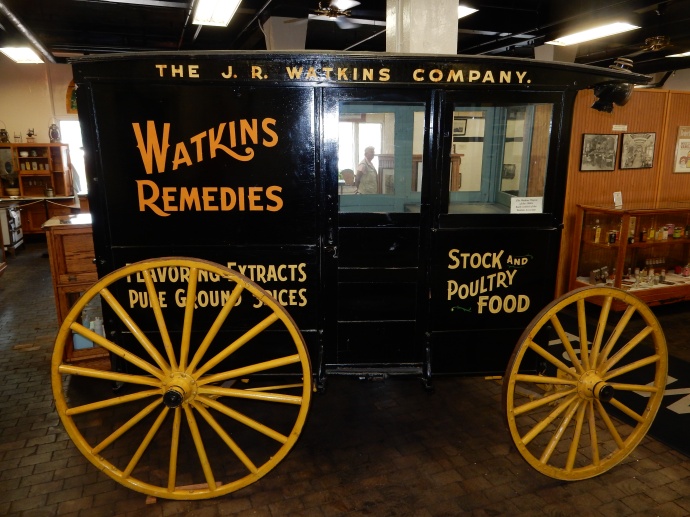
At the JR Watkins museum in Winona MN
Winona is the headquarters and site of the manufacturing facilities of the J.R. Watkins Company. The company hired notable architects to design their headquarters and production area, including a section that is ten stories tall. It has a 70 foot high rotunda dome with 24 carat gold leaf, 224 stained glass skylights and three custom Tiffany stained glass windows. Watkins = beauty products, spices, cooking products, cleaning products, was farm products and medicinal (castor oil, liniments, milk of magnesia, etc.) Watkins began in 1868 and became well-known when it’s salesmen went door to door with sample cases and in cars with company name on it. Watkins first introduced the “Trial-Mark Bottle” and America’s first money-back guarantee in 1869. Relying on door-to-door sales, Watkins gave customers a risk-free way to try his products by adding a molded “trial mark” to each bottle. Customers who used the natural products and stayed above the mark could get a full refund. This practice, while allowing customers to try a sample without worry, also gave the salesperson a reason to re-visit the home and hopefully make even more sales. At one point, they had over 15,000 salesmen. His first major product was a pain relieving liniment now 96.5% natural. The original product was primarily alcohol with some opium. If it did not cure you, I guess you no longer felt any pain.
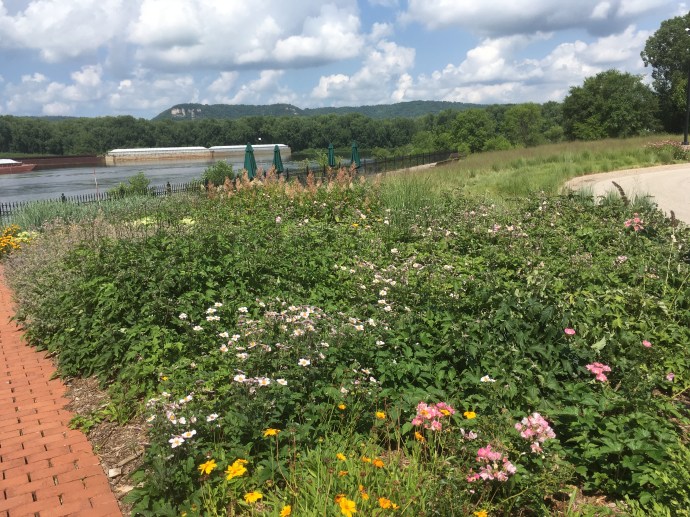
Viewing barges on the Mississippi River from the Minnesota Marine Art Museum
The Minnesota Marine Art Museum was next. It is just a spectacular collection in my opinion, particularly with great marine art and Hudson River School collections. It also has Renoir, Picasso, Van Gogh, Monet, etc. It opened July 27, 2006. The painting “Washington Crossing the Delaware” by Emmanuel Leutze is here. The original was in Bremen Germany but destroyed in a 1942 British air raid. Leutze painted two other versions, both of which are still in existence. The other version is in the Metropolitan Museum of Art. This version used to hang in the West Wing of the White House. The museum is along the river and one can view the barges and tows loading and unloading. I saw three tows and over twenty barges. There are at least three elevator complexes in town. One of them, Malterup, is a one stop shop for breweries distributing malt, barley and hops.
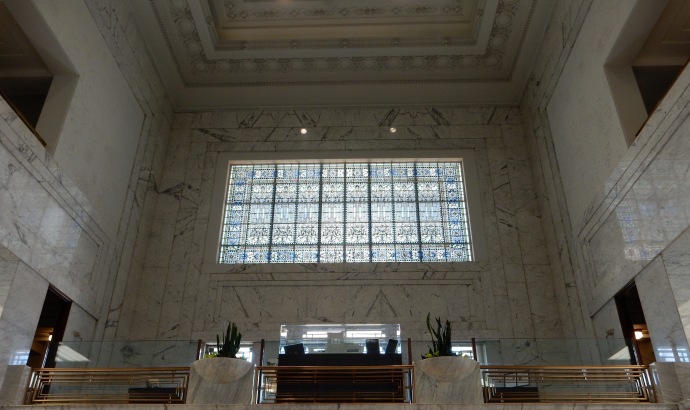
An interior view of Winona National Bank
Our final stop was at Winona National Bank, the bank begun by the Watkins. The same architect as was used by Watkins, George Maher of Chicago, designed this building. The downtown headquarters building of Winona National Bank just celebrated its 100th anniversary. The main office has stained glass and a collection of stuffed African animals, hunted and brought back for education in the 1920s by the Watkins and bank owners. Tiffany stained glass and marble friezes are inside the bank. It is still a locally owned bank.
Dinner was back at the cabin with crock pot chicken.

Doe and fawn leaping fence at out cabin in Dakota MN
Saturday, our first stop was Bloedow’s Bakery, voted number one donut store in MN by viewers of WCCO TV in March of 2012. We thought the donuts were excellent, possible better than the “World’s Best Donuts” in Grand Marais MN. From Bloedow’s we went to the Polish Cultural Institute and Museum detailing the history of Polish pioneers (in the late 1800s Poles were 25% of Winona’s 20,000 people).
The Polish Museum in Winona depicts the history of Poles in Winona. The vast majority of the Winona Poles came from Kashubia in Poland. Most were recruited through the mailing of the Winona Polish language newspaper back to relatives in Kashubia. During part of this time, Poland was being controlled by Russia, Austria and Prussia. The very first Pole to arrive in Winona was named Bronk and descendants of his still live in Winona and run a garden center selling fruits and vegetables. (We did stop and purchased fruit, vegetables and flowers.)
The museum is in a former print shop and displays artifacts and family heirlooms donated by local residents of Polish descent. The museum is in the east end where most Poles live while Irish and German immigrants settled in the west end. Many of the immigrants worked on the river and in saw mills where the inability to speak English was not a major issue. Some settlers moved into the hills and valleys where small farms were possible. The hills and bluffs can continue for three to fifteen miles before the more rolling plains and fertile farmland begin.
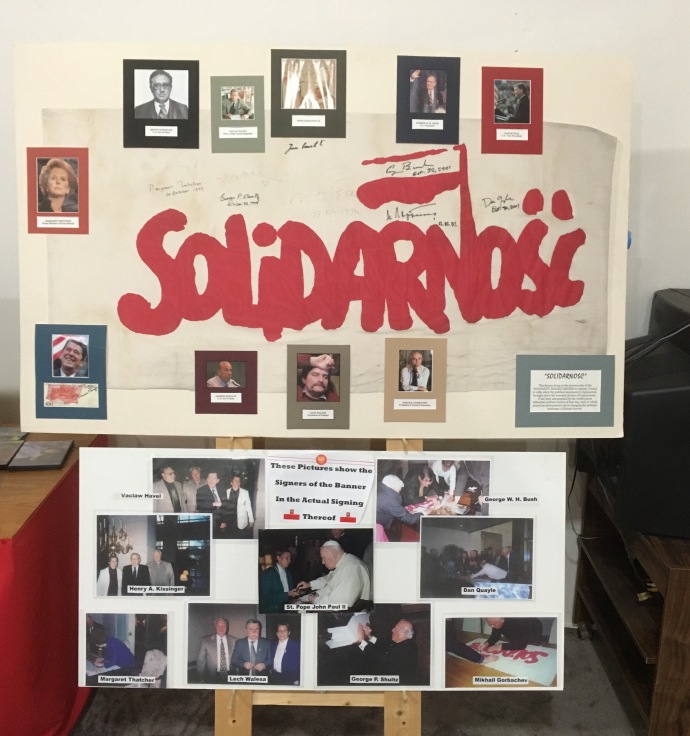
The Solidarity banner in the Polish Cultural Institute and Museum in Winona MN
One of the most striking items on exhibit is a banner that hung in the offices of Solidarity, the Polish liberation organization, in Warsaw. The banner has been signed by various notables who visited the Warsaw office including Ronald Reagan, Margaret Thatcher, George H.W. Bush, Pope John Paul II, and Mikhail Gorbachev.
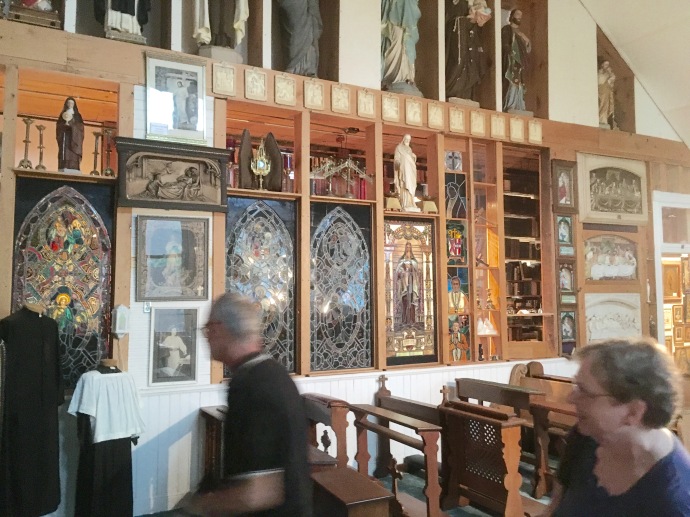
Kathy and guide at the Polish Cultural Institute and Museum, second floor
The second floor of the cavernous museum is dedicated to the history and relics of the Catholic Diocese of Winona. A number of closed churches have donated their pews, vestments, statues, and books written in Latin. Of particular note were two iron eucharistic wafer makers that made one wafer at a time by means of hand pressing the tongs, similar to a notary stamp.
After lunch at the Blue Heron Cafe we went to Winona State University Performing Arts Center and dashed through the rain to see the play “Georama”. The play is loosely based on John Banvard, the first celebrity billionaire American artist. Banvard grew up in New York City but spent time in mid-America along the Ohio and Mississippi rivers. He drew sketches of the scenes in front of him, eventually welding them into a half mile long canvas 12 feet high (georama) on a moving belt which was shown to audiences around the world. Georamas, or panoramas, were well publicized and well attended public showings, sort of a spectacle like a circus, On this canvas were painted scenery scenes representing the Mississippi; sometimes from Lake Itasca to New Orleans, sometimes just St. Louis to New Orleans. The canvas was on a roll, with a cylinder at each end. The canvas would be unrolled, and people could walk by. In other exhibitions, one panel would be unrolled at a time, and the painted scene would be explained by a narrator accompanied by music. When Banvard’s was exhibited in Boston, a ticket cost fifty cents and Banvard pulled in $50,000 in ticket sales (in 1800s money). In 1849, Banvard exhibited the Georama for Queen Victoria in London. His was the most famous traveling exhibit of its day. Over time Banvard’s Georama was cut up and sold; recently a few pieces of it were found used for insulation in the walls of a house in South Dakota.
Today only one panorama is known to survive, owned by the St. Louis Art Museum. It periodically has been loaned out; to the Metropolitan Museum of Art in NYC and to the Dallas Art Museum. This one has 27 scenes and is in fragile condition. This panorama was painted by John Egan and commissioned by a Philadelphia doctor who had visited the Upper Mississippi.
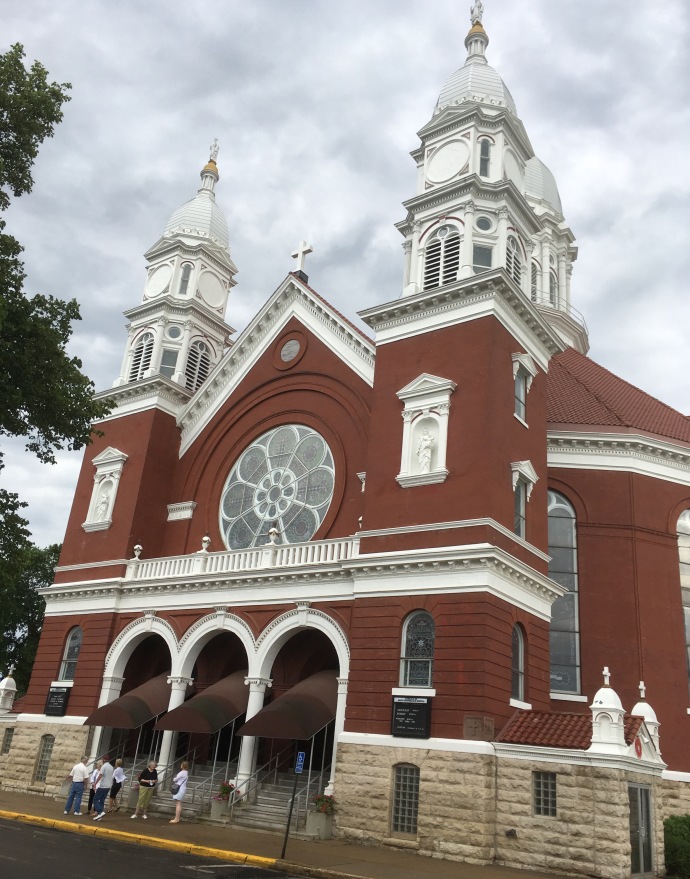
Basilica of St. Stanislaus Kostka in Winona MN
After the play, we went to Mass at the Basilica of St. Stanislaus Kostka. When America was going through the major European immigrant days, having a mass of fellow countrymen allowed you build a church and use your own language, sort of a coming rite of passage for the community. In Winona it was the construction of Saint Stanislaus Kostka Church with its great golden dome. The congregation dates back to April 2, 1871, when leaders of Winona’s Kashubian Polish community formally declared its intent to organize a parish under the patronage of St. Stanislaus Kostka. Prior to this they had been attending Mass at either the “Irish” (Saint Thomas) or the “German” (Saint Joseph) Catholic Church, but they wished to worship in their own language and to be led by a Kashubian or Polish pastor. Their church was a source of pride: In Poland only the nobility could undertake building a church, here people who had been humble villagers worked together to establish churches, frequently quite elaborate and ornate, rich in color and ornamentation. St. Stanislaus in Winona is a good example; the Poles stunned their neighbors with the huge, domed church. But that impudence was not forgotten by their neighbors. When Winona became a diocese, a smaller, non-Polish church was made the cathedral rather than the beautiful church of St. Stanislaus. Two years ago it was consecrated a basilica.
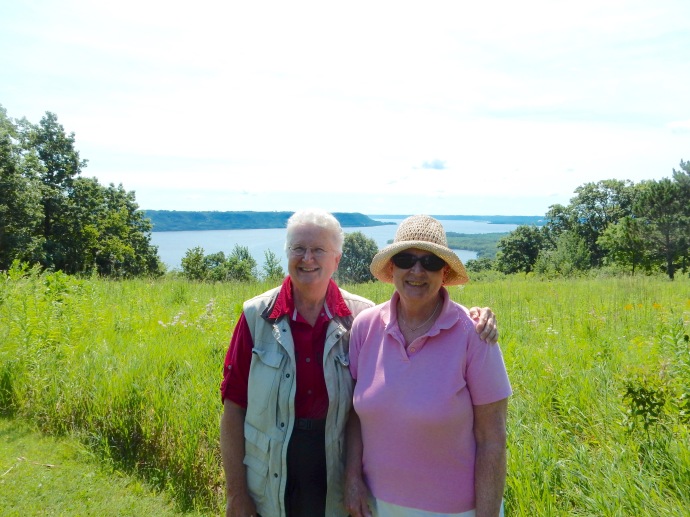
Chris and Kathy at Frontenac State Park along the Mississippi River
Sunday we checked out and headed back to the Cities. We did make a stop at Frontenac State Park near Red Wing. We have been here before but the views from the bluff are impressive and it was a good place to stop and finish off the brownies we brought with us for the trip.
Ed and Chris St. Paul July 24







 Chris Klejbuk and Ed Heimel travel adventure
Recent Comments