Posts Tagged With: Mississippi River

2025 Trip One: Mississippi River

River Nest B and B, Reads Landing, MN

March 30, 2025 Reads Landing,MN

Just a brief wrapup post to complete the blog for trip one. Saturday was not quite as rainy as we expected so we did go down to do some recreational shopping in Wabasha Minnesota. Wabasha is the home of the National Eagle Center, but we had been there before. We just walked the streets of the downtown and a little bit of the river.

Chris doing some recreational shopping Saturday

We returned to the River Nest bed-and-breakfast for several hours of reading and relaxing. Then we headed out to church in Wabasha and then had dinner at a local bar. All in all, not a lot to report.

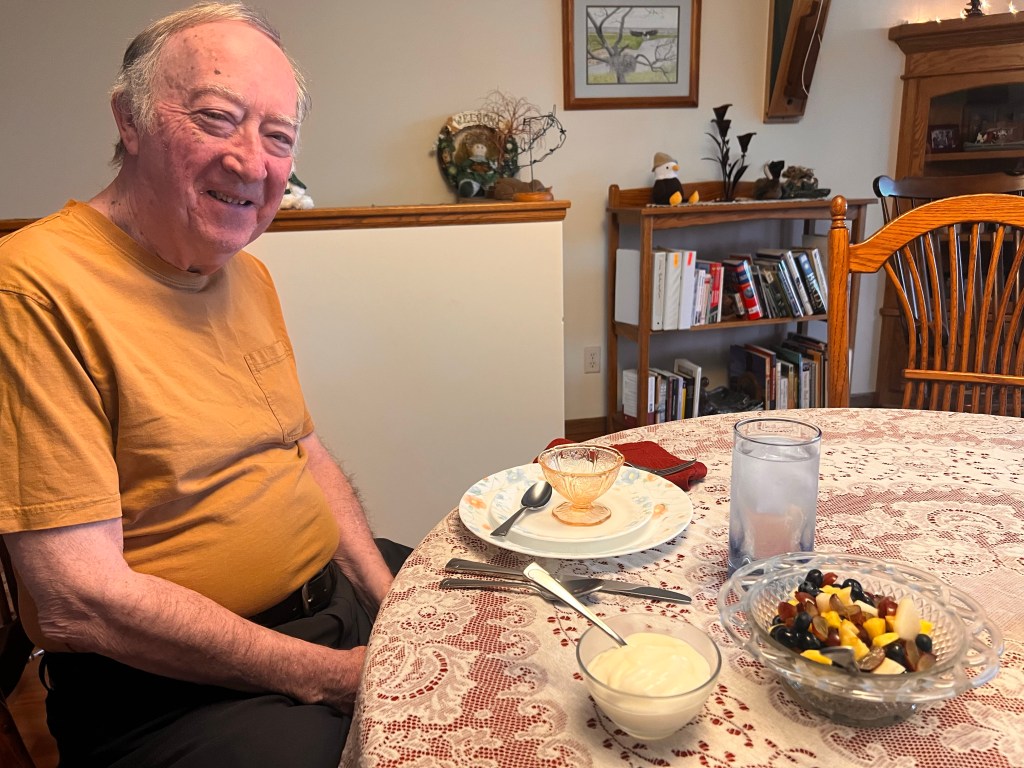
What we did want to post are a series of pictures showing the elaborate and delicious breakfast meal provided at the River Nest. It starts with danish and juice at 8 AM. We enjoy this sitting in front of the windows in our room, watching the river and whatever birds, boats, and trains we might see. At 9 AM we go out to the dining room and have breakfast. This starts with a first course of yogurt and cut fruit. The main entrée varies. On Saturday it was crème brûlée French toast with sausage. After that, you have breakfast dessert. Saturday was Swedish cream and raspberry compote. You leave the table not planning on having lunch.

I have included a picture of another one of the tows that we saw from our room. The one we saw last night was not particularly visible in a picture, except for the search light used to help guide the tow and barges. I did not go outside to get a picture of the Empire Builder. Our views of that were pretty much head on and so only showed one or two cars. I didn’t feel like going out in the rain to get an angledshot of the entire train from engine till the end.

Today we just had breakfast, packed up, and headed for home. This ended our first trip. We believe the uncertainties have been conquered. The planning for additional and longer trips in the future will now begin.

Ed and and Chris March 30th.

Categories: travel | Tags: , , , , | Leave a comment

2025 Trip One: Mississippi River 

March 27, 2025 Reads Landing, Minnesota.

Yes, we are back. It has been a while. 2024 and the first part of 2025 had limited travel. The trips we took were of very short duration in Minnesota or to visit family. We chose not to put those on the blog. More extensive travel was postponed due to various health issues. Hopefully, the health issues are all past and travel will regain its priority in our lives.

Today’s trip is also of limited duration, but it’s a trip designed to get our toes in the water again, check out our stamina and ability to hike, etc.

We are starting with a four day, three night trip to a bed-and-breakfast along the Mississippi River in Reads Landing, Minnesota. Reads Landing is a small town just south of Lake Pepin and about a half an hour north of Winona, Minnesota. The B&B has an optimum viewing location that allows us to see eagles, ship traffic on the river, and trains.

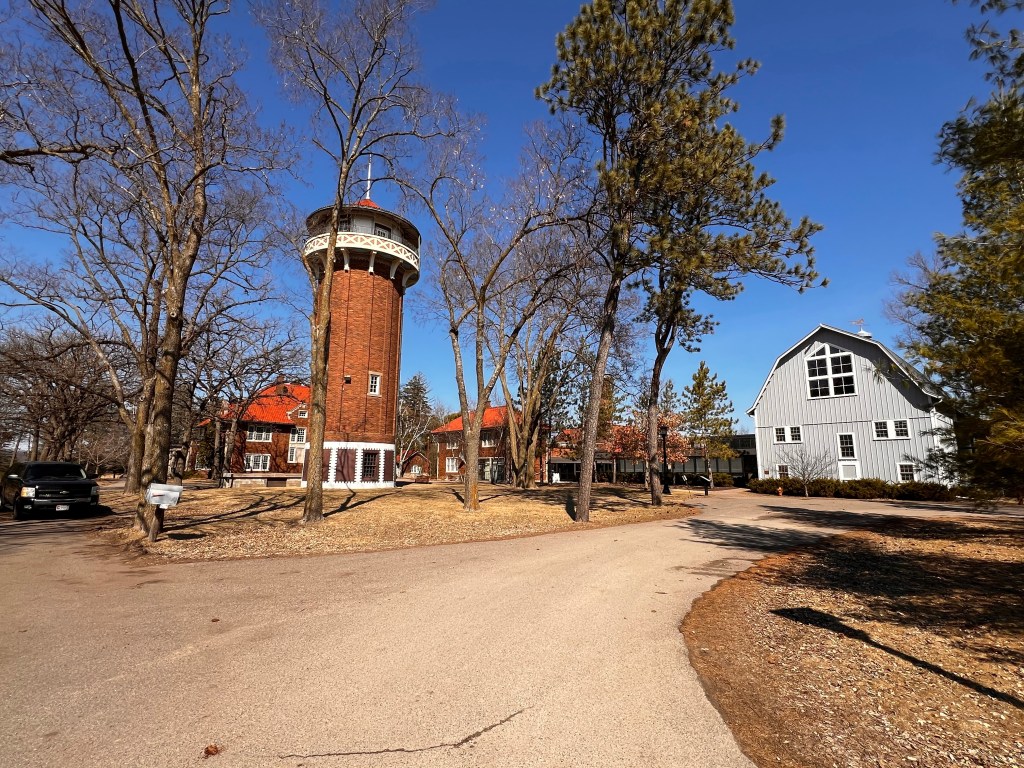
Anderson Center at Tower View Farm 

The day began with a visit to the Anderson Center in Red Wing, Minnesota. The Anderson Center has an interesting history. While it is currently houses an art museum, alternative school, and some local offices, it began its existence as the home to the inventor Alexander Anderson. Anderson was born in the rural area just outside of Red Wing. Some of you who are old enough may remember Quaker Puffed Rice and Quaker Puffed Wheat. Anderson developed the process to puff grains into a cereal. Even though those cereals no longer can compete with sugary and chocolate cereal brands on the market, he made a lot of money from it. Anderson continued to develop other food related products and continued to obtain patents. He built the Anderson Center which was where he lived after he made his money.

Other connections to the Anderson Center include Central Research Laboratories which provides remote and sterile handling devices for nuclear and hazardous manufacturing processes. It was begun by three MIT graduates who relocated to Red Wing due to the wife of one of the founders being a daughter of Alexander Anderson. CRL had a unique product that won US government approval and continues to be an important manufacturer today.

We have been to the Anderson Center previously. It has several small gallery rooms with artwork from extremely well-known artists. Today, we came to see an exhibit of puppets. Minnesota is home to numerous puppet masters. This exhibit shows off their work in hand, tabletop, mask, and full-size puppets.

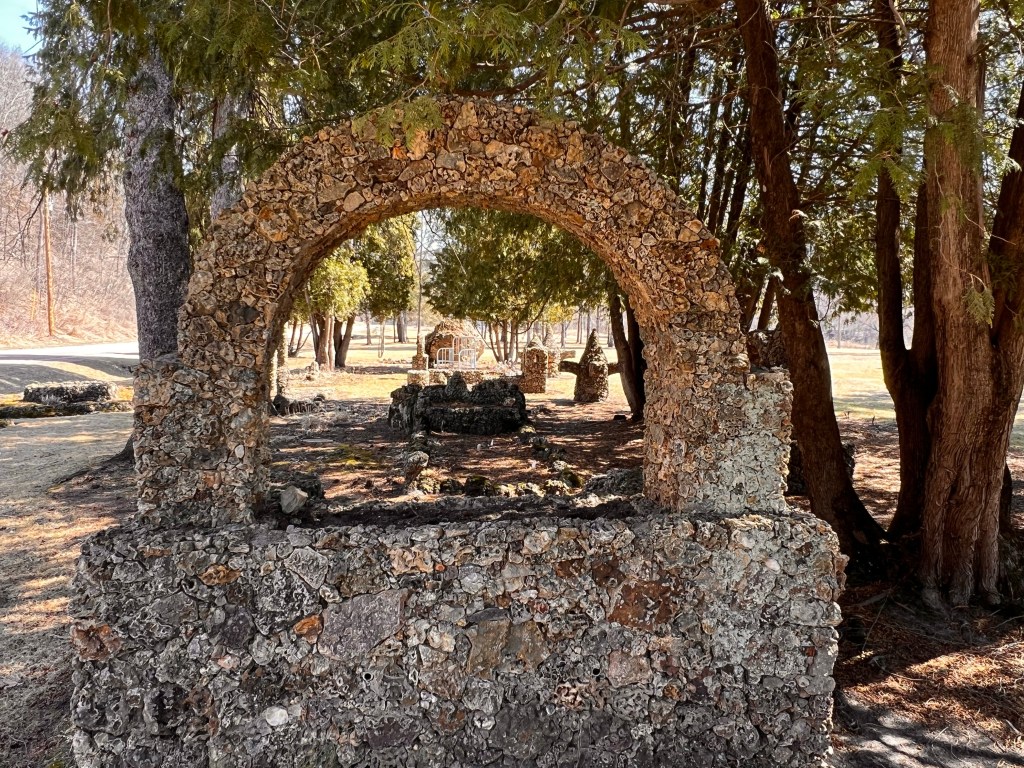
After the Anderson Center, and then lunch, we drove through the rural sections of Goodhue County to the Jarrett Rock Garden. This is one of those gardens/grotto’s with a series of sculptures made of stone or metal. Off the top of my head, I can recall at least three others that we visited in Wisconsin, one in Iowa, and one in Kansas. Seems to be a minor theme of our travels.

The Jarrett Rock Garden was completed about 60 years ago by a bachelor who did his work over three decades without communicating to others the meaning, purpose, or origin story behind his efforts. Now the sculptures are maintained by a local couple and are visited by back road wanderers like us.

After the rock garden, we drove to Lake City Minnesota. Lake City is at the center of the west side of Lake Pepin. Lake Pepin was formed by the sand dam created by eroded soils coming down the Chippewa River. When the fast flowing waters of the Chippewa River hit the Mississippi and its slower pace, the sand and soil dropped out, creating a barrier that backed up the Mississippi River creating Lake Pepin.

When the water of the Mississippi spreads out across the wide surface of Lake Pepin, it slows down. Likewise, at the end of the lake when it passes the sand blocking the exit of the lake, it speeds up as it goes into the narrow Mississippi River channel. This faster flowing water does not freeze during the winter. This makes it an ideal area to see eagles on a year-round basis. Just south of here in Wabasha, Minnesota is the National Eagle Center. It has wonderful exhibits and year-round viewing platforms to see eagles along the river. 

Lake Pepin and Lake City are also the acknowledged home of the beginning of water skiing. A local gentleman, Ralph Samuelson, in his late teens, sampled several different processes to be able to ski on top of water, similar to snow skiing. It took a while, but he was successful. He ended up traveling around the US giving water skiing demonstrations. The US Water Skiing Association recognizes Samuelson and Lake City as the origin of water skiing. We just took a little while to walk along the shore and enjoy the beautiful day and the sight of the lake hemmed by the 600 foot bluffs on both sides.

After Lake City, we stopped at LARK Toys in Kellogg, Minnesota. This is an amazing toy store which sells every type of new and old style book, puzzle, wood carved toys, dolls, Legos, etc. We did not buy anything, other than dessert of ice cream. The store is still family run and has been rated one of the top 10 toy stores in the world by USA Today.

Finally, we arrived at the River Nest bed-and-breakfast in Reads Landing, where we will spend the next three nights. Dinner was at the Reads Landing Brewery just up the street. Entertainment has been watching multiple trains go by, still waiting for the daily westbound Empire Builder, however.

Ed and Chris, March 27, 2025 

Categories: travel | Tags: , , , , , , , , , | 2 Comments

2023 Trip 8: Flagstaff, South Texas, and Mississippi River: Jan. 10-11

Iowa City, Iowa Jan. 11, 2024


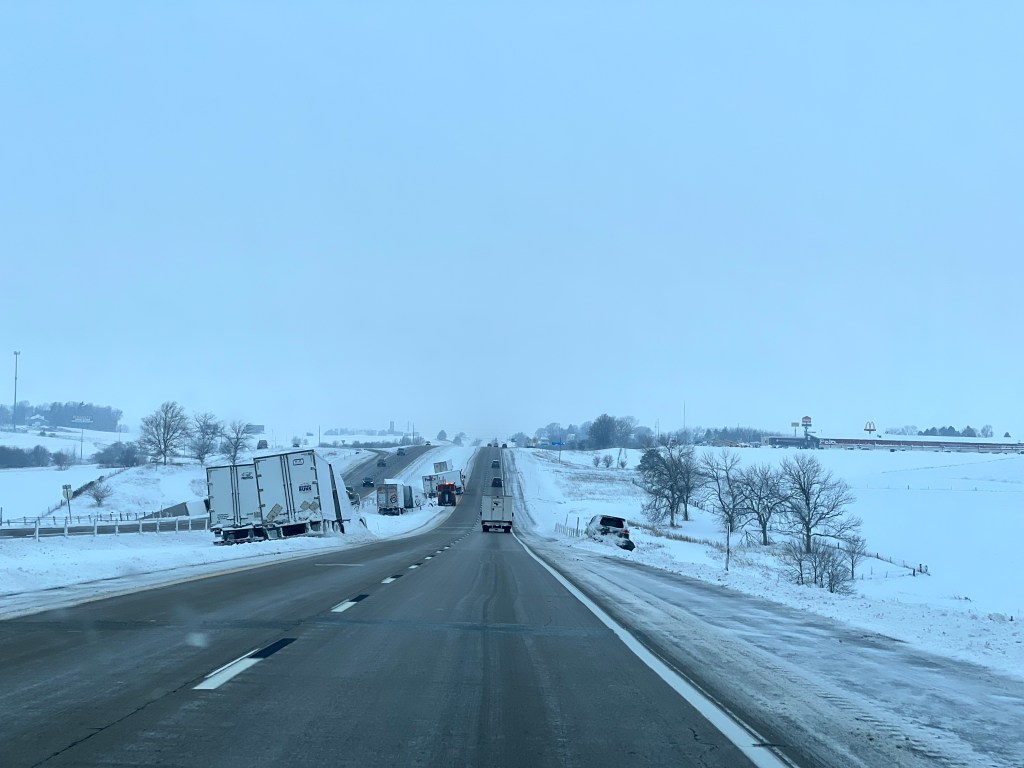
Interstate 80 in eastern Iowa Thursday morning


We will be returning home a day earlier than planned as we travel between two snow events. Both St. Louis and St. Paul have missed, and will be missing, major snowfalls. The geographical area in between is another story as central/northern Iowa gets hammered with snow. On Wednesday, north of St. Louis we started seeing snow on the ground and while roads were clear, there were numerous cars and trucks still in the ditch. Just as we got to Iowa City where we are spending the night, the roads were icy and/or snow covered. On Thursday morning, leaving Iowa City, Interstate 80 was littered with cars and semis, particularly semis, in the ditches. Thursday night to Friday morning another 3-5 inches are predicted so we plan to reach St. Paul this afternoon Thursday, Jan. 11.


Driving through Missouri Wednesday


Yesterday we visited our two last National Park units of this trip. At Ulysses S. Grant National Historic Site we saw their video, had a tour of the home, and visited the excellent museum exhibits. The combination was informative and well done. I had not been sure what to expect here but I would recommend this spot to others to visit. The house, which was called White Haven, was his home for only a short period of time, from 1854-1859.

Grant dropped by the home as a bachelor Army officer stationed in St. Louis to visit the family of a fellow Army officer and West Point grad. There he met Julia Dent, sister of the other officer. White Haven was a plantation with slaves and Julia’s father a strong Southern sympathizer. Grant and Julia fell in love, which survived a four year separation as he had a tour of duty out west, and were then married.

After several years, Grant surrendered his Army commission but had a tough time making a living managing the plantation and other jobs he had to pick up. They moved to Galena Illinois to work for Grant’s father. When the Civil War broke out, he signed up with an Illinois volunteer brigade and moved up the ranks quickly. Hopefully you know about the Civil War, his Presidency, and post Presidency life.

Grant’s views on slavery were at odds with Julia’s father. During Grant’s Presidency, he made a major effort to reunite the country and to implement the promises of equality for all. He had partial success but after his terms ended, the equality efforts ended.

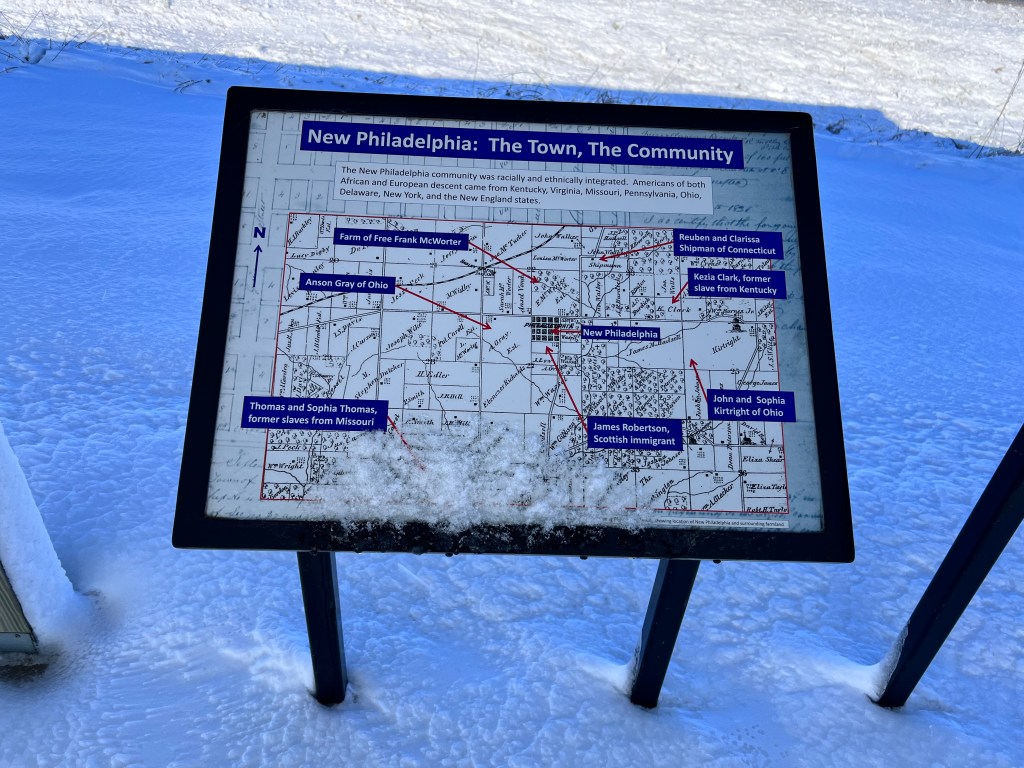
Our next NPS site, our 13th of this trip, was across the Mississippi River again in Illinois. This is a new NPS unit whose site is not yet fully developed. New Philadelphia was the first town site platted and recorded by an African American. However, the railroad bypassed the town in favor of the nearby “white” town of Barry, Illinois and eventually New Philadelphia died away.


Our effort to learn about the site was hampered since some of the displays are in the Barry Public Library-which was closed due to the snowfall the day before. The walking tour with audio displays and an augmented reality app didn’t pan out as the site was covered with snow. The Barry City Hall did help a bit with one brochure, the NPS stamp, and directions to the site-about four miles east of Barry.

We had lunch back in Barry at the only restaurant open downtown. It had two large Trump banners prominently displayed on the rear wall facing the door.

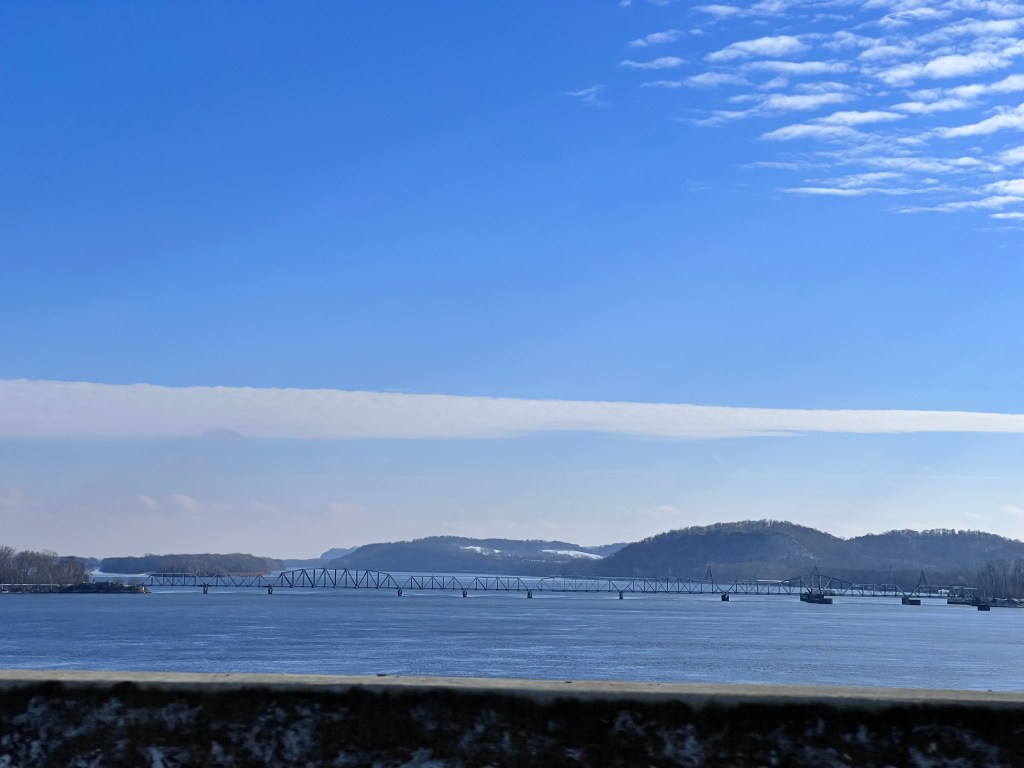
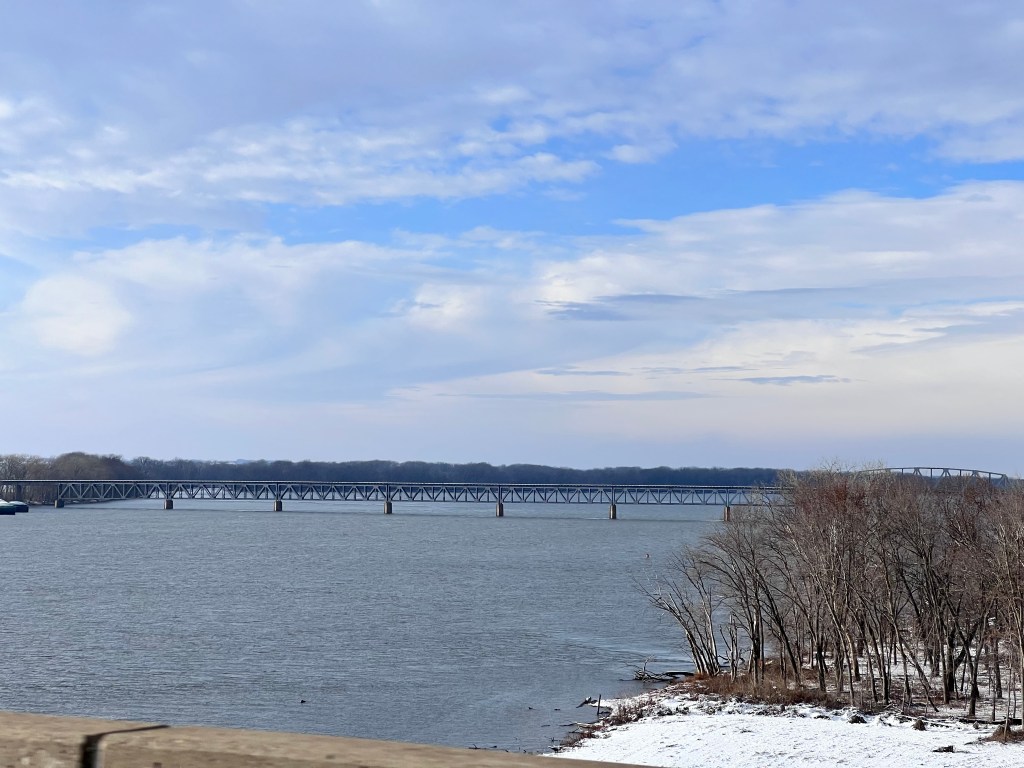
We recrossed the Mississippi River back into Missouri and drove to Iowa City. Today, as mentioned above, we finished this road trip back in Saint Paul. 25 days, 6,464 miles, 13 National Park Service sites, 14 states and we crossed the Mississippi River eight times.

Ed and Chris

Categories: travel | Tags: , , , | 1 Comment

Another 2022 Winter Getaway in Northern Minnesota, March 8

Grand Rapids, MN March 8, 2022

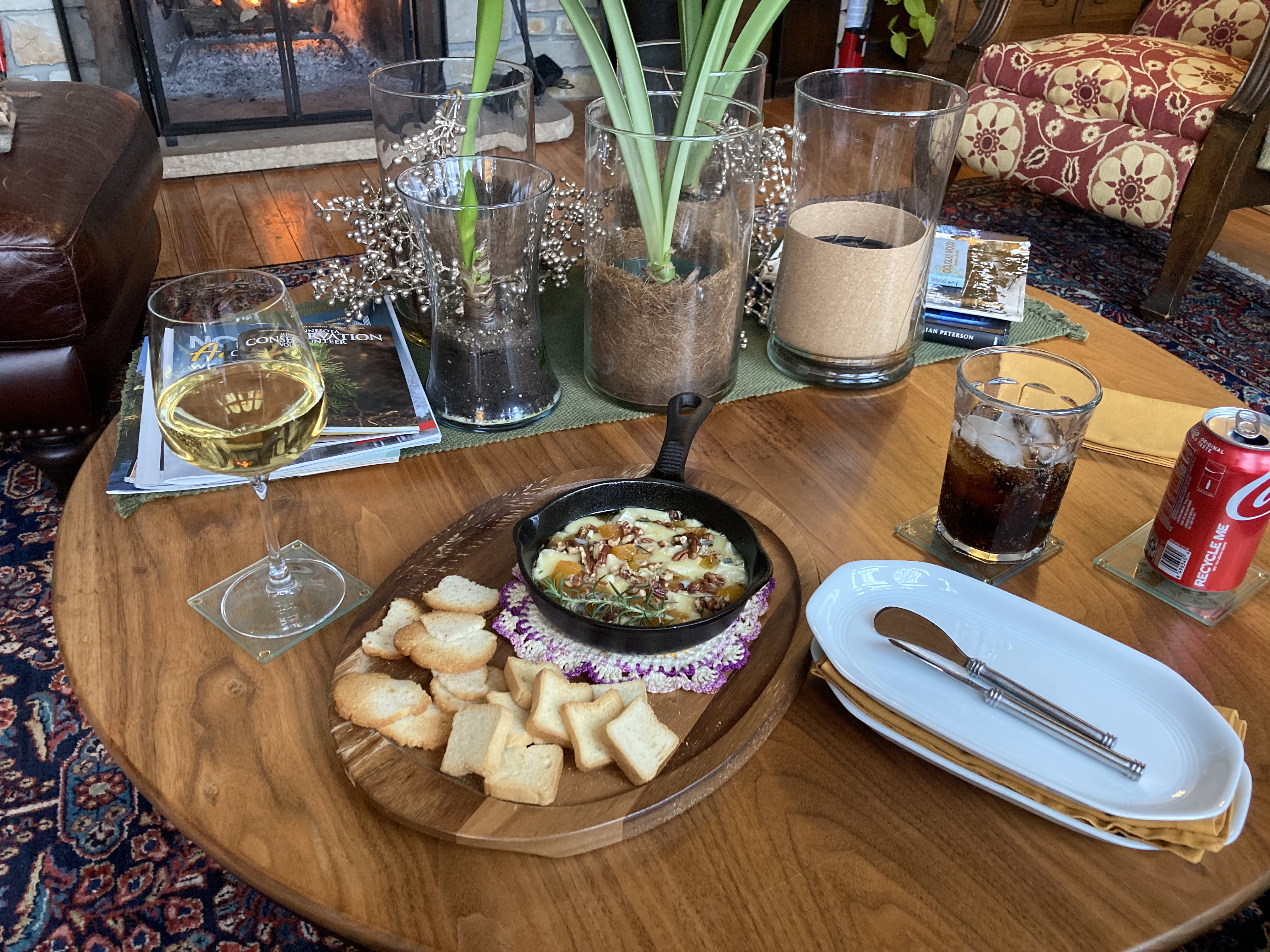
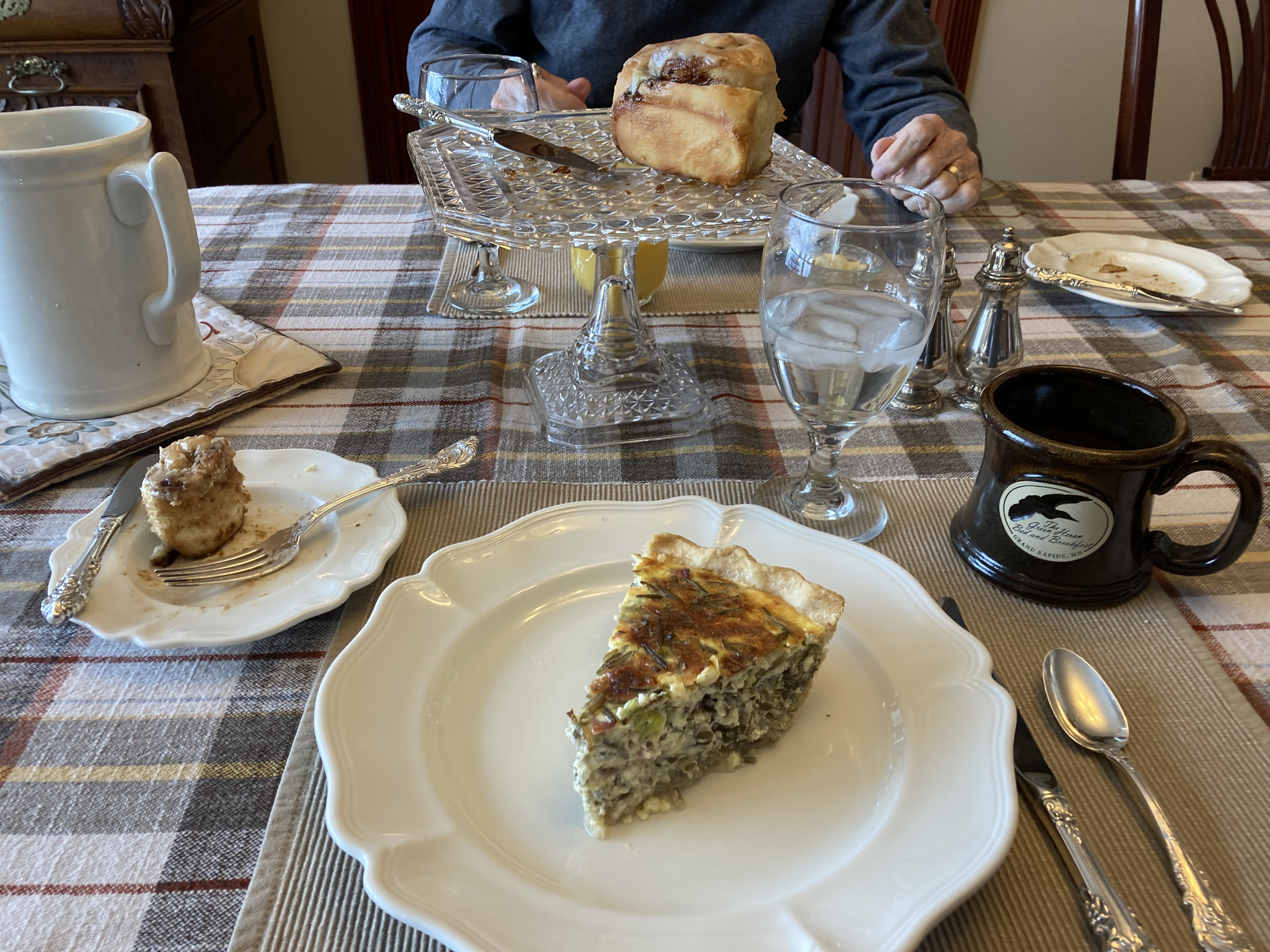
Our hosts here at the Green Heron admitted they had to stop having breakfast with their guests or they would be gaining weight all the time. I can understand that. Our breakfast of wild rice quiche and homemade cappuccino rolls fuels us up for hiking and allows us to skip a meal later. The wild rice in the omelette was harvested by the hosts and then sent to the Fond du Lac Indian nation near Duluth for processing. Soon they will be making their own maple syrup.

One of my volunteer activities is as a National Park Service (the Mississippi National River and Recreation Area) docent at St. Anthony Falls Lock and Dam visitor center on the Mississippi River in Minneapolis. I have known that the Army Corps of Engineers constructed a series of six dams on the Mississippi River in northern Minnesota to regulate water flow for navigation between St. Paul MN and Prairie du Chen WI. The dams were built between 1884 and 1913. However, Chris and I had never observed one of these dams.

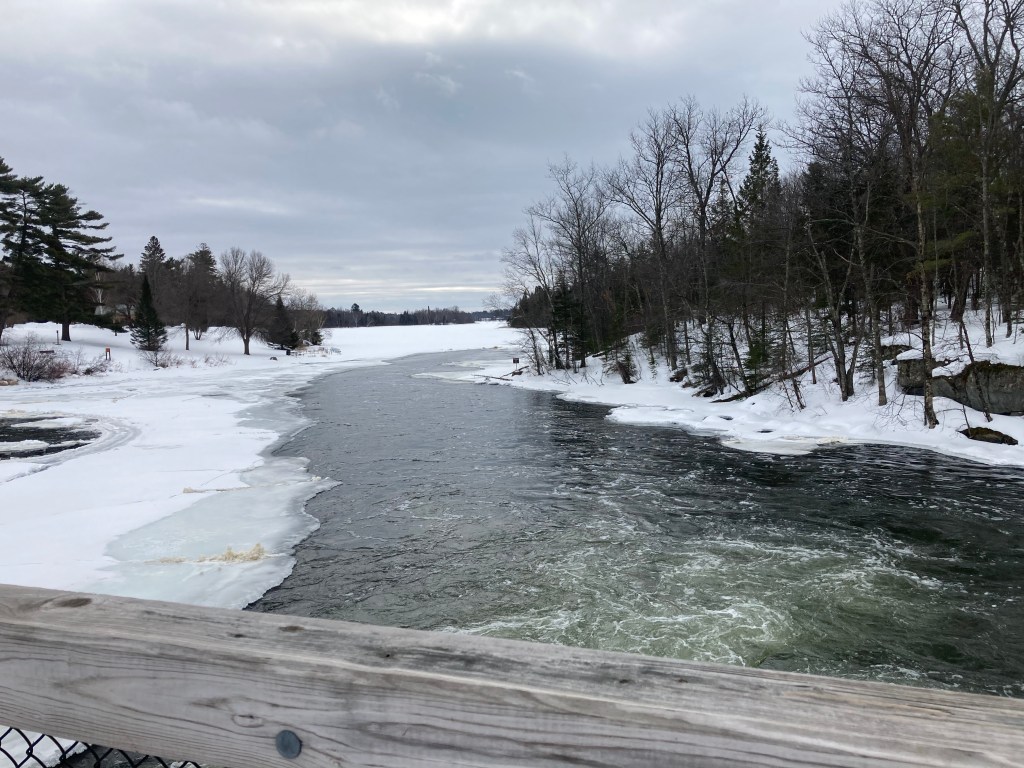
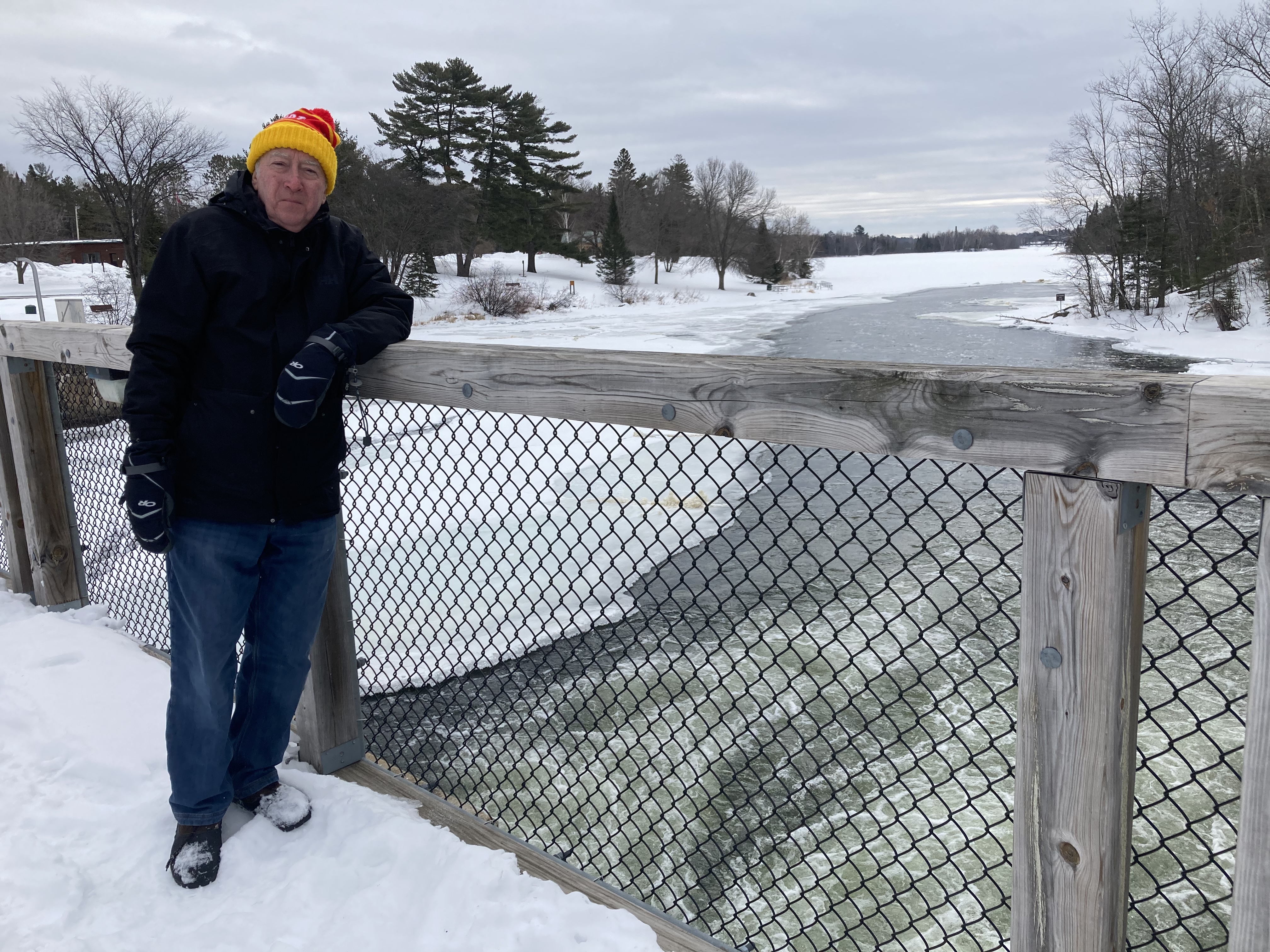
We eliminated that oversight today, visiting Pokegama Dam just upstream from Grand Rapids. The dam is not as dramatic as the dams located at most of the locks south of Minneapolis. The Corps has stated that the dams’ original purpose for water flow regulation has been less important since the Corps increased the depth of the navigation channel between St. Paul and St. Louis from 6 feet to 9 feet in the 1930s. Recreation, flood mitigation, and environmental purposes are now more important.

The dam stop was a nice adjunct to our visit in February to the headwaters of the Mississippi River. At the headwaters, the river flows out from under the ice covered lake and runs free until eventually the river has its wintry ice cover. At Pokegama Dam, the upstream river surface is frozen and then the water runs free for a short spell on the downstream side of the dam.

Our second stop was at Schoolcraft State Park. Henry Schoolcraft and his Native America guide Ozawindib are credited with making known the true source of the Mississippi River at Lake Itasca. This small state park along the Mississippi is named after him. We took a morning hike here; the two mile trail was quite clear but uneven due to the previous hikers path over the snow. Our first trip here in 2017 had been in August. No bugs this time of the year. While we did not see deer, evidence of their presence was obvious by depressions made by resting deer, tracks leading across the river, and deer scat abundant on the trail.

Our final stop of the day was at the Itasca County Historical Society. The museum had nice displays of the area with special exhibits covering topics such as local high schools, mining, logging, the river, and veterans from the area. The director checked their records and sent me a digital photo of the Pokegama Falls from the late 1800s. Then it was back to the B and B for a late afternoon snack and discussion with our hosts.

Chris and Ed, Grand Rapids MN March 9

Categories: travel | Tags: , , , , | Leave a comment

2021 Sep.8, The Great River Road

Buffalo City, WI Sept. 8

The Great River Road follows the Mississippi River from its headwaters at Lake Itasca in northern MN to the Gulf of Mexico. Other blog posts have discussed the river at Itasca, along the MN-WI border, down to Louisiana, etc. This entry is for a three day, two night trip along the river in MN-WI to celebrate our 49th anniversary.

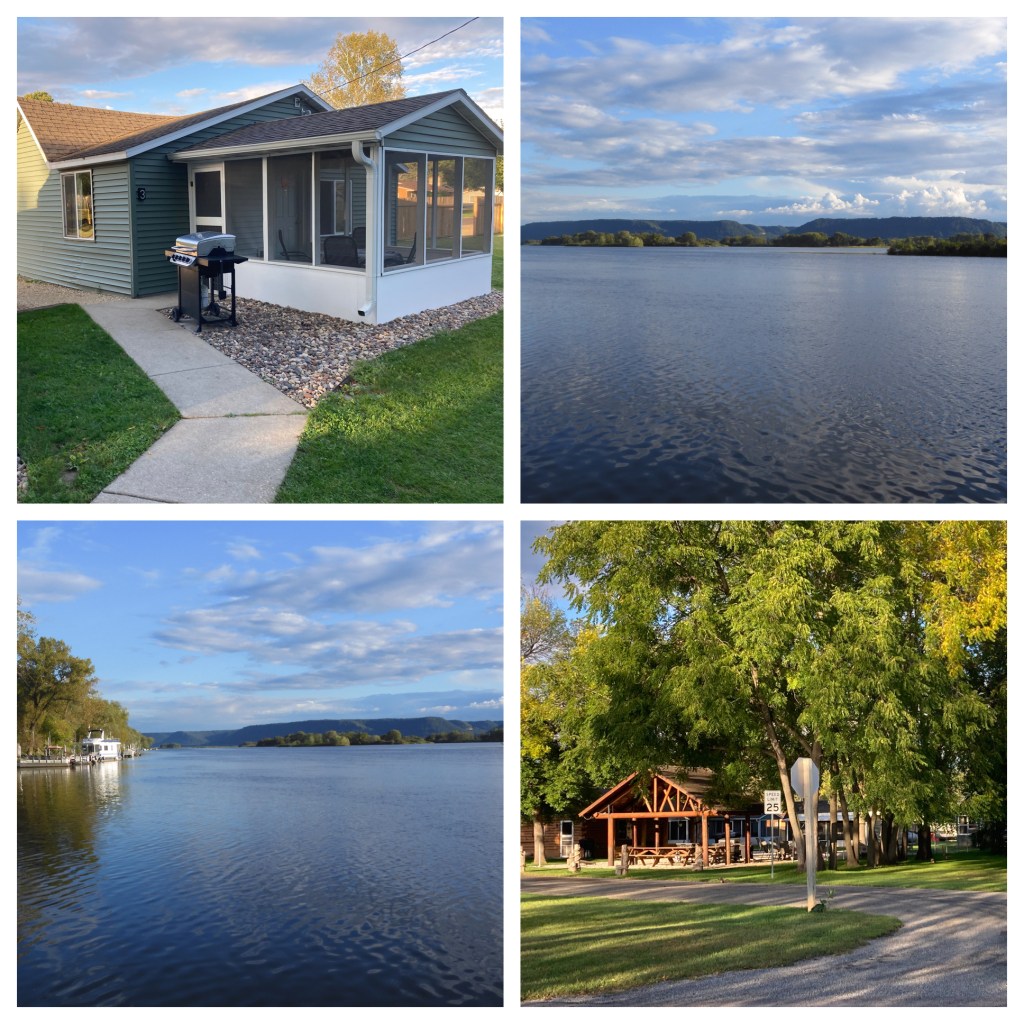
Buffalo City is not a tourist hot spot. Chris originally was planning on a camper cabin at Forestville State Park in southeastern MN. I upset her plans. A skin cancer surgery a week ago made her hesitant to stay at a camper cabin-no running water. This mom and pop small collection of cabins (Big River Escape Riverside Cabins) is right along the Mississippi River in a town of about 930 souls. Our cabin has two bedrooms with bathroom and kitchen and, importantly, a screened in porch. The Mississippi River’s main channel is closer to the Minnesota side; we have several backwater channels, islands, and sloughs between us and the main channel. The entire river complex is much wider here than it is in St. Paul.

Buffalo City is about 90 miles from St. Paul and yet a world away. Chris keeps saying: It is so quiet here. It is so quiet here. And it is-at least mid-week in September. The town is well-maintained, numerous parks, grass cut, houses neat. It has lost population in the last 10 years. We purchased milk and juice at a Dollar General-a chain we normally avoid but the best option we could see.

The day’s experiences began in Minnesota though. We drove down to Great River Bluffs State Park, a two hour drive, southeast of Rochester MN, along the Mississippi River. This part of MN is called the Driftless Area since the last glacial period (the Wisconsin) which ended 10,000 years ago skipped this area. The rest of MN was impacted though. The result is that the land drops down 500 or more feet to the river bed from the plains, prairies and pasture lands of Minnesota west of here. Limestone bluffs bracket the river on both the Minnesota and Wisconsin sides. The meltwater from Glacial Lake Agassiz (we will skip the details) 10,000 years ago carved out the Mississippi River that we viewed today.

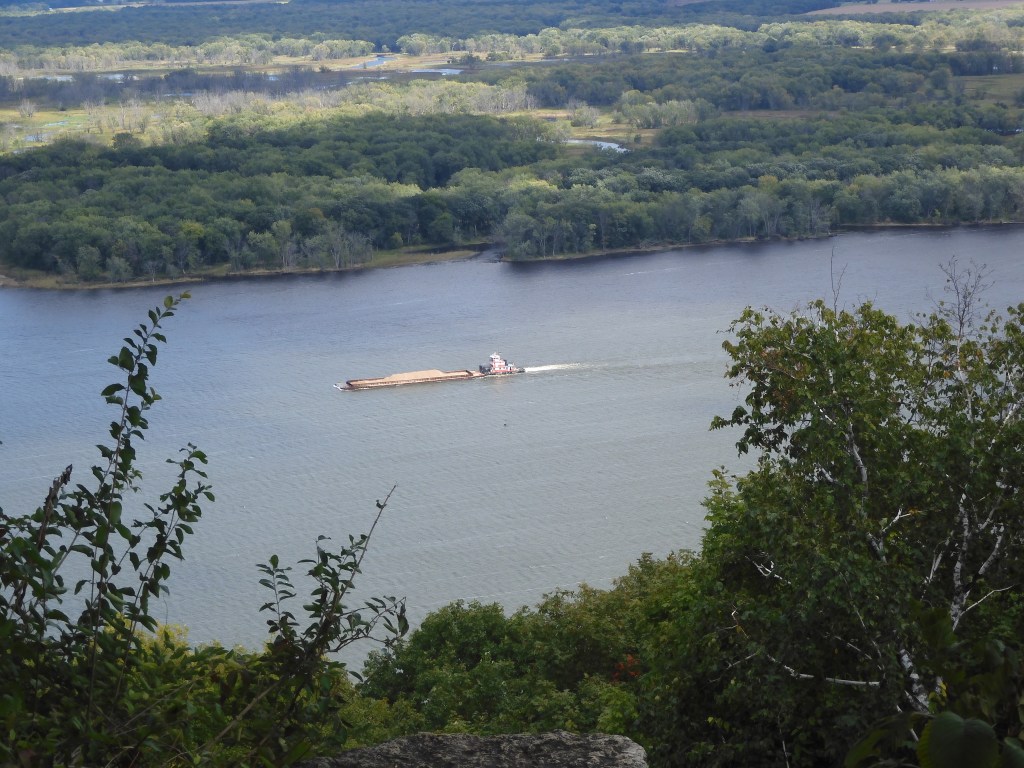
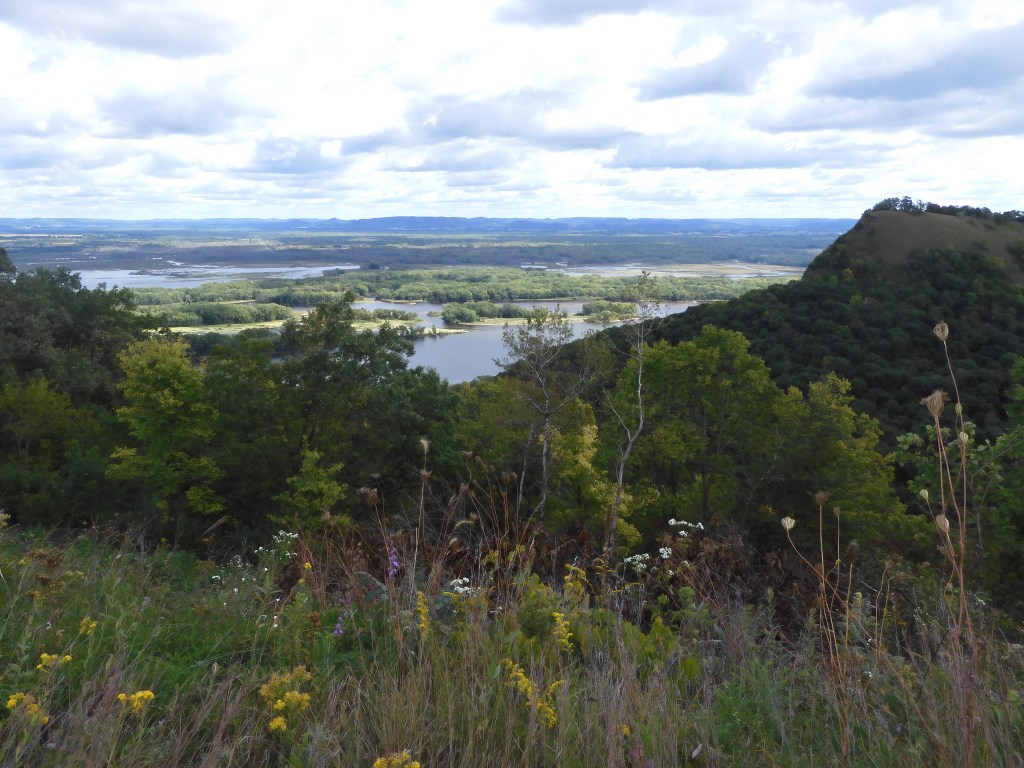
Great River Bluffs State Park has a hiking trail that takes the traveler out to three overlooks which view the river from 500 feet above. The trail starts in a pine forest, not native to the area but which was planted by farmers. After a bit, the trail takes the hiker into the native hardwood forest of oak-hickory-basswood trees. The hard dolomite rock leaves tree roots exposed so a lazy hiker who does not lift their feet high will trip. The view over the river valley from up on high makes the tripping hazard worth the risk.

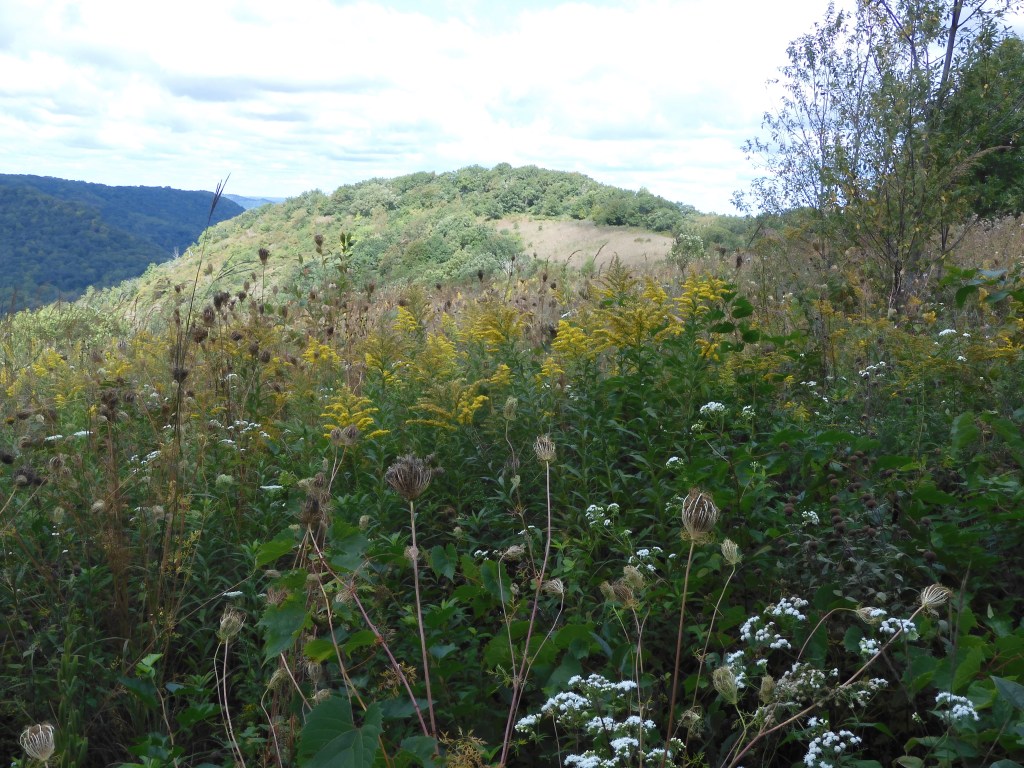
Unique to the area are ”goat prairies”, steep treeless patches of prairie high on the southwest side of the bluffs. The hot sun keeps the soil hot and dry, not suitable for the normal trees of the area. The name comes from the belief that only goats could survive on the steep slopes. The prairie today still had summer flowers predominantly of yellow, but with highlights of white and blue; the fall colors of red and orange have not arrived yet.

After lunch in the park, we drove 20 miles to La Crescent MN, a hot spot of apple growing. We picked up a bag of Zestar apples, fresh today from the orchard. Zestar is an early ripening apple with a sweet-tart taste. It was developed at the U of Minnesota Horticultural Resource Center.

It was an easy hour drive to Buffalo City, our cabin and a light dinner in our screened in porch. Tomorrow-another day of high excitement.

Ed and Chris

Buffalo City, WI Wednesday Sept. 8, 2021

Categories: travel | Tags: , , , , , | Leave a comment

2016 Minnesota State Parks: Water and Woods

Friday, November 4, 2016 Saint Paul

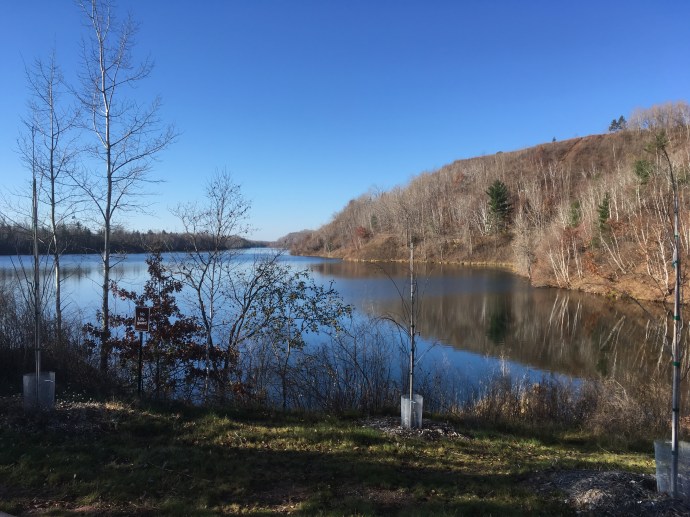
The St. Croix River, looking into Wisconsin

The St. Croix River, looking into Wisconsin

This was a three-day, two night swing to cover six state parks. Chris has a goal of seeing almost all 76 state parks in three years. So far, we are sixteen months into the project and have visited 57 of 76 state parks. One state park is only accessible by boat and we do not have a boat. Fall colors are past peak. (For those of you unfamiliar with this, in the fall deciduous trees shed their leaves after the leaves turn red, orange, yellow and shades in between. This is not the scientific explanation, but the simplistic explanation of what we see. The vibrancy of the colors and actual dates of coloration vary from year to year. In general, this fall was spectacular.) For early in November, the weather was perfect. Ten to twenty degrees warmer than usual. Bright blue skies. Plenty of rainfall earlier so rivers are still running strong.

The six parks are no more than 100 miles apart. For this journey, we stayed somewhat in the center of the region at the Grand Casino at Mille Lacs Lake. How could we not? The mid-week, off-season rate was only $40 per night!. The indoor pool was large and the spa could hold 21, if that many actually showed up. We went to the spa and pool both days, at 4-6 PM it was practically empty. At 8-9 PM, there were maybe 20 people, 1/3 kids. Recognize that the casino is run by the Mille Lacs Band of Ojibwe. There is smoking in the casino (although our room was non-smoking.), there is no alcohol (fine by us), and no ADA compliant entrance/egress into the pool or spa. We ate at the buffet both nights and the food was tasty. Good choice for lodging.

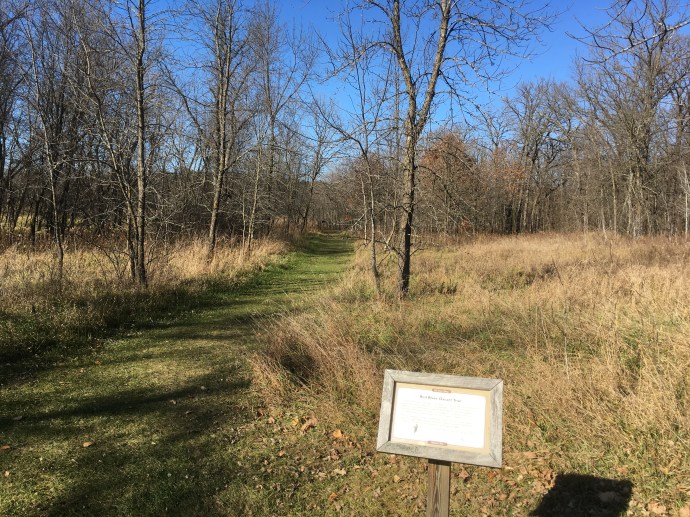
Hiking through the woods at Wild River State Park

Hiking through the woods at Wild River State Park

So, on to the parks, the reason for the trip. Tuesday we drove to Wild River State Park, only 60 miles from our house. Wild River is along the St. Croix River, one of the eight rivers originally protected under the Wild and Scenic Rivers Act of 1968. About 70% of the land was donated by Northern States Power Company. Pre-state park days, great swaths of northern Minnesota pine trees were the source of lumbering with great fortunes made. The St. Croix was a transportation route for shipping the cut logs downriver to sawmills. At a point in the park, a dam was constructed to control the logs and to help enhance a hydroelectric power plant downstream. NSP ended up owning the land and when the dam here was not needed to control logs or for the hydro plant, they were willing to donate the land to the state. Thus, the park is long and narrow, along the banks of the river.

Inside the park, alternating areas of tallgrass prairie, mixed hardwoods forest (that replaced the cut pines), and oak savannah plains intermingle. We hiked primarily along the river, overtaking and then being overtaken by a group of six people who seem to hike here regularly. We did not see boaters today but the river itself was flowing fast and we could hear it gurgle as it swept into and then around small rock islands. It appears that horse back riding has ended for the season so those trails were quiet and it is too soon for cross-country skiing and snow shoeing. Hikers seemed to have the park to themselves today.

From Wild River we headed west to Mille Lacs Lake. Mille Lacs is shallow, only about 40 foot maximum but it is the second largest lake in Minnesota. It is about 14 miles wide and about 19 miles long. It was formed when the glaciers retreated and at the point where the end moraine of one glacial lobe created a ridge blocking most water from flowing out. The park is named after Father Louis Hennepin, a French Franciscan Recollect priest-explorer. Father Hennepin came to Mille Lacs Lake after Native Americans captured him and two fellow explorers in 1679 hundreds of miles south along the Mississippi River and brought him to Mille Lacs Lake. Eventually he was released and returned to France. Mille Lacs was a gathering, hunting, and fishing location for Native Americans for hundreds of years. It is still home to many Native Americans. The casino here is on reservation land. The State of Minnesota and Indian tribes have a mutual agreement over fishing rights to Mille Lacs under treaties dating back to the 1800s, although Governor Dayton this summer unilaterally broke the mutually agreed upon 2016 limit for walleye which did not endear him to the Indian tribes.

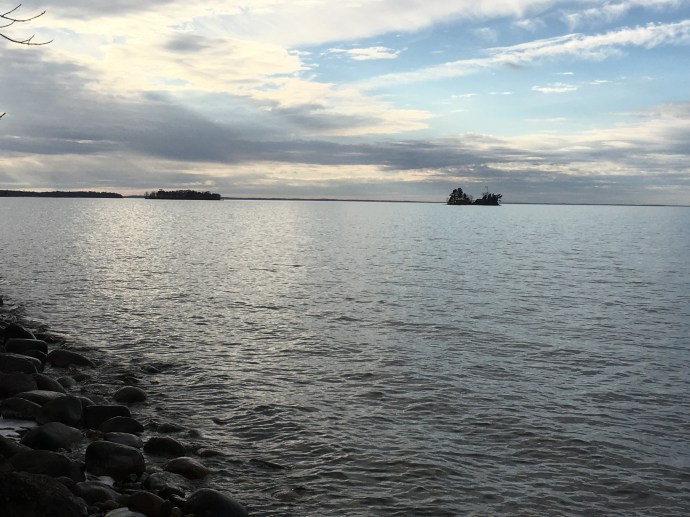
At Father Hennepin State Park, looking at the two islands comprising the national wildlife refuge

At Father Hennepin State Park, looking at the two islands comprising the national wildlife refuge

Father Hennepin Park is small, located on the south shore of Mille Lacs Lake, and is not even where he is thought to have been held but it still represents the early exploration period in Minnesota. On the lake are two small islands which are the smallest national wildlife refuges in the country. The two islands are the nesting and breeding grounds for the common tern. We walked along the shore, out to a headland jutting out into the lake. After Father Hennepin, we drove a short distance to Mille Lacs Kathio State Park, located along the southwest corner of Mille Lacs Lake. Mille Lacs Kathio is much larger, about 10,000 acres. The naming of the park takes after names from the Dakota Indians for the “Sacred Lake”. The Dakota lived here before the Ojibwe replaced them in this area in the 1800s. The word Kathio comes from poor translations by the French of Dakota words.

We have been to Mille Lacs Kathio before, both to cross-country ski and to geo-cache and to hike with Bernie and Tony. Our stay here was brief, daylight was drawing to a close. Grand Casino Mille Lacs is just a few miles away so we checked in and enjoyed the spa and buffet.

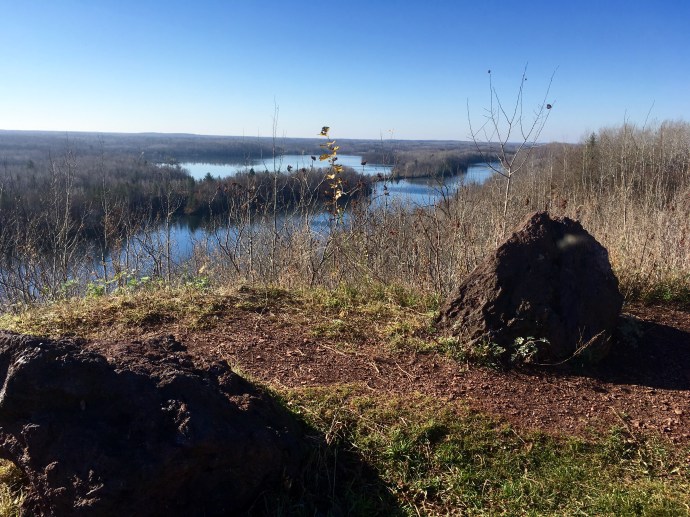
Looking down on Cuyuna Country Recreation Area from one overlook

Looking down on Cuyuna Country Recreation Area from one overlook

Thursday morning we drove an hour to visit a new type of state park. Cuyuna Country State Recreation Area is new, technically becoming a park in 1993. However, it took almost twenty years before it became a major recreational site. The 5,000+ acres were home to open-pit iron ore mining. The area was abandoned by mining companies over thirty years ago and the park specializes in mountain biking. Over 25 miles of trails will challenge the mountain bike rider with a new trail center to allow for competitions to be held here.

Cuyuna Country with mining waste hill to right

Cuyuna Country with mining waste hill to right

Cuyuna has 21 lakes, 15 of which are former iron ore mines. The water is clear now and scuba diving has found a home here along with fishing. Vegetation is now prevalent on the abandoned hills of mining waste; although the red rock roads and hills are stark reminders of the iron ore geology. Hiking is not a major focus here although one state trail goes through the park. After mistaking exploring back roads of private property next to the park, we viewed the park from the water level and then again from the top of two overlooks. There were just a few mountain bikers out; I guess most were in school. The trails certainly seemed challenging enough. They did not tempt us to try to rent a mountain bike, we will leave that for the more agile and adventurous.

"Main Street" of Old Crow Wing with Mississippi River just to the left

“Main Street” of Old Crow Wing with Mississippi River just to the left

Crow Wing State Park is thirty miles from Cuyuna and is much more your typical state park. Crow Wing was a gathering place at the confluence of the Crow Wing and Mississippi Rivers. The Dakota and Ojibwe gathered here in settlements. The Red River Oxcart Trail had one branch traveling through this area. This trail was the major trading route between St. Paul and Winnipeg. Fur traders and missionaries began a settlement here and the logging industry in Minnesota kept the town prosperous until the railroads laid their tracks through the neighboring community of Brainerd and Crow Wing as a town dried up.

Hiking along the old Red River Oxcart Trail

Hiking along the old Red River Oxcart Trail

At Crow Wing we were able to view the old town site, lined along the banks where the two rivers meet. A recreated boardwalk and building foundations give one a sense of life here 160 or so years ago. Canoeists on the river replaced the thousands of pine logs that would have floated down the river to sawmills downstream. A hike through the woods demonstrated the sandy soil of much of the area which keeps the trails dry. The hike presented a peaceful way to end the outdoor part of the day. The spa and buffet took care of the indoor portion.

Friday we headed east for 70 miles, back to the St. Croix River which forms much of the Minnesota-Wisconsin northern border. St. Croix State Park at 33,000 acres is our largest park. The St. Croix is joined here by the Kettle River, both active rivers duirng the lumbering period of the late 1800s. Most of the land was purchased when homesteaders tried, and failed, to make a living farming on the cut-over logging land. The Civilian Conservation Corps and Works Progress Administration constructed many of the park facilities still in use.

Hiking along the Kettle River at St. Croix State Park

Hiking along the Kettle River at St. Croix State Park

It took us 30 minutes of driving inside the park to reach our first destination; an overlook touting the “Head of the Rapids”. For once, it was more hype than reality. We retraced our steps partially and went for a nice hike along the Kettle River, spotting our second bald eagle of this trip. We checked out the camper cabins but they appeared to be less modern than my taste prefers. We also wasted time trying to get Chris’ State Park Passport book stamped. Normally there is a ranger at the main office or visitor center; when there is none, some form of outside stand will hold the stamps along with self registration and entrance fee paperwork. Neither option presented itself to us, despite returning to the office several times, stopping a carpenter who was working on a building, and driving through the staff only area in search of a ranger. We finally left and just wrote in the book: We Were Here-Really.

St. Croix is only 90 minutes from home so it was an easy drive back. Interstate 35 northbound was busy; Saturday was the first day of deer hunting season and the boys and their toys were gunning up the highway to be in place before the season started 30 minutes before dawn.

Ed and Chris

Categories: road trip, travel | Tags: , , , , , , , , , , , , | 1 Comment

2016, Trip One, Chicago, Day One

April 10, 2016 Chicago IL

The first trip of 2016 is a short one. We have been on hiatus for a while, enjoying one of Minnesota’s milder winters by staying home. We made one or two short, local MN trips during the winter along with numerous MN activities, and, we have replaced our 2001 Saturn (226,000 miles) with a new Subaru Legacy. However, the Legacy will have to wait a while for a road trip.

Ed and Amtrak observation car at Union Depot in St. Paul

Ed and Amtrak observation car at Union Depot in St. Paul

This first trip was planned for us to ride Amtrak as paying passengers, something we have not done for probably 15 years. As readers of this blog know, Ed is a volunteer with the Trails and Rails program jointly offered by the National Park Service and Amtrak. His journey only goes 2/3 of the way to Chicago and Chris does not participate. So, we put our money down and headed out early this morning.

The Empire Builder arrived in St. Paul an hour early (6:43 AM), a real departure from its 2015 on time (not) performance. We had arrived around 7 AM by bus and were able to board the train by 7:10 to get our seats. Seating is on your own, not assigned seats. We grabbed two coach seats, left our jackets at the seats and snagged a table in the observation car on the river side for most of the trip and with Chris seated looking forward (an important priority). The Empire Builder left Union Depot in St. Paul at its scheduled departure time of 8 AM for the 8 hour trip to Chicago. We had three main goals; a successful train ride, a journey to the new Pullman National Historic Site in Chicago, and a visit with my cousin Sue.

Red Wing MN and the Mississippi River

Red Wing MN and the Mississippi River-not including the eagles

Goal one has been accomplished. Both of us enjoyed the ride. The MN portion (obviously) is more scenic than the WI portion as it parallels the Mississippi River most of the way. Trees are just beginning to leaf out although Chicago is a bit ahead of us on that score. Birds were everywhere, boaters were out on the river. In Red Wing there must have been 20 eagles roosting in trees in a small area near the local Marina. (Well maybe a few were turkey vultures but most were Eagles.)

I did not give my Trails and Rails “spiel” to Chris but instead noted the topics I present in various areas along the route. Most of the topics she is familiar with, having heard me discuss them, or going to some of the same lectures I attended, or read the same books.

Ed and Chris in the observation car

Ed and Chris in the observation car

The observation car was our home for 2/3 of the ride, with its expansive windows which are great for viewing up and down. The coach seats are comfy with plenty of leg room. The train was not crowded today and empty seats were frequent. The observation car, unlike in the summer, was never full.

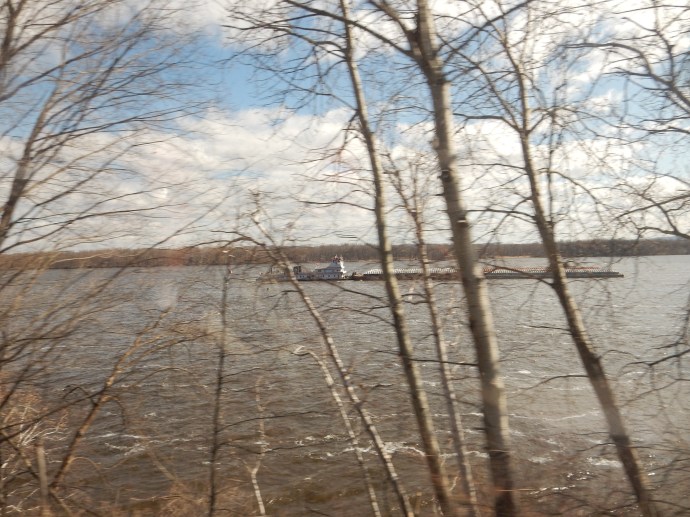
A tow along the Mississippi River

A tow along the Mississippi River

We spent more time observing than socializing. We did manage some conversation with a number of Canadians, from Saskatchewan and Winnipeg. Our lunch companions (you are seated to fill up tables and thus you automatically meet others) were from just north of Seattle. The two women are fans of National Parks. Their week-long journey will stop at numerous NPS units and will start off tomorrow at Pullman National Historic site. We may see them again. We swapped stories of parks we have seen and have yet to see. While the lunch menu is brief, our burgers were quite tasty.

Chicago River on our walk to the hotel

Chicago River on our walk to the hotel

Union Station in Chicago (the name is quite similar to Union Depot in St. Paul)is large with many Chicago commuter trains as well as Amtrak trains that head out all over the country. We decided to walk to our hotel, about 1.5 miles away. It was sunny and 48 degrees F-although Chicago is always windy with the numerous skyscrapers. We are staying at a Hampton Inn in the River North district.

Dinner was at Andy’s Jazz Club, with Dana Hall group playing.

Ed and Chris April 11, 9 pm
Chicago

Categories: road trip, travel | Tags: , , , | 4 Comments

2015, Trip Five, Voyageurs National Park and Northwest Minnesota, August 14-15

Bemidji, MN August 14, 2015

Well we are “Up North” in Minnesota, currently in the lakes and forest region around Bemidji. Later on we will be out on the prairies of the Red River of the North, finishing up by following the Rainy River (the boundary between Canada and the US) over to International Falls, home to Voyageurs National Park. Voyageurs was our original destination but we thought we would include the NW corner of MN which we had not visited previously.

Lakes and trees and rivers are much of the beauty of the area. Most tourists fish and swim in the summer, hunt and ski/snowmobile in the winter. We will do our usual of hiking/biking, touring historic sites, go on a few industrial plant tours, and get out on the water at Voyageurs.

Paul, Ed and Babe in Bemidji MN

Paul, Ed and Babe in Bemidji MN

Bemidji is 225 miles from St. Paul and we arrived here just after lunch time. We sacrificed lunch to go on a 90 minute bike ride at Lake Bemidji State Park and on the Paul Bunyan State Trail. Bemidji is “Home” to Paul Bunyan and Babe, the legendary lumberjack and ox. It is also a town of 13,000 people; the largest northern MN town between Grand Forks at the ND border and Duluth at the WI border.
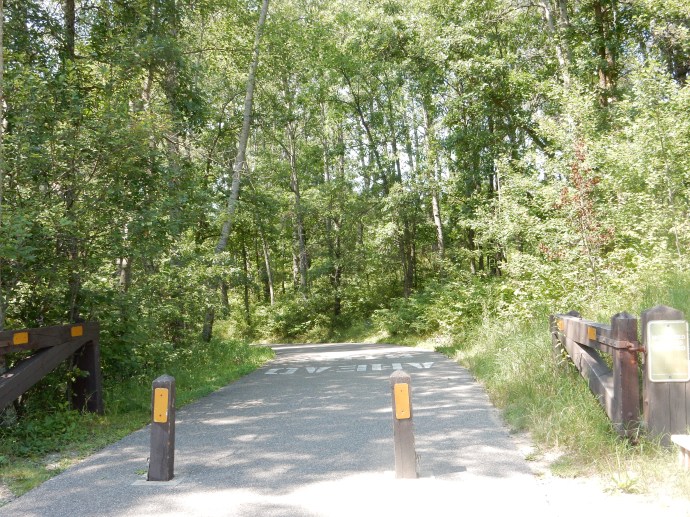
Part of the bike trail
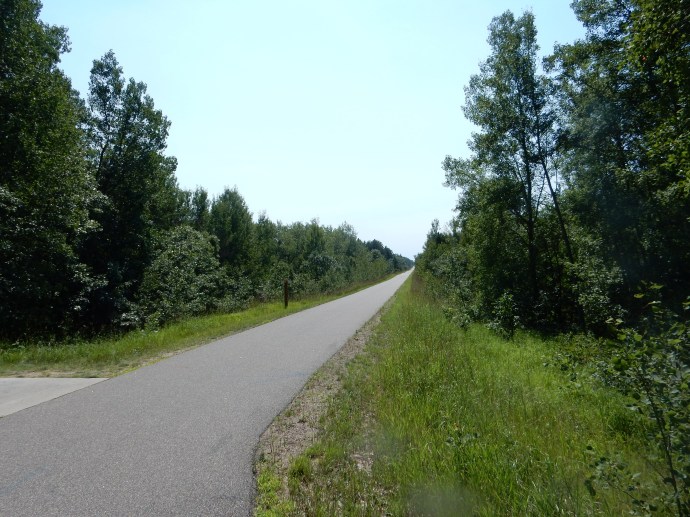
Part of the bike trail

The sunny Paul Bunyan Trail

The sunny Paul Bunyan Trail

Lake Bemidji State Park has bike rentals which even include a helmet that you can keep. We took them, even though we had brought our own along with us. The weather today was hot (90 degrees) and sunny. We justified only biking for 90 minutes due to the heat. Dinner was at Brigid’s Cross Irish pub in downtown Bemidji, great food (hunger may have impacted on that evaluation) with a group of four local musicians providing entertainment.

This part of MN was settled by European immigrants late in the 1800s, around 1890. Logging was the first driving force for settlers, followed by the railroad (James J Hill’s Great Northern). Bemidji grew, partially due to lobbying to make it the county seat, and partially due to friendships between town settlers and James J Hill. The settlers convinced Hill to change his original planned route which would have gone south of Lake Bemidji to one directly through their town site. Then flour magnate John Pillsbury had lumber lands back north of the lake and they had to construct a feeder railroad to bring his lumber down to his mills in Brainerd and in Minneapolis.

In any event, there was enough lumber to make several people rich. Between lumber and railroads, the early town prospered. Today lumber is still a major economic force, along with higher education and tourism. The lakes in this region are home to numerous resorts and fishing is a major sport.

Well before the Europeans, the Dakota lived in this area. In the 1750s, the Ojibwe drove the Dakota south and west, taking over this part of MN until the Europeans arrived. Once again, through broken treaties and land fraud, the Native Americans were removed to reservation lands-much of which was later stolen from them. Today three main reservations are in this area, although much of the land is still owned by whites. The Leech Lake Reservation, the Red Lake Reservation, and the White Earth Reservation.

The Mississippi River flowing out of Lake Bemidji

The Mississippi River flowing out of Lake Bemidji

The Mississippi River headwaters are only 30 miles away at Lake Itasca. When the river reaches Bemidji, it flows through the lake, entering on the west side and exiting on the east side. Bemidji actually means lake with crossing waters in Ojibwe. The river is not dramatic in scope here, resembling many other small rivers.

August 15

We were wilderness hikers today, out in what may be Minnesota’s last true wilderness area. You were probably thinking of the Boundary Waters Canoe Area or maybe Voyageurs National Park. If so, you would be wrong. Big Bog State Recreation Area. More than likely you have not even heard of it. It took us over an hour to reach it from Bemidji.

Big Bog State Recreation Area

Big Bog State Recreation Area

Big Bog is 50 miles long, 12 miles wide and almost completely uninhabited. It is the largest peat bog in the continental United States; i.e., excluding Alaska. You might think of it as the Everglades of the North. It contains enough water to cover the entire state of Minnesota to a depth of two feet (per the Park Ranger).

The Big Bog dates back to Glacial Lake Agassiz 10,000 or so years ago. As this area warmed up and the glacial waters receded, the glacial drift left in this area was relatively flat. The vegetation here is primarily peat and sphagnum moss as the base material. Black spruce and tamarack trees are here, usually in stunted form due to the acidic water.

Our walk was primarily on a special boardwalk. Walking on the vegetation kills it and regrowth is slow. The boardwalk is about 10 years old and was experimental at its time of installation. The posts are drilled down into solid footing, which varies from 3 to 14 feet. The grates are a plastic material, and the construction was undertaken by extending out new portions from the section just completed. No construction equipment drove on the bogs.

Site of a failed canal in Big Bog State Recreation Area

Site of a failed canal in Big Bog State Recreation Area

Technically a bog is a nutrient poor, slightly acidic wetland characterized by sphagnum moss. It has less plant species than fens. (I hope that clarified things in your mind.) Our walk started in an area with enough short trees to be shaded. It progressed to being able to see the hillock areas covered in moss and grasses with fewer trees, until at the end, the view was primarily of waving grasses growing out of the soft moss/peat on undulating ground. Water was sometimes visible, many times not. Evidently the moss is like a huge sponge, soaking up the water.

Big Bog State Recreation Area

Big Bog State Recreation Area

At the park headquarters, there is an aerial map that was very helpful. From the air, one can see islands of slightly higher elevation where trees tend to grow. The flow of water is quite visible primarily in the wavy lines of vegetation but also in the flow of certain water channels. In between are lighter colored areas of grassy vegetation.

This area is uninhabited for a reason. Man could not conquer nature. Those European settlers thought this would make great farm land. Ha! Efforts to drain the bogs failed. Even today one can see where the failed drainage channels were dug. The acidic soil meant that the trees here were not valuable to lumberjacks. Individuals lost their shirts in homesteading and in major commercial ventures. Abandoned land went back to the counties for unpaid taxes.

The counties sold bonds to construct the drainage canals and hoped to repay the bonds from land sold for farming. Part of the area seceded from one county and set up its own in order to avoid the debt. When the canals did not work, the county debt was taken over by the state in exchange for the land so the state was stuck with it. It was not until the 2000s that the area was made into a park, partly to offset lost tourism when Upper Red Lake walleye fishing went into a slump-from which it has since recovered. Thus, the area is not agriculturally viable, not forestry viable, and not viable for much of anything but attracting people like us.

There is supposed to be wildlife like moose in the area. We did not see any. This is a major birdwatching area, sandhill cranes, eagles,etc; we did not see those and were not blown away by what we did see. We did see insect-eating pitcher plants. BUT, lest you misunderstand, the trip was great fun and amazing. We had no concept this existed. Seeing miles of waving grasses, the up close view of the moss, seeing man’s effort to conquer nature defeated (much like the Okefenokee Swamp in GA). If interested, I did find two other newspaper articles about Big Bog you might find more interesting than mine. The Star Tribune of July 24, 2014 and the New York Times of June 13, 2008.

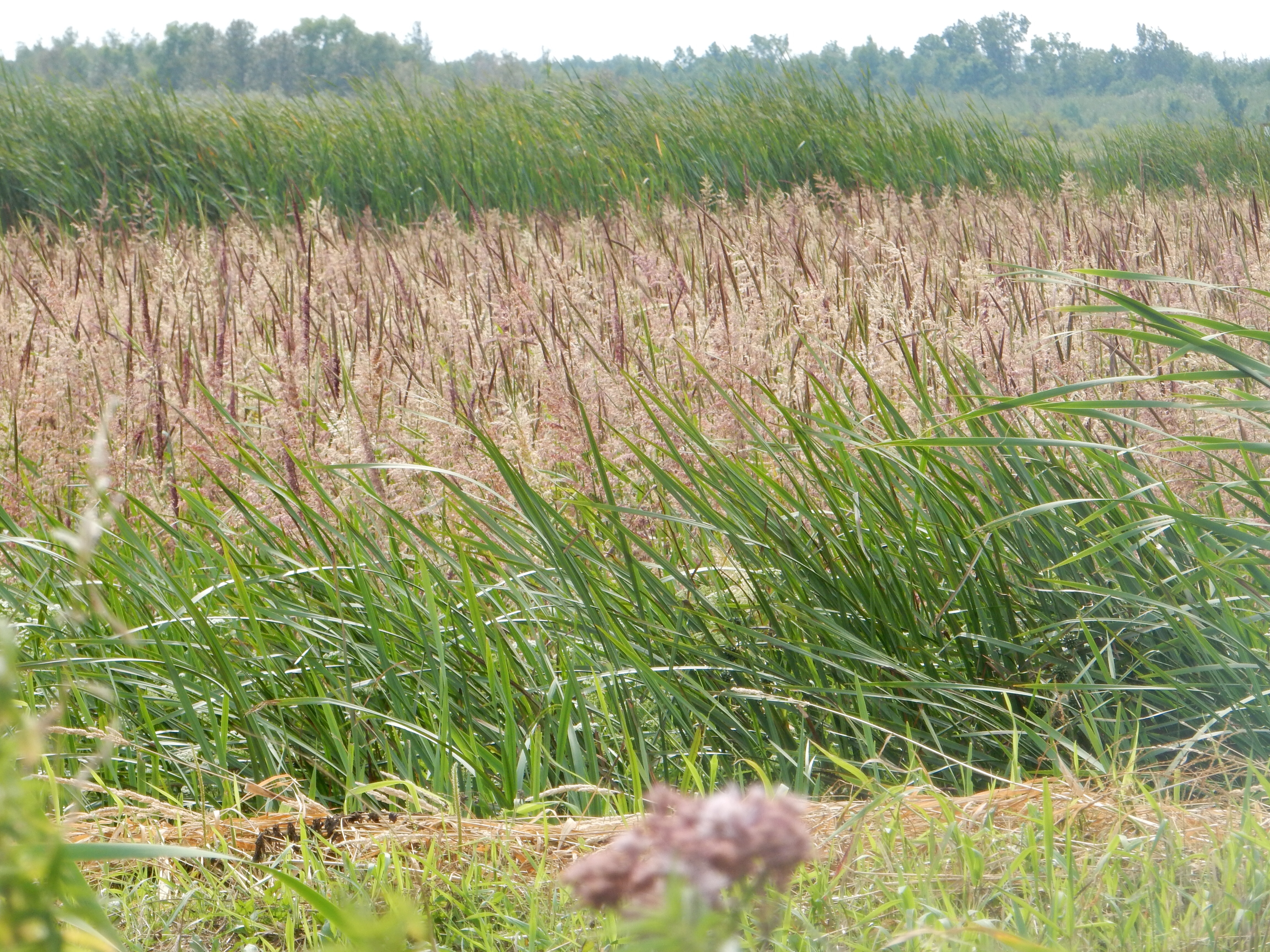
Wild RIce

Wild RIce

While in the area, we went out exploring on back roads and came across numerous fields of wild rice. This was our first time that we knew we were seeing wild rice growing. We stopped by the beach at Red Lake, the largest lake totally within the borders of MN and the 14th largest non-man made lake in the U.S. I climbed the fire tower at Big Bog (137 steps) for a view of the area.
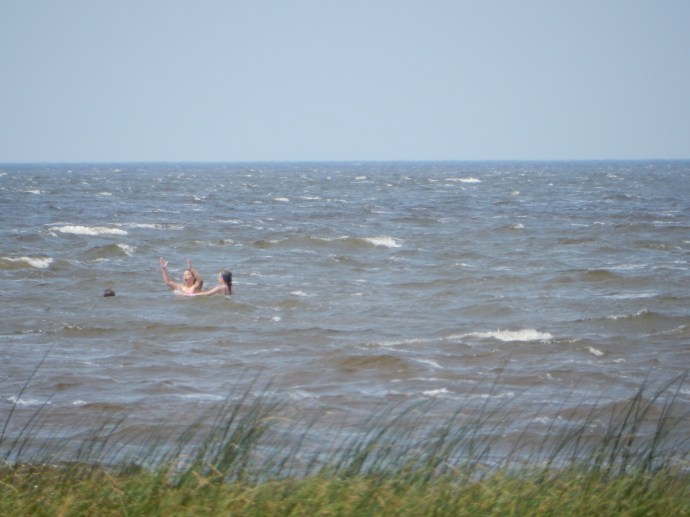
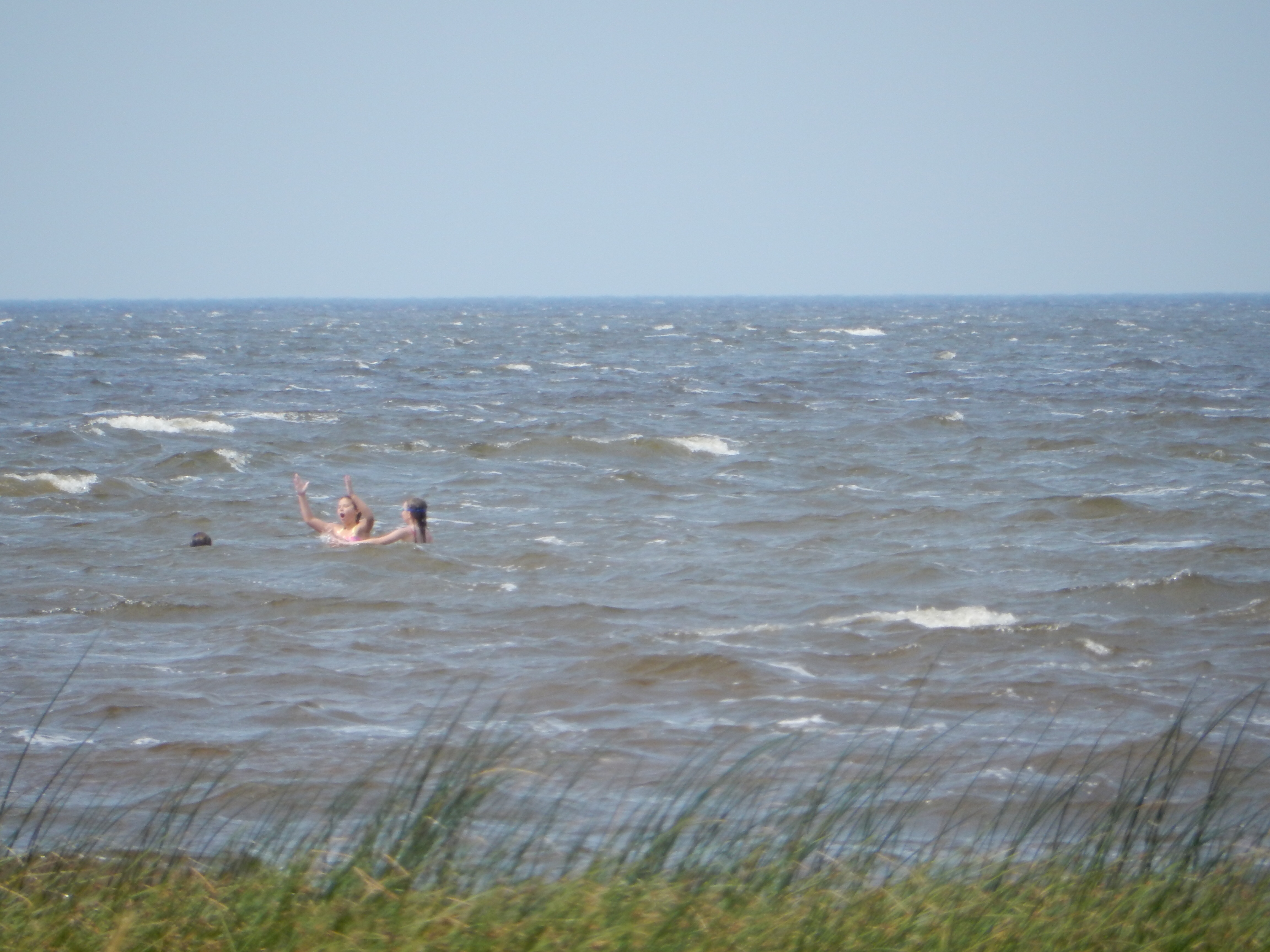
People swimming in Red Lake

People swimming in Red Lake

Now remember we are in a remote area; this bog area is practically uninhabited. So for lunch our options were limited. We ate at the West Wind “Resort”, the only game in town, so to speak, of the town of Waskish, the nearest town to Big Bog. The interior was standard northern MN; log paneling, trophies mounted on the walls, Twins banners, and the bait shop was just across the parking lot. But the burgers were great, the onion rings and wild rice soup quite good.

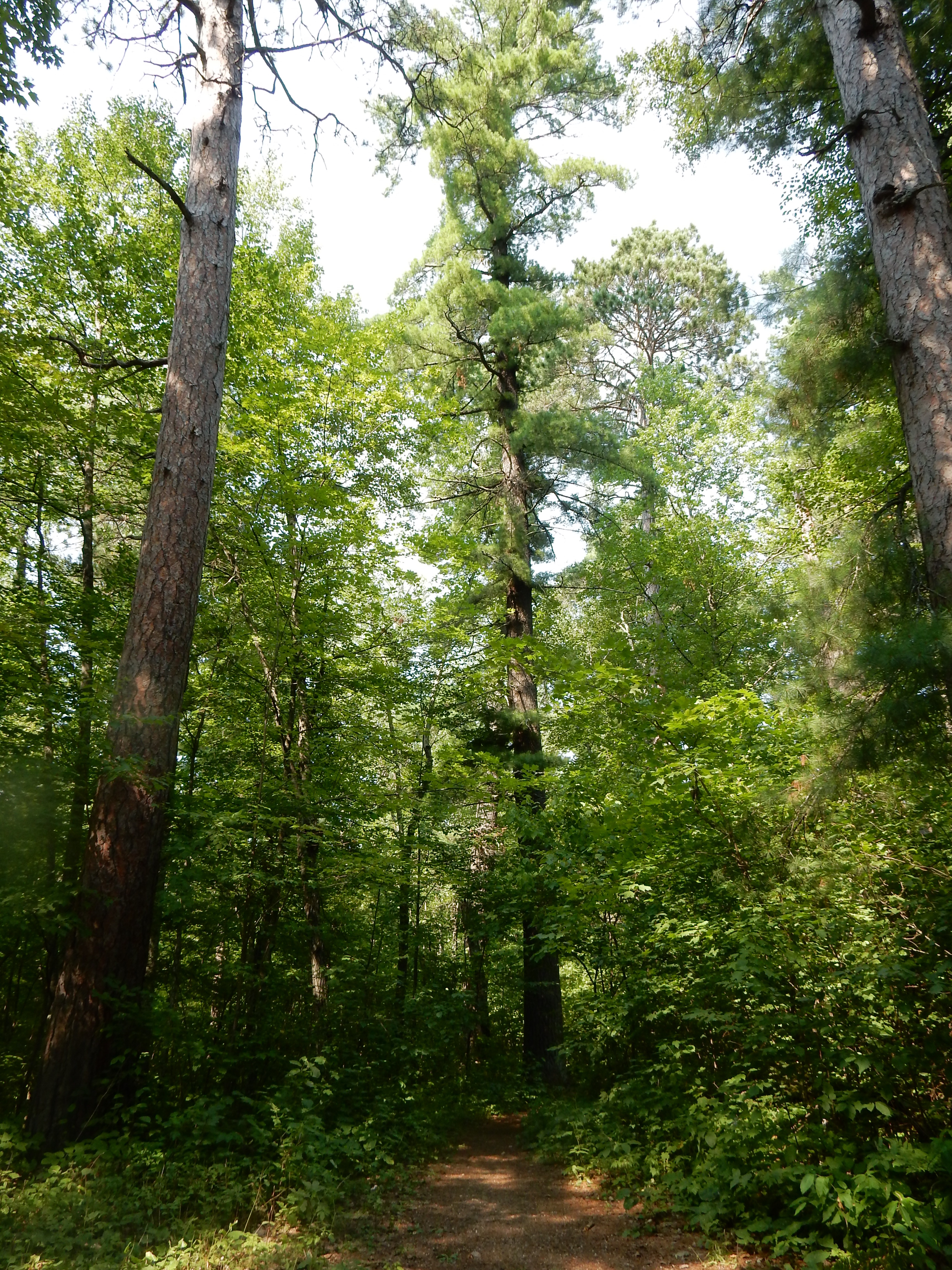
Part of the Lost 40

Part of the Lost 40

After lunch, we hit another remote area; a result of inaccurate surveying. The Lost 40 refers to an area where the lumbering whirlwind of the late 1800s missed some of the largest trees around. The surveyor for the area made a mistake and plotted this parcel of land as water and swamp, so no lumber company bought it. When all of the large red and white pines trees around were cut down, this area remained. Today it provides a rare glimpse into what old growth MN forests looked like over a hundred years ago. Not redwood or sequoia size, but impressive nonetheless.

After returning to the Doubletree here in Bemidji (very nice with a great breakfast) we showered and went to church. (A full house.) For dinner lets just say we did not make the best decision and leave it at that. The group at the next table complimented Chris on her dress (her Hawaii purchase) and then warned us that one of our next towns was a real “wasteland”. We will leave it nameless until we explore it in person.

Bemidji seems nice. I know, one makes these superficial judgments but that is all we have to go on. The town seems clean, there is sculpture on many corners in the business district, and Bemidji State University must be an economic engine to the area. There appear to be numerous cultural and social activities thriving. We made an early morning stop at the Bemidji Woolen Mills, a factory that still makes woolen products here in town and also sells other U.S. made clothing products on-line. Check ’em out. http://www.bemidjiwoolenmills.com

I do miss the longer days and earlier sun rises from June and early July. The Doubletree is on the water’s edge and sunrise and sunset views are wonderful. Families are out and about enjoying the water sports. Boats dot the lake. It all ends too soon each day.

Sunday we head out to East Grand Forks for three nights.

Ed and Chris
Saturday August 15

The Minneapolis Star Tribune featured Big Bog in this article: http://www.startribune.com/exploring-big-bog-state-park/268499352/
In addition, on December 11, 2015 the Outdoors section discussed the photographer and reporter that journeyed around the state ranked Big Bog as one of the special features of the state. http://www.startribune.com/state-of-wonders-lives-on-in-book/361435711/

Categories: road trip, travel | Tags: , , , , , , , , , | 3 Comments

Blog at WordPress.com.