Posts Tagged With: Minnesota travel blog

2015 Trip 3, Isle Royale, June 27

Little Marais, MN June 27

Tettegouche State Park was our primary destination today. A year ago they completed a brand new and expanded visitor center and rest stop on MN Highway 61. The large and attractive park name sign has yet to be installed; we normally take a picture of each park or location sign as a reminder of where pictures were taken. Today I took a picture of the glass door with the park name on it.

Baptism River at Tettagouche State Park in MN

Baptism River at Tettagouche State Park in MN

Tettegouche State Park is a combination of the previous Baptism River State Park (6000 acres of land) and an additional 3400 acres of land which had previously been the largest lumbering site on the North Shore and then a gentlemen’s club when the pine forests were all cut down. The name Tettegouche originated in the New Brunswick Canada origins of the owners of the lumber company. They replicated many of the French and Algonquin names of that area.
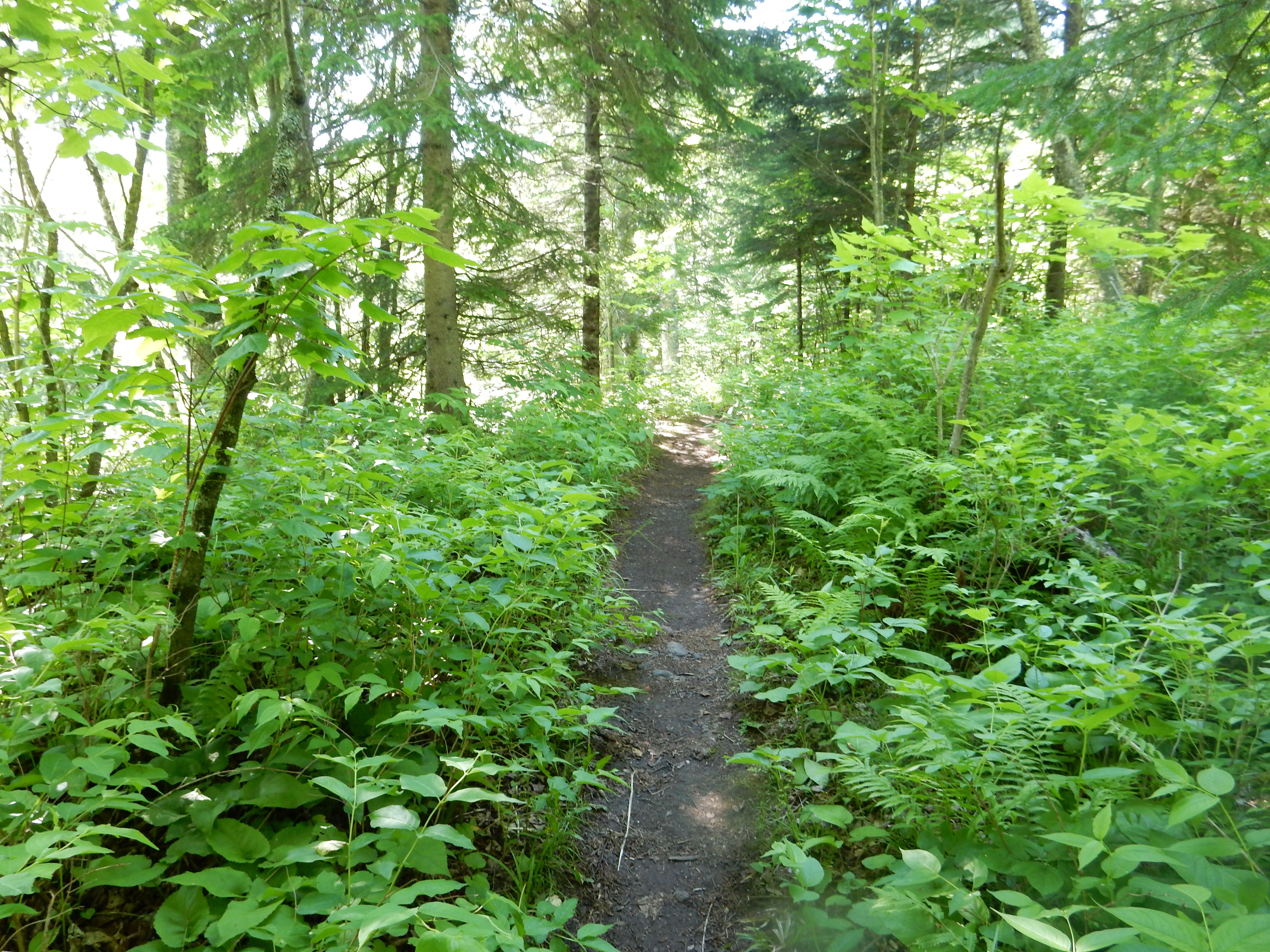
The hike along the cascades of the Baptism River
The hike along the cascades of the Baptism River

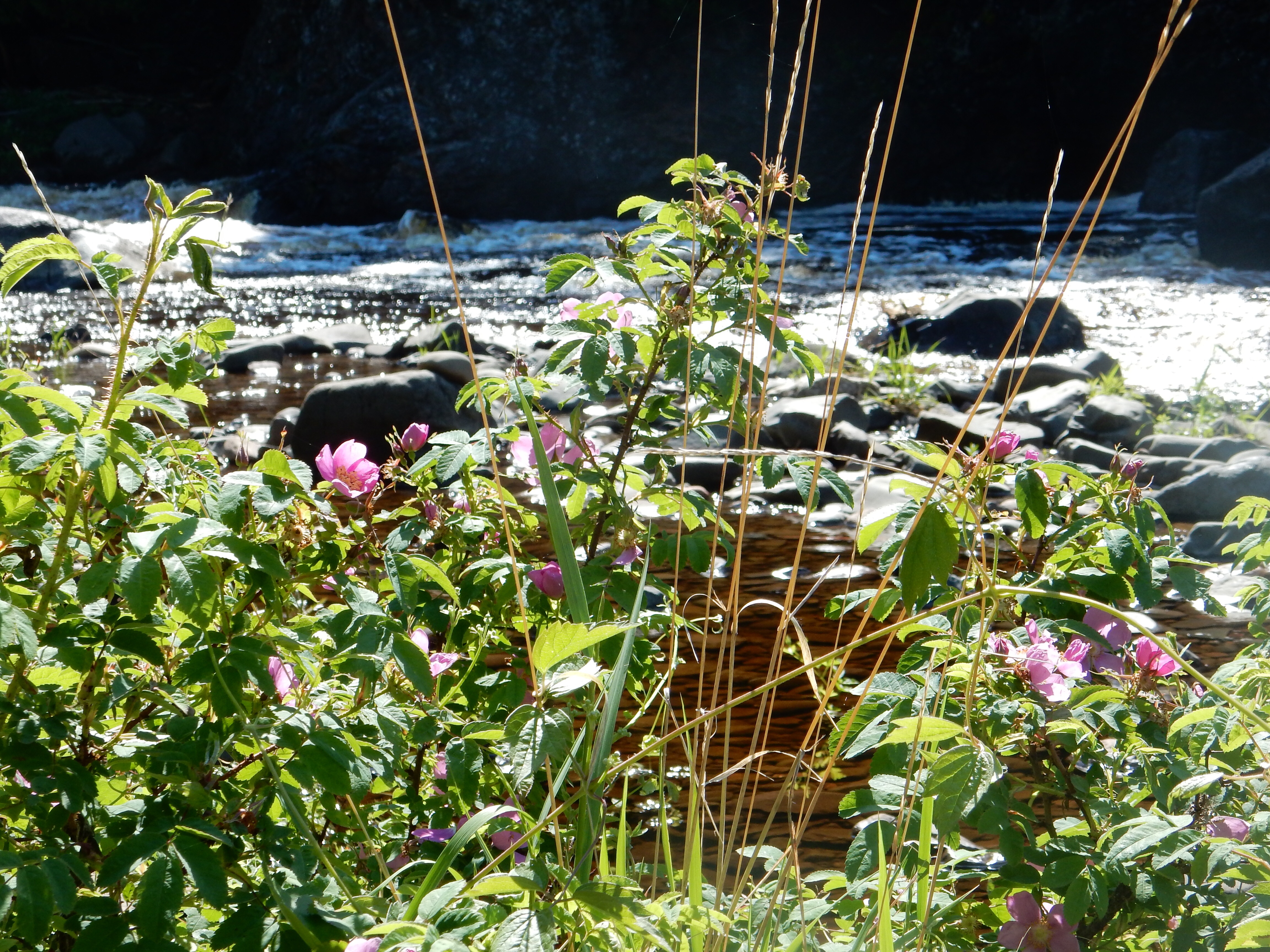
Along the Baptism River

Along the Baptism River

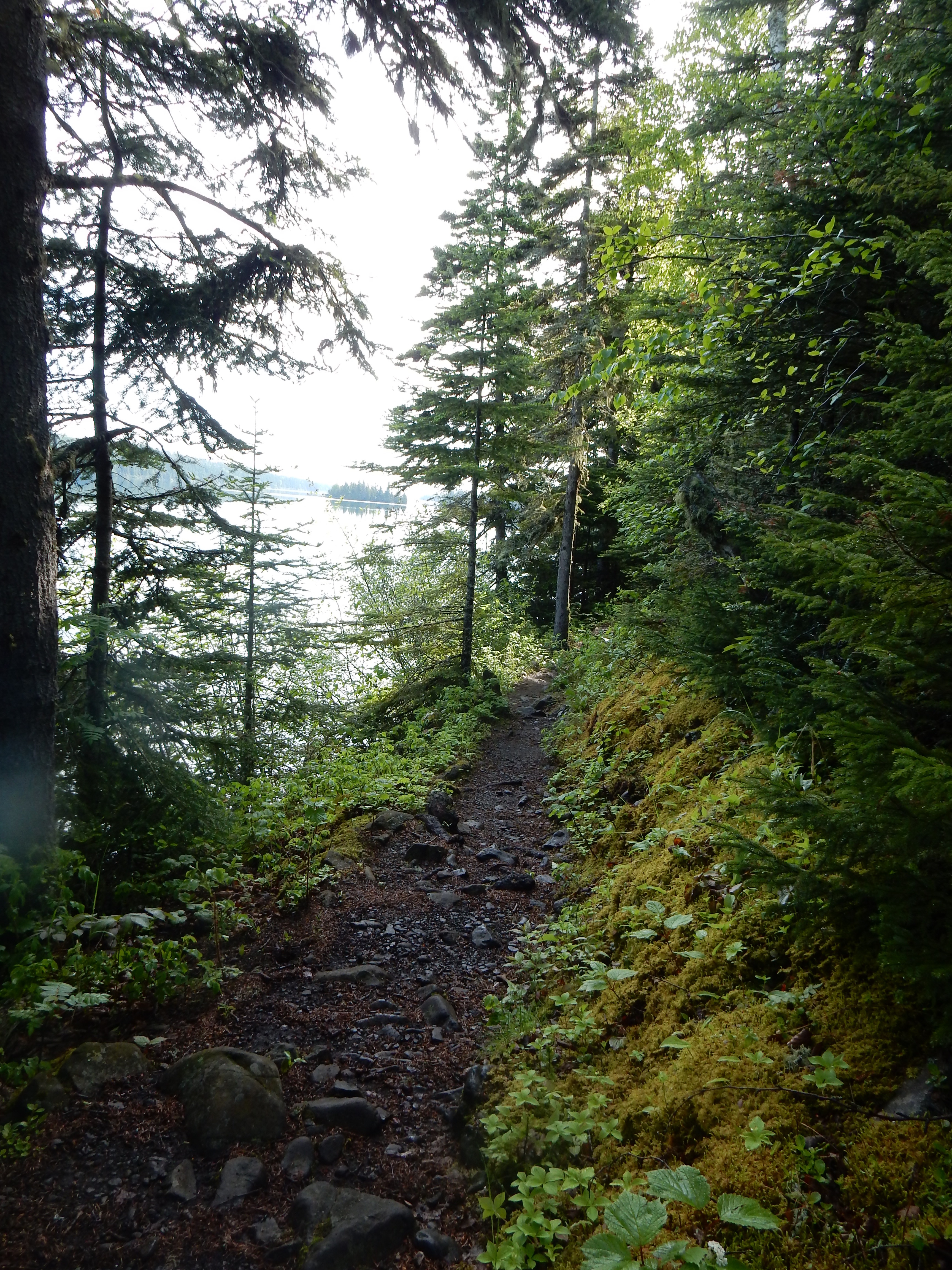
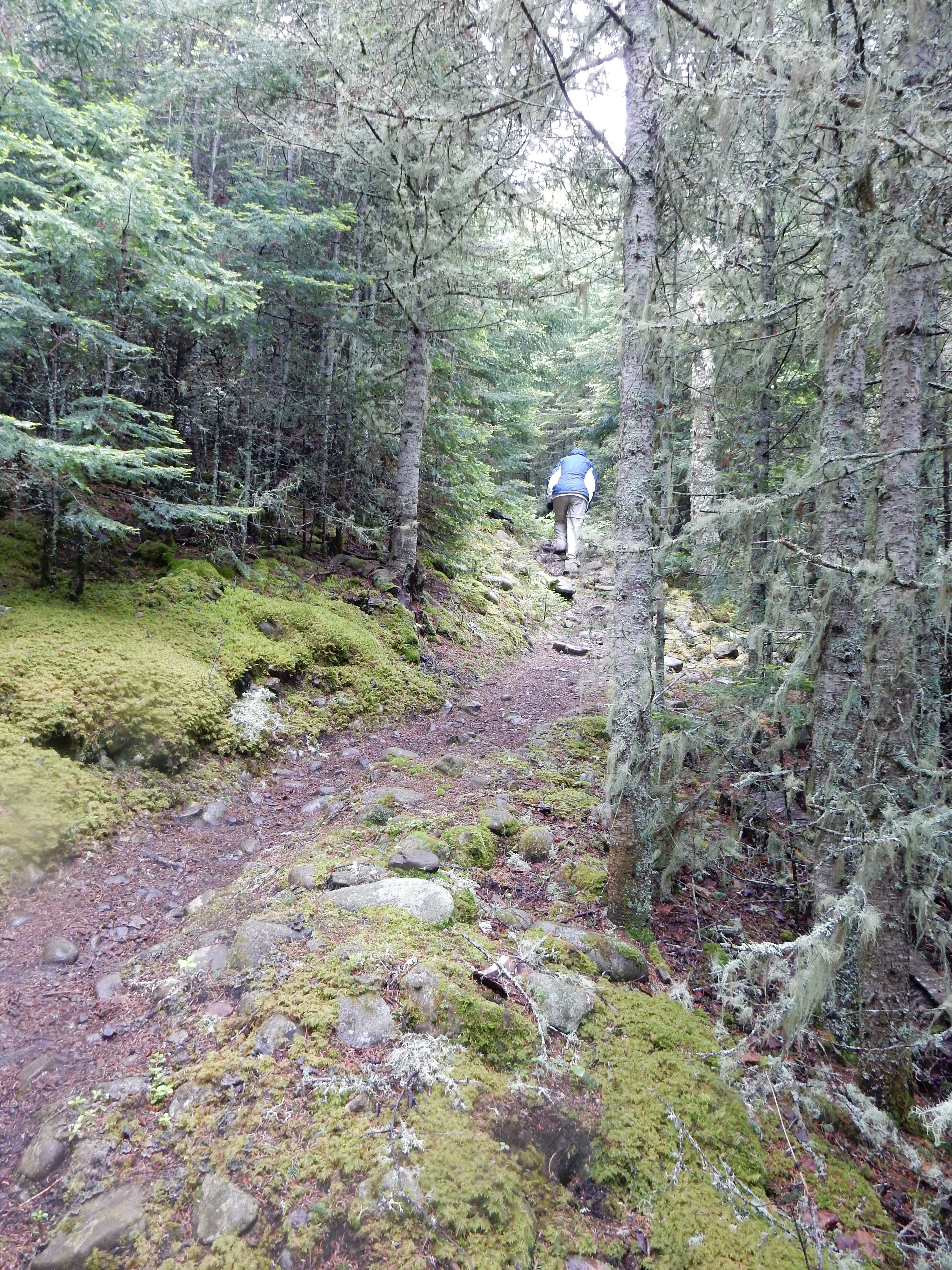
We hiked along the cascades trail. It was a glorious hike; birds were chirping, you could hear the sounds of the river just below, wildflowers continued to be blooming, and there was a slight breeze to complement the 70 degree temperature. Oh, I suppose the undergrowth along the trail could have been cut back a bit but that just added to the ambience.

one of many colorful spots along the trail

one of many colorful spots along the trail

We could have hiked more trails but we had decided to explore the area. In our travels up to the Finland Co-op Store, we had driven past the Finland Heritage Site. It was a cluster of buildings along the side of the road in the middle of nowhere. It seemed to be one of those little curiosities that we tend to check out, so we had decided to visit it after Tettegouche.

The Heritage Site is open Thursday through Sunday from 11-4 during the summer months. A couple of retired RVers from Minneapolis are the volunteer staff. The wife took us around the site. It was originally the homestead of a bachelor Finnish immigrant farmer who, when in his eighties, just disappeared one winter day, breakfast sitting on the table, and was never seen again.

Finnish bachelor farmer homestead

Finnish bachelor farmer homestead

When the property eventually reverted to the county due to non-payment of taxes, volunteers formed an organization to recognize the Finnish immigrant heritage of the area. The volunteers exhibited plenty of “Sisu”, a Finnish word meaning plenty of guts and determination under adversity.

The bachelor farmer’s house and property were the first buildings but they have added a one-room schoolhouse, a blacksmith shop, the state’s first forestry field building, a museum with informative displays, and a stage and food stands for the cultural events held there during the year. The town of Finland is still heavily Finnish, with several generations of families of the original immigrants still living here. The site is a pleasant means to spend a little time.
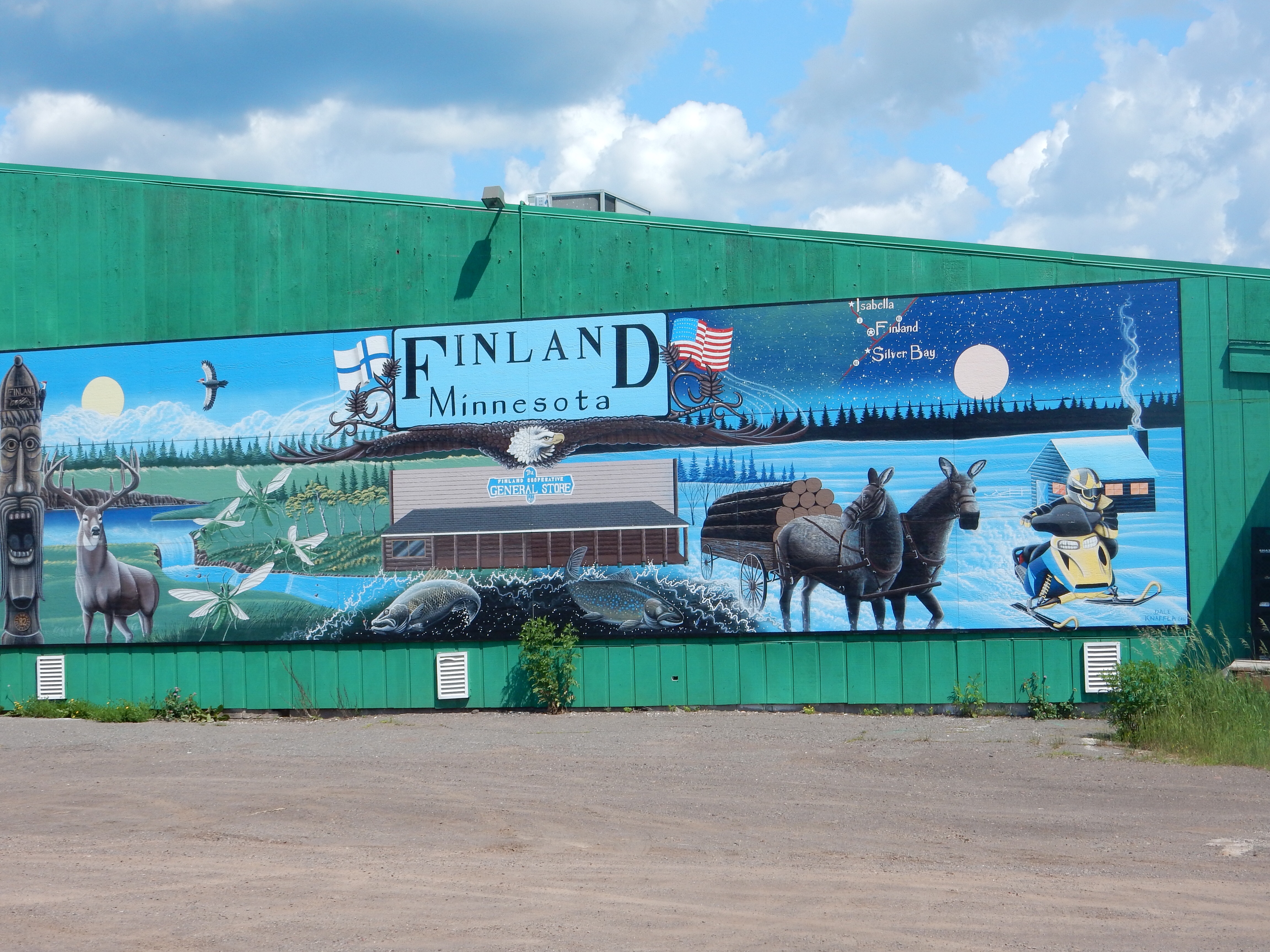
Wall mural on the Finland co-op

Wall mural on the Finland co-op

Lunch was at Our Place, a typical small town bar/restaurant with a northwoods ambience. Prices were a lot less expensive than the cities and we each had their pork bar-b-cue and potato salad for $6.50 each. A raspberry and a rhubarb shortcake for $2.50 each completed the meal. Everything was quite tasty.

We left and headed out to find George Crosby Manitou state park. This park is a wilderness park, meant for backpacking only. Their literature suggests day hikers use other parks. We thought we would at least check it out.

"St. Urho"

“St. Urho”

On our way to the park, we stopped and took a picture of the wood carving of St. Urho, patron saint of Finland. What, you never heard of St. Urho? Well, that is not unusual. St. Urho is actually a fiction, created by a Minnesotan in reaction to constant comments about St. Patrick of Ireland. Finland is over 80% Lutheran and does not recognize saints. But, they celebrate St. Urho around here just before St. Patrick’s Day.
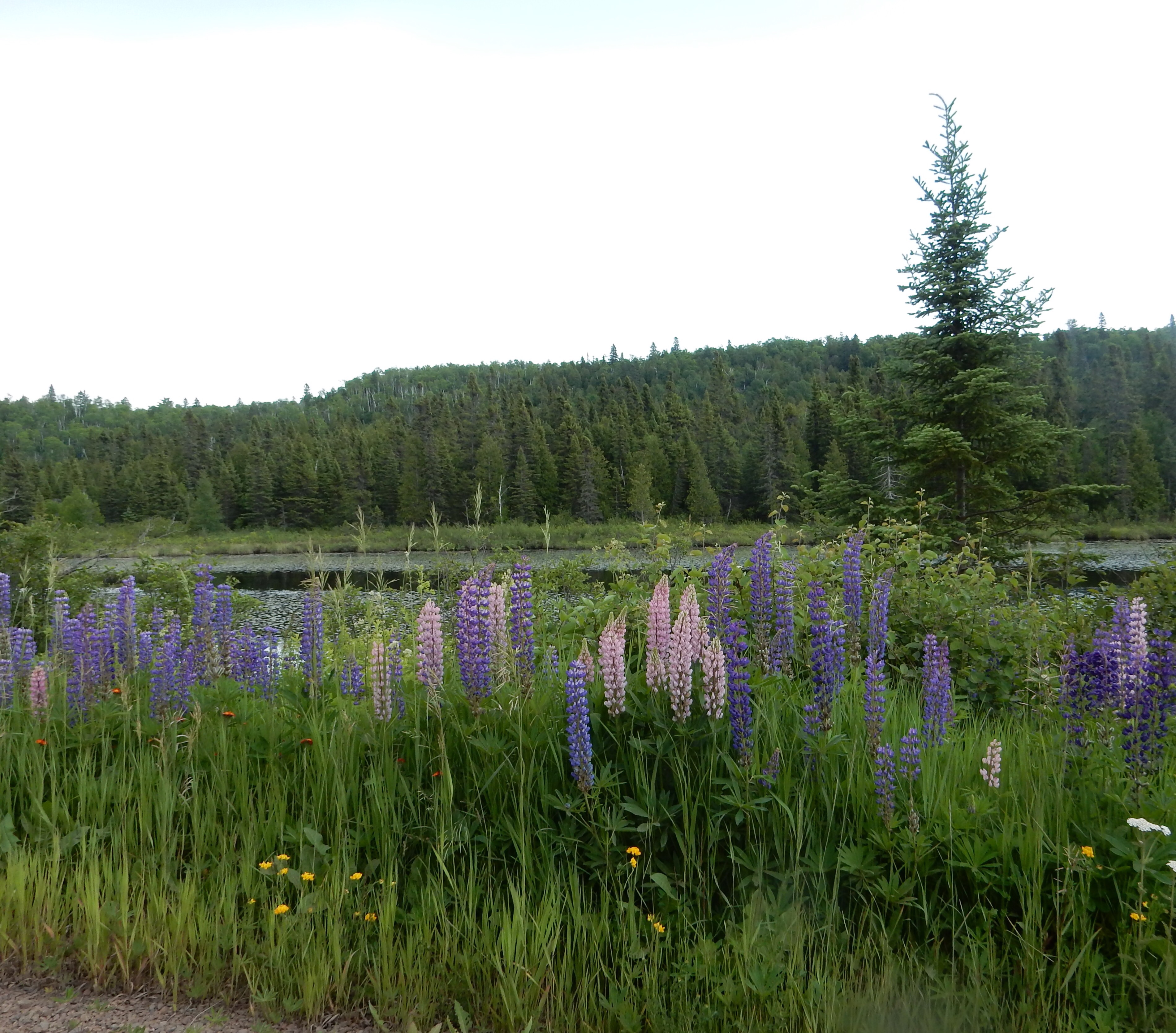
Lupine near George Crosby Manitou State Park

Lupine near George Crosby Manitou State Park

Along the roads in this area, we have just seen an explosion of lupine, particularly purple in color. We thought maybe there was a concerted effort to plant them as an identifying mark of the area. But, no, it seems the lupine tend to grow in clusters when their seeds are disbursed. A few people locally seem to be getting tired of them.

As we were driving to Manitou State Park, the skies darkened and there was lightning off in the distance. The asphalt road ended and became gravel. Then the rains came. We reached the park and agreed we had no need to go hiking in the wilderness under these conditions. The Superior Hiking Trail runs through this park and we had talked to several hikers just minutes before the rains who still had 4-6 miles left to hike today.

Gravel roads were our companion for most of the ride back to Lakeside Cottages in Little Marais. A nap was our reward for our activities.

Before church, we had dinner again at the Northwoods Family Grille in Silver Bay. Good food; not artisanal, not organic, not small plates, not locally sourced, just good food in the old style. The bowl of chili was large enough to feed a family. Reminded me of my parents’ restaurant back in the 1960s.

We spent our last night at the “Nest”, our small cabin at Lakeside Cabins and Estates. The unit is comfy, plenty of hot water; they ingeniously arranged the space so there is room for a TV, small refrigerator, table, chair, kitchen dishes, etc.

Ed and Chris June 28
Categories: road trip, travel | Tags: , , , , , , , , | Leave a comment

2015 Trip 3, Isle Royale, June 25

2015 Trip 3, Isle Royale, June 25

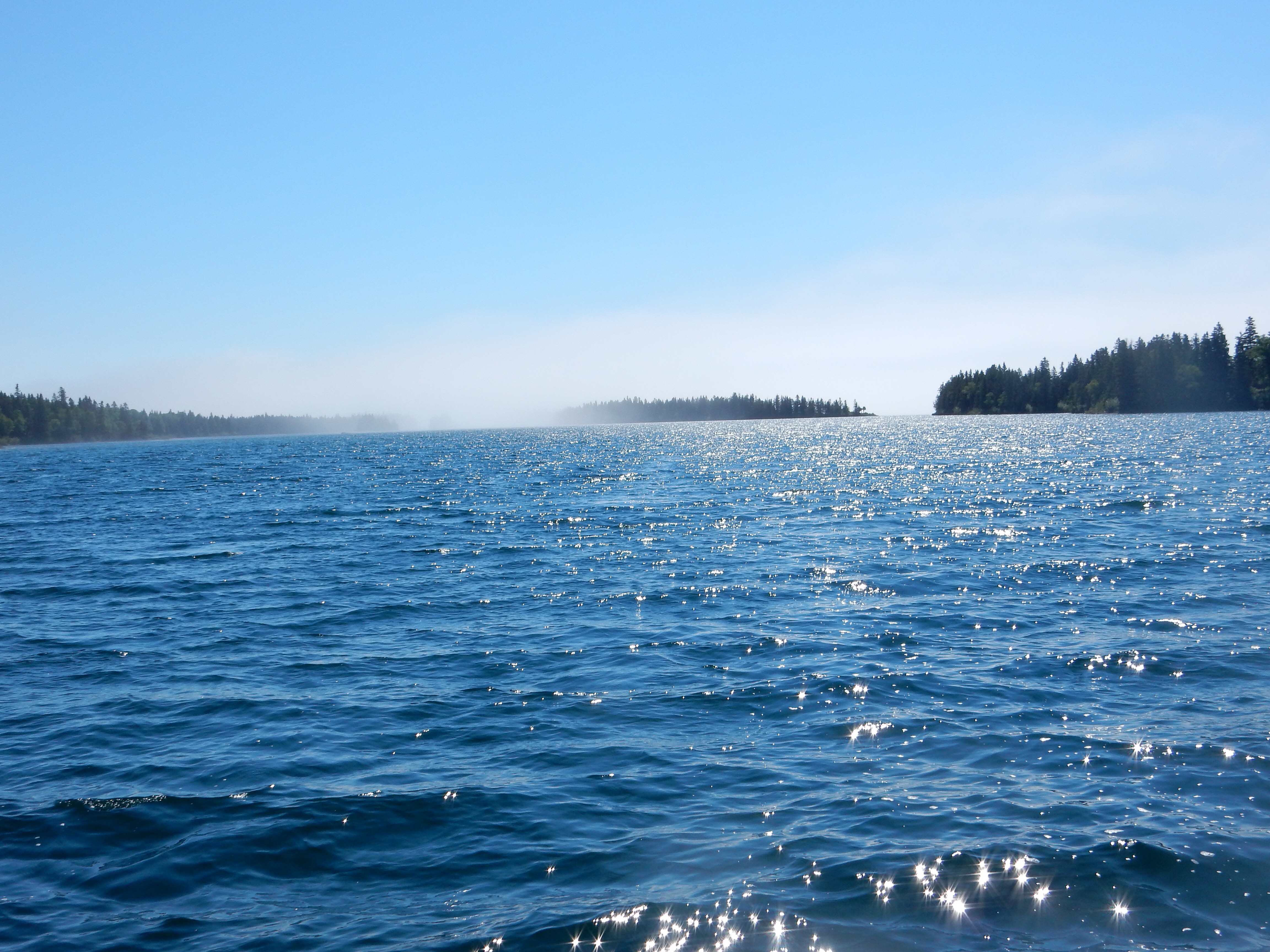
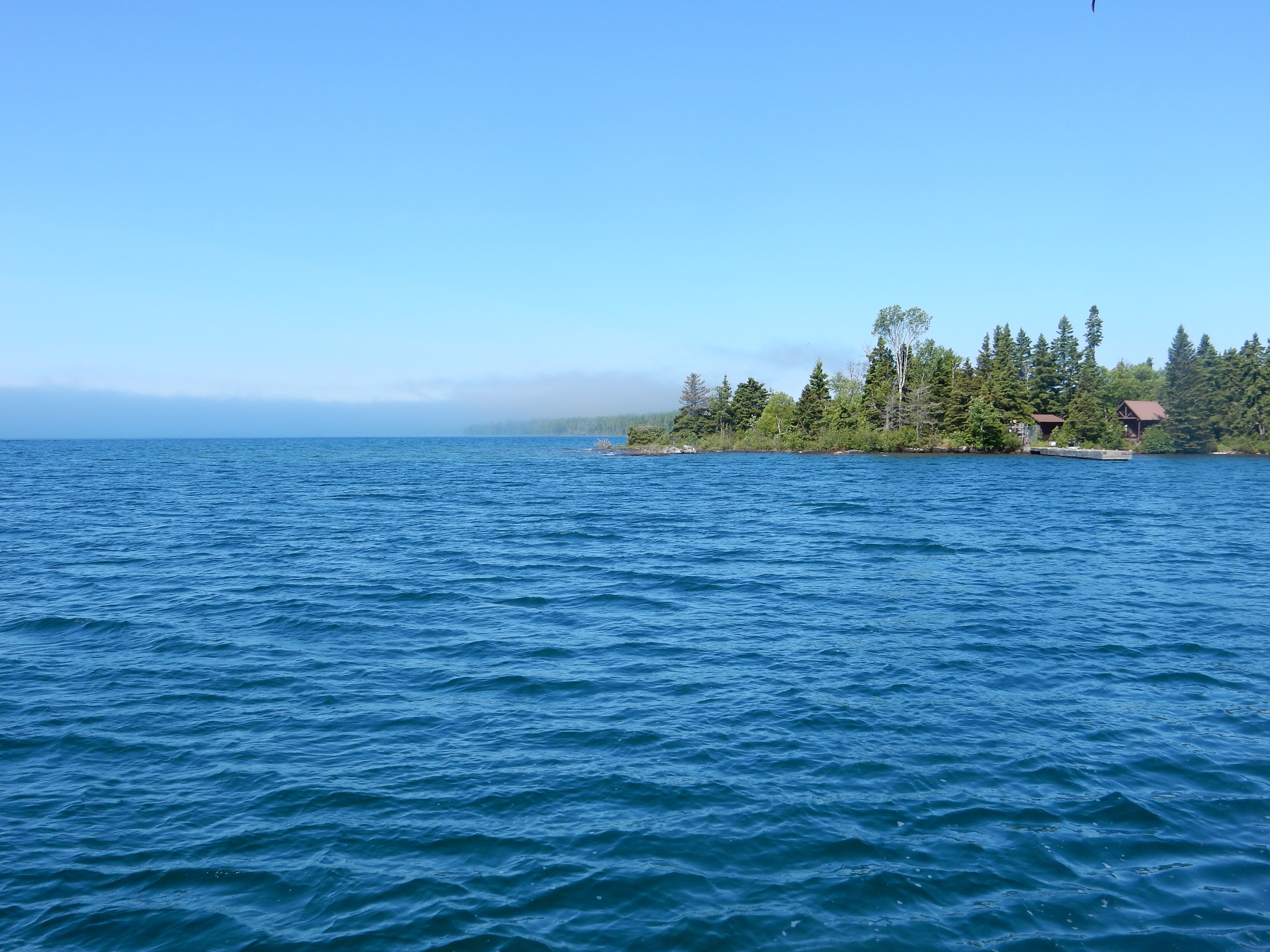
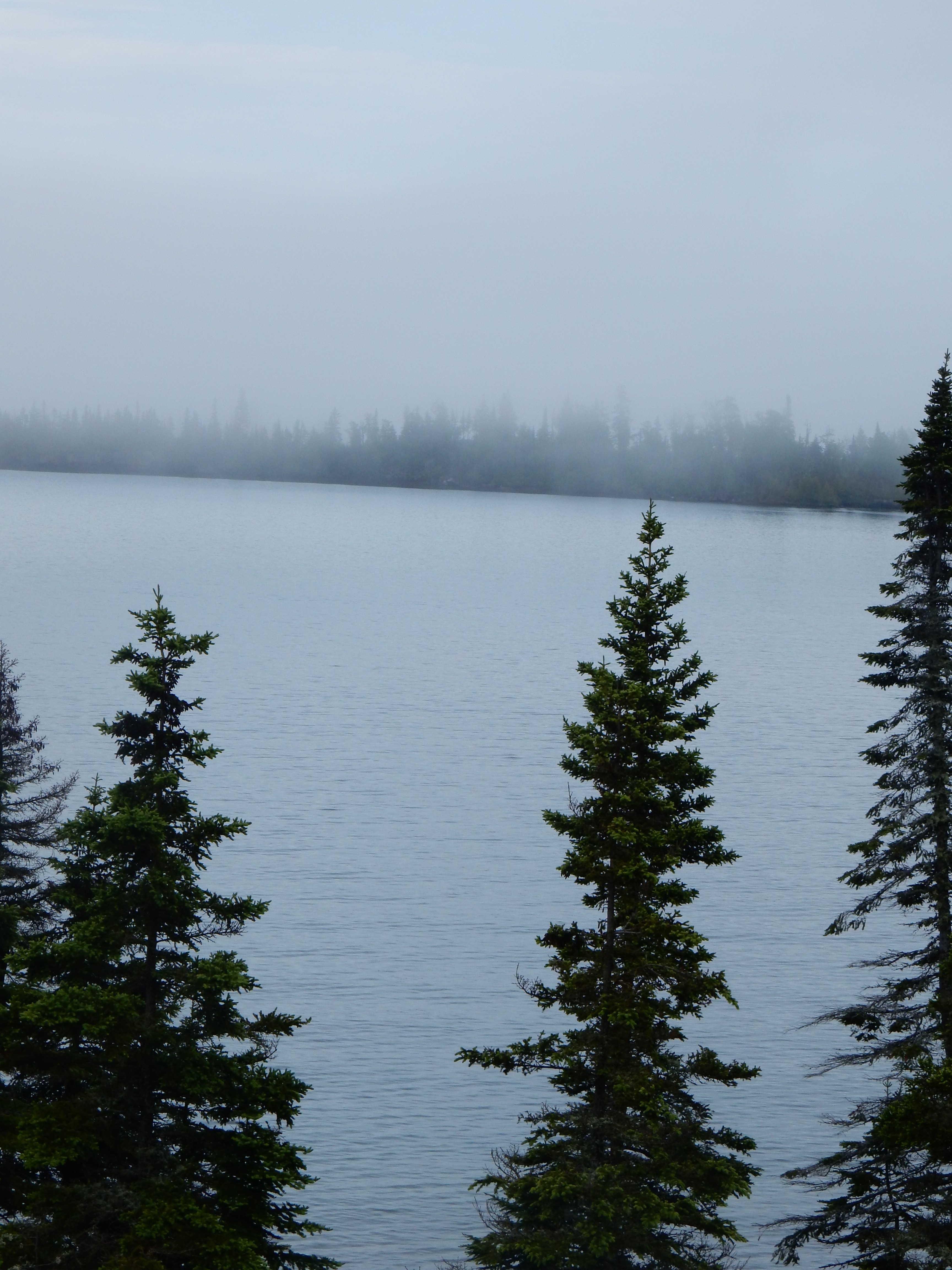
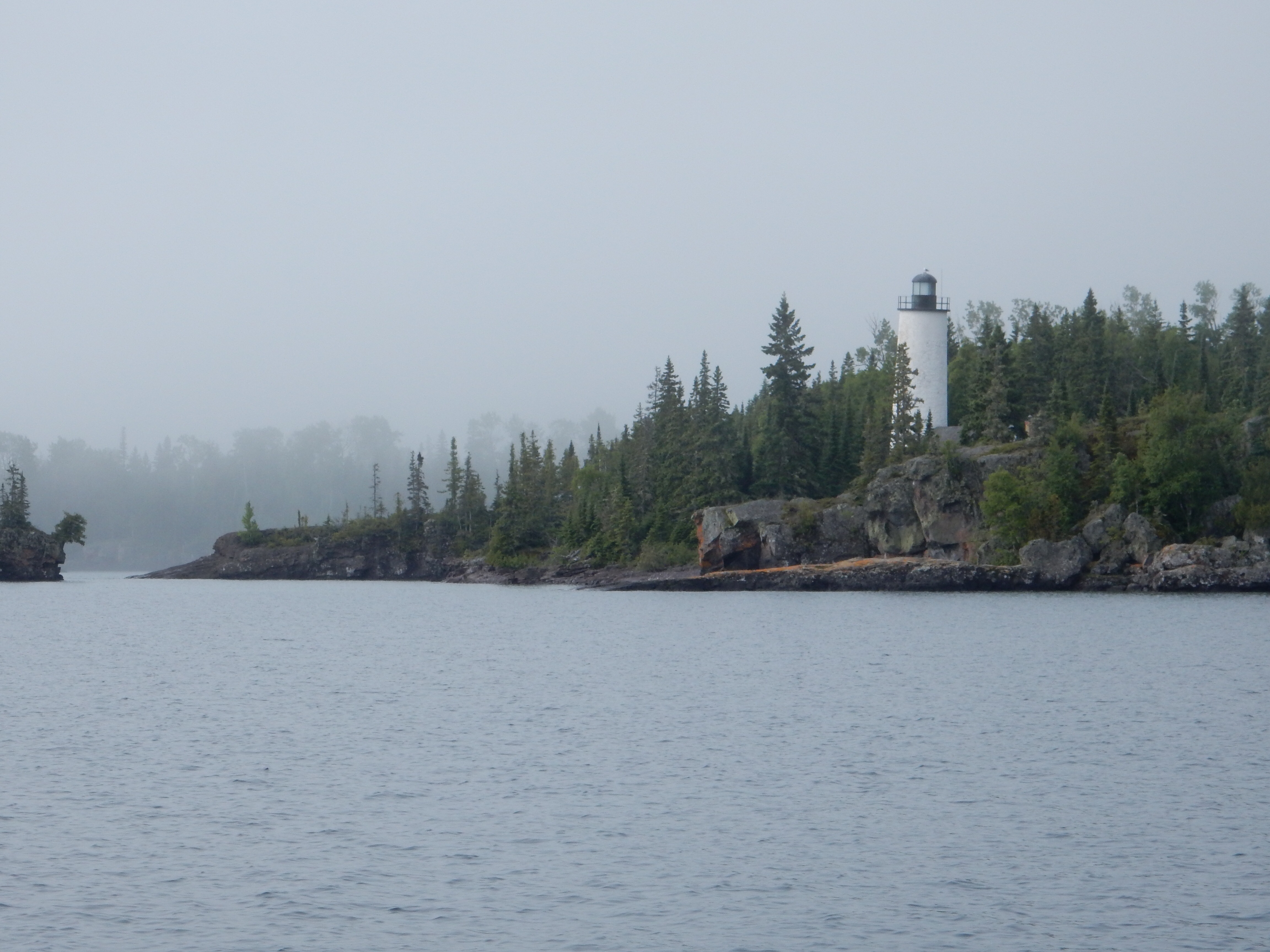
Fog in June on Lake Superior seems to be a constant. It comes, it goes, it re-forms and moves around. The cold water evidently interacts with the warmer air temperatures and, voila, fog. We have watched it from our cabin, from various hikes, from the shores of Rock Harbor, and from the deck of Voyageur II.

Rock Harbor Lighthouse in Lake Superior by Isle Royale

Rock Harbor Lighthouse in Lake Superior by Isle Royale

Fog banks moving around the islands

Fog banks moving around the islands

Today was no exception. All night long the fog was heavy outside our cabin. The Voyageur II left at 9 AM EDT and the harbor was socked in. As we traveled around the island, picking up stray backpackers from small, isolated docks, the fog eventually dissipated; the views of the rocks and forests of Isle Royale are much more spectacular with blue skies and bluer water. Then, as we arrive in Grand Marais this evening, the fog is present again as a light mist covering the ground.

Malone Bay- a pick up point for backpackers

Malone Bay- a pick up point for backpackers

Several of the people returning with us are like old friends; the couple from Minocqua, the Montana couple that ran in Grandma’s Marathon, the Iowa party getting on at Malone Bay after backpacking. We joke about the boat ride and hope today’s return trip will be smoother. It is. But the length of the journey has only increased. The pick up of backpackers from remote locations requires slower speeds in narrow channels and extra time to go in and out of pick-up points. All in all, we enjoy the smoother trip and better scenery. We congratulate ourselves for tackling another adventure.

Captain Ben spends some time with us chatting. We discover the boat was built in 1972, originally planned for commercial fishing. The back section, the noisier one that we have avoided, was to hold fish. The original owner died and the ferry people bought it and converted it. Both Ben and Kirk have been doing this for four years and sleep on board. We have smelled their lunches on each trip as Kirk makes something in the galley for them. Evidently, sometimes they use a Crockpot and the smell drives the travelers nuts.

On our way out of Windigo, going through Washington Harbor, Voyageur II stops at the site of the wreck of the steamship America which went down in 1928. The America was the mail, freight, and passenger delivery service to Isle Royale and much of the North Shore. In 1928, the 2nd in charge ran the boat aground, all passengers got off safely. The new Highway 61 in Minnesota was making the ship less profitable and the ship was left in the water to break up further rather than salvage it. We were able to see portions of the wreckage still under the water.

More than 25 ships have sunk around Isle Royale over the years. There are still four lighthouses around the island. We saw all of them and heard lots of foghorns. Isle Royale National Park does extend out into Lake Superior so park rangers have to patrol the waterways also.

You probably know that Lake Superior is the largest freshwater lake in the world by surface area and the third largest in the world by volume. We also wrote about Lake Superior in two previous trips: 2013 Trip 7, Sept. 7-12 (the Upper Peninsula of Michigan) and 2014 Trip 6,Sept. 8-11 (Ontario from Thunder Bay to Sault Ste Marie).

Skies darkening as we approach Grand Portage

Skies darkening as we approach Grand Portage

We arrive at Grand Portage and are able to leave (after getting our luggage and paying the parking fee) around 3:45 PM CDT. The skies in front of us are getting ominously dark. Our plan is to drive the short distance to the High Falls of the Pigeon River at Grand Portage State Park. Doing this hike now will save us 1.5 hours tomorrow of driving time by having to back track from Grand Marais.

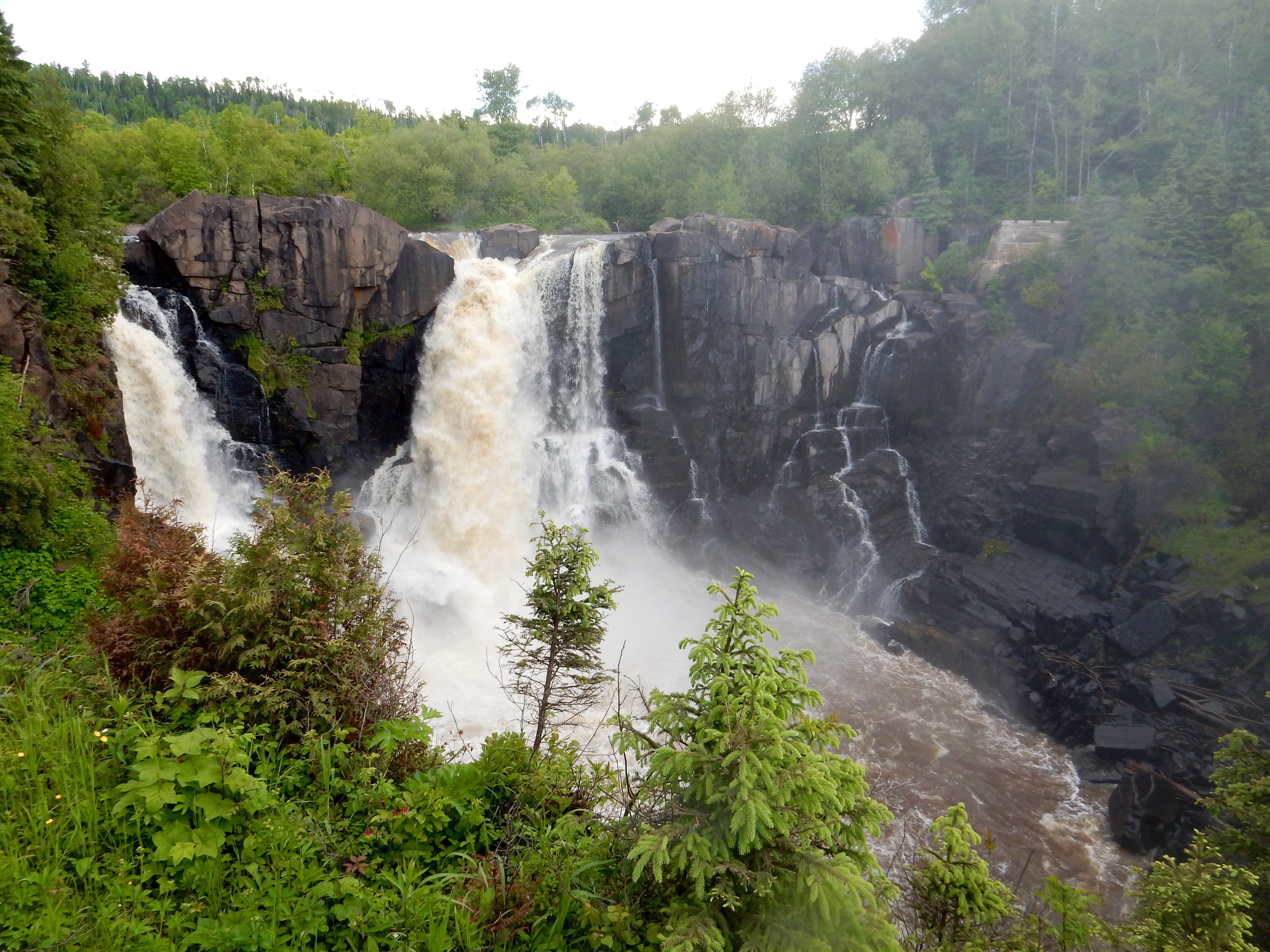
The High Falls are notable for several reasons. First, they are the tallest falls in Minnesota at 120 feet and with recent rains, should be impressive. Second, the falls and Pigeon River are on the boundary of the U.S. and Canada. One can view the falls from either country.

High Falls on the Pigeon RIver at Grand Portage State Park

High Falls on the Pigeon RIver at Grand Portage State Park

Third, the falls created an impediment for Indians and fur traders who traveled by canoe during the days of the fur trade. This required a nine mile portage around the falls. This “Grand Portage” lead to the creation of a trading post for decades; now it is memorialized in the Grand Portage National Monument. We have been here before and will not go into its history and significance in this post.

Fourth, the park land is owned by the Grand Portage Band of Chippewa and is leased by them to the state for use as a state park.

We reach the visitor center and hike at double-time speed to reach the falls before any rains come-and before the park closes. Success is ours; the falls are running fast and we manage to avoid rain.

Lodging is in Grand Marais MN, an upscale town along the North Shore. We are at the Best Western with great Lake Superior views. But first we have dinner at The Pie Place Cafe in downtown Grand Marais. The meatloaf dinner and the Black Bear Blueberry Salad are fantastic; almost as great as the Blueberry/Sour Cherry pie and the Raspberry/Rhubarb pie.

Ed and Chris June 26

Categories: road trip, travel | Tags: , , , , , , , , | Leave a comment

2015 Trip 3, Isle Royale, June 24

2015 Trip 3, Isle Royale National Park, June 24

With the drapes wide open, the early morning slowly greets us and the sky gets lighter and lighter. At 4:45, Chris decides to fight the mosquitoes and goes down to the dock and takes pictures of the early morning sunrise. I let her do it.

Sunrise on Tobin Harbor

Sunrise on Tobin Harbor, Isle Royale National Park

Early morning fog that comes and goes

Early morning fog that comes and goes

Isle Royale is about 50 miles long. Don’t expect us to hike the entire island. Rock Harbor Lodge is on a spit of land and I am guessing most of the moose population here is scattered around the island where the backpackers are more likely to observe them. Score one for the backpackers.

The trail to Suzy's Cave

The trail to Suzy’s Cave, Isle Royale National Park

The trail to Suzy's Cave

The trail to Suzy’s Cave

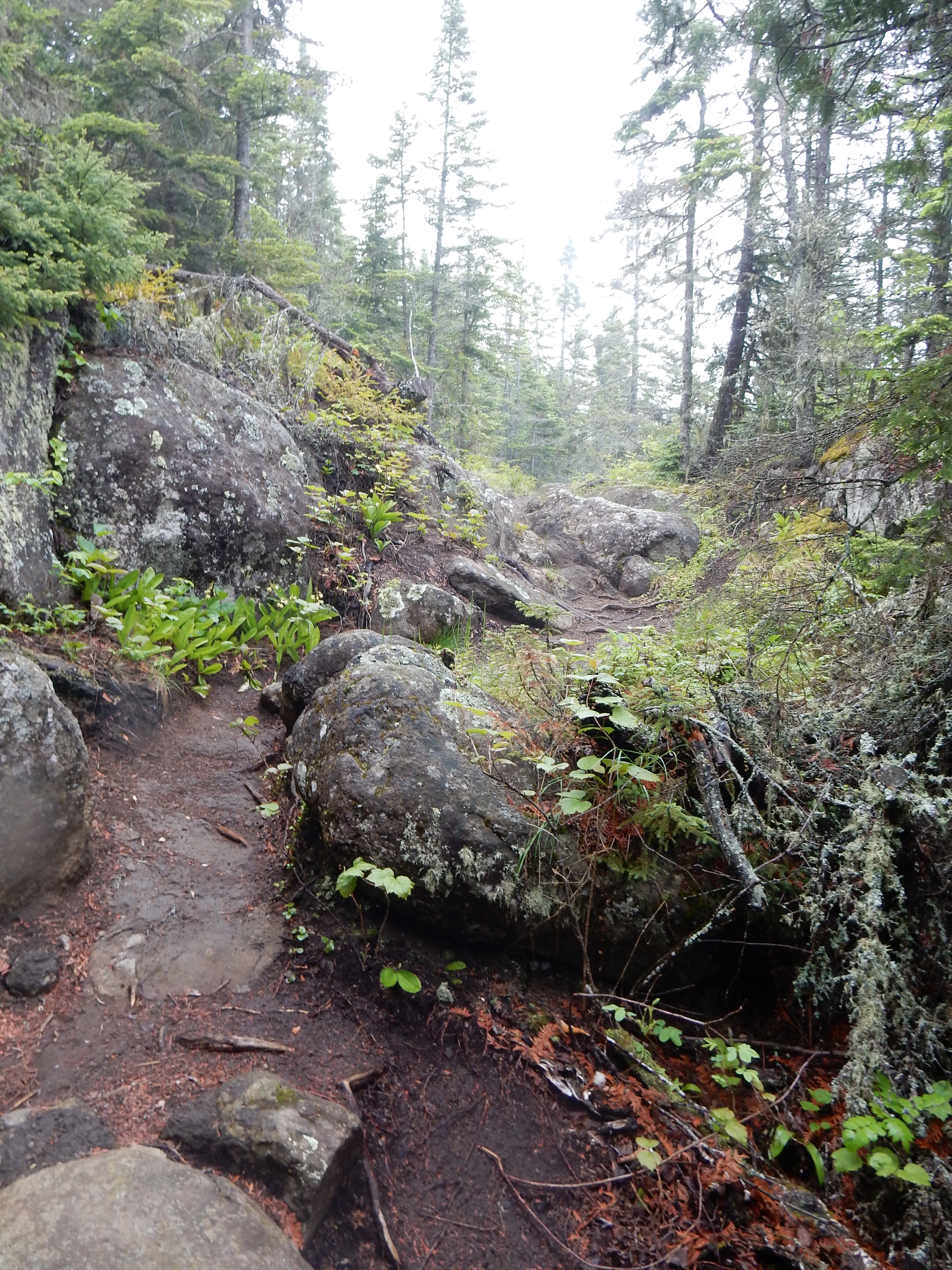
After breakfast in the grill, we headed out on a hike to Suzy’s cave to see how much water will be on the trails this morning. Theoretically, moose may be present on this trail but I will end your suspense early; we did not see any. Like yesterday’s trail, this is a loop that has one leg on Tobin Harbor (north side) and one leg on Rock Harbor (south side). The trail is rocky, after all this island is here because the rock formation has withstood erosive effects. The trail goes through forest, along water, over rock formations, and up and down the ridge as it crosses from the Tobin Harbor side to the Rock Harbor side.

Suzy's Cave

Suzy’s Cave, Isle Royale National Park

Suzy’s cave is a small cave that a young girl discovered and sought shelter in during a storm. Her family lived on one of the islands in Rock Harbor back before the park was formed. The cave is on the ridge between the two bodies of water. As we leave the cave and hike down to Rock Harbor, we notice that fog has started to develop on the water. Soon the islands begin to disappear and it is time to get a little nervous (Chris) as to whether the fog will develop enough to envelop the trail.

The fog starts to move in

The fog starts to move in

The trail coming back from Suzy's cave

The trail coming back from Suzy’s cave

Eventually light fog reaches the shore but our trail never disappears. We do meet two other couples out backpacking. One woman has a face mask of mosquito netting. My DEET spray this morning appears to be more effective than yesterday’s eco spray. We hike a little faster on the way back, but I soon realize that I am getting tired and need to be cautious so as to not lose my footing on the wet rocks or mud. We end up back to “civilization” in a little over two hours. Our reward is a snack of cinnamon, sticky buns at the grill.

Rock Harbor  with fog

Rock Harbor, Isle Royale National Park with fog

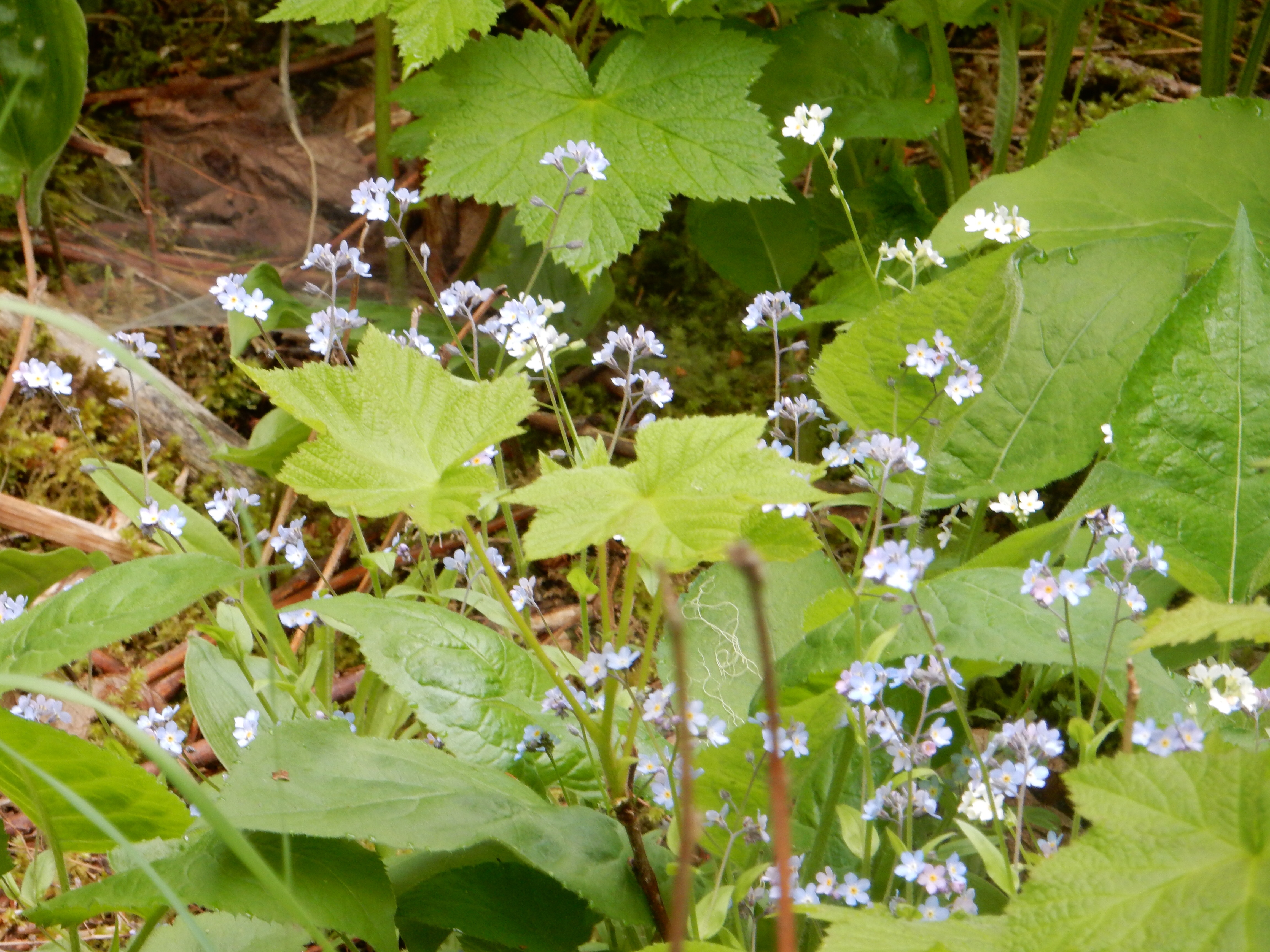
In the afternoon, we partake of a ranger hike focusing on wild flowers. Isle Royale has a short growing season and right now numerous plants are budding. Our ranger is here through the conservation corps and is a recent grad of Rutgers in environmental policy. This is a summer internship for him. The fact that this presentation only attracts the two of us doesn’t discourage him. It presents him with the opportunity to practice for the larger crowds that come after July 4th. In addition, the large boat that brings day hoppers over from Michigan does not run today. His talk is well done but unfortunately, like previous wild flower talks I have listened to, I don’t seem to retain a high degree of information. It was interesting to learn about a few flowers here that change colors over the period of several weeks. The white ones below can be seen in a yellow shade in other locations along our trails.

This flower changes from yellow to white

This flower changes from yellow to white

Wildflfowers at Isle Royale

Wildflfowers at Isle Royale

Wildflowers at Isle Royale National Park

Wildflowers at Isle Royale National Park

Ed and Chris June 26

Categories: road trip, travel | Tags: , , , , | Leave a comment

2015 Trip 1, March 20-21, Florida in Winter

Miami Beach Saturday March 21

Flat Florida landscape with cattle

Flat Florida landscape with cattle

Night and Day. We left quiet little Ruskin FL for Miami Beach. It is 250 miles in distance but a whole ‘nother world. We could have driven via the interstate but once again drove the two lane roads, east across the entire state and along the shore of Lake Okeechobee. Towns in the interior part of the state are few and far between. The area’s RV and mobile home parks are definitely not in the high rent district. Cattle and tomato growing transferred into sod and sugar farms.

Lake Okeechobee is the seventh largest freshwater lake in the United States. It is only about 10-15 feet deep and is an integral part of the process of keeping the Everglades fresh. There is a long history of how the water has been used and abused. Today there are watershed districts trying to manage competing demands for use of the water in addition to the need to not diminish the flow to the Everglades. There is a 30 foot high dike around the lake with a 110 mile long walking/biking path on top of the dike. I would not recommend it as a walking path. There is absolutely no shade and at Florida heat, it would be about the last hike I would want to undergo.

Arrival in the Miami area brings back the wide highways, speeders, high density of new skyscrapers, etc. The normal 10-15 minute drive into South Beach across the causeway next to the cruise ship harbor was bumper to bumper, 50-60 minutes of stop and go driving. Pedestrians are everywhere, never waiting for a light.

The next five days are probably beach days, depending on weather. 2015 is the 100th birthday of Miami Beach and there will be a few celebrations this week. Part of the allure of Miami Beach is the architecture. Art Deco for some of the oldest hotels from the 1920s; the Miami Modern movement from the 1950s with over-the-top hotels and motels.

Fish Shack restaurant in Ruskin

Fish Shack restaurant in Ruskin

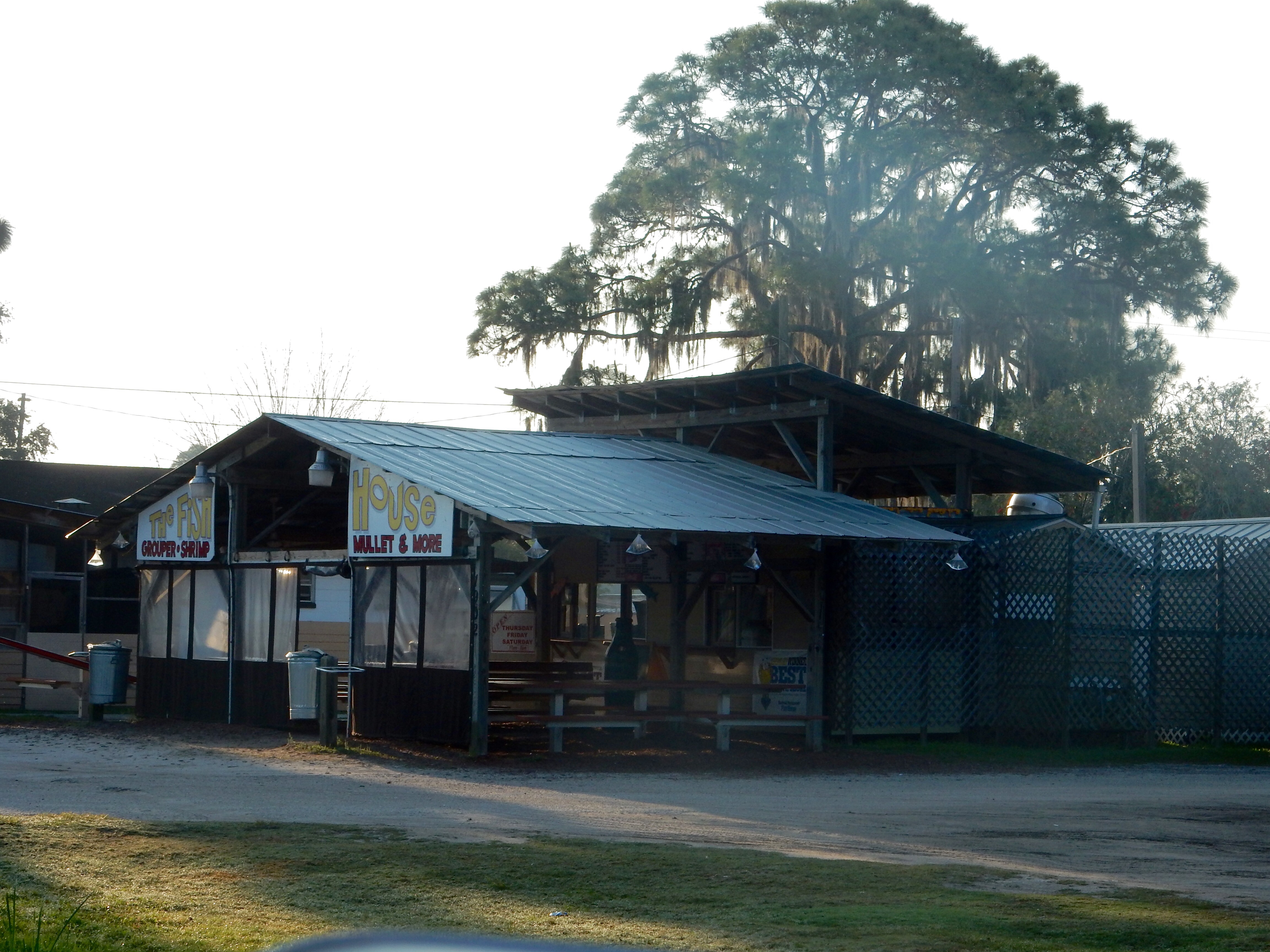
In contrast, little Ruskin began life in 1908, named after John Ruskin, a social critic and utopian. Tomato growing (Di Mare Fresh and Pacific Tomato are two big firms still operating in the area) was its major crop and activity until after WWII. Suburban development has occurred but there is no downtown, not even nice strip development. The two most popular and highest rated restaurants on TripAdvisor are a hot dog shack and a fish shack. And I do mean shack. The cooking facilities look like an enclosed car port; the dining area is picnic tables under a larger car port type enclosure. We did try the hot dog place, it was good barbecue. The crowds keep coming and the parking lots are always full. Not everything has to be artisanal with modern vibe architecture to be good.

Resort at Little Harbor

Resort at Little Harbor

The marina at The Resort at Little Harbor

The marina at The Resort at Little Harbor

Our lodging for the last three weeks, the Resort at Little Harbor combines hotel, timeshare, and townhouse condominiums. It has two restaurants, three pools, and a marina. The staff was always friendly. The beach area is on Tampa Bay, not the Gulf of Mexico so the wave action is less.

The Gulf beaches in this area have been highly rated consistently. However, we found them too highly priced. There were also articles in the Tampa paper how horrendous the traffic is going to Clearwater Beach. Clearwater Beach is on an island. There are less than 2,000 parking spaces. During Spring Break, 10,000 vehicles try to access the beach. One person we met in the elevator at Little Harbor went to the Gulf beaches and just had a horrendous drive. When we were at Siesta Key three weeks ago, there was little public beach access and no parking. Not for us this year.

Gambel mansion in Ellenton FL

Gambel mansion in Ellenton FL

Friday we drove into Ellenton and visited a state park memorial “mansion”. The building was home to an early pioneer. He moved here from the Tallahassee area in the 1840s and raised sugar cane primarily-with the major assistance of slaves. However, his luck was rotten. Storms, fires, diseases combined to force him to turn the plantation over to his creditors in 10 years. The home was the hiding place of the Secretary of State of the Confederacy when the Civil War ended and he escaped to Europe rather than facing charges.

The Tampa area (Clearwater, Tampa, Sarasota, Bradenton, etc) does offer numerous activities across a range of interests. We enjoyed the time here at little Ruskin.

Ed and Chris Saturday March 21, 11 pm

Categories: road trip, travel | Tags: , , | 1 Comment

2014 Trip Six, Sept. 28, Fall in Canada and Deb and Rebecca’s Wedding

Montreal, Sunday Sept. 28

This is Sunday. It must be time to visit another large church. In case you have not gathered, the French-Canadian history of the province includes a strong dose of Catholicism. It seems that every other town and every third street is named after some saint. And around every corner is another church, famous for some feature.

St. Joseph Oratory

St. Joseph Oratory

Today’s spectacle was St. Joseph Oratory. (An oratory is usually considered similar to a chapel and set aside by ecclesiastical authority for prayer and Mass, frequently for a private or semi-private use. We had to look it up.) St. Joseph Oratory, however, is huge, but not beautiful. Its dome is the second or third largest in the world for Catholic churches, surpassing St. Paul’s in London, Notre-Dame in Paris, St. Patrick’s in NYC, and Sainte-Anne de Beaupre up by Quebec. St. Peter’s in Rome is larger and possibly one in the Ivory Coast.

Inside of St  Joseph  Oratory

Inside of St Joseph Oratory

We went to 11:15 Mass in the crypt (basement) church which only holds about 750-900 people depending on how many you squeeze into the pew. It was in English, one of the few such available to us although the accent made listening a challenge. The main basilica seats 2,200 and supposedly can hold another 10,000 people standing. That last fact seems questionable to me, maybe it includes the outside terrace. The interior seems plain to me, although the sculptures and stained glass are praised.

The Oratory was built due to Brother Andre (now a saint) who joined the Congregation of Holy Cross in 1870 and became famed for extraordinary cures attributed to him. In 1904 a little chapel was built. Construction of the current building began in 1924 and completed in 1955.

Some of the crutches

Some of the crutches

In the votive chapel area of the Oratory are walls with crutches from grateful pilgrims who attribute their cure to him. These are just the ones up to the year 1937 when he died. The temperature in the votive chapel is markedly warmer than the area around it due to the number of candles burning. We did not notice any air-conditioning; not sure how warm the votive chapel gets in summer. This chapel can hold 10,000 votive candles. Not all are burning but we observed a constant stream of people lighting candles.

Pilgrim climbing the stairs

Pilgrim climbing the stairs

We observed a number of pilgrims climbing the 283 stairs on their knees. A center portion of the stairs are reserved for pilgrims. This keeps the pilgrims safe from the 2,000,000 visitors the Oratory receives each year.

Some of the creches on display

Some of the creches on display

At the museum, a display of creches from around the world lined the walls. The diversity and creativity was remarkable; many were made of simple materials indigenous to a region. The display was not heavy with fancy/expensive creches.

Some other interesting facts. The carillon have 56 bells originally made for the Eiffel Tower. Technical difficulties prevented that and generous pilgrims bought the bells and had them installed here. The organ has 5811 pipes. The oratory is named after St. Joseph, the patron saint of Canada.

View from Mont Royal

View from Mont Royal

After our visit, we went to Mont Royal. This park is situated on high ground just east of St. Joseph Oratory. Mont Royal was designed by Frederick Law Olmstead who is well-known for planning NYC’s Central Park. We stopped at one overlook to view Montreal but, frankly, we had walked enough yesterday and seen enough heights and were not impressed by any descriptions of the park to spend further time here. I know,it is ranked highly in travel guides but one needs to set your own priorities.

We turned our car back into the garage, happy to get off the roads and to stop commenting on bicyclists bad habits. But, we did comment to each other the near absolute absence of car horn honking. Given the traffic, the pedestrians, and the bicyclists, there was a wealth of opportunity to sound one’s car horn. But it did not happen. We do not know if it is illegal (for instance,red turns on red are illegal in Montreal) but found nothing to support this theory. Maybe it is just cultural.

Chris' poutine dinner

Chris’ poutine dinner

A late lunch was at a local dive serving poutine and smoked meat sandwiches. Both are local traditional foods and both are over-rated. Poutine is now available in the Twin Cities but we had not tried it before. It is french fries with gravy and cheese curds; Chris added pulled pork to hers. I had the smoked meat sandwich with fries and cole slaw. Smoked meat is basically pastrami. We can say we tried it and can put the memory behind us. This one at least was inside an open-air courtyard between two buildings. Many of the cafes stick a couple of tables on a wood frame floor constructed for this purpose and using 3/4 of the sidewalk. People get squeezed into the remaining 2 feet of sidewalk.

Ed and Chris 9/28 7 pm

Categories: road trip, travel | Tags: , , , , , , | Leave a comment

2014 Trip Five, August 3, Summer in the Cities

Saint Paul, MN  Sunday August 3

We have been back from WI for a week now and are continuing our explorations of our home area, an area we have neglected for the last 18 months as we have traveled around the U.S.  The last week was one in which we continued testing out a few new  events unaccomplished in our previous ten years here.

Friday and Saturday we explored the Minnesota Fringe Festival. The Fringe Festival is a potpourri of short (less than 60 minutes), adventurous acts of comedy, drama, dance, music or a combination of the former. This year there are 169 different shows at 19 different venues around Minneapolis. Each show is performed five times over an 11 day period, but at just one of the 19 different venues. Show descriptions are brief, until online reviews are written providing an attendee’s explanation and critique of a show. Ticket options vary from one show, to ten ticket packages, on up to an unlimited number. Shows are offered every 90 minutes. To get into a show, you have to show up, get in line to obtain a ticket, and then get in line to get into the theater. Seating capacity varies on the venue. Performers actually receive 65% of the ticket revenue for each show they perform so online reviews are important. The artists may also have friends passing out flyers about their show at some of the other 168 shows. It seems they also try to get friends to write early positive reviews, sort of stacking the deck.  One veteran fringe-goer we talked to in line said to pay more attention to reviews written by people who write multiple reviews, those are less likely to be written by friends or family.

There are about 25 fringe festivals in the U.S, 10-12 in Europe,and another 10-12 in Canada and Australia. Minnesota Fringe is the largest non-juried festival in the United States and the third-largest Fringe festival in North America. This year is the 21st one in Minnesota. Supposedly it started in Edinburgh Scotland in 1947 but took a while to gain traction elsewhere.

Doing the Fringe Friday night in Lyn-Lake area

Doing the Fringe Friday night in Lyn-Lake area

This being our first time, our tactic was to focus on two locations and decide among shows being offered Friday and Saturday. Friday evening we were in the Lyndale-Lake area with three venues close by each other. Saturday we chose the Rarig Center at the U which offered four venues in the same building. We figured trying to drive to another part of town and get into a theater in 30 minutes would be a pain. We had purchased a punch card good for ten tickets, or five shows for us as a couple. Of course, given our habits, we were in each area plenty early. In fact, Friday night we had time to walk around Lyn-Lake and have appetizers at Bryant -Lake Bowl (one of the venues). The neighborhood has changed dramatically since we lived here 40 years ago; much more upscale housing nowadays.  This first weekend of fringe we did not encounter any sold out performances; supposedly this is likely the second weekend as reviews coalesce around the top shows and attendees try to make sure they can get in to the top performances.

Four of our choices were comedies, one was a mystery. Three were pretty decent, one so-so and one kinda lousy. The lousy one was still receiving pretty positive reviews 24 hours later from other people on-line. No sense describing the plots, you won’t see them and I probably could not detail them in an interesting and concise fashion. But the overall experience was a fun one; one we might well continue if we are home next summer. But we think five is a reasonable number to see. There is considerable standing around time for a performance that probably will only last 45-55 minutes. (If the show goes over 60 minutes, they turn on the stage lights and tell them to get off.)

Saturday was a particularly busy day. A morning bike ride went into Crosby Farm Park to observe if the bike/walking trails had been completely cleaned up after the flooded Mississippi River had inundated the park. The City crews had done a great job and we enjoyed the ride, even more so when Jim and Heidi spotted us on the path and we stopped to chat for a while. Unfortunately our Fringe Festival activities prevented us from watching Jim’s St. Paul Pioneers football team win again Saturday afternoon.  One more win and they are on to another national title play off next January in Florida. We may have to adjust our winter plans if they make the championship.  After the bike ride, we headed over to the Guthrie area of Minneapolis. We had a 1 P.M. walking tour sponsored by the Mill City Museum.

Jim, Heidi and Chris along the bike trail

Jim, Heidi and Chris along the bike trail

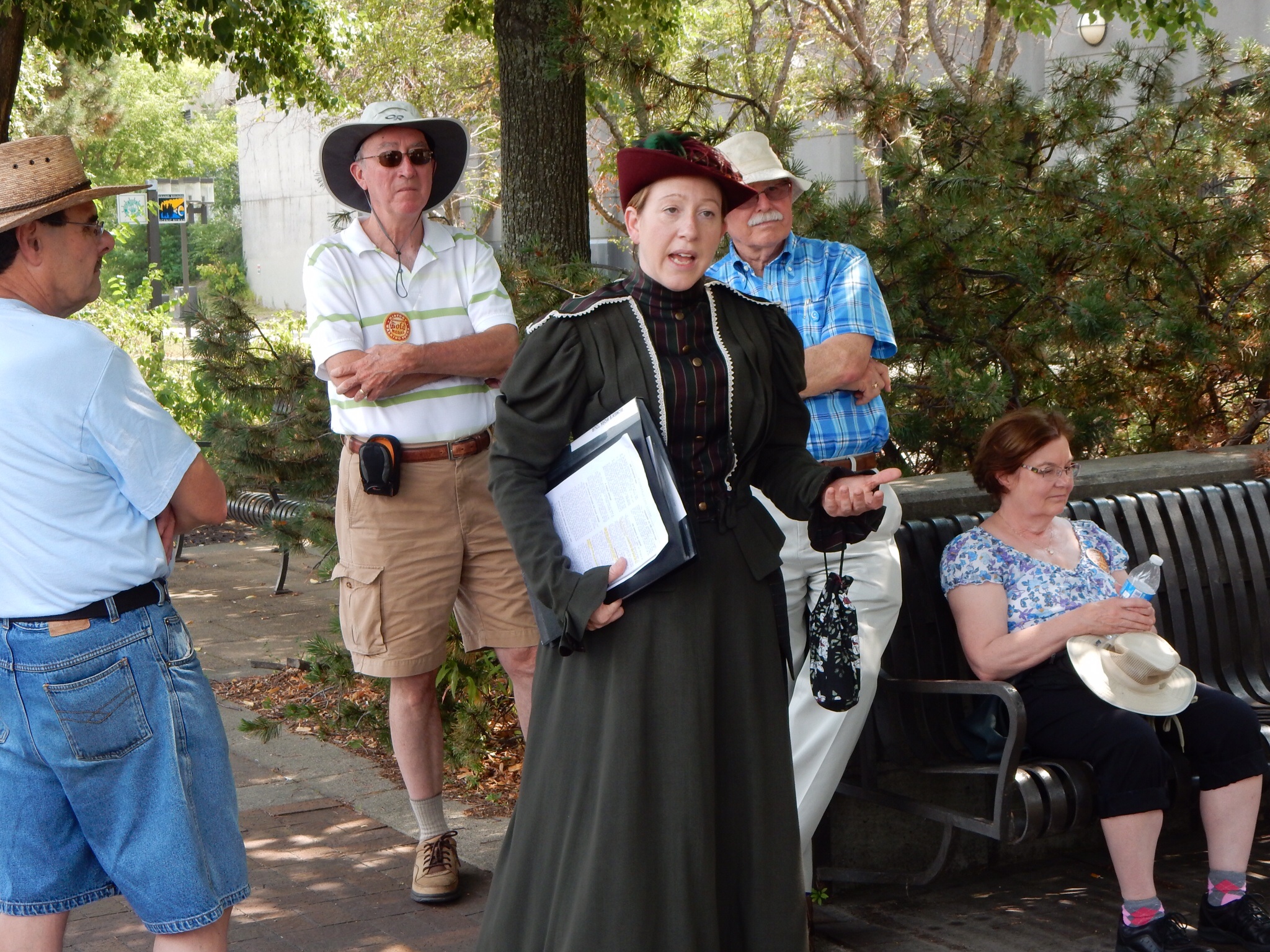
This walking tour was about the conditions for working women in the mill area during the late 1800s and early 1900s. A re-enactor in period dress gave the presentation for us and about 15 others as we walked along the mill area streets and the river. The day was warm and hazy (smoke from Canadian wildfires has drifted our way) but the 90 minute tour was worthwhile. The re-enactor portrayed a female reporter(Eva Valesh) for a St. Paul labor paper who later became a union organizer and national speaker.Valesh was just 19 when she began reporting and would go undercover, get jobs in the factories, and then report on working conditions. The good factories were relatively clean with reasonable wages for the time ($6-7 per week.) Many were dirty, low paying, and required standing on concrete for 10 hours per day, frequently 6 days per week. At one factory, the women went on strike for better working conditions, the owner would not make improvements and the factory closed and went bankrupt a few months later. When Valesh was on her speaking tours, she charged $5 per speech except when she was back in Minneapolis where she presented her talks for free.

Mill City Museum working women tour

Mill City Museum working women tour

Sunday we returned to the Mill City Museum for another 90 minute walking tour. While we were waiting for it to begin, we caught the 19 minute film on the history of Minneapolis. It is a humorous account of the city’s history but there is one inaccuracy. When talking about the local labor movement, the narrator (Kevin Kling) gives the history of Minneapolis labor but calls it Twin City labor history. In reality, the two cities approached labor relations in completely different attitudes. St. Paul was more benevolent while Minneapolis was run by corporations who maintained a strict anti-union workforce until the 1930s and 40s.

St. Anthony falls area today at non-flood and with water not diverted for mills

St. Anthony falls area today at non-flood and with water not diverted for mills

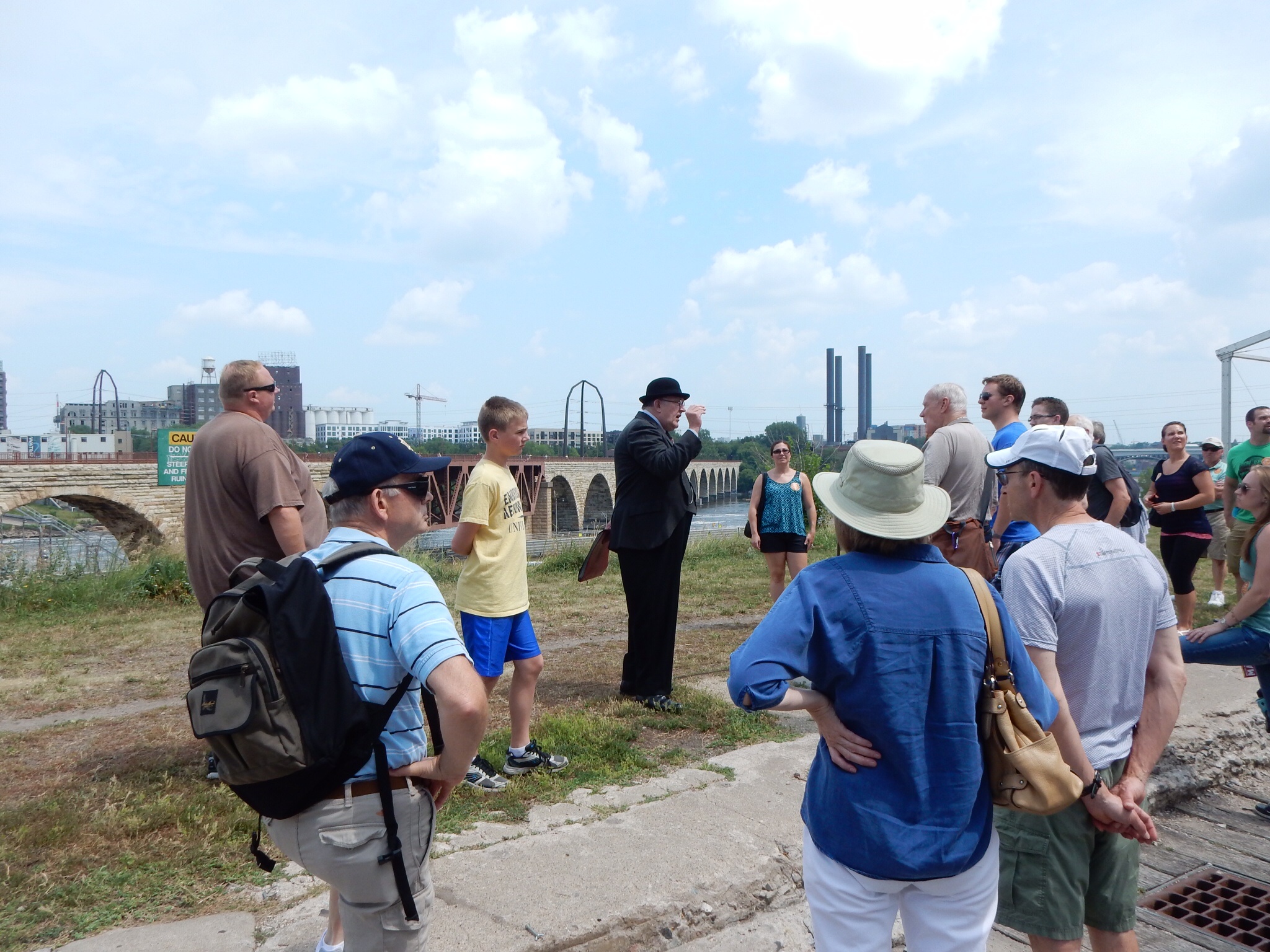
The  Sunday walking tour was about the water power of the falls. In this tour, a costumed museum interpreter portrays William de la Barre, who was born in Austria and moved to Minneapolis from Philadelphia to be the head engineer working for the Washburn Crosby mills and water power company. He spent half a century developing flour mills and waterpower for the company. The guide has been giving these presentations for a dozen years and does it very well. The Washburn-Crosby mills were the forerunner of today’s General Mills. General Mills makes a flour labeled as Gold Medal. In 1880, the national milling association held an international competition to determine the best flour. The Washburn Crosby company, using the new technology that de la Barre installed, won the gold prize and hence the brand name. Fortunately for the company, the competition was only held once and thus the prize could not be claimed by any other company.

Engineering the Falls Mill City Museum tour

Engineering the Falls Mill City Museum tour

Mr. de la Barre was hired after the Washburn A mill exploded in 1878 to build a new mill that would not explode and went on the be the person responsible for controlling and maximizing the water power created at St. Anthony Falls as Washburn bought up all of the riverfront land and its water rights. The city wanted water power and the industry it would sustain. Flour mills, saw mills and textile mills all lined the riverfront and along the parallel canal which had been created to furnish the waterpower. Over time, saw mills and textile mills dropped out and milling became the dominant force for many decades. The river bed geology is soft sandstone over a varying depth of harder limestone. Besides creating Minnehaha and St. Anthony Falls, the geology led to numerous sinkholes and collapsed tunnels at the dam and raceways that had to be repaired.  One factoid we learned, the original suspension bridge on Hennepin Avenue was the first bridge crossing the Mississippi River.  (St. Louis tries to take credit erroneously.)  Izzy’s ice cream has located a second shop three blocks from the Mill City Museum so we ended our afternoon activities with a visit there.

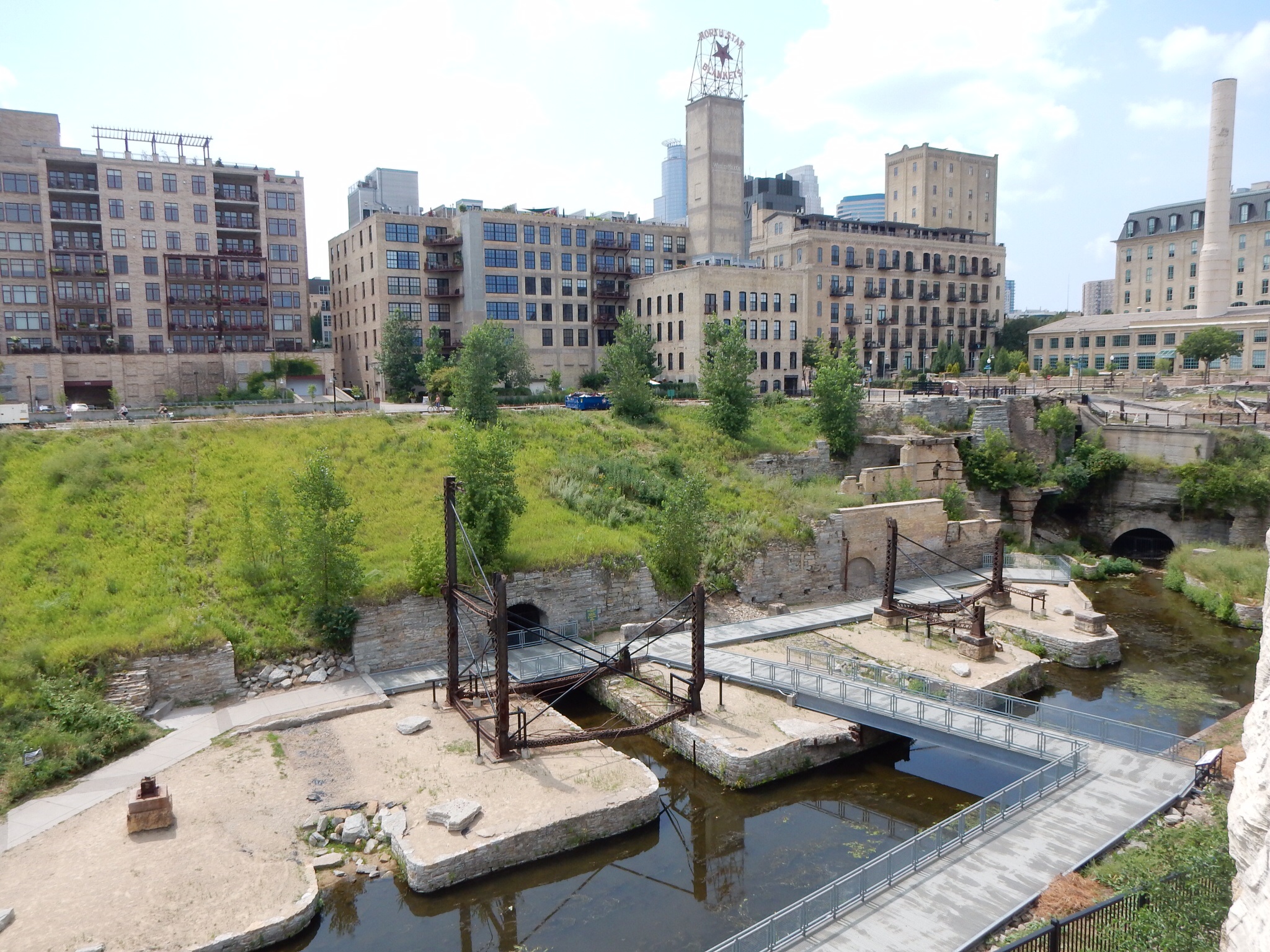
Mill City ruins area of Minneapolis

Mill City ruins area of Minneapolis

Earlier in the week I volunteered for the National Park Service doing the enviable task of pulling weeds. At Coldwater Springs is a new park along the Mississippi created on the site of a spring that provided water to Fort Snelling. The Park Service has been the responsible party in bringing this to fruition as a park. In most of the Mississippi River National River and Recreation area, they just partner with local governments and park agencies to provide a coordinated approach. I spent 1.75 hours bending over, hunched over, or kneeling on the ground pulling out crown vetch. Great fun;  my lower back is still crying out to me.

Thursday night was the Lynx, our WNBA team that has won the WNBA championship two of the last three years, finishing second the third year.  We met the Sarahs and some of their friends at Kieran’s Irish pub before the game. The Lynx had close to a sell out crowd at Target Center as they played the Phoenix Mercury, the team currently with the best record in the WNBA and riding a 16 game winning streak.  Well, the Lynx put an end to that streak in an exciting game.

MN Lynx defeat the Phoenix Mercury

MN Lynx defeat the Phoenix Mercury

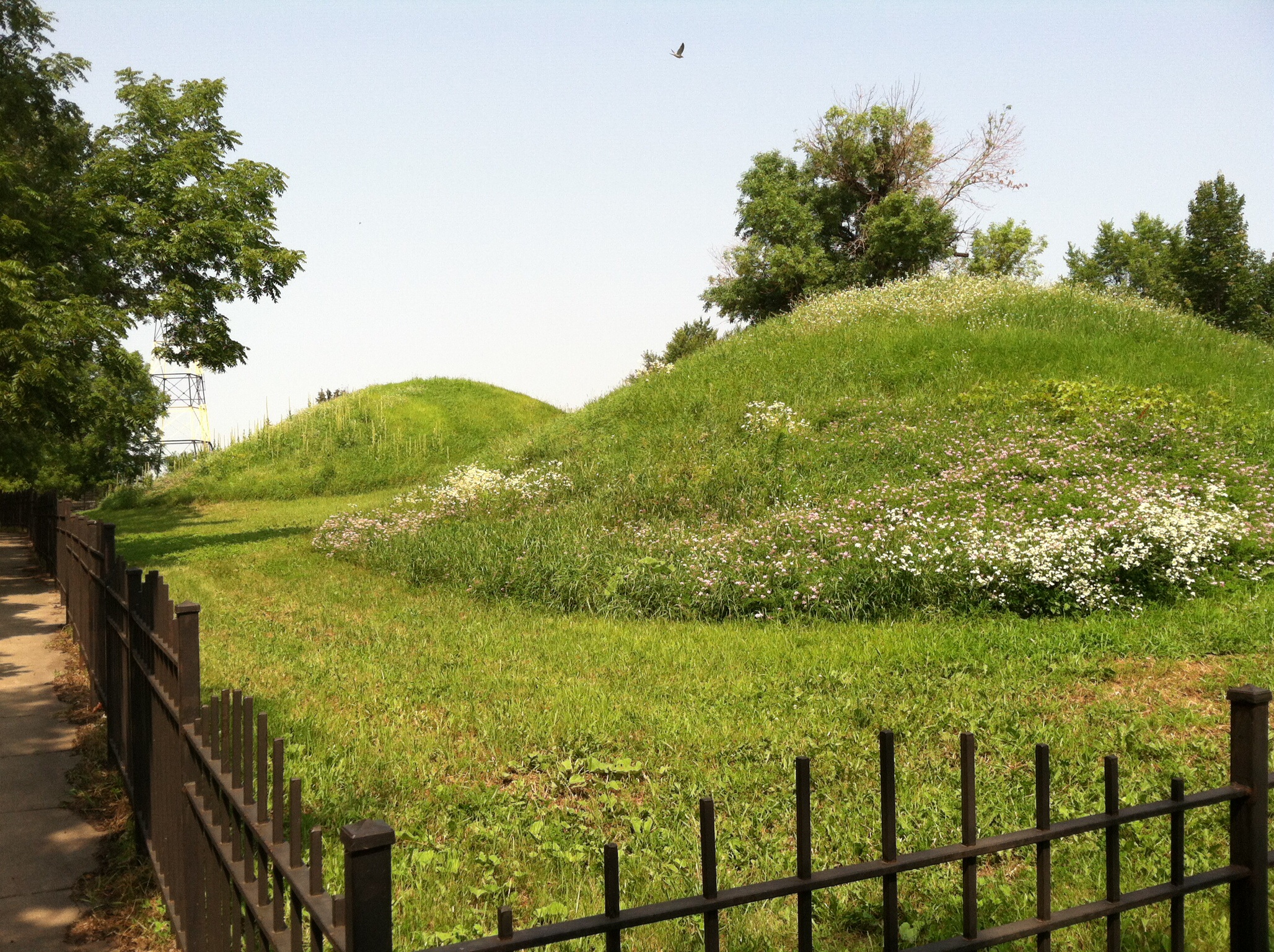
The rest of the week was quieter. We had dinner with Kathy and breakfast with Bernie and Tony.  We paid a visit to Indian Mounds Park in the Dayton’s Bluff area of St. Paul. We figured if we drive to Iowa and Mississippi to see Native American mounds, we can certainly make another visit to our local ones. There is no museum here though.

Indian Mounds Park in St. Paul

Indian Mounds Park in St. Paul


Ed and Chris Monday August 4  2 PM

Categories: road trip, travel | Tags: , , , , , , , , , , | Leave a comment

2013 Trip Two, Day Nine Maui

imageimageimageWell I am writing this in the AM for a change. Maui has presented a different set of problems. Good problems, but problems. What to do?

On Kauai, we really were into seeing things. The weather was pleasant temperature wise but cloud cover frequently provided brief showers and cooler (low 70s) temperatures.

Here our unit overlooks the bay in Makena right by an excellent sand beach. The sun is out and it is warmer with stronger winds. We can listen to the waves at night and watch the moon shine on the ocean, watch and listen to the ocean waves crashing during the day, observe kayakers and snorkelers in the bay, see some whales out in the water, go to the beach or to the pool. Or we can drive the road to Hana, go on sail boat rides, do stand up paddling, biking, zip lining, hiking and much more.

It is hard to make a decision. What ever we do, though, is going to be enjoyable.

9 pm
So we decided to do a little shopping, a fair amount of beach time at the ocean and wrapped up the afternoon at the pool. Finally, we drove up to Kahuluhi airport and picked up the four girls whose flight arrived at 7:30 pm. A great day all in all.

Ed

Categories: road trip, travel | Tags: , , | Leave a comment

Blog at WordPress.com.