

Corkscrew Swamp, Florida
North Fort Myers, FL. March 31
Sunday was a little slower. Our Evergreen hosts had a delicious egg bake for breakfast before we went to church with the husband. We headed out exploring about 12:30 to Corkscrew Swamp Sanctuary, an Audubon sponsored preserve. The first detailed governmental report on this Everglades area described it as: “useless to civilized man, for any purpose”. Another description characterized our attitude towards the Everglades as fear (alligators, bears, bugs, snakes, etc), followed by greed (cattle, crops, bird feathers,etc) and concluding (hopefully) with understanding as we learn the interconnectedness of nature and how our short-sighted actions have long-term consequences (farming and over-building eliminate the fresh water aquifer that feeds both the Gulf Coast and Atlantic Coast urban areas).

Corkscrew Swamp Sanctuary
Corkscrew Swamp Sanctuary had to be preserved twice. In the early 1900s, hunters were killing massive numbers of herons and egrets to sell their feathers as decorations in ladies hats. Feathers were more valuable than gold on a per pound basis. Locals and the Audubon Society hired wardens to successfully chase away the plume hunters. Then after WWII, the area around Corkscrew was being logged heavily, primarily for cypress trees used in rebuilding Europe. Once again, groups of local residents and the Audubon Society worked together with the lumber companies to stop the lumbering, preserving the last and largest collection of old growth cypress trees.
When the state of Florida was unwilling to spend money to preserve the area, the Audubon Society took possession of the property and still owns it today. The initial acreage of 5,680 acres has grown to almost 16,000 acres. The most important rookery in the country for wood storks is also preserved-and off-limits.

The transition between two types of habitat, an ecotone where marsh and cypress forest come together
Our walk was on a 2.25 mile boardwalk above the swamp, allowing one to look down and up without fear of getting wet. The eco system includes (in their terms) marsh, pond cypress, wet prairie, pine flatlands, bald cypress, and lettuce lakes. The Sanctuary has numerous landmark trees, the really large and old bald cypress trees.
However, Hurricane Irma came through this area in September 2017. Nearby Naples recorded gust winds of 142 mph. Corkscrew Swamp was just 2.5 miles east of the eye of the storm. Many trees were felled by high winds, either at the root level or twenty feet up. At least three of the 12 landmark trees were victims to the storm. Rainfall was 12.6 inches on the Sanctuary over three days. Volunteers responded to the call for assistance and came out to clear debris and repair the boardwalk; it took two months before the full boardwalk and visitor center were re-opened.

A strangler fig wrapped around a tree at Corkscrew
The walk took us 90 minutes as we wandered at a slow pace, enjoying the view and listening for birds. At one point, I waited for 5-10 minutes to try to find the bird (likely a woodpecker of some species) that made a tremendously loud drumming sound. Several of us strolling on the boardwalk tried but were unable to spot it.
When we finished up Corkscrew, we headed over to another sanctuary. CREW, Corkscrew Regional Ecosystem Watershed Land and Water Trust is a public-private partnership and non-profit that coordinates the purchase and protection of 50,000 acres of land. Land once purchased is turned over to the South Florida Watershed Management District for land management. They sponsor five main pieces of land and we walked a portion of one of them, Bird Rookery Swamp.
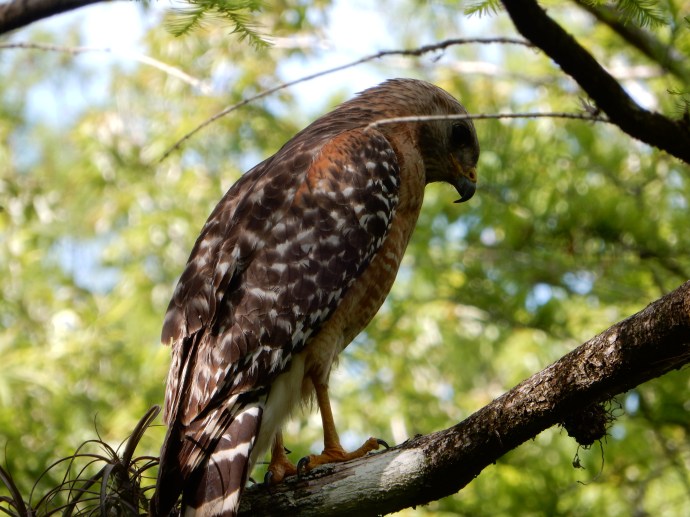
Red tailed hawk at CREW Bird Rookery Swamp
The CREW trail starts out on a boardwalk and then segues into a grassy trail. The trail follows the old route used by logging companies to cut the cypress in the mid-twentieth century. We did not hike the entire 12 mile trail, only about three miles. The highlight of this hike was a red-tailed hawk perched on a railing and then in a tree just feet away from us. During the hike, we talked with several other hikers. One couple mentioned how a bobcat had been seen by friends of theirs on the trail a week ago. Five minutes after we left them, we heard a strange cat-like sound. We looked and looked but did not see anything. Two women coming from the opposite direction stopped and, being more knowledgeable than us, speculated that we had just heard a grey catbird. No bobcat for us.
Sunday was our final night with our second Evergreen hosts. Their home in North Fort Myers suffered only minor damage from Hurricane Irma. There were several homes in the area completely destroyed but, in general, it appears that North Fort Myers suffered less from Hurricane Irma in 2017 than Punta Gorda had suffered in 2004 from Hurricane Charlie. We expect to see continued hurricane damage left over from Hurricane Irma as we drive through the Everglades and on to the Keys.
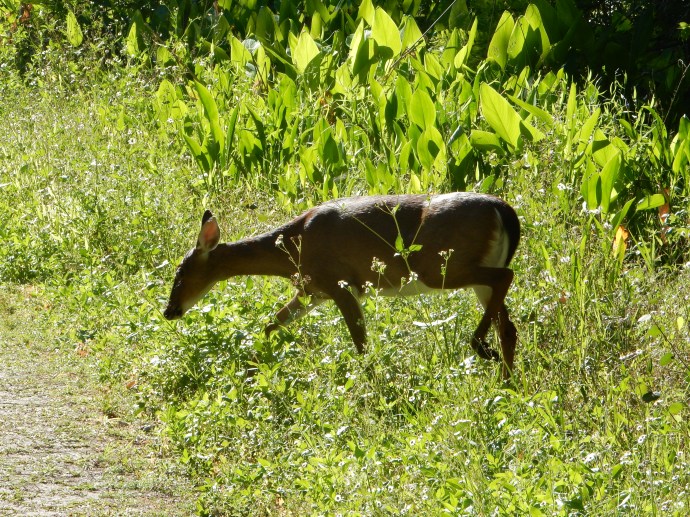
No bob cat at CREW, just a deer
Ed and Chris. Everglades City. April 1
 Chris Klejbuk and Ed Heimel travel adventure
Recent Comments