
Louisville, KY. April 23
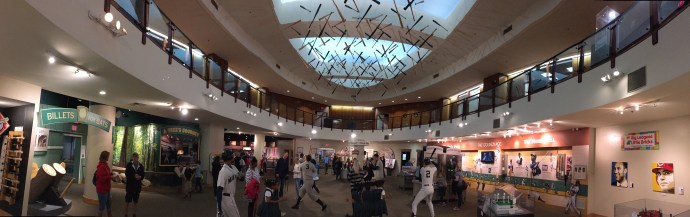
Louisville Slugger Museum
From the grave of the 2006 Kentucky Derby winner Barbaro to the grave of heavyweight boxing champion Muhammad Ali, we are wrapping up our time in Louisville KY before beginning the journey back to St. Paul, MN.
Sunday the 22nd was pleasant, in the 60s and partly sunny. The day’s activities began with a tour of Churchill Downs, the home for the Kentucky Derby horse race since 1875. The 144th Run for the Roses will be held on May 8 this year. We went on a 30 minute tour with a guide who explained the history of the track and the race. While Keeneland is more attractive, Churchill Downs is older, more storied, and holds more people. It is estimated 150,000 to 170,000 people will be at the track on May 8, most in the infield where viewing is poor but partying is great. Celebrities and wealthy individuals will be in the box seats.

Churchill Downs with Barbaro
Churchill Downs was begun by a grandson of William Clark of the famous Lewis and Clark team of explorers that surveyed the new Louisiana Purchase of President Jefferson. Clark had been to Europe and wanted to recreate three races and tracks he visited there. The name Churchill comes from his two uncles who leased him the first 80 acres necessary for the track. The grounds now cover 147 acres. It took decades for the track to become profitable with profits from pari-mutual betting being the primary factor. A quirk in Kentucky law that prohibited gambling allowed the use of the machines.
After the tour, we spent time in the Kentucky Derby museum reading about the various horses that won the Derby. Jockeys, the composition of the track, trainers, and owners are also covered. Barbaro, the 2006 winner was thought to be headed for Triple Crown winner status, but broke his leg in the second race of the three race Triple Crown and was later euthanized. His owners wanted him buried where fans would not have to pay to see him and so his grave and statue are outside the main gate to Churchill Downs.
The Derby Cafe was closed for a private event so we ate a late lunch at Check’s diner, a local bar close to our Airbnb lodging. After lunch, we settled in before making a late afternoon church service.
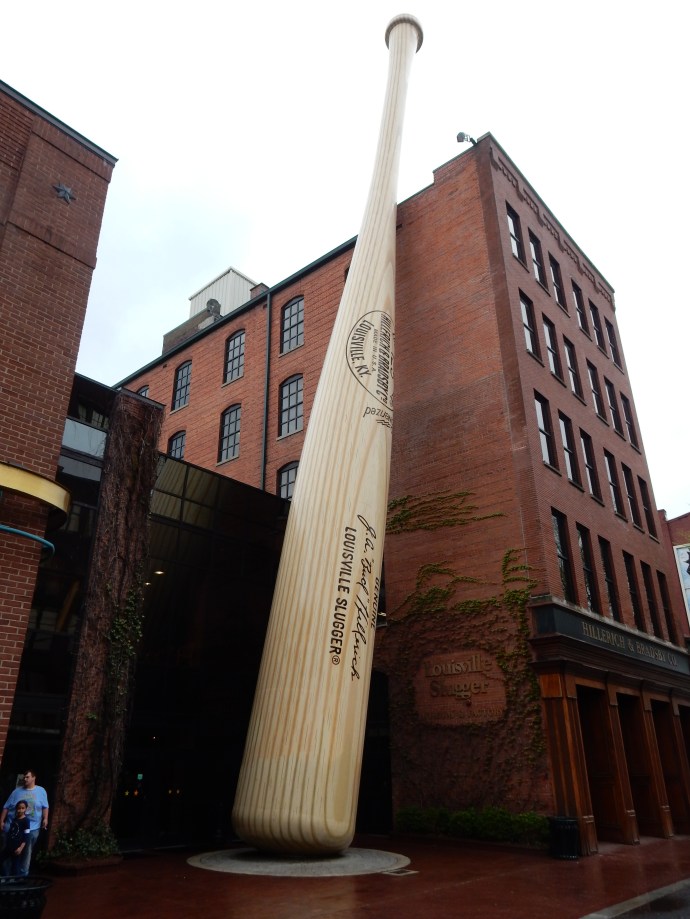
Louisville Slugger Museum
Today was rainy, lucky for us we did Churchill Downs yesterday. Our first task though was to get a 6,000 mile preventive maintenance service on the Subaru. Afterwards the Louisville Slugger museum and factory tour in downtown Louisville called to us. In case you are not a sports fan, and I know at least one of you is not, the Louisville Slugger is the brand name of the wood bats used by professional baseball players.
Still a family owned business, started as the Hillerich and Bradsby company, makers of furniture and butter churns, Louisville Slugger branded bats had been the bat of choice for major leaguers for decades. An upstart, Marucci, which makes hand crafted bats compared to the precision tool made Louisville brand, has been coming on strong lately. In any event, Louisville Slugger has a history with baseball stars since those first days in the 1880s when a young Bud Hillerich made a custom bat for a local Louisville Eclipse baseball star, Pete Browning.

The Bat Vault where each players specific bat type is recorded
The wood baseball bats are still made at the downtown Louisville factory. The tour guide mentioned how the emerald ash borer is wrecking havoc with white ash trees, one of three main trees used for making bats. Maple and birch are also used, maple actually being the predominant trees. The forests of southern New York and northern Pennsylvania are the sources of the trees. Each player can choose from five colors allowed by Major League Baseball and from numerous weights, shapes, and lengths. His final selections are kept on file and new bats are shipped as requested. His team pays for the cost of the bats.

Artwork with vapors at 21c Museum Hotel
Lunch was down the street from the museum at Proof, a restaurant attached to a hotel called 21c Museum Hotel. The owners made five old tobacco and liquor warehouses into a modern hotel and showcase the artwork of 21st century up and coming artists. The art was different. The food was very tasty although overpriced.

Ohio River on a dreary Monday in April
This section of Louisville is only two blocks from the Ohio River. There is a riverwalk and downtown park but the sections we saw were not that attractive. Numerous cities are trying to re-do their riverfront areas but it is a challenge with floods, freeways and railroad tracks frequently competing for space.

At Muhammad Ali’s grave site
Cave Hill Cemetery is the final resting place for many prominent Louisville residents. The cemetery was laid out in the garden cemetery style that allowed the Victorian era residents to ostentatiously show the world their wealth and standing. We stopped by two sites, that of Muhammad Ali (heavyweight boxing champ and activist) and Colonel Harland Sanders (KFC founder). There is a Muhammad Ali museum in Louisville but it is closed on Monday and Tuesday.
Tomorrow we begin our two-day drive home. But in three weeks time, we head out to Arizona for a two-week trip.
Ed and Chris. April 23
Epilogue: Snippets on life in America from Chris
Day 39 : For hundreds of years, people have crossed oceans with very little to flee poverty and come to America. Many people from Maine eventually moved to the mill area of Massachusetts. The Dust Bowl migration saw people flee the Midwest for California. African-Americans came north for work. Why people in south eastern Kentucky do not move for work is a puzzlement to me; they continue to live in extreme poverty.
 Chris Klejbuk and Ed Heimel travel adventure
Recent Comments