
Lexington, KY. April 19

Early morning view from our lodging, Lexington KY
This morning (Thursday) arrived cold, windy and overcast. The view from our Airbnb lodging in Lexington helped shake the cold temps as we looked out onto the grounds of a stable and horse farm. We are lodging in a room over the garage of the owners of the working stable. Chris liked the view of a white horse out grazing.
Wednesday we left Pine Mountain State Resort Park. The lodging and food were decent, we would stay there again. The park lodge displays many prints of Ray Harms, an artist credited with developing the limited edition art print process to sell artwork. His work features wildlife and botanicals. While not born in Kentucky, much of his work was created here.
Did I mention Kentucky and Tennessee state parks do not charge admission? I believe I forgot to mention that. The fee-free policy is appreciated.
Our drive north to Lexington included two stops, Renfro Valley and Berea. Once we were past them, we were out of the Cumberland Plateau and the land was more green and flowering. Renfro Valley is home to a bluegrass entertainment theater and to the Kentucky Music Hall of Fame and Museum. The museum opened in 2002 partially utilizing a renovated riding stable owned by the founder of Renfro Valley, John Lair. Lair founded and ran a radio station for decades that focused on uniquely Kentucky artists and bluegrass music, called the Renfro Valley Barn Dance.
The museum is not limited to country and bluegrass but has all genres included. Some of the artists had absolutely no name recognition for me, they were local through and through. But the original inductees in 2002 included such artists as Tom T Hall, Rosemary Clooney, Merle Travis, Loretta Lynn, the Everly Brothers, and Bill Monroe among others.

Kentucky Music Hall of Fame, Renfro Valley KY
The museum traces the development of Kentucky music, starting with the tunes carried over from England and Scotland, often passed on by women singing to children. Instruments like the fiddle and bingo added music; then camp meetings and Bible revivals added their dimensions. Other influences included minstrel shows, riverboat entertainment, and protest songs-frequently about coal mines. The remote locations of many Kentucky communities meant songs and singing were a major social feature of the community.
The museum was well done and did not require a lengthy stay. I would have enjoyed more opportunities to hear specific songs played rather than just displays with narration.
Fifteen miles further up Interstate 75 is the town of Berea, home to Berea College and to the Kentucky Artisan Center. We hoped to find a few mementos at the Artisan Center. The center has for sale works of juried art by Kentucky artists in every field imaginable. Photography, pottery, paintings, sculpture, wood working, food, clothing, candles, glass work, brooms, etc. were all on display. The prices were beyond what we wanted to spend, although not outlandish. I considered the time spent more as visiting a very diversified museum or art gallery.
We went into downtown Berea where the College is located. Berea was established in 1855 and was the first Southern college to be co-educational and racially integrated. It offers its education to students tuition-free, all students have to work for the college for at least ten hours per week. Berea was also in the news recently when Sen. Mitch McConnell of KY exempted Berea from a new federal tax on large endowments of institutions of higher learning.

Historic Boone Tavern, Berea KY
The campus was pleasant but not our main focus. Instead we headed for the historic Boone Tavern Hotel and Restaurant run by Berea College. The Tavern was an idea of the wife of the Berea College President who in 1909 felt she had to entertain too many official visitors to the college. The Tavern was constructed by students in the college wood-working department utilizing bricks from their own brickyard. The food was excellent.

Man o’War statue and grave, Kentucky Horse Park, Lexington, KY
Today we spent six hours at the Kentucky Horse Park, a 1200 acre complex that includes two museums, event facilities for horse-jumping, dressage, etc., barns for several Kentucky champion horses, sculptures of famous horses, etc. Besides the museums, we attended an outdoor presentation of six horses representative of different horse breeds and an outdoor presentation of three famous, champion horses. I mention the outdoors to remind you again that the day was windy, cold, and overcast. The temperatures may have helped to hold the attendance down and prompted us to sandwich the outdoor presentations with the indoor museum viewing.
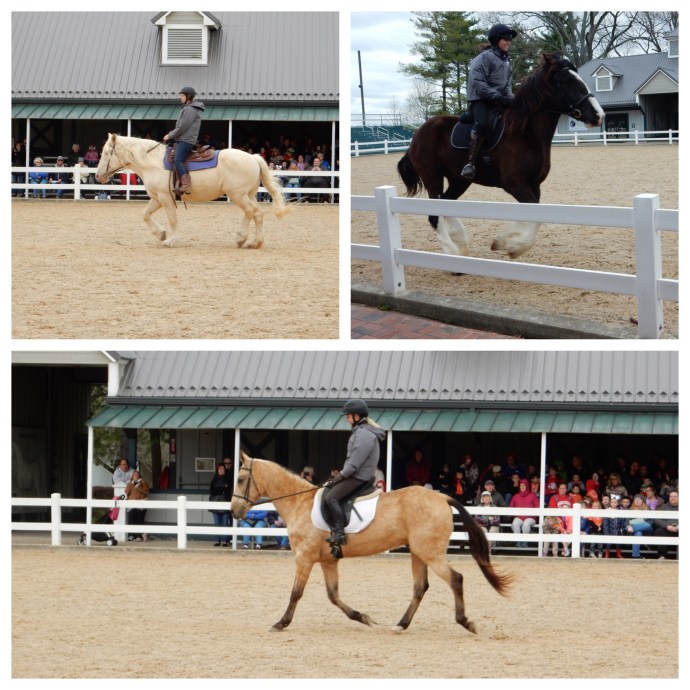
Part of the Parade of Breeds, Kentucky Horse Park, Lexington KY
The International Museum of the Horse was outstanding. It traced the development of the horse back to species that originated in North America, migrated over the land bridge to Asia and then to Europe and Africa while dying out here. Re-introduced by the Spanish explorers and settlers, America has become one of the foremost breeding countries in the world. Arabians receive special attention but the development of various breeds is well-covered as are the changes in how horses were used over the last three centuries. Famous race horses are profiled and statues erected to them: Secretariat, Man O’War, John Henry, etc.
The second museum is the Showplace for Saddlebreds. It was satisfactory; it might have received a more positive response but a major portion of the museum is under renovation.

Our lodging in Lexington KY
Ed and Chris. April 19
 Chris Klejbuk and Ed Heimel travel adventure
Recent Comments