

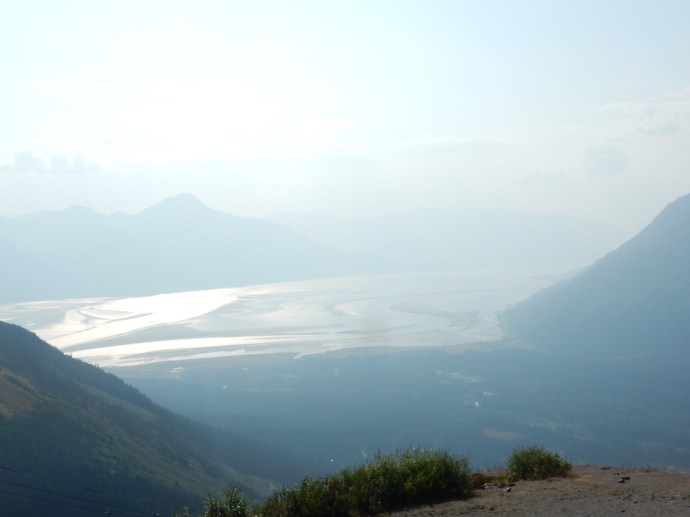
First view of Cook Inlet from Kenai Peninsula at Ninilchik, AK
Homer, AK. Monday (Labor Day) September 2
Just about the end of the world here. The road to Homer continues for about 20 miles past it and then comes to a stop. Everything else has to be reached by air or boat. The weather varies greatly from the impact of mountains, ocean currents, as well just variation within the day. We can see rain shower clouds frequently in the distance which has dissipated by the time we arrive at that estimated location. During Monday we had several periods of rain as well as sunny skies.

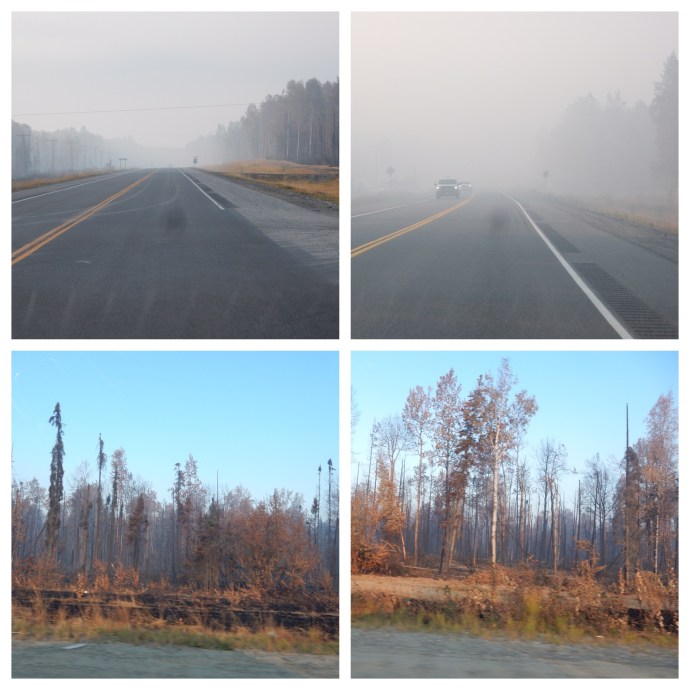
Driving through the fire zone on the Sterling Highway between Cooper Landing and Sterling
The day began with the drive. We left Cooper Landing, able to drive on our own for five miles until there would be a check point. At the check point, you wait for the pilot car to follow it through the fire zone. Well, for us, we had not yet reached the check point when we saw the pilot car gaining on us from the rear. We pulled over, let it pass, and then joined the group. When we passed the next check point, the group just kept going. Cars waiting at the check point joined in at the end.
Sunday, the stretch to Cooper Landing looked like any other roadway except for the fire preparations areas. Monday, the stretch of road with the pilot car was definitely going through a fire zone. Our pictures are not the best, quick shots from a car moving at 55 mph through hills, curves, and stretches of gravel road. The gravel road portions were unclear to us; was this road under construction before the fire and unable to be finished or did the fire cause damage to the road surface? Don’t know the answer yet.
In several places, the forest fire had jumped the road. Burnt trees were on either side of us. Trees were down, some trunks coming close to the road. Areas of smoldering turf lurked just past the shoulder, wisps of smoke curling to the sky. The road had been completely shut down for two periods of time, we could see why. Smoke smell was everywhere, smoke haze was minor today. Our assumption was that the light rain had cleared the skies somewhat. This stretch continued for about 12 miles, then the pilot car pulled over and we continued the rest of the drive to Homer as if nothing was out of place.
The Kenai Peninsula is slightly larger than the state of West Virginia with a population of about 55,000. Four towns, Kenai, Sterling, Soldotna, and Homer each have a population between 5500 and 8000. The vast majority of the land is part of governmental units; Kenai National Wildlife Refuge, Chugach National Forest, Kenai Fjords National Park, and Kachemak Bay State Park.

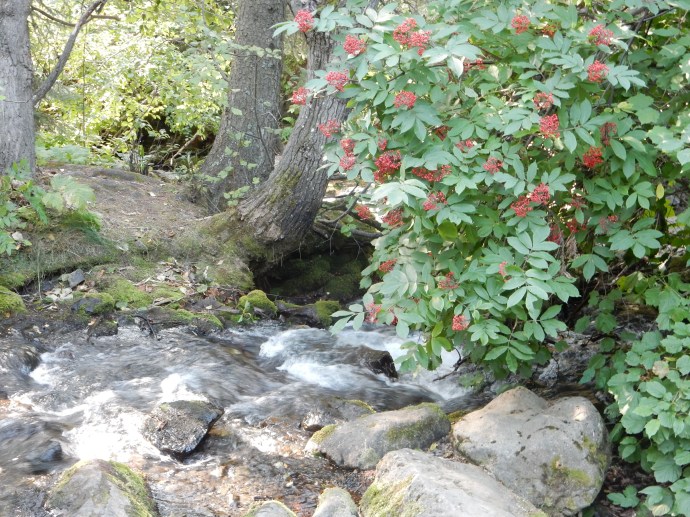
A short hike at Kenai National Wildlife Refuge in Soldotna, AK
We drove through Sterling and Soldotna on our way to Homer. In Soldotna, we stopped at the visitor center for Kenai National Wildlife Refuge. It was relatively new with wonderful exhibits and friendly, informative staff. Out back, we went for a nature hike between light rain drops. Evidently, we had just missed the arctic terns who summer on the lake (and other lakes). Arctic terns make the longest migratory journey of any bird, flying between the Arctic to the Antarctic every six months.
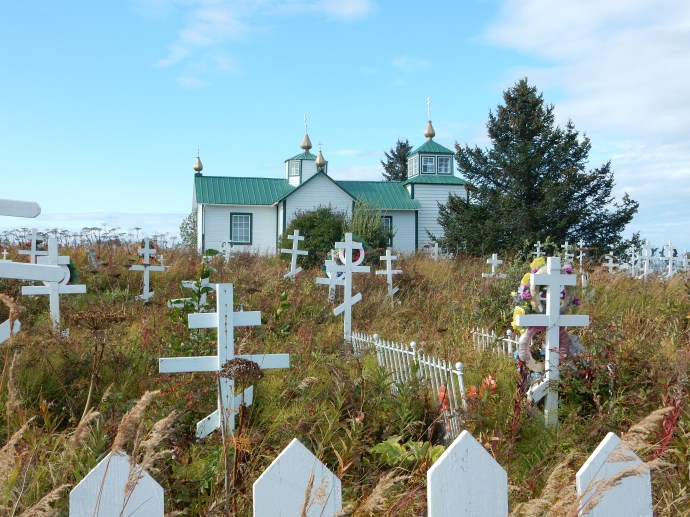
Church of the Transfiguration, Russian Orthodox Church in Ninilchik, AK
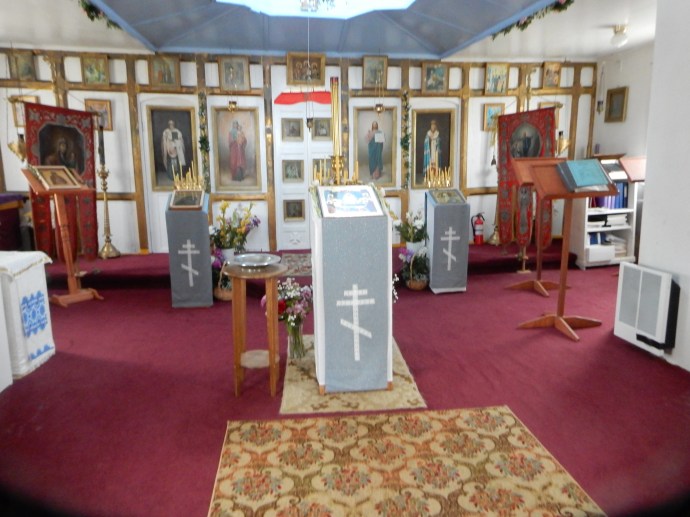
Interior of church
The Kenai Peninsula was one of the areas that Russians settled during its period of Alaskan colonization (1733-1867). We stopped in Ninilchik to visit a Russian Orthodox Church. By now, the sun was out and the church overlooks Cook Inlet with a beautiful view of the water. To our surprise, a bearded gentleman was sitting outside the church! Turns out he is a priest, born down by Sitka. The church itself is very small with numerous icons and paintings inside. The priest was clear that the Orthodox Church is the one Christian Church true to the original Christian beliefs and service.

Views from Homer Spit
Our drive continued to Homer, stopping for periodic photos. In Homer, we drove first to the Homer Spit; a 4.5 mile peninsula jutting out into Kachemak Bay. The town of Homer began as a fishing spot, with canneries and fleets. Competing towns existed across Kachemak Bay but the Sterling Highway came to Homer in 1950, and the 1964 earthquake damaged the towns across the bay to a greater degree. Now Homer is the major commercial center of the southern area with the towns across the bay accessible only by air or boat. The spit itself dropped nine feet in elevation during the earthquake, with most buildings destroyed. It is rebuilt now, both commercial fishing and sport fishing being major economic drivers.

Another Homer Spit photo
On the spit is the office of our air flight service, Alaska Bear Adventures. We had to be weighed in as the plane has a limit to what it can carry. We received our instructions, including that the departure time is now scheduled for 10 AM. Early morning fog is expected and pushed back a more normal start time of 6 AM. We should arrive back in Homer at 4:30 PM or thereabouts on Tuesday.

Beluga Slough, part of Alaska Maritime National Wildlife Refuge, Homer AK
Lunch was at a nice restaurant overlooking the water with fresh halibut as our meal choice. Homer claims to be the halibut fishing capital of the world. After lunch we stopped at another wildlife refuge, Alaska Maritime National Wildlife Refuge. At 3 million acres stretching from the end of the Aleutians to the southeastern tip of Alaska, it is the largest national wildlife refuge. More sea birds nest here than all other U.S. wildlife refuges combined. We took a hike to an estuary slough and finished with dessert at a local bakery.
For three nights we will be in Homer. Our lodging is east of town on the road that dead ends into nothingness. We checked out a portion of the road, hoping to return later when the rain has stopped and the sun is out to get better photos of the glaciers across the bay.
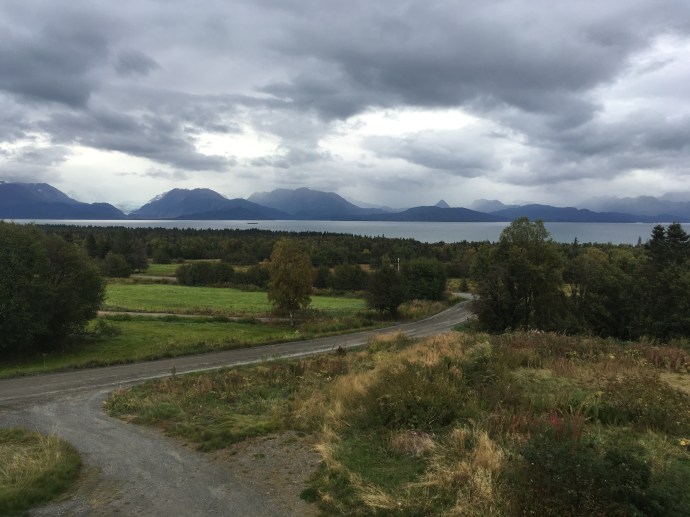
View overlooking Kachemak Bay from the patio at our AirBnB in Homer, AK
Ed and Chris. Homer Alaska. Tuesday September 3, 3:30 AM




 Chris Klejbuk and Ed Heimel travel adventure
Recent Comments