
Gatlinburg, TN April 11

Great Smoky Mountains at dusk from Roaring Fork Motor Trail
Two very different activities have occupied our last 24 hours. After completing yesterday’s blog, we realized it was still sunny and decided to go for a short drive. The Roaring Fork Auto Tour seemed to fit the bill, highly rated and seemingly just minutes from our lodging.

Roaring Fork Motor Trail at dusk, Great Smoky Mountains National Park
I say seemingly because it turns out the auto tour is a one-way drive and we were located at the end of the tour. This was discovered after ten minutes of driving around and ten minutes spent at Ely’s Mill, a local, looks like it is 100 years old, weather-beaten arts and craft store at the end of the trail. I think they survive by visitors like us getting lost and stopping in the store for directions. They had a pre-printed map all ready for visitors and plenty of stories. The store even carried T-shirts with pockets; unfortunately for them, I stocked up last Christmas with Duluth Trading Company pocketed T-shirt gifts.

A farm site carved out of the forest along Roaring Fork Motor Trail
The one-way auto trip rises up towards the top of mountains, traversing numerous ecosystems. Portions of the area were within the fire zone of November 2016. Hazy views that symbolize the name and nature of the Great Smoky Mountains are a primary gift of the ride. Hard as it was for us to believe, farming was a major economic factor in this region prior to the creation of the park. “Hardscrabble” life certainly fits the situation here. The isolation of the area created pockets of farming community that lived relying almost entirely on their abilities.
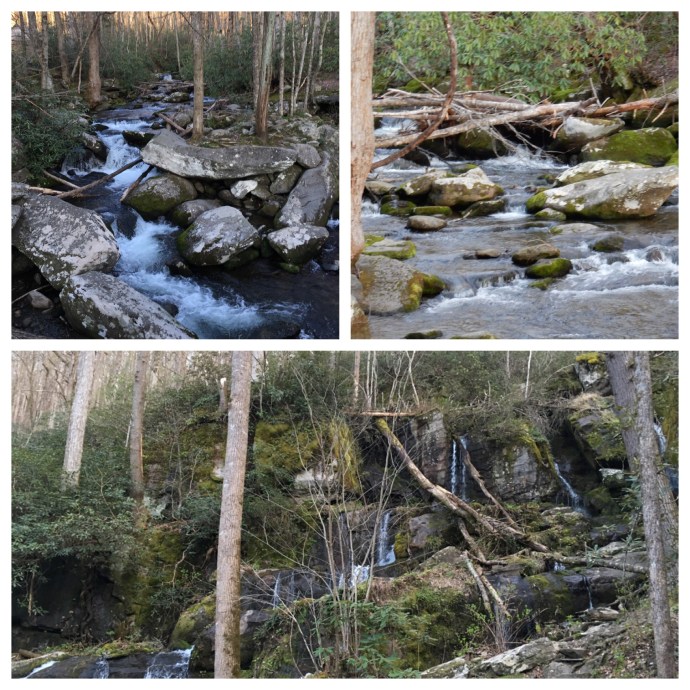
Roaring Fork Creek top; Place of a Thousand Drips bottom; along Roaring Fork Motor Trail Great Smoky Mountains
Mountain streams with clear, fast, cold water rushed down the hillsides. We passed over several creeks and passed by several small waterfalls. Different wildflowers appeared along the roadside than we had observed in the Elkmont region. The one way route meant no need to worry about oncoming cars but translated into waiting behind cars that had stopped on the roadway to take a picture. One of them later turned out to be a Knoxville woman who had grown up in the St. Paul suburbs. The trip turned out to be a very pleasant end to an already nice day.
Then we came to today, Wednesday. Our goal was to visit Oak Ridge TN, about 90 minutes away. Oak Ridge is home to the NPS Manhattan Project, one of the three national sites secretly created to develop the atomic bomb used to end WWII. We had not purchased tickets in advance; 16 tickets are available for advance purchase and 16 tickets are available on a first-come, first-served basis. Chris wisely called them Tuesday and they explained most tours sell out quickly. She recommended getting to Oak Ridge before 9 AM to get in line for the last 16 tickets. We did.
The Manhattan Project National Historical Park was established in 2015 to preserve portions of WWII-era sites where the United States developed the first atomic weapons. The other two sites are Los Alamos NM (which we have visited) and Hanaford WA. The project was top-secret; so much so that Vice-President Harry Truman knew nothing about the project until after the death of President Franklin Roosevelt.
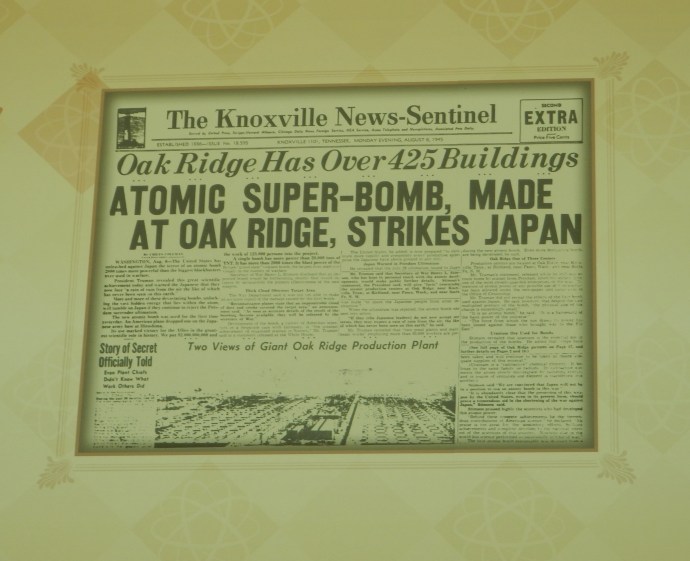
Local Knoxville paper after atomic bomb dropped and veil of secrecy lifted
Oak Ridge’s secrecy was stunning. Some examples of the scope include that a town of 70,000 people was constructed along with research and manufacturing facilities. Schools, hospitals, grocery stores were built. Oak Ridge had the seventh largest transit system in the country at the tine. At Oak Ridge, 13% of the nation’s electrical output was consumed here but no one knew why. 300 miles of road were built or improved, 55 miles of railroad track. The community knew it had some WWII effort behind it, but nothing more.
So what was here? Well, that was what we tried to find out today. A 40,000 square foot museum is open to all, but the three-hour bus tour which left at 11:30 AM is only open to 32 people. I am not a scientist and I may not be well able to describe Oak Ridge but I will give it my best effort.
Oak Ridge had three primary facilities; X-10 Graphite Reactor, K-25 Gaseous Diffusion Process Building, and the Y-12 Beta-3 Racetrack. The identifiers (X-10, K-25, and Y-12) are completely random to not provide any hint as to the purpose of each during the war years. The X-10 graphite reactor was a pilot plant to convert Uranium 238 into plutonium 239. The plutonium was eventually sent to Hanford which was the world’s first large-scale plutonium processing reactor. The building where this was conducted is still standing and we visited it during the bus tour.
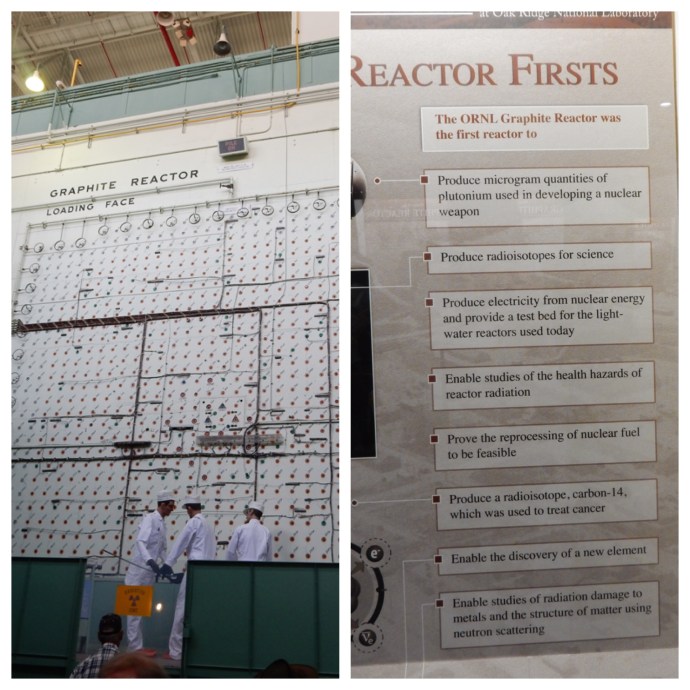
Graphite Reactor
X-10 has evolved into Oak Ridge National Laboratory, a scientific research facility under the Department of Energy. Basic scientific research is conducted here with facilities open to researchers from around the country. One of the largest supercomputers in the world is located here.
The K-25 Gaseous Diffusion Process was a huge building, half a mile by 1,000 feet, larger than the Pentagon. It was used to produce weapons grade U-238 from natural supplies of Uranium 235. The process here produced uranium 238 on the principle of that molecules of a lighter isotope would pass through a porous barrier more easily than molecules of a heavier one-U-238 being the heavier one. This plant alone employed 12,000 workers during WWII. Gaseous diffusion was the only uranium enrichment process used during the Cold War. The huge structure has been taken down and site clean-up and environmental remediation are underway to allow the land to be used for development by private business.
Y-12 was the facility producing uranium 238 under the third process. Here charged uranium particles are sent via a calutrons, essentially a mass spectrometer used to separate isotopes of uranium, through a series of huge electromagnets. Because copper was in such demand for military needs during the Second World War, Y-12 borrowed $300 million of silver from the U.S. Treasury to run the electromagnets. (I asked-the silver was returned by 1976.) Both the K-25 process and the Y-12 process were new technology and the buildings were constructed not necessarily knowing how, or if, the entire process would work out.

Moon box built at Y-12
Y-12 has evolved through the years to maintain a presence utilizing new technology. Y-12’s unique emphasis is the processing and storage of uranium and development of related technologies. Y-12 thus is responsible for maintaining the security and effectiveness of the U.S.nuclear weapons stockpile; for securing vulnerable nuclear weapons around the world and making that weapons marterial available for peaceful uses; and to provide fuel for the U.S. nuclear navy. Y-12 also has unique production capabilities so it undertakes special assignments like designing and making the two air-tight “Moon Boxes” that went on each of the Apollo missions to the moon to bring back soil and rock samples.
Y-12 employes 4700 people today in the Oak Ridge area. Security is tight, and admittance to the Y-12 (or Oak Ridge National Laboratory) is restricted. We passed through security checkpoints and had to provide proof of identification before being allowed to sign up and again before boarding the tour bus.
Our thoughts? The history was fascinating. The experience less great. The auto tour was overlong, the tour guides not offering much enlightenment in lay terms. We were told this was a not to miss experience, but in our opinion, the museum would have been sufficient. Learning how the government came in and removed the 3,000 people living here in less than a month was eye-opening. So was the massive construction crews efficiency, such as the fact that during one period a house was being completed every 30 minutes, while maintaining a veil of secrecy. As one might expect, African-Americans played a major role in the effort but segregation was still a reality. Young female high school graduates were a majority of the workers in the Y-12 process, tending to gauges and dials in the complex process while not understanding why the gauges and dials were important.
Evidently, this museum is being down-sized but up-graded technically in the next few months. The upgrade is needed, a number of exhibits spoke of history in the sciences that last occurred in the early 2000s. While this is a National Park Service site, we saw no rangers. The site is managed by the American Museum of Science and Energy. Supposedly the rangers were being relocated to the nearby Children’s Museum, why we could not fathom. Our visit there to obtain a NPS passport book stamp did not discover any rangers either. The Manhattan Project Historical Park is termed a partnership park with split responsibilities with other agencies. I have seen that partnership work much better at other park units.
We finished the day with dinner at home and listening to an entertainer sponsored by the resort. He played guitar and fiddle while telling stories and cornball jokes.
Ed and Chris April 12
 Chris Klejbuk and Ed Heimel travel adventure
Recent Comments