
Spencer, TN. March 26
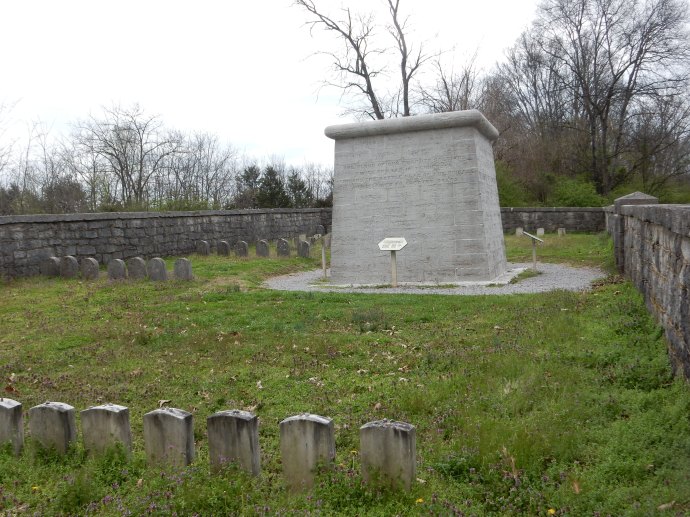
The Hazen Brigade Monument at Stones River National Battlefield. Probably the first Civil War monument erected.
We are a world away from the hustle and bustle of Nashville; its crowds, building cranes, and traffic. Tonight we are staying at Fall Creek Falls State Park, about 40 miles north of Chattanooga but a world away with its presence in forested mountains (1700 feet above sea level). The notable attraction here is the falls, at 256 feet high, one of the highest east of the Mississippi.
However, Fall Creek Falls is the end of our day. Our first stop this morning was at Stones River National Battlefield at Murfreesboro Tennessee. Frankly, Stones River is not a Civil War battle that I recollect ever hearing about. We stopped here since it was roughly on our way and it was a National Park Service site. Visiting here was a good choice.
Stones River is 25 miles southeast of Nashville and was right on the Civil War era tracks of the Nashville and Chattanooga Railroad. Thus, it was a strategic transportation crossroads. The Union army had a primary mission to cut the Confederacy in half. Victory here would be an important piece of that effort.
Lincoln was desperate for a victory. The Emancipation Proclamation was to take effect on January 1, 1863. Yet at the end of 1862, Grant was bogged down at Vicksburg and Burnside’s army had lost a battle at Fredericksburg. Rosecrans was the only hope left and the pressure from Washington was intense. On December 31, 1862 Rosecrans Union Army faced Bragg’s Confederate Army at Stones River. On December 31st, intense day long fighting left the Confederates feeling good but the Union troops still held many of their positions.
The intense fighting forced the two sides to use Jan. 1, 1863 to regroup, bury the dead, and address the wounded. On January 2nd, the battle resumed and while early fighting went the way of the Confederates, the Union Army used 57 cannon to stop and drive back the Confederate advances at great cost to the South. The 3 day battle inflicted grave consequences: for the Union 13,249 casualties; for the Confederacy 10,266 casualties. Bragg had to retreat from the area and Lincoln had the victory he wanted to emphasize the Union’s ability to implement the Emancipation Proclamation.
While visiting the battlefield we talked to some of the staff. We met the Superintendent who is leaving in a few days for a temporary, additional assignment to oversee the redevelopment of the National Park units in the Virgin Islands which had been heavily damaged by Hurricane Irma and Maria. She was familiar with the Mississippi National River and Recreation Area (MNRRA), our home NPS site, due to previously working at Indiana Dunes National Seashore. The superintendent there was previously in change of MNRRA and Chris and I had met him.
One of the volunteers at Stones River was a retired Army soldier and we chatted about the National Park Service. He also emphasized the differences between Western, Middle, and Eastern Tennessee; and reinforced the value of visiting Oak Ridge Manhattan Project NPS site west of Knoxville which is on our schedule when we return home from Great Smoky Mountains National Park.
Stones River has an informative museum and short video. We also drove the scenic loop and walked to various locations that were critical to the battle. When the battle was won, the Union forces established a major supply depot in Murfreesboro that served the Union well on Sherman’s drive to the sea. Another stop was at Hazen Brigade Monument. Colonel William Hazen’s brigade was the only Union troops who did not retreat during the December battle that favored the Confederacy. The fighting was so bad, the area was called “Hell’s Half Acre. In 1863, Hazen’s men had a monument built to honor their fallen comrades. It is the earliest known Civil War Monument. Most Civil War monuments were not built until the late 1880s or 1890s as the veterans wanted memorials built to commemorate battles before the veterans died.
Booze was our second stop. Jack Daniels to be specific. The 42 miles from Murfreesboro to Lynchburg TN took us an hour as we enjoyed the hilly terrain. Jack Daniels offers several types of tours, we did not select one in advance not knowing what time we would arrive. When we were at the ticket counter our choices were a dry tour (no liquor sampling) beginning in twenty minutes or one with liquor beginning in an hour. It was an easy choice for us, soon and sober was our selection.

Finished product at Jack Daniels Distillery, Lynchburg TN
Technically Lynchburg is located in a dry county, meaning no liquor can be sold. Jack Daniel’s nephew (Jack Daniels never married) was heading the business after Prohibition, ran for the Legislature, won and introduced a bill, that passed, allowing them to sell commemorative bottles that happen to have liquor inside and to run educational classes about alcohol that happen to include sampling the product. Or so said our guide.

Jack Daniels statue in front of cave with spring water. Daniels was only 5’2” with a size four shoe
The Jack Daniels story involves several heart warming aspects. First, the founder Jack Daniels built up the business after running away from home as a child, by buying up the land around the spring that provides the water at age 13, and by avoiding extra revenue agents at his distillery by never distilling more than 99 barrels of liquor per day. Mr. Jack began working at the distillery at an early age.
He had two mentors; the first being the owner, Rev. Dan Call, who sold the business to him when his parishioners told the reverend to either preach or make moonshine. Rev. Call chose preaching. The second mentor was a freed slave, Nearest Green, who was effectively the first master distiller here. Green’s heirs still work at the Jack Daniels distillery today. The distillery had to weather Moore County becoming a dry county and Prohibition but Jack Daniels nephew, Lem Motlow, persisted and the company has grown ever since. It is now owned by a conglomerate, Brown-Forman.

The original Jack Daniels office where he kicked the safe
The tour lasted about an hour. You walk through areas involved in all of the steps making the liquor from the wood burned for charcoal filtering to seeing the barrels being stored for aging. At the building housing his original office, we were told how Mr. Jack had arrived early to work one day (not his usual style) and had to open the safe. He did not remember the combination and kicked the safe in frustration. The stubbed toe got infected, multiple amputations occurred, and he eventually died of gangrene. Choose your take-away message: #1. Don’t arrive early to work. #2. Don’t kick a steel safe. Our guide did talk fast and in some noisy areas we did not always hear everything she had to say. BUT, as an added bonus we and three others were able to see a rat scurry along the floor.
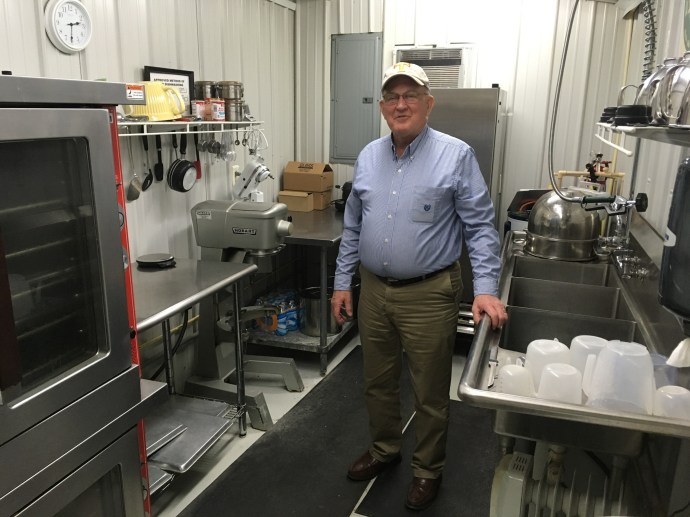
Billy Thomas in his Lynchburg Cake and Candy Company
After Jack Daniels, we made a stop at the Lynchburg Cake and Candy Company, another heart warming story. The owner, Billy Thomas, retired as an accountant and mayor of Lynchburg. In 2003 he decided to start a hobby with a goal of making 50 cakes a month from a family recipe. The cake recipe uses one of the Jack Daniels liquors. Well he is still a hometown business operating out of a small building but he now has ten employees. He and the product have been on Nashville Public Television, “The View”, and “Food Network”; his product can be found in regional Cracker Barrel restaurants and in Kroger grocery stores. We met Mr. Thomas and he gave us a detailed explanation of the company grew, how he keeps costs down, and his extremely high sanitation rating. Quite impressive. Of course, we purchased a cake, a package of the whiskey balls, and several bags of whiskey praline pecans, although at the moment all are still unopened.
We drove two hours though Tennessee mountains to Fall Creek Falls State Park. The park is about 70 miles north of Chattanooga on the Cumberland Plateau. Tennessee and Kentucky have numerous parks with resort lodges, this is one of the Tennessee ones. Fall Creek Falls is the largest Tennessee State Park at 26,000 acres. It is known for its gorges and waterfalls. We will be spending two nights here. Our lodging is pleasant with a view overlooking the lake formed by damming Fall Creek, and the restaurant offers buffet meals that were quite tasty. And there is no admission fee to KY or TN state parks.
Ed and Chris. March 27
Epilogue: Snippets on life in America from Chris
Day 11: Many of us feel like we are living in very, very troubling times in our country. A good reminder (which is impossible to do in Minnesota) is to visit a Civil War battlefield site. The horror, the bravery, the carnage. Communities were destroyed and families took sides. The Civil War lasted for four years.
 Chris Klejbuk and Ed Heimel travel adventure
Recent Comments