
Ellsworth, Maine Sunday Sept. 17

Cruising around Acadia NP and the Cranberry Islands with a fog bank
What happens when travelers wake up at 5 AM? Well, they are waiting for the breakfast doors to open at 6 AM; they are one of the first to shop at the grocery store when it opens at 7 AM; and they “squeeze” in a 2.75 hour boat ride along with hiking 11 miles by dusk. Oh, and they have Maine lobster for lunch and Maine blueberry pie for an afternoon snack. All in all, a fulfilling day although by the end of the last hike, I think a turtle would be walking faster than I was.
Chris and I are in New England for a twelve day adventure. We get to see Deb and Rebecca for four of those days. Saturday was the travel day; we had decided to fly and rent a car versus one of our usual multi-week driving tours. No hassle flying. Driving a rental car is less fun now that we own a newer vehicle. I miss the compass, the back-up camera, the adjustable cruise-control, the quieter door lock sound, etc.
Driving from Boston’s Logan airport, I had left an “avoid tolls” feature in the Google maps driving directions. When we got to the New Hampshire line, we took a thirty minute extra drive and were able to observe a running race, a craft festival, and lots of back roads of New Hampshire. Not a problem though as we had just enough time to have a quick dinner and make it to 5:30 PM church in Kittery Maine. Chris accepted the invitation to bring up the gifts at the Offertory so everybody in church got to wonder who were these strange folks. We made it to the Hampton Inn Ellsworth at 10 PM and crashed.
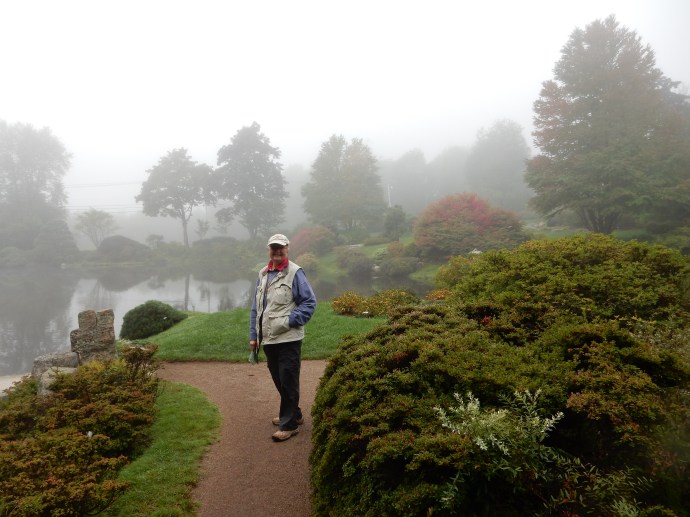
Asticou Azalea Garden in Northeast Harbor on Mount Desert Island Maine
As you know from paragraph one, we got up early. Our boat cruise was scheduled for 10 AM (please arrive at 9:30 AM they had requested) so we had two hours available to drive a thirty minute trip. Our first stop was at the Asticou Azalea Gardens, only a little over 2 acres in size but wonderfully laid out even when azaleas and rhododendrons are not blooming. A person was out sweeping away gathered leaves so the dirt paths were immaculate. We were impressed with the juxtaposition of plants and shrubs; everywhere one looked was another stunning layout. We should not have been surprised, the Gardens are part of the Mount Desert Land & Garden Preserve, a total of 1,165 acres of gardens, lawns and trails set up decades ago by the Rockefellers to preserve the land for all to enjoy.

our first carriage road hike in Acadia National Park
After the gardens, we took our first hike along one of the famous carriage roads of Acadia National Park. The 45 miles of carriage roads were built between 1913 and 1940 when John D Rockefeller and his family built motor-free byways for horse and carriage to travel around Mount Desert Island. The carriage roads are an example of attention to detail; Rockefeller oversaw much of the work. The road has a deep base with a heavy crown to drain water away. The roads follow the contour of the land, using native granite for the stone and accenting the roadway with native vegetation. Bridges received particular attention; using bridges in New York City’s Central Park for inspiration. While the bridges are steel-reinforced concrete they are faced with native stone.

Upper Hadlock Pond viewed from a carriage road
The walk was pleasant; the roadway smooth and the trees line both sides with overhanging arches. Few people were out. We turned around before making our hoped for destination, one of the bridges based on a bridge in Central Park. We wanted to make sure we were at the cruise docks on time. Of course, we were early. The cruise boat was about the size of the boat we had taken two years ago to Isle Royale National Park, and even though it was not fancy, it was much nicer than the Isle Royale one. It holds about 50 people, we had maybe thirty plus two Park Rangers and two crew-one of whom was a retired park ranger.

Harbor at Hortheast Harbor
The boat ride lasted for two hours and forty-five minutes around the Cranberry Islands, a series of five islands just off Northeast Harbor. Forty five minutes of that was at the town of Isleford, a community of year-round residents, most of whom still fish, and summer residents, who take the daily mail ferry back and forth to the mainland as necessary. Isleford is on Little Cranberry Island. The Cranberrys were named after the fruit which is native to the area. The Native Americans introduced the Europeans to the berry.
Little Cranberry Island has a museum dedicated to the history of the European people who moved here, with fishing being the primary reason to settle here. Maine was settled relatively late; the English and French were contesting the area. After the 1763 Treaty of Paris resolved the issue, settlers came here in greater numbers. They were attracted by the offer of land from the Commonwealth of Massachusetts. Maine remained part of Massachusetts until 1820 when it split off and became a separate state as part of the Missouri Compromise.

lobster pots at Isleford
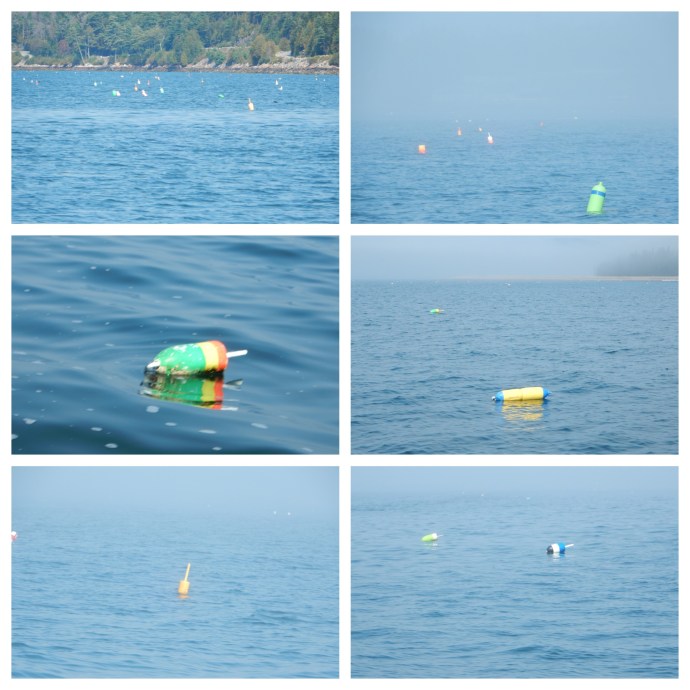
Lobster buoys in the water
In Maine, logging and fishing were early commercial activity. Fishing is good due to the currents of Arctic cold water that flows in here, above the Gulf Stream warm waters. Cod was the early fish caught here, salted and shipped around the world. Cod was over-fished and fishermen here who normally go back generations remember that and have taken precautions to keep the lobster fishing from repeating that mistake.
On Little Cranberry, I observed stacks of lobster pots and buoys. Each fisherman has a buoy that is distinctively painted to identify his buoys. The buoys are tied by rope to the pots on the bottom of the ocean; normally several pots are tied together. The fisherman will check the pots once every one to three days and can have several hundreds pots of his own. They may place their pots as far as 20 miles out to sea, or right next to the shore. On our cruise we saw numerous buoys in the water, with the variety of colors a remarkable occurrence.

On Somes Sound looking toward Cadillac Mountain (on the right)
The rangers staffed the museum at Isleford and narrated our trip through the water. We saw cormorants, loons, harbor seals, eagles,etc. The fog removed the chance to view much, but not all, of the shoreline and coast. No matter, the fog presented unique photographic opportunities.
After the boat trip, we had a lobster lunch in Northeast Harbor. Chris and I split a lobster roll and a lobster salad. Both were good but we preferred the lobster salad. Then we headed back to the carriage roads and trails, finishing our trip to Hadlock Pond where we examined one of the 17 bridges Rockefeller had built; this one was specifically modeled after a bridge over the lake at 59th Street in Central Park.
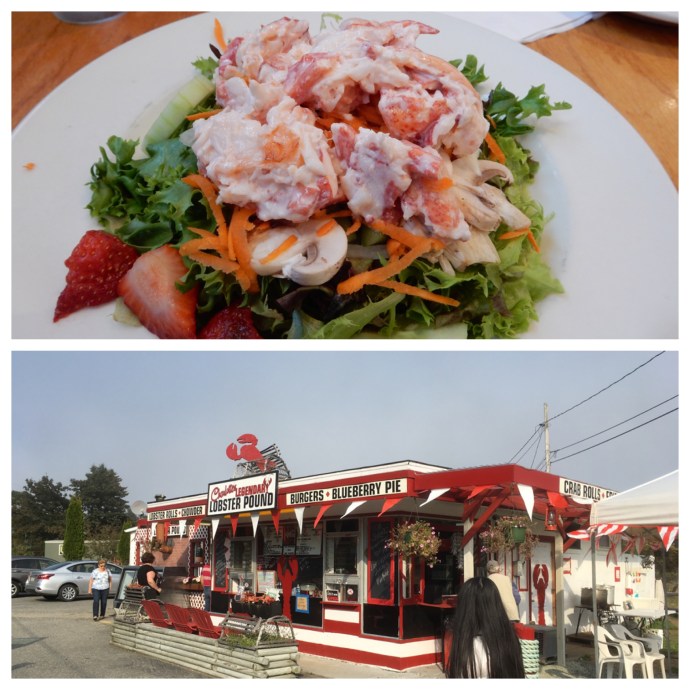
Food for the day
Two separate hikes to the coast followed, the Wonderland hike and Ship Harbor hike. But before hiking, we fortified ourselves with fresh blueberry pie and ice cream at a small, roadside stand in Southwest Harbor. We could have had a lobster dinner at this place too. We also made a quick visit to a lighthouse which could have been skipped.
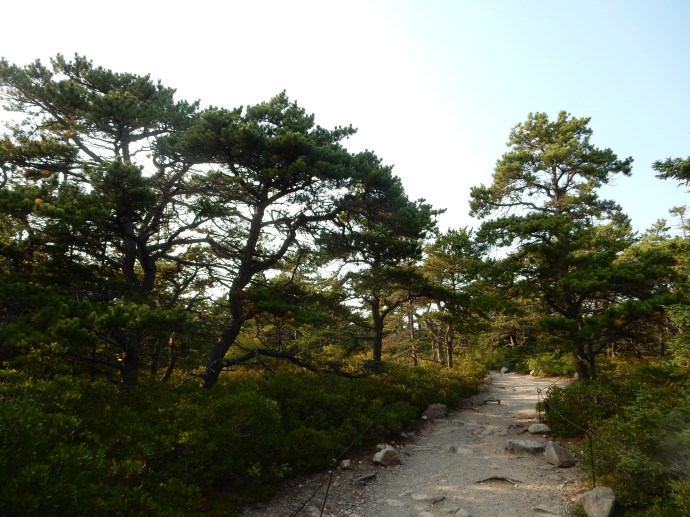
The Wonderland hike

The Ship Harbor hike
Each hike traveled through the woods leading to the ocean, with the path alternating on rocky ledges and on soft forest paths. It was low tide with minor waves. The Ship Harbor hike was more interesting, longer, and more varied. Fog was intensifying again and daylight starting to lessen so we headed for the hotel and a cheese pizza before we collapsed for the night. It was a long but extremely fulfilling day; it was not until the next day that we realized how truly peaceful and quiet our day had been.
Ed and Chris. Ellsworth Maine. Sept. 18
 Chris Klejbuk and Ed Heimel travel adventure
Recent Comments