
Miami Beach, FL April 5

Birds in Biscayne Bay, part of Biscayne National Park
Wednesday we returned to the beach. It was a quiet day, people-watching-wise. Sunny and warm, in the 80s, causing us to rent the umbrella and lounge chairs to make sure I did not turn lobster red in the south Florida sun. The afternoon forecast was for rain around 3 PM; it came at 2:30 PM.
At first we thought we would ride out the rain on the beach. No lightning, it was warm, we would have been wet if we had gone in the ocean, etc. But the rain continued, came down harder, temperature started dropping, wind started blowing the rain under the umbrella, etc. so we packed up and got wet walking back to our time-share. The rain and humidity continued long enough to make us feel justified in leaving the beach. Dinner was left-over chicken from previous nights, nothing fancy.
Thursday we left Miami Beach by 8 AM to drive south to Biscayne National Park. The national park is primarily water, islands and keys, and land underwater. It takes about an hour to reach it, and traffic was reasonably clear. Biscayne National Park’s visitor center is near Homestead Florida, a town that had been heavily destroyed by Hurricane Andrew twenty-five years ago in 1992.
In 1990, Homestead’s population was 27,000. Today it is estimated at 67,000. We saw evidence of the new housing development along with expansive nurseries growing palm trees, etc. for the Miami area market. We even passed two huge landfills, one we were told had grown enormously with construction debris from Hurricane Andrew; the second, smaller one growing now with construction debris from Hurricane Irma when it hit here and at the Keys last fall. Airplanes from the neighboring Homestead Air Force Base were frequently overhead. We passed the Homestead Speedway, a NASCAR racing circuit location.
But eventually we arrived at ocean side, the Biscayne National Park. To learn more about the park, we took a three-hour boat ride with a park ranger out to one of the keys, Boca Chita Key. It takes one hour to reach Boca Chita Key across the bay, you have one hour on the key, and a one hour boat ride back.
Creation of the park has an interesting story; like many NPS sites it was born out of controversy of competing interests. As Florida was developing in the 1950s and 1960s, a group of commercial interests were pushing for a major shipping port and a commercial/residential complex to be located on the shore and the keys in this area. At the same time, environmental groups were recognizing the unique value of Biscayne Bay.
The commercial interests went so far as to bulldoze a “highway” six lanes wide and seven miles long down the middle of one of the keys to limit its natural value. They lost. President Johnson signed legislation creating Biscayne National Monument in 1968. It was upgraded to a national park in 1980. It currently comprises over 170,000 acres, 95% of which is water, stretching from south of Key Biscayne to north of Key Largo.
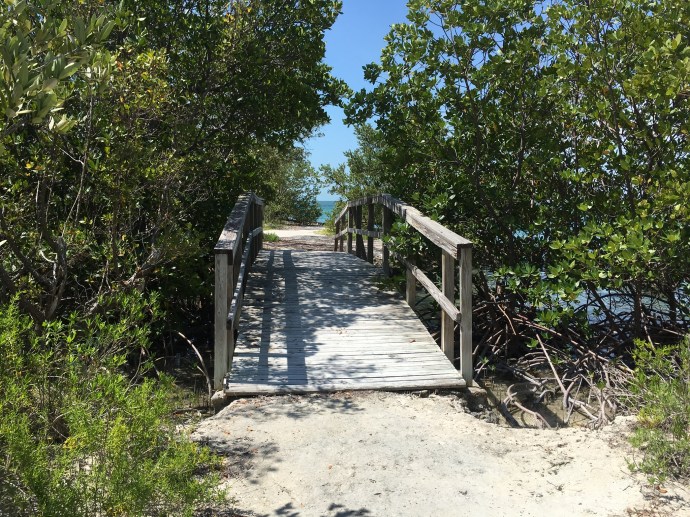
Red Mangrove trees while hiking on Boca Chita Key, part of Biscayne National Park
First off, you should understand the difference between a “key” and an “island”. An island was created by geological forces; deposits of sand, uplift of the earth’s core, volcanic action, etc. A key was created by the actions of biology, coral reefs. The islands and shoreline are formed by limestone deposits, the bottom of the bay is only six to eight feet below the water level. In some areas the bottom as just a few inches of dirt and soil, while in other areas the dirt on top of the limestone deposits is deep enough to grow saltwater grasses. Both keys and islands exist here and protect the shoreline from wave and storm action by the presence of the rock/coral outcroppings and the mangrove forests located on them. Mangrove forests, of red, black and white mangrove species, also exist on the shore of the mainland.
Our boat ride out was on calm water, clear skies and temperature around 80 degrees F. We only saw one sting ray, no dolphins and plenty of birds. The ranger told us the history of the park and the diversity of plant and fish life here. Two power plants south of here were constructed prior to the National Monument, early operation allowed for direct dumping of their hot “cooling” water and the heated water practically killed life in the Biscayne Bay. The plant operators (willingly or not, I am not sure) switched to an on-land recycling system to cool their water and the bay has since thrived. The plant and fish life here are a feeding grounds for all sorts of larger fish, on up the food chain.
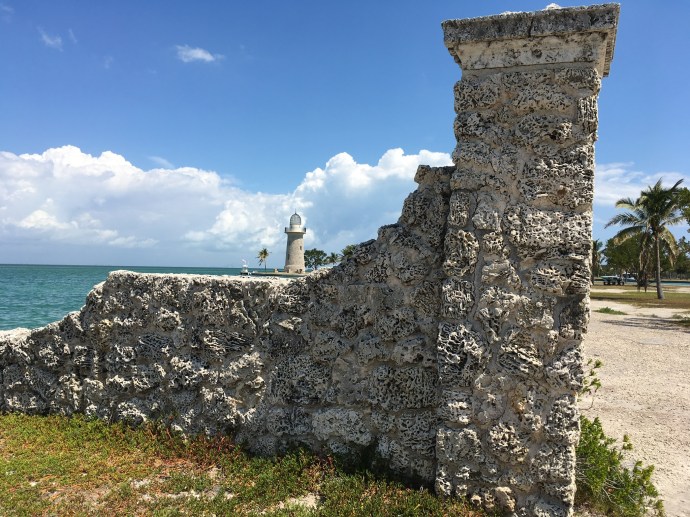
Fake lighthouse on Boca Chita Key, part of Biscayne National Park
Boca Chita Key was the site of a rich man’s toy; Mark Honeywell of the Honeywell thermostat company, was one of many rich people locating a warm second home retreat in Florida, starting back in the late 1880s. His house on Boca Chita Key was built in 1937 and included a fake lighthouse. We climbed up to the top of the lighthouse when we toured the island. He only stayed a few years as his wife died here from a fall.
While I could say more about Biscayne National Park, I will just conclude with the comment that the three-hour trip was fun, educational, and cost-effective. We were pleased to make the trip. Our decision was enhanced as once again the clouds rolled in and rain cleaned our car as we left the park for a late lunch. We were hungry for a burger, not having one for quite a while. A recommendation led us to “Chefs on the Run” in Homestead where we had a delicious burger and fries. We brought back a homemade chocolate cake which we have not tasted yet.
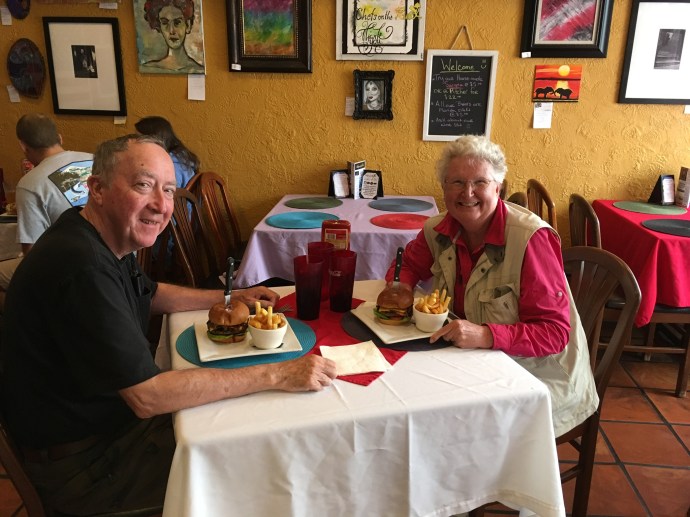
Chefs on the Run in Homestead FL
Tomorrow we leave Florida, driving back north with stops in Georgia, South Carolina, Tennessee and Kentucky.
Ed and Chris. April 5
Epilogue: Snippets on life in America from Chris
Day 21: Unless you are a direct descendant of Native Americans-one of the approximately 562 indigenous groups, then you are a descendant of immigrants to this land. How white does one’s skin need to be an American? What a frightening time we are living in. And the hatred is fueled by our president. Diversity is one of the factors that made this country great.
 Chris Klejbuk and Ed Heimel travel adventure
Recent Comments