
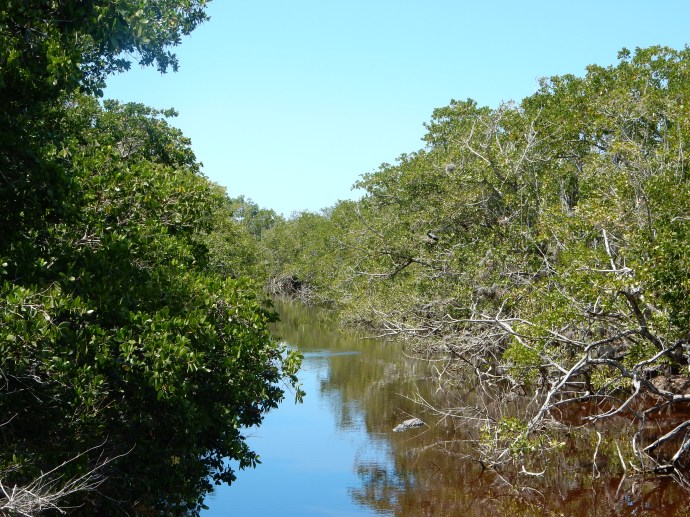
Can you find the alligator?
North Fort Myers, FL. March 31
Ding Darling National Wildlife Refuge is located on Sanibel Island on the Gulf Coast of Florida. It occupies about one-third of Sanibel, about another one-third is protected conservation areas under other authorities and about one-third is developed with buildings no higher than the tallest pine tree. Ding Darling is the most visited national wildlife refuge in the U.S. with about one million visitors per year. We have frequently encountered people and Refuge rangers who said we just had to visit here. So we did.
Saturday, we spent the entire day at Ding Darling, arriving around 8:30 AM to hike the Bailey tract, a marsh area near the Gulf of Mexico. The area was quiet, some people were out hiking but it was not real busy. In terms of beauty, the area was so-so; but the function of wildlife refuges are to protect the habitat for birds and animals, not to grow public gardens.

Our tram-it filled up completely and we also observed people being turned away from the 1 PM tour
We had previously made reservations for a 90 minute tram ride at 11:30 AM along Wildlife Drive with a naturalist to talk about the refuge and what we were seeing. By now it was 9:30 and at the visitor center we made arrangements to transfer our reservation to the 10 AM tour which had a few seats available. It was a good decision, the naturalist was knowledgeable and she enlightened us about numerous topics as we drove along. Bird sightings were plentiful.

Red mangrove at Ding Darling National Wildlife Refuge
Ding Darling was hit by Hurricane Irma in 2017, we could see where some of the oldest and tallest mangroves had been knocked down. Research has shown that mangrove forests can decrease hurricane impact by 30%. Where mangroves had been knocked over, new mangroves were already growing, their new shoots green under the open sky created by the destroyed, taller trees. Red mangroves have a root system that looks like your hand upside down with fingerlike roots growing down into the water that makes the tree look like it is a person walking. (There are also white and black mangrove trees.)
This estuary refuge with its combination of salt and fresh water is the only place mangroves grow, they can tolerate the mix of water types. On one stop we noticed mangrove crabs, ugly crabs that thrive living on the trees, not along the beach. At another stop, we could see manatees in the distance doing their courtship ritual, splashing and frolicking in the water instead of their usual just cruising along.

Squadron of American pelicans and a reddish egret
A squadron of pelicans was standing in a marsh, surrounded by smaller shore birds and a reddish egret. We were informed that the reddish egret is relatively rare and this refuge is one of the few where you can frequently see them. Great blue herons, ibis, egrets, swallowtail kites, osprey, and other birds were easily seen. The American pelican is the second largest U.S. bird, after the California condor. The pelican has a nine foot wingspan; the bald eagle has a wingspan ranging from 6-8 feet.
After the tram ride, we had a quick sandwich for lunch at one of the many retail hubs on the island and then back to the refuge. This time, we went on the Indigo trail with a volunteer guide. This woman and her husband are spending five months here before taking a month off to “re-position” themselves and their RV to Grand Teton National Park for their sixth, five month summer volunteering stint there.

While Ding Darling is the most visited national refuge, it has still seen its annual federal allocation reduced by 50% in the last years-a reflection of our national priorities. Volunteers are critical to its existence. The refuge has over 300 volunteers, they staff the visitor center. The volunteer groups raised the funds and built the new visitor center without federal dollars.
Ding Darling Refuge is named after J.N. “Ding” Darling, a Midwesterner who drew editorial cartoons for the Des Moines IA Register. He also spend vacations in Florida. Darling was known for his fierce emphasis on protecting the natural environment and his cartoons were an important messenger in an era where newspapers were the critical force in national life. He began the national duck stamp program, was the founder of the National Wildlife Federation, and served as FDR’s first head of the agency that was the forerunner of today’s Fish and Wildlife Service.

The two friendly alligators
The Indigo trail hike was too much for a family with three young children who preferred the beach today but the rest of us enjoyed the hike through the refuge, learning about the inter-relationship among the plants, insects, water, trees and birds. Towards the end of the hike, we watched two alligators. Initially 100 feet apart, the second slowly drifted towards the second gator, eventually laying quietly together on the shore bank just inches from each other.

A new mangrove tree growing in the estuary, likely to form another island in the future.
Following the hike, Chris and I drove the Wildlife Drive in our car, replicating the ride we had on the tram. This time although the pelicans were still around, fewer birds were to be seen and the manatees were no long visible. Switching to the 10 AM tram ride had been a good decision. After visiting the lighthouse, we left Sanibel Island at 5 PM to re-fuel at dinner for Sunday’s adventure.

Sanibel Island lighthouse
Ed and Chris. April 1


 Chris Klejbuk and Ed Heimel travel adventure
Recent Comments