

The type of Nike air defense missile stationed at Everglades National Park from 1962 to 1979.
Florida City, FL. April 6
We never knew the U.S. had a missile base in the Everglades. Now we, and you, do. The Cuban missile Crisis of 1962 identified a lack in perceived readiness against a hostile missile attack. Previously the U.S. only prepared for a Soviet missile attack over the North Pole. The Cuban Missile Crisis made evident a need to protect against an attack from the south. This and more we discovered during an excellent presentation by Ranger Leon today on our second ranger led program.
We took advantage of two ranger led programs out of the Royal Palm Information Center. The Royal Palm area is the initial foundation of the Everglades. The Florida Federation of Women’s Clubs worked with the State of Florida to create a state park to protect about 1,000 acres of the Everglades. The state park was incorporated as the heart of the Everglades when it was made into a national park in 1947.

A large turtle along the Anhinga Trail at Everglades National Park
The first ranger program was a walk along Anhinga Trail. Once we got on the trail, Chris and I remembered this walk from a decade or more ago when a German couple on the ranger walk were shocked that an alligator had earlier that day just walked right by them on the path when they were pushing their baby stroller. No such excitement today although we took some excellent turtle pictures.
The ranger again talked about the wet and dry seasons. This year, the dry season which is just ending, has been wetter than usual. Some of the areas we have observed, including the canal along the Anhinga Trail, would have been dry most years. It is possible some of the increase in wetness is due to the recent bridges just built over U.S. 41 allowing more water to flow naturally south than has been the case for over a hundred years when canal building began.

Along the Anhinga Trail at Everglades National Park
Ranger Leon did a great job re-creating the feeling of October 1962 when the U.S. discovered the Soviet Union had installed offensive nuclear missiles in Cuba, 90 miles south of the U.S. The U.S., and indeed the world, was on tenterhooks while the two superpowers postured and negotiated. There was an extremely high chance of a nuclear confrontation. As in any conflict, the possibility of a mistake or an action taken by any one of many lower level military commanders of either side could escalate the conflict out of control. In fact, there were numerous near-chance accidents.
As one of the actions taken while the negotiations were occurring, an Army Missile Battalion deployed to an area just outside the Everglades. The Missile Battalion was on war readiness to shoot down incoming missiles while living in a tent city in mud and mosquitoes. Park Managers gave permission to build a site within the park and Nike Missile Site HM-69 was built within the park-the mosquitoes moved with them. It was operational until 1979. We were able to tour the site today.

The Administrative offices of the Nike Missile site, now the Everglades research offices.
The pink painted buildings were a surprise but otherwise Ranger Leon expressively laid out the reality of life on the base. Mud, snakes, lightning strikes (Florida has more lightning strikes than any other state and at least one soldier died here due to one.), snakes, high shoot to kill security, Jim Crow laws in nearby Homestead, etc. all were part of life here.

Replica of actual sign on missile site
Young men led by only slightly older officers had to maintain a state of high readiness for years. The closeness of Cuba meant immediate responses would be necessary. Other Nike missile sites were deployed around the country but this site was the last to be de-activated. This one site (U.S. Army’s 2nd Missile Battalion, 52nd Air Defense Artillery, A Battery) received exceptional honors for its performance during the tour of duty here.
It was gratifying to me to hear that this presentation was started by a National Park Service volunteer ten years ago. It is offered daily Dec. 1 to March 31st and the first two weekends in April and has become an extremely popular tour.
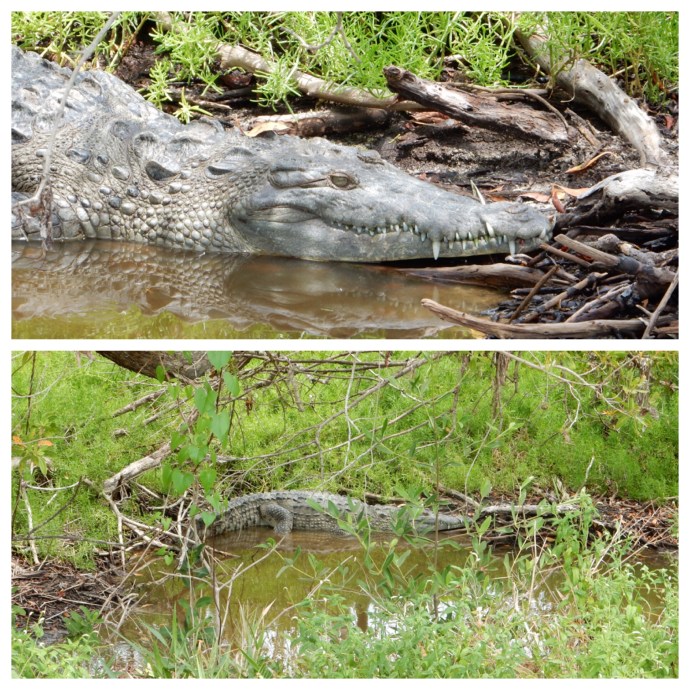
The only crocodile we saw in the Everglades. We did see hundreds of alligators.
Ed and Chris. April 7
 Chris Klejbuk and Ed Heimel travel adventure
Recent Comments