

In the space of 10 hours, we went from areas almost deserted of people to extremely dense communities. It was a day of contrasts. Leaving the Fairfield Inn of Carlsbad, we drove to Guadalupe Mountains National Park. In western Texas, just below the border with New Mexico, the Guadalupe Mountains, rising steeply from the plains, are the remains of an ancient marine reef, uplifted over time. 47,000 acres or half of this park is wilderness. There is no scenic drive or criss-crossing the park on paved roads. Given its location away from major interstates, even the non-wilderness areas are not crowded. The park visitor center had a limit of 6 people at a time. Was not a problem when we arrived.
Since we are past the point of even considering back packing into the wilderness, we undertook two morning hikes that would give us a flavor of the park. The hikes presented some history of the area and a view of the varied plants that exist in this arid, mountainous land. We kept our hikes to the area around the visitor center. The park visitor center is at 5700 feet although Guadalupe Peak at 8751 feet is the highest point in Texas. The temperature was 40 degrees but the wind was gusting so hard, even the birds were not flying around. Flowering shrubs and plants were still evident, despite the lateness of the season.

Nde, or Mescalero Apache, were living in this area in the 1800s and fought the U.S. Army from about 1850 to 1880 to retain their homelands. They lost. Cattle ranches generally took over their land. The Mescalero have a reservation northeast of Alamogordo.

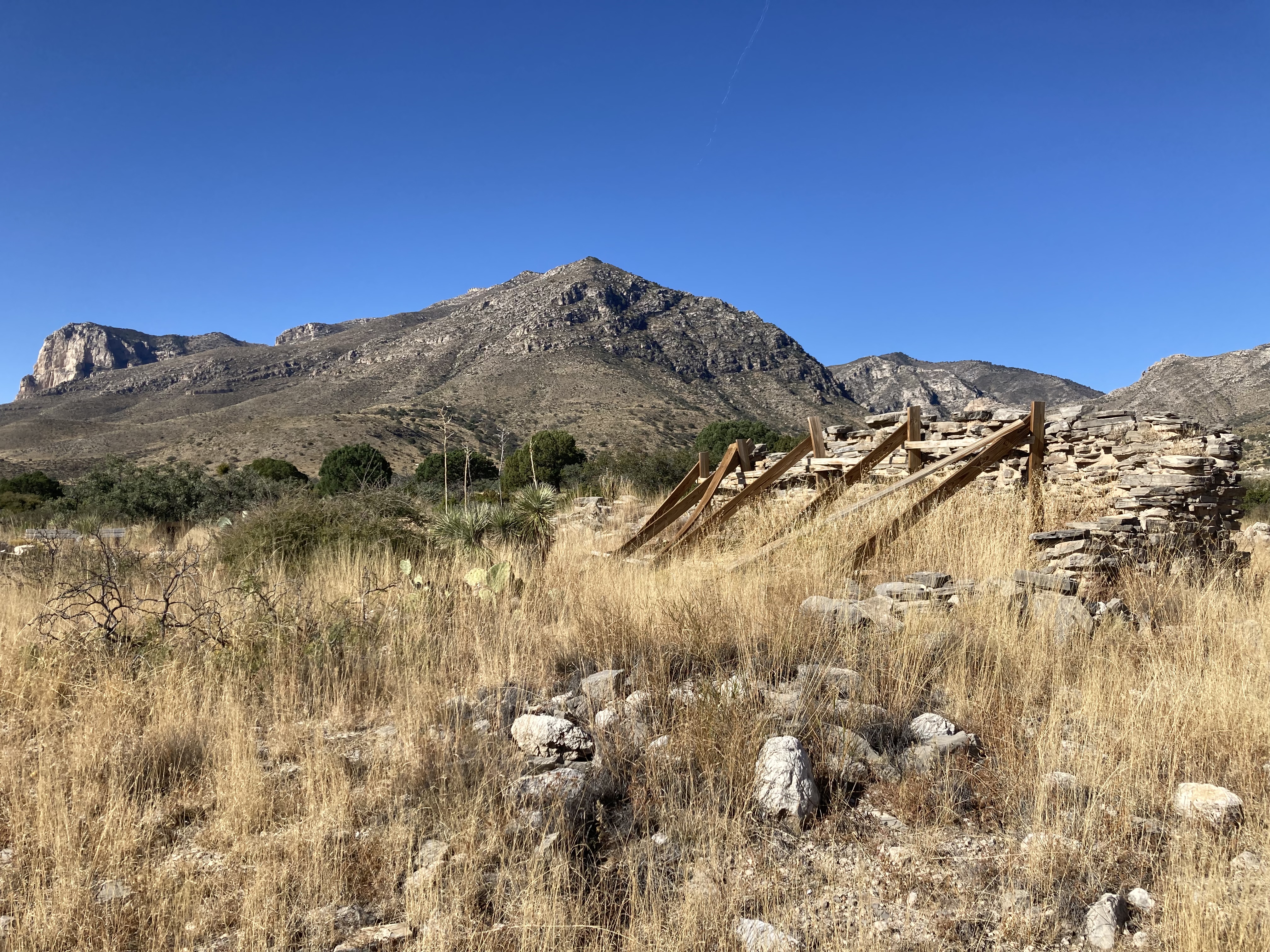
The first overland mail route from St. Louis to San Francisco went through this area. The Butterfield Overland Mail was the first successful attempt to deliver the mail across the country. Previously mail went by ship around the tip of South America. This 2700 mile overland route was competed in 25 days with coaches being driven night and day by rotating shifts of drivers and mules. The Butterfield only lasted 11 months (Sept. 1858 to August 1859) on this route before being shifted farther south and then curtailed due to the Civil War. A small ruin (see photos above) still exists on park property.


Driving to our next stop in El Paso took us to lower elevations and warmer weather. First, though, we had to drive along the edges of the mountains and through scrubland and salt flats. El Paso, at just under 700,000 people is the 23rd largest city in the United States. It pops up quickly, to our eyes there was not a lot of urban sprawl. While trees, shrubs, and grass exist, there is no canopy of tall trees projecting a cover of green. Homes, businesses, concrete, and yards of dirt and stone are the images that remain in ones mind. But obviously people are comfortable here. A town does not reach a population of 700,000 people without positive attributes.
We were here not to evaluate El Paso but to visit Chamizal National Memorial. Chamizal celebrates history and cross-cultural artistic endeavors. Due to Covid-19, the art aspect has been curtailed. We were left with the history portion, which provided a rich lesson in U.S.-Mexican relations. This will not be a long history lesson but several salient points need to be made.
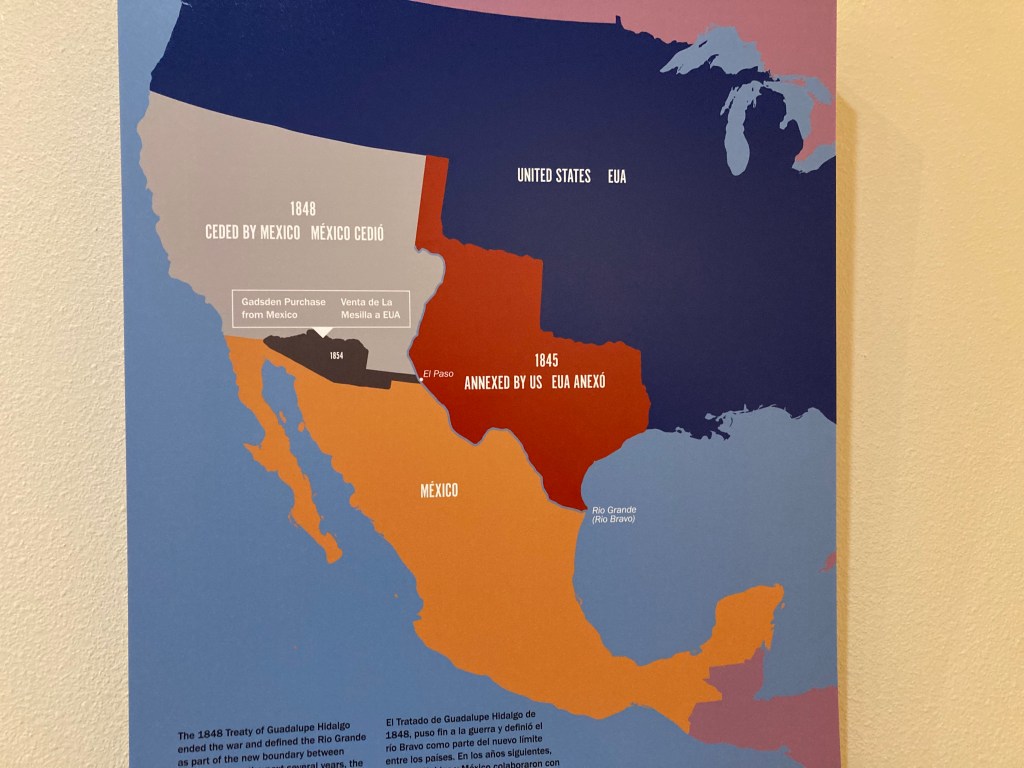
Over time, the U.S. has absorbed or taken one-half of Mexico’s original land mass. One half! Imagine if it was the reverse, and one-half of the U.S. was now part of Mexico or Canada. California, Nevada, Utah, Arizona, New Mexico, Texas and part of Colorado all were originally part of Mexico. For the most part, borders have been surveyed and agreed upon. Disputes have arisen and resolved although not always quickly.
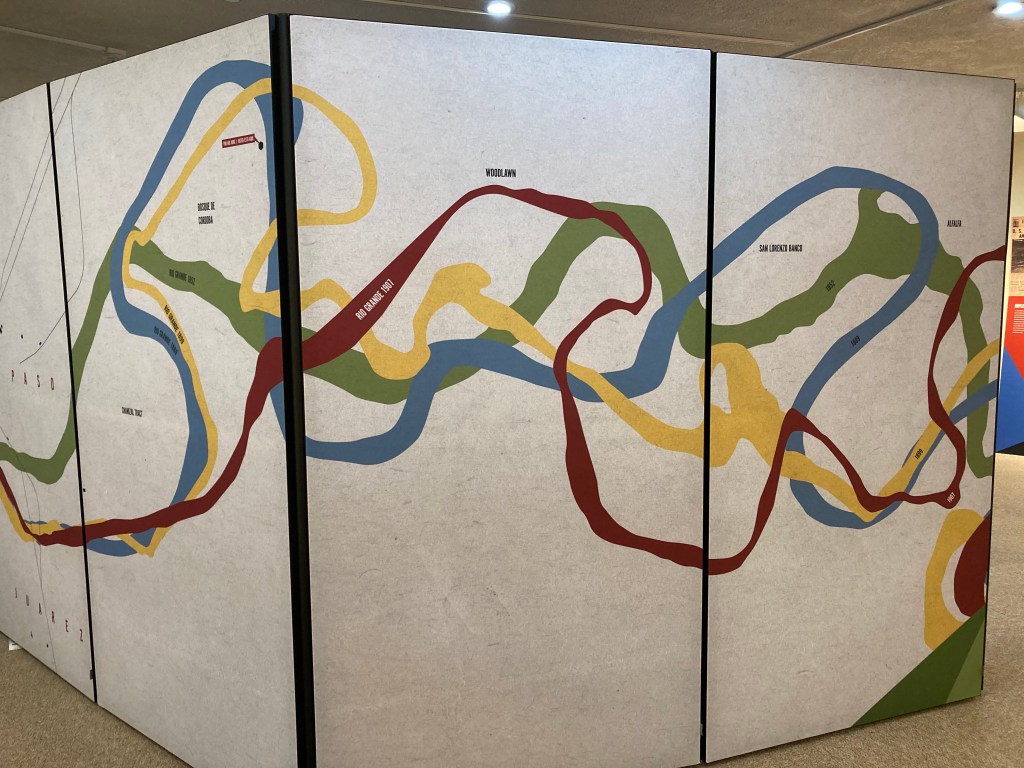
Some of the borders are along rivers. As discussed earlier in this trip, rivers can move due to floods and other weather phenomena. We have seen portions of Iowa and Nebraska end up on the ”wrong” side of the Missouri River. There are two understandings about border changes due to river changes. Accretion is the process of a river changing slowly due to erosion of one bank and the addition of land on the opposite bank. In this case, the boundary moves with the river’s deepest channel. Avulsion is the process where a river changes suddenly, leaving its river bed and adopting a new one. Under this process, the boundary remained in the old river bed. Over the history of river changes by the Rio Grande and Colorado Rivers, border issues have had to be addressed frequently. (The photo above with different river paths marked by various colors demonstrates easily how land can shift from one side of the border to the other.)
One case remained unique. Without going into great detail, a section of land called Chamizal was caught in a tug of war between El Paso in the U.S. and Ciudad Juarez in Mexico. Shifting boundaries created a flash point that began in 1866 and went to formal dispute resolution in 1895. It took personal involvement of the two Presidents to resolve the dispute in 1963! Resolution of the dispute meant the purchase of hundreds of homes and rebuilding of public facilities. People and communities were uprooted due to the long delay in resolving the dispute. Through displays and videos, Chamizal National Memorial commemorates this peaceful, although delayed, difficult dispute resolution.
El Paso was left behind as we drove back into New Mexico. Our plan is to visit two more national park units before reaching Flagstaff. Las Cruces, a community of 100,000 will be our base for the next two days. The town grew through farming and the railroad, enhanced by the establishment of New Mexico State University here. Now, it is a space hub. White Sands Missile Range and Test Facility are here. Spaceport America and Virgin Galactic have their headquarters in the Las Cruces area.
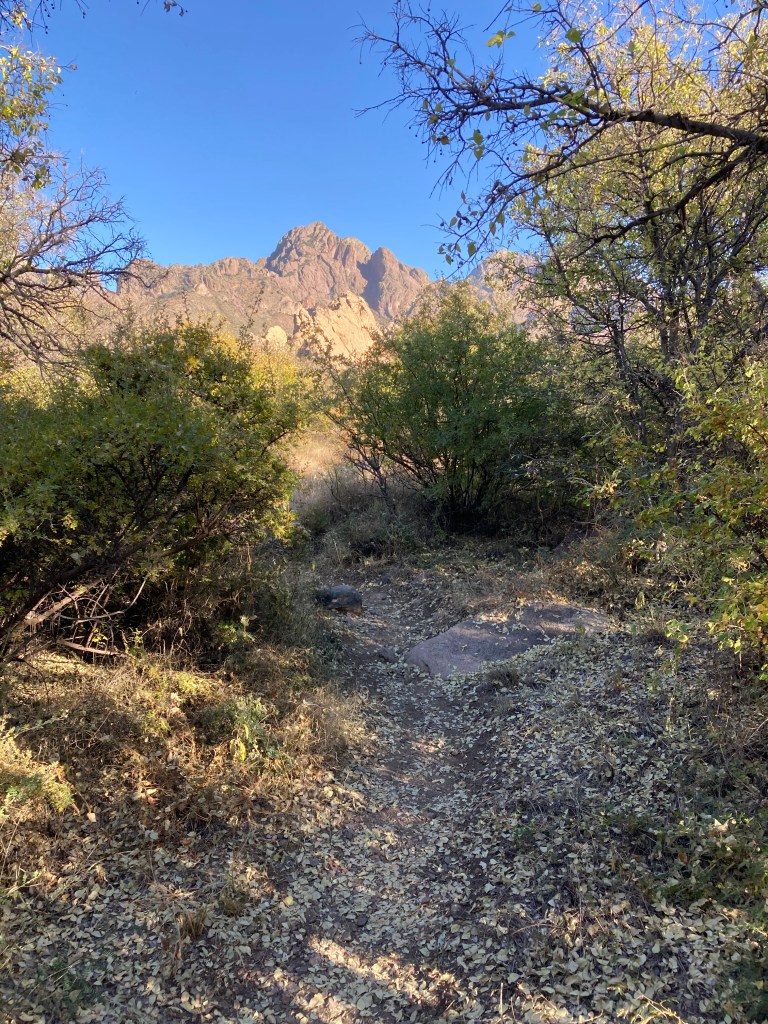
The Bureau of Land Management administers the Dripping Springs Natural Area of the Organ Mountains-Desert Peaks National Monument east of Las Cruces. The Dripping Springs section has a colorful history. Unfortunately, we arrived too late to spend extensive time here. We managed to get in a hike before the national monument gates were closed. The national monument has several sections worth investigating that are on our potentials list for the next few days.

Ed and Chris, Las Cruces New Mexico Thursday Nov. 18, 2021
 Chris Klejbuk and Ed Heimel travel adventure
Recent Comments