Posts Tagged With: Grand Marais MN

2018 Trip 6: The Gunflint Trail, Dec. 5-6

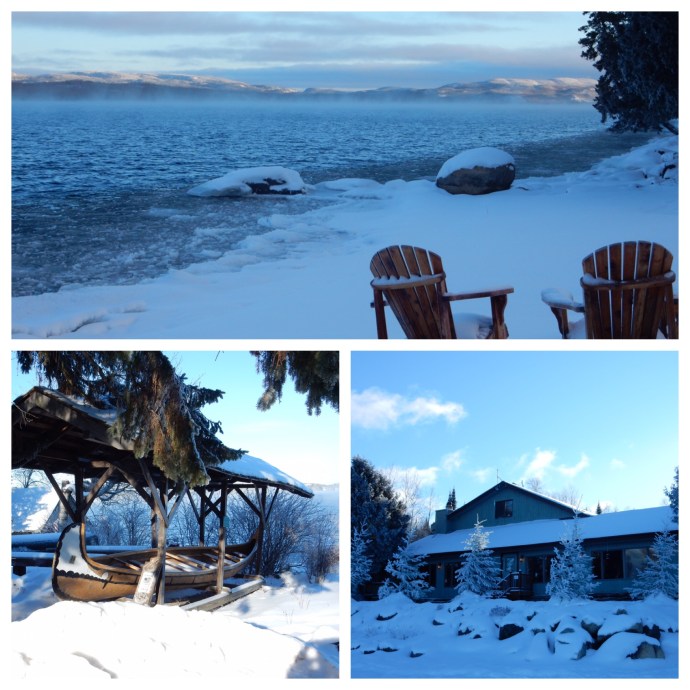
Gunflint Lake from Lookout Point

Gunflint Trail, Grand Marais, MN Dec. 5-6

Wednesday was our last full day at Gunflint. We hiked up to Lookout Point for a high view of the still unfrozen Gunflint Lake. We overheard at the lodge that almost all other lakes had frozen over, evidently Gunflint is frequently one of the last lakes in the area to freeze over. Of course, this is the same place where I heard one gentleman state: ” I used to drink Pabst Blue Ribbon but then in high school I switched over to Miller’s.”

Driving to the end of the Gunflint Trail

Still hoping to see moose, who did not come wandering in front of our cabin window, we drove the last 12 miles of the Gunflint Trail. The day had started to lightly snow, sort of the snow that you know is fake on the Hallmark Channel Christmas movies; a light, wispery couple of flakes here and there. As we drove to the end of the trail, seeing neither people, autos, or moose, the snow increased. We probably ended up with an additional two inches of light, powdery snow that day. Chris took a few pictures of rocks to prove we had been here.

We even skipped lunch, despite it being paid for in our meal plan. We have just been enjoying the food, eating more than we normally would at home. Another meal might have had us explode-and it would have made it difficult to finish the larger meals served at dinner time. Our last Christmas cards were addressed, completing one of the tasks we had brought with us to work on during slow times. One more naturalist program awaited us. John, the naturalist, is a jack of all trades and gave an afternoon performance of country music. Besides enjoying the music, we conversed with him about various country artists. John knew much more than we did, but we were able to pitch in about several country western museums that our 2018 travels had brought us to.

Thursday morning at Gunflint Lodge

Leaving Gunflint Lodge and driving back to Grand Marais

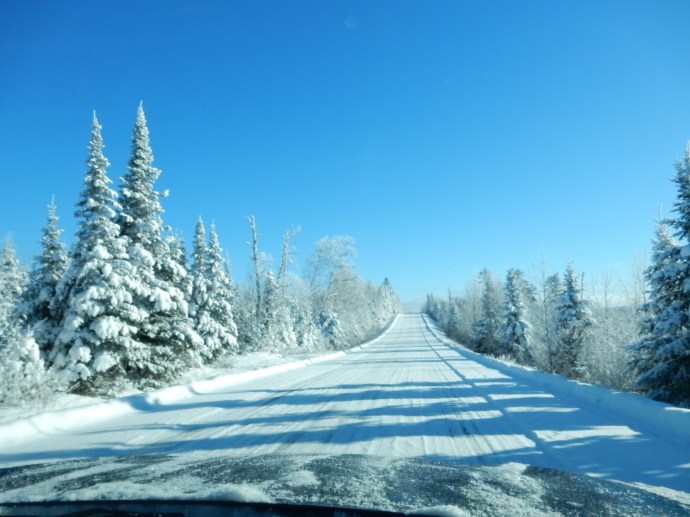
Thursday morning we packed up and said good-bye, thoroughly enjoying our time at the Gunflint Lodge. I know I drove slower than the locals on the way back to Grand Marais and Highway 61 since I pulled over several times to let cars pass. The two inches of powder from the day before was primarily packed down; the snow plow we saw was heading up the Gunflint and had no impact on our driving lane. A shopping stop in Grand Marais was successful for some items for me and a few Christmas gifts. The drive to St. Paul was still another 4.5 hours but under sunny skies. The truism that cloudy skies in winter are usually warmer than clear skies was accurate today. The blue skies made for brighter pictures but it was probably 10-15 degrees colder than Monday through Wednesday.

Have you ever been asked by a company how you found them, internet, direct mail, etc? In most cases, when I even remember, it is a mix of factors. Such it was for our next stop, Wild Country Maple Syrup. We had left Grand Marais and were heading home. Along the side of the road, I observed one of those state transportation signs thanking a person, family, company, etc for picking up litter along a particular section of the road. This sign thanked Wild Country Maple Syrup. It rang a bell. My cousin and her husband had mentioned this place after their recent visit to the North Shore of Lake Superior. Chris did a quick search and found that the company was about a 20 minute drive off Highway 61. We looked at each other and said why not, we are retired, what is another hour or so for the drive home.

Sap collecting tubing lines at Wild Country Maple Syrup

The 20 minute one-way estimate was accurate even those the miles were much less. Once again, the paved clear road transitioned down to a snow-covered lane and a half road lightly traveled. As we neared Wild Country, we noticed the plastic lines my cousin had mentioned. This company taps into thousands of maple trees over the 320 acres of land they own. 60 plus miles of food grade PVC tubing collect the sap in the spring and bring it into the sugaring house. When sugaring is over, all of the lines and 18,000 plus taps have to be cleaned. At the site, the sales building had an open sign. Well, that was accurate. The door was open and interior notices indicated this was an honor system of payment. You took your selections of maple syrup, noted them in the ledger, and then dropped cash or a check in one box or used an app program to pay by credit card. We dutifully complied and left without seeing a soul.

We made two other quick stops, one at the gift store at Split Rock Lighthouse (nothing of interest) and at the Rustic Inn Cafe for a meal/snack. From there, it was all clear sailing until reaching St. Paul around 7 PM. Next trip, two weeks in Orlando in mid-January.

Wild Country Maple Syrup sales building

Ed and Chris Saint Paul MN Dec. 7

Categories: road trip, travel | Tags: , , , , , , | Leave a comment

2018 Trip 6: The Gunflint: Dec.3-4

High Falls of the Pigeon River at Grand Portage State Park,MN

Gunflint Trail, MN (Boundary Waters Canoe Area Wilderness) Dec. 4

Chris is starting her 70th birthday celebration six weeks early. This is a winter vacation in the north woods of Minnesota. Monday morning we left Duluth. It is 110 miles to Grand Marais where we turn NW to our lodging at Gunflint Lodge. The trip from Duluth to Grand Marais is all along the Lake Superior shoreline. We decided to go 40 miles past Grand Marais and visit Grand Portage State Park. Since we are on our second go-round with visiting all of MN’s state parks, visiting Grand Portage at the tip of the Arrowhead region made sense. The state park highlights the High Falls of the Pigeon River which forms a portion of the boundary between Canada and the U.S. We have been in the area before, writing in blogs in 2014, 2015, and 2016 so I am not going to go into details.

Chris and Ed at the High Falls, the walking sticks belong to the group of five women.

The High Falls are 120 feet compared to the 135 feet of Manitou Falls in Pattison State Park in WI which we visited Sunday. The falls here are much more impressive. We had our picture taken by a group of five women friends visiting the area and celebrating the falls with glasses of wine. After picture-taking, we back-tracked to Grand Marais and began the 42 mile drive up to the Gunflint Lodge.

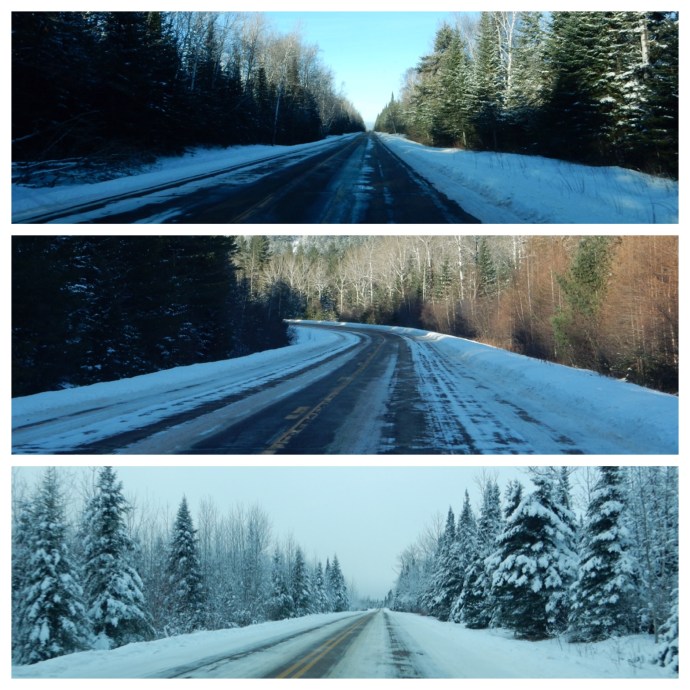
Road transition top to bottom on the Gunflint Trail.

The Gunflint Trail is a 57 mile scenic byway stretching from the city of Grand Marais on Lake Superior northwest to the Canadian border. The landscape is a transition zone of the boreal forests (fir trees) and the hardwood forest, interlaced with lakes, rivers, and bogs. The drive begins as an uphill drive from the lakeshore up the cliffs into the forests. The road is paved but given the snowy weather, the clear pavement gradually becomes more snow-covered as we drive further inland.

This area is home to state and national forests, to numerous resorts, cabins and outfitters, and to the Boundary Waters Canoe Area Wilderness. The BWCA is 1,000,000 acres of wilderness devoted to canoeing, hiking and fishing. As regular readers know, we are not going to be doing outdoor camping. We are staying at the Gunflint Lodge which has been around for 90 years, although much modernized from those early days. We had hoped to see the northern lights but cloud cover is going to put that idea out of mind. There is a regular naturalist program and we plan to attend several of the programs. (Remember last summer’s Geezer Camp? This is definitely more upscale.)

Chris, Gunflint Lodge, and Gunflint Lake

The lodge is located on the south side of Gunflint Lake, on the north side of the lake is Canada. The use of the term Gunflint stems from hard rock, frequently called chert. Native Americans and French Voyageurs found that the chert could be used as the spark (or flint) for igniting flintlock muskets, ergo the name which is still in use. Winter outdoor activities at the lodge, depending on the weather, include snow shoeing, cross-country skiing, dog sledding, hiking, fishing and sledding. Summer activities are broader, including outfitting services if you wish to go on canoe trips into the BWCA.

Gunflint Lake has not frozen over yet. Ice was forming but wind-driven waves destroyed the early ice and has prevented the lake from freezing over. Smaller lakes are frozen. This area receives more snow than the Twin Cities; not deep enough for snow shoeing yet but noticeably deeper than back home.

The lodge top; our cabin bottom

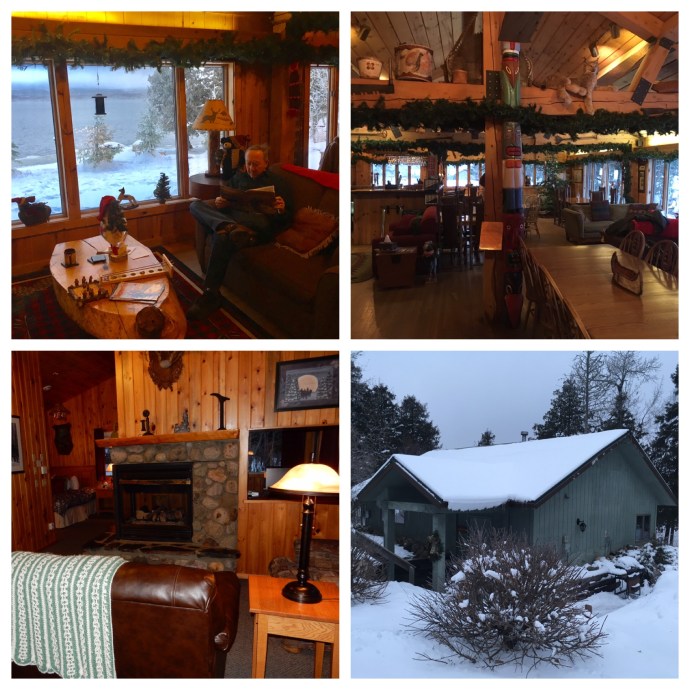
Gunflint Lodge has about 50 cabins ranging from one to five bedrooms. We have a one bedroom cabin right next to the water. Mid-week early December is relatively slow. We chose a cabin for lodging with the meal plan option; all of our meals are provided in the lodge. The meals have been very good and there is a wide selection. Staff that we have met range from people who have been here for over fifteen years to some newbies just arriving for a stint of several months to a year. The lodge used to hire foreigners on work visas; in today’s changing legal environment that is not an option. We were told that all of the resorts up here were seriously understaffed this summer. Still there are over 20 staff working here from a dog musher to wait staff to a naturalist. Most live on the property; it is a long drive to Grand Marais. It took us an hour and a quarter to drive the 42 miles.

There is no cell service up here and Internet is only available in the lodge, hence the delay in writing and posting the blog entries. The idea is to relax and get away from day-to-day stress. People seem to enjoy the idea, although there is some use of the wi-fi by visitors in the lodge-including us obviously. Visitors and staff come from all over. The ones we have met have come from Roseville MN, South Dakota, Rochester NY, Atlanta, and Milwaukee.

On the hike to Lonely Lake from Gunflint Lodge

The trail to Lonely Lake

on the trail to Lonely Lake

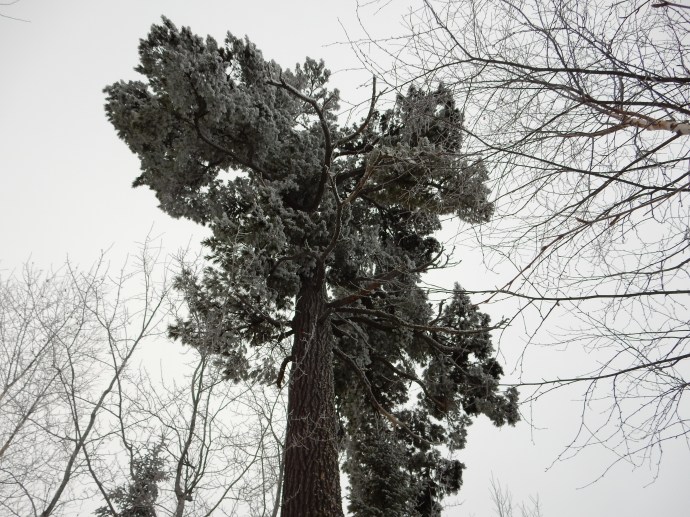
Tuesday we spent most of the day, excluding meals, attending naturalist activities. A two-hour hike in the morning with the naturalist took us to Lonely Lake through a forest of spruce, tamarack, white pine, birch, and aspen. The trees had a cap of snow on many of the branches. The skies have been consistently cloudy but the shades of gray along with white and green still provide attractive vistas. We saw jays, ravens, pine grosbeaks, and chickadees, no wolves, bear, or moose.

In the afternoon, we were indoors. We made dream catchers and listened to presentations on northern lights and shipwrecks of the Great Lakes. It has been a relaxing and enjoyable time so far.

Chris and Ed at Lonely Lake

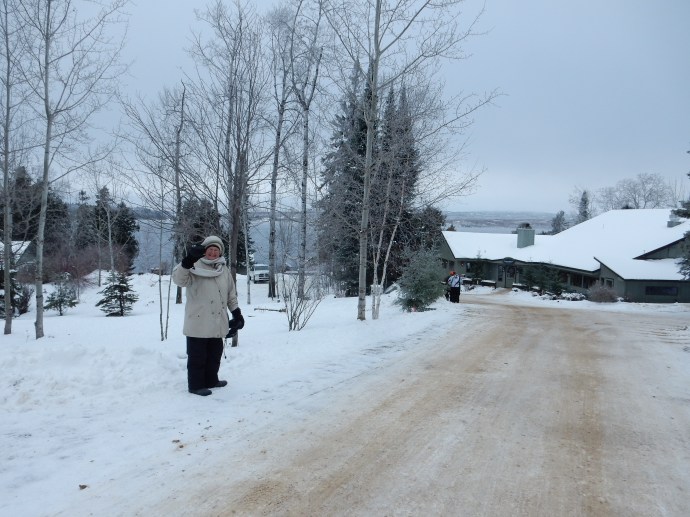
Ed and Chris. Dec. 5

Categories: travel | Tags: , , , , , , , | 4 Comments

2016 Trip Five, North Shore of Lake Superior, June 12-17

Little Marais, MN. June 16 Thursday

Finally, clear skies. Luckily we have one full day plus our return trip to enjoy nicer weather. Not that we haven’t enjoyed our time up here, it is just better when it is sunny.
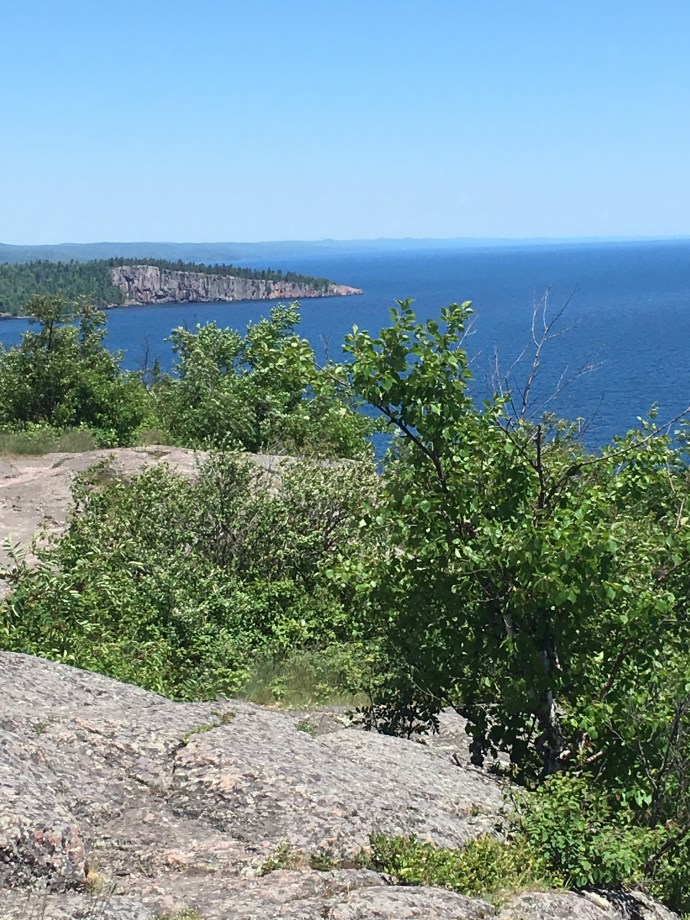
View of Lake Superior from Palisade Head near Tettegouche State Park on MN North Shore

View of Lake Superior from Palisade Head near Tettegouche State Park on MN North Shore

“Here” is the North Shore of Lake Superior, a 151 mile drive from Duluth, Minnesota to Grand Portage, Minnesota at the Ontario border.  This is called the North Shore, but the road generally goes northeast, although with curves it meanders in most directions except south, and frequently you are driving true eastward. Technically, that would mean one is on the west shore of Lake Superior, but rationality and logic don’t always win out over popular tradition. This has been called the North Shore for decades, we won’t fight it. So it is the North Shore.

Chris and Kathy at Tuesday night's bonfire at Lakeside Cottages

Chris and Kathy at Tuesday night’s bonfire at Lakeside Cottages

Our cabin at Lakeside Cottages, Little Marais MN

Our cabin at Lakeside Cottages, Little Marais MN

Chris, her sister Kathy, and I, are spending five nights and six days at Lakeside Cottages at Little Marais MN. Little it is, population 30. This is an independent, small operation, similar to the ones that used to line Highway 61 along the North Shore for decades. Many of those old-fashioned places have gone out of business in favor of newer, fancier resorts. Lakeside Cottages  suits us just fine; no TV, clean and comfortable, gracious hosts, and a picture window that looks out at the lake. Our hot spot provides Internet service and a portable boom box plays NPR and CDs. Our plans are to read, do puzzles, relax, and do some hiking and minor touristy type activities. Plus, some knitting for Kathy.

View from Shovel Point at Tettegouche State Park

View from Shovel Point at Tettegouche State Park

On the hiking side, two of the mornings, Chris and I left Kathy behind to work on her knitting, puzzling and reading while we headed off for some longer hikes. Tettegouche State Park is just 10 minutes south of Little Marais with a new visitor center and several nice hikes. Tuesday morning we drove down and made our first hike be one out to Shovel Point. There are several overlooks along the path providing great views of Lake Superior, although this day was cloudy and foggy. The path has been improved by the installation of numerous wooden steps to ease the way up, and down, the bluffs. I counted 655 such steps on the return, that makes over 1300 steps for that hike. Good exercise.

The geology of the North Shore includes ages old igneous rocks that have weathered very slowly. The Sawtooth Mountains and Superior National Forest are to the west of the lake, and the entire path of Highway 61 takes one along bluffs, green pine and deciduous trees, and blue lake water. Because of the igneous rock and mountains, numerous waterfalls line the shores and are frequently located in state parks. After the hike to Shovel Point along Lake Superior, we hiked to the High Falls of the Baptism River in Tettegouche.

Due to the rain, all of the rivers have been running strong. High Falls on the Baptism was no exception. The hike through the woods was not too bad, a few muddy spots but generally just wet and slippery. Picture taking was not the best with the clouds and with the location of the river crossing not being over the falls themselves. But we did the best conditions would allow.
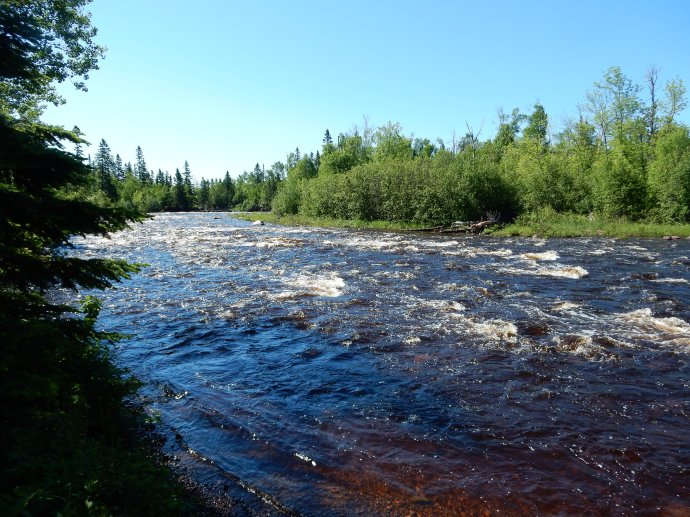
Temperance River above the falls, MN North Shore

Temperance River above the falls, MN North Shore

Better pictures came on Thursday. This morning Chris and I drove about 20 minutes northeast to Temperance River State Park. We skipped the lower pools that are located between Highway 61 and Lake Superior and headed upriver. The Temperance is named because unlike the other rivers running into Lake Superior, there is no sandbar at the mouth of the river where it meets the Lake. (No bar, temperance, get it??) The trail follows the river through the gorge, then reaches the flat plains before continuing on up to Carlton Peak. Chris and I  had climbed the Peak previously and turned back after hiking out for about 45 minutes.

Temperance River on MN North Shore

Temperance River on MN North Shore

The rock formations of these rivers make for interesting cascades, waterfalls, potholes, gorges, etc. And unlike the Southwest which we just visited, there are forests of green trees surrounding the rivers. The combination of blue skies, green trees, gray and red rocks, and the blue/tan river water makes for pleasant viewing. Most of the rivers have a brownish color. This originates from the iron deposits and from decaying organic materials that create humid acid. Frequently the tumbling action of the water going over the rocks creates a foam. Unlike some other rivers, this is not pollution since there is no industrial development along these short rivers running into the lake. Most of the mining in northeastern Minnesota is located farther west in the Iron Range, not along the North Shore. ( I am trying to upload a video of the Temperance River which I think is quite good but either WordPress or my home Internet is not cooperating. Not sure if you will get to see the video or not.)

Both parks allowed us to continue our efforts to complete the MN DNR State Parks Passport Club. This is an program encouraging people to visit all of the Minnesota State Parks, stamping the name of the park in a “passport” book to prove you made it to the park. We started this in April of 2015 and the program has induced us to visit portions of Minneosta we might not otherwise visit.

Our historic/cultural activities included introducing Kathy to the Finland Historic Society and its guided tour at a recreated village outside of the town of Finland, MN. Yes, most of the founders of the town came over from Finland, taking ships that brought them to Duluth and them small ships or trails that brought them to this remote area. There were no roads connecting the North Shore to the rest of Minnesota until 1929 when Highway 61 was completed. Until that time, ships dropped off supplies to small villages along the shore and immigrants hiked further inland to claim their 160 acres of homestead land.

Logging was the major industrial activity in this area. Logging would occur in the winter; at spring time, cut logs would be sent down the rivers to the lake where they would be towed over to Ashland WI for processing. Eventually local logging railroads were built to replace the rivers and allow for year round lumbering. Most of those trees were sent to Cloquet MN for processing. Farming was not profitable, the soil was too rocky. The Finland museum had a nice exhibit. Excellent actually for a town of its size.
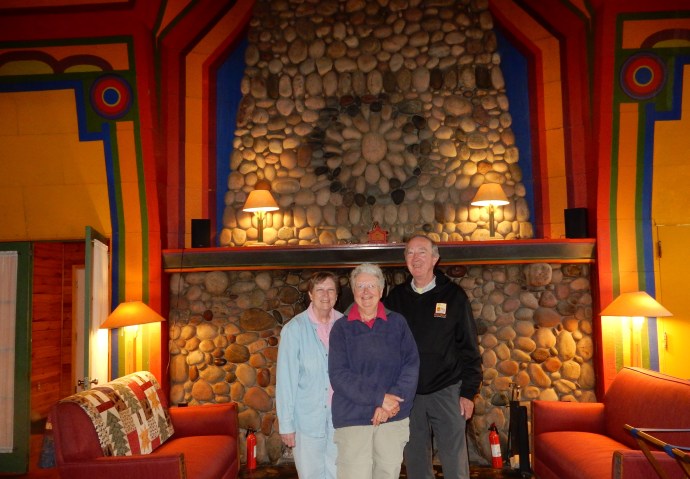
Dinner at Naniboujou Lodge with the fireplace and Cree Indian design in background

Dinner at Naniboujou Lodge with the fireplace and Cree Indian design in background

We spent an afternoon in Grand Marais, MN. GM is the local hub of the area farther north of Duluth. It markets itself on artistic endeavors and wilderness experiences. We traversed the floors of several galleries and stores, making a few small purchases. Dinner was at Naniboujou Lodge; an inn founded in 1929 by a group of wealthy Easterners. As you might expect, the Great Depression put an end to its grand pretensions but it continued as a hunting club and now it is a rustic inn and restaurant, just 25 miles from the Canadian border.

The interior of the dining room at Naniboujou is exquisite. There is a huge fireplace, created out of native Minnesota stone. Supposedly it is the tallest native rock fireplace in MN. The colors in the dining room are vibrant, with the decorations in the designs of Cree Indians. The walls and ceiling have not been repainted since it was first applied in the 1920s. It still looks spectacular 90 years later.

Our other meals have been created in the cabin. Our trusty Crock Pot made pork roast one night and chicken another. Leftovers filled in the other days. Homemade granola for breakfast along with eggs and toast kept us away from restaurant food and, of course, peanut butter and jelly sandwiches are always good for lunch. Dessert was pretty much brought along with us, homemade oatmeal cookies and brownies although we did stop at Betty’s Pies in Two Harbors for a slice to go for each of us on Sunday.

One afternoon we visited the Cross River Heritage Center at Schroeder MN. This small museum featured displays on the lost resorts of the North Shore and on Taconite Harbor. Taconite Harbor is now ghost town, having gone from boom to bust in 50 years. In 1950, Erie Mining created a harbor out of scratch to transport taconite pellets from its mines and processing site in Hoyt Lakes. Erie built the mine, the taconite center (which takes low-grade iron ore and through crushing, milling, heating and pelletizing, makes a high concentrate pellet of iron for use in steel mills. Erie then transported the pellets on its own railroad to Taconite Harbor, 80 miles away on the shores of Lake Superior. Erie built the company town of Taconite Harbor with its homes, ball fields, stores, etc. As steel making needs changed, the plant, the town and the harbor fell into disuse. The company sold the homes and now the former town site sits empty. (We drove by it.) The three bridges that crossed Highway 61 as the coal trains descended to the harbor still  cross the road, although unused. The coal-burning power plant which created electricity for Taconite Harbor and Hoyt Lakes continued; although now scheduled to close this fall due to  changing energy needs and generation modes. Again, for a small town, the displays are excellent, and there is a variety of local crafts for sale.
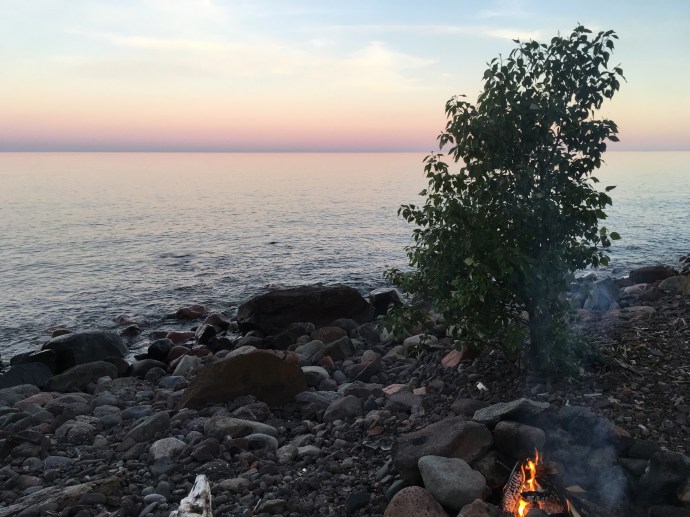
Sunset at Lake Superior with our fire Thursday night

Sunset at Lake Superior with our fire Thursday night

Relaxing might have gotten a boost from the cloudy and rainy weather. 1550 puzzle pieces were assembled. One hat knitted, second one started and likely to be finished by the end of the car ride Friday. Numerous crossword puzzles. Two books down already, another likely to be knocked off. (Your Ridley Pearson author, Jude) Soft music in the background, lapping waves watched and listened to. Well, Tuesday and Wednesday nights it was crashing waves listened to; luckily we were on dry land and not on a houseboat on the lake. Two campfires lit, one on a cloudy, crash wave night, one on a sunny, quiet wave night.

St. Louis RIver at Jay Cooke State Park Friday noon

St. Louis RIver at Jay Cooke State Park Friday noon

On the way home Friday we stopped at Jay Cooke State Park for lunch. It is located on the St. Louis River which courses from the Iron Range south to the Duluth harbor.

Chris and Ed, Friday June 17

Categories: road trip, travel | Tags: , , , , , , , , , , , , , , | Leave a comment

2015 Trip 3, Isle Royale, June 25

2015 Trip 3, Isle Royale, June 25

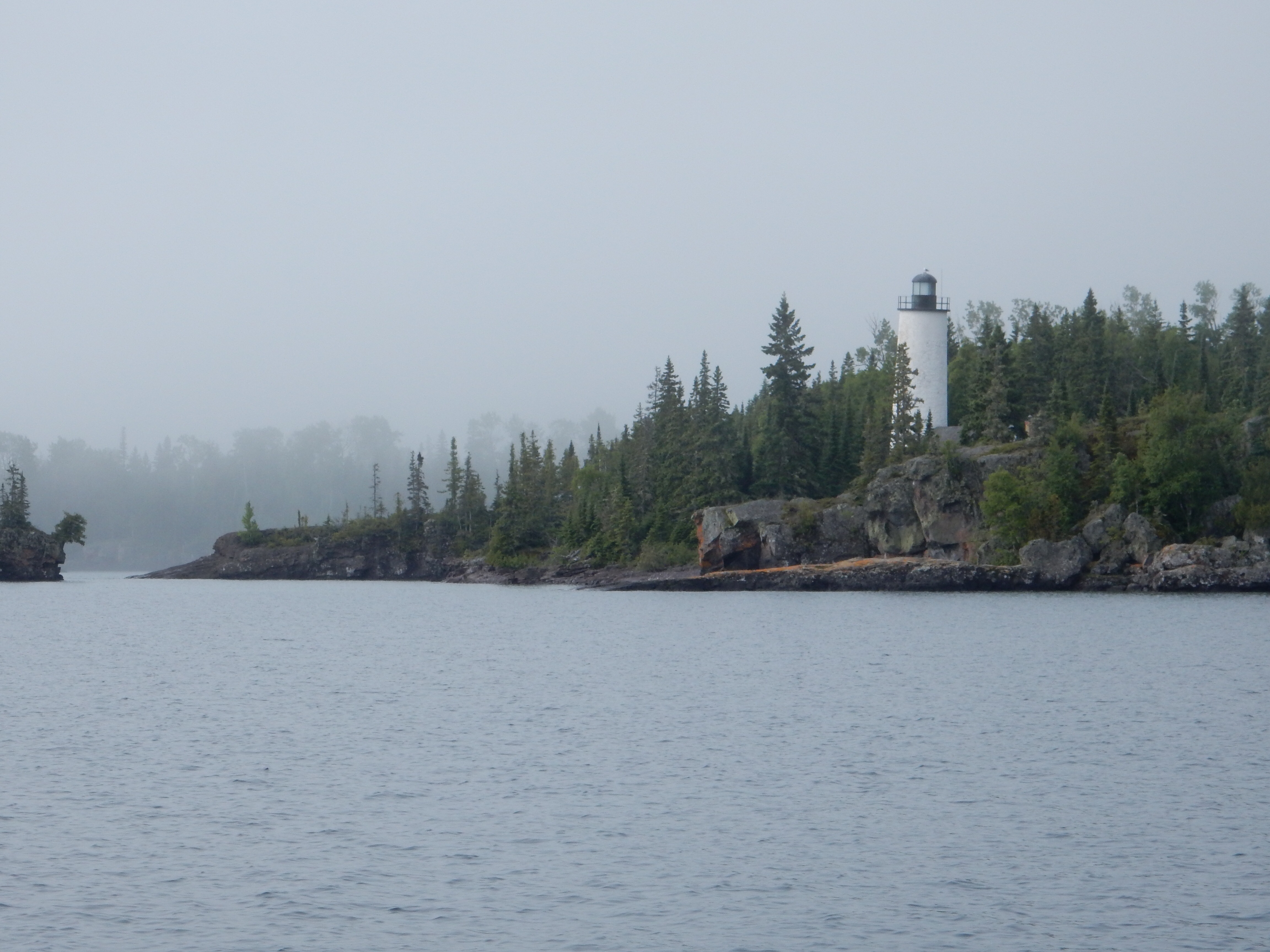
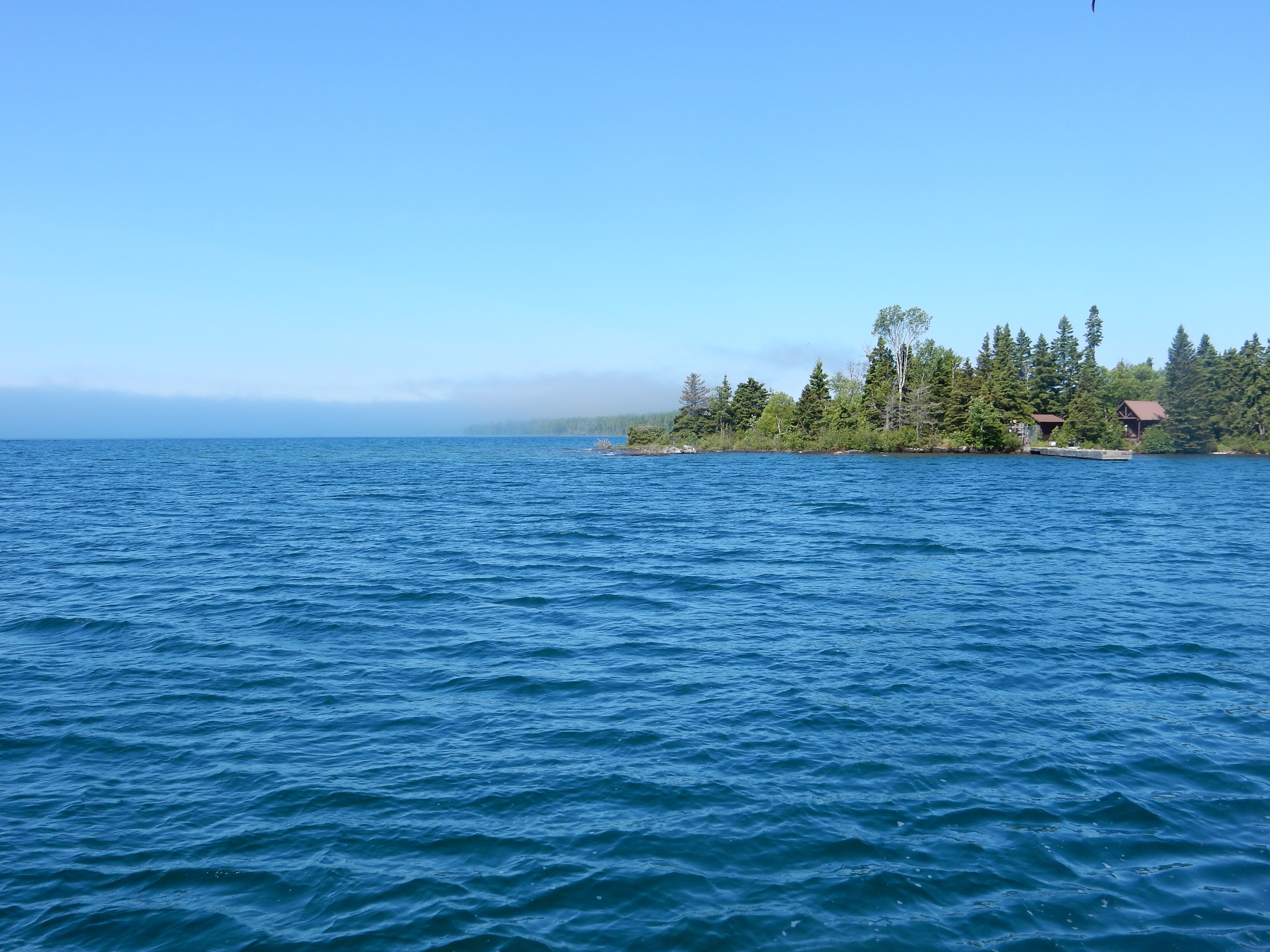
Fog in June on Lake Superior seems to be a constant. It comes, it goes, it re-forms and moves around. The cold water evidently interacts with the warmer air temperatures and, voila, fog. We have watched it from our cabin, from various hikes, from the shores of Rock Harbor, and from the deck of Voyageur II.

Rock Harbor Lighthouse in Lake Superior by Isle Royale

Rock Harbor Lighthouse in Lake Superior by Isle Royale

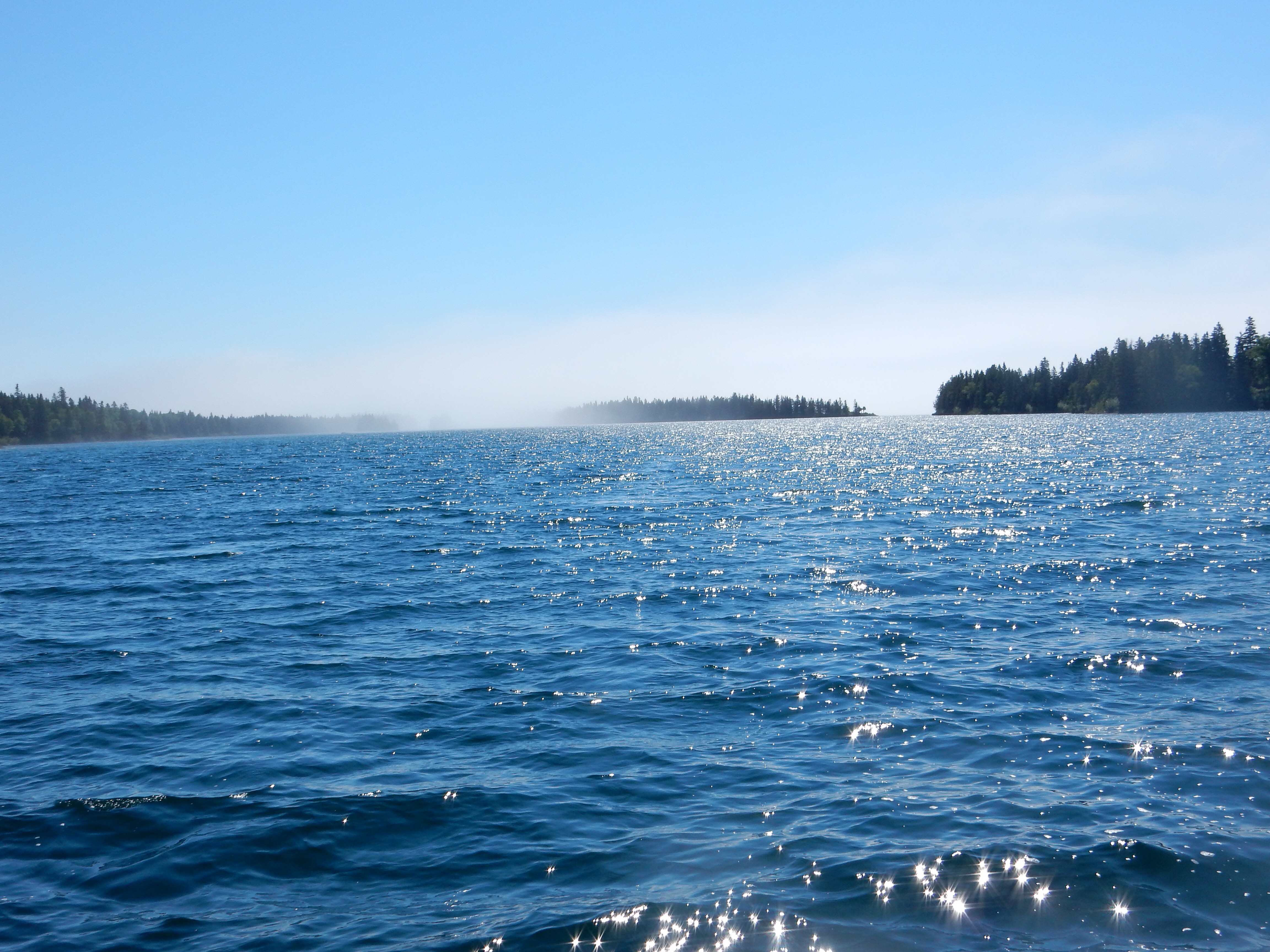
Fog banks moving around the islands

Fog banks moving around the islands

Today was no exception. All night long the fog was heavy outside our cabin. The Voyageur II left at 9 AM EDT and the harbor was socked in. As we traveled around the island, picking up stray backpackers from small, isolated docks, the fog eventually dissipated; the views of the rocks and forests of Isle Royale are much more spectacular with blue skies and bluer water. Then, as we arrive in Grand Marais this evening, the fog is present again as a light mist covering the ground.

Malone Bay- a pick up point for backpackers

Malone Bay- a pick up point for backpackers

Several of the people returning with us are like old friends; the couple from Minocqua, the Montana couple that ran in Grandma’s Marathon, the Iowa party getting on at Malone Bay after backpacking. We joke about the boat ride and hope today’s return trip will be smoother. It is. But the length of the journey has only increased. The pick up of backpackers from remote locations requires slower speeds in narrow channels and extra time to go in and out of pick-up points. All in all, we enjoy the smoother trip and better scenery. We congratulate ourselves for tackling another adventure.

Captain Ben spends some time with us chatting. We discover the boat was built in 1972, originally planned for commercial fishing. The back section, the noisier one that we have avoided, was to hold fish. The original owner died and the ferry people bought it and converted it. Both Ben and Kirk have been doing this for four years and sleep on board. We have smelled their lunches on each trip as Kirk makes something in the galley for them. Evidently, sometimes they use a Crockpot and the smell drives the travelers nuts.

On our way out of Windigo, going through Washington Harbor, Voyageur II stops at the site of the wreck of the steamship America which went down in 1928. The America was the mail, freight, and passenger delivery service to Isle Royale and much of the North Shore. In 1928, the 2nd in charge ran the boat aground, all passengers got off safely. The new Highway 61 in Minnesota was making the ship less profitable and the ship was left in the water to break up further rather than salvage it. We were able to see portions of the wreckage still under the water.

More than 25 ships have sunk around Isle Royale over the years. There are still four lighthouses around the island. We saw all of them and heard lots of foghorns. Isle Royale National Park does extend out into Lake Superior so park rangers have to patrol the waterways also.

You probably know that Lake Superior is the largest freshwater lake in the world by surface area and the third largest in the world by volume. We also wrote about Lake Superior in two previous trips: 2013 Trip 7, Sept. 7-12 (the Upper Peninsula of Michigan) and 2014 Trip 6,Sept. 8-11 (Ontario from Thunder Bay to Sault Ste Marie).

Skies darkening as we approach Grand Portage

Skies darkening as we approach Grand Portage

We arrive at Grand Portage and are able to leave (after getting our luggage and paying the parking fee) around 3:45 PM CDT. The skies in front of us are getting ominously dark. Our plan is to drive the short distance to the High Falls of the Pigeon River at Grand Portage State Park. Doing this hike now will save us 1.5 hours tomorrow of driving time by having to back track from Grand Marais.

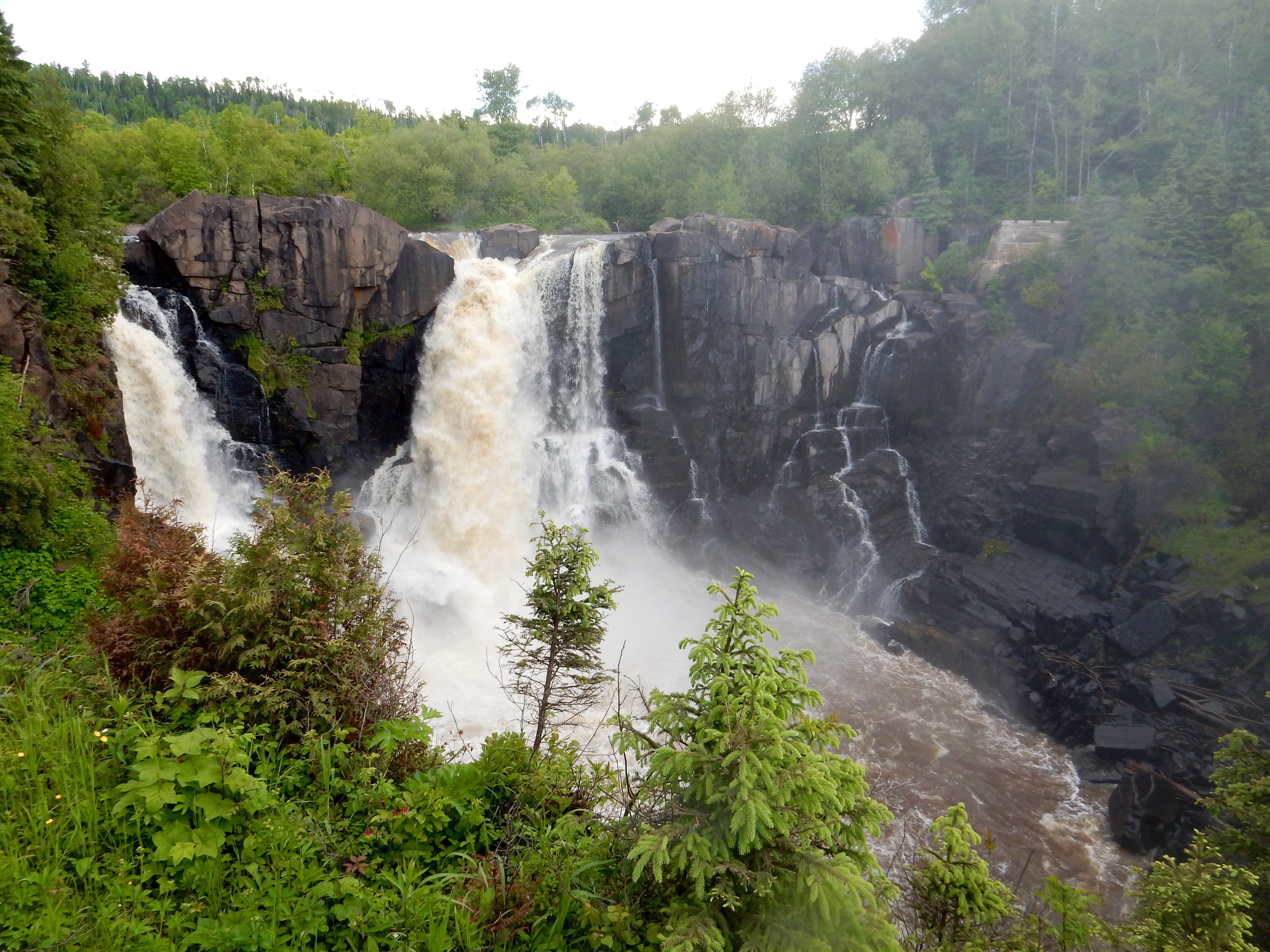
The High Falls are notable for several reasons. First, they are the tallest falls in Minnesota at 120 feet and with recent rains, should be impressive. Second, the falls and Pigeon River are on the boundary of the U.S. and Canada. One can view the falls from either country.

High Falls on the Pigeon RIver at Grand Portage State Park

High Falls on the Pigeon RIver at Grand Portage State Park

Third, the falls created an impediment for Indians and fur traders who traveled by canoe during the days of the fur trade. This required a nine mile portage around the falls. This “Grand Portage” lead to the creation of a trading post for decades; now it is memorialized in the Grand Portage National Monument. We have been here before and will not go into its history and significance in this post.

Fourth, the park land is owned by the Grand Portage Band of Chippewa and is leased by them to the state for use as a state park.

We reach the visitor center and hike at double-time speed to reach the falls before any rains come-and before the park closes. Success is ours; the falls are running fast and we manage to avoid rain.

Lodging is in Grand Marais MN, an upscale town along the North Shore. We are at the Best Western with great Lake Superior views. But first we have dinner at The Pie Place Cafe in downtown Grand Marais. The meatloaf dinner and the Black Bear Blueberry Salad are fantastic; almost as great as the Blueberry/Sour Cherry pie and the Raspberry/Rhubarb pie.

Ed and Chris June 26

Categories: road trip, travel | Tags: , , , , , , , , | Leave a comment

Blog at WordPress.com.