

Glenarden, MD April 8
Thursday, April 7 was a rainy day in Harpers Ferry. Fortunately we have been to the National Historical Park before so we didn’t spend time walking in the rain. Instead we drove down 50 miles to a new NPS site, Cedar Creek and Belle Grove National Historical Park. Cedar Creek and Belle Grove are in the Shenandoah Valley of Virginia, a major battleground during the Civil War. Control of the territory passed between the two frequently.
In late summer of 1864, the Union adopted a new policy of burning the buildings, crops, and animals that were supplying the Confederate troops here in the Shenandoah Valley. The battle of Cedar Creek was fought on October 19, 1864. Early Confederate success came from surprising the sleeping Union soldiers. However, the Union troops were rallied and returned to the battlefield to defeat the Confederates. Helped by the Cedar Creek victory and with Sherman‘s victories in the south, Lincoln was reelected that November.

Belle Grove was founded by the Hite family. Isaac Hite Junior married Nelly Madison, sister of President James Madison Jr.. Isaac Hite, Jr received 483 acres from his father. He expanded the farm to encompass 7500 acres at one time. Belle Grove became the heart of their plantation. Belle Grove grew a wide variety of crops, raised cattle and other animals, and operated as its own little town with various mills, smokehouses, quarries and blacksmithing.
Belle Grove is combined with Cedar Creek as one National Historical Park. That combination is because much of the battle was fought around the Belle Grove mansion and its farm land. Despite the proximity to the battle, Belle Grove was not destroyed and only suffered multiple bullet “wounds” to the building.

We received an excellent tour by a volunteer docent. Details of the home, its construction, its furnishings, and its historical ties to the area were all covered extremely well. As is finally occurring with many other historical properties, Belle Grove is coming forward and detailing its ties to slavery. Isaac and Nelly Hite began their married life with a gift of 15 slaves from her parents, James Madison,Sr.. Over the duration of the plantation, over 200 enslaved people were here.
A new feature we had not seen elsewhere was a collection of biographies of enslaved people. Each person receives about two pages of information detailing what was known about them. The task was obviously difficult since most enslaved people did not receive a second name, slaves were not allowed to be married and thus fathers were frequently not listed, and multiple enslaved people had the same first name. The attempt, however, is important and the stories presented helped to create an understanding of life for enslaved people.

Since it rained Thursday, Friday morning we returned to Harpers Ferry Historic District. Harpers Ferry is situated at the confluence of the Potomac and Shenandoah rivers. It is a narrow pass through the high hills surrounding it. Early canal and railroads traversed the gorge on their way to the Ohio River. George Washington established an armory and arsenal here. That combination of transportation and munitions made Harpers Ferry a strategic location during the Civil War. The town changed hands eight times during the war. The constant battles and threat of battles decreased the population from 3000 prior to the Civil War to less than 200 at its conclusion. The armory was gutted during the Civil War. Afterwards it was torn down and the railroads, as they did so often around the country, took the land and incorporated it into their rail yards.

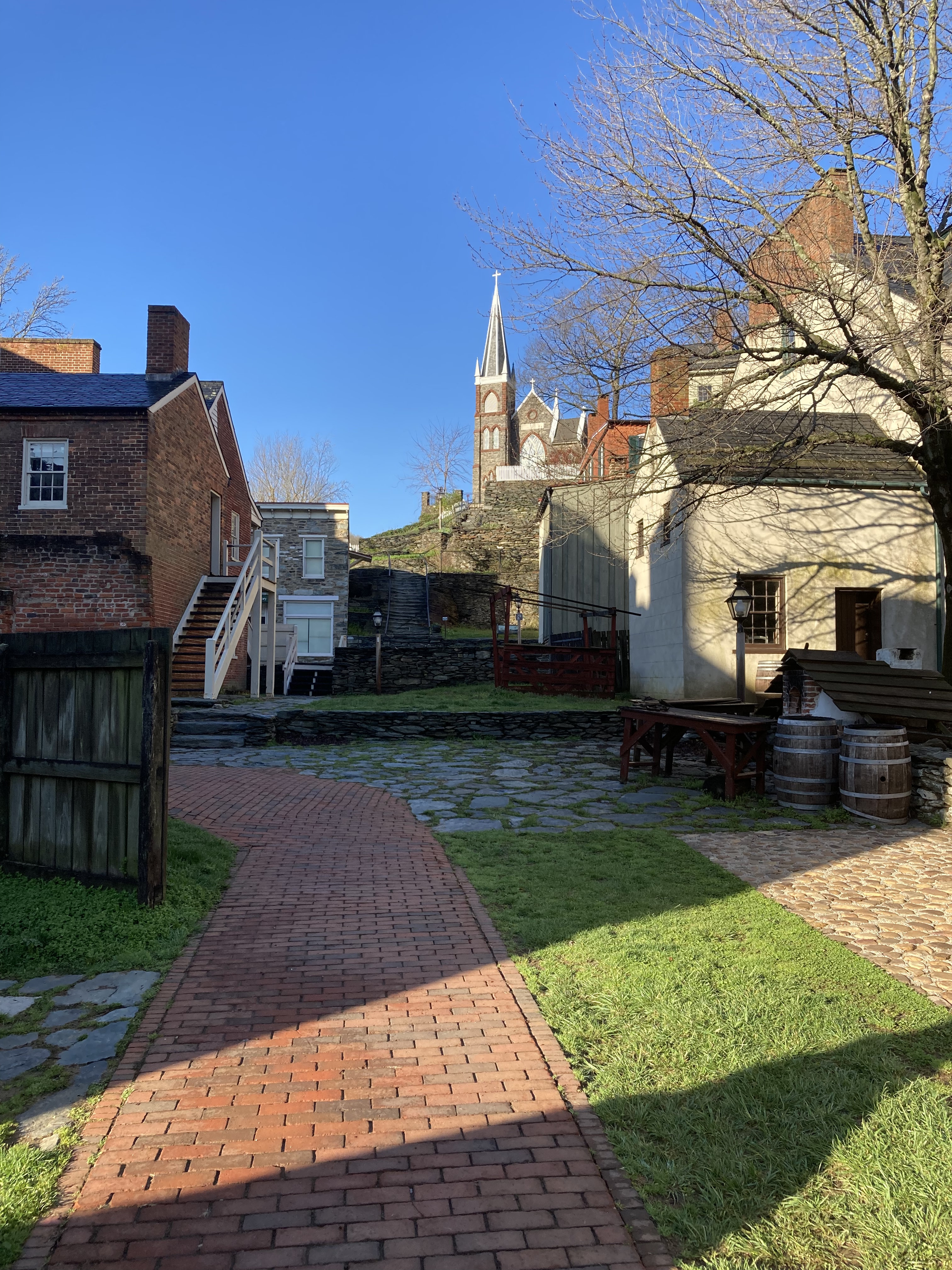
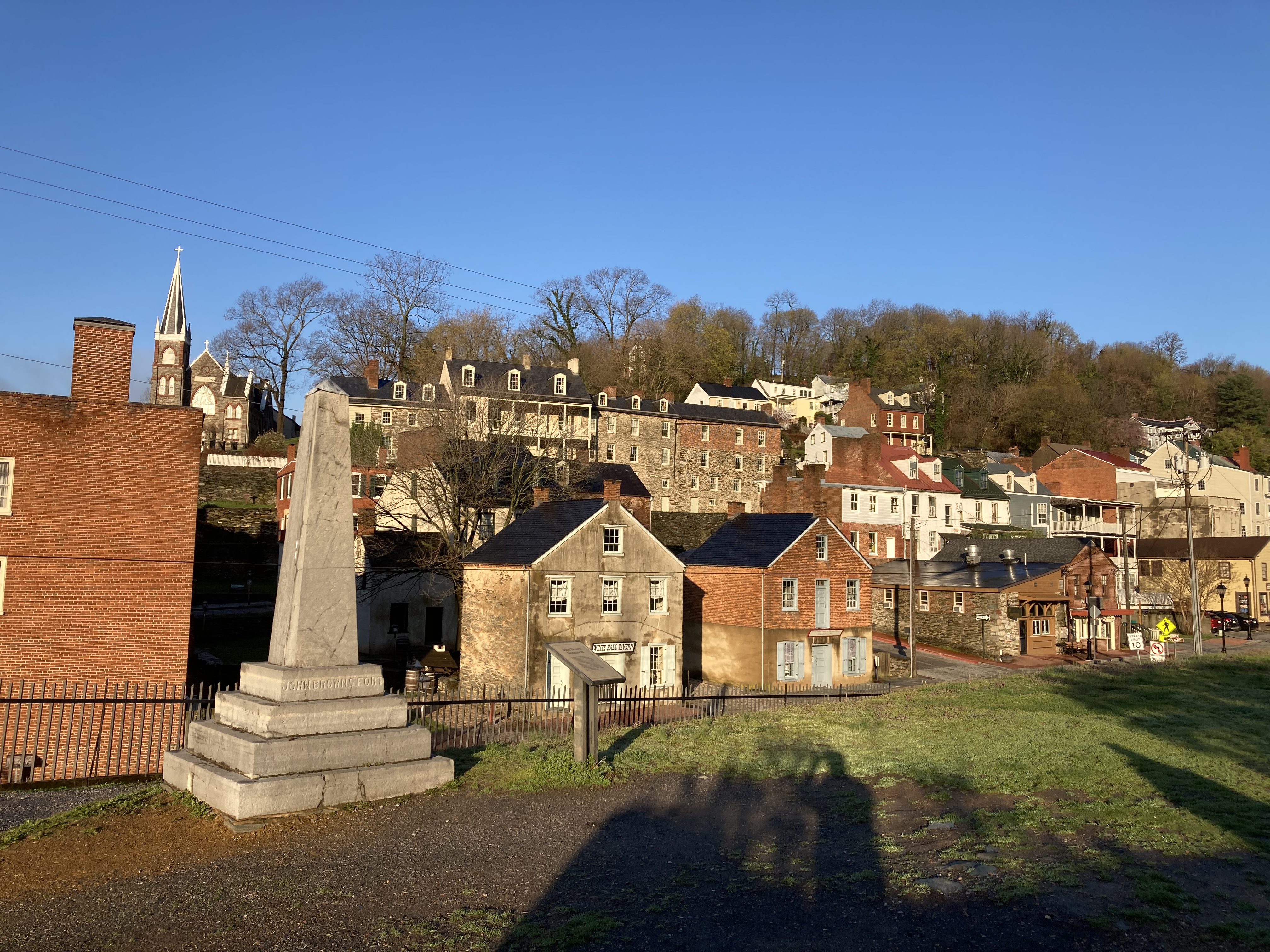
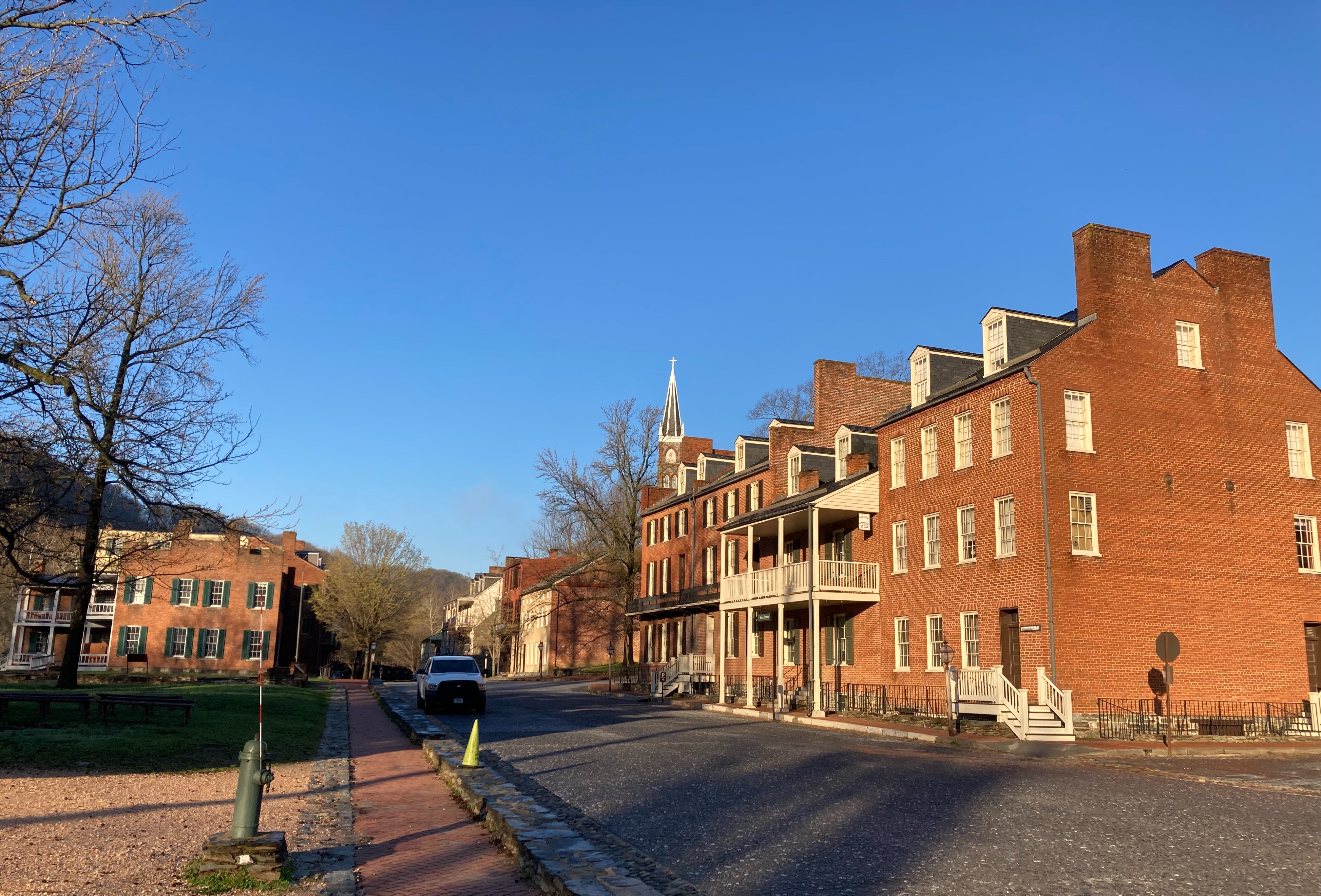

Views of historic Harpers Ferry-above
The other major historical activity for which Harpers Ferry is well known is the raid by John Brown in 1859. John Brown was an famous (even in those days) abolitionist who calculated on breaking in to the arsenal and stealing arms. The weapons would be used to ignite a revolt by slaves-he hoped. His rebellion lasted over three days and by the end, 10 of his men were killed while seven were captured, tried and executed, and five escaped. This incident was broadcast by telegraph around the country to huge headlines. It was later tagged as a precursor to the Civil War.
We left Harpers Ferry to go to Nirvana. Slight joke, but also somewhat true. In our quest to obtain national park stamps, we go to those locations and they have a stamp to use in your passport book. However, around the District of Columbia, there are a number of parks which don’t really have visitor centers. I have not researched it but I’m not really sure why these parks are part of the National Park Service and not just a county or state park. For whatever reason, they are part of the National Park Service. We will be visiting them over the next week.
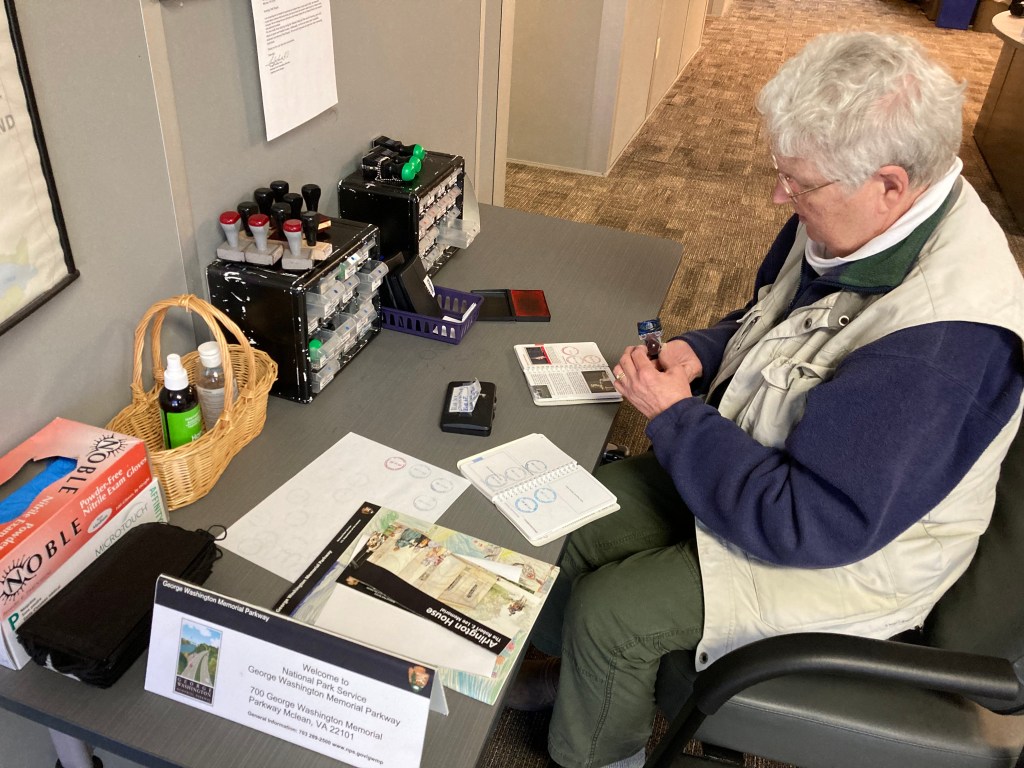
Chris did some research and found out that there are a few locations which have a collection of stamps for those parks that don’t have a visitor center. One central location was the headquarters for the George Washington Memorial Parkway. This office is for administrative services but there was a table in the front lobby with multiple stamps. Chris had a field day, parking herself on the chair in front of the multiple stamps and applying them to the correct pages. The George Washington Parkway is a 7,600 acre national park area protecting the landscape and native habitat of the Potomac shoreline. Within the park are over 25 sites associated with George Washington’s life and the life of the nation he helped establish. It extends from Great Falls MD to Mount Vernon.
As you probably know, Washington DC is a magnet for memorials to various people, causes, and events. Some memorials rank high enough to become an official National Park Service site. President Lyndon Johnson’s memorial is one of these. It is a grove of trees on an island not far from the Pentagon. There is a large stone monument that marks the location where he and his wife, Lady Bird, would frequent and gaze over at Washington DC. You can see the Washington Monument, Lincoln Memorial, and Thomas Jefferson Memorial from this location. The LBJ Memorial is not ostentatious nor highly visited but we could see why the view would be comforting.


Patuxent Wildlife Refuge and Research Station
Our final stop for the day was at the Patuxent Wildlife Refuge and Research Station. This is one of the 560 wildlife refugees around the country. Among wildlife refuges, it has the largest exhibit display area—Minnesota Valley National Wildlife Refuge is the next largest. Notable research has been completed here. Their efforts were critical to the saving of Whooping Cranes well as the discovery of DDT as the primary cause for the near extinction of bald eagles. DDT caused the thinning of eagle egg shells. When the parents were warming and incubating the eggs, their weight was too great and the eggs cracked. Since DDT was banned, the bald eagle population has soared.
We learned this and more from a knowledgeable volunteer at the front desk. Patuxent has a wall dedicated to volunteers. Their names and plaques line the wall listing the total hours worked. Their totals put my efforts at the Mississippi National River and Recreation Area to shame-there are numerous plaques with 5,000, 10,000, 15,000 hours volunteered by one person. Amazing. Of course, part of the reason their effort is critical is the shortfall in funds for staffing many Department of Interior programs.
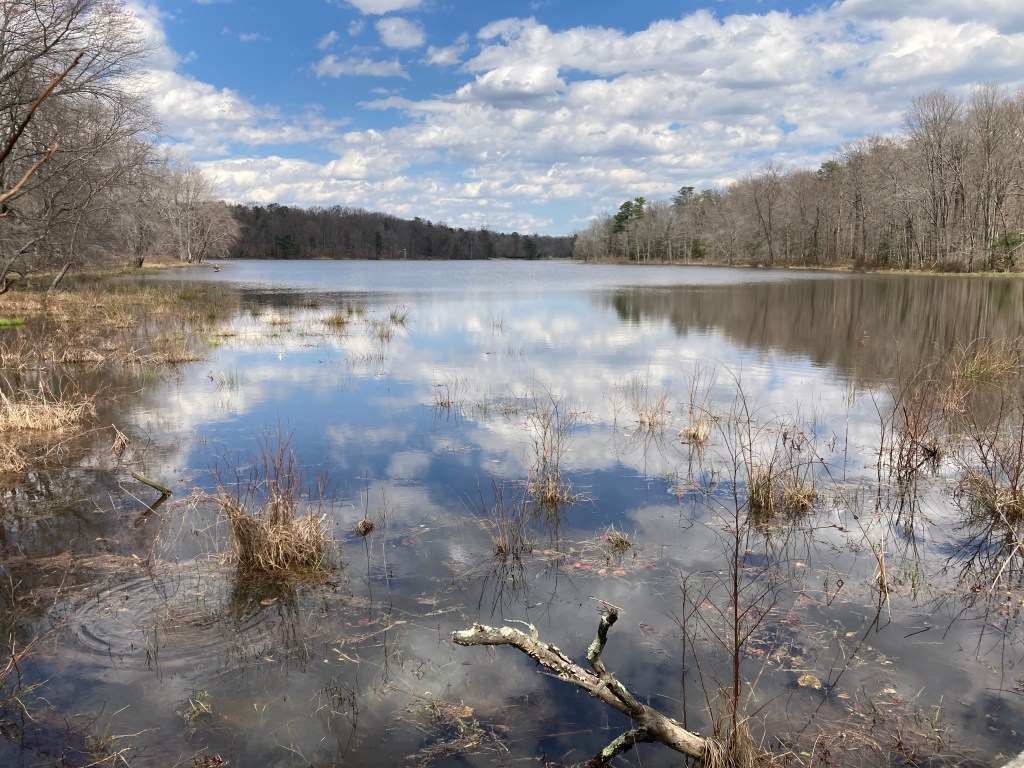
We finished the afternoon with a hike along one of the many trails offered at this large refuge in the middle of a major metropolitan area. No rain and pleasant temperatures created a nice ending to a good travel day.
Ed and Chris, Glenarden MD Friday April 8

 Chris Klejbuk and Ed Heimel travel adventure
Recent Comments