

A section of Florida not usually seen by visitors
Everglades City, FL. April 1
Florida has panthers. Not black panthers but mountain lion beige. We really had no hopes of seeing one but we hiked the only accessible trail in Florida Panther National Wildlife Refuge just because. Most of the refuge is off-limits to humans and most sightings of panthers have either been on trail cameras at night or dead panthers who have tried to cross the highway. About 10% of the panther population is killed each year by cars.
Since we wanted to get a stamp in our wildlife refuge Blue Goose Passport, we drove the interstate to the office address listed on the Internet brochure. The office was located in the Comfort Inn just off the interstate-or at least, it was until several years ago. Hoping there would be a stamp at the trailhead, we continued our drive to the refuge. There were two other cars in the lot, one belonging to the U.S. Fish and Wildlife Service.
Maybe 10 minutes into our hike, we encountered the refuge ranger and a college intern. We mentioned the error for the refuge headquarters address and he gave us directions to the office. At the office (after the hike), the woman at the front desk was from Wisconsin and we chatted for a while about the Midwest. Yes, we did obtain the stamp and one for Ten Thousand Islands National Wildlife Refuge which we will be visiting during the next two days.
It is estimated that only 120 to 230 panthers still exist in the wild. Needing large acreage to exist, they live in this wildlife refuge and adjacent public land preservation areas. Generally they eat deer, raccoons, and wild hogs. The panthers are an endangered species with loss of habitat the largest challenge to their continued existence. As you have probably guessed, we did not see any on our hike.
The Florida Panther National Wildlife Refuge is 26,000 acres and our 1 1/3 mile trail hike was behind the fencing used to help protect the panthers but limited to a small section of the refuge. We hiked through wetlands, prairie and hardwood forest with a view of Florida not seen by most visitors.

Entering the western portion of Everglades National Park
After the hike, we drove to Everglades National Park. ENP has several visitor centers, this one is at the western edge of the park. ENP is the third largest national park in the lower 48 after Death Valley and Yellowstone. The views here are not similar to the grand parks of the western U.S. Even getting this area declared a national park was a challenge; Ernest Coe was a Floridian instrumental in raising the awareness of the possibilities of this area for a national park. One of the visitor centers is named after him.
A second important person in spreading the knowledge of the value of the Everglades as a national resource was Marjory Stoneman Douglas. Marjory Stoneman Douglas was born in Minneapolis but spend most of her life in Miami as a reporter and writer. Her influential book The Everglades: River of Grass was published in 1947 and was an instant best seller. It has sold over half a million copies since it was first published.
Originally we were planning to take a 10 AM boat tour Tuesday of the ten thousand island area. We changed our plans and went on the 5 PM tour today. While the Everglades includes wetlands on the mainland, it also extends into the Gulf of Mexico. The water around Everglades City at low tide is only 2-4 feet deep, even though it stretches as far as one can see. Any thing sticking out of the water is classified as an island, thus in reality there are over 16,000 islands in this area off the coasts. Islands might be just mangroves growing on a sandbar, a higher piece of land created by the Colusa Indians out of shells, or a combination of limestone and washed up sand from ocean tides.
Our boat tour was on a pontoon boat and lasted 90 minutes. We observed numerous islands obviously, some dolphins, and lots of birds. Several fishing boats were returning to the harbor after spending the day in the Gulf fishing for crabs; Everglades City is a major crab fishing locale, we hope to try some local fish Tuesday.
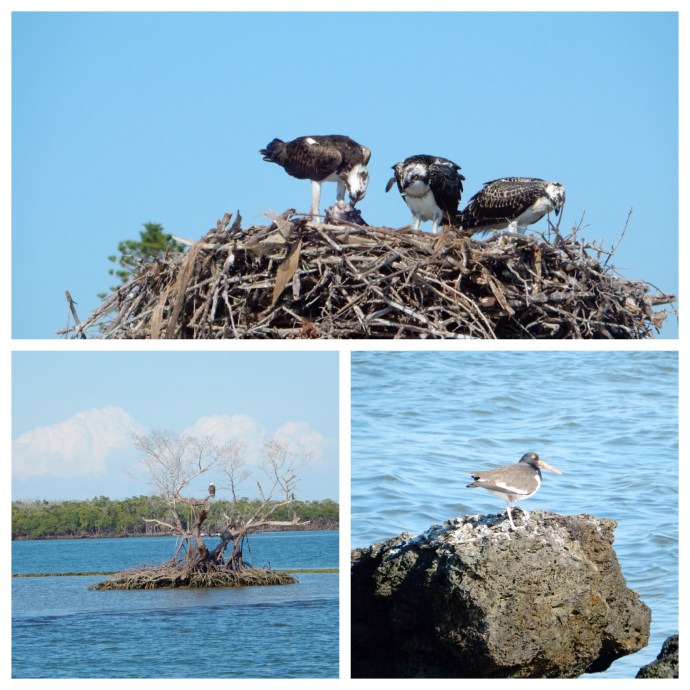
Osprey and chicks top, bald eagle lower left, American oyster catcher lower right
The tour was delightful way to end the evening. We will be staying in Everglades City for three nights at a local place, Ivey House. It is a combination lodge, inn, B &B. Half of the establishment is open for business, half was destroyed in Hurricane Irma and is under re-construction now. Everglades City is another town with Hurricane Irma damage. Over at the National Park, the visitor center was destroyed by the hurricane while the maintenance building next to it and constructed similarly was spared. The park is operating out of a series of modular buildings at the moment.
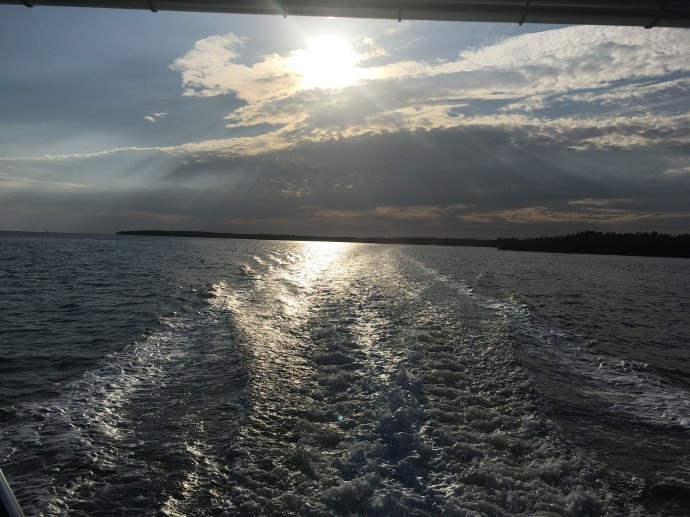
End of day after boat tour in Ten Thousand Islands
Ed and Chris. April 2
 Chris Klejbuk and Ed Heimel travel adventure
Recent Comments