Posts Tagged With: Florida City FL

2019 Trip 3: South Florida: April 5

Florida City,FL. April 5
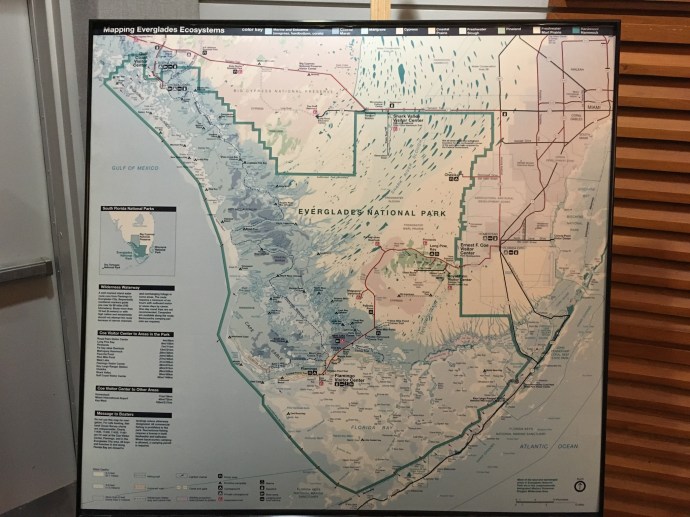
Map of Everglades National Park

I have included a map of Everglades National Park for your ease in understanding the park. We started over in the upper left, proceeded to upper center, and today spent our time along the red line (road) in the center of the photo. That area with the green lines and splotches to the left (west) of the red line is pretty much wilderness area, unseen by visitors and even most rangers.

The red line marks the road leading from the Ernest Coe Visitor Center down to the Florida Bay Flamingo Visitor Center. This visitor center is also operating out of temporary quarters (like Gulf Coast) as its previous center was damaged by Hurricane Irma in 2017 and a new center is at least two years away.

Manatees at the marina dock at Flamingo Visitor Center Everglades National Park

We went down to the marina and were in time to see 5-6 manatees frolicking by the docks. At one point, there was a garden hose dripping water into the bay and the manatees were lined up to taste this water as it trickled into the marina waters. When we came back to this area about 20 minutes later, all of the manatees were gone. For once luck was on our side.

A hike along the bay where the depth of the water is only a few feet was next. Lunch was a quick bite from the marina store watching the waves and a few birds. Along the shore, and inland also, were areas of dead mangrove trees killed by Hurricane Irma. We did not ask what the storm surge was here; Gulf Coast had 14 foot surge killing trees on the islands in the bay and eight foot surge destroying that visitor center.

After Irma: Bottom new vegetation near Eco Lake; top left Eco Lake dead mangrove trees, top right new shoots among the mangroves at West Lake

In some areas we could see new vegetation beginning. Not far from Eco Lake it was bright yellow-green grasses. Along West Lake, it was small mangrove shoots among the dead trees. The loop boardwalk at West Lake was destroyed, part of the walkway and railings still hanging in the water. Particularly at West Lake, most of the visitors we encountered were speaking a foreign language. I wondered if their impression of the U.S. and its national parks was taking a hit given the long time to repair the hurricane damage. But as Chris reminded me, we still have people whose homes have not been replaced yet from numerous previous hurricanes.

Elevation change sign

We have mentioned the slight elevation changes in the Everglades. On our way to Flamingo Visitor Center, we passed two signs indicating the elevation and the new habitat. At Mahogany Hammock, the very slight elevation gain produces an island of hardwood trees surrounded by the river of grass; grass growing in the slow moving water coming down from central Florida.
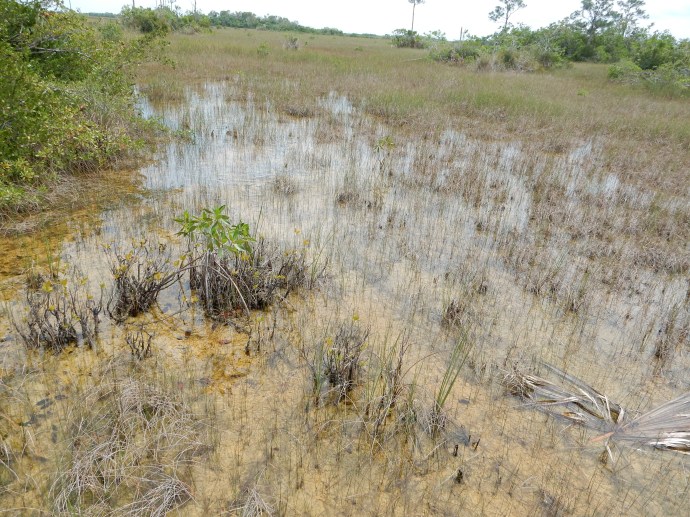
Periphyton at the bottom of the water surrounding Mahogany Hammock

During this dry season one can clearly observe the periphyton; a beige mass of organisms including blue-green algae, fungi, microbes, bacteria, plant residue, and animals that compose the foundation of the eco system. Some animals eat the stuff, the periphyton produces oxygen and helps create soil for other plants to grow on, some animals burrow into it to stay cool, and other animals and plants lay larvae and seeds that are dormant in the dry season but blossom in the wet season. Amazing results for what looks like a blob of gunk.

Our bird photo of the day

Ed and Chris April 5

Categories: travel | Tags: , , , , , , , | Leave a comment

2019 Trip 3: South Florida: April 4

The Everglades “River of Grass” from the observation Tower at Shark Valley, Everglades National Park

Florida City, FL. April 4

Today we entered what some people call the “real” Everglades, that eastern sea of grass and water fed by waters starting in Kissimmee and reinforced by waters from Lake Okeechobee. We drove over three new bridges on U.S. 41 that increase the volume of water that can flow unimpeded on its southward journey to the Florida Bay. This whole area is considered a river that moves at a rate of one mile per day.

The Everglades have been labeled a national park, the largest subtropical wilderness in the U.S., an international Biosphere Reserve, a World Heritage Site, and a Wetland of International Importance. It is no wonder we see and hear visitors from around the world here.

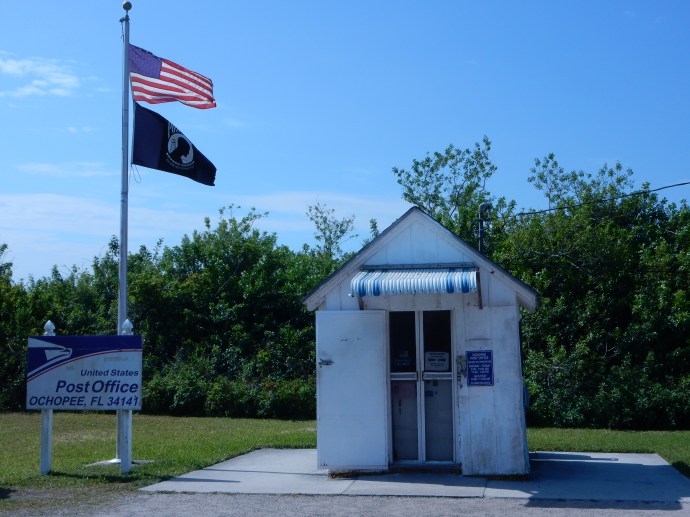
Ochopee FL Post Office

Before we entered our second visitor center and gateway to Everglades National Park, we made two stops. Well, maybe two and a half stops. The half stop was a quick stop and visit to a working post office serving Ochopee FL. It is billed as the smallest U.S. Post Office. We thought we had previously visited the smallest post office somewhere in Door County WI.

In honor of Clyde Butcher, we took one of our photos and converted it to black and white

The first real stop was at the gallery of Clyde Butcher (clydebutcher.com), a well-known photographer who has been honored for his large-scale black and white photography still made in the ‘wet’ darkroom. Much of his black and white work has been done with a large format view camera that he caries and sets up in the middle of forests, swamps, and rivers. His gallery here (he has two others) showcases his work and that of a few others. One of them, Andy Morgan, was staffing the gallery today with Andy’s wife. Andy’s work was also on display and we spent about an hour here. (andymorganphotography.com).

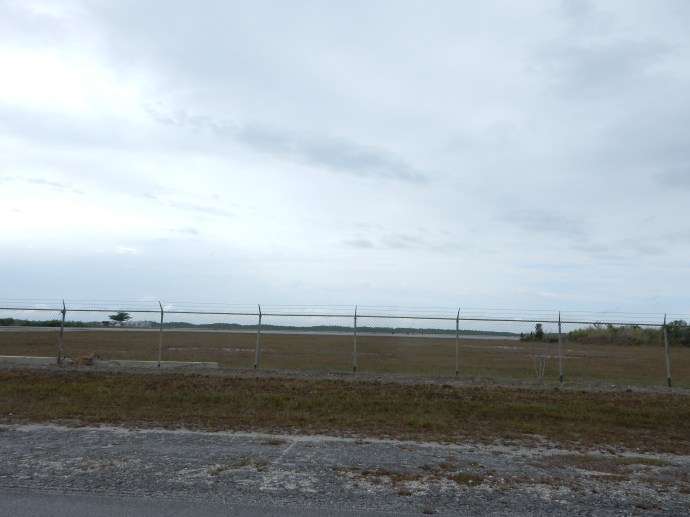
The runway at the canceled Miami Jetport

Our second stop was at the Dade-Collier Training and Transition Airport. Actually this was kind of a half stop too; maybe we did only make two stops before the Everglades. You may recall in an earlier post that Big Cypress Preserve was created in response to stopping a new airport. This “Everglades Jetport” or “Big Cypress Jetport” would have been five times the size of JFK in New York and would have been the largest airport in the world at the time. Since one 10,500’ runway had already been built, the runway was kept. It is considered part of Miami Dade Airport Authority. We drove to it-you had to know what you were looking for to find it. After driving three miles in, we found the gate locked. A person can gain access if they pick up an attached phone, call Miami Dade Airport Authority and probably convince the powers that be that access should be granted to them. No visible activity was evident to us.

Scenes along the Shark Valley Tram Tour, Everglades National Park

Finally, we stopped at Shark Valley Visitor Center for Everglades National Park. We had a 10 AM Friday reservation for the two-hour tram ride. In talking with the staff, we were informed that it might take us two hours to drive to this visitor center Friday morning due rush hour traffic and road construction on the major road leading from Florida City to Shark Valley. Tomorrow’s weather was projected to be sunny and no rain. This afternoon rain was forecast. We chose to take a chance that the rain would not come and changed our Friday reservation to a tour leaving in 20 minutes.

By now, I think we could give most of these tours. Not a lot of new information was given, hopefully hearing the history, etc once again will help us retain it. The major difference is the lack of marsh and much fewer forests. The Shark Valley area is actually a depression, about 7 feet above sea level. Tampa to the west and Miami to the East are 20-30 feet higher. Not huge but enough to direct the flow of water to this central region and validate the concept that this is a river and a valley.

The water here is fresh, not the brackish fresh/salt combination back at Gulf Coast Visitor Center. Remember, Everglades is 1.5 million acres. Shark Valley is sort of at the north central part of the park. Gulf Coast is at the north west end. There are two other visitor centers. Coe is at the east central and Flamingo at the south central portions of the park. Part of the park includes water. While not a true rectangle, the park width is about 65 miles and its length about 60 miles. It is big and encompasses differing terrain. Tomorrow we will go to the Flamingo Visitor Center area.

A typical scene from the tram tour; prairie grass, a few trees, a dry season water hole, an alligator and some birds

The tram tour drives through the prairie area. As the guide indicated, even the difference of a few inches changes the prairie grass to clumps of trees with different vegetation and animal life. Prairie grass predominates. This is the end of the dry season when some areas are dry and birds, fish, and alligators congregate in the remaining wet areas. When the rains begin soon, the entire area will be wet and we would be less likely to observe the mix of animals so close together.

Alligators were numerous. We have restricted our alligator photos to particularly unusual ones, we have so many. It is almost like seeing deer or squirrels. Halfway through the tram ride we stopped at an observation tower built on the site where Humble Oil drilled for petroleum. They found it but of a low quality so they shut it down and gave it to the feds in exchange for a tax deduction. But our guide did slip up. On the way back, we passed an alligator by the side of the road with it’s mouth wide open. They do this to help cool off. He ignored the chance to educate the tram riders.

Tonight we are lodging at Florida City, close to Homestead, FL. It is an easy shot from here to the next two Everglades Visitor Centers.

Young alligators. Despite Mom alligator’s best efforts, less than 10% will make it to year thee.

Ed and Chris Florida City FL, April 4

Categories: road trip, travel | Tags: , , , , , , , , , | Leave a comment

Blog at WordPress.com.