Posts Tagged With: Florida

2019 Trip 3: South Florida: April 13-18

Taking the beach walk to the beach

Miami Beach, FL. April 18

Our old haunts awaited us as we returned to Miami Beach. We have been coming here almost every year since 2001-18 years. Some things change, Hurricane Irma closed down one hotel which had a restaurant we used to frequent. A new transit option appeared, free rides in an electric driven small open air van paid for by advertising. Some things are the same, Front Porch restaurant is still open after 25 years and just half a block north of our place as is La Sandwicherie, a famous hole in the wall sandwich shop we frequent.

At the beach: pelicans, cruise ship in background and parasailing, typical beach scene, and moon rising over the ocean.

The people watching continues of course. A better writer than I could keep you spellbound with anecdotes of the various antics one sees on the beach and on the sidewalks. The family whose dad is complaining how the teenage daughters are whining about the experience and how much the parents are paying. We only heard the father’s many whines, few from the daughters. The people trying to open their less expensive store-bought umbrellas that turn inside-out in the strong wind. The woman and child walking down the middle of the street. You will have to use your imagination or your own experiences to expand the number of anecdotes.

Monday was supposed to rain and it was the day for our room to be cleaned so we went walking down to South Pointe, next to the ship channel that is the means for boats, cargo ships, and cruise ships to reach the ocean. We passed two hotels where, when we were working, we used to spend a night or two to extend our vacation. When we stayed at those hotels, we never went to the beach, just stayed at the hotel pool.

Wolfsonian examples of Art Deco inspired furniture: oven, dressing table, hutch,and desk.

The Wolfsonian Museum is a favorite of ours. Usually we go to the Friday night free admission and docent tour. Once we heard James Dyson talk about his revolutionary new vacuum cleaners. That gives you an idea of how long we have been coming here also. Monday we went and actually had to pay the senior admission rate of $8 each. While various exhibits come and go, the heart of the exhibits are items from the Art Deco period.

Wolfsonian: Art Deco in everyday life: mail box, radio, movie ticket taker booth, toaster

Art Deco was highlighted at a 1925 exposition in Paris and took off in the U.S. in the 1930s. Art Deco architecture was the driving style in Miami Beach’s expansion. But Art Deco took over in design for many everyday experiences. There are connections between styles and ornamentation visible on hotels from that period and furnishings and appliances created in the 1930s.

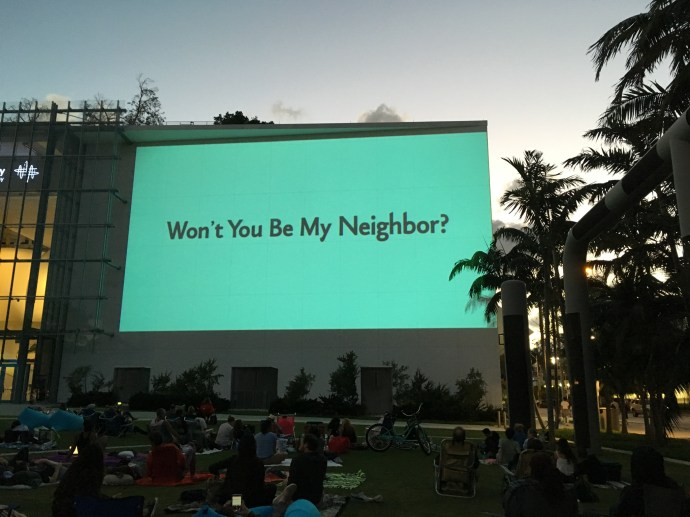
New World Symphony wallcast

The New World Symphony, started by Michael Tilson Thomas, is a post-graduate school training academy for musicians. For Wednesday night’s activity, its outdoor wall is used to simulcast some of their concerts and to host weekly outdoor movies during the winter season. We ambled over last night and watched “Won’t You Be My Neighbor”, the story of Fred Rogers. Besides enjoying the movie tremendously, we saw a new (to us at least) form of outdoor seating. The Porch Couch is a piece of plastic like material, open at one end, and you simply wave it around to fill it with regular air. It provides a couch like seating that held up well for the two groups we saw using it. When the event is over, let out the air and pack it up. Neat.

An unexpected experience wraps up our trip. When walking along the Beach Walk, I came across large tents being erected. Nothing unusual there, Miami Beach is host to many conferences and events. Upon closer perusal, I realized that the tents were for the Longines Global Championship, an international horse jumping competition. It runs Thursday (today) through Saturday on the beach. And attendance was free.
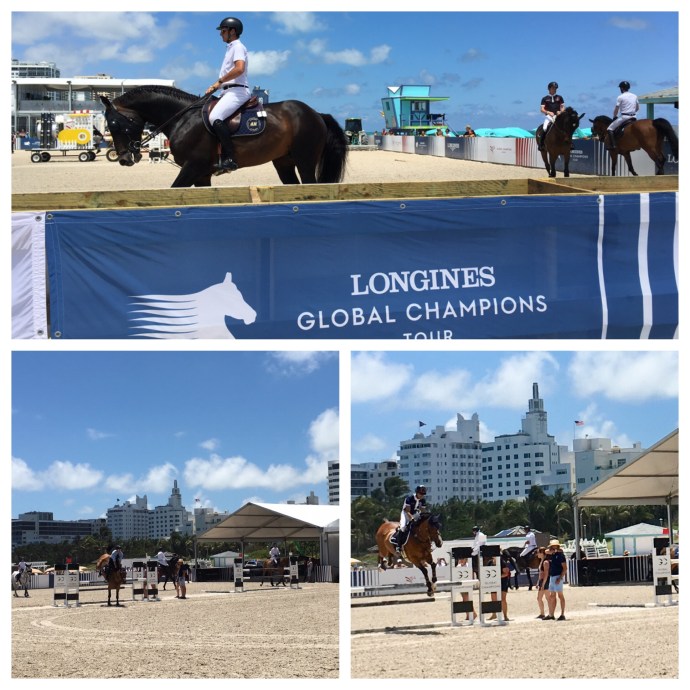
Preparing for the event, Longines Global Championship

Chris and I went to the opening day afternoon competition. Horse and rider teams from the U.S., Great Britain, Qatar, Sri Lanka, Czechoslovakia, Netherlands, Germany and Switzerland were represented. Several different levels of competition were scheduled, we have no clue as to the rules which determine who can enter each round. After two and half hours, our event winner was from the U.S. Listening to the announcers, it was evident that the competitors were top-level. This Global Championship has 20 events in cities like Mexico City, Shanghai, Montreal, Prague, London, Monaco, Stockholm, etc.

During the event.

I was surprised the horses were jumping outside in the heat, 86 degree Fahrenheit at show time. But the views of the ocean and the horses made for great viewing for the spectators. Given the high cost of the horses and of travel, I am sure the horses would not be jumping if it would harm them.

This will be the last post for this trip unless something unexpected happens in the next 24 hours. Friday we fly home.
Ed and Chris April 18 Miami Beach

Categories: road trip, travel | Tags: , , , , , , , , , , , , , | Leave a comment

2019 Trip 3: South Florida: April 6

The type of Nike air defense missile stationed at Everglades National Park from 1962 to 1979.

Florida City, FL. April 6

We never knew the U.S. had a missile base in the Everglades. Now we, and you, do. The Cuban missile Crisis of 1962 identified a lack in perceived readiness against a hostile missile attack. Previously the U.S. only prepared for a Soviet missile attack over the North Pole. The Cuban Missile Crisis made evident a need to protect against an attack from the south. This and more we discovered during an excellent presentation by Ranger Leon today on our second ranger led program.

We took advantage of two ranger led programs out of the Royal Palm Information Center. The Royal Palm area is the initial foundation of the Everglades. The Florida Federation of Women’s Clubs worked with the State of Florida to create a state park to protect about 1,000 acres of the Everglades. The state park was incorporated as the heart of the Everglades when it was made into a national park in 1947.

A large turtle along the Anhinga Trail at Everglades National Park

The first ranger program was a walk along Anhinga Trail. Once we got on the trail, Chris and I remembered this walk from a decade or more ago when a German couple on the ranger walk were shocked that an alligator had earlier that day just walked right by them on the path when they were pushing their baby stroller. No such excitement today although we took some excellent turtle pictures.

The ranger again talked about the wet and dry seasons. This year, the dry season which is just ending, has been wetter than usual. Some of the areas we have observed, including the canal along the Anhinga Trail, would have been dry most years. It is possible some of the increase in wetness is due to the recent bridges just built over U.S. 41 allowing more water to flow naturally south than has been the case for over a hundred years when canal building began.

Along the Anhinga Trail at Everglades National Park

Ranger Leon did a great job re-creating the feeling of October 1962 when the U.S. discovered the Soviet Union had installed offensive nuclear missiles in Cuba, 90 miles south of the U.S. The U.S., and indeed the world, was on tenterhooks while the two superpowers postured and negotiated. There was an extremely high chance of a nuclear confrontation. As in any conflict, the possibility of a mistake or an action taken by any one of many lower level military commanders of either side could escalate the conflict out of control. In fact, there were numerous near-chance accidents.

As one of the actions taken while the negotiations were occurring, an Army Missile Battalion deployed to an area just outside the Everglades. The Missile Battalion was on war readiness to shoot down incoming missiles while living in a tent city in mud and mosquitoes. Park Managers gave permission to build a site within the park and Nike Missile Site HM-69 was built within the park-the mosquitoes moved with them. It was operational until 1979. We were able to tour the site today.

The Administrative offices of the Nike Missile site, now the Everglades research offices.

The pink painted buildings were a surprise but otherwise Ranger Leon expressively laid out the reality of life on the base. Mud, snakes, lightning strikes (Florida has more lightning strikes than any other state and at least one soldier died here due to one.), snakes, high shoot to kill security, Jim Crow laws in nearby Homestead, etc. all were part of life here.

Replica of actual sign on missile site

Young men led by only slightly older officers had to maintain a state of high readiness for years. The closeness of Cuba meant immediate responses would be necessary. Other Nike missile sites were deployed around the country but this site was the last to be de-activated. This one site (U.S. Army’s 2nd Missile Battalion, 52nd Air Defense Artillery, A Battery) received exceptional honors for its performance during the tour of duty here.

It was gratifying to me to hear that this presentation was started by a National Park Service volunteer ten years ago. It is offered daily Dec. 1 to March 31st and the first two weekends in April and has become an extremely popular tour.

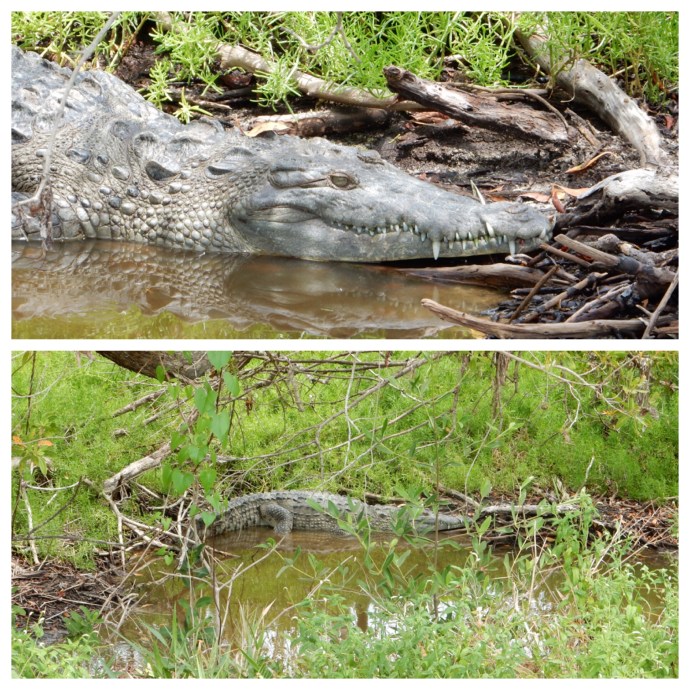
The only crocodile we saw in the Everglades. We did see hundreds of alligators.

Ed and Chris. April 7

Categories: road trip, travel | Tags: , , , , , , , | Leave a comment

2019 Trip 3: South Florida: April 2

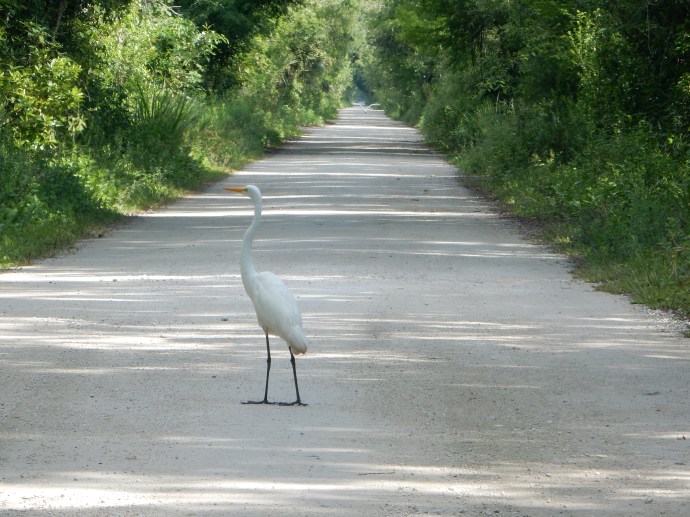
This bird knows he owns the road and he is not moving until he feels like it

Everglades City, FL April 2

We spent much of the day in the Fakahatchee Strand Preserve State Park. Fakahatchee is Seminole for forked river and a strand means a long narrow, swamp forest. The Fakahatchee is Florida’s largest state park and is home to numerous wild orchids, one of which is in bloom now. The FSPSP connects Florida Panther National Wildlife Refuge (one of Sunday’s stops) to the Gulf of Mexico. FSPSP is the orchid capital of the US and has the largest population of native Royal Palms in the US.

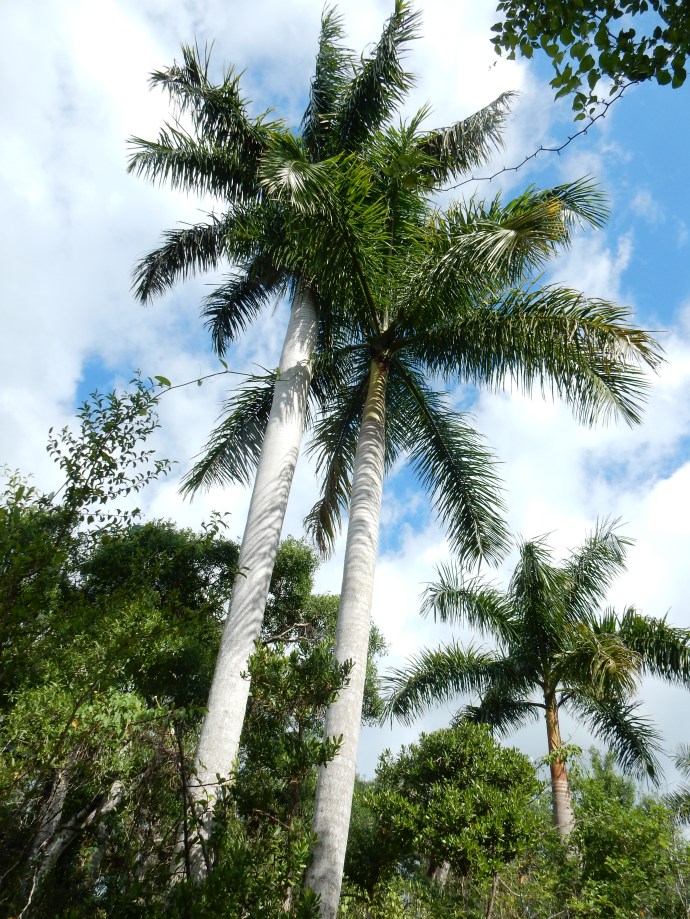
Royal Palms in Fakahatchee Strand Preserve State Park

Met another volunteer couple staffing the welcome center; they summer in Rhinelander WI and have been volunteering here for over six years. They gave us a few pointers about the best places to hike. Instead, we ended up driving most of the time we viewed the park. The Janes Scenic Drive is gravel (not a problem) but full of potholes that suggest strongly that one drive slowly and carefully. The portion of the road that is open for cars is only 6 miles; we drove it at speeds of 3-6 mph. There were just many birds to see and it was relaxing to motor along nice and slow.

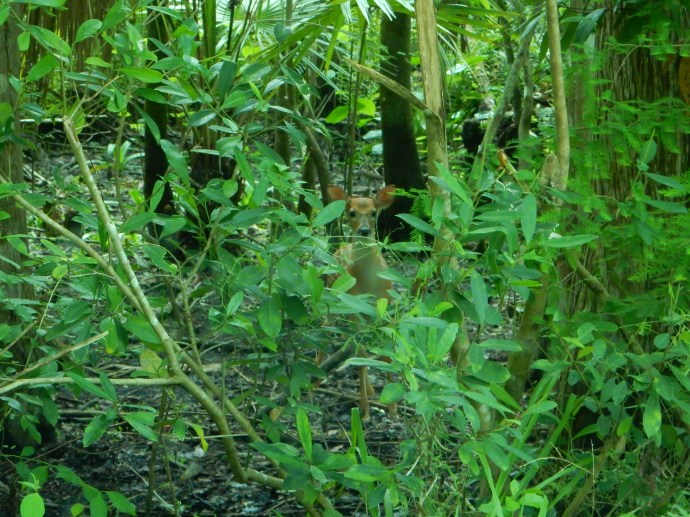
Can you spot the fawn?

Twice we headed out on hikes. For the first one, we chose to be safe rather than sorry. Signs about alligators tell you not to harass them, not to feed them, etc. The signs we read were not specific how to deal with them sitting in your trail path.
In general, alligators are not aggressive and do not attack humans. But what if they are just right there?? Alligators are big, have strong jaws and tails, and can move fast for short distances. On this first hike, the alligator was taking up about one-third of the trail. Oh, did we say they frequently just stay in one spot? Thus, the likelihood of the gator ambling along soon was low. We chose to turn around and abort this hike.

Along our hikes

On our second hike, we met another volunteer clearing the trail to assist people in walking along. We asked him about the alligator and he suggested that in the future, we should use a big stick and gently touch the alligator on the tail. That touch normally would encourage it to just move forward a bit. We thanked him but I am not sure we will take advantage of this suggestion in the future.

Along the Big Bend Cypress Boardwalk at Fakahatchee Strand Preserve State Park

All in all, we spent about three hours at Fakahatchee Strand Preserve State Park. We returned to the Ivey House, had a snack, went in the pool, and then returned to our exploring. This time we went to a different portion of the park to explore the Big Cypress Bend Boardwalk Trail. Here, we were told that a bear was just ahead on the right side and to be quiet as we approached it. Well, we were quiet but alas, the bear had disappeared. Chris, who was not excited about seeing any bear, was nonetheless 30 feet ahead of me on the trail; I was trying to look everywhere and she was just marching at double pace. In any event, it was just a walk in the woods.

Our final stop was exciting. Monday we had taken in a presentation at the Everglades National Park Visitor Center. The ranger giving the talk, besides telling us about his adventures in Alaska, advised us to take the Marsh Trail to watch the birds returning to the roost at sunset. The experience was magnificent. An observation tower is strategically placed for bird watching. We spent at least 45 minutes there until sunset had occurred.

Birds landing along the Marsh Trail at Ten Thousand Island Wildlife Refuge

Birds at Marsh Trail at Ten Thousand Island National Wildlife Refuge

When we arrived, the ponds and marsh were already busy with roosting birds. As we watched, more birds arrived in groups of 1, 2, 3 or 4. As time went on, the groups grew in size to have 20, 30, or 40 returning birds. A variety of species were landing, chirping, and gathering. But as time went on, many of the birds which had landed in the pond to our right picked up and flew to a group of trees on our left to roost for the night. It must be a safer location to avoid predators there. Only about 20 people were here, it was a great experience and lightly attended. Several of the human attendees had cameras that likely cost at least 10 times the cost of our point and shoot but our pictures are sufficient to illustrate the experience.

On our way back to the car, we saw an alligator crossing the paved trail from west to east about 100 feet in front of us, heading home evidently for the night. When we passed the point where the gator had crossed, we could see the wet trail his feet and tail had made on the pavement. This time we did not have to worry about what to do with a gator on the trail.

This marsh area was also part of Ten Thousand Islands National Wildlife Refuge. We did not observe any damage from Hurricane Irma here, evidently the barrier islands had helped to mitigate the storm. When we had taken the boat ride Monday, several islands had been hit with a 14 foot tidal surge. The amount of salt water was enough to kill a long line of mangrove trees at the edge of the islands. We did not observe that here.

Ed and Chris Everglades City FL. April 3

Sunset over the Everglades and Ten Thousand Islands

Categories: road trip, travel | Tags: , , , , , , , , | 1 Comment

Blog at WordPress.com.