Posts Tagged With: Fall Creek Falls State Park

2018 Trip 3: March 27: KY and TN

Spencer TN. March 27

Rhea County Tennessee courtroom, site of the Scopes Monkey Trial of 1925

We woke up a little chilly this morning. During the night our room’s HVAC decided to not turn on the heat and to keep blowing cool air out constantly. At least the shower water was warm. At the front desk we explained our issue and were told maintenance would address it. Breakfast was a nice buffet and our server was chatty. She informed us, we had not known this previously, that this Sunday was the last day the restaurant and our lodging units would be open. The facility, excluding the campgrounds, cabins, golf course, etc. was to be destroyed and replaced with a new complex with less rooms and twice the nightly rate. Over 60 staff are being let go; in this depressed area, the impact will be severe. The new complex will take at least 18 months to build, probably longer. When completed, the current staff will be invited to interview for jobs with no guarantee of re-hiring.

Evidently, the TN Governor has tried unsuccessfully to privatize the park lodging system with no success. Twice bids to replace this lodge have been sent out and no private bidders have come forward to knock it down and build a new place at private expense. So evidently the state will re-build it and hope that they can encourage a private company to run it once a new facility is in place. Don’t know the economics or politics of the decision-making but on the surface it seems unwise for the state to go forward if no private enterprise thinks the idea will produce a profit. We left breakfast wondering if anyone would be bothering to fix our HVAC.
Dunlap Tennessee Coke Ovens

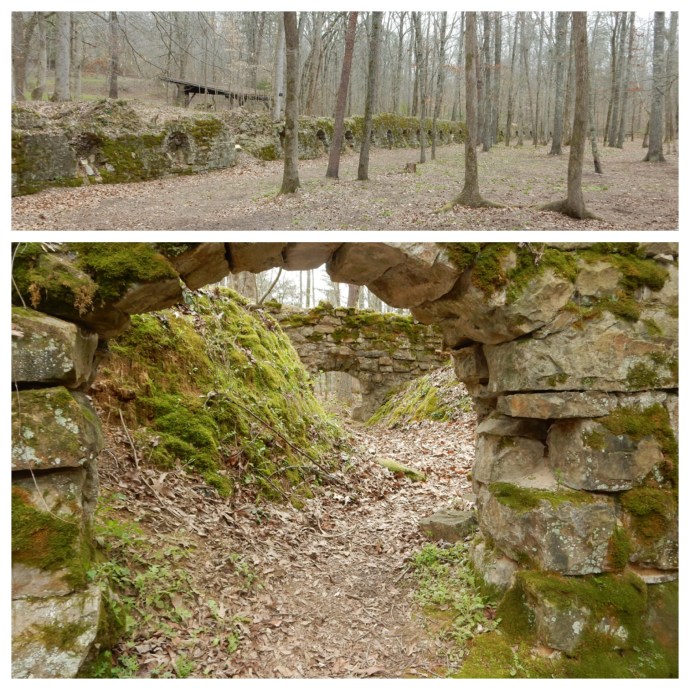
Since the day was predicted to warm up, we postponed hiking to the falls and headed out to Dunlap, Tennessee, an hour away. Dunlap is the site of a mine opened in 1899. Coal was mined out of Fredonia Mountain and at the base of the mountain, the coal was turned into coke for use in the iron and steel foundries of Chattanooga. The mine filed for bankruptcy in 1927 and the mines and coke ovens closed. They stood vacant for more than fifty years until local residents were able to organize and gain funds to restore the site.

Today, a restored commissary and museum (closed today) sit among the coke ovens, coal washer, and idled and rusted equipment in a 77 acre park. We hiked among the relics and the 286 stone ovens, some more deteriorated than others.

Part of the Trail of Tears

Towards the back of the park, there was a trail marker for the Trail of Tears. As we have reported previously, the Trail of Tears was a forced journey in 1838 moving Native Americans (Shawnee, Cherokee, Creek, Choctaw, etc.) from the Southeast U.S. to what would become Oklahoma. This location was on one of the trails as recorded by a missionary traveling with this group of approximately 1000 Cherokee. It is thought the spring in the park was the reason for stopping here.

After Dunlap, we drove through mountains (which would probably be more gorgeous with green leaves on the trees) to Dayton TN. Dayton was the site of the famous Scopes trial. Once again, our luck was not the best, the museum here was being refurbished and closed today. But we had wanted to see the original courtroom and knew it was open. The original judge’s bench, jury chairs, railing, spectator seats, etc. are still present. Part of the trial was held outdoors due to the temperature at the time of the trial.

For those of you unfamiliar with the Scopes Trial, here is a brief summary. Tennessee had passed a law forbidding the teaching of evolution in any school that received state funding. Locals in Dayton, including the head of the Cumberland Coal and Iron Company (part of which was the Dunlap Coke Ovens) convinced locals to contest the law in order to draw attention to Dayton. While local attorneys headed up the defense and prosecution, eventually William Jennings Bryan (three-time Presidential nominee) and Clarence Darrow (nationally known attorney) affiliated with the prosecution and defense respectively. The case did draw national attention. It is still commonly called the Scopes Monkey Trial. Scopes, the teacher, was convicted of teaching evolution.

On appeal to the Tennessee Supreme Court, the anti-teaching of evolution law was upheld but the conviction of Scopes tossed out on a technicality and the case was never re-tried. Tennessee repealed the law the following year.

Clockwise from upper left, Piney Creek Falls, Fall Creek Falls, and Cane Creek Falls at Fall Creek Falls State Park, Tennessee

The road back to Falls Creek Falls State Park took us over new mountain passes. At the park, we hiked several trails to view Fall Creek Falls at 256 feet, Piney Creek Falls at 85 feet, and Cane Creek Falls also at 85 feet. We kept running into a gentleman from New Orleans at the various sites who comes here every year, actually he visits Great Smoky Mountains and this park before returning home. He checked into the lodge this evening before returning tomorrow to New Orleans.
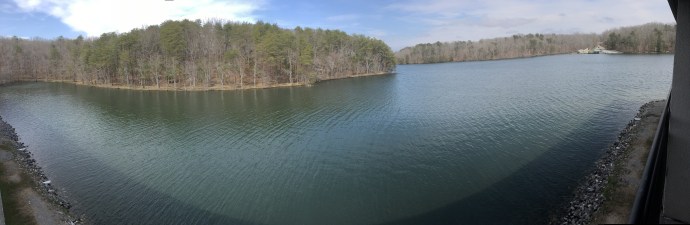
The view from our room at Fall Creek Falls State Park, Tennessee at a rare moment of some sunlight

After the hikes, we returned to our room, wondering: Fixed or Not Fixed? Turns out it was not fixed BUT luck was on our side. We checked in with the front desk, who was not even familiar with our request. She called the maintenance supervisor who showed up at our room. He also had never received any notice of an issue. Luckily the gentleman has worked here for 13 years and knew immediately what the problem was and how to fix it. We chatted some more about the closing of the lodge and restaurant. Personally his job will continue but many of his long-time co-workers will be out of work. Morale is lousy he said and the Governor would not win any votes in this county. One positive: the state will pay to the county the amount of hotel room tax to be lost. The tax revenues are dedicated to education and the loss of revenue would hurt the schools dramatically.

Ed and Chris. March 27
Categories: road trip, travel | Tags: , , , , , , , , , , | Leave a comment

2018 Trip 3: KY and TN: March 26: Caves and Crafts, Booze and Bluegrass (Music and Horses)

Spencer, TN. March 26

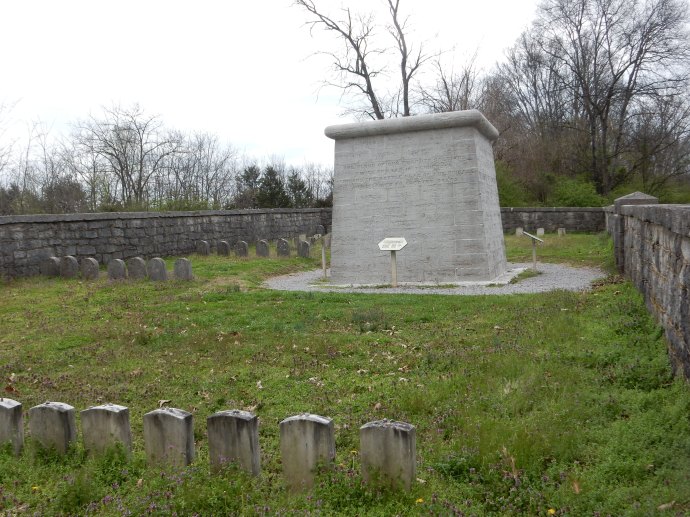
The Hazen Brigade Monument at Stones River National Battlefield. Probably the first Civil War monument erected.

We are a world away from the hustle and bustle of Nashville; its crowds, building cranes, and traffic. Tonight we are staying at Fall Creek Falls State Park, about 40 miles north of Chattanooga but a world away with its presence in forested mountains (1700 feet above sea level). The notable attraction here is the falls, at 256 feet high, one of the highest east of the Mississippi.

However, Fall Creek Falls is the end of our day. Our first stop this morning was at Stones River National Battlefield at Murfreesboro Tennessee. Frankly, Stones River is not a Civil War battle that I recollect ever hearing about. We stopped here since it was roughly on our way and it was a National Park Service site. Visiting here was a good choice.

Stones River is 25 miles southeast of Nashville and was right on the Civil War era tracks of the Nashville and Chattanooga Railroad. Thus, it was a strategic transportation crossroads. The Union army had a primary mission to cut the Confederacy in half. Victory here would be an important piece of that effort.

Lincoln was desperate for a victory. The Emancipation Proclamation was to take effect on January 1, 1863. Yet at the end of 1862, Grant was bogged down at Vicksburg and Burnside’s army had lost a battle at Fredericksburg. Rosecrans was the only hope left and the pressure from Washington was intense. On December 31, 1862 Rosecrans Union Army faced Bragg’s Confederate Army at Stones River. On December 31st, intense day long fighting left the Confederates feeling good but the Union troops still held many of their positions.

The intense fighting forced the two sides to use Jan. 1, 1863 to regroup, bury the dead, and address the wounded. On January 2nd, the battle resumed and while early fighting went the way of the Confederates, the Union Army used 57 cannon to stop and drive back the Confederate advances at great cost to the South. The 3 day battle inflicted grave consequences: for the Union 13,249 casualties; for the Confederacy 10,266 casualties. Bragg had to retreat from the area and Lincoln had the victory he wanted to emphasize the Union’s ability to implement the Emancipation Proclamation.

While visiting the battlefield we talked to some of the staff. We met the Superintendent who is leaving in a few days for a temporary, additional assignment to oversee the redevelopment of the National Park units in the Virgin Islands which had been heavily damaged by Hurricane Irma and Maria. She was familiar with the Mississippi National River and Recreation Area (MNRRA), our home NPS site, due to previously working at Indiana Dunes National Seashore. The superintendent there was previously in change of MNRRA and Chris and I had met him.

One of the volunteers at Stones River was a retired Army soldier and we chatted about the National Park Service. He also emphasized the differences between Western, Middle, and Eastern Tennessee; and reinforced the value of visiting Oak Ridge Manhattan Project NPS site west of Knoxville which is on our schedule when we return home from Great Smoky Mountains National Park.

Stones River has an informative museum and short video. We also drove the scenic loop and walked to various locations that were critical to the battle. When the battle was won, the Union forces established a major supply depot in Murfreesboro that served the Union well on Sherman’s drive to the sea. Another stop was at Hazen Brigade Monument. Colonel William Hazen’s brigade was the only Union troops who did not retreat during the December battle that favored the Confederacy. The fighting was so bad, the area was called “Hell’s Half Acre. In 1863, Hazen’s men had a monument built to honor their fallen comrades. It is the earliest known Civil War Monument. Most Civil War monuments were not built until the late 1880s or 1890s as the veterans wanted memorials built to commemorate battles before the veterans died.

Booze was our second stop. Jack Daniels to be specific. The 42 miles from Murfreesboro to Lynchburg TN took us an hour as we enjoyed the hilly terrain. Jack Daniels offers several types of tours, we did not select one in advance not knowing what time we would arrive. When we were at the ticket counter our choices were a dry tour (no liquor sampling) beginning in twenty minutes or one with liquor beginning in an hour. It was an easy choice for us, soon and sober was our selection.

Finished product at Jack Daniels Distillery, Lynchburg TN

Technically Lynchburg is located in a dry county, meaning no liquor can be sold. Jack Daniel’s nephew (Jack Daniels never married) was heading the business after Prohibition, ran for the Legislature, won and introduced a bill, that passed, allowing them to sell commemorative bottles that happen to have liquor inside and to run educational classes about alcohol that happen to include sampling the product. Or so said our guide.

Jack Daniels statue in front of cave with spring water. Daniels was only 5’2” with a size four shoe

The Jack Daniels story involves several heart warming aspects. First, the founder Jack Daniels built up the business after running away from home as a child, by buying up the land around the spring that provides the water at age 13, and by avoiding extra revenue agents at his distillery by never distilling more than 99 barrels of liquor per day. Mr. Jack began working at the distillery at an early age.

He had two mentors; the first being the owner, Rev. Dan Call, who sold the business to him when his parishioners told the reverend to either preach or make moonshine. Rev. Call chose preaching. The second mentor was a freed slave, Nearest Green, who was effectively the first master distiller here. Green’s heirs still work at the Jack Daniels distillery today. The distillery had to weather Moore County becoming a dry county and Prohibition but Jack Daniels nephew, Lem Motlow, persisted and the company has grown ever since. It is now owned by a conglomerate, Brown-Forman.

The original Jack Daniels office where he kicked the safe

The tour lasted about an hour. You walk through areas involved in all of the steps making the liquor from the wood burned for charcoal filtering to seeing the barrels being stored for aging. At the building housing his original office, we were told how Mr. Jack had arrived early to work one day (not his usual style) and had to open the safe. He did not remember the combination and kicked the safe in frustration. The stubbed toe got infected, multiple amputations occurred, and he eventually died of gangrene. Choose your take-away message: #1. Don’t arrive early to work. #2. Don’t kick a steel safe. Our guide did talk fast and in some noisy areas we did not always hear everything she had to say. BUT, as an added bonus we and three others were able to see a rat scurry along the floor.

Billy Thomas in his Lynchburg Cake and Candy Company

After Jack Daniels, we made a stop at the Lynchburg Cake and Candy Company, another heart warming story. The owner, Billy Thomas, retired as an accountant and mayor of Lynchburg. In 2003 he decided to start a hobby with a goal of making 50 cakes a month from a family recipe. The cake recipe uses one of the Jack Daniels liquors. Well he is still a hometown business operating out of a small building but he now has ten employees. He and the product have been on Nashville Public Television, “The View”, and “Food Network”; his product can be found in regional Cracker Barrel restaurants and in Kroger grocery stores. We met Mr. Thomas and he gave us a detailed explanation of the company grew, how he keeps costs down, and his extremely high sanitation rating. Quite impressive. Of course, we purchased a cake, a package of the whiskey balls, and several bags of whiskey praline pecans, although at the moment all are still unopened.

We drove two hours though Tennessee mountains to Fall Creek Falls State Park. The park is about 70 miles north of Chattanooga on the Cumberland Plateau. Tennessee and Kentucky have numerous parks with resort lodges, this is one of the Tennessee ones. Fall Creek Falls is the largest Tennessee State Park at 26,000 acres. It is known for its gorges and waterfalls. We will be spending two nights here. Our lodging is pleasant with a view overlooking the lake formed by damming Fall Creek, and the restaurant offers buffet meals that were quite tasty. And there is no admission fee to KY or TN state parks.

Ed and Chris. March 27

Epilogue: Snippets on life in America from Chris
Day 11: Many of us feel like we are living in very, very troubling times in our country. A good reminder (which is impossible to do in Minnesota) is to visit a Civil War battlefield site. The horror, the bravery, the carnage. Communities were destroyed and families took sides. The Civil War lasted for four years.

Categories: road trip, travel | Tags: , , , , , , | Leave a comment

Blog at WordPress.com.