
Columbia, SC. April 8
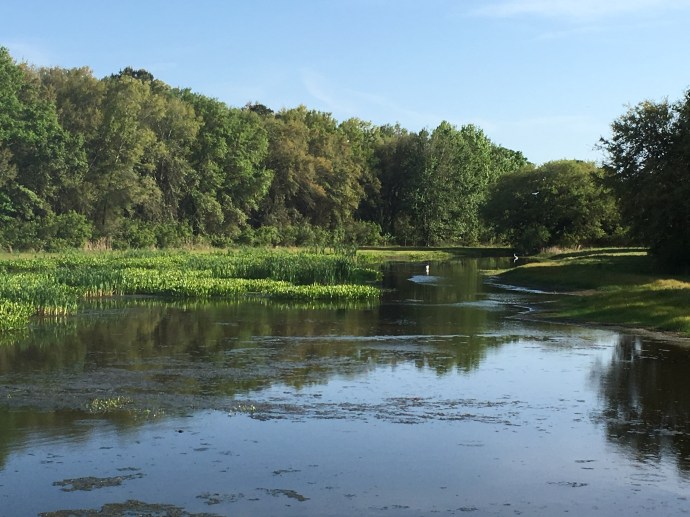
Harris Neck Wildlife Refuge, Georgia
Friday April 6
Driving Day. Hassle Day. Road Construction causing traffic delays Day. Unlike Atlanta, the delays and stop and go traffic, particularly in northern FL and southern GA were not caused solely by traffic but by road construction, stopped cars along the roadway, or roads narrowing from three lanes to two. Somehow, it made the delays easier to handle.
We were able to be on the road by 8 AM. Our destination for the day was Darien, GA. Nothing dramatic, just a location that did not push us too much on Friday and left us with a relatively short drive on Saturday. Our research had uncovered a U.S. Fish and Wildlife Refuge called Harris Neck that was only 20 miles past Darien. It was open until sunset and was our secondary target if tine would allow.

Anhinga at Harris Neck Wildlife Refuge, Georgia
Well we arrived at the refuge at 5:30 PM and it was a relaxing end to a harried day of driving. The refuge offers a driving route with several stops with views that might be worth stopping. The first stop was a beaut; we saw two alligators (one was a female with three young gators), an anhinga, two blue herons, and a large egret rookery full of white egrets. We drove the four mile route, stopping a few more times but no other stop rivaled that of the first one.
As mentioned, Darien was just an overnight stop. It appears that Darien has lost population, lost wealth, lost commercial establishments, etc. It is not far from Brunswick GA, which is a gateway to wealthy off-shore islands like St. Simons, Jekyll Island, etc. and the third largest port for roll-off containers in the U.S. Evidently, Darien is not sharing any spin-off business.
Saturday April 7
Saturday was a rainy day as we drove up to Columbia SC. Congaree National Park is just southeast of Columbia and was the primary reason for visiting here. Columbia is also the state capital and we targeted the late afternoon tour of the Capitol as our stop for Saturday. Sunday would be Congaree. Traffic was okay, we got our early and thus made it to Columbia to add one more item to our visit schedule, the South Carolina State Museum.
You may remember from two weeks ago that we visited the Tennessee State Museum and we were not at all impressed. The South Carolina Museum, however, was great and well worth a visit if any of you are ever in the area. The residents of South Carolina must agree, the place was always busy in contrast to the near emptiness of the Tennessee Museum. We arrived in time to score a free, 90 minute docent tour and I would have been happy to spend another 90 minutes or more exploring the displays more closely. The museum is four floors and is housed in an old, cotton mill. Inside you can still see the brick walls from the mill.
The first floor has an artists’ gallery with works from artists with some connection to the state. A planetarium is also located here. On the second floor, are displays concerning natural history, a 4D theater and a cafe with good food. The third floor is home to science and technology connected to South Carolina. For instance, the man who invested the laser was from South Carolina; and the state at one time was the home of more NASA astronauts than any other state in the US.

Part of the telescope collection at South Carolina State Museum, Columbia South Carolina
The fourth floor has displays about cultural history, an observatory, and a telescope gallery. A South Carolinian, Robert Ariail, was a major collector and restorer of American made telescopes and one entire room is devoted to his collection. The history of South Carolina takes up much of the floor, and in my opinion, their organization and summary of the history of South Carolina well represents on accurate summary. For instance, they noted that until the 1930s, South Carolina had a majority of African-American residents. Our docent was quick to point out to us that more Revolutionary battles were fought in South Carolina than any other state. Before the Civil War, South Carolina was the wealthiest state. After the Civil War as slaves were freed, it became the least wealthy and has remained one of the ten poorest. It is currently ranked 43rd from the top.

South Carolina State House, Columbia SC
After lunch in the cafe, we headed for the South Carolina State House and a 2:30 PM tour. The capitol building is the third one built for the state, the first two were destroyed by fire. The building was started before the Civil War but the Reconstruction Era was difficult economically and this building was not completed until 1907. It is small, housing only the two chambers and major executive offices. The light, the artistic use of granite and marble, and strategic use of statues, art, and wall coverings produces a pleasing appearance without being overwhelming. Outside, the southerly location has provided a much more robust profusion of flowering shrubs than we had seen in Kentucky or Tennessee.
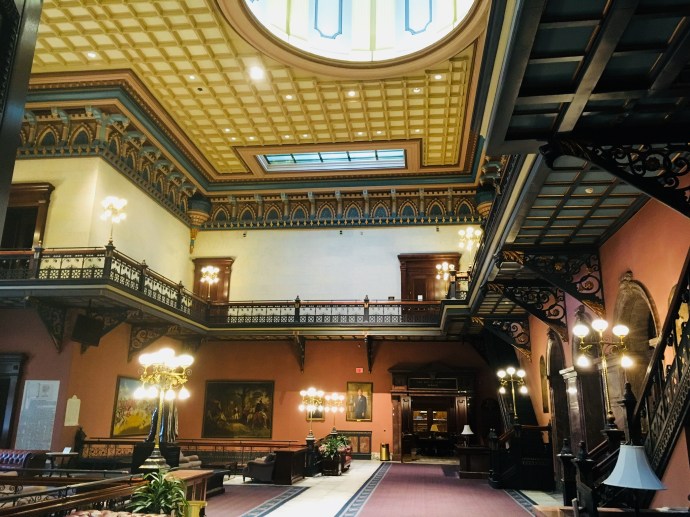
South Carolina State House, Columbia SC
As non-South Carolinians, we noted the conflicting presentation about segregation in the State House and its grounds. For instance, the difference in reverence for two of the their most well-known politicians. Storm Thurmond served for over 60 years in the U.S. Senate and his statue has a central place outside on the grounds. To us, he represents one of the South’s most determined segregationists. John Calhoun, who served as a U.S.Vice-President, Secretary of War, Secretary of State and a U.S. representative and senator, has a statue in the lobby. He is pivotal figure in U.S. history, including as a leading and strong proponent of segregation. In Minneapolis, however, Lake Calhoun, named after him, just had its name changed due to his segregation ties. He had no real ties to Minnesota and his other accomplishments in life were given little weight over the segregation views. There is a wonderful African-American history monument on the grounds of the State House. And the state finally removed the Confederate flag that was flying proudly on the State House grounds.
Before church we walked portions of the University of South Carolina campus, located in downtown Columbia. It is a beautiful campus, again the flowers and shrubs helping to accent the buildings. Numerous banners along the walkways helped to educate us to the University’s high standing academically.
Dinner was just a few blocks from the State House at Noonah’s, voted Columbia’s best restaurant for desserts for about a gazillion years. After a quick appetizer, we chose our desserts and had made an excellent choice in an Amaretto bread pudding and a praline apple pie.
Lodging tonight and Sunday are at an Evergreeners home not far from the University. They tend to travel more globally than we do so it was informative to learn of the trips and ideas we could incorporate if and when we start travel overseas.
Ed and Chris, April 8


 Chris Klejbuk and Ed Heimel travel adventure
Recent Comments