
Florida City,FL. April 5
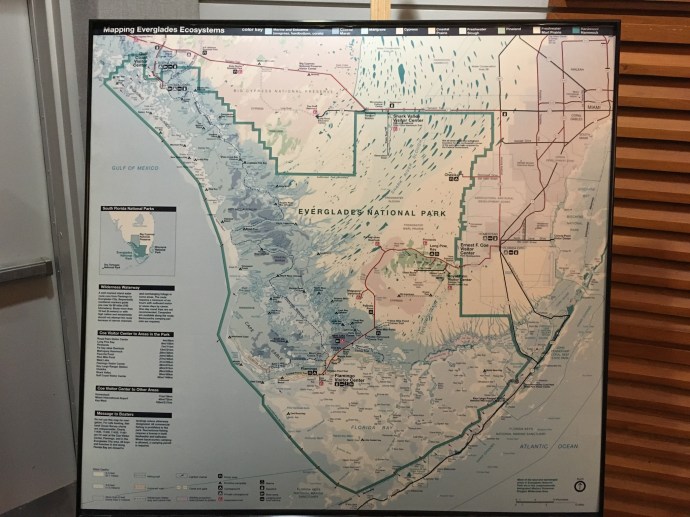
Map of Everglades National Park
I have included a map of Everglades National Park for your ease in understanding the park. We started over in the upper left, proceeded to upper center, and today spent our time along the red line (road) in the center of the photo. That area with the green lines and splotches to the left (west) of the red line is pretty much wilderness area, unseen by visitors and even most rangers.
The red line marks the road leading from the Ernest Coe Visitor Center down to the Florida Bay Flamingo Visitor Center. This visitor center is also operating out of temporary quarters (like Gulf Coast) as its previous center was damaged by Hurricane Irma in 2017 and a new center is at least two years away.

Manatees at the marina dock at Flamingo Visitor Center Everglades National Park
We went down to the marina and were in time to see 5-6 manatees frolicking by the docks. At one point, there was a garden hose dripping water into the bay and the manatees were lined up to taste this water as it trickled into the marina waters. When we came back to this area about 20 minutes later, all of the manatees were gone. For once luck was on our side.
A hike along the bay where the depth of the water is only a few feet was next. Lunch was a quick bite from the marina store watching the waves and a few birds. Along the shore, and inland also, were areas of dead mangrove trees killed by Hurricane Irma. We did not ask what the storm surge was here; Gulf Coast had 14 foot surge killing trees on the islands in the bay and eight foot surge destroying that visitor center.

After Irma: Bottom new vegetation near Eco Lake; top left Eco Lake dead mangrove trees, top right new shoots among the mangroves at West Lake
In some areas we could see new vegetation beginning. Not far from Eco Lake it was bright yellow-green grasses. Along West Lake, it was small mangrove shoots among the dead trees. The loop boardwalk at West Lake was destroyed, part of the walkway and railings still hanging in the water. Particularly at West Lake, most of the visitors we encountered were speaking a foreign language. I wondered if their impression of the U.S. and its national parks was taking a hit given the long time to repair the hurricane damage. But as Chris reminded me, we still have people whose homes have not been replaced yet from numerous previous hurricanes.

Elevation change sign
We have mentioned the slight elevation changes in the Everglades. On our way to Flamingo Visitor Center, we passed two signs indicating the elevation and the new habitat. At Mahogany Hammock, the very slight elevation gain produces an island of hardwood trees surrounded by the river of grass; grass growing in the slow moving water coming down from central Florida.
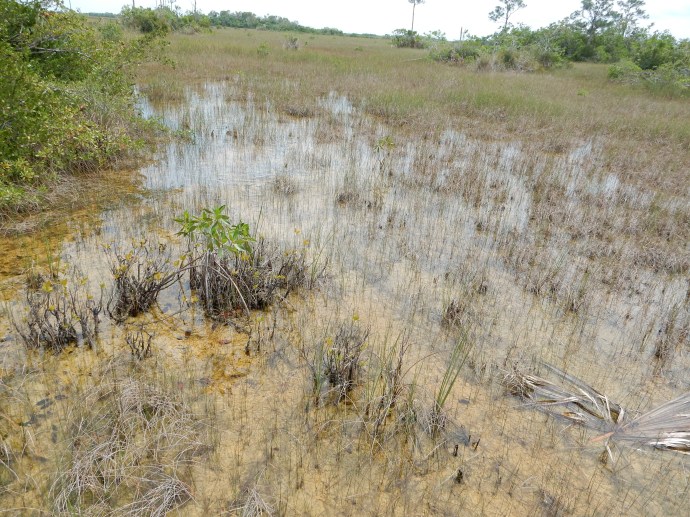
Periphyton at the bottom of the water surrounding Mahogany Hammock
During this dry season one can clearly observe the periphyton; a beige mass of organisms including blue-green algae, fungi, microbes, bacteria, plant residue, and animals that compose the foundation of the eco system. Some animals eat the stuff, the periphyton produces oxygen and helps create soil for other plants to grow on, some animals burrow into it to stay cool, and other animals and plants lay larvae and seeds that are dormant in the dry season but blossom in the wet season. Amazing results for what looks like a blob of gunk.

Our bird photo of the day
Ed and Chris April 5
 Chris Klejbuk and Ed Heimel travel adventure
Recent Comments