

Approaching Fort Jefferson at Dry Tortugas National Park after a 2.5 hour trip from Key West.
Key West Florida, April 11
Another day, another fort. Another day, another dip in the pool. Another day, another boat ride-but this one without any queasy feelings.
Wednesday April 10 was slated for our all-day trip to Dry Tortugas National Park. Dry Tortugas is the home to Fort Jefferson, located on an island 70 miles west of Key West. All of these keys are part of the third largest barrier reef system in the world. The keys are the exposed portion of ancient coral reefs extending from a point south of Miami to Dry Tortugas. Dry Tortugas is named for: Dry-to warn mariners that there is no fresh water here, and Tortugas (turtles) for the abundant turtles found by the earliest Spanish explorers which provided them with fresh food.

Inside of Fort Jefferson
Fort Jefferson was one of the many forts built by the United States in the mid-1800s to protect itself from foreign countries. Fort Jefferson would have been the largest and most heavily armed of all of the forts. At completion, the fort would have even able to train 120 cannons at any one spot in the water. Plus, land based cannon were more formidable than ship based; giving a huge advantage to the fort over attaching ships. But, given government funding and the difficulty of bringing construction materials all the way out here prevented the fort from ever reaching its intended size and armament.

One of the few remaining original cannon at Fort Jefferson
Fort Jefferson has one of those “what if” stories. The fort is located in Florida. At the time of Florida’s secession, Fort Jefferson had not been completely built and its cannon were still being shipped here. A Union ship had left Boston on a hurried trip to the island, landed here, and disgorged a battalion of artillery. The very next morning, a Confederate ship arrived and demanded the surrender of the fort. The Union artillery commander came out and basically told the Confederate ship to back off and tell all of the rest of the Confederates that this was their last and only warning, the next Confederate ship that approached would be blasted out of the water. The Confederate ship retreated. Lucky for the Union artillery battalion. The Confederates did not realize that the cannon for the fort were not yet here. Soon enough, the cannon arrived and Fort Jefferson proved an important part of the Union blockade of the Confederacy.
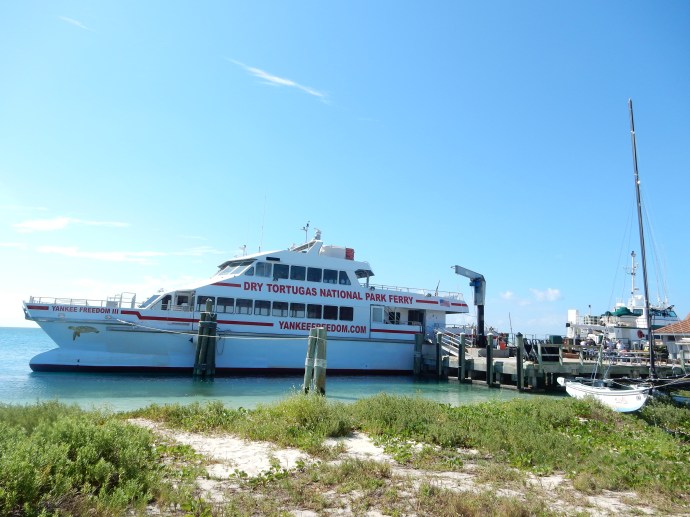
The Yankee Freedom III
We learned this and other details during an hour and a quarter tour given by a very knowledgeable crew member of the Yankee Freedom III. The Yankee Freedom is the authorized concessionaire to bring tourists out to the island. The boat ride is 2.5 hours out and leaves at 8 AM. We were warned there could be rough seas about one-half way out. We had taken our Dramamine but opted out of partaking in the free breakfast on the ship. Instead we chatted with our table mates, a couple from Eden Prairie MN and a couple from Annapolis MD-the wife had recently retired from the geography section of the U.S. Census Bureau.
The Dry Tortugas National Park was the impetus for our travel to Key West and was a worthwhile stop for us. Many of the people who rode the Yankee Freedom were here to scuba dive, a few others were here to camp out for a few nights. By the way, there is no fresh water on the island for them. We did meet and talk with a ranger who is responsible for running the island’s power generator and small desalinization plant. About 30 park employees live here year round, pretty much off the grid. We were happy to get back on our boat and take the 2.5 hour ride back to Key West. Both ways the seas were friendly enough and Dramamine worked its magic. We even ate lunch on the Yankee Freedom before venturing back to Key West.
After the day long journey, it was back to the Fairfield and its pool with water just the right temperature. It has an outdoor bar which we enjoyed also.
Today, Thursday, we rode the hotel shuttle to downtown Key West. Our primary destination was the Ernest Hemingway home. It is a major tourist draw, we got here early. Hemingway lived here from 1931 (with his second wife) until 1940 (when he moved to Cuba with his third wife). Tours begin every 5-10 minutes through the house and grounds. The home was originally built by a man who provided supplies to ships. He made a fortune and the home is the largest private residence on the island, built on the highest point (12 feet above sea level), has the largest pool, and has the only basement. His riches did not prevent personal misfortune and the home eventually fell into disrepair until Hemingway’s wife bought it with her uncles’s money.

One of the cats on the bed in the master bedroom at Hemingway house.
Of course the tour is full of anecdotes about Hemingway, his wives, his books, his famous friends, etc. One other highlight for some people is the 50+ cats on the premises. They all are related to a white cat given to Hemingway by a Key West friend. The original cat had 6 toes. The majority of the cats here have six toes and are all descended from the first one. Each female gets one litter before she is neutered; except for one female named Elizabeth Taylor who had two litters. The cats have free range, have staked our their own territory on the property, and chase away any stray cats that try to get in. THey have a full-time veterinarian and accompanying staff.
We spent some time wandering the streets of Key West. Plans to visit other museums went by the boards as the heat and humidity took its toll. We returned to the Fairfield to work on this blog post and to enjoy the pool.

Hemingway’s writing studio was in this building next to the pool.
Ed and Chris April 11
 Chris Klejbuk and Ed Heimel travel adventure
Recent Comments