

Burlingame, CA March 5
Tomorrow we fly home from San Francisco Airport. This last blog will cover the Monterey Peninsula area, from noon Friday to Sunday afternoon (today). We left the Calla lilies and came north up the coast to Monterey. Not for us the 17 mile drive or Monterey Aquarium. Instead we went to discover the history of the area.
Our learning started at the Monterey Historical Park. This is the area of old Monterey, where California began its transition from being part of Mexico to the 31st American state. In 1542 Spanish explorers first discovered Monterey Bay, a large sheltered bay capable of receiving large ships. It was not until 1770 that settlers, military, and missionaries arrived to establish up a more permanent settlement. In 1776 Spain named Monterey the capital of upper and lower California. In 1822, control shifted from Spain to Mexico after Mexico won its independence from Spain. From this point, the population, trading, and development of ranches increased.

The Custom House in Monterey
In 1827, the old Custom House was built by Mexico to collect tariffs on the shipping of goods into and out of California. This building still stands today. The warehouse for the Custom house is used as a museum whose exhibits we viewed. The Custom House is the oldest surviving government building in California. The exhibits helped us understand the history of this area, from the earliest Native Americans living here to the statehood period. An excellent docent tour Friday afternoon deepened our understanding and knowledge.
In 1846, war between the U.S. and Mexico broke out and most of the fighting occurred in Texas and Mexico. On July 7, 1846 U.S. Commodore John Drake Sloat landed in Monterey and with marines and sailors seized Monterey and proclaimed California to be part of the United States. When the war was over, with the Treaty of Guadalupe Hidalgo signed on Feb. 2, 1848, this large and poorly defined area of “California” became part of the U.S. Just in time for the U.S. Gold was discovered in California on January 24, 1848. News of this did not reach the U.S. or Mexico until after the treaty was signed. Would not have life been different for the U.S. if Mexico retained not only California but those parts of Nevada, Utah, Arizona, New Mexico, Colorado and Wyoming that became part of the U.S. also?
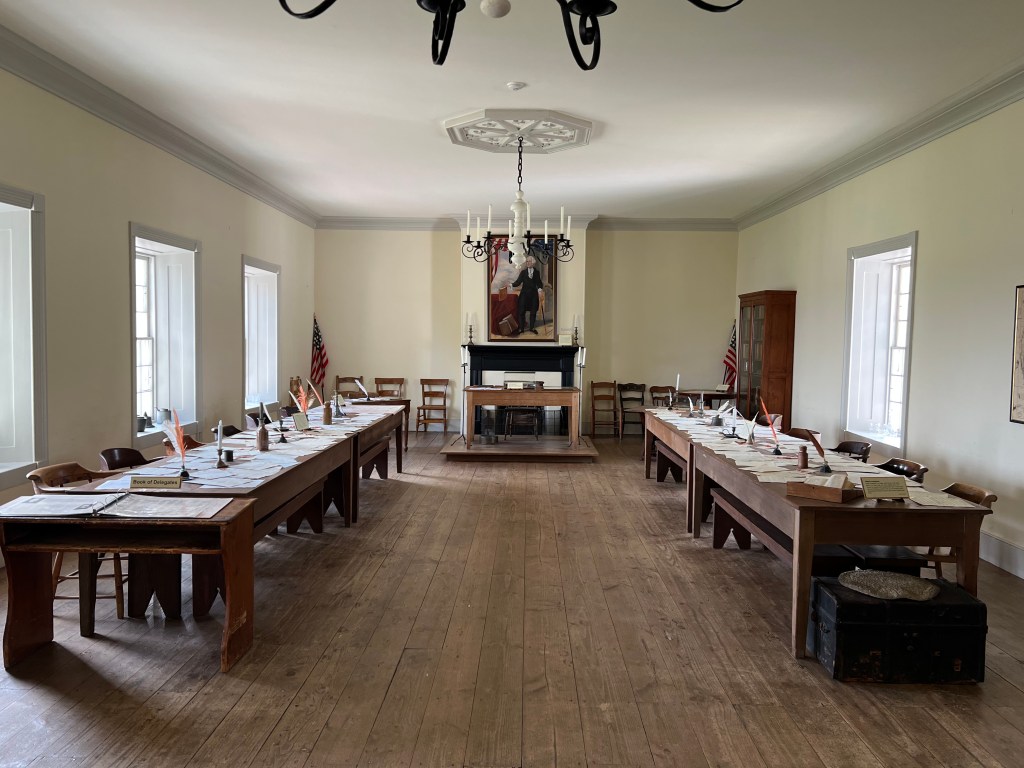
The inside of Colton Hall where the California Constitution was debated
In 1849 the first American built government building was constructed. Colton Hall, still standing, was built “out of the slender proceeds of town lots, labor of convicts, taxes on liquor shops and fines on gamblers.” This is where the constitution of California was debated and approved. Note that: California went directly from a province of Mexico to a U.S. state without first being a territory, has a constitution that outlawed slavery and guaranteed married women could keep the property they had before they got married, and the first capital was in San Jose. Monterey never was the capital of California.
The docent tour started at the Custom House and the docent explained the history of Monterey. We walked among sections of the historic area; seeing portions of a sidewalk constructed from whale bone, and two other buildings dating from the mid to late 1800s. We saw another example of papel picado, a Mexican folk art which cuts elaborate designs into tissue paper. Our docent explained different designs and colors would be used to celebrate various holidays and celebrations. Earlier we had seen them in the bar of the hotel at San Juan Bautista.
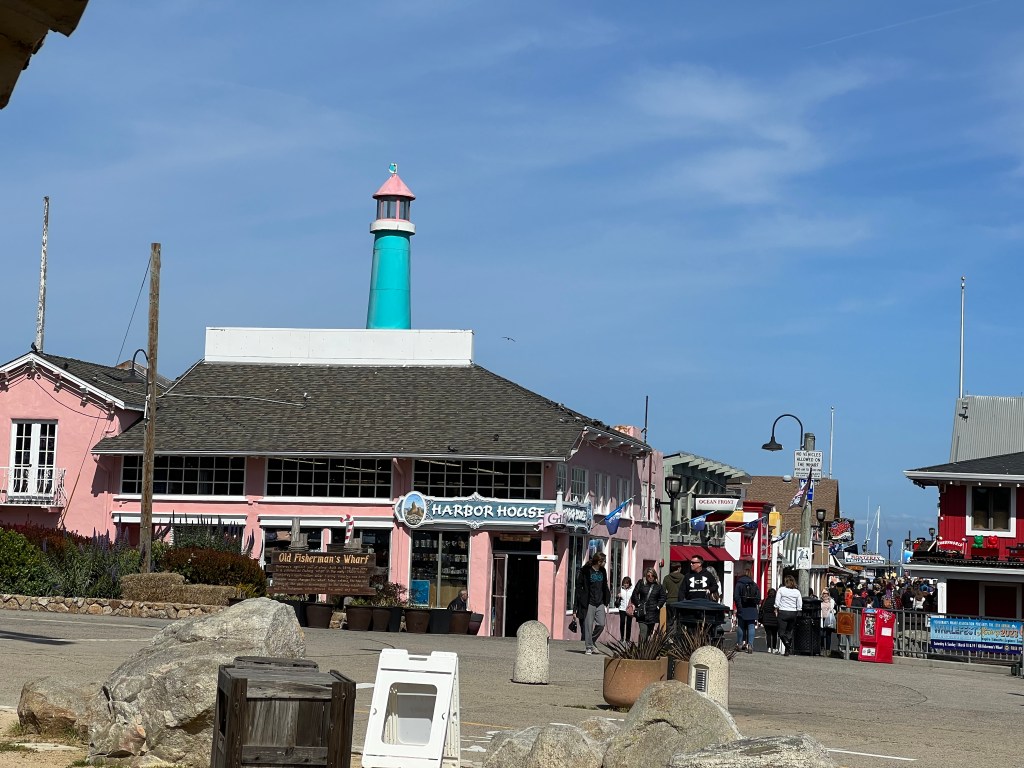
Fisherman’s Wharf
Lunch/dinner was at a fancy restaurant along Fishermans Wharf. The clam chowder was excellent.
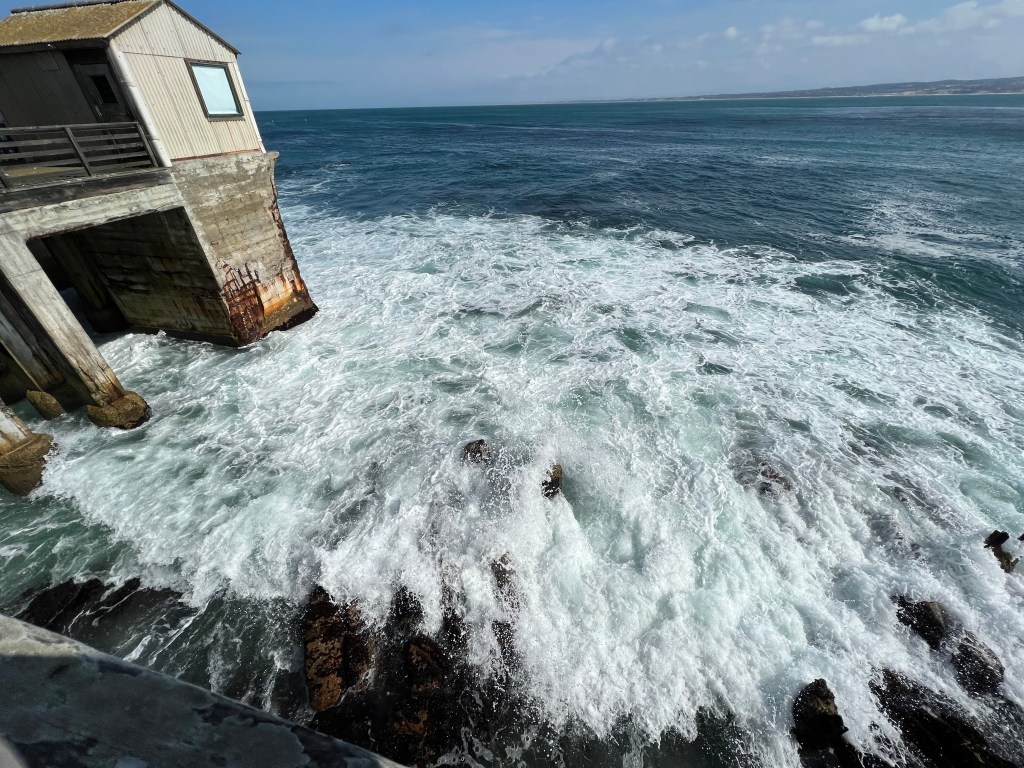

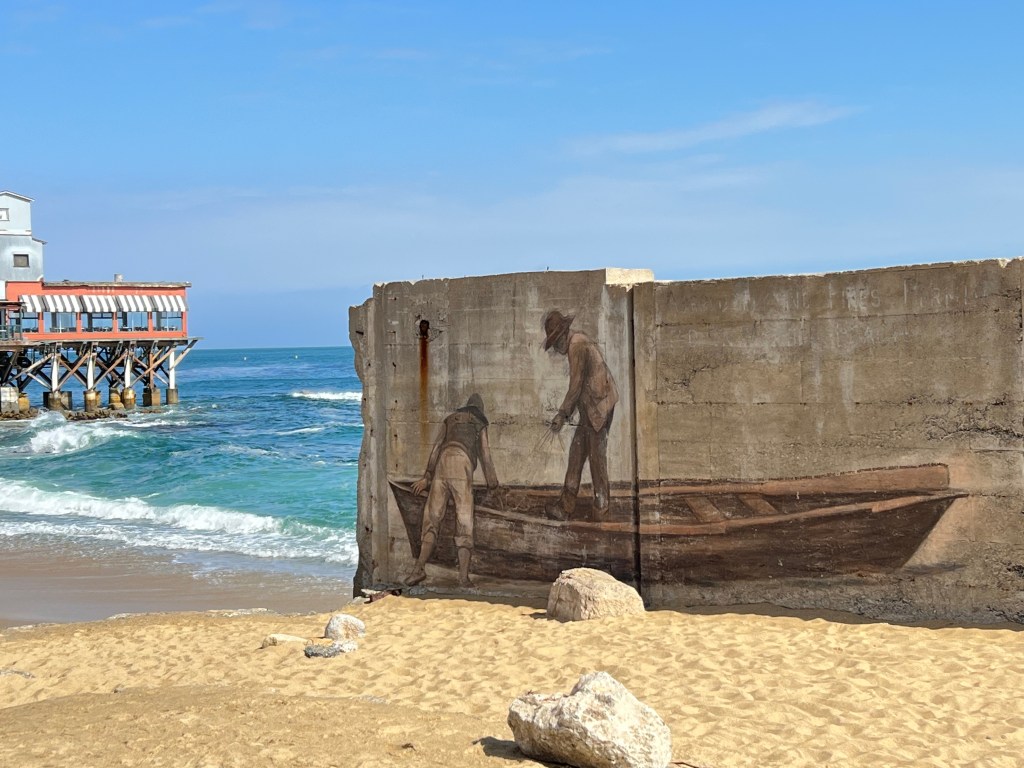
Saturday we visited Cannery Row, the area of Monterey where fishing, particularly for sardines, was a huge business from about 1915 to 1955 when the sardines were either overfished or just at natural down cycle in their existence. Cannery Row was made famous by John Steinbeck’s novel of the same name. We wandered around the Cannery Row area, mainly tourist shops except for the Monterey Aquarium. After that, we did our tour of Coltan Hall and old Monterey Jail, finishing up as the afternoon rains kicked in.

San Carlos Cathedral
Church was at San Carlos Cathedral, originally the chapel for the Monterey Presidio. It is the second smallest cathedral in the U.S. (after the one in St. Louis.) and the oldest continually operating parish in California. Dinner was at a very popular Italian restaurant downtown, we were lucky church was at 4 PM and we arrived at the restaurant before the hordes.
Sunday we had one destination in mind. The National Steinbeck Center is in Salinas, just 15 minutes from Monterey. First though, Chris had us stop and walk over the dunes to have a last look at the Pacific Ocean. Then we drove over to Salinas. In case you have a good memory, yes we spent the night here earlier this week but the Steinbeck Center was not open at that time. I had not realized that John Steinbeck, the author, grew up in Salinas. Towns and locales we have been visiting or driving through the last few days are the sites of many of his books. His life here gave him a perspective on working people and their experiences, thus his books are based on people he knew and their lives. Not for him the well off life in the books of Sinclair Lewis for instance. Some of his novels include: Of Mice and Men, Grapes of Wrath, East of Eden, Cannery Row, and Tortilla Flat. Steinbeck won one Pulitzer Prize and one Nobel Prize.

The National Steinbeck Center is a museum devoted to his life and his works. We spent two and a half hours viewing videos, listening to recordings of actors reading his works, viewing the exhibits, realizing that during WWII he experienced the war firsthand and wrote about it for wide spread circulation, and in general, re-acquainting ourselves with his literary works and impact. It was time well spent and a fitting end to our time in the south bay of San Francisco.

The camper used by John Steinbeck when traveling around the U.S. gathering insights for his book “Travels with Charley” The truck was named after Don Quixote’s horse-Rocinante.
Ed and Chris Burlingame CA-just south of the San Francisco airport March 5
 Chris Klejbuk and Ed Heimel travel adventure
Recent Comments