Posts Tagged With: Cedar Breaks National Monument

2021 Southwest Circle Tour-June 11

Cedar Breaks National Monument

Brian Head UT, Friday June 11, 2011

Flagstaff had been the purpose of our trip, to visit with Lou and Joyce once again after the pandemic had begun to diminish. The trip home will take us eight days as we head north and then east. Our first day mainly retraced portions of the country we had seen before, except for one section in southern Utah. Despite this, we encountered some surprises and long periods of great scenery.

The first surprise came as we approached Page AZ. Horseshoe Bend, a well known bend in the Colorado River south of Page, seemed to have a new entrance facility. Long lines of cars were backed up to visit the site. The river is about 1,000 feet down and it takes a hike of over a mile to reach the observation overlook. My advice, go to Goosenecks State Park in Utah. Shorter walk, deeper canyon, more bends, fewer people.

Second surprise-Lake Powell is at a record low. Glen Canyon dam was finished in 1963 and by 1966 Lake Powell was in operation. Today the water level is at its lowest depth since 1966. The resolution of this issue of decreasing water supply and increasing water usage is beyond me. Come see Lake Powell while you can.

Lake Powell and Wahweap marina

Our trip continued along US 89 through more desert country until we stopped in Kanab Utah for lunch at a local park. The park was very nice with great red rock backgrounds. It was only tonight in our hotel room that we did some research on Kanab. Kanab comes from the Paiute word meaning “place of the willows”. Kanab is very conservative and in the early 2000s faced much backlash from travelers about its stance on marriage and family practices.

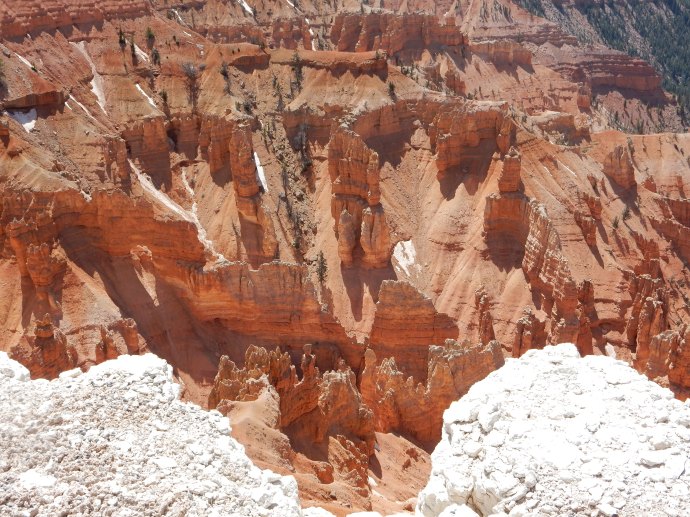
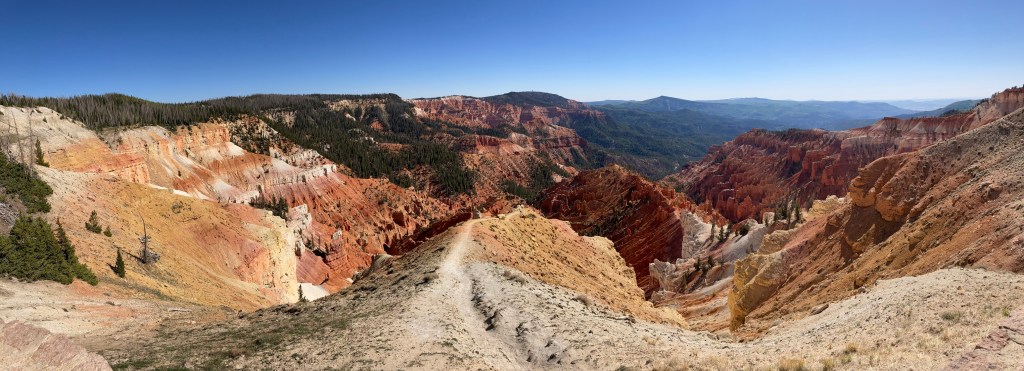
The primary destination for the day was Cedar Breaks National Monument. We were here once before and Chris loved the scenery. We decided to plan our return trip to include it. Cedar Breaks is at an elevation of over 10,000 feet and was constituted as a national monument in 1933. The monument preserves an area created over millions of year from limestone uplifted by a natural fault and eroded by ice, water, and wind. The scenery is spectacular and the monument is not crowded. Wildflowers are just beginning to come out in the prairie and along trails.

Cedar Breaks National Monument
Wildflowers at Cedar Breaks

Hiking at 10,000 feet above sea level is not a primary activity for us but today we hiked the Alpine Pond trail. The trail is in the shape of a figure eight and due to the elevation (it starts out at 10,460 feet), we only hiked one of the loops. They classify the hike as easy to moderate and it probably is. But, still, with an elevation gain of 200 feet and rocky trails, we were tired when we completed it.

Alpine Pond

The Alpine Pond is one highlight. The water leaving the pond flows out to the Great Basin many miles to the west. Great Basin is a national park in east central Nevada that we have not visited yet. At Cedar Breaks, the forest is sub-alpine, with predominantly fir and spruce. The spruce trees have faced a major die-off from bark beetles starting back in the mid-1990s. It will take a long time for the forest to regenerate. There are some Bristlecone pines here, one of the longest living life forms on earth.

Some of the dying trees

Not far from Cedar Breaks is Brian Head, the mountain and town. The mountain peak is at 11,300 feet. The town is basically a ski resort but it had the closest lodging to Cedar Breaks that made sense for us. We are staying at a very nice Best Western and ate at its sit down restaurant. There are not too many other eating options in town.

As I mentioned, a number of sites along today’s journey have been visited before. May 12, 2013 our first sighting of Bristlecone pine in CA. May 10-15 of 2014 when we spent a week house boating on Lake Powell. May 31-June 4, 2016 when we visited the North Rim of the Grand Canyon, Antelope Canyon, and Cedar Breaks. (Cedar Breaks still had snow on the ground at that visit.) May 31, 2018 when we stopped at Horseshoe Bend.

Tomorrow we head north and will be visiting more of Utah, Wyoming, Montana and North Dakota.

Ed Heimel, Chris Klejbuk Brian Head UT June 11, 2021
Categories: travel | Tags: , , , | Leave a comment

2016 Trip Four, Southwest Discoveries, June 3-4

Las Vegas,Nevada, June 5

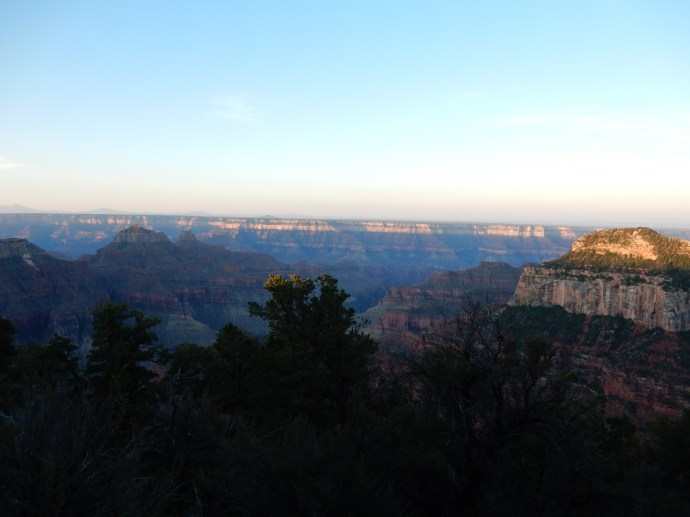
Sunrise at the North Rim of the Grand Canyon

Sunrise at the North Rim of the Grand Canyon

Heat Advisory to Snow. Friday and Saturday were days of contrast. The North Rim of the Grand Canyon is higher in elevation than the South Rim with greater precipitation, more trees, and cooler temperatures. It did get into the high 80s both days on the North Rim but the temperature on the canyon floor was to reach between 115-120 degrees F. When we arrived in Las Vegas Saturday evening, the temperature was 107 degrees. But let me back up a bit on the story line.

Friday morning we were scheduled to go on a rim top mule ride. Only one hour, and not the ride down to the bottom and back up again. However, on this trip I began to experience problems with altitude headaches and shortness of breath. I have been at higher elevations than the 8000 feet or so at the North Rim in the past and have not experienced those problems. Second, I have some vertigo issues but again, on this trip, it was worse than usual. In fact, I was getting nervous Thursday night while trying to sleep just thinking about Friday’s rim ride. Finally, I was getting a sinus headache and my eyes were watering. I told Chris Friday morning we were not going to do the mule ride; I did not want to be on a mule, my eyes watering and getting dizzy from looking over the edge. We canceled the ride. One has to accept one’s limitations, even if they are increasing.

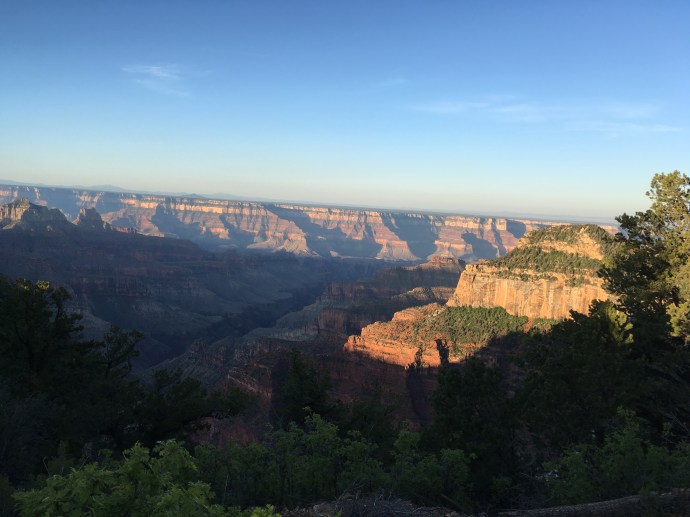
Sunrise at north rim

Sunrise at north rim

Seeing the sunrise on Friday was still on the agenda. We were up at 4:30 AM but Chris took many of the pictures. I stayed back from the edge. There were fewer people out for the sunrise than had been out Thursday night for the sunset. The sunrise, and sunset, would have been enhanced by more clouds and more color but still it was a unique experience to watch it over the huge canyons below us.

Reflecting now on our visit, I think the vastness of the Grand Canyon reduced its pleasure for us. Driving the roads along the many mountain cliffs, where the cliffs are closer, change color, and contrast with the valley floors provided a more intimate and more visually rewarding experience. Even the drive down I-15 is impressive through the mountain valleys in that stretch of Utah, Arizona, and Nevada (as long as you ignore the haze/pollution).

We did take a morning ranger talk about the Grand Canyon. He explained how the geology contributes to the heavier rainfall that flows southward from the Kaibab Plateau to the north of the canyon edge down here to its edge. The north gets 15 feet of snow per year and that melting water creates more erosion on the north rim. More erosion equates to more visually stimulating gorges, rocks, etc for viewing compared to the steep drop-off of the South Rim. The 400 bison here are one of the more genetically pure herds in the U.S. Many herds have some cattle genes intermixed.

The North Rim has greater variety in vegetation. One can walk a few hundred feet and the juniper and pinyon pines of the desert change to Ponderosa pines of the forest. The south facing canyon wall provides for up drafts of warm air from the canyon floor 5500 feet below that limit the vegetation along the edge. Roaring Springs Canyon which runs just east of our cabin provides all of the water for the North and South Rims from the springs in its gorge. The vast majority of the park’s electric bill is for pumping water.

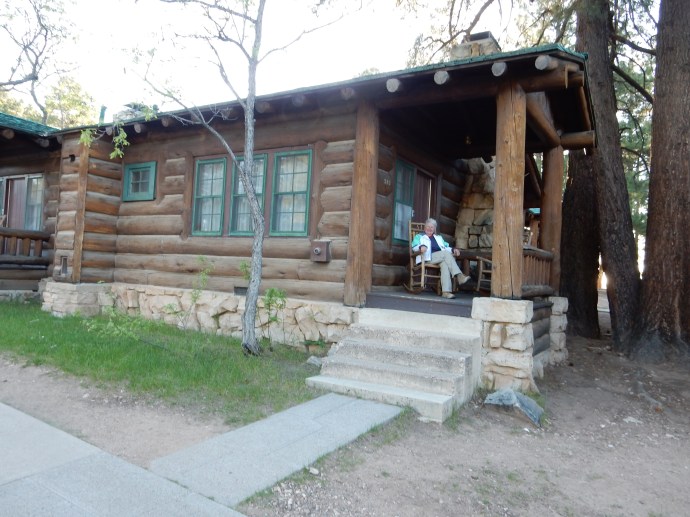
Chris on front porch of our cabin

Chris on front porch of our cabin

After the ranger talk, we took most of the day easy. We enjoyed the views, watched people, did our laundry, and listened to a second ranger talk. It was more relaxing for me to not feel the pressure to go on long walks or look over the edge. With the trees and the breeze, it was a comfortable day. We had our meals in the Grand Canyon Lodge; there are few options and the food was tasty. Our evening dinner was a buffet with a wide-screen showing a variety of National Park films. All of the accommodations are in cabins, the lodge is for meals, gift shop, etc.

Saturday we drove to Las Vegas via two National Park units; Pipe Spring and Cedar Breaks National Monument. Quite a difference between the two. Pipe Spring is in the northern strip of Arizona, just south of the Utah border. It proved handy for the early days of the Mormons when they could cross over the border to avoid prosecution for polygamy.

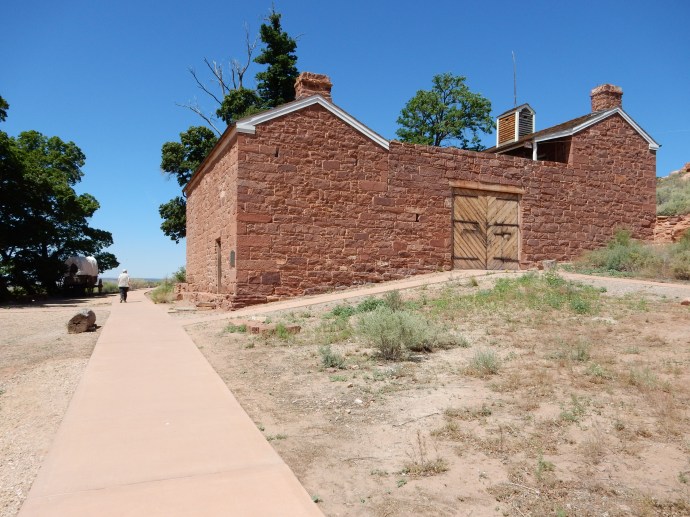
The fort at Pipe Spring National Monument

The fort at Pipe Spring National Monument

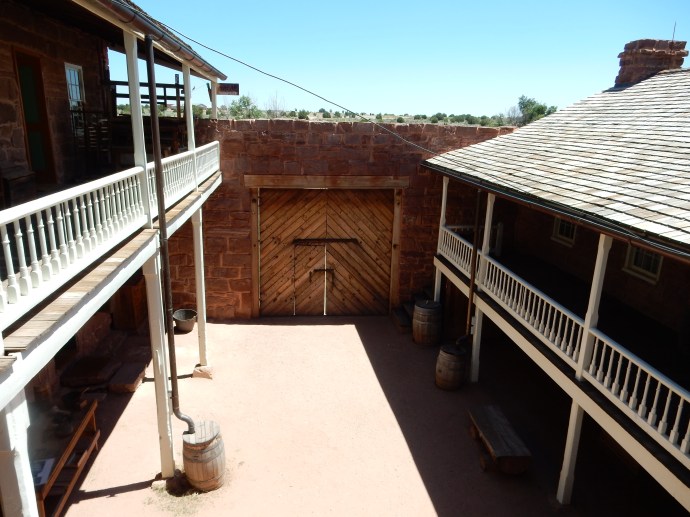
Pipe Spring had been a long time habitation for the Kaibab Paiute Indians. It has a spring sufficient to support wildlife or some grazing and growing of crops. A Mormon missionary came across the spring, passed the word up the chain of command, and the inevitable conflict over land use and water rights began. Grassland was more abundant then and Mormons established a ranch here. During the building of their temple in St. George, Utah, this ranch provided meat, dairy and cheese to the workers. In order to provide protection against raiding Navajos (the Paiute here were peaceful) and to support the early Mormon desire to establish their own kingdom of Deseret, a small fort was built at Pipe Spring. The fort was built right over the spring; Indian access to the water was denied.

Interior court yard at Pipe Spring National Monument

Interior court yard at Pipe Spring National Monument [/caption

Pipe Spring has a video of the conflict of values that existed here. In addition, the park rangers provide a 45 minute tour of the fort designed to show how the fort operated. It was less a US Army style fort as a walled in ranch house with enclosed courtyard. The Mormons even had their our telegraph system to connect their far-flung outposts with the headquarters and main temple in Salt Lake City.

From the over 100 degree temperature at Pipe Spring, we drove scenic Highway 89 in Utah in the area between Zion and Bryce National Parks. We continued through the Dixie National Forest on Highway 14, a road normally closed in winter due to snow. Our destination was Cedar Breaks National Monument.

Cedar Breaks National Monument Cedar Breaks National Monument
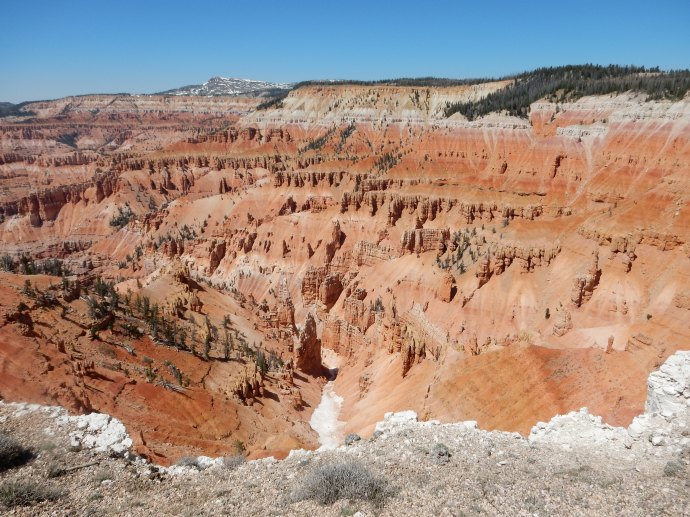
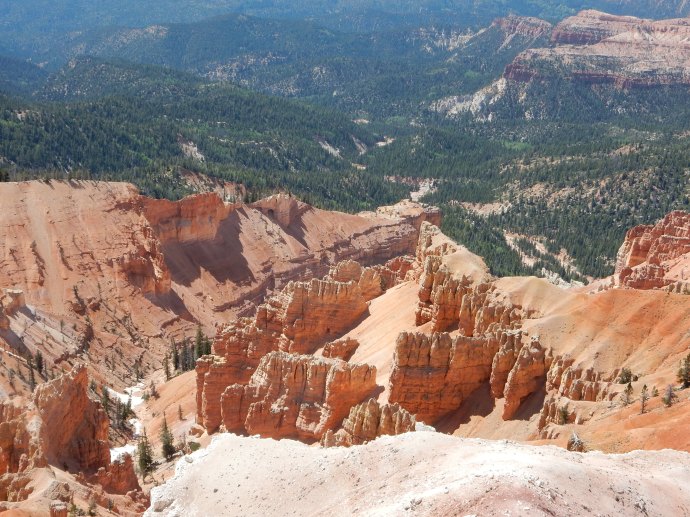
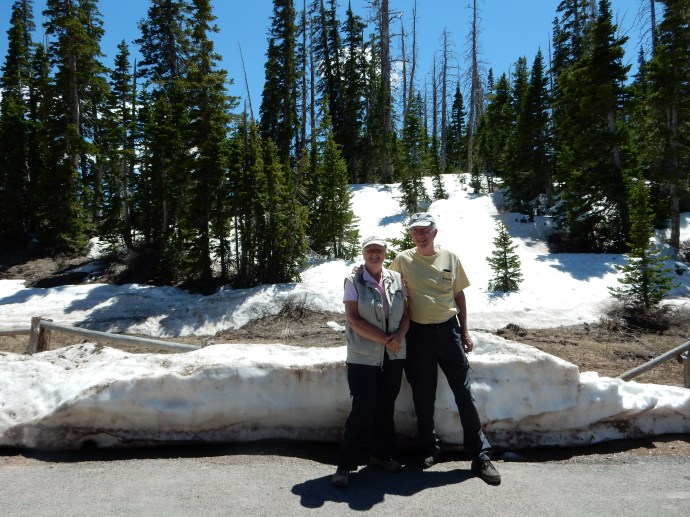
Cedar Breaks is another of the mis-identification by early settlers. The trees here are not cedars as they thought but junipers. Breaks refers to the steep, heavily eroded terrain. The road winds through forest and climbs up to a 10,400 foot elevation. As we approached the visitor center, snow appeared on the side of the road and the car gauge indicated the outside temperature was 68 degrees. Heavenly.

Cedar Breaks National Monument

Cedar Breaks National Monument
Cedar Breaks does not have many trails and the two we attempted still had snow blocking much of the trail. At this altitude, I was not inclined to do a long walk anyway. The main feature here is to observe the rocks in “The Amphitheater”, which we did from several locations. The rangers here were all young and enthusiastic about being assigned to such a scenic location. I can’t blame them. The sight was amazing and quite unexpected. We enjoyed our “lunch” of granola bars overlooking “The Amphitheater”.

Cedar Breaks National Monument

Cedar Breaks National Monument

Cedar Breaks might be a great place to return to in late summer when the wildflower are out. For now, it will remain a great memory of wonderful vistas. For once the time differences among these states proved to our advantage. We were in Utah, an hour later than Nevada and Arizona so we had an early dinner at a steakhouse in Cedar City. Cedar City is also the home of the Utah Shakespeare Festival which begins here in late June with an expansive schedule of plays.

After dinner, it was a quick 2.5 hour drive down the Interstate to Las Vegas. We are here for three nights with a timeshare spiel tossed in Sunday.

Chris and Ed at Cedar Breaks National Monument

Chris and Ed at Cedar Breaks National Monument

Ed and Chris

Categories: road trip, travel | Tags: , , , | 1 Comment

Blog at WordPress.com.