

On Turner Loop Road, canal in foreground, next grass prairie with palm hammock in center background
Everglades City, FL. April 3
“Ours is a water world”. A quote from the introductory video at Big Cypress National Preserve. Even though we spent most of today in our car drving, this message has been driven home as we visit numerous forests, swamps, sanctuaries, preserves and parks in southern Florida. Big Cypress Preserve is 720,000 acres run by the National Park Service to help preserve this area’s water and habitat.
The Big Cypress area had been originally included in the proposal for Everglades National Park but was not funded. In the 1960s, it was proposed to relocate international flights for Miami International Airport with a new facility in the area. One runway had already been built when enough pressure was created to stop it. As part of the agreement to create Big Cypress Preserve, the Seminole and Miccosukee Indians were allowed permanent right to occupy and use the land in their traditional practices and off road vehicle use and hunting allowed under set rules for others.
The Miccosukee and Seminole moved into the area after the Calusa were killed, died or had moved to Cuba. As mentioned earlier, the region was so rich in food from birds and fish, little farming was done. There are still middens, or piles of refuse, existing in the preserve to indicate some of the patterns of Calusa life.
Big Cypress has two visitor centers. After viewing the video at the first, we drove our first scenic road, the Turner-Wagonwheel-Birdon Loop Drive. The area is bisected by numerous canals, originally built to facilitate the expected land development. Since the land is wet and low, construction frequently used canals to drain away water and to place the excavated land to create higher ground that would be dry.
The roads in the area, including US 41 (the Tamiami Trail), the first road connecting Tampa and Miami completed in 1928, act as a barrier to the natural flow of water. Today the canals and culverts try to mitigate the obstruction. The resulting land produces a mixture of plains, prairies, forests and marshes. Even a foot or two in elevation change may mean the difference between a cypress forest and a pine forest, between grassy prairies and wet marshes.
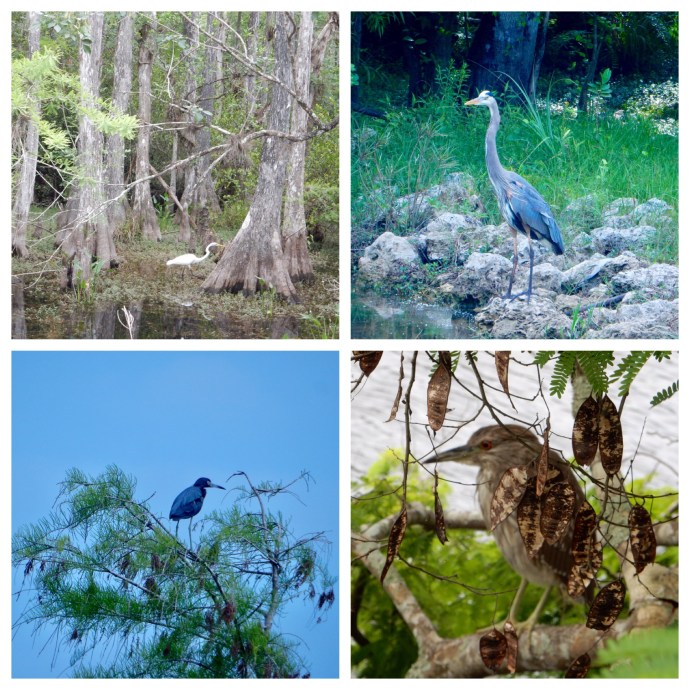
Birds in Big Cypress Preserve
The Turner Loop Road, north of US 41, primarily showcases prairies and forests. The road was not heavily traveled, even though it is a county road, not just a park road. It is gravel with continuous washboard surface. It is wider and presents a more open perspective. We did view several swamp tour vehicles, jeep like vehicles mounted high above the ground. In general, this loop route was just average in terms of interest.

Loop Scenic Road with one of the few alligators we saw along the road
We had high hopes for the second loop road, simply called Loop Road Scenic Drive. It is longer, 24 miles versus 16 for Turner. One third of the road is paved, the eastern end where numerous homes belonging to members of Miccosukee Tribe of Indians live. The road is narrower than Turner Loop. As we left the paved section and drove west and north, the road has a more closed in feel than Turner Loop. Vegetation is heavier, views of birds and animals are limited to the openings provided by the culverts transferring water from one side of the road to another. The land is more swamp and marsh than prairie.
Chris and I had driven this road in March of 2002 or 2003. Our recollection of that time was of much less vegetation, and an open view of the canals lining the road. In particular, we had been struck by the high number of alligators lining the canal and grassy embankments. In our memory, there had been hundreds of alligators. We had joked there must be an alligator convention in town there were so many gators. Not so this time, we only saw a few and the vegetation limited the opportunity to look for more.

Remnants of the railroad ties used by the logging trams during the period when the area trees were harvested.
A hike off of Loop Scenic Drive brought us into the recent history of the area. The logging period before the Preserve was created used railroad type trams to remove the logs. We came across remanants of the ties, still well-preserved.

Camelia Street Grill in Everglades City
We had an early dinner at the Camelia St. Grill along the waterfront. It was a relaxing setting. An evening downpour came as we used the pool at Ivey House and made us glad we had visited the marsh trail with the roosting birds last night instead of tonight. Tuesday night we had eaten at Angler’s Cove, a restaurant in Port of the Islands resort just west of Everglades City. Anglers Cove was more formal and had live music.

Scene along the hike off of the Loop Scenic Drive
Ed and Chris. Everglades City, April 4


 Chris Klejbuk and Ed Heimel travel adventure
Recent Comments