
Boston, January 22-29
Another trip to Boston. Well I never wrote up this trip to Boston and since we leave in 10 days for another six-week trip down through Kentucky and Tennessee, I thought I’d better get caught up. Much of the trip was family related but this blog will cover the sites that we saw in the Boston area. We have been to Boston numerous times, but we are still able to find a few things that are new to us.

One of the Map Room maps
Our plan was to leave on Monday, January 15 for about a week. However, a major snowstorm was projected and Delta was offering free flight changes, so we took them up on their offer and left on Sunday the 14th. Hertz rental car company was not as agreeable. Changing our reservation and adding one day would’ve doubled the cost. Instead, Deb picked us up on Sunday at the airport. Monday morning Rebecca gave us a ride to downtown Boston. We spent the morning going through the Boston Public Library. That might seem a strange way to spend the morning but the library is home to numerous famous murals. Chartered in 1848 as the first large, free American municipal library, it was so successful it outgrew its home.
The current Boston Public Library, built in 1895 and expanded in 1972, has three sets of murals of dramatic import and size which are noteworthy. However, our first stop was at the Map Room. The Leventhal Map Center is primarily a research center but has a changing exhibit of maps. The exhibit expands one’s understanding of the numerous varieties of maps depending on the material to be presented. The area had children sized nooks and desks also to allow kids the opportunity to explore at a less overwhelming level of detail. As we headed on to the murals, we passed an interesting wall mounted art piece that upon closer inspection was a mural/painting/composition created by various book covers.
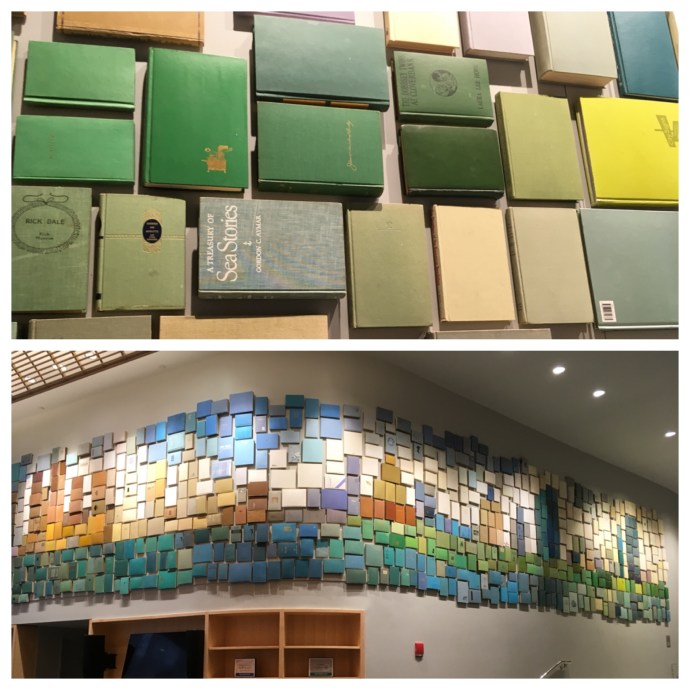
The book collage at the Boston Public Library
From the map room we headed to the murals. The murals are all located in the McKim Building, the 1895 building. Edwin Austin Abbey was an American who worked primarily in Europe. His mural is entitled “Sir Galahad’s Quest for the Holy Grail” and was installed in 1902. It is installed on all four walls below the ceiling in the Abbey Room on the 2nd floor. The 15 paintings depict the Arthurian legend.
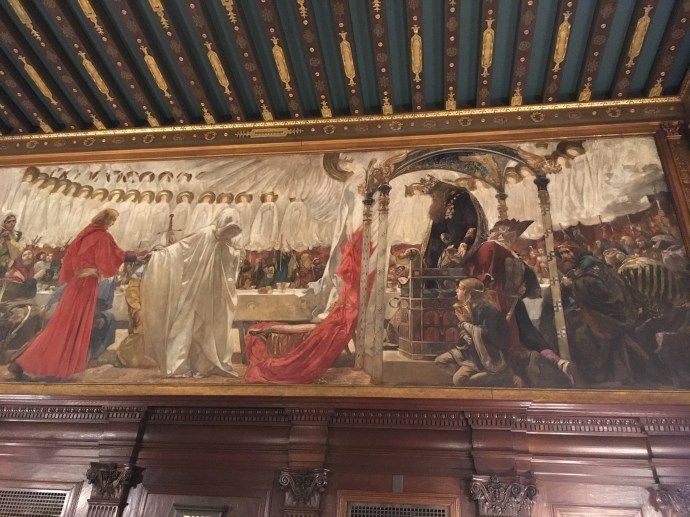
One of the Abbey murals at Boston Public Library
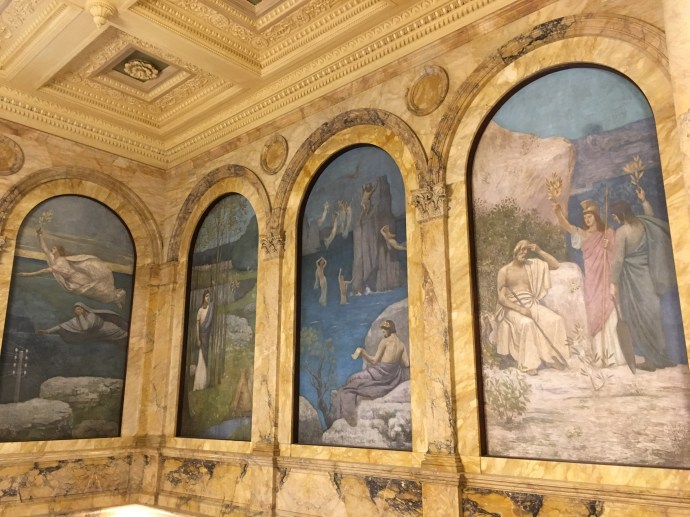
Pierre de Chavannes mural at Boston Public Library

Part of the Sargent murals at Boston Public Library
The French Artist Pierre de Chavannes’ “Muses of Inspiration” was completed in 1895 and is installed outside of Bates Hall on the second floor and on the grand stairway leading from the first floor to the second. Finally, John Singer Sargent’s “Triumph of Religion” was completed during the period of 1895-1919 and is installed in the Sargent Gallery on the third floor of the McKim building. During our time in the library, numerous people and even groups came in to examine the murals. Given that my art knowledge is rudimentary, if you are interested there are numerous on-line articles that provide greater detail regarding the murals. While at the library, we made a stop in the Bates Room which had genealogical records and looked up some family names but had no luck in finding anyone halfway related to our ancestors.
From Copley Plaza we hopped on an airport shuttle that took us directly to Logan airport and the rental center where we picked up our rental car and managed to avoid the heavy penalty Hertz would have charged us for coming in a day early.
Tuesday was a wet, rainy day, excellent for inside activities so we visited The Boston Museum of Fine Arts (MFA) which is the fifth largest museum in the United States. Obviously one does not see the entire museum in one visit. Our plan was to partake of docent tours; a.) Three Masterpieces from Asia (30 minutes); b.)Art of the Americas (60 minutes); and c.) Art of Europe (60 minutes). Seven different tours are available; docents have to be able to lead all seven. After training, a docent is active for only four years, providing for a rotation of new docents and greater opportunities to lead. After the four years are over, a docent can provide sporadic tours. A little different than most museums we have visited. All three of our docents were knowledgeable and easy to understand.
Our Asia tour talked about Buddha and the development of Buddhism. Evidently the first portrait of Buddha in art did not allow for a human visage. The next development allowed for the image of a footprint and it was not until the third phase that Buddha himself was portrayed. Interestingly, even though Buddhism started in India, the real development and current strength of Buddhism is in China; India is primarily Hindu.

Art of the Americas exhibit
Art of the Americas took us into the newest wing of the museum. We found it notable that the galleries are not white and glass like so many new museum galleries, but are painted in a series of shades that I would call neutral naturals contrasting with wall fabrics to break up the gallery features. After lunch, the third tour was the Art of Europe. It was a good way to spend a rainy day in Boston.
Tuesday evening we attended the open house for REACH, the domestic violence center and shelter for which our daughter Deb is the Associate Executive Director. The organization was finally able to move to a new administrative office where they are able to provide individual advocacy, run support groups, offer child art therapy and a safe place to meet. It was exciting to see an arrangement that provides a proper working environment.
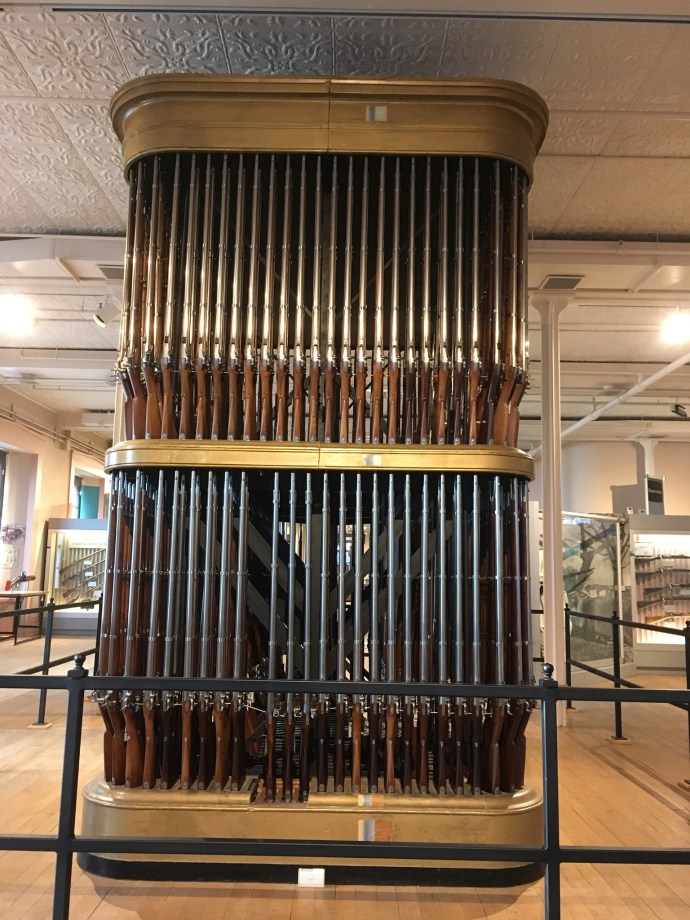
Exhibit at the Springfield Armory
Our travels for family and a funeral also took us to Springfield Massachusetts. This town of 150,000 is home to numerous museums and attractions. We revisited (actually Chris does not remember us being here but I am certain we visited decades ago) the Springfield Armory, part of the National Park Service. The Armory was established in 1794 to manufacture muskets so that the new country would not be dependent on foreign countries for its arms. A second armory was established at Harpers Ferry VA (think John Brown’s raid of 1859). The Armory was a large facility; the NPS site is reduced to one building while the rest of the buildings and grounds are home to the Springfield Technical Community College with over 7,500 students.

Exhibit at the Springfield Armory
Until 1968, the Armory was the pivotal point for the manufacture, research and development of military weapons (pistols and rifles). Along the way, the military arms development also developed advancements in manufacturing processes and the inventiveness of Springfield employees flowed also to other industries. One of the creative geniuses at Springfield was instrumental in developing early manufacturing replicating machinery to produce exact copies of each gun, in creating an automobile, and a steamboat.
Chris and I got a little over exposed to gun models but did note a display covering the development of the Lyle Life Saving Cannon which we had seen at other NPS sites. It was used to rescue sailors at sea. “These line guns are used primarily for shore based rescue operations. The Lyle Gun was hauled to the shoreline usually by U.S.L.L.S. surfmen in specially made beach carts. The iron wheels that supported the cart had wide bands outside the wheel to keep it from sinking into soft sand. The Surfmen would set up and fire the Lyle gun, aiming over the stranded or wrecked vessel and then pull the line within reach of the victims. The line fired to the ship in distress was a messenger line that was in turn tied to a heavier line, the Tally Board (with instruction in English and French), and a Tail block designed to support the breeches buoy. Once the breeches buoy lines and the Crotch Pole(an A frame) assembled, the survivors could be removed from the vessel by hand hauling the breeches buoy lines. The Lyle Gun could shoot the projectile about 700 yards (640 m), although in actual rescues the practical range was much less. Rescues at greater distances were to be accomplished by lifeboats.” (Wikipedia)
In 1964 the decision was made to close the Armory, ostensibly to save money despite local cost/benefit studies that deemed the Defense report inaccurate. Closing went ahead due to “the basic evolution” of Defense Department policies that were never explained. By then, Rock Island Illinois was performing administrative functions and private manufacturers were producing our weapons. (Note that the Colt firearms company facility in Hartford CT has also closed and another NPS site has been proposed there. As usual, Congressional approval for the site was relatively easy and funding to create the site almost impossible.)
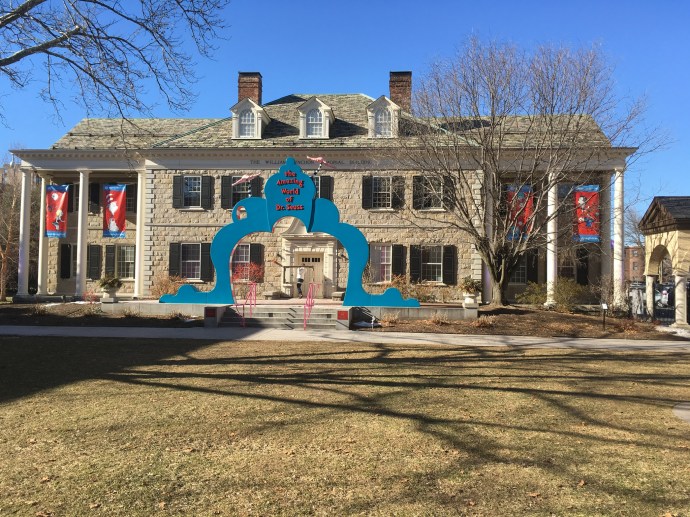
Dr. Seuss museum in Springfield MA
Friday before returning to Boston we visited the Springfield Museums with Chris’ cousin and her husband. The Museum complex includes a science museum, a history museum, two art museums and the Dr. Seuss museum. Our first stop was the delightful, although small, “Amazing World of Dr. Seuss Museum”. Theodor Seuss Geisel was born in Springfield MA in 1904 and while he moved to CA after WWII, many of the ideas, locations, and concepts in his childrens’ books are based on Springfield images and occurrences. Even though he died in 1991, his books are still popular. Chris frequently looks for his books as a gift idea. He is ranked in the top ten fiction authors of all time by the number of books sold.

Dr. Seuss museum in Springfield MA
Part of the museum recounts his life through photos, displays and personal letters and while we enjoyed learning more about him, it was the exhibits based on characters in his books that tugged at the emotions. Good memories all around.
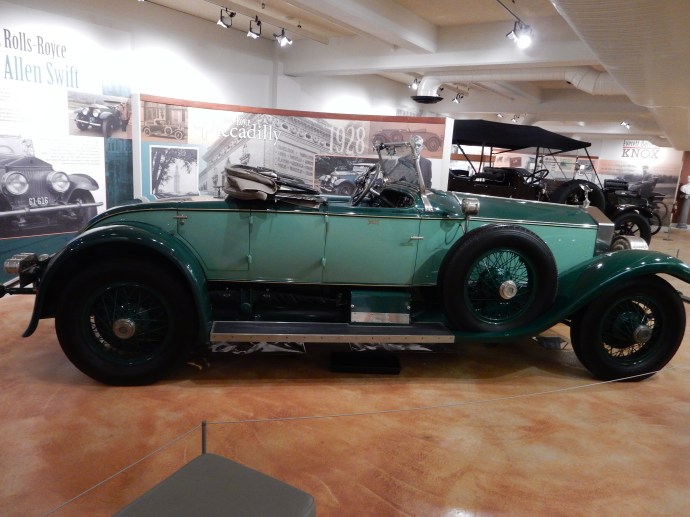
A Rolls Royce Phantom built in Springfield MA
After Dr. Seuss, we visited the Museum of Springfield History. Even Chris’ cousin was not aware of the extent of Springfield’s history and the number of companies that began here. Springfield was home to Breck shampoo, Milton Bradley games, Merriam Webster books (think dictionary), Fisk (Uniroyal) rubber, Indian motorcycles, Knox automobiles, and the only U.S. manufacturing facility of Rolls Royce back in the 1920s, among others. The museum is new, well laid out and was a pleasure to visit.

Replica of U.S. Senate at Sen. Edward Kennedy Institute
The rest of the weekend was family oriented with one visit to the Edward Kennedy Institute for the United States Senate on the University of Massachusetts Boston campus. The Institute is less about his life and more designed to educate people about the role and processes of the U.S. Senate. Sen. Kennedy had served from 1962 to 2009. The Institute includes a full size replica of the U.S. Senate and visitors are encouraged to take part in a mock debate and vote on rotating issues.
The displays are all electronic with each visitor touring with a tablet computer around the building. Frankly, it turned me off, the information struck me as limited and pre-packaged. Evidently, my impression is not unique, the attendance numbers for this institute are well below projections.
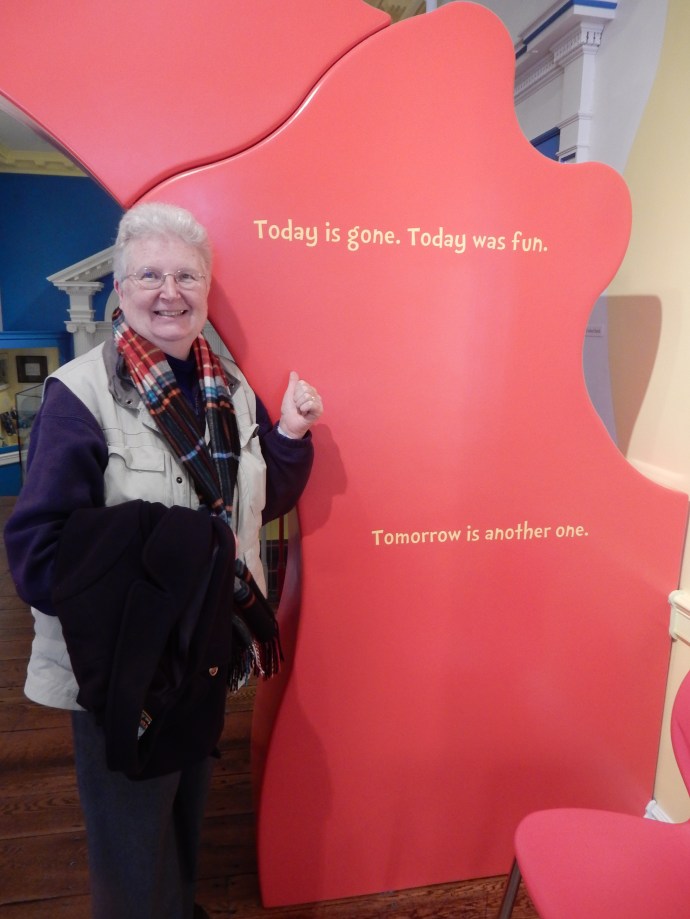
Chris and Dr. Seuss message
Ed and Chris
March 6, 2018
 Chris Klejbuk and Ed Heimel travel adventure
Recent Comments