

The Everglades “River of Grass” from the observation Tower at Shark Valley, Everglades National Park
Florida City, FL. April 4
Today we entered what some people call the “real” Everglades, that eastern sea of grass and water fed by waters starting in Kissimmee and reinforced by waters from Lake Okeechobee. We drove over three new bridges on U.S. 41 that increase the volume of water that can flow unimpeded on its southward journey to the Florida Bay. This whole area is considered a river that moves at a rate of one mile per day.
The Everglades have been labeled a national park, the largest subtropical wilderness in the U.S., an international Biosphere Reserve, a World Heritage Site, and a Wetland of International Importance. It is no wonder we see and hear visitors from around the world here.
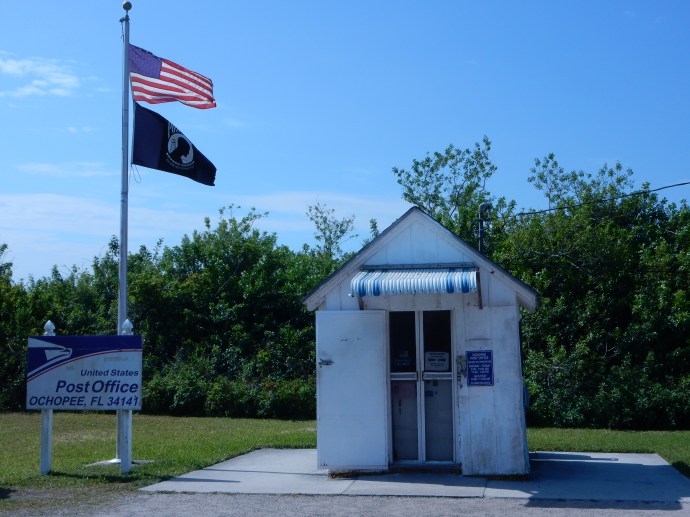
Ochopee FL Post Office
Before we entered our second visitor center and gateway to Everglades National Park, we made two stops. Well, maybe two and a half stops. The half stop was a quick stop and visit to a working post office serving Ochopee FL. It is billed as the smallest U.S. Post Office. We thought we had previously visited the smallest post office somewhere in Door County WI.

In honor of Clyde Butcher, we took one of our photos and converted it to black and white
The first real stop was at the gallery of Clyde Butcher (clydebutcher.com), a well-known photographer who has been honored for his large-scale black and white photography still made in the ‘wet’ darkroom. Much of his black and white work has been done with a large format view camera that he caries and sets up in the middle of forests, swamps, and rivers. His gallery here (he has two others) showcases his work and that of a few others. One of them, Andy Morgan, was staffing the gallery today with Andy’s wife. Andy’s work was also on display and we spent about an hour here. (andymorganphotography.com).
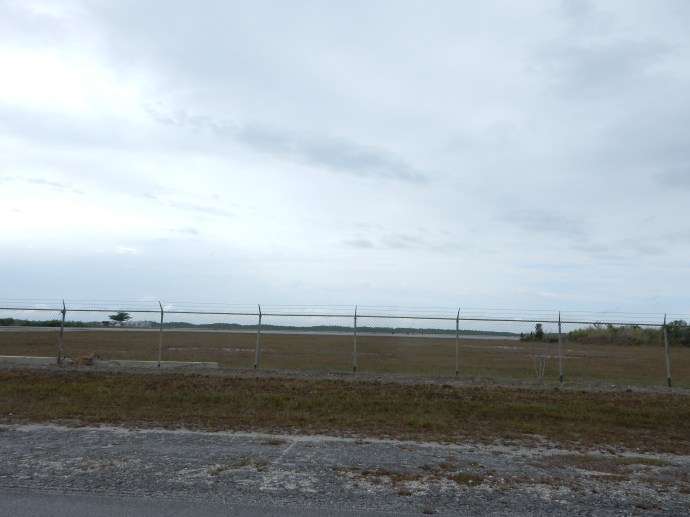
The runway at the canceled Miami Jetport
Our second stop was at the Dade-Collier Training and Transition Airport. Actually this was kind of a half stop too; maybe we did only make two stops before the Everglades. You may recall in an earlier post that Big Cypress Preserve was created in response to stopping a new airport. This “Everglades Jetport” or “Big Cypress Jetport” would have been five times the size of JFK in New York and would have been the largest airport in the world at the time. Since one 10,500’ runway had already been built, the runway was kept. It is considered part of Miami Dade Airport Authority. We drove to it-you had to know what you were looking for to find it. After driving three miles in, we found the gate locked. A person can gain access if they pick up an attached phone, call Miami Dade Airport Authority and probably convince the powers that be that access should be granted to them. No visible activity was evident to us.

Scenes along the Shark Valley Tram Tour, Everglades National Park
Finally, we stopped at Shark Valley Visitor Center for Everglades National Park. We had a 10 AM Friday reservation for the two-hour tram ride. In talking with the staff, we were informed that it might take us two hours to drive to this visitor center Friday morning due rush hour traffic and road construction on the major road leading from Florida City to Shark Valley. Tomorrow’s weather was projected to be sunny and no rain. This afternoon rain was forecast. We chose to take a chance that the rain would not come and changed our Friday reservation to a tour leaving in 20 minutes.
By now, I think we could give most of these tours. Not a lot of new information was given, hopefully hearing the history, etc once again will help us retain it. The major difference is the lack of marsh and much fewer forests. The Shark Valley area is actually a depression, about 7 feet above sea level. Tampa to the west and Miami to the East are 20-30 feet higher. Not huge but enough to direct the flow of water to this central region and validate the concept that this is a river and a valley.
The water here is fresh, not the brackish fresh/salt combination back at Gulf Coast Visitor Center. Remember, Everglades is 1.5 million acres. Shark Valley is sort of at the north central part of the park. Gulf Coast is at the north west end. There are two other visitor centers. Coe is at the east central and Flamingo at the south central portions of the park. Part of the park includes water. While not a true rectangle, the park width is about 65 miles and its length about 60 miles. It is big and encompasses differing terrain. Tomorrow we will go to the Flamingo Visitor Center area.

A typical scene from the tram tour; prairie grass, a few trees, a dry season water hole, an alligator and some birds
The tram tour drives through the prairie area. As the guide indicated, even the difference of a few inches changes the prairie grass to clumps of trees with different vegetation and animal life. Prairie grass predominates. This is the end of the dry season when some areas are dry and birds, fish, and alligators congregate in the remaining wet areas. When the rains begin soon, the entire area will be wet and we would be less likely to observe the mix of animals so close together.
Alligators were numerous. We have restricted our alligator photos to particularly unusual ones, we have so many. It is almost like seeing deer or squirrels. Halfway through the tram ride we stopped at an observation tower built on the site where Humble Oil drilled for petroleum. They found it but of a low quality so they shut it down and gave it to the feds in exchange for a tax deduction. But our guide did slip up. On the way back, we passed an alligator by the side of the road with it’s mouth wide open. They do this to help cool off. He ignored the chance to educate the tram riders.
Tonight we are lodging at Florida City, close to Homestead, FL. It is an easy shot from here to the next two Everglades Visitor Centers.

Young alligators. Despite Mom alligator’s best efforts, less than 10% will make it to year thee.
Ed and Chris Florida City FL, April 4
 Chris Klejbuk and Ed Heimel travel adventure
Recent Comments