Posts Tagged With: Austin Texas

2017 Trip Two: Tour of Texas April 12-13

Austin, Texas. April 12. Wednesday

Graffiti Hill in Austin

1,483. That is the number of school children scheduled to be visiting the Bullock State History museum today, as we were told by several docents and employees. It was the largest number in several weeks and they expected to be busy. They were busy, but the museum is large (three floors) and we were not overly bothered by throngs of young students.

Our arrival at the museum was preceded by dropping off our car at the Austin Subaru dealership for its 30,000 mile check-up. It was a little before it was needed but there aren’t any dealerships in the sections of West Texas we will be visiting over the next week to ten days and the miles will be adding up. The dealership provided us with a ride downtown and picked us up in the afternoon.

Bullock Texas State History Museum

AAA rates this museum as a gem and said to expect to spend three hours here. We were here for 4.5 hours, including lunch in their cafe and did a pretty good job of visiting exhibits of interest. There were two exhibits that we went through quickly (Music Festivals and Stevie Ray Vaughn).

As one expects of a state history museum, the focus is on Texas history from Native Americans through its time under Spanish and then Mexican rule up to the 20th century. The Texas Independence movement a highlight and is told from the American side, as one would expect. The Mexican immigrants and European settlers that were invited into this province of Mexico were losing their previously granted freedom of action and subject to stronger central Mexican rule. They chafed under it and demanded their independence. Mexico said no way and the Mexican army was the better prepared.

Then in 1836 came Mexican victories at the Alamo and Goliad (lesser known outside of Texas but the Texas rebels were slaughtered by the Mexican forces). Instead of shutting down the independence drive, the two losses fueled it. Sam Houston and his troops defeated the larger and better trained Mexican forces under Santa Anna at San Jacinto and Texas became a newly independent country. In 1845, under request of the Republic of Texas, Texas was annexed into the United States. It was not an easy decision, even though many Texans were for it from the beginning. Some Texans wanted to remain a separate country and many US Northerners did not want an additional slave holding state to enter the US. The Republic of Texas faced a mounting debt, a weak currency, and continual threats of invasion by Mexico. Becoming part of the Unites States addressed those issues. The Mexican-American Was of 1846-48 (or from the Mexican side, the War of the United States against Mexico) resolved the question of Texas and portions of today’s Colorado, New Mexico, Arizona and California were added to the United States.

I was struck by how long-lasting and deep can be the development of cultural myths and story lines. All history is complicated but people have a pattern of developing a concise world view that is usually based on some facts but which facts are kept and which discarded form the lens by which we decide current issues.

Texas’ varied geography is shown along with the crops and minerals produced by those different geographic areas. Wool, rice, cotton, cattle, goats, lumber, mercury mining, wheat, and oil all played a major role in different areas. The new role of technology is presented but we breezed through that.

As we have seen in other museums, the fact that cowboys were not really white males with European ancestry but began as Mexicans and were significantly influenced by newly freed blacks after the Civil War was prominently shown.

The Broken Spoke honey tonk restaurant in Austin

Our Evergreen hosts took us to a honky-tonk restaurant (the Broken Spoke) for dinner and for a ride around Austin. The photo at the top of the page illustrates “Graffiti Hill”, a landmark Austin shows off to outsiders. People are invited to paint their own graffiti message and the wall changes constantly. We saw several new works of art going up as we stood there.
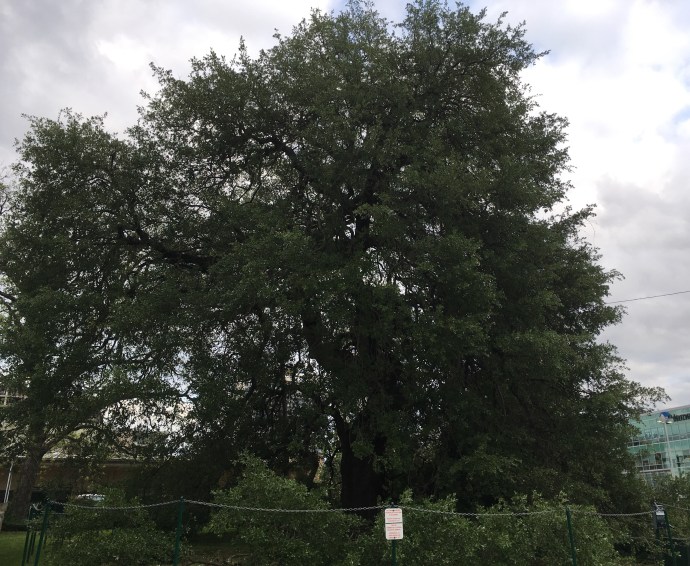
Treaty Oak in Austin

A second stop was the Treaty Oak, the last remaining oak tree from a grove of trees (the others fell victim to neglect and urban development) standing when, according to folklore, Stephen Austin negotiated a treaty with Indians. In 1989 a vandal poured an enormous amount of pesticide on the roots of the tree. Two-thirds of the tree died but a massive effort funded by a “blank check” from H. Ross Perot of Dallas saved the rest of the tree.

Thursday, April 12

Glass bottom boat on Spring Lake at the Meadows Center

From glass bottom boat: Turtle, scuba diver, springs bubbling up

Our drive to San Antonio took us through San Marcos, Texas and we stopped at the Meadows Center for Water and Environment run by Texas State University. The Meadows is located at a spring on the Edwards Aquifer, a huge aquifer providing drinking water for people from Austin to San Antonio. The spring is on a fault where the flat land starting at the Gulf of Mexico ends and the hills of the Texas Hill Country begin. The aquifer bubbles up here through numerous springs and creates Spring Lake where we took a glass bottom boat ride. The boat ride allows one to see the springs bubbling up, turtles, fish, vegetation, and two scuba divers who were trimming the vegetation underwater so it does not get out of control.

Mission San Jose y San Miguel de Aguayo

In San Antonio we stopped at one of the five missions still standing from the 1718-1824 period when the Spanish originated missions were vital in establishing control and settlement. The missions are now church buildings run by the Catholic archdiocese in San Antonio while also part of the National Park Service.

San Jose Mission in San Antonio Texas

The Park Service has films and displays about the Spanish role in colonization. Native Americans were decimated by European diseases and threatened by other Indian tribes. A number of the Indians gave up their way of life for a chance at survival by living at the missions and being almost forced labor to keep the missions functioning. It did work in that many Indians were converted to Catholicism and are a significant cultural force in Texas today. It also was one of the factors in the loss of Indian traditions.

Ed and Chris. April 13

Categories: road trip, travel | Tags: , , , , | 1 Comment

2017 Trip Two: Tour of Texas April 10-11

Austin, Texas April 11

Monday, April 10

Austin is a short drive down I-35 from Dallas-Fort Worth but we, of course, drove the longer, smoother, and more scenic route along two lane roads west of I-35. The wildflowers re-appeared but not in the same profusion as around Ennis. The northern half of the route is hilly, once again surprising us about Texas geography. The ranches are different from the farms of the Midwest-no huge silos to store the crops.

Our first stop was at the junction of I-20 and US 281 as we began the two lane road drive. Gilbert Pecans beckoned to us and we purchased some pecans for us and for my sister (to use to hopefully make a pecan pie). Our second stop was in Hico Texas, population 1300, for a piece of pie at a local, well-known pie shop.

The Lyndon Baines Johnson Presidential Library In Austin

In Austin, we visited the Presidential Library of Lyndon Johnson at the University of Texas-Austin campus. LBJ’s library is well done, being completed in 1971, shortly before his death. There are several levels of exhibits, with six floors of archived records also in the building. This was a Presidential Library which we both appreciated.

LBJ had a tremendous record of legislative accomplishments, although the Vietnam War legacy is one that he can not escape. Sometimes we forget that he chose not to run for re-election almost seven years before the war actually ended. During the five years of his presidency, monumental legislation was passed; such as: Medicare, Head Start, the War on Poverty, Civil Rights Act, Voting Rights Act, Immigration Act (changing from heavy European preference to world-wide acceptance), creation of the Department of Housing and Urban Development, Clean Water Act, VISTA, new educational programs, National Foundation for the Arts and Humanities (think Sesame Street and Corporation for Public Broadcasting, and other programs), etc.

Part of the records collection of the library-maintained by the National Archives

It was somewhat disheartening to think that today, fifty years later, we are still arguing how to implement voting rights, how to get kids properly educated, how to allow immigrants in from non-European countries, etc.

One story we had to pull out of a library aide was the details behind the courtship of Lyndon and Lady Bird. The exhibits only mentioned the dates they met and the date they married. Lady Bird came from a well-to-do family, Lyndon did not. A friend lined up a blind date for the two of them when Lyndon was home from his job as a congressional aide in D.C. They spent the weekend together and Lyndon proposed, Lady Bird declined. They corresponded for the next two months, he came home at Thanksgiving, she accepted and they eloped.

The library allows you to listen to numerous selections of telephone conversations between Johnson and others on a variety of topics. One moving conversation we listened to was between the President and Jackie Kennedy about two weeks after JFK’s assassination. The fondness between the two was touching. Another feature here was a modern-day triptych, a series of three-part panels combining TV clips and memorabilia about the cultural and political happenings over three-year periods around the time of his Presidency.

After the Library, we had lunch at La Madeline, a national chain but a nice French cafe style restaurant. On our way to our Austin Evergreen hosts, we stopped at Mueller Lake. We thought it was just a park and we would get a little exercise walking around the lake. Turns out Mueller Lake is a 700 acre former airport now being converted into a planned community within the City of Austin. The lake does have walkways so we hiked around it land got our extra exercise for the day.

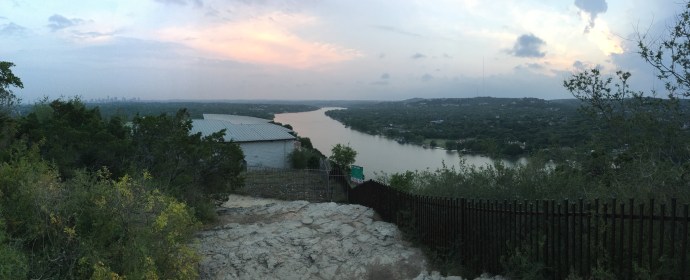
Sunset view from Mt. Bonnell overlooking the Colorado River and downtown Austin at the far left

Our Evergreen hosts took us out exploring that evening. We visited Covert Park at Mount Bonnell. The park provides a great observation point for the city, showcasing the hills along the Colorado River; the other Colorado River. This Colorado River begins in Texas, south of Lubbock, and travels 862 miles to the Gulf of Mexico, all within the state of Texas.

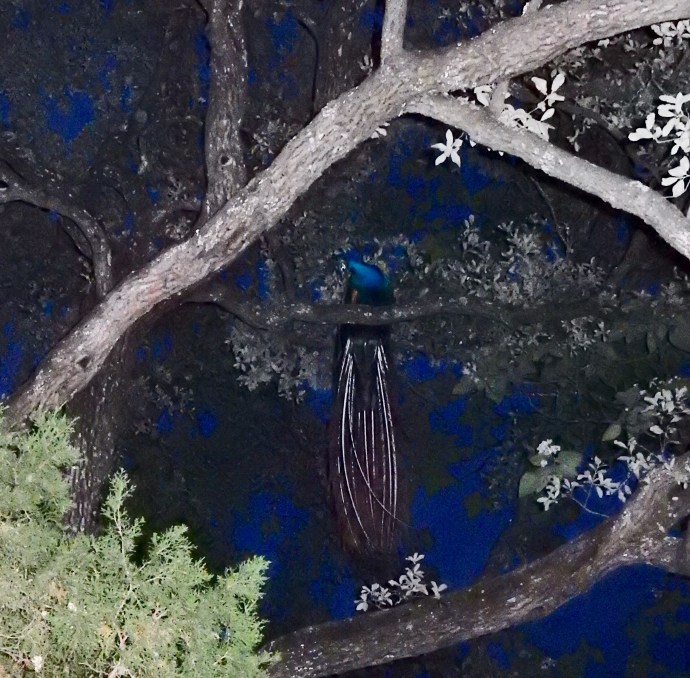
Peacock roosting at night

After Covert Park, we made a quick stop at Mayfield Preserve, home to a group of peacocks. The peacocks were roosting in the trees for the evening. It was amazing seeing the birds with their feathers hanging down from the branch the bird was perched on.

Tuesday, April 11

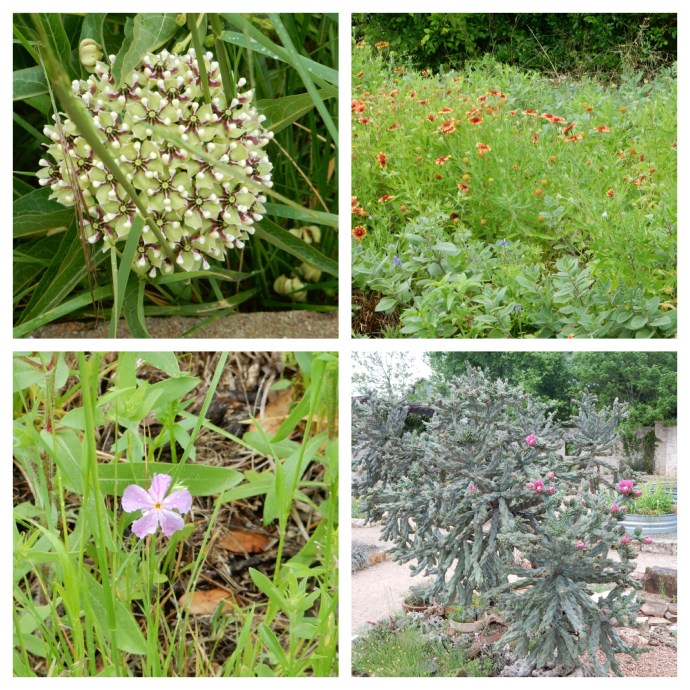
One can not control the weather. We had planned for this day to be our time outdoors, hiking and observing nature. The rain slowed us down and made a slight adjustment to the planned schedule. The initial stop was at the Lady Bird Johnson Wildflower Center and the Texas Arboretum. Two and a half hours gave us plenty of time to walk the trails, view and smell the flowers, and even eat lunch during the heaviest portion of the rain.

A selection of photos from the Lady Bird Johnson Wildflower Center in Austin Texas

The Center is 279 acres, self-supporting, devoted to education and research, an arm of the University of Texas, and specializing in native wildflowers of Texas. The gardens and trails were well laid out, with plenty of color to keep me busy snapping photos. The rains came about 90 minutes into our walk so we visited the inside exhibits and then had lunch in their cafe.

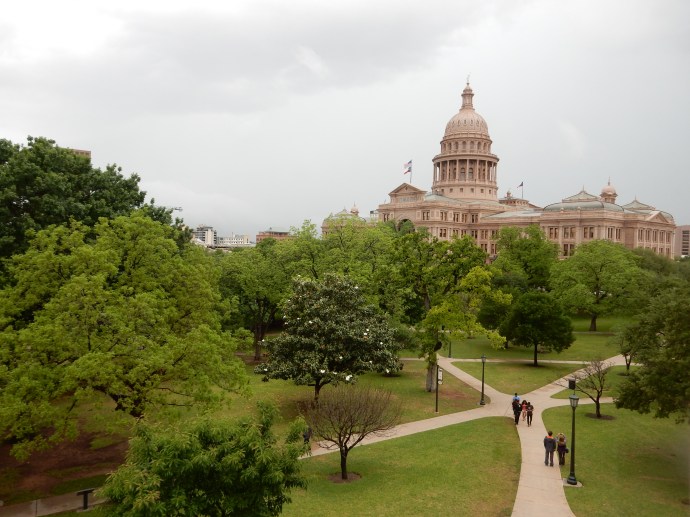
The Texas State Capitol clad in red granite from Texas

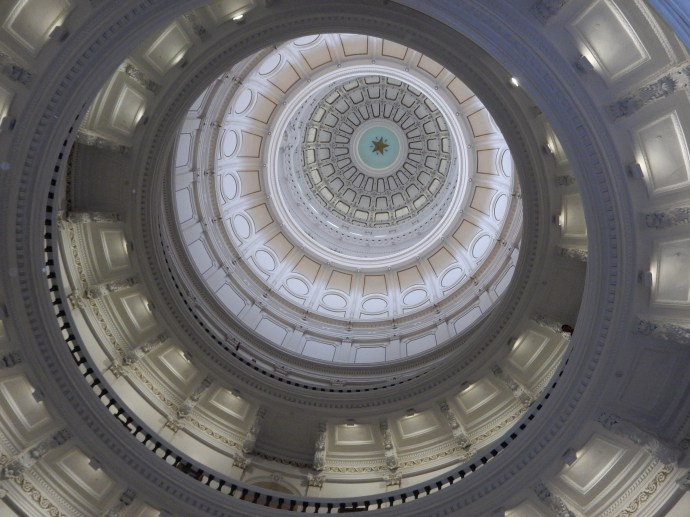
After lunch, the rain persuaded us to drop McKinney Falls State Park and went to the Texas State Capitol for a tour. The Texas Capitol is the largest capitol in the nation, is 14 feet higher than the U.S. Capitol, and underwent a major renovation and expansion in 1993. The Texas Legislature meets for 140 days every other odd-numbered year. Thus, it was in session while we were here. Tours could not go into the chambers but after our tour we did go into the visitor gallery and view each chamber.

The tour was strong on the major points of Texas history, the control by six different nations; Spain, France, Mexico, the independent Republic of Texas, the Confederate States, and the United States. Portraits of all Texas Presidents and Governors are on the walls, including the first woman Governor (who served two separate terms, the first being in 1924).

The dome of the Texas State Capitol

The Capitol itself was, while imposing and majestic, a disappointment in terms of artistic embellishments. Most of the state capitols we have toured have entire corridors devoted to large, grandiose, and impressive murals and paintings. The Texas Capitol walls are uniformly white. Only in the Senate chambers are two large paintings, one for the battle of the Alamo and one for the battle of San Jacinto.

A separate visitors center is located on the grounds of the Capitol complex, housed in the former General Land Office. In this building were excellent displays that explained the building of the current Capitol. In brief, this second Capitol (the first went up in flames) was financed by two Chicago investors who received a land grant of 3,000,000 acres of land out by the border with New Mexico. Unfortunately for the Chicago guys, the land grant did not make them rich. The market for beef fell apart. The land was too far out to really cash in on settlers homesteading the area. But the Capitol got built.

One other novelty was mentioned in the exhibits. O. Henry, the short story novelist, moved to Texas in 1882 when he was 20. From 1891-1894, he worked in the General Land Office (where the visitor center is located) and several of his short stories include significant references to this building and people he worked with while here.

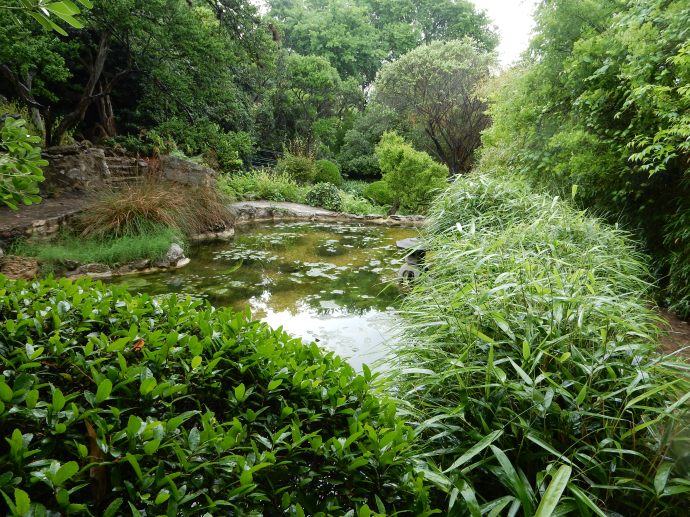
walking in the Japanese Garden in Zilker Botanical Garden in Austin TX

After the Capitol, the skies were only gray and drizzly so we drove to the Zilker Botanical Gardens. This 31 acre garden has separate sections maintained by different garden clubs in the City of Austin. The Japanese Garden was built by one man, when he was 70, over the course of two years. He had retired and moved here to be near his son. He had free time and offered to help at the garden. They asked him to construct a Japanese garden. He designed and constructed the wonderful garden we observed today.

A selection of photos from the Zilker Botanical Gardens

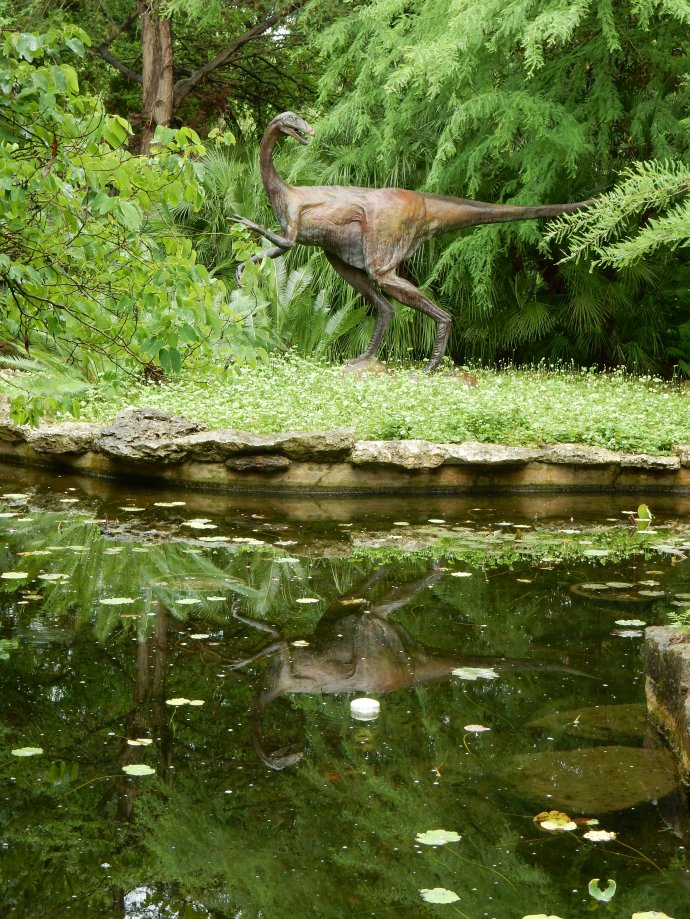
Prehistoric Gardens at the Zilker

We spent 90 minutes here walking the grounds; we had our rain jackets but the skies remained just gray with no major rain. The rain earlier in the day made the walking stones slippery but the leaves still had raindrops glistening on them and the odors of the flowers were rich and heavy.

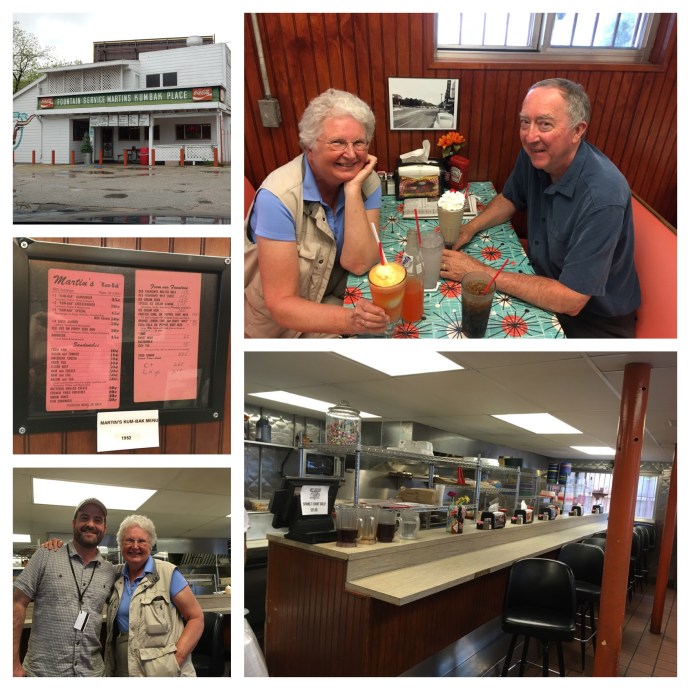
Dirty Martin’s in Austin TX

Dinner was at Dirty Martin’s, an establishment dating back to 1926. It is an old style (in the best sense of the words) hamburger joint, serving burgers, fries, and shakes-and alcohol now. We love to visit restaurants that have stood the test of time but which today have to fight the franchise chains and newest “in” restaurant. We talked to the staff, one cook having been here for 20 years. The General Manager showed us around and gave us the history. He is working to keep attracting new customers while still maintaining the regulars. In today’s world, the name Dirty Martin’s can have several negative connotations; yet the name has its history-it goes back to the original days when the floor was made of dirt.

I was impressed with the cleanliness; remembering back to my youth and the amounts of grease on and behind the stoves at the restaurants our family owned. Our Evergreen hosts had recommended the place and we were happy they had. Of course we had burgers with onion rings and tater tots, chocolate malt for Ed and an orange creamsicle for Chris (vanilla ice cream with Fanta orange pop).

Ed and Chris April 11

Categories: road trip, travel | Tags: , , , , , , , , , | Leave a comment

Blog at WordPress.com.