
Willcox AZ Saturday May 19

Organ Pipe Formation at Chiricahua National Monument
Up and out early today. When climbing in hot weather, one wants an early start. So we were away from the hotel by 8 AM and at the trailhead by 8:45 AM.
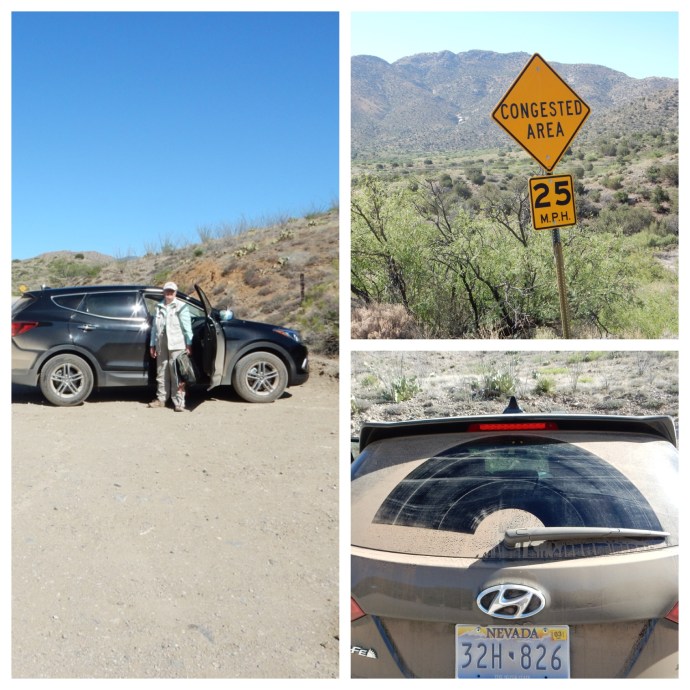
Fort Bowie Trailhead parking lot. Dirt road leads to it, we thought it was interesting to see the congested area sign and no one else in the parking lot when we arrived
Fort Bowie National Historic Site has an unusual feature. One must hike 1.5 miles from the parking lot up to the fort at Apache Pass in the Chiricahuan Mountains. Actually I liked the requirement. The hiker not only observes the change from grasslands to thickets of small trees and brush, but can visualize being on one of the early stage coaches on the Butterfield Line and seeing Indians on horseback on the ridges above. Of course, that visualization is more due to TV westerns than reality, but still it resonates.
As related at the Amerind museum Friday, the Apaches had seven different but related tribes. The Chiricahuas were one of the seven and lived in southern Arizona and New Mexico. Apache Pass was part of their normal territory. If you have the time, the trail to Fort Bowie provides several opportunities to learn more about the Chiricahua and about westward expansion by settlers eager to cross Chiricahua territory to reach California and other western locations.

The spring at Apache Pass, another reason the area was so important
You may recall the names Cochise and Geronimo. Both were Chiricahua Apache. Cochise came to leadership before the Civil War and in many ways preferred accommodation to fighting. Unfortunately, circumstances did not always assist. In 1861 a raiding party of unknown Apaches stole cattle and the stepson of a local rancher. Cochise and the military met to discuss this at Apache Pass. Cochise was accused of being the guilty party. Cochise denied it but offered to help find the boy. The U.S. military did not believe him. Cochise, insulted, escaped and for the next eleven years the U.S. military and the Chiricahua were at war.
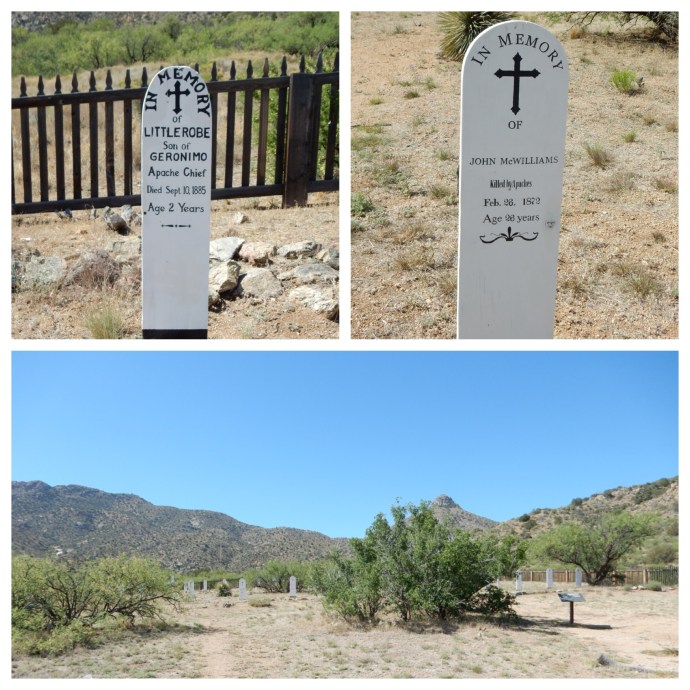
The cemetery along the trail to Fort Bowie
At another spot, you come upon a cemetery. Here the soldiers buried their dead. But you also find graves of Indians, including one of Little Robe, a two year old son of Geronimo. Little Robe was one of 15 Chiricahua captured by the U.S. in Mexico in 1885 and brought back to Fort Bowie as captives. The soldiers grew attached to the two year old boy but he died soon after, probably of dysentery. He is buried here. Apache custom was to bury their dead in small caves or crevices and to conceal the location. Cochise, for instance, was buried in a location not found to this day.

Fort Bowie close up
Upon reaching Fort Bowie, you can observe the value of the pass in crossing the mountains on either side of you. As usual, the ranger on duty was informative and helpful, after visiting over 200 NPS sites, I don’t think we have met even 5 rangers who were less than great. We also met a couple from Doylestown PA who have been retired for 13 years and we swapped various travel suggestions.
The fort itself is not reconstructed as were several forts we have visited. Various buildings have partial walls showing and you can walk the area and visualize what the site would have looked like in the latter half of the 1800s. Fort Bowie had a short life. A first fort was built in crude style and lasted less than six years. A larger, better fort was built in 1868 and these are the main ruins you can view. From 1862 to 1868, Fort Bowie was active in the campaigns against the Chiricahua. Geronimo surrendered in 1886. He and the whole tribe were exiled, the reservation abolished, and Geronimo ended up in Florida. We had previously visited Fort Pickens in Florida and the Castillo de San Marcos in St.Augustine where he and his family were separately housed for a number of years.
One other sad note. We lived in Carlisle PA for over 20 years. Particularly in the early years there, one read of the Carlisle Indian School (now home to the U.S. Army War College) and how the U.S. trained Native Americans in work skills and reading. It was only in the latter years and as we have traveled that one learns that the Indian children sent to Carlisle were forcibly removed from their families and forbidden to learn or practice their native religion or culture. Fort Bowie displays stated that the Chiricahua children were primarily sent to Carlisle and how many of them died there.

View of Fort Bowie from above on the return hike, the visitor center is at the lower left
Our hike back took a different path to create a loop. We began the hike by climbing up above the Fort and looking down at it. The view was stupendous. All in all, a rewarding three hour journey.
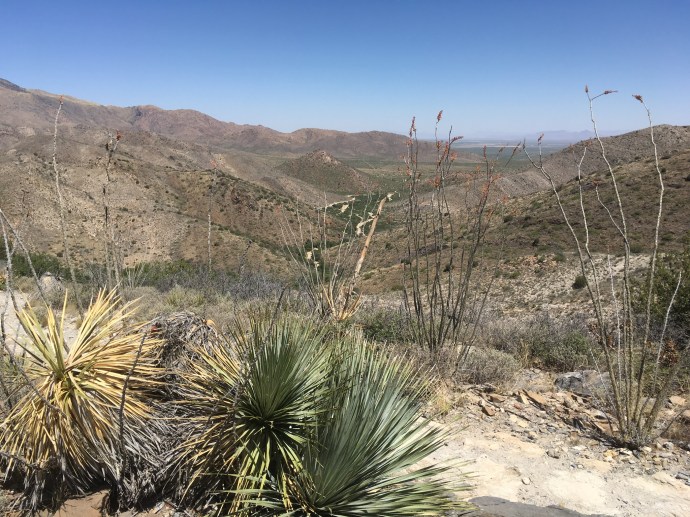
Hiking back from Fort Bowie
A side note. The NPS sites we are visiting participate in a program they call “I Hike for Health”. Each park sets its rules, generally you must hike three to five miles in order to win an award. Our hike to and from the trailhead to Fort Bowie qualifies so we received a Fort Bowie NHS I hike for health pin. Hooray for us.
Yesterday’s blog informed you that Chiricahua National Monument, one of our planned stops, was closed due to a forest fire. The ranger at Fort Bowie informed us that it was opened today and we decided to make that our afternoon stop instead of the copper mine in Morenci. It took us less than 40 minutes to make the drive to Chiricahua NM.

Some of the hoodoos at Chiricahua National Monument
Chiricahua was made a national monument in 1924 to preserve and to protect unique rock formations. Turkey Creek Volcano, long inactive, was south of Chiricahua and its explosive eruptions gave rise to the rock formations here, including hoodoos. Hoodoos are columns of weathered rocks. For those of you who have been to Bryce National Park, you recognize hoodoos. Chiricahua NM is also an area where different geological forces met and four ecological systems resulted.
One unique feature is called “sky islands”, a term common in this part of Arizona. Sky islands refers to mountain ranges isolated from each other by intervening grasslands or deserts. The valleys act as a barrier to the movement of forest and mountain species of animals and fauna.

Along Bonita Canyon Drive in Chiricahua National Monument
I will admit upfront that after the morning hike at Fort Bowie I was in no mood, or condition, to do another hike (five miles at Chiricahua) to earn a second I Hike for Health pin. Instead we drove the 8 mile Bonita Canyon road and stopped at lookouts. In 1976, most of Chiricahua NM was designated a national wilderness and Bonita Canyon road is the only road open to vehicles. Our original plan when we left St. Paul had been to arrive here early today and spend most of the day hiking after having spent Friday at Fort Bowie. The fire and revised schedule meant no hikes but we still enjoyed the spectacular rock formations.
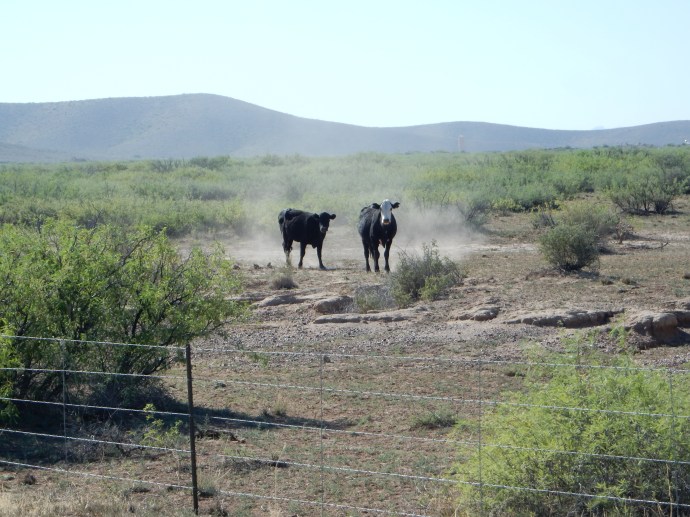
The source of our dust clouds
On our various drives the last two days, we kept seeing small dust clouds; a column, almost tornado looking, that appeared in the distance. I thought these were localized wind patterns creating an eddy stirring up the dust. We never seemed to get close enough to be able to take a good picture. Finally, one dust cloud was close enough to shoot—then we saw that the cloud was caused by cattle ambling along and stirring up the dirt on the ground.
The day wrapped up having an early dinner at a truck stop in Willcox. Dining options are not huge, the two or three local restaurants being in the area of the wine festival and everything else was a national burger/taco/pizza chain. But the food was quite good and helped to restore my flagging energy. Of course, we had dessert at Apple Annies again.
We thought we would end up this post with some flower pictures. Arizona is in drought conditions but some flowers are finding their way to bloom. Enjoy.
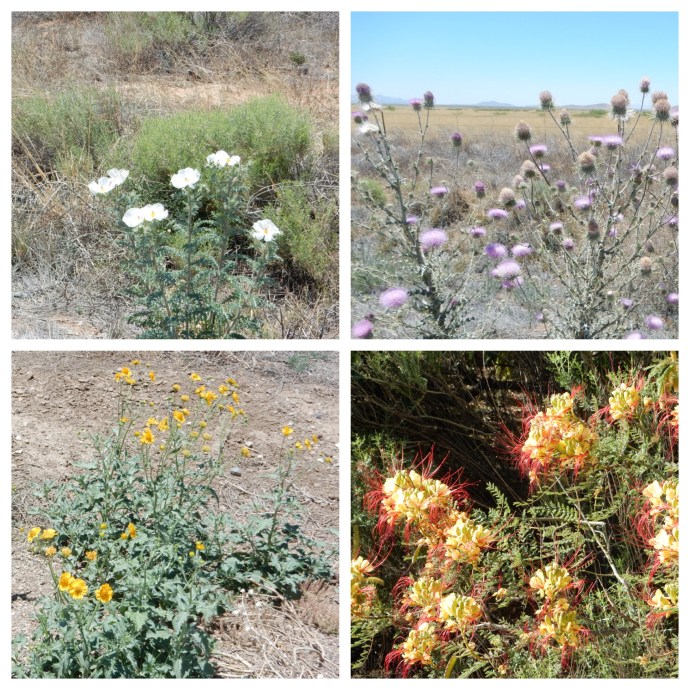
Flowers near Fort Bowie and Chiricahua
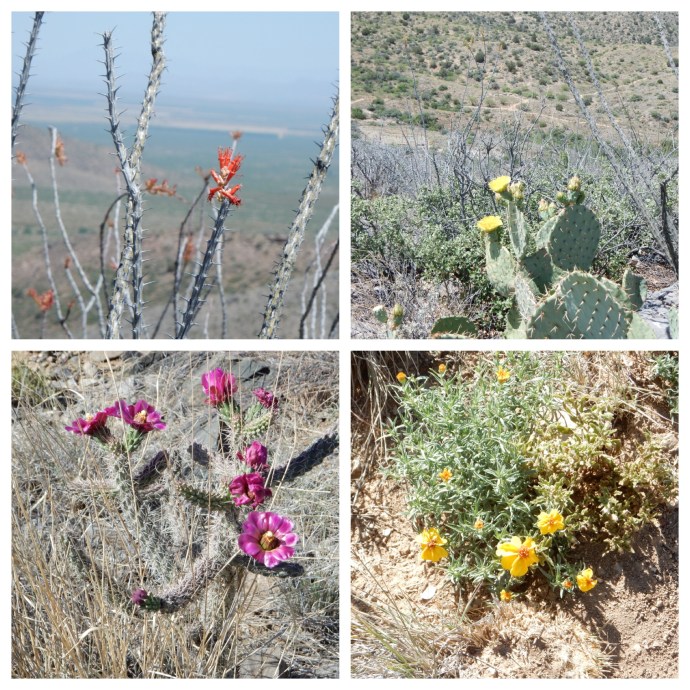
Ed and Chris. Willcox AZ May 20
 Chris Klejbuk and Ed Heimel travel adventure
Recent Comments