Posts Tagged With: Amtrak

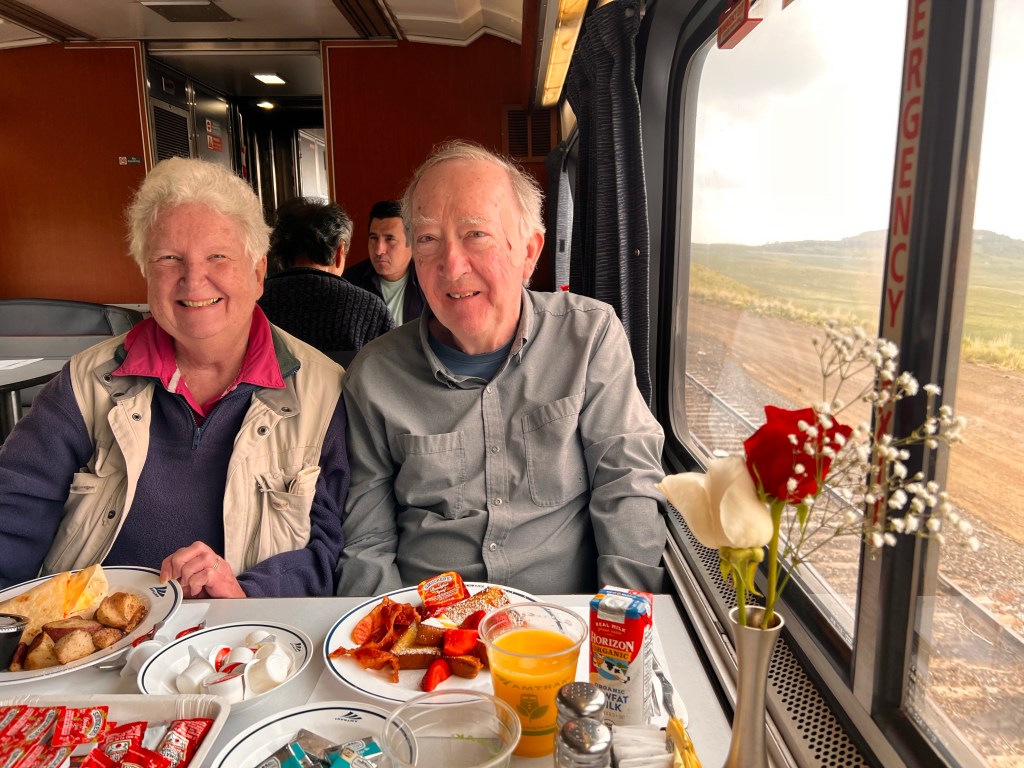
2025 Trip 3: California Zephyr: May 26-27

Sacramento CA May 27

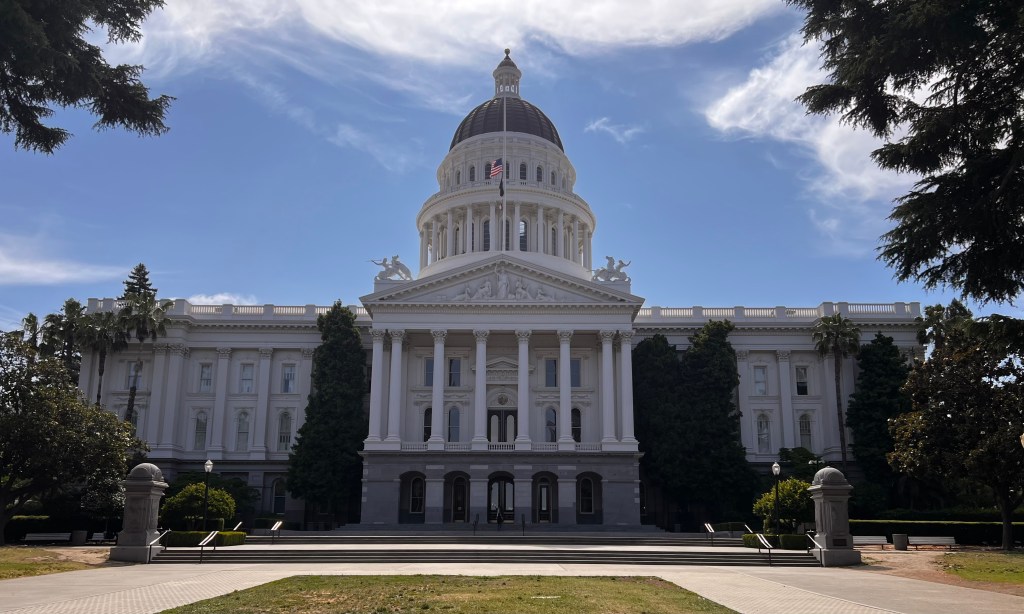
Our plans for Sacramento are to visit a few locations downtown. As in Denver, we have no car. We took an Uber to our Residence Inn seemingly near the State Capitol, one of our sites to visit. In retrospect, after walking to Old Sacramento and to the Capitol, other hotels may have involved less walking. Luckily, the temperature will not reach over 100 until Saturday, two days after we leave, so our walking has not been overly strenuous.

One note about Sunday. The train stopped a ways outside of the Roseville, CA station. The conductor announced we were stopped due to freight traffic ahead. Once we were moving and reached the Roseville Amtrak station, the train was met by three Roseville police cars and several police officers. They were concentrated around the coach cars. I believe they took a person off the train, if not into custody. I have observed this before, that Amtrak conductors will brook no misconduct and have no hesitancy in kicking people off the train and calling police if the conductor believes the actions of the passenger warrant it. It is my belief, with no specific knowledge, that the stopping of the train before Roseville was to allow time for the police to arrive.

We arrived at our hotel around 4 PM and took care of details. Chris did the wash, I worked on the blog, we ate at a Mediterranean restaurant around the corner from the hotel.

Monday, Memorial Day, our main activity was a boat ride on the Sacramento River. Both the Sacramento and the American River flow through Sacramento. Old Sacramento is the area along the river where the town began. We walked past the State Capitol to reach the river and discovered construction of a new Capitol Annex building had closed numerous walkways, making our journey a tad more complicated.

Old Sacramento’s historical significance derives from its geographical location. It was the western terminus of the Pony Express, the first transcontinental railroad, and the transcontinental telegraph. Old Sacramento covers almost 300 acres. It has over 50 historical buildings, more than any other area of similar size in the West.

We walked around the area and at the Visitor Center met the docent whose family goes back six generations here in Sacramento. He convinced us to try the Sacramento Underground tour which we were not going to take. Evidently the town buildings were raised about 15 feet to protect them from flooding. We will find out more on the Wednesday tour-which we booked after we returned to the hotel Monday afternoon.

Our river cruise lasted for an hour. We were surprised by several items. First, large numbers of people were fishing from boats and the riverbanks. Evidently, now is time stripers migrate up river to spawn. Second, there is a marker along the river indicating the height of the most notable floods. That marker gave me a better feel why the buildings in Old Sacramento were raised. Third, the water clarity where the American River joins Sacramento River clearly demarked cleaner water from the American. The water in the American generally comes from the mountains while the Sacramento picks up mud and contaminants from the valley.

Fourth, we saw sea lions by the port. Sea lions are not new to us, we just were not expecting to see them this far up the river. Fifth, an interesting sight was the original drinking water intake station just slightly upriver from the new, modern intake system. The juxtaposition made for a chance to reflect on the growth in population and in drinking water treatment over the years.

The river view was not that scenic. The breeze and the awning made the ride pleasant although I could have done without the background music that frequently blocked us from being able to clearly hear the captain’s presentation.

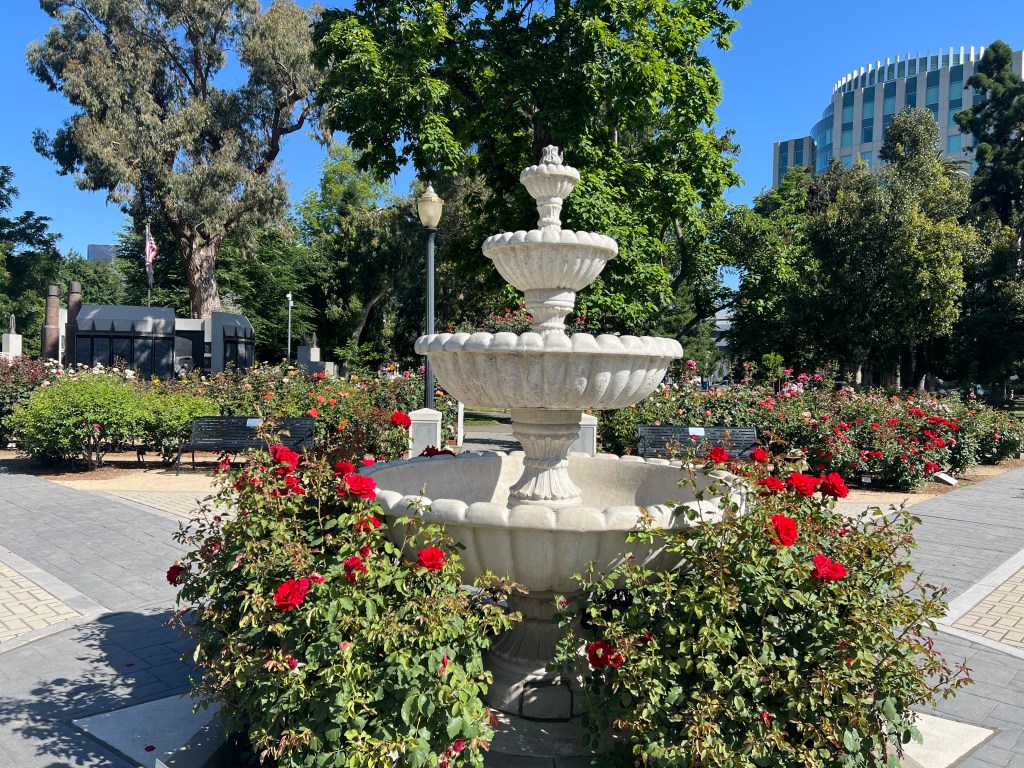
After walking to and around Old Sacramento, I had to wonder how St. Paul would have fared if I-94 had not cut off the State Capitol from downtown. In Sacramento, the state government complex blends into the city, the freeway separates this from Old Sacramento, but that area is more a touristy area than a living and working area. The California Capitol greenway and downtown make a favorable impression, although the Capitol is not a particularly attractive building in our opinion (more on that for Tuesday).As in Denver, neither downtown had many people out and about.

Sacramento’s population is over 500,000 with the metropolitan area around 2.6 million.

Monday the hotel pool called to us. We spent more time in the hot tub and resting our weary bones than in the pool. The hot tub’s rejuvenation was not long lasting. Tuesday we walked to the State Capitol for a one hour tour. This tour guide rarely commented on the architecture or building materials. Our guess-they were not that notable. I take that back, the Capitol is one of the oldest in the West, the guide mentioned the architect, and the same red and green motif in the two legislative chambers was covered. But our distinct impression was blah.

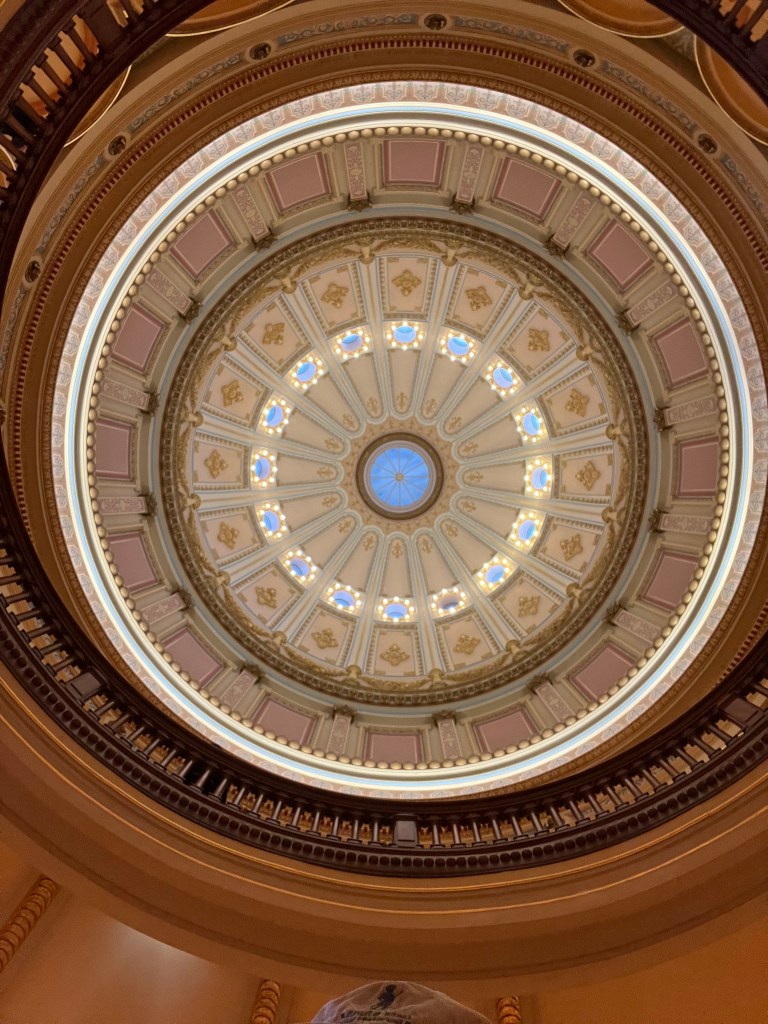
The one big deal was a series of murals depicting four periods of California history. What I thought was dark and foreboding, or simply a dirty canvas, was a result of “tonality”, an artistic method that is meant to contrast light and dark. This one came across as all dark.

Ceiling mural in California Museum

Just a few blocks away is the California Museum. This museum focuses on commonly overlooked stories, reflecting the state’s diverse population and the cultural contributions of all Californians. It took me a little while to get used to its format, generally briefly highlighting people around specific topics. For instance, the second floor, the first section we visited, highlighted activism; people who made a difference in art, politics, sports, culture, etc.

The first floor focused on stories and people around four themes that particularly interested me: incarceration of Japanese Americans in WWII, California Indians, California missions, history and contributions of Chinese Americans. While many stories were uplifting, others honestly portrayed negative actions by government and people. I had to compare these displays to the anti-honesty of the Trump administration and its Interior Secretary mandating that historical information be presented in a positive light. “Negative” facts about our past are to be buried; with visitors to national parks and monuments actively encouraged to report on negative facts presented by Department of the Interior employees. Both Colorado and California are to be commended for accurate portrayals of their state’s history.

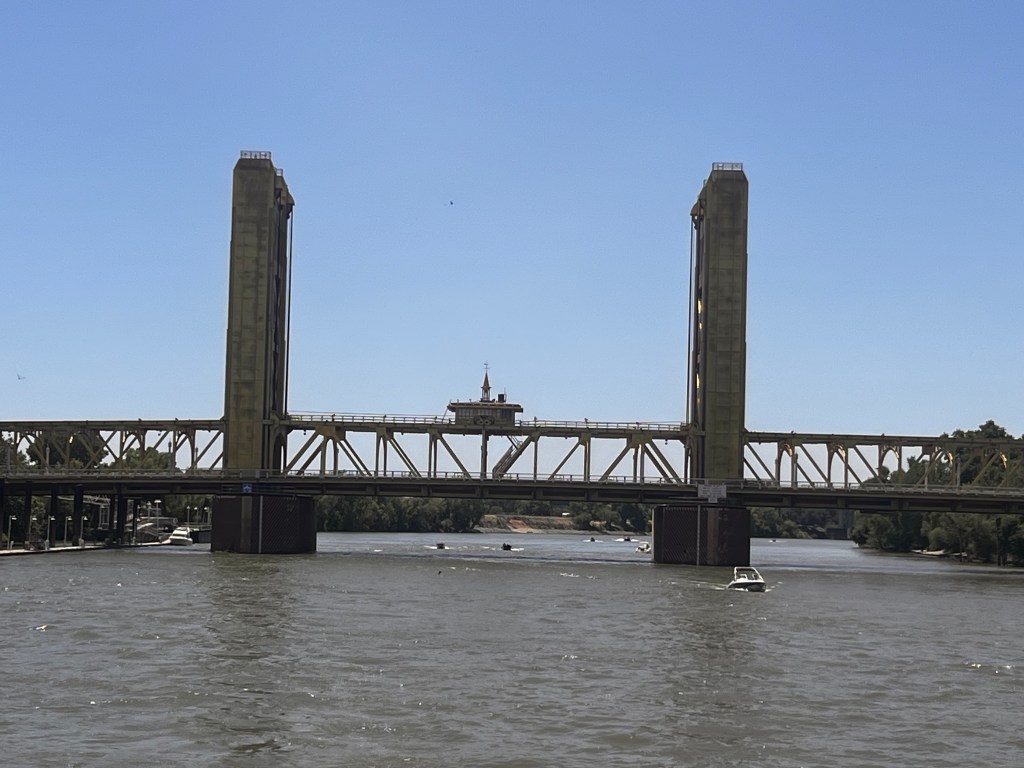
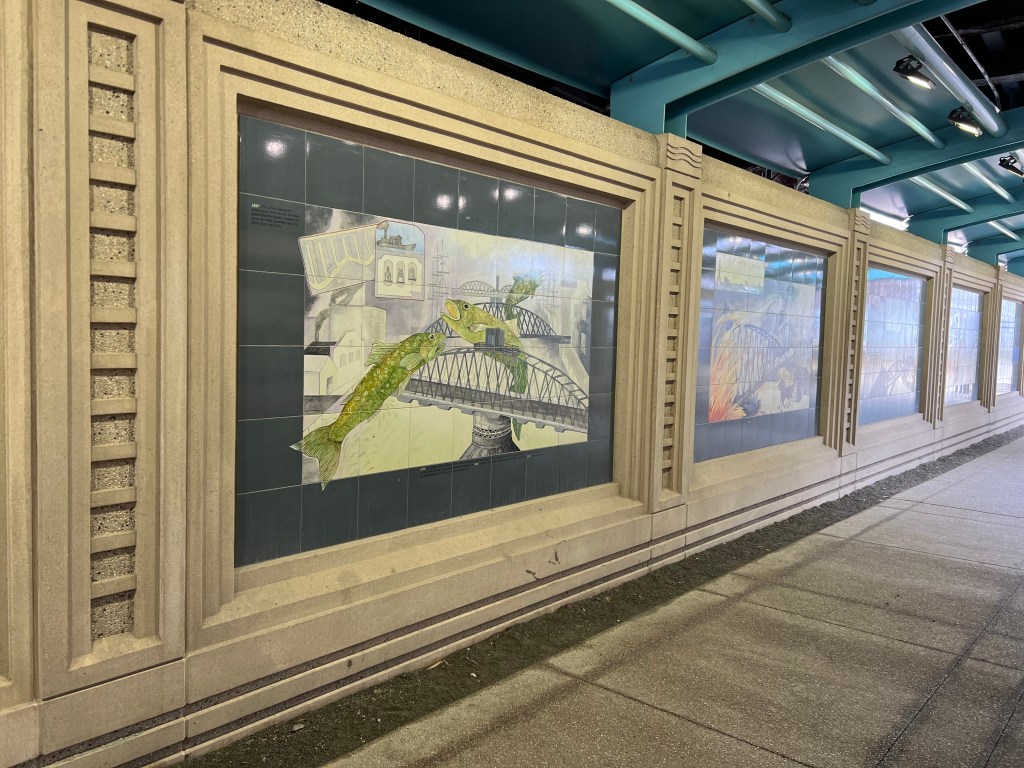
Tower Bridge along Sacramento River

Ed and Chris Sacramento CA May 28, 2025

Categories: travel | Tags: , , , , , , , , , , | Leave a comment

2025 Trip Three: May 24-25. The California Zephyr. 

Sacramento, California, May 26.

Well I lost several paragraphs from the beginning of this post. Hopefully I’ll remember enough of it to re-dictate. They are not showing up in back up either.

This post will be primarily pictures. I will start with narration to explain the trip and then finish with the pictures.

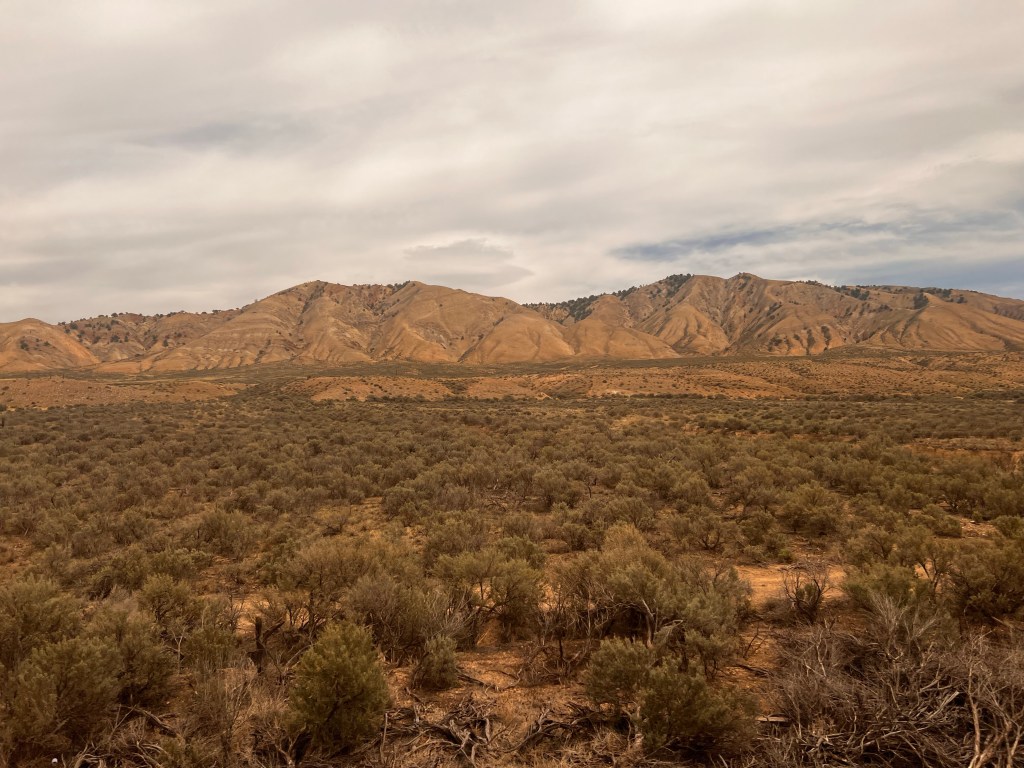
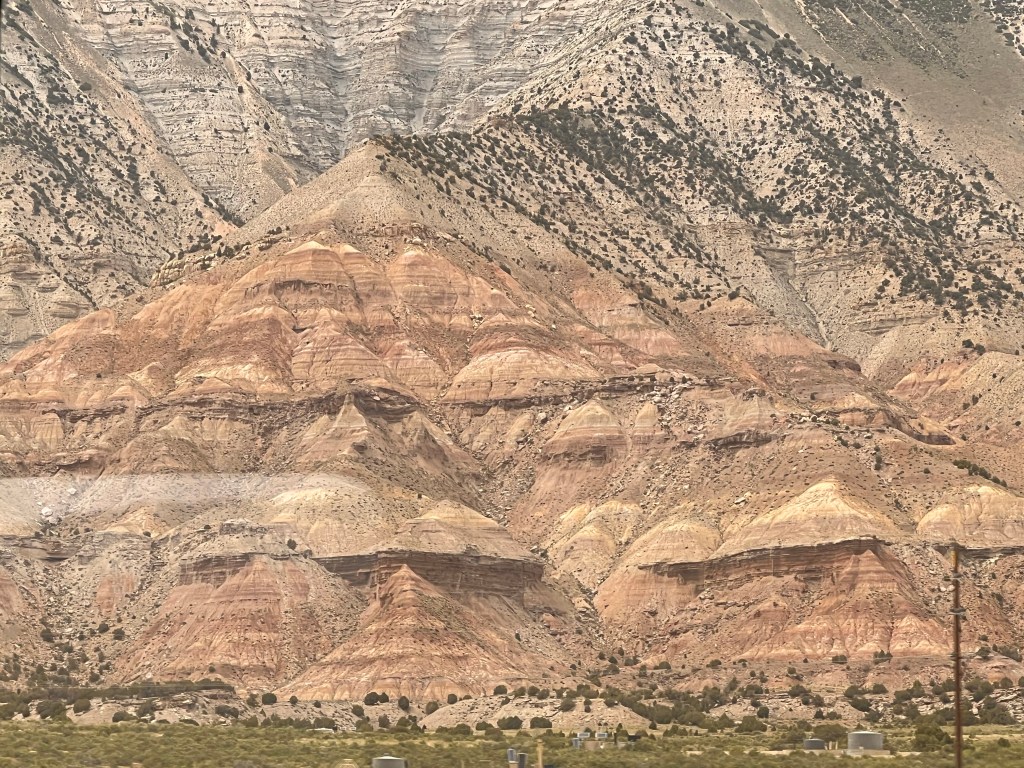
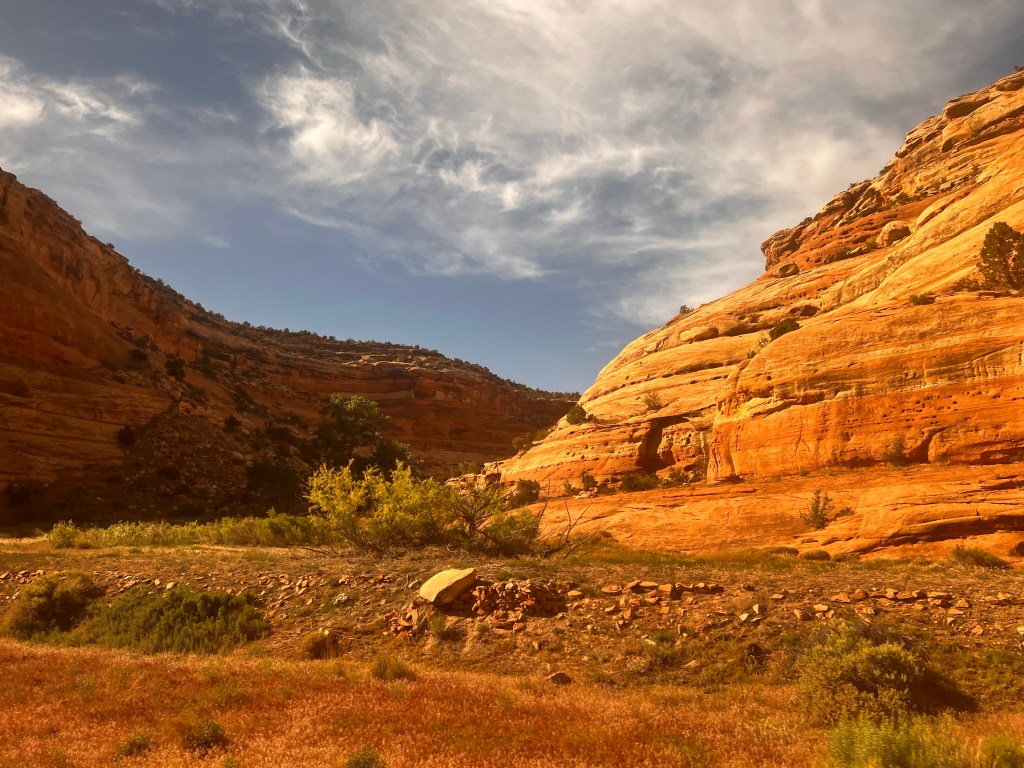
This journey is about the California Zephyr. Zephyr is one of Amtrak’s long distance routes, going from Chicago to Emeryville, California, which is across the bay from San Francisco. The stretch between Denver and Grand Junction Colorado is noted as particularly scenic. Since we have driven the flatlands of Illinois, Iowa, Kansas, Nebraska, we flew to Denver and skipped those sections.

We thought the journey would be important enough that I purchased a digital book that explains the scenery outside the window as a train travels west. Some of Amtrak‘s long distance routes have the Trails and Rails program that narrates that scenery to the people sitting in the observation car. The Zephyr no longer does.

Our train was on time and boarding began at 8:15 AM. We left our hotel early enough to make it via walking to Union Station. We’re in a family room, which is considered one of the sleeper units. The other sleepers are called roomettes and sleepers.All of the sleeper passengers boarded last in Denver. In this way, the crew has sufficient time to clean the rooms that were used last night and were vacated here in Denver. Our family room was the last of the sleeper suites available when we bought our tickets.

The family room is on the lower level and is the only unit that stretches the width of the train. It’s narrower, so the total size is not much bigger. Amtrak says it’s suitable for two adults and two children under 12. The family room does not have a private bathroom or shower. That is only available in the sleeper unit. The roomettes also do not have a shower or private toilet. While the communal toilets were clean enough, they could’ve have been enhanced by the judicious use of air fresheners. We chose not to shower on the train, it’s only one night.

Passengers traveling in the coach cars are given a ticket while on the platform by the conductor that indicates which car and which seat they will be in. This ticket is put above their seat and also has written on it their destination. This information is used by the conductor to make sure that people getting off the train in the middle of the night are awakened at the proper time.

Food on Amtrak trains is quite good. There’s no variation, the menu has stayed the same for several years. Meals are part of the package for those in sleeper units. For those of you who do not know, the equipment, (coaches, sleeper cars, observation car, and dining car) are all at least 30 years old.

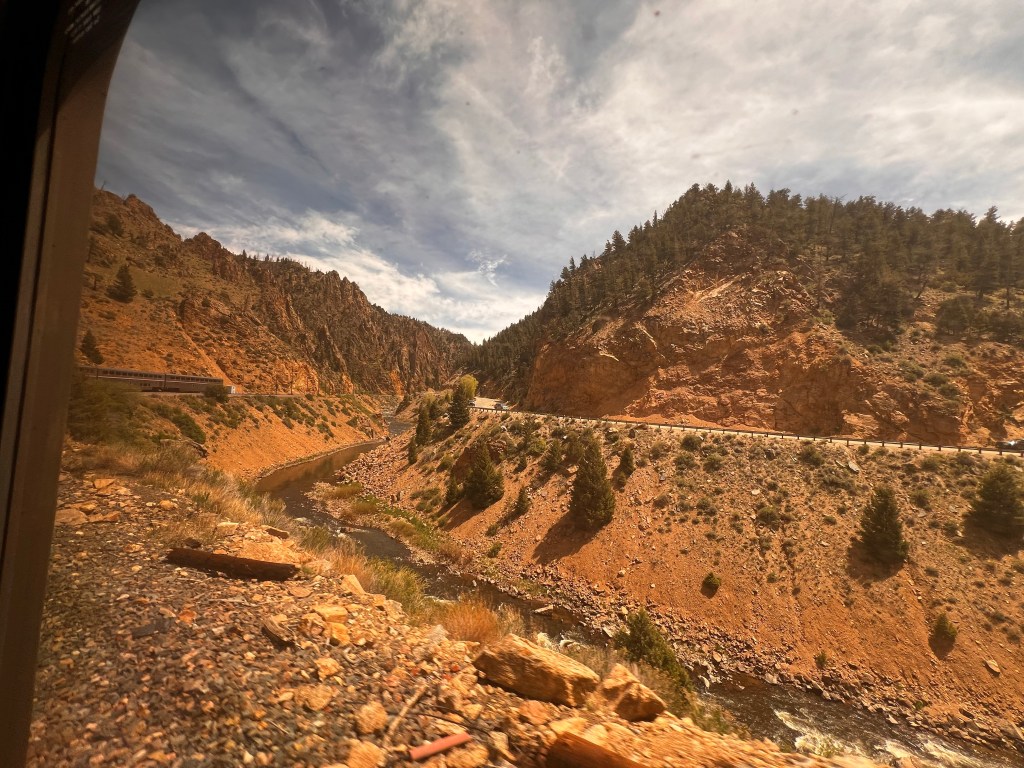
Instead of going due west and following interstate 70 all of the way, the California Zephyr leaves Denver and goes northwest towards Winter Park and Granby before dropping down in the southwesterly direction to pick up Interstate 70. The California Zephyr picks up the Colorado River around Granby. We went through numerous canyons and tunnels, along rivers, and generally had great scenery.

One tunnel, the Moffat tunnel, is 7 miles long. I think in total we went through well over 50 tunnels. Being somewhat egotistical, while the scenery was very nice, it was not dramatically different from other locations we have visited around the US. The meals on the train were good. The sleeping arrangements, while tight, accommodated two people easily in the family room. Amtrak says the family room can accommodate four people, two adults and two children under the age of 12. However, neither one of us slept well or long. We are not anxious to repeat an overnight travel trip on Amtrak in the future.

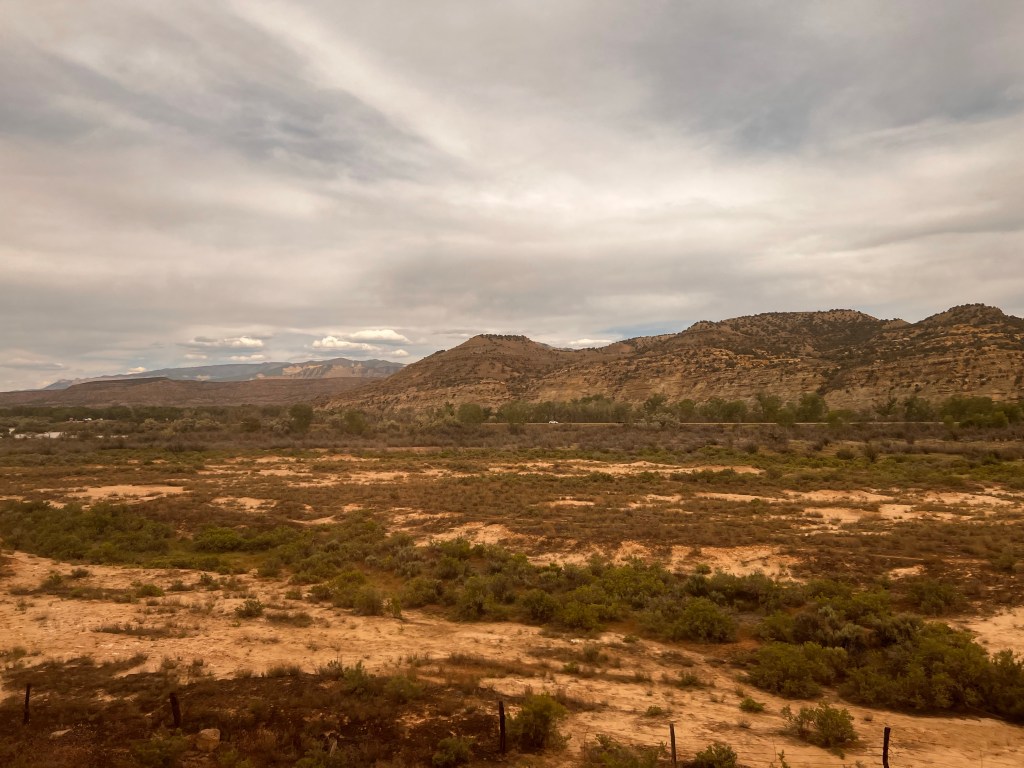
On a sidenote, I mentioned the digital book I had purchased. The book was written 15 or 20 years ago and it referred to a section of the Colorado River as Moon River. Along that section of the river, fishing and kayaking are popular activities. At the time of publication, it was not uncommon for these people to drop their drawers to moon the passengers on the Amtrak. I certainly thought the passage of time would have eliminated that tradition. However, the tradition is still alive and we were mooned four times during the trip. I did not take any pictures of that. 

As I mentioned, the train was full. This translated into a very busy observation car. For those of you who do not know, the observation car does not have assigned seats. People come to it from their regular seat. The advantage here is that the windows are twice as tall as the regular windows and go high enough to observe the sky and tall mountains. The conductor, every hour or so, would make an announcement that people in the observation car should leave in order to allow new people to come in and take advantage of it.

The observation car seats about 40 to 50 people. A coach car can hold over 70 and we had several of them. Sleeper cars can handle easily 30 and we had three of them. So it is not difficult to conclude, as the train travels through particularly scenic areas, it becomes difficult to snare a seat in the observation car. In this regard, the family room was an advantage, although even while at a lower level and with smaller windows, you could observe scenery on both sides of the train.

Enough with the narration. On to the pictures.

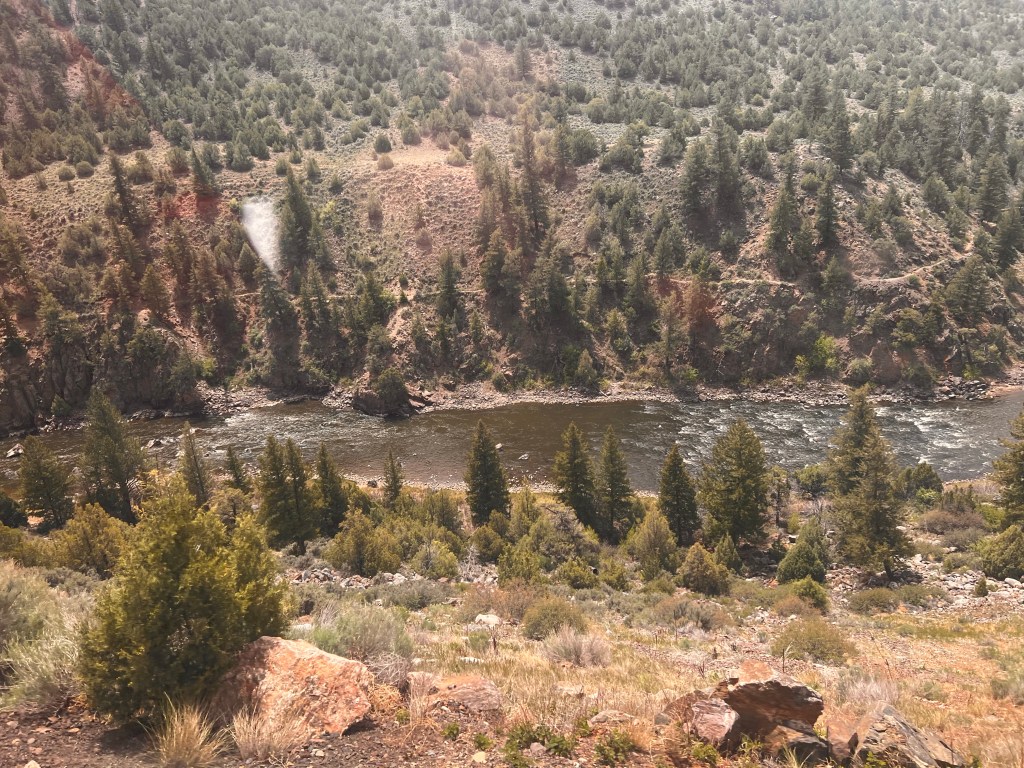
Starting to climb up to the Rocky Mountains 
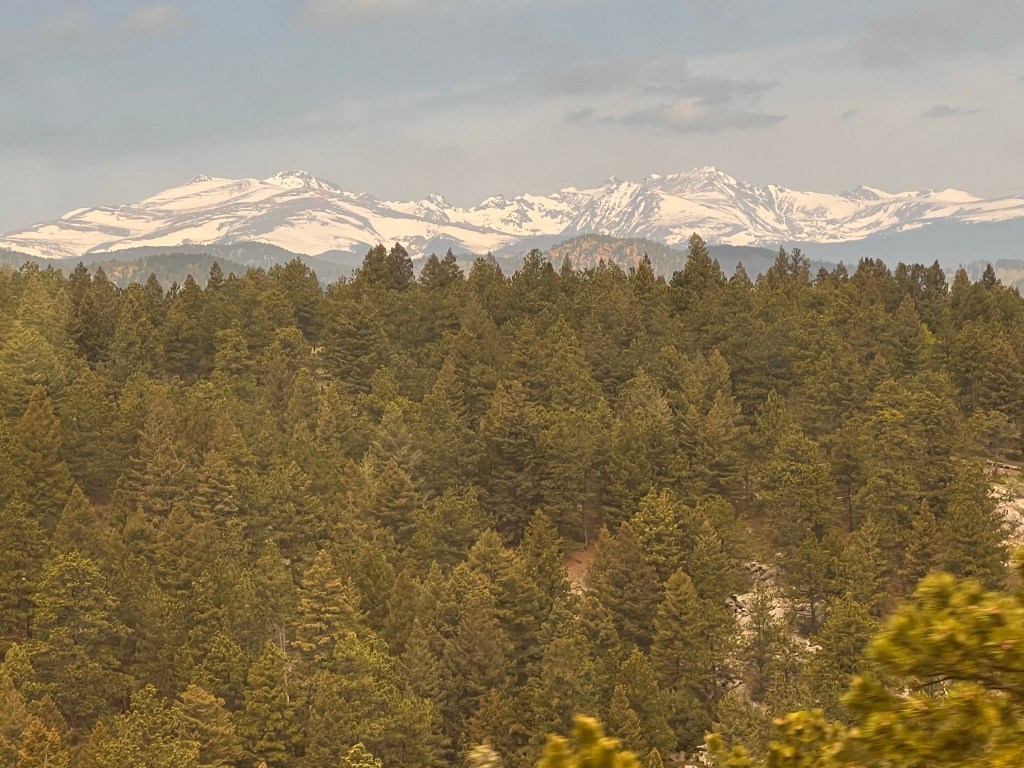
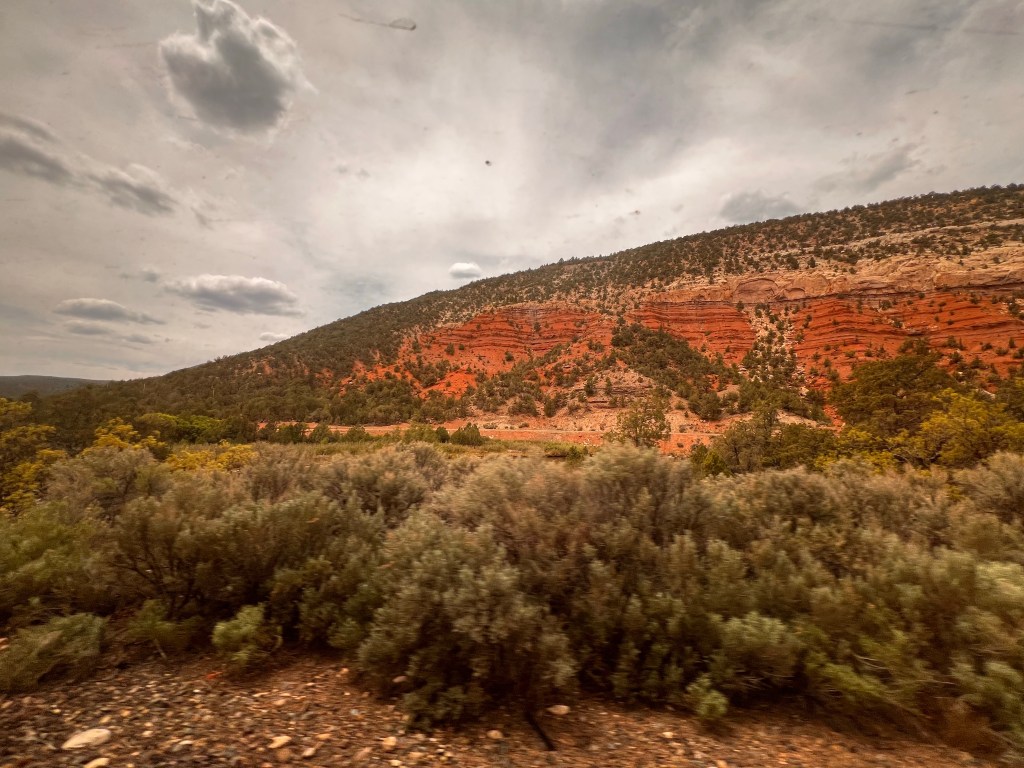
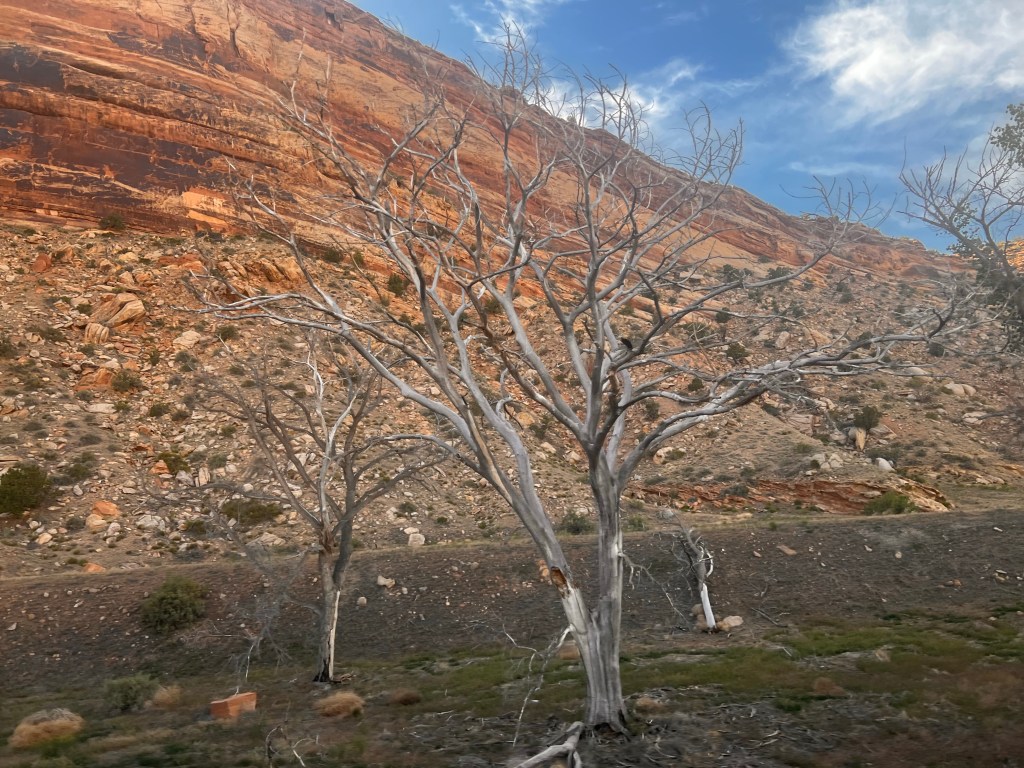
Rocky Mountains 
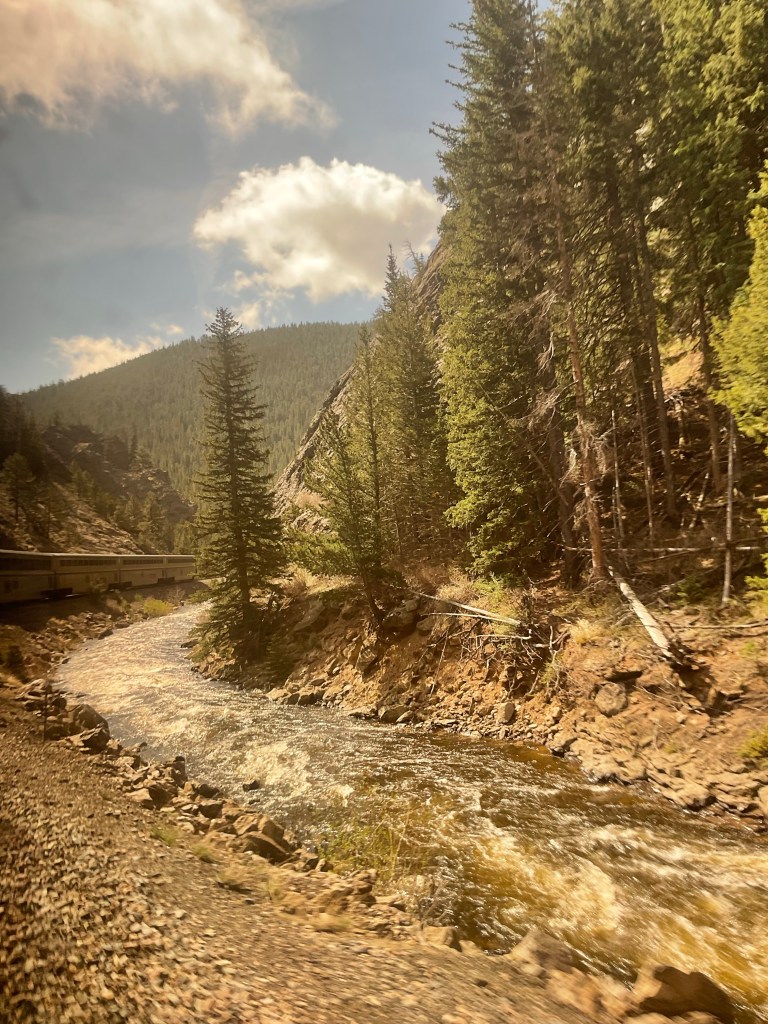
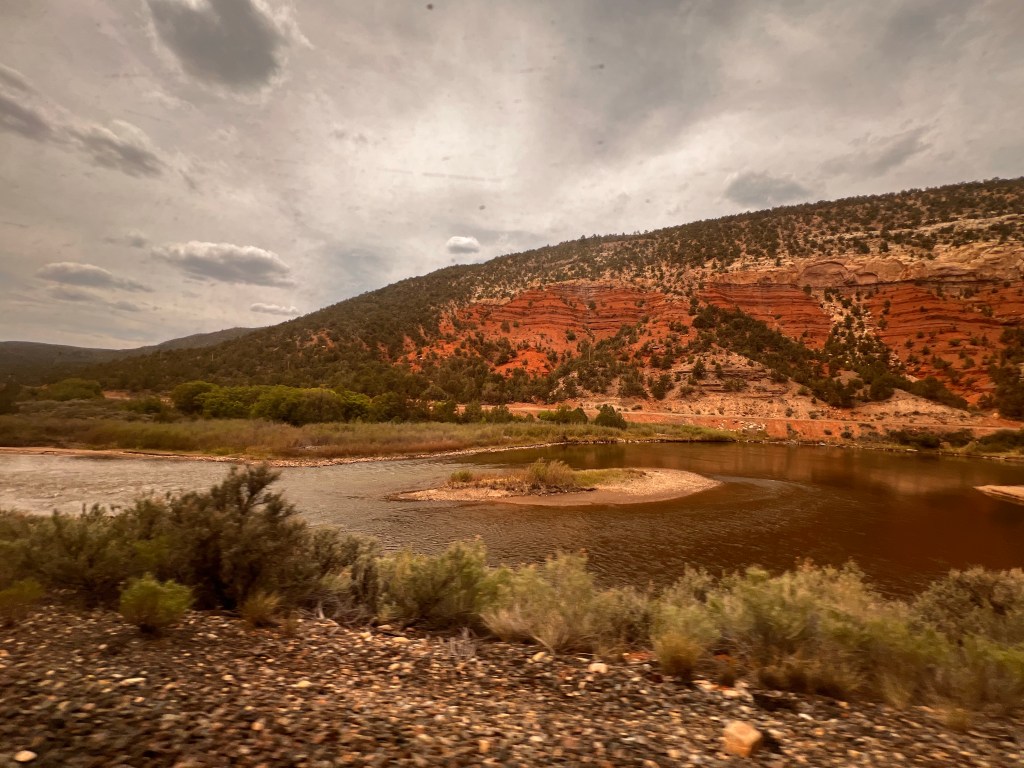
The moon River area 
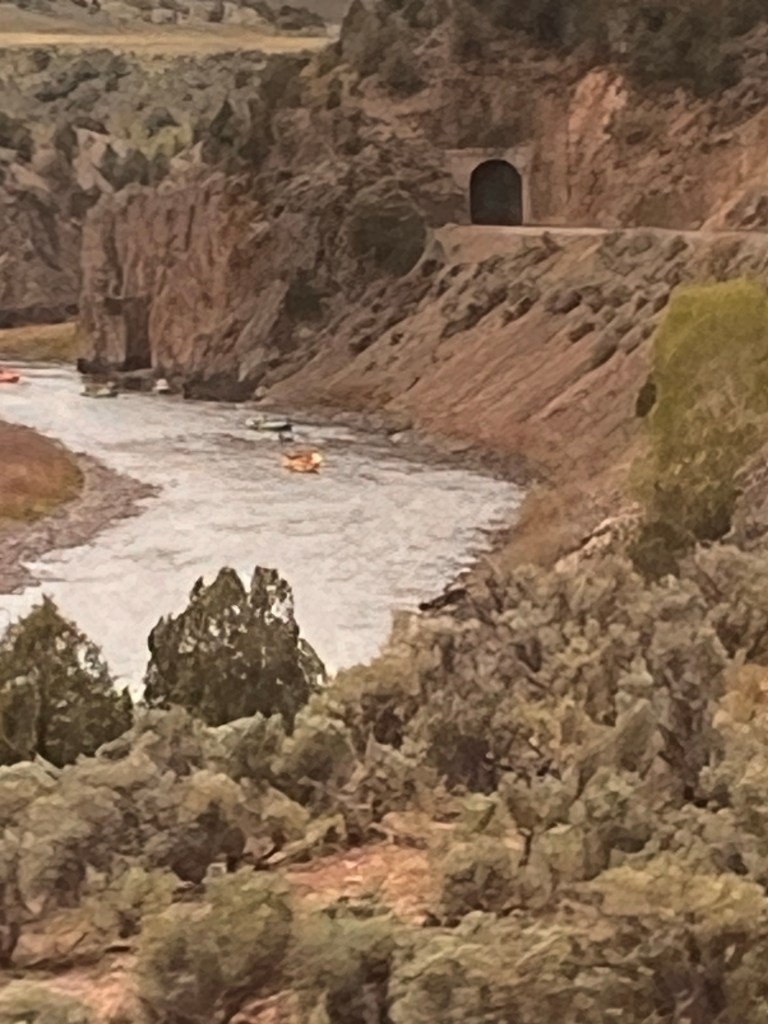
People on the river and one of the tunnels 

In the Sierra Nevada Mountains. Almost to Sacramento.

Ed and Chris, Sacramento, May 26.

Categories: travel | Tags: , , , , , , | Leave a comment

2023 Trip 3: Quickie to Chicago: March 19-23

Our alternate Amtrak transportation on Sunday March 19

March 24, 2023

We made this trip to Chicago to use up our timeshare points since we waited too long to book South Beach and because a trip to Chicago on the Amtrak would refresh my memory of the route prior to beginning this summer’s Trails And Rails program. The plan was to take Amtrak down on Sunday, spend four nights at the Hilton Grand Vacation Club location in the Doubletree hotel, and then return on Amtrak Thursday, March 23.

I try not to dump on Amtrak too much. After all, air travel is full of hassles also. However, Amtrak‘s on-time record for the Empire Builder going east from Seattle to Saint Paul to Chicago is poor. The train is normally late, sometimes dramatically so. The Amtrak app gives an overly optimistic view of the time the train will arrive in Minneapolis St. Paul. I use another program that tracks the Empire Builder’s journey once it leaves Seattle. For this trip, while the train left Seattle on time Friday early evening, east of Spokane it encountered a delay and was running 3 1/2 hours late. It never made up the time as it traveled further east.

Saturday afternoon around 4 PM we received an email from Amtrak that while the train was running late, they had made alternate arrangements for us. Turns out they had arranged for a nice coach bus to take us directly to Chicago. We should still show up at our usual departure time Sunday morning at Saint Paul’s Union Depot. This left some questions for us, but we were willing to go with the flow. Sunday morning we arrived at Union Depot and after talking to the Amtrak agent we learned we could either take the bus or wait for the train. At this point the train was scheduled to be about 3 1/2 hours late. (It ended up being 5 1/2 hours late.) We talked to some people in the waiting area and discovered that 35 students and chaperones from Richfield Senior High were going down to Chicago for two nights on a class trip. We ended up taking the bus with them. Our belief is that the bus was only arranged because there were so many people going directly to Chicago. A second bus was arranged for people going to intermediate stops, including Milwaukee. But our bus would go directly to Chicago.

The bus left around 9 AM, made a one hour lunch stop in Wisconsin Dells, and arrived in Chicago’s Union Station about a half hour sooner than the train would have. That is, sooner than the train would have arrived if it were on time. Since the train was actually over five hours late, we got to Chicago six hours earlier than if we had waited for the train. We took a taxi to the hotel, checked in, and had dinner at an Irish sports bar (O’Toole’s) across the street. Chris had their shepherd’s pie while I had their meat loaf. Both were very tasty. While we were on the 23rd floor, the view was only of downtown office buildings, so not as dramatic as the view in San Francisco.

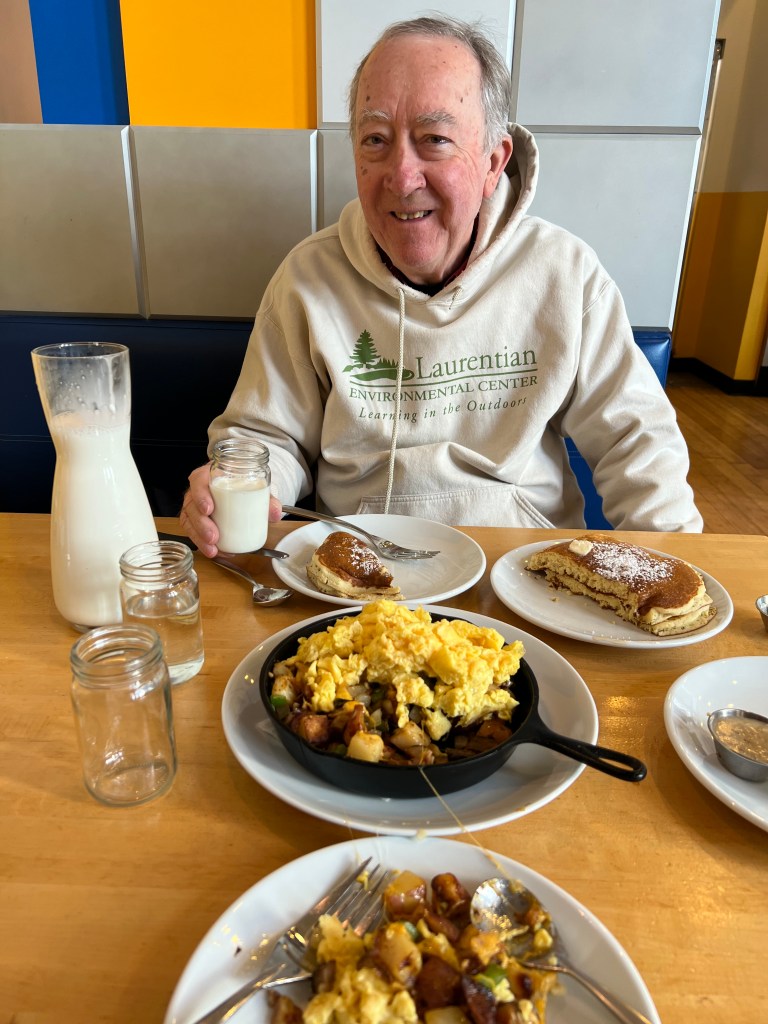
Monday morning we walked to a local breakfast place called Yolks. Great breakfast menu and it offered a carafe of 32 ounces of milk for $10. What a deal. We ordered it of course. We had only one scheduled activity for the day which was the Adler planetarium. There was a taxi outside the hotel, and we took it down to the Adler, part of the museum complex in Chicago.

At the Adler

The Adler planetarium was the first planetarium to open in the United States and did so in 1930. It has several floors of exhibits and theaters. We paid for one planetarium show called planet nine about Pluto and other planetary like bodies in the Kuiper belt area of the solar system. We found the exhibits well done covering some topics we knew such as moon exploration, but numerous topics that we had no concept of prior to our visit. One such new item was “retes”, which are pierced plates on an astrolabe. Hopefully we walked away remembering some of that information. Monday afternoon was probably the nicest day, weatherwise, and we walked 3 miles back from the museum complex to our hotel.

Walking back from the Adler

Pop Up book of Our Lady of Guadalupe

Tuesday we changed our plan a bit and took a tour of the Newberry library. The Newberry is a private research library devoted to the humanities, renowned in its field and in genealogy. We had a tour of the library which dates back to 1887. We viewed the original building but not the archival section which is off-limits. They had an exhibition of book arts, the process of creating fold up and pop up books. We are used to these nowadays as more of a children’s book with pop-up pictures. However, the history of these goes back hundreds of years and it was interesting to see the origins and variety that have been created as publishing skills have expanded. Another special exhibit presented the perspective of black and indigenous artists and how their art has shown resilience and resistance in the face of oppression.

The tour of the Newberry had a particularly curious twist. Mr. Newberry, another one of those millionaires with too much money to spend, left his money for a library. As Chris would say, long story short, he died on a boat trip to Europe to meet his free spending wife and two daughters. A superstition of the time was to have a dead body on board a ship. Given his wealth, people accompanying the trip convinced the captain to stuff his body into a barrel that had been emptied of it’s cargo of rum. The barrel was then lashed to the side of the boat. He and his barrel were transported to England, where his body greeted his wife and daughters. The docent did not describe how the body got back to Chicago for eventual burial.

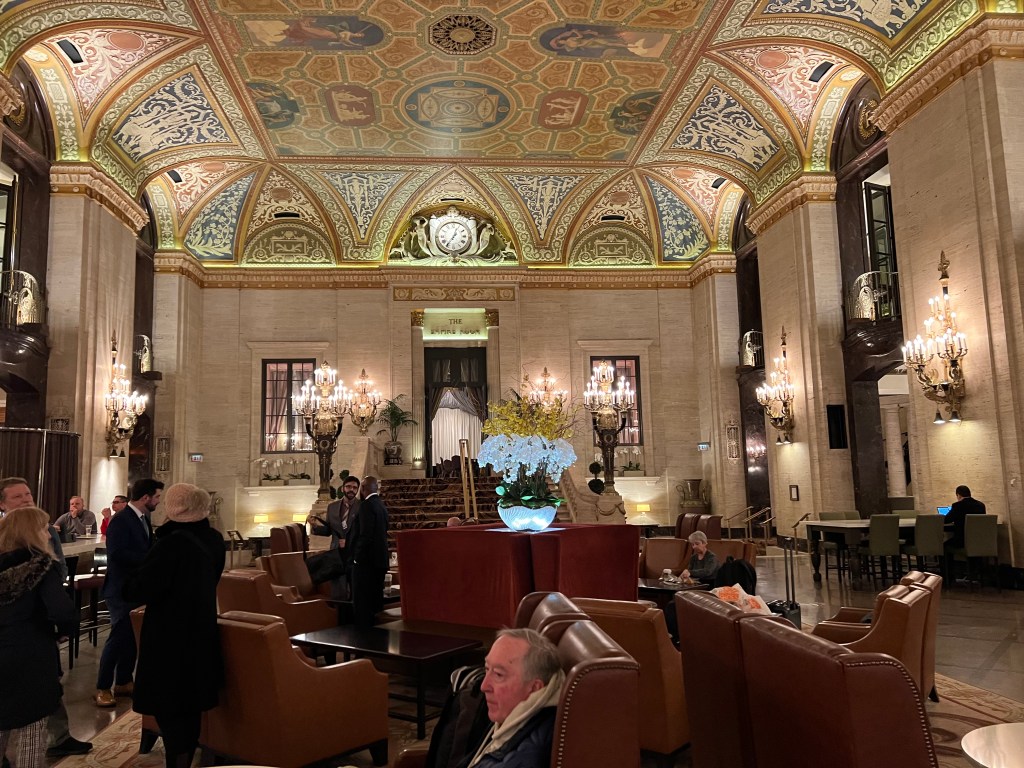
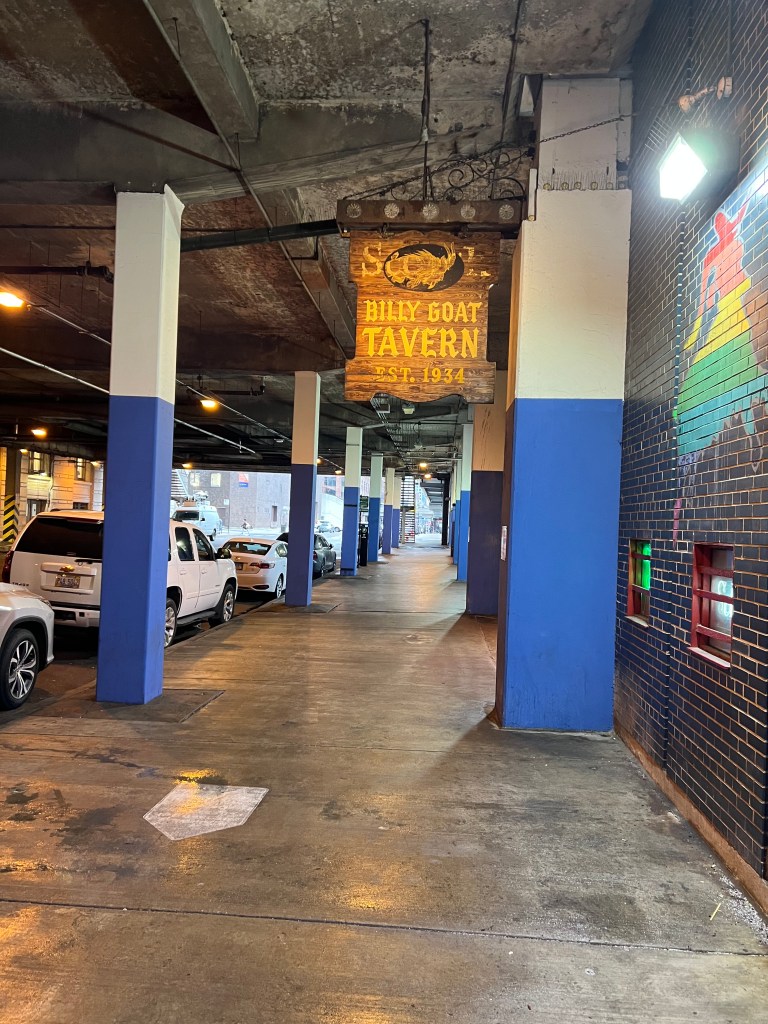
Chicago dining, from upper left, Palmer House, Giordano’s, Billy Goat Tavern, at Yolk, at O’Toole’s

For lunch, we walked a few blocks down Rush Street to Giordano‘s pizza, a Chicago institution since 1974. Once there we discovered they have expanded so much there is a location only a few miles from us in Richfield MN. Since their deep dish pizza is famous but would take an hour to create, we had the thin crust pizza with a salad, and were quite pleased.

Chris liked this from the Museum of Contemporary Art

After that, we walked over to the Museum of Contemporary Art. This was kind of a snoozer, I would’ve been happy to have skipped it. A lot of space, but not much art that spoke to me. In fact, not much art at all given the size of the building.

Sue

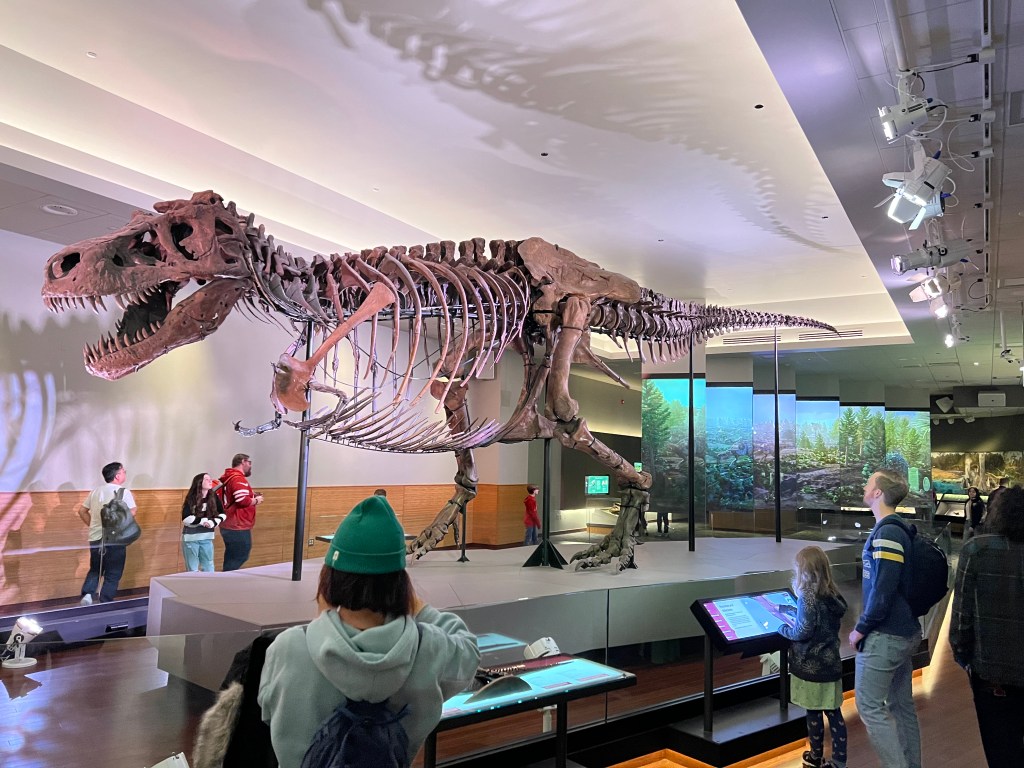
Wednesday morning started with our having the breakfast buffet in the hotel restaurant which gave us a chance to have fruit, vegetables, protein, etc. to fortify ourselves for a busy day. After breakfast, we took another taxi to the museum complex, this time to visit the Field Museum of Natural History. The Field dates back to 1894. It is one of the largest natural history museums in the world. Here we purchased the special exhibit about China, and also had an hour tour focusing on dinosaurs. Their main dinosaur, called Sue, is a Tyrannosaurus rex found in South Dakota, and named after the female archaeologist, Sue Henderson, who was the first to spot the bones of the dinosaur. The docent gave a very knowledgeable talk about the mass extinctions that led to, and killed off, the dinosaur, as well as the various types of dinosaurs that existed during the time frame they inhabited the earth.

Other exhibits were equally well done and extensive. We spent five hours here and by the time we got back to the hotel, I was pretty well wiped out. Not too wiped out, though, as we explored a dive type hamburger place located on a dingy lower level street. For some reason I thought at the Billy Goat Tavern, I could get a great burger and tater tots. But no, the burger was good, but it was only chips as your optional accompaniment. I made up for it by stopping at a little deli next to our hotel, and picking up some chocolate chip cookies and milk.

At the American Writers Museum

Thursday was our last day in town. We slept in, and then spent an hour at the American Writers Museum. This museum opened in 2017, and has a series of static and interactive displays of a wide range of American writers. They even had a section of manual typewriters where younger people visiting had a chance to find out how to properly insert a piece of paper in the typewriter so you type on the page with the logo at the top front. They also had difficulty understanding that you had to hit the keys smartly in order to make an impression. It was a bit of humor to watch among the multitude of displays about individual writers.

We had lunch at the Palmer house, another Chicago institution before heading to Union Station to catch our Amtrak home. The homebound train was only about 10 minutes late leaving the station. It was kind of a madhouse in the waiting room, but everything got sorted out smoothly as people were directed to the proper car for the journey west. We spent over half the time in the observation car enjoying the scenery. Only major hiccup was a male rider who appear to have some mental health issues. The train was stopped in Tomah, Wisconsin to escort him off the train for violating the no smoking rule, among other things.

We arrived back in Saint Paul about 11:15 p.m. There were no taxis wedding, so we dialed up an Uber and got home a little bit after midnight. Next trip, Arizona and Nevada for Great Basin National Park, and visiting family.

Walking back from the Adler to our hotel in downtown Chicago

Ed and Chris, Saint Paul, March 25

Categories: travel | Tags: , , , , , , | Leave a comment

2017 Trip Four: Chicago July 25-28

St. Paul, MN July 31, 2017

For this short trip to Chicago we traveled light; no iPad so no blog while traveling. This is our fourth trip to Chicago in the last ten years or so and for the second time in a row, we rode the Amtrak Empire Builder from St. Paul’s Union Depot. Overnight parking ranges from $49 to $64 per night and our plans for the visit did not require a car. The Amtrak round trip fare for two was $234; it seemed like an easy decision to train it. Amtrak seats are roomy and comfortable, you can walk around, there is scenery to observe, and plenty of people-watching and listening. Amtrak is always an adventure though; you can not plan on it being fully on time. I have a habit of checking to see how the Empire Builder is doing, time-wise. Often it is 15-30 minutes early (it waits in St. Paul to depart on time if it arrives early). It can also be late. When it is late, it can be hours late. Of course, our train was one of those. The engine for our train broke down in the mountains out west and the train had to wait for a BNSF freight engine to arrive and pull it the rest of the journey to Chicago. We knew it was going to be late, so we had breakfast at the Buttered Tin in downtown St Paul while we waited.

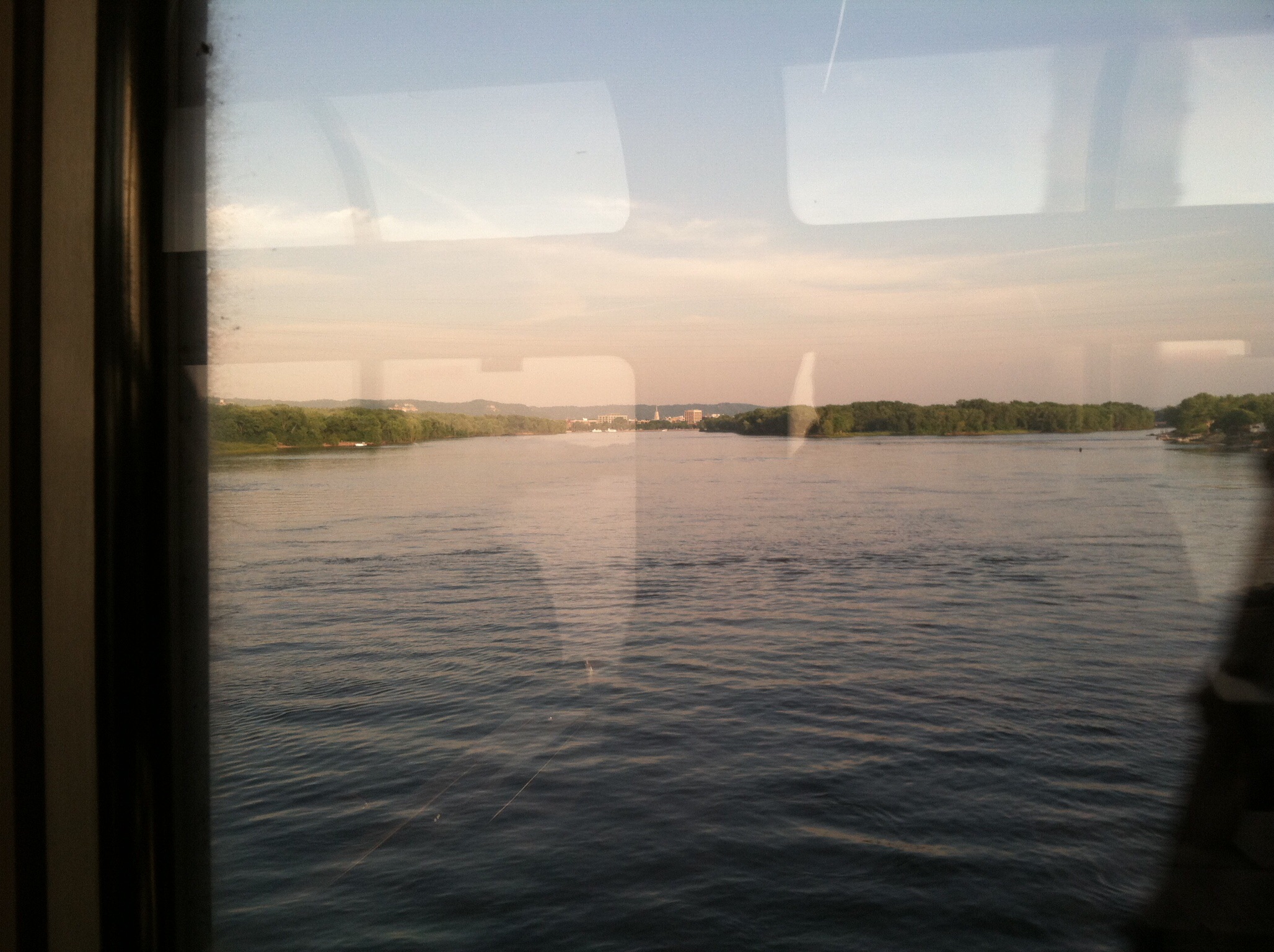
Crossing the Mississippi River on Amtrak going from Minnesota into Wisconsin

The Empire Builder arrived in St. Paul three hours late. The freight engine goes slower than the Amtrak engine and we arrived in Chicago four hours late, 8 PM instead of 4 PM. The Empire Builder usually stops on the northern side of the depot, ours went further into the southern portion of the station, providing a shorter walk for passengers trying to connect with other trains. The ride was smooth, the views scenic. Many moons ago Mark Twain described the view along the Mississippi River in grandiose words. His words may have been a little over the top but the view does make for a relaxing and enjoyable trip. Chris and I split our time between our coach seat and riding in the observation car.

Readers of this blog may recall that I have been a volunteer docent on the Amtrak Empire Builder as part of the Trails and Rails program jointly sponsored by Amtrak and the Mississippi National River and Recreation Area (MNRRA), a unit of the National Park Service. Unfortunately, this year the program is in on hold. MNRRA lost two rangers, one was the supervisor for this program, and with the federal freeze on hiring they did not have enough staff to oversee our program. Hopefully it will return in 2018. I felt a little weird riding the train, particularly when in the observation car where we did our presentations, and not speaking or being able to listen to any speaker. Most passengers did not know the difference. On this train, I did not recognize any of the conductors or car attendants. On our return trip on Friday I recognized a conductor and he did indicate some people had asked why the Trails and Rails program was not being presented.
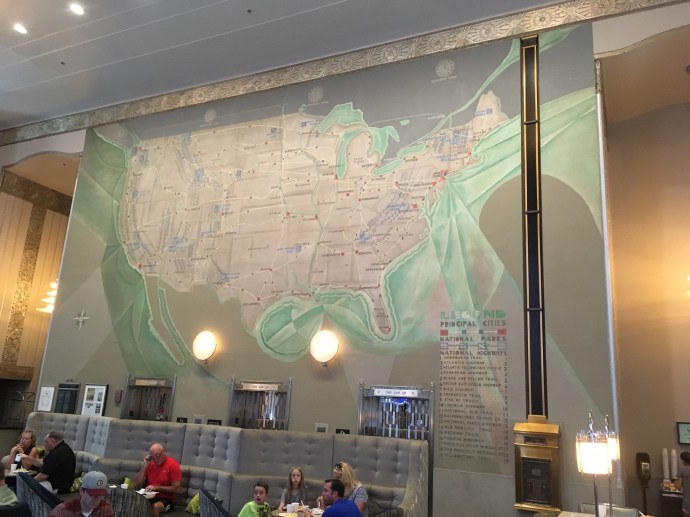
Mural dating back to the days of the Chicago Motor Association in our Hampton Inn Chicago

In Chicago, we stayed at a Hampton Inn at Wacker and Michigan, one half block from the Chicago River. It was a very convenient location. The hotel building originally was the home for the Chicago Motor Association (AAA) but had been vacant for many years. The renovation retained the Art Deco feel of the original building. Like many hotels in large cities, the rooms were small. Of our four stays in Chicago, three have been Hamptons and all have been a good choice. We walked the mile to the hotel from Union Station, once again enjoying the architecture of the buildings along the way. Dinner was across the street at a Jamaican bar/restaurant.

The “Bean”

Wednesday, our major activity was a bus tour of Chicago Historical Neighborhoods run by the Architectural Association of Chicago. This group organizes numerous architectural tours; we have been on three others before this one. All are well done and reasonably priced. The tour did not begin until 11 so we wandered around Millennium Park beforehand. Millennium Park was a project of the second Mayor Daley to take the northern section of Grant Park, cover over numerous unused railroad yards and make it into a spectacular park to celebrate the year 2000. Well, typical of many projects it came in over budget, past its scheduled completion date but wildly successful. It is full of notable scenes; the “Bean”, a cascading waterfall, a new garden, a kids play area which is spectacular, and another outdoor amphitheater.

The Crown Fountain in daytime, at night the towers change colors

We have been to Millennium Park before but Lurie Garden and the Maggie Daley kids play area were new to us. Millennium Park cost almost 500 million dollars and was a combination of city and private funds. It is always a pleasure to stroll around, particularly in pleasant summer weather. People gather at the Bean (technically titled Cloud’s Gate), a shiny structure shaped like a bean, that reflects the views of the spectators as well as the background of the Chicago skyscrapers. Others splash in the reflecting pool of the Crown Fountain, situated between two fifty foot towers with changing faces of people on them. Periodically the mouth of the person opens up and directs a spray of water onto the people, usually children, waiting underneath.

Grant Park as a whole is over 300 acres, over 1.5 miles long, provides scenes of the lakefront, is home to several museums, fountains, sculptures, etc. It is the site of large gatherings, such as an outdoor Mass by Pope John Paul II, Barack Obama’s 2008 Election Day victory speech, the celebration for the Bulls and Cubs national championships, and a riot during the 1968 Democratic National Convention.

But back to the tour. We were on a double-decker bus, with probably about 20 others. Many of the “Hop-on, Hop-off’ double decker buses that circulate around the downtown area were full. Our tour guide was a volunteer for the Architectural Association who was quite knowledgeable. We drove through Greektown, Little Italy, Pilsen, Chinatown, and Bronzeville. Most of these neighborhoods have changed from their original ethnic roots, although the architectural style may still survive. The 1960s and 1970s were particularly destructive as freeways were constructed and universities and hospitals expanded. This “modernization” destroyed neighborhood cohesiveness and scattered residents to new neighborhoods or suburbs as large, new buildings were erected. For instance, Bronzeville was once home to a major African-American community, located here as informal segregation limited where they could live. When the Illinois Institute of Technology came in with its brutalist, concrete style of buildings, many residents had to move and much of the original housing stock destroyed. We were able to view remnants of the homes from that era.
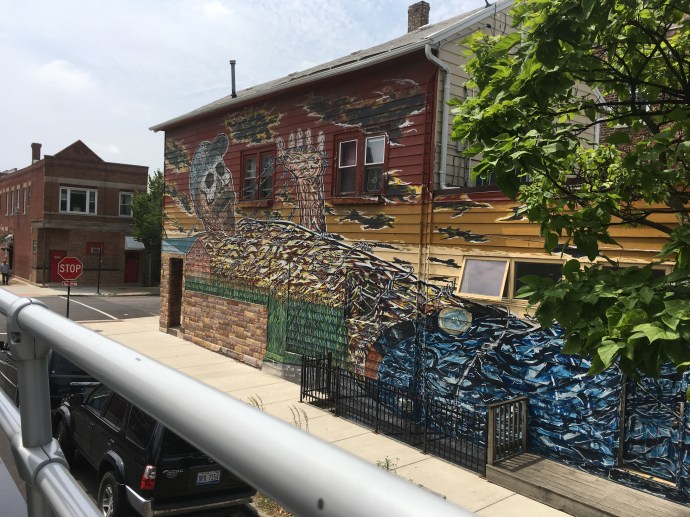
One of the murals in Pilsen neighborhood

Pilsen was originally a Czech neighborhood. Now it is central to Chicago’s Mexican-American heritage, with numerous wall murals decorating the community. Chinatown is actually expanding, unlike many other “Chinatowns” around the country. Chicago’s Chinatown originally developed when the Chinese who immigrated to the U.S. faced discrimination and violence on the West Coast. Several neighborhoods had homes where the first floor was below street level. Evidently much of Chicago was built on swamp land which has settled. Unlike downtown Chicago where fill was added and building were physically raised, these residences settled without any city intervention. When we visited the Pullman National Monument in Chicago last year, we learned that George Pullman was one of the contractors hired to raise downtown buildings.

We were only able to view these buildings due to the skill of our bus driver. The downtown “Hop-on, Hop-off” buses drive down wide streets with few trees. Our bus traversed narrow streets with tree branches and wires frequently threatening the people on the upper deck of the bus-us. He did a fantastic job; I escaped without any scrapes or bruises and we did not hit any pedestrians or cars. On the tour we saw the outside of the National Mexican-American Art Museum and the National Hellenic Museum; we will have to put them on our list for the next trip.

At the Grant Park Orchestra performance

Wednesday evening we went back to Millennium Park. This time my cousin Sue picked us up with picnic food. We met two friends of hers at the Jay Pritzker amphitheater. The Grant Park orchestra was playing to a crowd of several thousand. Actually, I have no idea of the number of people. The crowd was not announced but it is a large area and people were spread out everywhere. It was a pleasant evening, the music was enjoyable, and we had several hours to chat. Honestly, our talking very quietly during the orchestra did not interrupt or bother other people. It is a setting where you can talk quietly and still enjoy the music as a standard part of the audience participation.

Thursday was projected to be a rainy day but the rain prediction disappeared and we changed our plans. We took a bus north to Lincoln Park. Lincoln Park is 1200 acres and includes the Zoo, Conservatory, History Museum, beaches, playing fields, numerous statues, and nature museum. In the morning, we visited the Peggy Notebaert Nature Museum including its butterfly house, the Conservatory, and the lily ponds. At the Peggy Notebaert Nature Museum, we joined a throng of summer campers as the Nature Museum is free to residents of the state of Illinois on Thursday. Despite the kids, we were able to enjoy the exhibits and displays. Climate change is still alive there; displays showcased climate change, solar panels, green homes, purification of drinking water and the cleaning of waste water.

In Lincoln Park

Walking south, we encountered the conservatory with its glass domes and floral displays. The conservatory was not huge, probably no larger than the Como Park Conservatory here in St. Paul. We continued walking through the park, watching the maintenance crew repair the fountain, then we could observe the dogs and children play in the fountain. The flowers along the fountain area south of the conservatory were brilliant and well done. We even sat for a while and just enjoyed the view. Lunch was at a restaurant just 1/2 block west of the park.

In the Chicago History Museum

Our journey continued for several more blocks as we reached the Chicago History Museum. This was an excellently done. We spent several hours here until our bodies were tired of standing and reading and observing. One of their main exhibits is titled “Crossroads of America”. The displays highlight the role of Chicago in the development of the United States, touching on such topics as the stockyards, railroads, breweries, lumbering, medical advancements, etc. We spent probably two hours going through this one exhibit. The other exhibits we treated as more of a walk through for us since our energy was dwindling.
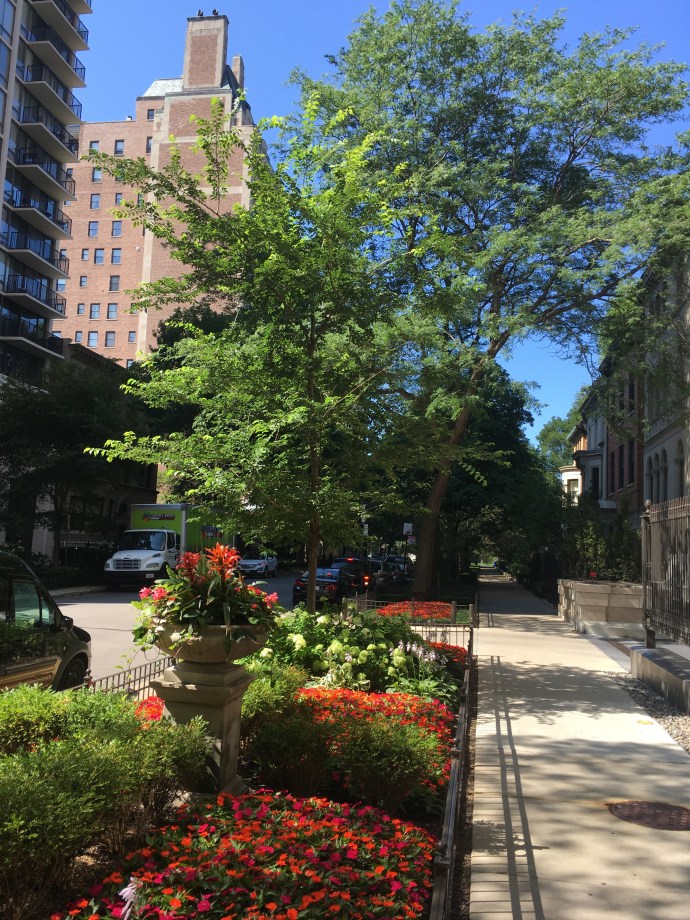
Walking down State Street

We decided to walk back to our hotel, choosing the quieter side street of State Street and Rush street. The first half of the walk was on quiet, tree-lined, flower-filled streets with probably expensive walk up residences intermingled among high-rise buildings. The final, more downtown section was still comparatively quiet as compared to Michigan Avenue just to our east. We congratulated the fact that we walked over 11 miles on Thursday with a stop at Ghiradelli Chocolate for some ice cream and sorbet refreshment.

Maggie Daley Park

Thursday evening we spent some more time at Maggie Daley park at Millennium Park. We were amazed at the variety, complexity, and beauty of the children’s play structures. There was even a climbing rock area, surrounded by a track where parents and children could rollerblade and ride on scooters. Even at 8 PM, there were a sizable crowd of parents and children utilizing the grounds and facilities.

As we returned towards the Pritzker amphitheater, we encountered the crowd for the live recording of the public radio show called “Wait, Wait, Don’t Tell Me”. The crowd was even bigger than the group present Wednesday night for the Grant Park Orchestra. We managed to wend our way through the park before the crowd left the performance.
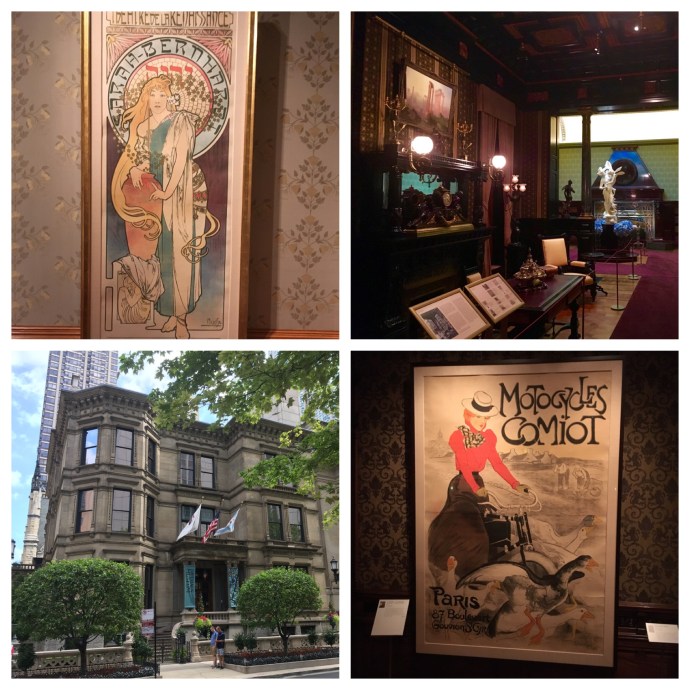
Driehaus Mansion Chicago

On Friday, our train was not scheduled to depart until 2:15 PM. We took a docent led tour of the Driehaus Mansion, a suggestion made to us by the friends of my cousin Sue who were with us at the Pritzker Wednesday evening. The mansion is one of the few remaining examples of the palatial homes erected by the wealthy of America’s Gilded Age. At its time, it was the largest private residence in Chicago. In the early 2000’s, it was purchased by a very wealthy investment manager (Richard Driehaus) in Chicago, renovated, and made available for tours. “The lavish interiors are complemented by stunning examples of furniture, decorative arts, stained glass, and period pieces selected from the Driehaus Collection.”

After the tour, it was time to walk over to Union Station to catch the Empire Builder home. The train left on time, but arrived ten minutes late due to slower speeds in areas of track construction work. We had an excellent dinner on the train. Our dinner companions were a couple spending several weeks touring the country, using the train to go from point to point. During our discussions we discovered we had been to many of the same places around the country, including lodging at the Duff Green B & B in Vicksburg. All in all, a pleasant journey.
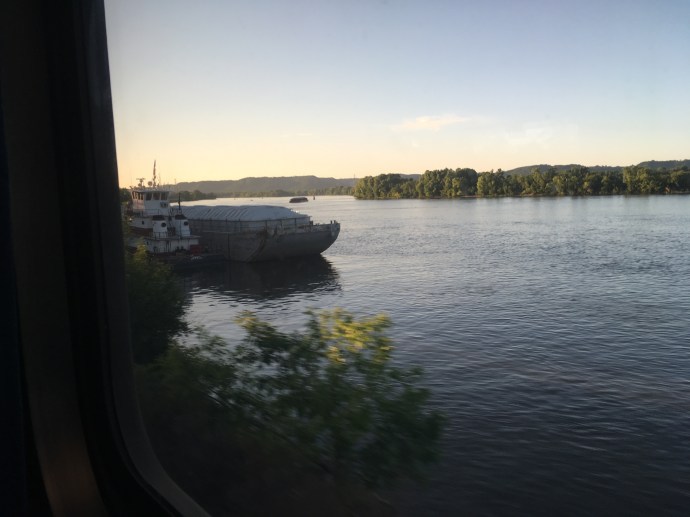
Returning home along the Mississippi River Friday night

Ed and Chris, Saint Paul Minnesota July 31

Categories: road trip, travel | Tags: , , , , , , , , , , , , | Leave a comment

2016, Trip One, Chicago, Day One

April 10, 2016 Chicago IL

The first trip of 2016 is a short one. We have been on hiatus for a while, enjoying one of Minnesota’s milder winters by staying home. We made one or two short, local MN trips during the winter along with numerous MN activities, and, we have replaced our 2001 Saturn (226,000 miles) with a new Subaru Legacy. However, the Legacy will have to wait a while for a road trip.
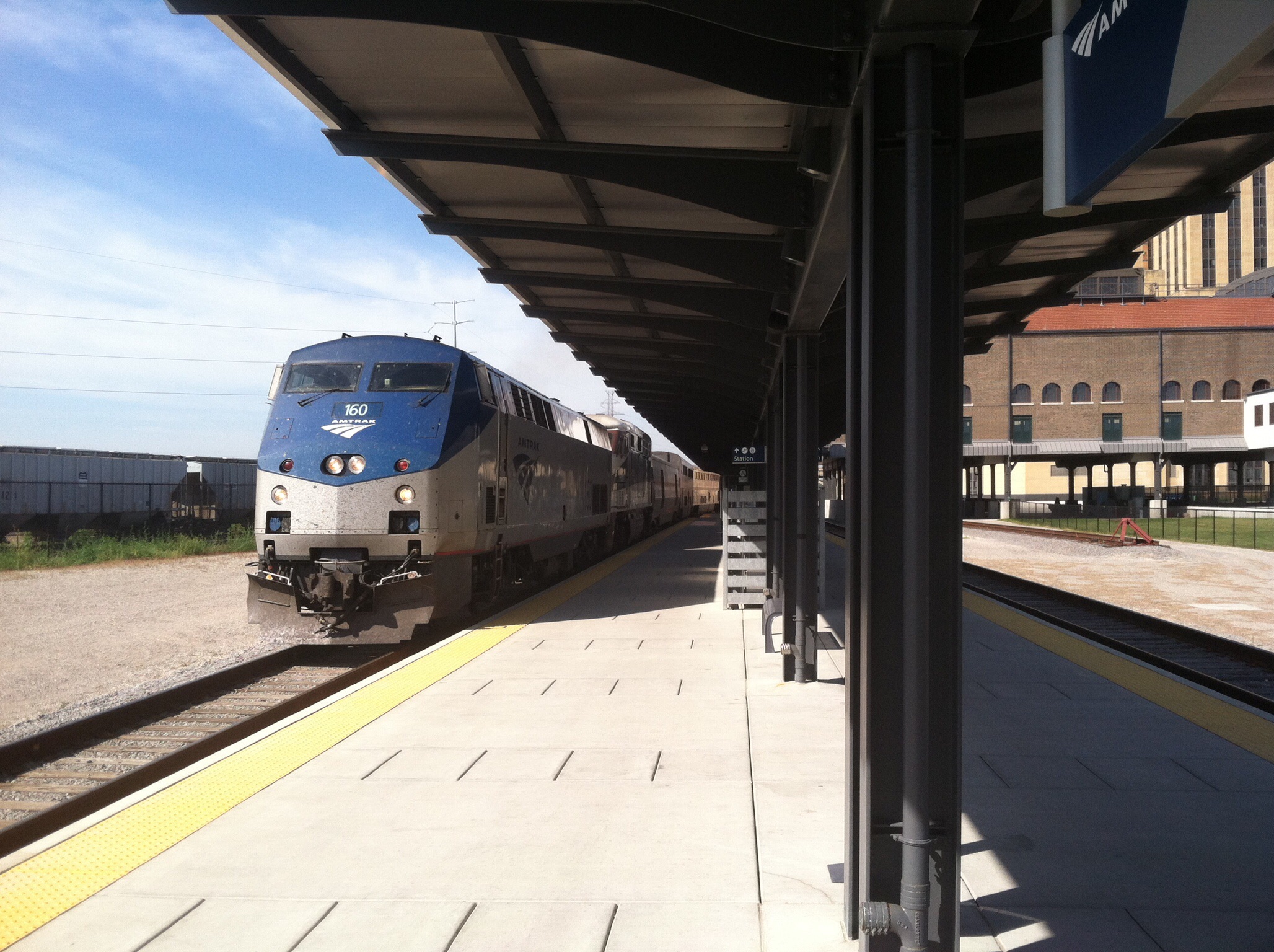
Ed and Amtrak observation car at Union Depot in St. Paul

Ed and Amtrak observation car at Union Depot in St. Paul

This first trip was planned for us to ride Amtrak as paying passengers, something we have not done for probably 15 years. As readers of this blog know, Ed is a volunteer with the Trails and Rails program jointly offered by the National Park Service and Amtrak. His journey only goes 2/3 of the way to Chicago and Chris does not participate. So, we put our money down and headed out early this morning.

The Empire Builder arrived in St. Paul an hour early (6:43 AM), a real departure from its 2015 on time (not) performance. We had arrived around 7 AM by bus and were able to board the train by 7:10 to get our seats. Seating is on your own, not assigned seats. We grabbed two coach seats, left our jackets at the seats and snagged a table in the observation car on the river side for most of the trip and with Chris seated looking forward (an important priority). The Empire Builder left Union Depot in St. Paul at its scheduled departure time of 8 AM for the 8 hour trip to Chicago. We had three main goals; a successful train ride, a journey to the new Pullman National Historic Site in Chicago, and a visit with my cousin Sue.

Red Wing MN and the Mississippi River

Red Wing MN and the Mississippi River-not including the eagles

Goal one has been accomplished. Both of us enjoyed the ride. The MN portion (obviously) is more scenic than the WI portion as it parallels the Mississippi River most of the way. Trees are just beginning to leaf out although Chicago is a bit ahead of us on that score. Birds were everywhere, boaters were out on the river. In Red Wing there must have been 20 eagles roosting in trees in a small area near the local Marina. (Well maybe a few were turkey vultures but most were Eagles.)

I did not give my Trails and Rails “spiel” to Chris but instead noted the topics I present in various areas along the route. Most of the topics she is familiar with, having heard me discuss them, or going to some of the same lectures I attended, or read the same books.

Ed and Chris in the observation car

Ed and Chris in the observation car

The observation car was our home for 2/3 of the ride, with its expansive windows which are great for viewing up and down. The coach seats are comfy with plenty of leg room. The train was not crowded today and empty seats were frequent. The observation car, unlike in the summer, was never full.

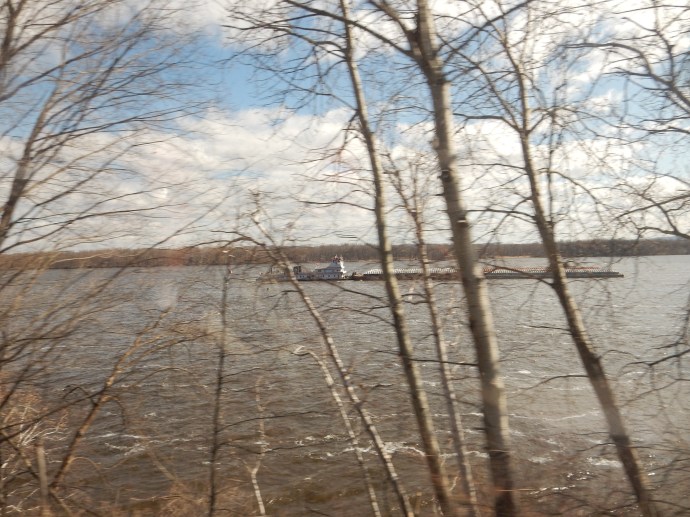
A tow along the Mississippi River

A tow along the Mississippi River

We spent more time observing than socializing. We did manage some conversation with a number of Canadians, from Saskatchewan and Winnipeg. Our lunch companions (you are seated to fill up tables and thus you automatically meet others) were from just north of Seattle. The two women are fans of National Parks. Their week-long journey will stop at numerous NPS units and will start off tomorrow at Pullman National Historic site. We may see them again. We swapped stories of parks we have seen and have yet to see. While the lunch menu is brief, our burgers were quite tasty.

Chicago River on our walk to the hotel

Chicago River on our walk to the hotel

Union Station in Chicago (the name is quite similar to Union Depot in St. Paul)is large with many Chicago commuter trains as well as Amtrak trains that head out all over the country. We decided to walk to our hotel, about 1.5 miles away. It was sunny and 48 degrees F-although Chicago is always windy with the numerous skyscrapers. We are staying at a Hampton Inn in the River North district.

Dinner was at Andy’s Jazz Club, with Dana Hall group playing.

Ed and Chris April 11, 9 pm
Chicago

Categories: road trip, travel | Tags: , , , | 4 Comments

2015, Trails and Rails-Amtrak and National Park Service

Saint Paul, MN

In July of 2012 I retired and, as readers of this blog know, began traveling extensively in January of 2013. I have also been seeking out volunteer opportunities that would still allow for travel. Periodically in 2013 and 2014 I would do some volunteer work for the Mississippi National River and Recreation Area, a unit of the National Park Service. As we cut back on our travels this year, I have been able to increase that volunteer work. In the words of the website for the Mississippi National River and Recreations Area, “In the middle of a bustling urban setting, this 72 mile river park offers quiet stretches for fishing, boating and canoeing. Other spots are excellent for bird watching, bicycling and hiking. And there are plenty of visitor centers that highlight the history and science of the Mississippi River. If you are interested in the Mississippi River, this is a great place to start your exploration.”

Empire Builder arriving at St. Paul's Union Depot

Empire Builder arriving at St. Paul’s Union Depot

The National Park Service and Amtrak cooperate on a program called Trails and Rails. In this program, volunteers from local national parks provide a combination of education, enlightenment, and entertainment on 25 to 30 Amtrak passenger routes around the United States. Our Amtrak passenger train travels between Chicago Illinois and Seattle Washington and is called the Empire Builder. The Empire Builder train is named after James J Hill, the founder of the Great Northern Railway. His efforts in making his railroad successful had a tremendous impact on the growth of the Midwest and Northwest. He was heavily involved in promoting Glacier National Park and his company ran the concession lodging there for many years. Here in St. Paul, our national park, the Mississippi National River and Recreation Area, is one of those sponsors with Amtrak for a Trails and Rails program.

Mississippi River Valley from Frontenac State Park

Mississippi River Valley from Frontenac State Park

20 volunteers from the Mississippi National River and Recreation Area, myself included, take turns providing the service from May 1 to September 1, Monday through Thursday. The program here is in its seventh year. Two volunteers will ride each train going from St. Paul Minnesota to Columbus Wisconsin. The train leaves St. Paul Union Depot around 8:15 AM. The train normally will arrive in Columbus Wisconsin around 1:15 PM. The volunteers wait a few hours and then board the returning westbound train at Columbus around 5:15 PM and arrive in St. Paul around 10 PM. Volunteers must monitor the progress of the eastbound train before it arrives in St. Paul, since overnight lodging is not provided. If the train is too late, the volunteers will not be able to catch the return train. For instance, this year, forest fires in Washington closed down the tracks to all train traffic, not just Amtrak, for several days. When the train is too late, we do not make the trip, or get off prior to Columbus. The eastbound train will frequently encounter delays as it goes through the mountains. It does not get priority over freight traffic and may have to wait for freight trains, and particularly oil tanker trains to go through. Track maintenance work will also require slower speeds through construction zones.

Winona MN Train Station

Winona MN Train Station

Mississippi RIver from downtown Red Wing

Mississippi River from downtown Red Wing, across the tracks from the train station

The Trails and Rails program out of St. Paul is dictated by the Amtrak schedule. There is no value in running a program at night when people are sleeping and no views outside the window are possible. The Empire Builder traveling between St. Paul and Columbus offers several hours of viewing of the Mississippi River, which is the purpose of our park here in St. Paul. The sights are beautiful, whether seeing a sunset over Lake Pepin or just viewing the river and farmlands. In the words of Mark Twain: ““Neither in this country nor in any other, have I seen such interesting scenery as that along the Upper Mississippi. One finds all that the Hudson affords-bluffs and wooded highlands-and a great deal in addition.. Every hour brings something new.”

Crossing the Mississippi River at LaCrosse WI-LaCrescent MN on Empire Builder for Trails and Rails

Crossing the Mississippi River on Amtrak Empire Builder Trails and Rails at LaCrosse WI-LaCrescent MN

So this year, I began as one of the 20 volunteers on the Empire Builder Trails and Rails. Training includes a six-hour classroom session, a two-hour train ride introduction, two trips on the train from St. Paul to Columbus with experienced volunteers, and a package of information to provide the starting material for your own narration. We are expected to provide narration, not read the material in the handouts. Thus the volunteer has the requirement and the opportunity to personalize the presentation. I was reassured by the fact that two volunteers always travel together and that we are not expected to be talking constantly. The presentation is made in the upper level of the lounge car. This car has higher dome windows to provide a better view. This type of car is normally not seen in the eastern United States due to lower bridge heights the trains pass under in the eastern half of the U.S.

Tow boat with a single barge on Mississippi RIver

Tow boat with a single barge on Mississippi River

One of my initial concerns was whether the passengers in the dome/lounge car would be irritated by our conversation and how receptive they would be to the presentations. After the first several rides in which we were applauded when we got off in Columbus; or overhearing passengers say “I did not know that”; or hearing passengers discuss your comments by themselves later during the trip made me realize that the effort was worthwhile and well received. Personally, I still have some trepidation each time a new trip starts but these are starting to go away. I continue to add to my own narration copy and work on my ability to know when to present various topics. I have over 50 pages of narrative by now. I do not intend to try to put that all in this post. I will highlight a few comments as an example of the information types we present. Even during my presentation, not all material gets presented. Some of my narrative is a fuller background on a locale but in speaking, I summarize the material. Based on the audience, if the view is being blocked by other trains on neighboring tracks, or whatever, not all material is presented.

Wisconsin farmland with rainbow

Wisconsin farmland with bike trail and rainbow

First, we talk about geology; there are interesting examples along the way. One of the areas that is mentioned I was completely unaware of prior to this activity. This is the so-called famous Driftless Area, particularly of Wisconsin. The upper portions of the United States have been covered by several glaciers over the past millennia. However, the last, or fourth, glacier did not descend as far south as the previous ones. Glaciers move sediment and rocks along with them, this has been categorized as glacial drift. Since the fourth, and last, glacier did not descend as far south, this un-glaciated area of Wisconsin, and a small portion of Minnesota, is called the Driftless Area. It has impacts for landscape and produces different topography then the glaciated area.

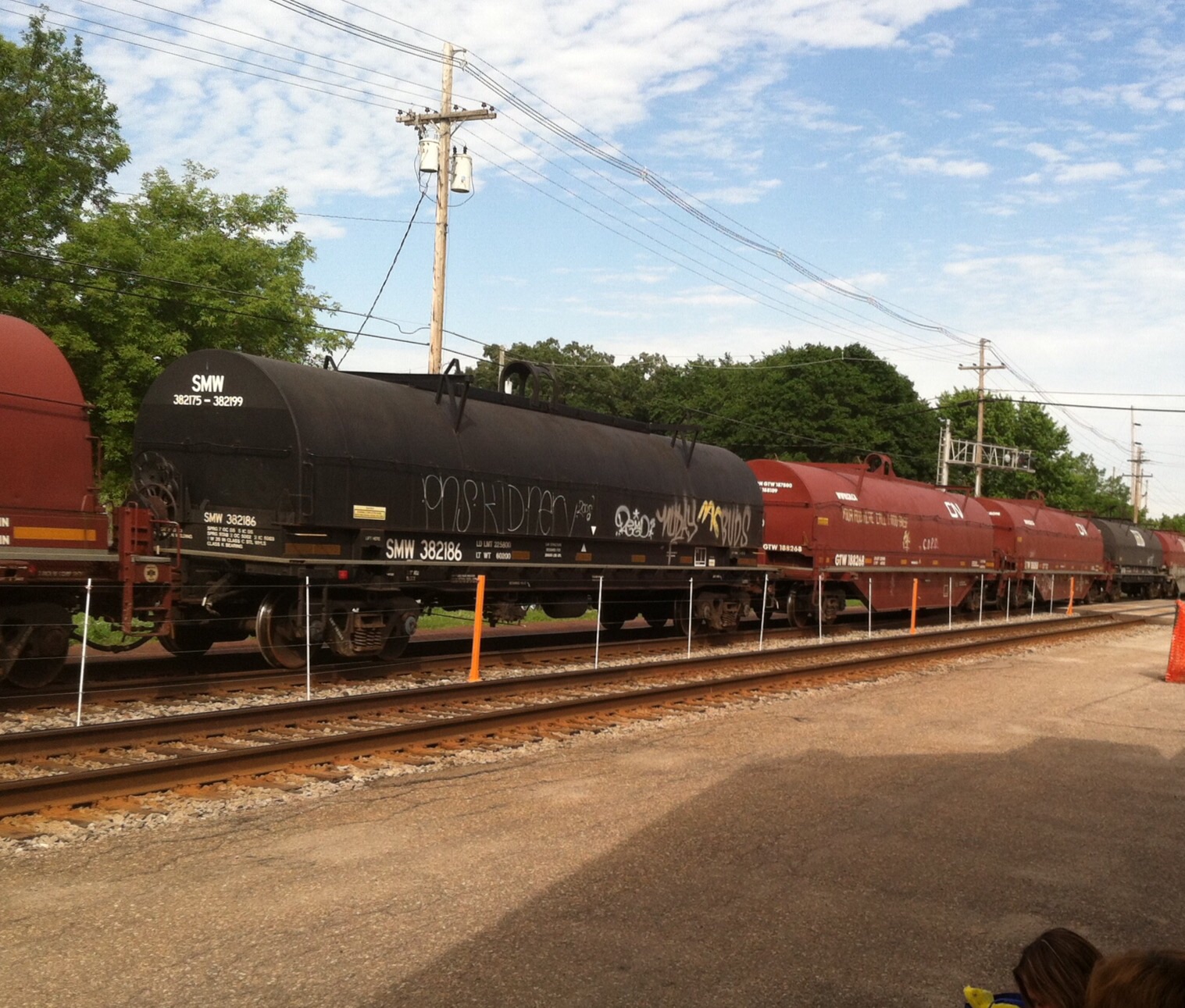
Standing in Columbus WI watching a freight train roar by

Standing in Columbus WI watching a freight train roar by

Second, we talk about the Mississippi River. We discuss its length, shipping in the 1800s, current barge traffic, wildlife along the river, and particularly, bald eagles. I mention the Upper Mississippi National Wildlife Refuge which is a major protective area for migratory birds. This wildlife refuge also has an interesting Facebook page.

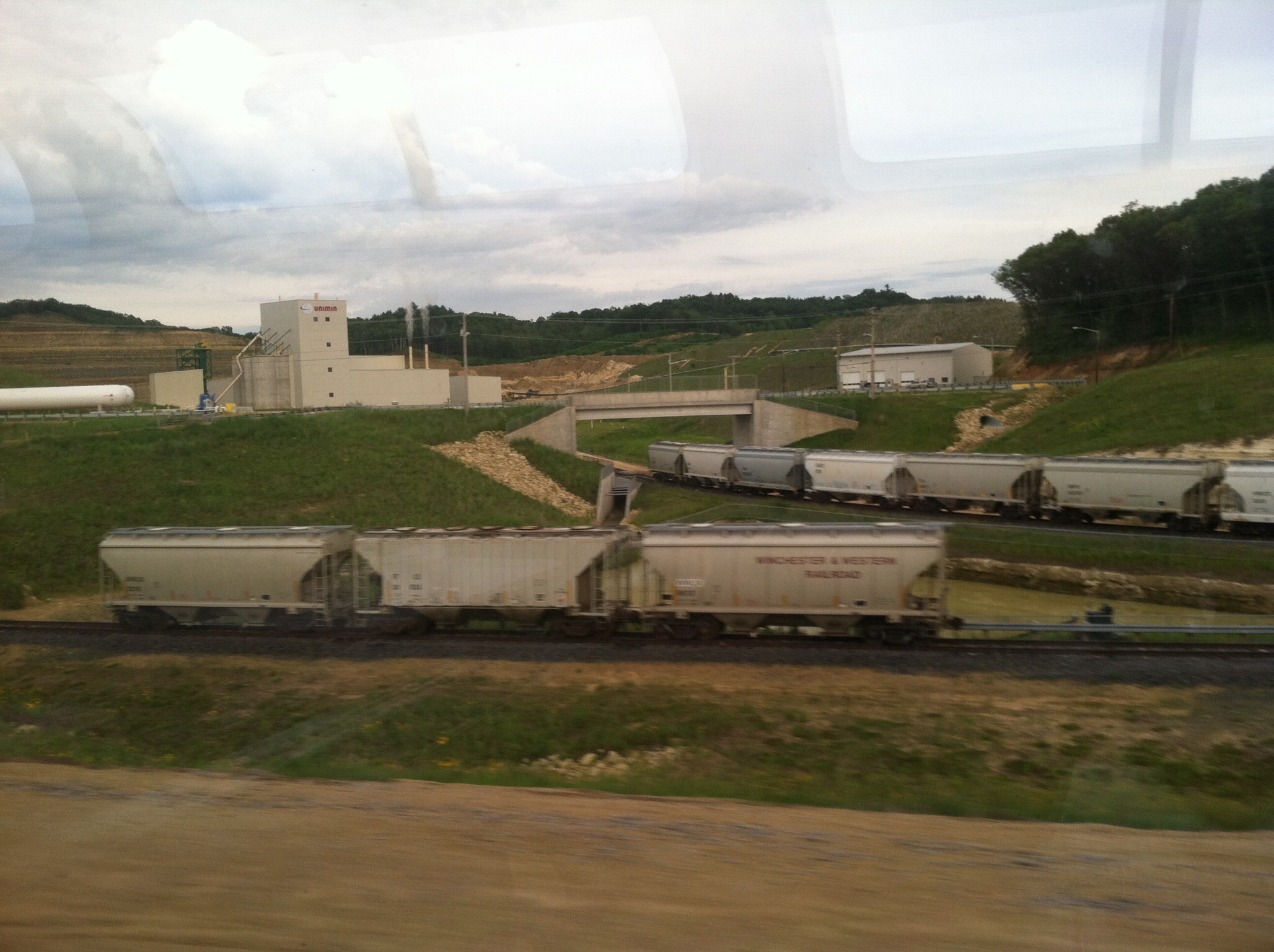
Frac sand mining operation just east of Fort McCoy, WI

Frac sand mining operation just east of Fort McCoy, WI from Amtrak Empire Builder Trails and Rails

Third, we pass Fort McCoy in Wisconsin. This is a large National Guard training base which was also used by the army for training troops prior to being sent to the Middle East. There is even a reproduction of a Middle Eastern village that is partially visible from the train.

ADM mill and elevators in Red Wing MN

ADM mill and elevators in Red Wing MN

Fourth, we talk about the history of various times. For instance, Portage Wisconsin is a point where the early French explorers transferred from the Fox River to the Wisconsin River in their efforts to explore the Upper Midwest and discover a passage to the Pacific ocean. Lumbering, agriculture, shipping and railroads played important roles in the development of most of the communities along the route of the Empire Builder.

View of trains and barges on the Mississippi RIver at St. Paul from Union Depot platform.

View of trains and barges on the Mississippi RIver at St. Paul from Union Depot.

Fifth, miscellaneous bits of relevant trivia are scattered throughout. For instance; it takes 10 pounds of milk to produce one pound of cheese, 12 pounds of milk to make a gallon of ice cream, and 22 pounds of milk to make a pound of butter.

Sixth, we offer youngsters the opportunity to become Junior Rangers. There is a Junior Ranger booklet designed for this route and one of the volunteers normally walks the train, letting parents know the program exists and asking if they would like a booklet for their child(ren). Upon answering the questions, spotting various landmarks and items unique to this route, and completing some drawings, the child will be made a Junior Ranger with a badge. We normally announce their first name and ask the riders in the lounge car to join us in applauding them.

Lock and Dam number five just above Winona, MN

Lock and Dam number five just above Winona, MN

So who is riding the Empire Builder? Well, college students are one frequent group traveling to and from their school. International travelers are often on board, sometimes taking long journeys like the fellow who started in South America, came up the Pacific Coast to Seattle, and was heading towards Montreal. Families on vacation, such as the family from the Winona area, parents and three teenagers, heading down to Chicago for a surprise weekend vacation. Amish, sometimes traveling in groups to weddings and other family get-together. People who enjoy riding trains and who do not have strict timetables to meet like the couple traveling to a convention in New Orleans from Seattle. Less frequently at the moment, but still present, are workers in the North Dakota oil fields who stay there for months and then go home to see the family.

Those who start their journey in Seattle or Portland will be on the train for 48 hours. They board in Seattle or Portland around 4:40 PM, ride through the night, the entire next day and night, arrive in St. Paul around 8 AM of the following day and enter Chicago about 4 PM. 48 hours but parts of three days.

Sunset over Lake Pepin on Mississippi River

Sunset over Lake Pepin on Mississippi River from Amtak Empire Builder Trails and Rails

A final note. I am not a paying passenger but I will say that all of the Amtrak personnel I have encountered have been extremely kind and helpful. Thanks for making our work so pleasant.

For another perspective on the Trails and Rail program, read the article in the Minneapolis Star/Tribune of August 11, 2015 written by reporter James Walsh and photographs by Rachel Woolf.
http://www.startribune.com/amtrak-volunteers-tell-passengers-tales-in-trails-and-rails-program/321296911/

Other links:
Mississippi National River and Recreation Area: http://www.nps.gov/miss/index.htm

Upper Mississippi National Wildlife Refuge: http://www.fws.gov/refuge/upper_mississippi_river/

Ed Heimel St. Paul, August 10, 2015

Categories: road trip, travel | Tags: , , , , , , , , , , , , , , , | 1 Comment

Blog at WordPress.com.