Posts Tagged With: Algiers Point New Orleans

2017 Trip Two: Tour of Texas March 26

New Orleans Louisiana Sunday March 26

St.Louis Cathedral flanked by the Cabildo on the left and the Presbytere on the right.

A sugar surge is keeping me energized as I write this post. Pralines (sugar, pecans, butter, milk and vanilla) from the New Orleans School of Cooking sit before me. Hopefully I will resist enough not to overdose on them.
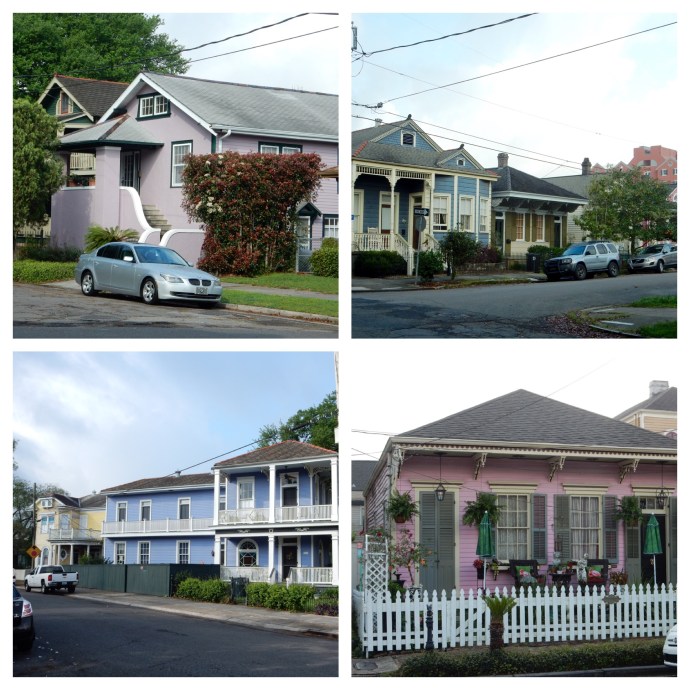
Some examples of homes in Algiers Point

Today was the opposite of yesterday. Early morning clouds and fog gave way to sunshine, a mild breeze, and temperatures in the high 70s. Algiers Point was settled in 1719 but many buildings burnt down in a major fire in the late 1800s. Wood homes seem to predominate in the historic district and are colorfully decorated. Chris and I walked numerous blocks marveling at the varied colors. On the negative side, in this area the streets are poorly paved and sidewalks in rough condition when they exist. Utility poles and wires are everywhere. I can not profess to be an expert on the area; when we drove 3 miles tonight to a grocery store, we encountered much better streets and new home construction. A former Navy base is being re-developed into a mix of public and private offices, businesses and housing.

From what we can tell, most of Algiers Point escaped major destruction during Hurricane Katrina. It is on higher elevation although walking on the levee this morning made that difficult to believe. During Katrina, there were incidents where the mostly white residents of Algiers Point shot blacks who were escaping the floods. News reports indicated that the whites were claiming they were protecting their homes from looters but facts proved otherwise. They shot first and asked questions later. The men shot all had legitimate reasons for being in the area. Issues I can not fully resolve for you.

Walking along the levee at Algiers Point. On our way to the ferry

After walking the neighborhood and the levee, we arrived at the Algiers Point Ferry Terminal. We took the ferry across the Mississippi RIver to a dock at Canal Street. The ferry charges $2 per person, exact cash only. We had to use some quarters to have the exact change. For the return trip, we had to make sure we bought just one post card to have four one dollar bills with us. We did encounter two women on the return trip asking people waiting in line if they had change. We saw them on the ferry so evidently they found a Good Samaritan with change.

There is a fancier river walk along the downtown New Orleans side of the river which we took to our first destination, the New Orleans Jazz Museum at the Old U.S. Mint. The first floor of the museum is dedicated to history of the mint. It had some unique roles in that during the Civil War it was seized by the State of Louisiana and used briefly to mint coins for the state and later for the Confederacy. Since New Orleans was re-taken by Union forces by the middle of 1862 and the Confederacy ran out of silver and gold bullion early on in the war, not many Confederacy coins were minted here. Items on display include a coin press and a gold bullion scale.

The second floor has exhibits about New Orleans Jazz and Louis “Satchmo” Armstrong. Displays discuss his upbringing here before he later moved to Chicago and New York. The last trumpet he used before his death is on display. There is an additional exhibit of art by southern artists, focusing on self-taught artists.
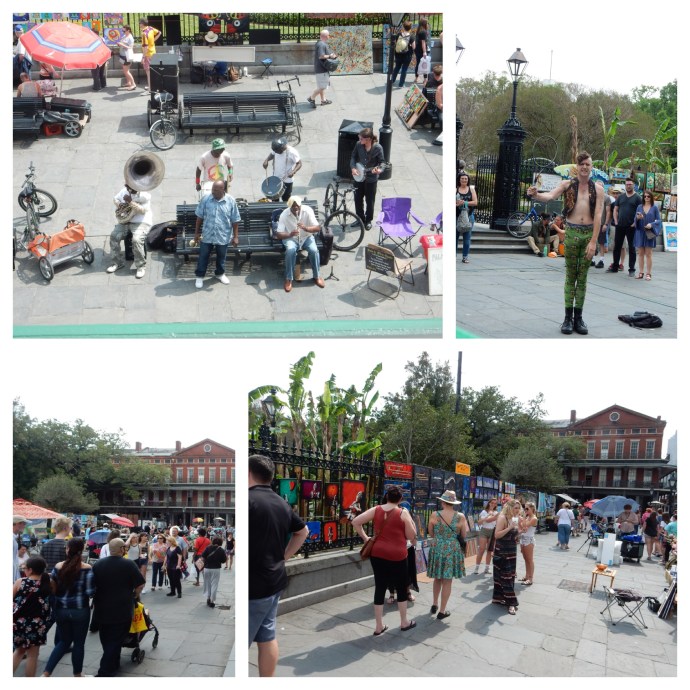
A collage of Jackson Square scenes

We left the Mint and headed to Jackson Square. Jackson Square is a large green space, with St. Louis Cathedral, the Cabildo Museum (history) and the Presbytere Museum (culture) flanking the Cathedral on the northwest side of the square. Three sides of the square were home to artists selling their wares and buskers performing for the tourists. One or two musical groups were always performing so you were serenaded as you strolled along inspecting the art. Even inside the two museums, you could hear the music. (Jackson Square is named after Andrew Jackson, the hero of the Battle of New Orleans where the Americans defeated the British in the War of 1812.)

The Cabildo was a pleasure. Three floors of displays on the history of New Orleans. There was so much info, I fear most of it went in one eyeball and out the other. When the museum covered the Battle of New Orleans, it mentioned how Andrew Jackson did not follow-up after the battle on his promises to the citizens. One of his actions was to not repeal martial law after the battle, waiting until the whole war was declared over. When a newspaper editor dared to write that the martial law could be lifted, he had the writer tossed into jail. When the judge said the writer was entitled to a public trial, he judge was tossed into jail. Gee, do we have a president who admires Andrew Jackson now? During his presidential elections, Jackson did not carry the city.

Some other tidbits.

The town early on had a Catholic heritage. The Catholics liked to go to Sunday Mass and then go out and eat, socialize, party on Sunday afternoon. When Protestants moved in, they were shocked at this scandalous behavior that did not keep holy the Lord’s Day.

New Orleans had six to ten times the number of saloons as were in Boston or Philadelphia.

New Orleans in its formative years had a wide variety of immigrants from Germans to Irish to French to Santo Dominguians to Canary Islanders etc that contributed to the mixed population. They called it the gumbo of the people. Yet, this did not stop anti-immigrant fever sporadically or the profitable discrimination against Indians and blacks.

Due to the early surrender of New Orleans, the Union government made an effort to test some Reconstruction plans here. Sort of “Reconstruction Light”. But actually due to the easy defeat, the citizens never faced the hardships of war. Thus the residents of New Orleans were more of a hassle to deal with than a pitched battle. They resisted the efforts and that helped lead to the eventual “Radical Reconstruction” that followed the Civil War with harsh enforcement. Louisiana was one of the last three Southern states to have rule by the military ended. Military forces left the state in 1877.

French quarter views

After the Cabildo (previously home to governmental functions), we went to the Presbytere Museum (previously associated with religious functions). The Presbytere focused on Hurricane Katrina (2005) and Mardi Gras. The Katrina exhibit had video of the storm, the damage and the stories of individual people. It discussed the geography of the area, the engineering failure that led to the horrendous flooding, and the actions of people who have destroyed the natural features of the land to help minimize the effects of major storms. The great flood of 1927 (the one that Herbert Hoover led the reconstruction for and which helped him to be elected President) was a major impetus in the levee building which now protects the city from river flooding. That same levee building makes the city more susceptible to hurricane flooding.

The Mardi Gras exhibit was informative but less interesting. Possibly this is due to our having seen the Mardi Gras museum in Mobile which covers the subject quite well also.
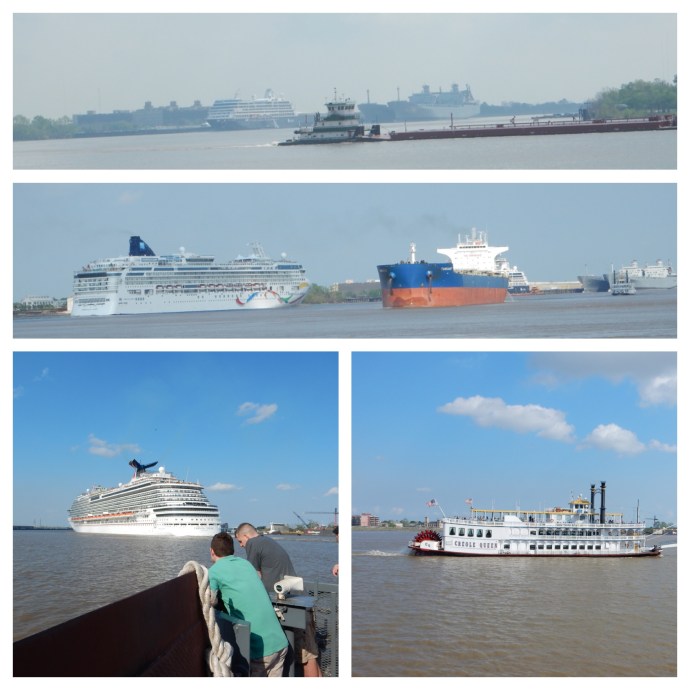
The Mississippi RIver at New Orleans is a busy river

All in all, a tiring yet informative day.

Ed and Chris
Categories: road trip, travel | Tags: , , , , , , | Leave a comment

2017 Trip Two: Tour of Texas March 22-25

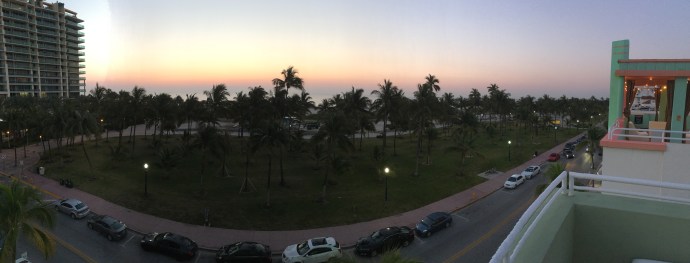
Sunrise Miami Beach March 23 from our hotel

New Orleans, Louisiana. Saturday March 25

The last four days have been, and will be, the most casual and slowest paced of the entire 60 day trip. I saw no need to write a post saying nothing much happened so I have waited until several occurrences cobbled together can make an interesting post.

Wednesday the 21st was an excellent beach day. We spent all day at the beach, nothing earth-shattering occurred. But isn’t that the point of just relaxing at the beach?

Thursday, our nightly destination was Ocala Florida. An hour out of Miami Beach we visited the Morikami Museum and Japanese Garden in Delray Beach. 110 years ago, a Japanese graduate of New York University came up with the idea of starting a colony of Japanese farmers in southern Florida. The colony was called Yamato, after a name used for Japan. The colony had ups and downs and never really made a continuing success. One of the colonists, George Morikami, stuck it out. However WWII intervened and over 6,000 acres of the land owned by the Japanese, and other U.S. residents, was taken by eminent domain for a military base. After the war, George Morikami bought land back and in his later years donated it to the county for a park and museum to preserve the memory of that early 20th century Japanese community.

Photos from Morikami Gardens in Delray Beach Florida

We toured the gardens first, as the weather was projected to turn rainy and windy. The gardens are spread over 16 acres and present a series of styles of gardens from Japan. As are most Japanese gardens, the theme is reflection and contemplation. A visitor is not presented with masses of flowering trees, shrubs, and plants. Benches are placed strategically and a reflective moment can be spent observing the interplay between the rocks, plants, water, etc.

The original museum is now used to display information about the original settlement. The settlement had difficulty establishing long-term continuity due to the difficulty in attracting Japanese women to marry the young , single men that were the original settlers. Second, competition from Cuban grown fruit decreased revenues. Finally, the land boom in Florida in the 1920s meant many of the settlers could sell their land for a better return than farming and they sold out and moved on. Then, the remainder got wiped out as mentioned above when the military base took their land.

This original building also is a hands-on learning area for children. Finally there was a wall display that demonstrated how KitKat candy bars took off in popularity in Japan. Uniquely Japanese flavors were added to KitKat, such as Kyoto powdered green tea KitKat and Shinshu apple KitKat.

The new museum building had an exhibit on Japanese Art Deco from the period of the 1920s and 1930s. It failed to mesmerize us.

Our second destination before Ocala was the Wakodahatchee Wetlands, a 50 acre wetlands established on utility land. It is a great bird watching area introduced to us by my cousin Chris and her husband Nelson. However, all of the parking places were occupied and there was a line of cars waiting to pounce on the first newly vacated parking space. We did not wait and continued our drive to Ocala.

Leaving early was fortunate as several downpours enveloped us as we made our way northwest along the Florida Turnpike. During one particular outburst, we pulled over along the side of the road with numerous other cars and trucks since we could not see the road or vehicles in front of us.

Ocala lodging was with a great Evergreen couple. We had several points of synergy including a connection to living in Pennsylvania previously. The Ocala area is huge with horse farms. Horses are bred and trained here and horse auctions are big business. The Ocala airport is used to send horses around the world.

Chris and Ed in Niceville. The husband of the Evergreen couple took up painting after retirement.

Friday we drove to Niceville Florida. Niceville is in the Florida panhandle. We have toured in the area on previous trips and this was meant as a stopover on our way to Texas via New Orleans. We spent the night with an Evergreen couple. When we set this night up, the couple had indicated that on Friday nights they helped serve dinner for a church function and we volunteered to help out.

We got a tour of the Crosspoint United Methodist Church in Niceville and its church facilities and programs at its main campus. The church now has five churches in the Niceville area and seems to be dramatically serving its population through numerous ministries. The function we were at was the CR Recovery dinner. CR Recovery is a Christ centered recovery program for all types of hurts, habits, and hang-ups. The program takes the 12 step AA program and adapts it to a 12 step program with biblical comparisons. They combine it with an eight step recovery program again tied to biblical comparisons. Chris and I had helped serve dinner and clean up afterwards. It was a popular night, we gave out all of the food so the four of us went out to Panera’s for dinner.

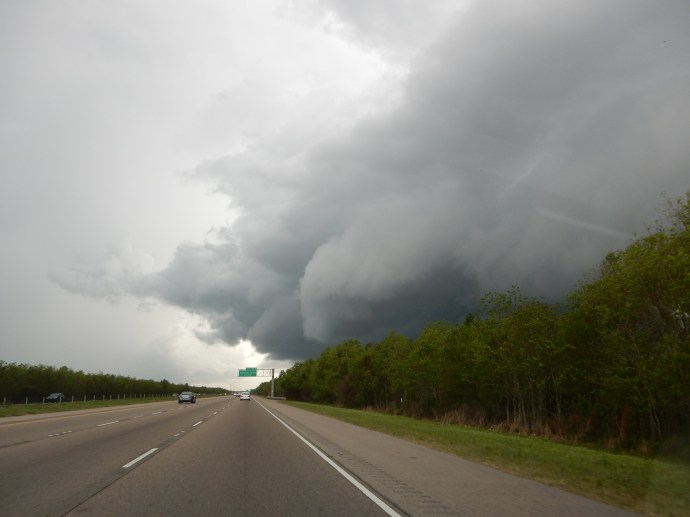
Thunderstorm approaching as we drove to New Orleans

Saturday the 25th we drove to New Orleans and once again got hit with thunderstorms. It was still raining when we arrived in the city and traffic was slow in the French Quarter as pedestrians were anxious to cross the street without getting too wet. Our only stop was at the Jean Lafitte National Historical Park Visitor Center. Surprisingly, the center is closed on Sunday and Mondays due to budget cuts. The orientation film was not working but we viewed the displays and obtained information from the ranger about the site. There are actually six locations as part of the National Historical Park and we plan to visit several of them over the next few days.

We have had to plan our visits in New Orleans tactically since Sunday, Monday, and Tuesday are all days in which museums and historical sites are closed. We are here through Tuesday morning. Our lodging for the three nights is through Airbnb in Algiers Point, an old neighborhood on the West Bank of the Mississippi River across from downtown New Orleans. The rain and clouds gave us limited time to explore on Saturday, but it appears to have some unique features. Most of the homes are brightly painted and we will have some photos for you in our next post.

the front of the Appetite Repair Shop in Algiers Point New Orleans

The community is not overly served with restaurants but we found a unique spot for dinner. The Appetite Repair Shop is 240 square feet in size ( I counted the floor tiles for a measurement), only open Thursday-Sunday from 5 pm until the food is gone, and only serves take-out. When we arrived at 6 PM, we were sixth in line. It took half an hour to get our food. The chef-owner cooks each person’s order from a limited menu that changes daily. We spent our time in line talking to the other customers and getting their life stories.

Most menu items were noted as “Hot”, “Spicy”, or “Silly Hot”. We chose the already prepared banana pudding, crackaroni and cheese (an upgraded mac and cheese), and Moroccan carrots and chickpeas salad. All were excellent. We went to bed after seeing some smokestacks of ocean-going ships in the distance over the banks of the levee.

Ed and Chris
March 26, 2017

Categories: road trip, travel | Tags: , , , , , , , | 2 Comments

Blog at WordPress.com.