

Saturday was a time to leave the beaten path behind and explore history and beauty along a scenic byway. It ended up being a relaxing day filled with pleasant, unplanned surprises. The end goal was to reach Silver City, NM, about a two to three hour drive depending on which route we take. Silver City will be our lodging for two nights. Sunday we head up to Gila Cliffs National Monument. The road to Gila Cliffs is twisty and mountainous and we have been advised to plan for two hours to reach it from Silver City. So, two hours to reach it, two hours to visit it, and two hours to get back again. In effect, a full day experience.
But first we had to reach Silver City. The Lake Valley Back Country Byway is sponsored by the Bureau of Land Management (BLM). It runs through ranching territory, old and new mining areas, mountainous forests, and an abandoned town. At the start of the byway, we passed wind turbines and solar farms. Those gave way to pecan farms and cattle ranches. Soon we reached Lake Valley, a once thriving mining town. In much of this area, a silver boom in the late 1800s collapsed when silver was devalued in 1893. Overnight, the economics of silver mining changed. Lake Valley became deserted.
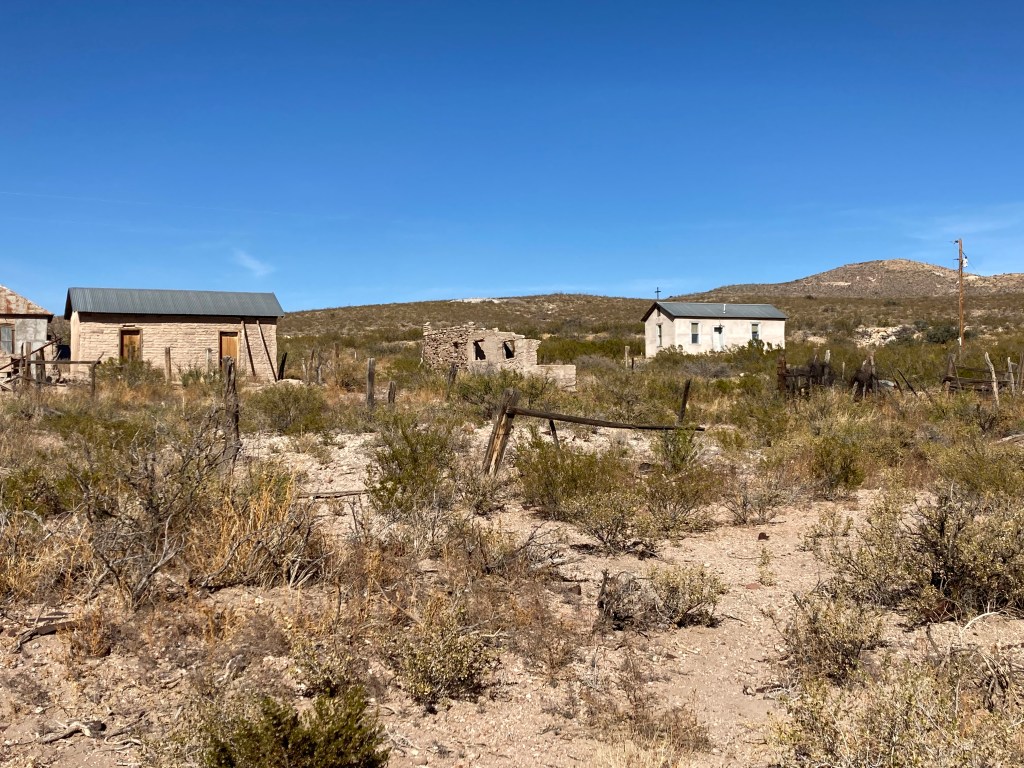
BLM sponsors a museum at Lake Valley that was open. However, the volunteer docent was nowhere in sight although it seemed their RV housing right behind the museum was occupied. In any event, we were able to view the museum and walk around the few buildings that were still here. Despite the museum and signs, it was hard to imagine this area as a silver mining hotspot. The ranches that proliferate here among low lying hills appeared to be the normal way of life.
As we left Lake Valley, we passed through land where Apaches and outlaw bands roamed. The stage coach and railroad spur to the mines had to be protected by the U.S. Army. We reached Hillsboro, a community of 184 people that dates back to those days. Luckily for Hillsboro, its mining was more than silver and though Hillsboro may not have prospered, it survived. There was a small farmers market here and we stopped to read a historical marker. Across the street from the marker was the Black Range Museum. It was open. We stopped in.
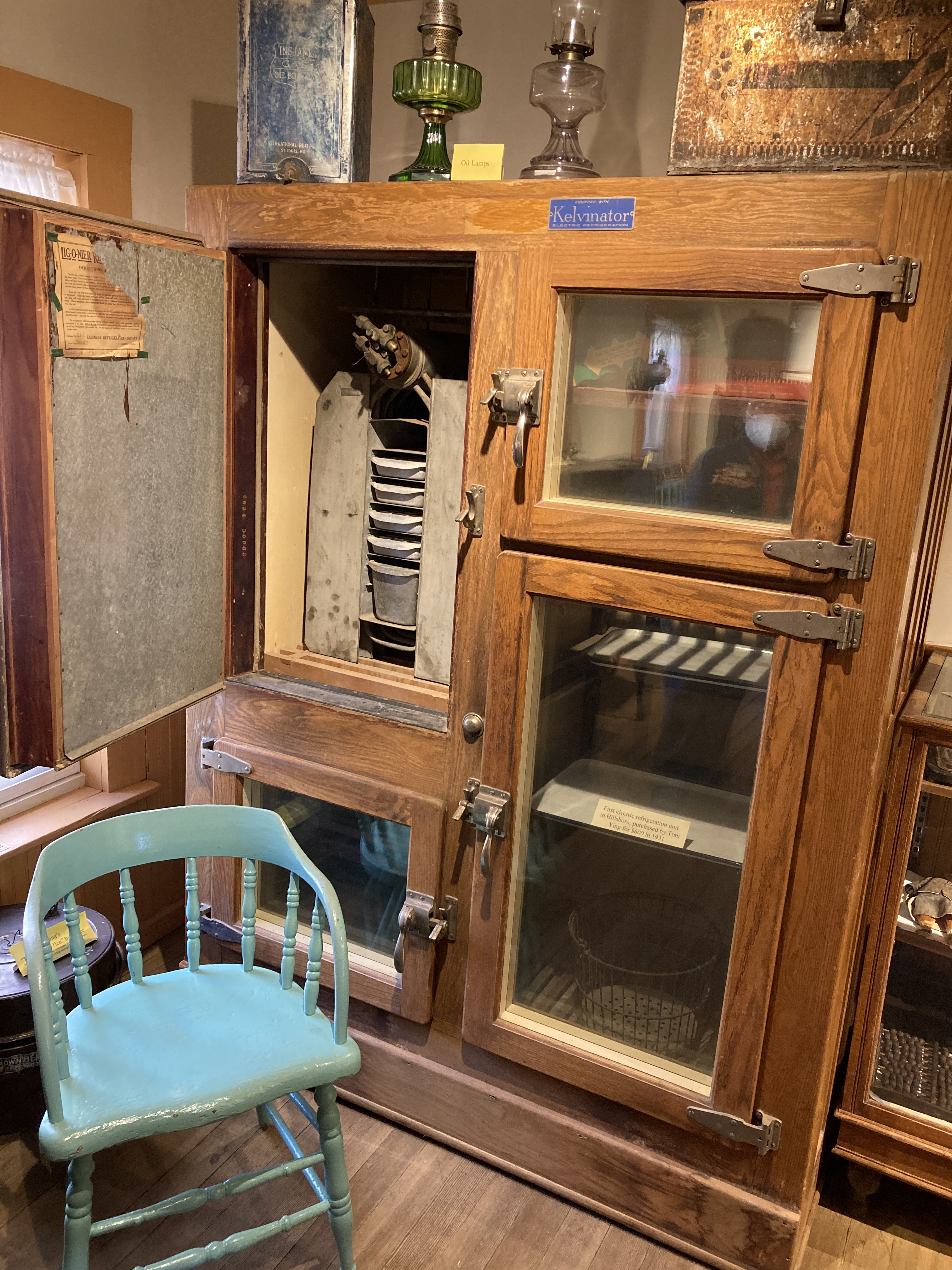
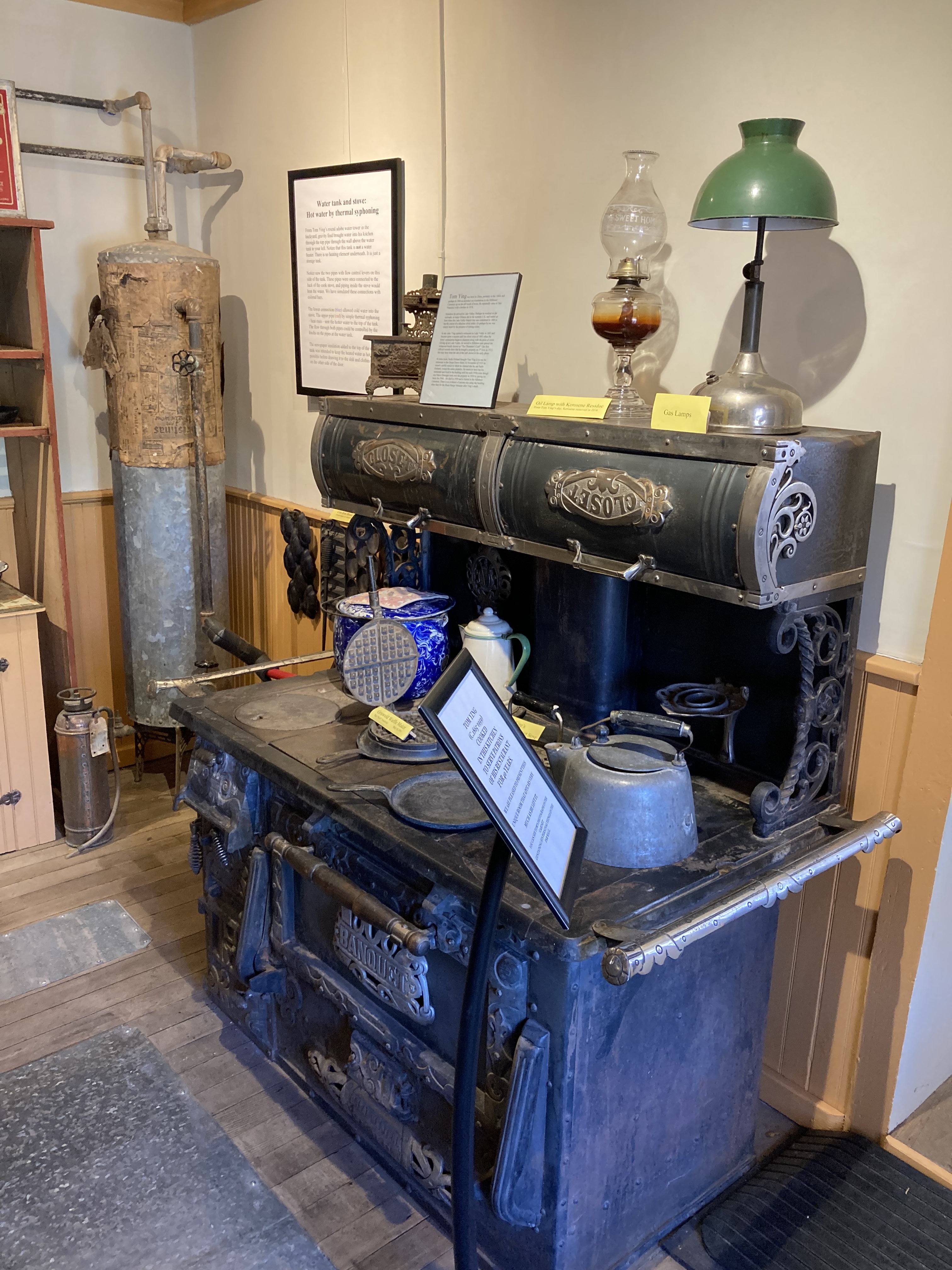
One of the docents gave us a wonderful tour. The museum building once housed Sadie Orchards Ocean Grove Hotel and Tom Ying’s restaurant. Both of them were fascinating characters. Sadie was a strong woman, of whom it was once said: ”For a bad woman, Sadie was one of the best.” Sadie drove a stage coach, ran the hotel, operated a brothel and was a prostitute, among other occupations. Tom Ying was Chinese and immigrated prior to the Chinese Exclusion Act. He operated the restaurant in Sadie’s hotel for decades. Pictured above are the refrigerator and stove he used. The refrigerator was the first electric refrigerator in Hillsboro and came with an ice maker.
After the tour, and a short stop at the farmers market, we drove on to Silver City. This 58 mile drive took us two hours as the hairpin turns, mountainous ascents and descents, and sharp curves required a slower travel speed. At Emory Pass, 8700 feet, we stopped for a quick lunch and numerous photos. The wind was so powerful we passed on sitting at the picnic table with a great view to eat in the car. We did not want to get blown over the side of the cliff.
Emory Pass is on the southern edge of the Gila National Forest and Wilderness area. For ecology folks, this was the first wilderness area in the United States. This wilderness area was created in 1924 primarily through the work of Aldo Leopold.

Leaving Emory Pass, we drove by another one of those huge mining sites we seem to frequent. The Santa RIta mine operates 24 hours a day, 365 days per year. Grant County, where the Santa RIta is located, has been the most important metal producing county in New Mexico. Native Americans were mining copper here before the Spaniards arrived. In 1853 the Gadsden Purchase transferred control of this area along with a swath of land over through Arizona to the United States from Mexico. This land transfer gave the U.S. huge mineral deposits and a path for a southern route for a transcontinental railroad. The Santa RIta was one of the first open pit copper mines in the U.S. It is huge. Similar to some other mines, as the ores were extracted, the new veins of ore extended underneath the city of Santa Rita. Eventually the town was bought out and disappeared.

Silver City also had mining back in the 1800s but today tourism, higher education, and servicing the surrounding areas keeps the town functioning. There is a thriving arts community here. We are helping the tourism sector survive. Our lodging is at the Bear Mountain Lodge, an establishment that dates back 90 years. The lodge has comfortable rooms, great food (our dinner tonight was excellent) and 180 acres of land on the edge of the Gila National Forest.

Ed and Chris, Silver City NM, November 20
 Chris Klejbuk and Ed Heimel travel adventure
Recent Comments