

Safety briefing number two at the runway by our plane
Homer AK. Tuesday September 3
Another WOW experience but maybe not for the reasons you might expect. Today was airplane vistas, bears and mud. The bears we were “hunting’ were in Katmai National Park, along the coast near Mt. Douglas. This is their natural environment and although we had planes and knew where they tended to congregate, there was no guarantee. Our locations were scattered; not Brooks Camp, a spot in Katmai National Park where bears line up to catch salmon and the Park Service had to install a boardwalk for people to see the bears without getting too close to them.
Our time to arrive at the hangar and begin the prep was 10 AM. Time is based on tides (we need low tide to land and take-off at Katmai), weather, and bear spotting. We arrived at the hangar early and were the second ones there. First task is to get fitted for waders, crotch high rubber boots with a strap at the top that goes through your belt or belt loops to make sure the waders stay up. Chris and I ended up selecting one size smaller than the initial estimate based on our shoe size; it seemed a better fit. (Remember for later.) You do not wear your shoes, just socks, inside the waders. I noticed our guide/naturalist/pilot wore a different type; waders with socks attached and lace-up boots over the waders.
Today Alaska Bear Adventures used three planes. Each was a Cessna 206, a plane highly popular and long in production. It holds six people, the pilot and five passengers. Our plane had us plus another Minnesota couple (from Eagan and he worked at WestLaw) and a local woman who was a firefighter with a day off from working the wildfires. We formed a jovial group.
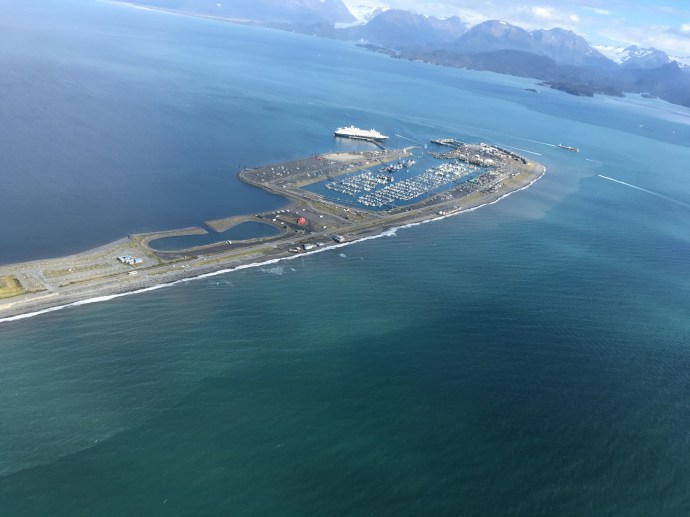
View of Homer Spit
The flight from Homer to Katmai takes about an hour. It is over water, we had on personal flotation devices. ABA gives you two safety talks, in the hanger area and at the plane. Chris and I had the two middle seats, each with a window. You are given ear plugs to use if desired, small plane engines can be noisy. Take-off was no worse than a normal take-off with a jet, just that everything is so close outside your window.
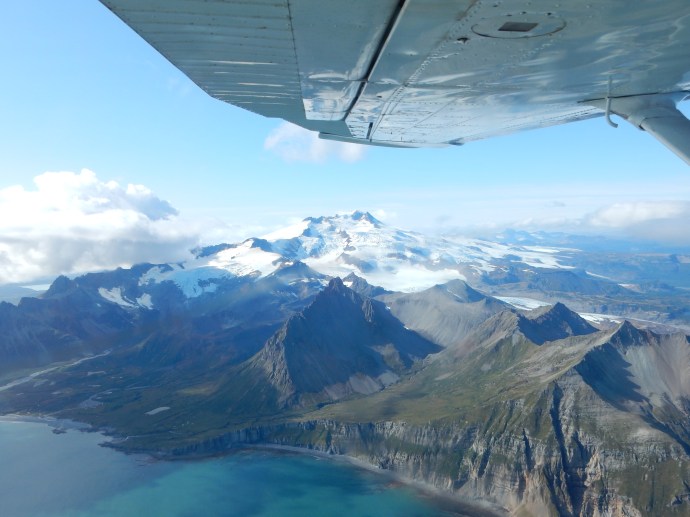
Flying to Katmai National Park from Homer

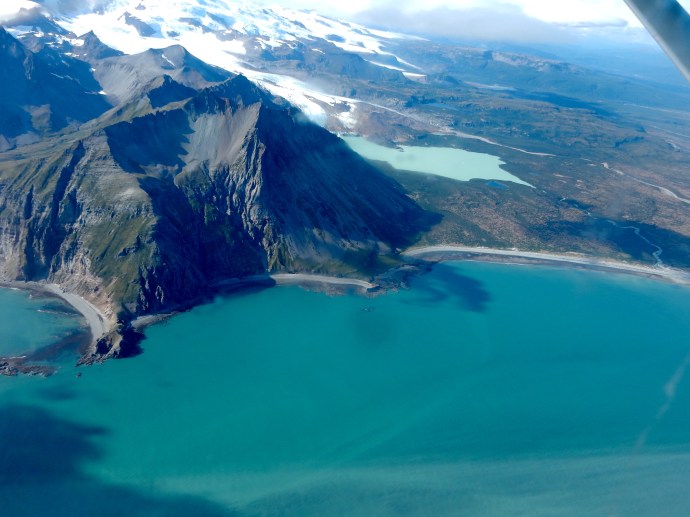
The views are amazing. We had never flown on small planes before, just the helicopter ride in Kauai, Hawaii six years ago. Frankly the plane ride was a big reason to take the trip, seeing bears was just a bonus. Chris had worried about it for weeks, even to the point of making sure she did not eat too much and gain weight. Well in advance of the trip, you have to weigh yourself at home with the clothes you are likely to be wearing. You can not be more than ten pounds more at weigh in than the weight you told them in advance. The night before the flight I found myself getting nervous about the flight over water and the bears for no apparent reason.

Our circular rainbow

The landing strip on the beach, our planes, and walking back to the planes after bear number three
Out the window we saw the Homer Spit with a cruise ship in port; fishing boats in the bay, Seldovia, mountains, glaciers, and islands. I saw my first circular rainbow down below the plane. When the conditions were right, the outline of the plane was inside the rainbow! Our landing spot was on the coast near Mt. Douglas, a volcano, between high tide line and low tide line. It had a lot of small rocks, quite bumpy. And Chris loved it; this from a woman who used to close her eyes and say a prayer at every commercial plane take-off and landing.

Beach view of Mount Douglas after landing at Katmai National Park
Katmai is huge, we were touching only a tiny portion of it. Katmai is the fourth largest national park, about the size of Connecticut. Katmai was initially a national monument formed to protect the area around a volcano. In 1912, severe earthquakes rocked the area for a week before Novarupta erupted with a force over ten times stronger than Mt. St. Helens in 1980. It is estimated that only two eruptions in modern times displaced more volcanic matter than Novarupta (Greece’s Santorini in 1500 BCE and Indonesia’s Mount Tambora in 1815). The isolation of the region prevented major loss of life. It is estimated that if the eruption had occurred in Manhattan, there would have been zero survivors, ash in Philadelphia would have been over a foot deep, and the sound would have been heard in Chicago. The eruption left a valley with thousands of smoke vents; named Valley of 10,000 Smokes.

Walking to find bears
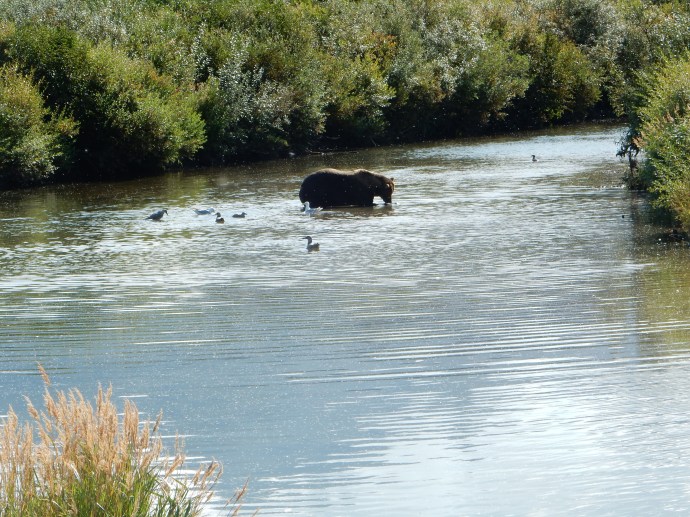
Bear number 1
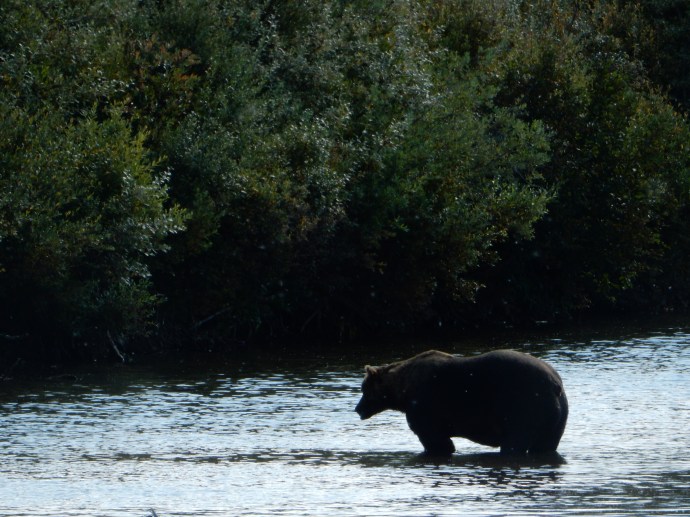
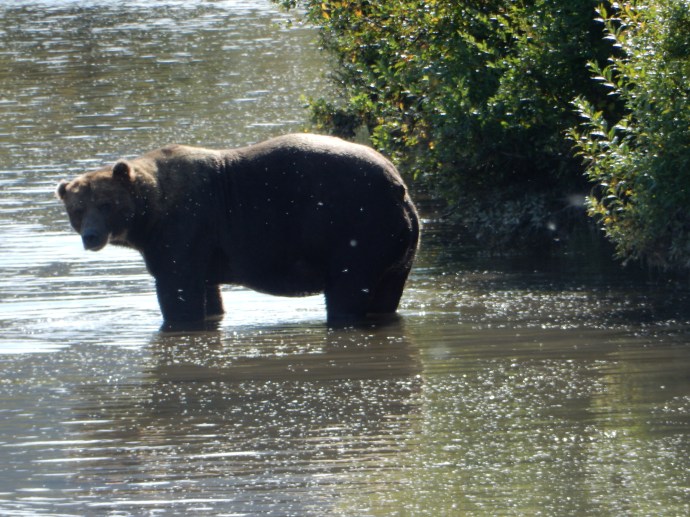
We were here to see bears though. Off on our hunt we went. Successfully. We saw three bears. The first was after a hike through the grasses to a creek feeding into Douglas River. We passed two indentations dug out along the creek where a bear had carved out a napping spot. The path we followed was one used by bears also. We maintained a safe distance of 50 yards or so; the bear acknowledged we were there but did not interest him. The guide estimated this one was about 900 pounds. Coastal brown bears tend to get larger than most in Alaska (1200 is not unusual here) due to the abundance of good food sources on a year around basis.
Salmon were abundant in the stream, many having already spawned and just starting their death spiral. These do not interest the bear. Given the abundance, the bears here can be choosy looking for fresh salmon who have yet to spawn. We spent about 20 minutes just watching the bear as it waded along the stream, catching fish, and eating.
To reach our next bear was a longer hike. Most of the travel was beside a creek bed where we walked along the creek on top of rocks. Here was where the lack of any real support in the waders became evident. One could feel the outline of each rock you stepped on. After a while the process was less than exciting. Some of the time we walked in or across the creek. The waders were essential. The water was frequently knee high. The creek bottom alternated between rocks and sand, that glacier flour we have commented on before which gives the unique coloring to glacial waters. One tried to avoid stepping on dead salmon. One woman found her waders had a hole so that at a certain depth in the creek some water came into the bottom of her wader.

Bear and human tracks across the mud
At other times we walked across the land left muddy by the changing tide levels. Frequently we passed the tracks of bears; large paw prints heading in the general direction we were traveling. It was curious to compare their prints with that of the six of us marching through the muddy plains.
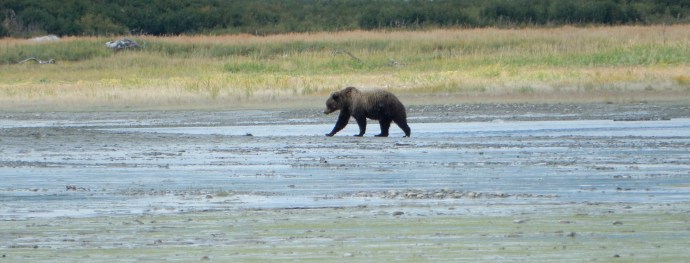
Bear number two that led to our adventure
The two other groups had taken off from the airport first, landed first, and then were the lead hikers. We were several minutes behind them. On the hunt for a second bear, the two of them followed a path and then our group started to veer away from theirs. Our leader had seen a bear in the distance. As we approached the bear, it noticed us and decided to take a hike. It walked behind a ridge and out of our view.
This left our group with the need to catch up with the first two groups. We, led by our naturalist/guide/pilot, cut across the muddy flats. Suddenly the muddy flats were turning into a quicksandish type of goo. One could not easily move forward without taking small steps, pulling up on your waders as you tried to move forward. Each slow step meant you were standing on your other foot for a longer period of time, allowing the pressure to push that foot further into the goo. You could hear the boots go “schlupp, schlupp” as they emerged from the suction grip of the goo. If we had been in the bigger boots, I fear they would have been pulled off despite the straps, the suction power of the goo was that strong. The phrase “stuck in the mud” has a much more personal feeling now.

After our mud adventure. Smiling? It was pretty scary.
Then in attempting to pull a foot out of the goo, one of the group went down. Getting back up is not easy. Then both Chris and I went down, getting goo over much of us. It took our guide with his more firmly attached boots to help each of us over to a safer location about 100 yards away. Each member of our group either fell or was stuck, needing assistance in getting to more solid ground. As one member stated, if a bear had come along then, we would have been a tasty morsel. As it was, all ended well. Clothes needed to be washed down and then laundered. We had a bonding experience. Long-lasting memories were made with a humorous tale to recount.

Bear number three
The two other groups had found a third bear and we joined them. This bear was lying down, trying to nap. our appearance caused it to raise its head periodically before it went back to attempting to nap. Despite our waiting and watching for the bear to do something more exciting, it just laid there. Eventually we headed back to the planes, only then realizing that we had come a long distance and the hike to the plane took longer than I thought it would. During the “goo” time I had stated I would no longer think poorly of walking on the stones and rocks. However, the long walk back along the rocky shore made we almost wish for the soft sand and mud.

Flying back from Katmai


The flight home was a gem. Our pilot took us up and around Mount Douglas. Mount Douglas is 7,000 feet in elevation, is a stratovolcano with a small crater lake near the top, and active fumaroles. Gorgeous views.

Flying home from Katmai
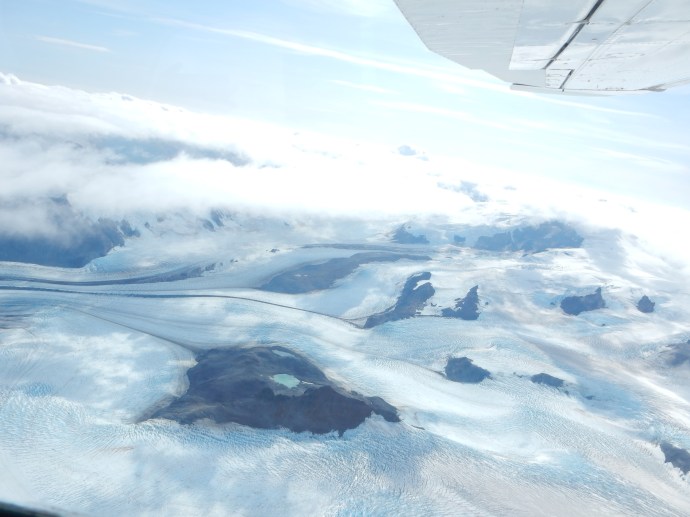

Kenai Mountains flying back to Homer
The trip back over Cook Inlet was uneventful but the views of the mountains and glaciers across from Homer (Kenai Mountains, town of Seldovia, Kachemak Bay and Kachemak Bay State Park, Wosnesenski Glacier, etc.) were another treat.
All in all, the day was 7.5 hours of fun and excitement. The vistas were great, Chris is even willing to try flying in a small plane again.
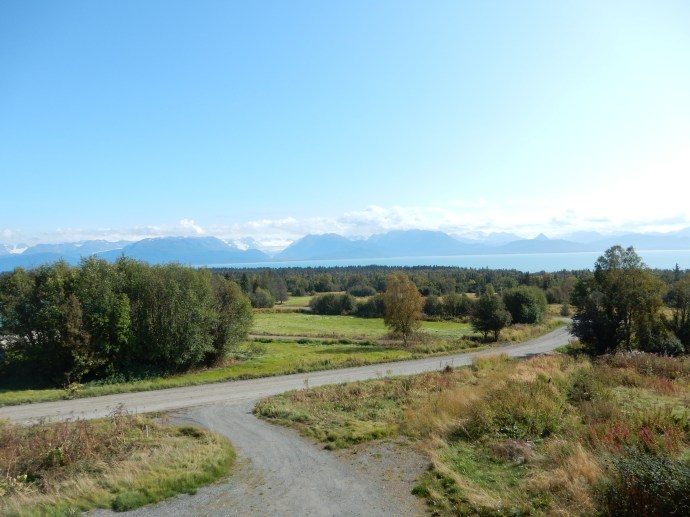
The view Ed had of Kachemak Bay and Kenai Mountains from the kitchen of our AirBnB while working on the blog
Ed and Chris. September 4. 4 PM




 Chris Klejbuk and Ed Heimel travel adventure
Recent Comments